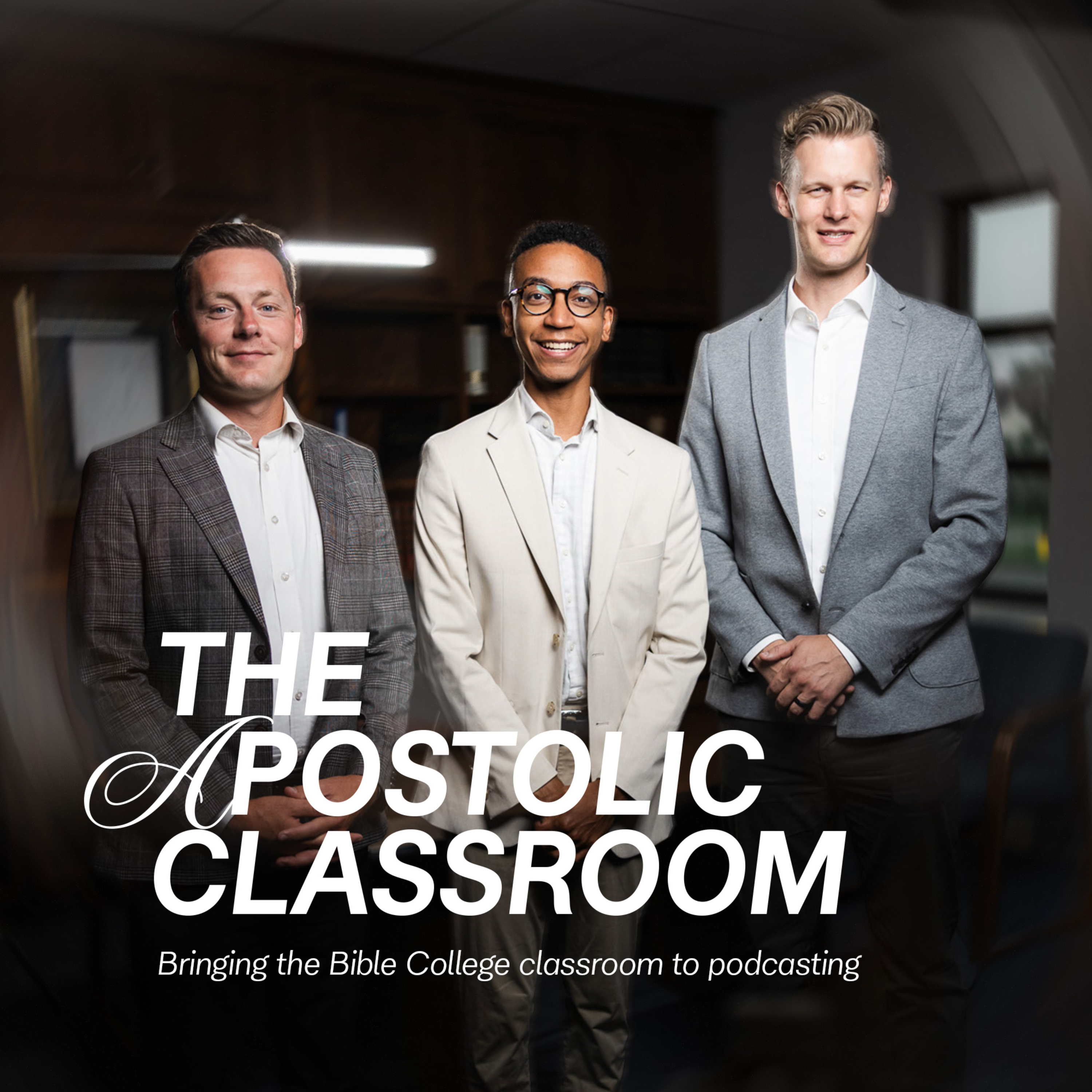
Speaker 1And welcome back everybody to the Apostolic Classroom. I'm one of your co-hosts, Stephen Gill, and I'm excited to be joined by one of my co-hosts today, Andrew Herbst. And you might notice if you've been watching the show for a number of months through our first semester that we're missing one of our hosts today, Jeremiah Zuniga. He'll be returning for a few episodes throughout the semester. And there are a number of episodes we're going to be doing with Andrew and I that I think are going to be exciting topics, topics that we probably have wanted to cover already at some point in the last semester. They've probably come up just in ancillary conversation and some of the things we've been talking about. But the one that we're going to focus most of our attention on today is understanding the relationship between the church and the church. And I'm going to be talking about the relationship science and Christianity. And it's going to be a great conversation. If you're somebody who likes apologetics, if you're somebody who's spent any time in these subjects, you might be familiar with some of the things we're going to talk about. You might not. But before we do that, I want to take some time here and thank one of our sponsors for this episode. And I don't know why that took me so long to get out. And a long day. We're not used to the sponsorships. No. And I was just so
Speaker 2tired from class. We taught at IBC, both of us today. So we've it's been it's been a long day, but we're here.
Speaker 1So, yes, I'm excited to introduce a new sponsor and this sponsor for this episode near and dear to my heart is a coffee roaster. This is Testament Coffee Roasters and Testament Coffee Roasters have something to say to you. Life is too short for bitter burnt coffee. Testament Coffee Roasters air roast small batches of specialty beans. For a smooth, naturally sweet cup. It's the way coffee should taste. We keep it affordable because really great coffee shouldn't cost a fortune. Oh, and we're apostolic owned. This company is passionate about helping missionaries and churches. If you're interested in their coffee, please visit their website at www.testament.coffee and use code apostolic. That's A-P-O-S-T-O-L-I-C for 10% off your first order. Again, that's www.testament.coffee and use code apostolic for 10% off your first order. Thank you again to Testament Coffee Roasters for sponsoring this episode and to Truth Book Co. for producing as they have been for the last now two semesters. And we're going to get we're going to get started here talking about Christianity and science. This is a subject that comes up a lot. Really doesn't matter what age group you're talking to students, adults, adult students. It doesn't really matter. Everybody's interested in this because throughout the course of our lives, especially in the past, we've been talking about in the West. Science has been in many contexts, it's been pitted against the Bible in conversation. Sometimes science is used to try and intellectually exclude religious believers from serious conversation. And conversely, sometimes Christianity is used to exclude scientific thinkers from inquiry into matters that they would call religious. The truth of the matter is that these two things have a strong relationship with one another. And anybody who's done serious inquiry into the subjects we're going to talk today understands that science and Christianity, not only can they not really be separated from one another, properly understanding one requires strong familiarity in many ways with the other and they complement each other. There is this scientific thinkers through history have come to realizations about God through their studies of science. And on the other side of it, religious thinkers have come to scientific understandings through the Bible, through understanding, through faith. And so we're going to talk about both of those here, but I'm going to kick this over to Andrew, who is sort of our resident apologetical thinker in this, certainly in our group. I think I could be wrong, but I think he's the only one of the three of us that's taught Christianity and science or, or I taught science in the Bible for
Speaker 2a few years at IBC. And just with different responsibilities, my, my focus has shifted a little bit to some other courses, but that, that was a class that I had a lot of fun with. And our question today, so we're kind of somewhat backtracking, I guess, because the first episode that we did, we dealt with philosophical as well as, um, arguments from nature, different ideas about God's existence. And so with this, I think a lot of times God's existence and science are tied together or not necessarily tied together, but they often get portrayed together. And so this is something we thought was relevant to bring into the discussion is this issue of is Christianity compatible with science or can they go together? Or if you are a scientist, does that mean that you cannot be a Christian vice versa? And we would say that, no, the Bible is, um, very scientific in many ways. Uh, we're going to talk about a few examples of discoveries that were made specifically because people were reading the scripture, which is fantastic. I know that some people might try to say something like, well, the Bible is not a science book. I've heard, I've heard that articulated a few times. And I guess, it depends on what you mean. If you mean a manual for how do we do chemistry, then, then no, no, one's going to make that argument, but the Bible is the foundation for everything that we believe, which would include science. And so there are some things there that I think we'll have fun with going through, but I wanted to start off with a story. I remember reading this a few years ago. So as far as a historical timeline would go, we have the 1500s, maybe a renaissance timeframe for a few hundred years. And then that progresses into what a lot of historians would call the scientific revolution, right? Well, there was a very progressive King of England named Charles the second. And I remember reading the story and it just really struck me that he brought in the Royal society. And this is a group of, you know, the, the top minds in England endorsed by the King. These are quote unquote scientists. Although, um, science is not a word that we use. It's a word that we use to describe the world. It's a word that we use to that is, uh, an old word. Science is a rather new word, right? So they would have been called natural philosophers back then. And, um, or, or at least hundreds of years ago, they would have been called natural philosophers. Anyways, the story goes that the King brought in these scholars, these scientists, and he had two, two bowls full of water. And one of them had a live fish. The other one had a dead fish. And the story goes is that he, he asked them knowing the answer, but he asked them, why does the bowl with the dead fish weigh more than the, the bowl with the live fish? And as the story goes, there is debate. There are reasons that are given different, uh, arguments. And eventually somebody had the bright idea to actually weigh the bowls and find out that they weighed the same. And this story struck me because the idea of an experiment, is, is fairly new, right? Within the scope of human history.
Speaker 1And so, and some of that gets back to what we talked about last week about there was a transition around the time of Francis Bacon of how do we, how, how we acquire knowledge. And whereas for centuries, human beings that were philosophical thinkers relied on a, I would say a philosophy rooted in ontology, uh, about Francis Bacon, it switches to epistemology. Is this, this focus on epistemology that, that the priority of the philosophical endeavor is to determine how we acquire knowledge. And that experimentation does come in through at this time, because this is the advent of empiricism and this, uh, this notion of proving like, how do I know that I know, you know, et cetera. And so it is, yes, experiment that you can't really separate philosophy from the development of, of scientific inquiry. They're, they're, they're pretty much the same thing just in two different fields. But, uh, yeah, anyway, well,
Speaker 2no, and that's a great point because the, there, there's another story with, I believe it was Galileo where he climbs to the, to the top of, is it the tower of Pisa? Was that where he was at? I'm trying to remember exactly what tower, but he climbed, he climbs a high place and he has these two weights, right? And, and I, I, when I was at Calvary Christian school, I actually did this a couple of times with, with a few classes, just for the fun of it. We went out to, uh, where there's essentially a balcony, a second floor, and then we dropped some things. And, uh, you know, which, which one is, is going to fall to the earth, the quickest, right? And the reason why I bring this story up when Galileo did this, he had his peers were all watching. And a lot of what we would call science in the middle ages and in, into this era was all based off of Aristotle and another ancient writer named Ptolemy. And they use logic. They had argumentation, a lot of, a lot of ideas, you know, scientists and scholars would look back to, to their, their standard and their foundation. But here's kind of a funny thought is that science is not always logical. And so this is relevant to our discussion because, um, to, to say that we're logical beings, yes, we are, but sometimes even logic doesn't make sense or, um, we are rational beings. Well, we don't always do what's rational anyways. Right. But, um, going back to the second story, is that Galileo had two size weights. Well, Aristotle would say that the heavier weight would fall to the earth quicker, faster, right? Right. It's it's it weighs more. Well, when he performed this experiment and they they saw, although they wouldn't have necessarily called it gravity, then they saw that gravity is pulling these things at the same rate. It was shocking to them. And those peers of Galileo that are watching this with their eyes did not believe it because what they saw goes against what Aristotle had said thousands of years before or, you know, approximately 2000 years before. And so it's it's just very it's very interesting, this development of the experiment and and analyzing things, as you were saying, epistemology, how do we know what we know through our senses, through experimentation? And so this idea of this progression of science, it really is a progression. Right. And so I think that's an important foundational piece here to say that science is is a search. It's it's trying to discover things. Science is not something that is all knowing. And we can see that throughout throughout history is that there is these steps that science has even corrected older ideas in the sense of Aristotle. So anyways, that I think that's a that's an interesting place to to start with this idea that science is progressive. It's seeking for something.
Speaker 1Yeah. Well, and the other thing is, I don't you know, in it seems like in the 21st century and present day, I'll just say that there the attitude towards science. Is that it is something science is something to be learned. Like you hear, we all heard during covid this science says, you know, or or settled science or according to science, blah, blah. And all that demonstrates is a lack of understanding of what science is and certainly what it was originally intended to be, what how it was understood as inquiry is that there is no such thing as settled. Science, if you mean settled inquiry, like as in, you know, even I remember being in my Christian philosophy class at Indiana Wesleyan and the instructor talking about, you know, you were talking about the limits of like logic and reason and stuff is scientists said that even the proofs that come from scientific inquiry are there only proofs to a certain degree. Like, for example, the fact that when you drop two items that they're going to fall at the same rate, you know, can you say with. One hundred percent certainty that every time you do that, it will always perform exactly the same way. And the answer is, of course, no, that there even if it's a point zero zero zero zero zero zero infinite, whatever, one percent chance science is not about determining what when we even when we say scientific laws, gravity is a law. But there's no guarantee that it will always be that way. That's a these are philosophical questions about, you know, well. You know, how do we know what we know and like what to what degree of certainty are we securing, you know, when you go see a doctor, you know, and they tell you that, you know, if they God forbid, they say that you've got a certain type of cancer and they are going to start this chemo treatment. And it's because they are they have a 80 percent degree of certainty that you have this type of cancer. Most people would want like, oh, I want 100 percent like I want to know 100 percent of this. And but that's not what. But that's not what the scientific tools that we've been given give us. It's science. Science is inquiry. And it's, you know, it's based on certainties and probabilities and likelihoods and that, you know. And so if somebody tells you, you know, again, if let's say that you're that person that's got cancer and they say, well, there's a 20 percent chance that you recover and there or there's a 20 percent chance that it's this other disease. Why is there ambiguity there? Why? Why is there ambiguity when when you go? It's like, well, because observability and testability has limits. And that's really the only point I'm trying to make is that science is based science as a tool is based on observability and testability. And that has limits, you know. And now does our ability to observe and test things change over time? Yeah, it does. It grows. We can observe and test things now that we couldn't observe and test 2000 years ago. And that continues to be the case. But it also always raises a whole new host of questions. And it's interesting how people have tried. To quote unquote pit science against Christianity as though they are two, you know, proper nouns in the sense that, you know, Christianity is a religion. You know, science is a method of inquiry like that. So you talk about like a true non sequitur, like the two things that there's no there's no reason to suppose that they should ever contradict each other in the most proper sense because they're not related in that in that way.
Speaker 2Well, yeah. And that that I think is the crux of what we're trying to articulate here, because. To simply say that science has disproven the Bible. There are things that science can help us see whether something is is accurate or inaccurate. But when I have talked to atheists and when we've had good discussions. When we later in the semester, we'll talk about the claim that the Bible and history are incompatible, which that that's a fun conversation, too. But when I have talked to atheists that are honest and we've been having good conversations. To say, OK, point point to point to something that science has disproven and. There are a few things that maybe are challenging, but when when you actually get into scripture, you see that the Bible points to very scientific things. And so I'm I'm jumping jumping ahead just a little bit. But what we're trying to articulate here is that science as an inquiry does not. Just. Dismantle scripture. No. And when you look at the history of science, and this is just a fun point, is that when you look at the fathers of chemistry, Robert Boyle, you look at the father of astronomy or anatomy. You look at the fathers of and then pick your scientific field. A lot of them were very devout Christians. And when you do. When you do some research into this, what's so fantastic is it's the reason that they were so scientific. The reason for that is because of their love of scripture. And what I mean by that is they saw God as being a God of order, a God of law. And then they saw things in nature and they were trying to figure out, OK, if God's a God of law and order, how did he design the universe? And that led them on this path to discovery and inquiry. And many discoveries were made just from that foundation. And that's a that's a really beautiful thing to show that these these early what we would again, I keep trying to be careful of terms, but what we would call these early scientists were very devout Bible believers. And they that's really was their their springboard, so to speak, to their inquiry.
Speaker 1Well, and I and going back to the first point that I made when we started the video was there on the flip side of it. There are also. Cases where we can look to and see how certain discoveries have led people closer to, I'm going to say, generically religious observance. And the reason why I word it that way is an example like Euclid, like in Euclid's geometry, in his propositions and his proofs that everything from what is a line to being able to prove logically that triangles exist to defining 90 degree angles and all. Euclid's proofs led later thinkers to realize not only are these these seem to be fixed points in reality that have order to them, but if we see fixed points in reality that seem to have order to them, we can't explain that in chaos. Like we can't explain that through randomness, like to your point about certain thinkers, Isaac Newton, who also not a Trinitarian, by the way, Isaac Newton, a Christian believer said atheism. When I look at the solar system, I see the earth at the right distance from the sun to receive the proper amounts of heat and light. This did not happen by chance. An ordered universe was something that was both observed and led people to ask where the order came from. And it was also assumed, which led people to make other discoveries about the order itself. And so the two really do feed into one another. Can I start this really quick?
Speaker 2Because I want to I want to keep going with your line of thinking here, because. That quote from Newton, he's basically saying, right, if the earth was just a little bit further away from the sun, it would freeze. If it was a little bit closer to the sun, it would burn up. Right. And so that is an argument looking back to that first episode of God's design. And so I love that about about Newton. So I didn't want to interrupt there, but just to really articulate he's making an argument for God's existence in just looking at nature.
Speaker 1Yeah. Some other quotes that atheists may not love. And, you know, And that's a pick on just atheists. But unfortunately, science has been weaponized in the hand of certain atheists who don't understand science or atheism. And one one another thing that Isaac. So Isaac Newton, some other quotes, some of my favorites. Number one quote, he says, gravity explains the motions of the planets, but it cannot explain who sets the planet in motion. And then my favorite of all, he says, quote, all of my discoveries have been made in answer to prayer, unquote. And so time and again, you see this. with scientific thinkers of not just of his age but ages before and after um it is improper to try and weaponize science against the bible i think what happens is people lacking familiarity with both uh they they come to incorrect conclusions about what what do you mean by compatible so for you brought up the is the bible scientific well is it you use the example of is it trying to teach us how to do chemistry no but a lot of the arguments that are made against the uh scientific accuracy of the bible is usually made uh the argumentations are usually rooted in passages of scripture that contain special literary forms that that atheistic or or i'll say agnostic or whatever non-ed non-trained readers don't recognize so for example
Speaker 2in non-trained in the sense of we're looking at an ancient text and they're talking in certain ways
Speaker 1yes and these people don't understand what they're reading so like job um fastening the corners of the earth yeah you know job is not the only book like this uh you see this in certainly in the books of the psalms um you see this uh in ecclesiastes usually the wisdom and poetry literature of the bible is where um people trying to quote unquote debunk they usually will go immediately to text within the bible that contains special literary forms what do i mean by that i mean everything from anthropomorphism to um you know hyperbole hyperbole or things that are um i talked about at our church uh yesterday uh i was i've been teaching through the book of proverbs and i was talking uh a little a little bit about uh antithetical parallelism and you know thing there there are styles of writing that exist in in hebrew and in greek but certainly in in hebrew and aramaic texts that are not intended to communicate a what i'll what i'll describe as an archival narrative it is a is a transcendent type of writing that is imagistic in a way if i could you know an example of this in the psalms would be uh when david i think it's david's david or asaph that says um keep me as the apple of thine eye hide me into the shadow of thy wing okay well does god have literal eyes and literal wings no uh psalm 16 because the lord is at my right hand i shall not be moved and then later on he says that he is at the lord's right hand you know these are images like how do you how are you how do you describe an omnipresent invisible god right this is anthropomorphism this is giving human characteristics to another way and we talked about this last semester giving um human characteristics or humanly perceived characteristics to an otherwise not human thing personification you see that a lot as well this is trying to paint a picture it's it's it's uh this is not uncommon throughout the scriptures but when you see this with people arguing against science in the bible they usually will go to those types of passages uh without acknowledging the you know the the common pitfalls of their own you know way of approaching thing everything from um and you know um whether it's something like uh creation which you know we we've discussed before um to anthropology like just understanding you know mankind you talk about history even how you know the the the interesting thing for me with with those types of conversations is as time goes on it seems like the scientific arguments against the atheistic position or the scientific arguments against the um i'll even say the biblical position are fading but more and more on scientific grounds like this this uh uh we're not going to talk about evolution but darwin's doubt was a book like this where stephen meyer approaching his subject for just from uh the perspective of a microbiologist demonstrates pretty soundly that it is a scientific evolution is not a religious problem it's a scientific problem and i thought that was interesting um and that's not the only one um you know you and i have talked about there are great apologetical books that deal with some of these uh frank turek um i don't have enough faith to be an atheist um one of the common claims made by uh anti-biblical thinkers or people who are trying to weaponize science against the bible they would look at that quote from isaac newton and say okay the distance from the earth uh to the sun is it is it perfect uh for life yes but it's just a coincidence it's just the only reason you're observing something that happened but it's only because it happened the way that it happened and it's just a coincidence it's just a coincidence that it happened and it could have happened another way etc and or steady state theory you know the idea that in in a in uh unquantifiable number of universes eventually you would get one like ours etc well these are these are ridiculous these are not scientific arguments they're neither observable nor testable they're philosophical they're philosophical arguments and in many cases just religious arguments and frank turek i'll i'll kick it over to you but he makes some um points about this in his uh surge analogy you know first and second law thermodynamics and and things of that are scientifically rooted
Speaker 2but when you said we're not going to bring up evolution that we're not trying to shy away from from that that was something that we had kind of decided would probably be too in-depth to try to fit into this kind of episode yeah so we're not we're not we've got a couple resources that we can present but it's just something we're trying to more so focus on this issue of of science and christianity they're not enemies is our main point um to kind of further just another cool fact about isaac newton he wrote more about theology and the bible than he did about science and you look at the size of the bible it's over 700 000 words and he wrote over a million words on theological topics and uh he was not a trinitarian he he also um some people say well he was a deist or he he denied jesus was god or whatever he he talks about messianic promises ties those to the old testament he's got a couple other uh passages where he he very well indicates that that jesus was that was god so i love that a few things that i wanted to share to you know we've said the bible shows this so the bible shows that here are excuse me a few things um matthew mowry is is the father of oceanography he has several several titles behind his name very um revered in in the ocean world i guess arena and he lived in the 1800s as an admiral and he was reading psalm 8 right who is man that you are mindful of him uh god has given dominion of the earth all the the animals on the earth and and the fish that swim in the paths of the sea to mankind and he's reading that and and the story um goes that he he's he's wondering well what are the pathways of the sea and it is through reading the bible that again set him to inquire and it was matthew mowry that discovered ocean currents because he was reading psalm 8 and i love that there are a number of these examples you know when in the days of the flood where it talks about the deep deep were opened there were a critiques of scripture looking at at that passage saying well how could there be underwater fountains and this is before submarines scuba gear etc well you know is a hundred some years ago what was discovered off the coast of south america but hundreds of these um i i forget the exact title but geothermal vents or geothermal springs that there are underwater fountains and so job you mentioned job just a little bit ago there are a number of really awesome evidences for for job in looking at the stars talking about i think this is job uh 38 39 um where he's talking about the the expansion it sounds like he's talking about the expansion of orion's belt and we just found out a hundred years ago that orion's belt is slowly separating but it's not something you would notice unless you were studying this for hundreds of years how could job the writer of the book know about the expansion of orion's belt
Speaker 1right well yeah and creator showed it
Speaker 2to him yeah and
Speaker 1something else you know to just kind of piggy back on what you're saying about the way that discoveries not not just discoveries that uh correlate so strongly with the bible that we're left to conclude that you know the the passage itself uh just drips with that understanding that this is the case but also uh the perfectly ordered universe is something that like just doesn't get a lot of attention with that argument is it i think sometimes people think when when the perfectly ordered universe argument is brought up that they think it well oh that applies to some things but not others and it doesn't do justice to what we mean by perfectly ordered even something as simple as think about because it's so cold right now and maybe my mind's on it freezing nearly everything when it gets colder contracts almost almost everything in the world you know and i think that's a really good point i think that's a really good point i think that's a really good point i think that's a really good point i think that's a really good point i think that's a really good point i think that's a really good point i think that's a when it when it's frozen it shrinks it contracts there is one exception water everything behaves in a particular way when it freezes except the one thing that if it did behave that way it would destroy all living things in the ocean um or in lakes ponds etc when lakes and ponds freeze water does not shrink when it freezes it doesn't contract it expands and it just so happens that in expanding water preserves the living things that are underneath it water preserves if you know if water were to contract and it would you know in in essence if you can imagine all the fish in a pond if water contracted it would crush them but that's not what happens when it freezes when it freezes it expands and life is able to be preserved even in those frozen things and isn't that wild is that like you know is that we have this is an example of like well is it a law that things contract when they freeze no there's these exceptions and they're they're perfectly ordered exceptions there are exceptions that were at any other way it would disrupt it would cause unimaginable chaos you know in the world and and you do see some of that certainly from the bible there are of course there are arguments that people make again that going back to the um depending significantly on uh whether special special literary forms or whatever like um sunrising they would say well look the bible talks about the sun is rising and we know that the sun doesn't move right and when you turn on the news every morning what what do they say right around
Speaker 2this time every morning i check to see the next couple days when the sun rises because i'm getting excited that the it's rising a little bit earlier and what do we call it we
Speaker 1call it sunrise you know it's like this is a different this is a way of talking about something that from a human perspective this is this is the way that it's observed and we accept that um and again you mentioned um you know certainly um you know things things that come out small things that if you if you read it is especially joe because you get that long extended you know yeah and i was just making
Speaker 2sure yeah i had the right the right chapter it was job 30 and i was just making sure that i had the right chapter it was job 30 and i was just making sure that i had the right chapter it was job 30 and i was just making sure that i had the right chapter it was job 30 and i was just making sure that i had the right chapter it was job 30 and i was just making sure that i had the right chapter it was job 38 the other really cool verse here is is um verse 32 can't style guide arcturus with his sons well what do we know now from studying the stars is that arcturus is kind of the runaway star while um and forgive me for my non-technical um language here but while our arcturus has a a route in one direction most of the other planets and stars are going the other direction it it's arcturus has a a route in one direction most of the other planets and stars are going the other direction it it's it's a a rogue so to speak but it has several stars that follow it and so it's fascinating that when you're reading job it sounds like what we actually see and what now scholars are seeing as man this layout from orion and there's a few other examples here um man what job was writing thousands of years ago is pretty
Speaker 1accurate yeah yeah and the other thing too is like you know people people people it would probably be not probably it definitely is always best when you're reading anything old or even something from 10 years ago but i mean certainly when you're reading the bible have a little bit of humility about the things that uh i remember who i was listening to recently a lecture about this the the the fallacy that came that especially came became prominent in the 20th century of the inevitability of progress that today is always better than yesterday and that we are constantly marching to a better tomorrow and that time is linear in this way and we're just marching forward. And I would just caution people that a lot of the things that you think that you know or that have been learned in the last fill in the blank number of years have probably been known for a lot longer than you think they have. And at some point in history, we're observed. At some point in history, we're disclosed. We don't think up as many new things as we think we do. And I think that sometimes the advances that have been made in technology distort our ability to see that, you know, there's exceptions, of course, and we do, we learn and grow and that's how generations, generations should pass on understanding one to another. But the volume of things that we think are new is not actually what is, we're mistaken. There's a lot less new than what you think. Most of that. Uh, comes from, especially for people who avidly read the Bible. They know this is that when you read the Bible, the, the time, when we say timeless wisdom, we mean not just wisdom that w that works for all ages, but the things that were perceived and understood and seen thousands of years ago. Um, it's humbling, you know, and, and one example that's brought up a lot is even the discovery of oil. The Bible was used, uh, you know, to discover, uh, oil fields in the middle East, you know, as, as, um, time. And again, people have. Went back to that. Well, they went back to the Bible and they've realized that, oh, actually it's been telling us things for thousands of years. Like there, there is this understanding and there's this wisdom here that, you know, if we would just spend some time in it, it would probably humble us, you know?
Speaker 2Well, I'm just thinking of this now. Um, what's the quote? Was it, was it Robert Jastrow? That was the kind of the premier, um, NASA expert. I'm trying to remember. Yes. I remember. I'm talking about that.
Speaker 1I even read this and what's so great about. About Christianity or in, I don't have enough faith to be an atheist.
Speaker 2Yeah. And, and he just, he has that great quote about, you know, scientists have been scaling the, the mountain of, of progress. And yeah, maybe if you find it, I just, I should have, I think I know what you're talking about, but, but he says, you know, we've been scaling this mountain and we've been researching and we've been experimenting. We've been doing all these things for hundreds of years. And then what do we find when we get to the top theologians that have been there for centuries? And that is a, that's a awesome quote showing that. You know, what science can, can maybe say through experimentation and inquiry, look at what we found, but theologians, we, we have been seeing these things since the creator has been, uh, inspiring people to write.
Speaker 1Yeah. And you know, something, something too is again, getting back to the definition of science is that if you can understand that science properly understood is inquiry, it's, it's observability, it's testability, it's rooted in proofs. Not in. In a reframing of the constitution of our, our world or, or a, a philosophical, a new philosophical foundation for existence, the early scientists and, and the best scientists in many cases, they understood that all of those questions belonged in the hands of theologians. And they, they did not see observability and testability as something that if one day, if we just do it enough, we'll prove the Bible wrong. It was exactly the opposite. And that Jasher quote you were talking about, I found. Yeah. It was, uh, for the science quote, it says for the scientists who has lived by his faith and the power of reason, the story ends like a bad dream. He has scaled the mountains of ignorance. He is about to conquer the highest peak. And as he pulls himself over the final rock, he is greeted by a band of theologians who have been sitting there for centuries and quote. And yeah, that's an incredible thing. And that's happening too. I know, again, I know we're not talking about evolution, but that's happening with evolutionary science too, is, um, you know, I know somebody. Like if somebody wants, there are Christians who have tried to apologize for evolution and by apologize, I mean, they've tried to be apologists for evolution over the last few centuries. It's, it's, it's quite silly. Um, if you, you know, everything from the discoveries in the last 50 years of, you know, the human body's inability to generate new proteins, um, the, uh, fossil record, the fossil record, lack of age, the, uh, Charles Mann's book about, um, um, the discovery of North America. And, and, uh, by the, by the. Uh, Europeans and, and the, uh, in examining native American blood, the, uh, the discrepancies in HLA classes in their blood and, and the havoc that it wreaks on evolutionary theory, because you, you almost need two evolutionary theories, uh, to, to explain, uh, the biological, uh, differences in, in these, in these people. And, and again, the, the, the lack of a generative principle is huge. And, and, uh, Stephen Meyer spent some time on that in Darwin's doubt is, um, there are entire societies of scientists today devoted to trying to think. Up new ways of explaining, um, the, the development and adaptation of the human species because they know the evolution, they knew evolutionary theories, insufficient cosmologically, um, the, the, the, you know, talking about the, the nature of, of, of existence and in our world. I know that, uh, Frank Turek, if you haven't read, I don't have enough faith to be an atheist is a great book, um, where he deals with some of these things, but he mentions the first law of thermodynamics, which is energy conservation, uh, which is, uh, the. Uh, scientific, I'll say observation that the total amount of energy and matter in the universe is constant. It cannot be created or destroyed by natural means, meaning it must have been, must have been created by something outside of the system. And when you combine that with the second law of thermodynamics, which is entropy, you learn that the universe is running out of usable energy and moving toward maximum entropy or heat death. If the universe were infinitely old, it would have run out of energy already. Things are winding down. Yes. And the, these two things go together is that energy is finite. And the universe is while expanding is dying, you know, as he, he death is, which that, that is one thing
Speaker 2I think we referred to in our first episode that if, if the earth is winding down, it had to have a starting point. Yeah. Because the earth is not eternal. Yeah. It's not in that steady, um, position that steady state. It is winding down.
Speaker 1It has a beginning. It is finite and it is not growing, you know? And, and so that's. Something to think about too, is when you combine these three things together, you know, what you do find, I'm not, and again, we're not scientists, so I'm not, I'm sure somebody, you know, some, some. Someone with a more scientific mind could articulate some of these things better than me. But what you do discover is that there are fundamental laws in science that do not serve the best interests of atheistic thinkers. And that is something that atheists not only have had to square with in centuries gone by but are continuing to wrestle with. It's also why atheism is a minority view in the world. You know, I'm not saying, of course, not everybody in the world is a Christian, but most people in the world do have a belief that God exists. And one of the reasons why is even if you can't get them to agree on the finer points of theology, and we talk about some of those things here. But there's this critique
Speaker 2that says, OK, you guys are talking about these early scientists, these fathers of et cetera. And I want to share just a brief story. But to set to. To set this up, I want to ask you, what would how would you respond if somebody says, OK, but everybody was a Christian back then? And, you know, they are pressured into their beliefs, et cetera. When I was in my undergrad, I was at Minnesota State and I was taking a history class and we were doing some student presentations. And one of my peers got up and this scientific revolution, this era of 15, 1600s was her focus for her presentation. And. And she must have said two or three times that these early scientists were making discoveries that was really upsetting the Catholic Church and really upsetting the theologians. So at the end, when it was the time for the students, the rest of the class to basically ask questions, clarity, different different things like that, I was just very kindly raised my hand and just asked. So you you brought this up that discoveries were made that upset theologians and Christians. At the time, could you give me an example of one of those? And her answer was, well, they were just making all these discoveries in through science, through experimentation. And it was really upsetting the Christians and the theologians at the time. And I said, OK, but can you give me an example of of that? Well, you see, what was happening is they were performing experiments and it was really upsetting. And I kid you not, she said that two or three times. And I just asking, yeah, well, can you give me one example? And she couldn't. And so, you know, of course, you know, you'd be kind, you know, I was like, OK, thank you. So there there are people that would use Galileo as an example or Christopher Columbus as an example. Christopher Columbus is a very easy, you know, people believed in the flat earth back then. No, they didn't. That is a lie. Essentially, that came up in the eighteen hundreds that was developed by two individuals to attempt to make Christians look dumb. People did not believe in the flat. I have I love doing this again when I taught at CCS. There is what we would call a globe. I can't remember the exact term that was, but the man that his particular globe has a specific name. But I have a picture of him and his globe in the year is fourteen ninety, I believe. Of course, a few years before Columbus set set sail on his voyage. And I just ask, OK, what stands out to you about this? And it takes. It took him usually a couple of seconds, but they figured out, wait a second. That's a globe before Columbus set sail. Exactly. People did not think that the earth. Maybe you have, you know, the random athlete somewhere. But overall, people did not believe that the earth was flat at that time. So the whole issue of Columbus, that that is pretty easy with Galileo. I want you to answer the question I just asked you in a second. But just very briefly, the Galileo issue, we don't have time. We probably got to. Wrap this episode up, but we don't have time to walk through everything. But that really was not an issue of theology. I think it was way more political than people make it out to be the the pope or even other theologians. They they were not upset with Galileo for his findings. In fact, a lot of them said, well, if if what is being seen through experimentation, through inquiry, if what we're seeing here, what is wrong is our interpretation. Not the Bible, it's our interpretation of the scripture. And then you have Galileo making various enemies. He's making the pope, you know, look like a like an idiot, you know, things like that. And so Galileo even said the Bible is not wrong. It's been our historical interpretation of the Bible. So to suffice it for right now, it is way more political than theological and people tend to make it. So back to that question, though, how would you respond to people saying, well, all. Those early guys, Robert Boyle, Isaac Newton, Galileo, the all these individuals, they are they were Christians, their products of their time, but they would not have been Christians if they lived today.
Speaker 1You know, look, if somebody is making somebody is making a claim that cannot be proved or disproved, it's a hypothetical. It's a hypothetical. But I would say this, number one, you know, we have examples. It's almost like they think. Atheism wasn't an option for them, but we but in the Enlightenment era, especially just before the Enlightenment for centuries, but, you know, a century or two before century two after you can find plenty of examples of of atheists. And it's not like they weren't privy to the possibility of the argument, but also, you know, the Bible says a fool has said his heart. There is no God. And these men weren't fools. And so I would just say a couple of things. Number one. Well, to your point with that,
Speaker 2sorry, just to reemphasize that all the way back in the. Year of Psalms, you did have some type of atheist.
Speaker 1Yeah, yeah, absolutely. And Voltaire, you know, was an atheist, you know, but yeah, and that's that's kind of my point is that they aware of the possibility. Isaac Newton makes it clear when, you know, by implication, when he says this could not have been an accident or chance, he is implying that that is a theory. Like people, people don't appreciate that. Is that what what are proofs? Well, proofs are proofs assume a claim. All proofs say it doesn't matter what field you're in. All proofs assume a claim. You have a hypothesis of some kind. They understood that. And as far as like the Galileo thing, you know, that's that is one that's used a lot. And I just pulled it. This is on history dot com. I just pulled this up. So this is like the linchpin for people to say, look, you know, the Bible and science contradict because here we go. On June 22nd, 1633, the church handed down the following order. We pronounce, judge and declare that you, the said Galileo, have rendered yourself vehemently suspected by this holy office. A heresy. That is of having believed and held the doctrine, which is false and contrary to the holy and divine scripture, that the sun is the center of the world and that it does not move from east to west and that the earth does not move and is not the center of the world. OK, a couple of things. Number one, it is a logical fallacy to say that because some people in a particular religious institution had a problem with one scientific thinkers theory that must necessarily condemn the scripture. Number two, it is a logical fallacy to say that because some people in a particular religious institution had a problem with one scientific theorist theory that must necessarily condemn the scripture. Number three, it is a logical fallacy to say that because some people in a particular religious institution had a
Speaker 2problem with one scientific
Speaker 1theorist theory that must necessarily condemn the scripture. Number four, it is a logical fallacy to say that because some people in a particular religious institution had a problem with one scientific theorist theory that must necessarily condemn the scripture. Number five, it is a logical fallacy to say that because some people in a particular religious institution had a problem with one scientific theory that must necessarily condemn the scripture. Number six, it is a
Speaker 2logical fallacy to say that because some people in a particular religious institution had a problem with one scientific theory that must necessarily condemn the scripture. Number seven, it is a logical fallacy to say that because some people in a particular religious institution had a problem with one scientific theory that must necessarily condemn the scripture. we've been throwing out a few resources here a book called christianity on trial christianity on trial and that is a great book that covers there's not a lot of chapters in it they kind of take i'm trying to remember it's like eight or nine topics and they hit um different things one of which is this topic science and christianity but then they have some other ones that are common critiques against christianity that are that are really fun reads and um so yeah this this is a a fantastic study there to reiterate your point about atheism not being an option we know that that's not true uh robert boyle is the father of chemistry we mentioned him a little bit ago this guy was i really uh like this guy robert boyle he donated money so that missionaries could translate the bible into uh like wherever they were going for their missions work they could take a bible that was the language of the locals that area i think that's really cool robert boyle used a lot of his lectures as well as you know isaac newton and robert boyle their works were used in classes to attack atheism
Speaker 1yeah and so atheism
Speaker 2definitely was an option yeah again
Speaker 1like voltaire and isaac newton died in the same century they both died in the 18th century i think isaac newton died in early 1700s voltaire died in the 17th like these the most prominent atheist of his time one of the most prominent religious thinkers of his time they they these men were not unfamiliar with each other and they certainly weren't unfamiliar with their argumentation so it is very silly to try and you know stand on that argument and say well if but if they live today it's like well first of all they don't live today and they would probably think that um the atheists of today uh they would find most of their claims uh absurd to the nth degree
Speaker 2but yeah hypotheticals so i'll just add one more resource and then i'll kick it over to you for a conclusion with uh with this episode a book that i've really enjoyed and that i used as a textbook while i taught uh science in the bible was a book called uh the icons of evolution by jonathan wells the icons of evolution by jonathan wells and he takes the most famous and popular examples of evolution such as the peppered moths the miller-urie experiment um i'm trying to think of what some of the other ones were the finches darwin's finches and he has a dozen or so chapters where he is essentially dismantling the the the common perception of these quote-unquote icons and it's a really fabulous read and he he documents everything uh very nicely it's it's a good read walking through so i i would really encourage people to to pick that book up and i think he's since passed away but there he does have a website where you could even interact with his material in a video and he does have a website where you could even interact with his material in a video and audio format as well uh maybe a youtube channel but that icons of evolution book is is a great resource yeah
Speaker 1and i've mentioned some of the ones that i enjoy um darwin's doubt by stephen meyer um i like that because he's a microbiologist and he you know comes at it from a scientific perspective on um and he his main his main issue in that book is evolution but i would just say that um you know keep in mind too that uh many of the the as as uh scientific arguments and theological arguments uh interact with one another has become increasingly popular to argue for the compatibility of evolution and christian theology and so one of the reasons why i recommend this book is to um if i could say like this temporarily table the conversation of compatibility and just deal with the science part because if you can dismantle the science part of you know uh of evolution uh which again many writers have done this is not original at this point but um if you can dismantle the science part it kind of hopefully it can it can be that first crack in re-examining the scripturals the script the scriptural perspective on the beginning of things and uh there are again theologians that have tried to to harmonize these things if you if you are somebody who's looking for if you want to know the argument richard writes biology through the eyes of faith is a terrible argument terrible book um but i do think that i but i do recommend that people take a look at it because you it's it's good to be familiar with um what professing christian thinkers how they try to argue in favor of evolution from the bible i do think it's valuable to be familiar with the argument um it's not difficult to dismantle i i remember writing a paper on it when i was an undergrad at indiana wesleyan he never even deals with eve like he he's trying to tell the story of genesis he's like yeah dust to the ground and formed and all this stuff from the earth and then he skips right over eve because he has no idea what to do with it so um not not not a good book not a well-argued book but it does present the argument which you know uh people need to know so as as a as a scientific approach against evolution darwin's doubt for more apologetical stuff though uh you and i have talked about a lot frank turek's i don't have enough faith to be an atheist um ivp academic puts out that christian handbook on or handbook on christian apologetics um is that is that the right hand is that the right handbook is that the right handbook is that the i'm not sure which one you're thinking of there are a few handbooks uh i can't remember the author of the one i'm thinking about um but uh yeah look those up though the handbooks on christian apologetics are great um uh you know what's so great about christianity there's another one that's a similar style of of uh apologetical book there's a lot out there and and one argument you'll find a lot from people that are atheistic or or skeptical of the bible they'll say well those books aren't written by scientists well there are a lot of books written by scientists on these issues now and uh stephen meyer's one of them but he's not the only one there are a lot of scientists that have a lot to say about these things and so uh don't be afraid of those arguments um there's a reason why the majority of all human beings throughout all of human history have acknowledged that there is a god and um and that our universe testifies to that fact so yeah all right awesome well get some testament coffee yeah thank you again to our sponsor testament coffee roasters and uh we hope that you enjoyed the episode if you haven't already please subscribe to the channel uh like share the videos uh with people we want to do everything we can to uh to increase uh our our reach uh with all the things that we're talking about and we hope that you'll join us again for our next episode uh you drink your coffee black or do you like a variety or what uh i i can kind of do both
Speaker 2it just sort of depends i put a little bit of that cold foam in there today but yeah you drink it black or whatever different i like it i like both i like it if it's good coffee i like this is good coffee
Speaker 1yeah yeah i can i can do it either way but yeah yeah good good black coffee is you know that's hard harder and harder to find um but all right well uh thank you again to truth book co as well for producing the show and uh we'll be back here for our next episode with you all next week thank you so much
 PodcastTranscript AI