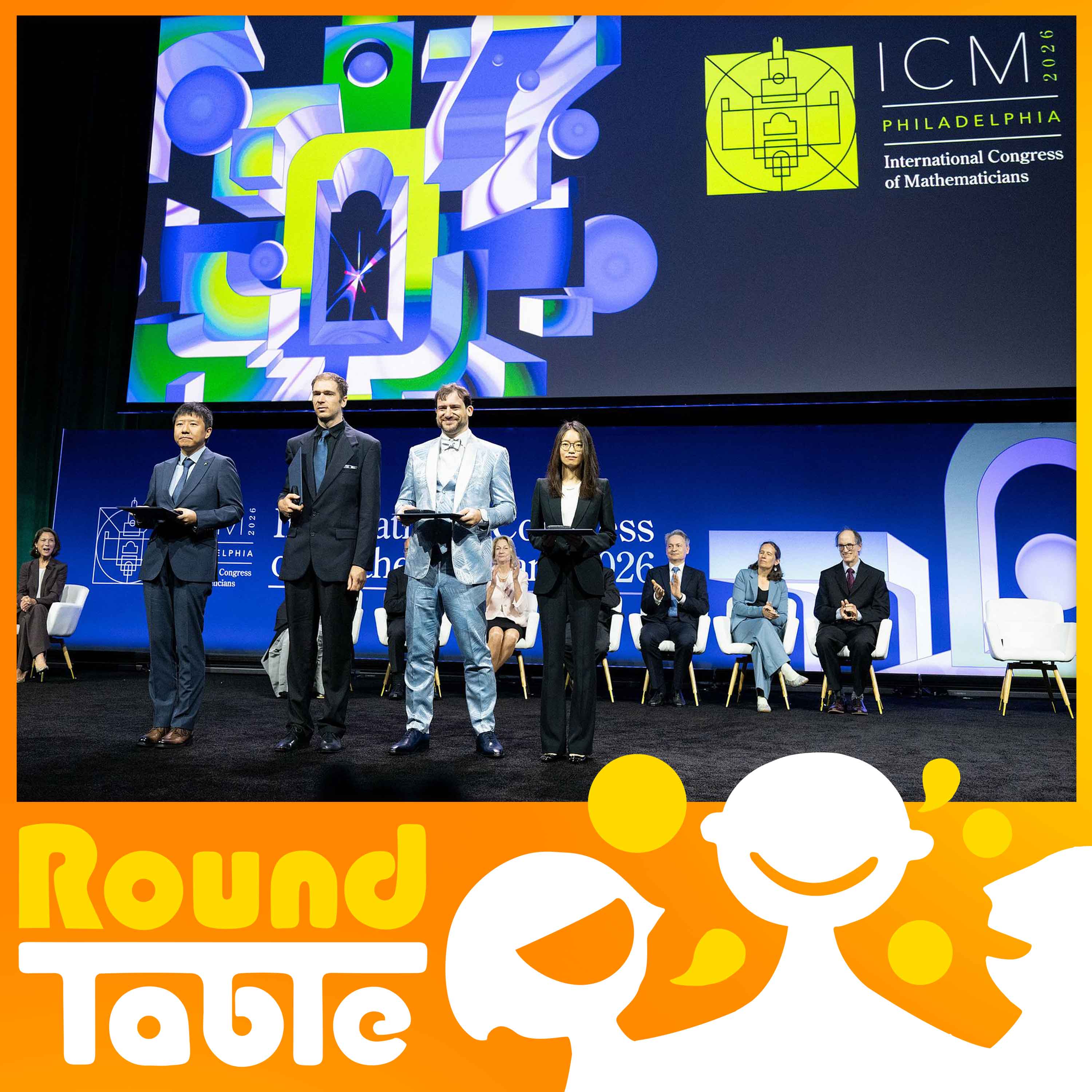
The podcast episode celebrates a historic double win at the Fields Medal ceremony, where two Chinese mathematicians, Wang Hong and Dong Yu, became the first Chinese nationals to receive the prestigious award simultaneously. The Fields Medal, often called math's Nobel Prize, is unique in that it is given to mathematicians under 40, aiming to boost their future careers rather than honor lifelong achievements. Dong Yu solved a problem posed by David Hilbert over 125 years ago, rigorously proving that the behavior of gases and liquids can be derived from particle motion, a foundational result for weather prediction and engineering. Wang Hong cracked the Kakeya Conjecture, a geometry puzzle, by merging diverse mathematical fields, with potential applications in medical imaging and cryptography. Their paths to success were starkly different: Dong was a childhood prodigy, fast-tracked through competitions and elite institutions, while Wang grew up in a small town, entered university at 16, and switched from Earth Sciences to math, driven by courage and persistence. Both stressed that passion, not just talent, was key, with Wang noting the beauty in tackling problems even if they lack immediate use. The episode underscores that these achievements not only mark a turning point for Chinese mathematics but also highlight how abstract research can unexpectedly impact everyday technologies and validate century-old assumptions.
"Discution keeps the world turning." "This is Round Table." "You're listening to Round Table. I'm Steve Hatterley today with Yushan and Yushan. Coming up, the field's medal is Math's highest prize, awarded once every four years to the best minds under 40. And this year, in Philadelphia, history was made. Two Chinese mathematicians won it in the same ceremony. One had been on a fast track since elementary school. The other grew up in a quiet town with no math hype whatsoever, no early label at all, just a curiosity that led to reshaping an entire branch of mathematics. Together, they took down problems that had stumped the world for generations. What a feat. We're going to learn about them today. You can find us at Round Table China on Apple Podcast and don't forget that we love to hear your voice. To send your voice notes and your emails, our way, Round Table Podcast at QQ.com, once again, Round Table Podcast at QQ.com. On July 23rd at the International Congress of Mathematicians in Philadelphia in America, two Chinese mathematicians did something no Chinese national had ever done before. They won the field's medal, often called Math's Nobel Prize. What makes it even more remarkable is that they won it at the same time, at the same ceremony. But look closer at how each of them actually got to where they are and you find two almost opposite life stories. One, a prodigy fast-tracked from childhood. The other, a small town kid who stumbled onto math almost by accident. Both ended up solving problems, though, that had stumped the world for decades and decades, and in one case, over a century. So today, what does this mean for China, this double win, and what do these two very different journeys tell us about how genius actually gets made? Let's start with a little background on the field's medal itself. It's, as they say, the Nobel Prize for Mathematics type thing. Yeah, it was actually created by John Charles Fields, who is a Canadian mathematician. You're welcome. Of course. I knew it. That's my only connection to this story whatsoever. All right. There's something to take pride in, of course. And he used surplus funds left over from a math conference. He organized it back in 1924, actually. And that prize, the Fields Award, was first handed out in 1936. And since then, has been awarded every four years. Unlike the Nobel Prize. I don't we mention that it's just like Nobel Prize in the realm of math. Yeah, kind of, but not really. Not really, because unlike Nobel Prize, which usually reward a body of work built up over a lifetime, the Fields Medal is actually deliberately different. And by design, it's meant to recognize outstanding work, someone's already done, while also betting on their future potential. And that's precisely why this is only awarded to mathematicians under the age of 40, which by first glance sounds absurd, like why they're relatively young. But it's exactly that early investment that's going to kind of help them in a mathematician growth way that they are expected to have later. Yeah, I was reading about this. It's kind of like the reason that the person designed it in this fashion is so that the person could get the award at a younger age in life, that it would help them help to propel them even further into what is to come next for them. Because if you win this prize, well, obviously everybody in the world of mathematics is going to know who you are. They're going to know what you've done. And you're going to, it could open a lot more doors for you so that you could use your research to solve even more problems. And I said earlier when I first heard about this mechanism, is that this is so sustainable in the sense that this award already gives you a patternless shoulder for acknowledging not just solving a really hard problem, but rather how you've successfully cracked on a problem that had defeated the entire field of mathematician for a long time. So it's like good job on that. And now you have the fund and the reputation to do even more. So this is more like an encouragement of younger mathematicians, not a retrospective lifetime achievement award. It's kind of the opposite. This is an amazing astonishment, this particular achievement, what they've done here. And it's really probably considered a turning point for Chinese mathematicians or at least Chinese mathematics in general, which would be more appropriate to say. Yeah. This year, these two very young and talented mathematicians when this award means a lot for China, for Chinese research fields too, because no Chinese national had ever won a fused medal before this. So two of them with Chinese heritage had won it, well, yeah, actually, it's two other mathematicians with Chinese heritage had won it previously, but neither holds Chinese nationality. Yeah. So this is genuinely rare. And only about 60 fields medals have ever been awarded in the prizes, what, 90 year history or so. And this is the first time to, no, sorry, the fifth time of the fifth country ever to have two fields medalist honored at the same ceremony. I think the US did it once, France, the UK, Russia, and now China. It's really an incredible story. But I want to learn about the two mathematicians that actually won the awards. Well, yeah, one is called Wang Hong, which who turns up very frequently on post these days, because I follow a whole list of female encouragement, kind of the content creators. And yeah, Wang Hong, of course, it's on the top discussion list these days. It's really interesting. She is only the third woman to win a field's medal in the prize entire history too. So that's one. And also there is Dong Yu, whom was Wang Hong's university peers back in early 2000s when they were studying together. They know each other. Yeah, they know each other back then. So Dong Yu actually helped solve a piece of one of the most famous unsolved problems in all of mathematics. Okay, let's talk about them a little bit later on. Let's start though with, I guess, yeah, what did they actually solve? Because this is impressive to say the least. Yeah, because this one is particularly interesting because the one that Dong Yu and I believe it's his coworker had cracked, had been sitting there unsolved for 125 years. Amazing. After all this years, it's cracked by this Chinese mathematician and his colleagues. So back in the back about over a hundred years ago, a legendary mathematician named David Helbert published a list of 23 problems he believed would shape the future of mathematics. One of the most whether you could mathematically prove that every day behavior of gases and liquids, how they flow, how they move, can be rigorously derived from the motion of the tiny individual particles inside them. I'm slowing down with good reasons because I'm trying to receive the information I'm othering right now. That's about the most simplistic way that we can describe that. And it's still almost impossible to understand. Yeah, how does gas behave? How does gas and liquids flow? Can they take that from the motion and use that to predict behavior forever? Apparently, that was a problem that was very difficult to prove. But Dong and his collaborators, they found a way to prove exactly that connection over any length of time. Something nobody had managed to nail down for over a century. So yep, that's the accomplishment that brought Dong Yu to the fields metal. But Wang Hong, this is a little bit different because this was an actual geometry problem that was solved. Was it not? Yeah, it's called Kakeya Conjecture. Essentially, a puzzle about how you can rotate a shape through every possible direction in space while taking up as little room as possible. I know it's hard for me, hard for a lot of people to understand it. But it had not only that, it defeated mathematicians around the globe for decades. And two crickets, she combined three different branches of mathematics that don't normally get used together. Harmonic analysis. Combined. It's okay. It's okay. It's okay. Thank you. And also, a geometric measure theory. Yeah. Of course, we have no idea what that is. But the thing is that is the like groundbreaking gesture that she did. So this was a big deal in the math world specifically because there was a particular person who who reportedly shared Wang's work online with really genuine
excitement before she had even won the prize. And apparently that person was a kind of a legend in the world of mathematics to who was also a child prodigy who had, you know, was taking university level math courses at the age of nine like that level of prodigy right. Yeah, so that guy was so excited about her finding. I mean, it was just, you know, it was something that people had been trying to solve for a very long time and then, you know, it was suddenly solved. Yeah, I think that guy you mentioned is Terence Tau, who is an Australian mathematician and also, yeah, childhood prodigy and also he became the youngest full professor in UCLA's history too. And he won his own fields medal back in 2006. Oh, did he win as well? Yeah, so that's these are the level of these are the top mathematicians in the world, the top math brains in the world that are celebrating this together. All right, so now let's let's learn about the stories because it is rather interesting that these two individuals took almost opposite paths to get to where they are. Yeah, for Donnie, it was more of a classic built of portagy at a young age like talented young math kids. And genius math genius. Yeah, since since early age, he grew up in Xinjiang in southern China and he showed talent in both math and go, which is the kind of chance. Oh, yeah, the strategy board game. Ever since he's very young and he won go to the international mathematical Olympiad in 2006. Now, if you don't know what that is, that's one of the toughest math competition a kid can never be part of at least here in China. And that also fast track and straight into peaking universities elite mathematics program through a special recommendation pathway. So yeah, you can tell this whole cultivation plan for Donnie was kind of heading all the way to a math related career. You even have to sit the general entrance exam apparently for peaking university just shoot straight into that program. Well, the universities are always on the watch for potential elites like that. He went from there to MIT. Yeah. And then earned his doctorate at Princeton. Just pretty impressive. Yeah, he listened to that. That's the dream of a tiger moment. Yeah, right. But yeah, when the media asked Donnie just how were actually is there a particular moment that she realized that math is the career he'd like to pursue in the future. He kind of said yes and no, I think. And this is exactly what he said. It's hard to say there was a single clearly defined moment when I made that decision. It just always felt that way to me almost unconsciously. I think talent, consistent effort and a bit of luck or all necessary. I was interested in math as a child and then I started taking part in competitions. It all felt very natural to me. Over the years, I gradually realized that I could really make something of it. I don't really want to get into anything for the Sophoco. For me, math is simply something I'm interested in. I find it fascinating and I want to study it. That's really as simple as it is. I think that's the core. You know, it's not like you got to be a prodigy pianist. You will have to practice a long, long time during a childhood. But people who are good at math, they got to be passionate about math. And he's talented. Yeah, of course. But I don't want to, you know, underestimate one person's diligence when people are just calling their talented. Because after the talent, of course, they need to spend still a lot of time in like working on it. I was considering including it in our chat today, but I couldn't find anything that was overly interesting. But I was curious to know, can you teach genius? Or are you born a genius? It's kind of a nature versus nurture conversation. That's something we used to recite in one of our Chinese articles that's actually drafted by one of the ancient Chinese writers. I don't remember who. But yeah, in our Chinese textbooks, there's an old article written in ancient Chinese that we kind of need to recite for a while as students. Just on the discussion of whether a genius should just be acclaimed as a genius and let them be. Or that once we see that this kid is talented, we need to actually pour more efforts on to cultivating him into an actual genius in the future. So that was a big discussion because one example I remember raised in that article was if a kid is just left there and that everybody thinks he's a genius, he's going to become a genius eventually. Then that's most likely not where he's going to end up to be because there's no cultivation. It has to be cultivated. It has to be put into efforts. Yeah. Now let's talk about Wang Hong because the path here for her is really quite different because she had no early science. She wasn't a child prodigy at all. Yeah, she grew up in the small town in Pingla in China's Guangxi region. So with no competition, math, training, whatsoever, she just got into the University, the normal way, like all the rest of us through the National College entrance exam, the Gao Gao. But I think she got it like with two years in advance. She actually got in at the age of 16 instead of 18. So more or less, I guess that proves she's also talented. She originally enrolled in the School of Earth and Space Sciences because her score wasn't enough for the math major. But she tried really hard to participate in the exam to switch major, which she eventually did and become the youngest students in her, among her peer to study math from Peking University. And later on, she also got schools, educational training in France and completed her doctorate at MIT. Oh, another MIT connection. Yep, and if you're wondering how she became this genius mathematician, here's her secret of success. I think you need to have the courage to do what you really want to do. If I didn't dare to try solving many of these problems, I would never be able to tackle them. And when I really can't figure something out, understanding why it can be done is also a good thing. I think it all comes down to persistence and luck because when things aren't going your way, it's worth hailing a little longer. Given enough time, the luck may eventually find you. Hmm, what do you think about what she said? Because it's kind of a different vibe. Well, not just a different vibe, but you have two incredible stories of success here. You have two genius math brains. One is a story of a child whose talent was recognized from a very early age. And he continued to cultivate his teachers and you know, the people around him and he himself through hard work and study cultivated that skill or perhaps nature given talent into something that was world renowned. For Wang Hong, there was no math passion from an early age at the age of four or five or whatever, something that she discovered later on in life. But the difference to me, it's just based on those two clips we just heard, the difference is what I heard from her is, when I see a problem and I don't know how to solve it, I'm going to keep going until I figure out how to find the solution to that. And if I have passion about that, if I really enjoy that, then the process, this is what I heard between the lines, then the process is just as rewarding as getting the answer itself. Exactly. Because in the same interview, she actually added up a few more lines saying, even if it doesn't work, even if what I research has no use at all, it's just like a few formula and lines that I'm trying to tackle in my own brain, I still think it's beautiful. That's exactly what she said. Yeah. And she mentioned you need to have the courage of solving the problems, solving as many as problems that you can and to chase the thing that you actually want to do. Well, I was thinking that is exactly what you mentioned is they she doesn't have that passion during her childhood, but I think that is also another manifestation of passion toward something that you actually into. So I think they have similarities. They have passion to something that they actually like and interested in. And I think a lot of fields, it's the same when you are having the passion, even though in other people's eye, it's something really, really difficult for me if I'm not interested in math, even I have the courage of solving a problem. I wouldn't be, you know, very passionate about. Dedicating your life to it. Exactly. Yeah, I agree with that sentiment. Talent is one thing, but if you don't enjoy what you're pursuing, then the chances of you being successful at that thing for a long period of time are quite low. I think because what are the chances that it will.
Retain your attention. You retain your passion, right? The odds are probably almost nonexistent. Yeah, so that's why this is such a cool story. Two paths that kind of crossed at one particular moment in Philadelphia. Well, before that, because they were, that seems cool, I guess. Here's another question I had. Why should the rest of us care? What mathematicians are doing with problems that are so abstract? There may be someone listening to this going, "Eh, it's cool, but how does, how do mathematicians have an impact on my everyday life?" Yeah, it may sound like this is a celebration among the nerdy circle of math, but not really, because when theory is out, it's always there to lead the practice. We hear cacchia conjuncture, and we don't know what that is. But actually, the math involved in that, which is harmonic analysis that Wanhong and her team had came to crack this year, is the same foundation behind image reconstruction in MRI and CT scans. Also, it's related to modern data compression and cryptography and a whole lot of things that's being put in practice these days. So researchers in the field have said that this specific breakthrough could feed toward, into, forward, into better versions of exactly those technologies. So, yeah, we see, we'll see more and more updates on those realms, for sure. Yeah, what about Dungy's problem? What was that connected to? It actually feels in something surprising, a gap we didn't realize we were actually heavily relying on. The questions that predict weather, model how air flows over an airplane wing, or simulate how liquids move. And those equations already work and also engineers already use them successfully every day. And what didn't exist until now was full mathematical proof that those equations are actually rigorously guaranteed to hold up over any length of time. And it's less, this changes what airplanes do tomorrow. And more, we just found out the ground we've been building on for over a century is actually as solid as we always assumed. Yeah, this is, this is the connection to science that we don't see, right? And this is the connection to science that even perhaps some scientists don't even see what they're researching in a lab today could have an impact on people's lives 10 years down the road or 15 years down the road. And they might not even realize it yet. And like Wang Hong said, maybe it will never make a difference. But that's part of what being a scientist is, right? Or a mathematician is is that the research you're doing, you don't know what kind of impact it will have. But it could be world changing. It could be something that changes lives all around the planet. That's a really kind of cool thing to think about. And it has an impact on us too, although admittedly it does seem very, very far away. Yeah. And another big lesson I learned from Wang Hong would be actually on the fact that you don't have to see something as as your dream and work all the way to it despite everything. That sounds so idealistic to us. That's the dream of many of us. But for Wang Hong, she felt like she was transparent when she was in Peking University because everybody else around her was genius. Geniuses. And then after she pursued her studies in France, she felt math is too hard. She quit and majored in architecture for a few years and thinking that maybe I can start over again. And she did. She got back to math later because she missed it. So that's all the stumbles that make sense. And success is not always a one straight path leading tours, hardship through hardship and challenges and leading tours success eventually. So yeah, it's something we can all learn from. Were you guys good at math in school? Absolutely not at all. Oh really. I tried to kind of comfort it. It's amazing. The three of us sitting here talking about math. What do you mean you tried? You tried at least? I tried to be good at maths and I tried to listen to the teacher of course, but just, you know, that is the moment that you probably won class that you miss. And all of the classes after that you'll, it is impossible for you to catch up. Do you miss it? I miss being good at maths though. If you were never good at it, how can you miss it? Were you good at it? No, you said no, you shot? Um, a big no. I don't miss it at all. And that's why the three of us are sitting in this room talking about people who were and are good at math. Yeah. All right, that'll do it for today's round table for you, Sean and you, Sean. I'm Steve Heatherley. Thank you so much for being a part of our program today. We had a good time. We hope you did as well. And we'll see you next time. (upbeat music)
Podcast Summary
Key Points:
Two Chinese mathematicians, Wang Hong and Dong Yu, won the Fields Medal at the same ceremony in Philadelphia on July 23rd, marking a historic first for Chinese nationals.
The Fields Medal, awarded every four years to mathematicians under 40, recognizes past achievements and future potential, unlike a lifetime achievement award.
Dong Yu solved a 125-year-old problem related to fluid and gas dynamics, proving the connection between particle motion and macroscopic behavior over any time period.
Wang Hong solved the Kakeya Conjecture, a geometry problem, by combining harmonic analysis, geometric measure theory, and other fields, defeating a decades-old challenge.
Their life stories contrast sharply
Both emphasized passion and persistence; Wang highlighted courage and luck, while Dong described his path as natural and interest-driven.
The breakthroughs have practical implications, such as improving MRI/CT imaging, data compression, and validating weather and airflow models.
Summary:
The podcast episode celebrates a historic double win at the Fields Medal ceremony, where two Chinese mathematicians, Wang Hong and Dong Yu, became the first Chinese nationals to receive the prestigious award simultaneously. The Fields Medal, often called math's Nobel Prize, is unique in that it is given to mathematicians under 40, aiming to boost their future careers rather than honor lifelong achievements. Dong Yu solved a problem posed by David Hilbert over 125 years ago, rigorously proving that the behavior of gases and liquids can be derived from particle motion, a foundational result for weather prediction and engineering.
Wang Hong cracked the Kakeya Conjecture, a geometry puzzle, by merging diverse mathematical fields, with potential applications in medical imaging and cryptography. Their paths to success were starkly different: Dong was a childhood prodigy, fast-tracked through competitions and elite institutions, while Wang grew up in a small town, entered university at 16, and switched from Earth Sciences to math, driven by courage and persistence. Both stressed that passion, not just talent, was key, with Wang noting the beauty in tackling problems even if they lack immediate use.
The episode underscores that these achievements not only mark a turning point for Chinese mathematics but also highlight how abstract research can unexpectedly impact everyday technologies and validate century-old assumptions.
FAQs
The Fields Medal is a prestigious mathematics prize awarded every four years to mathematicians under 40. Unlike the Nobel Prize, which honors lifetime achievements, it recognizes outstanding past work and supports future potential.
Wang Hong and Dong Yu won the Fields Medal in 2024, making history as the first Chinese nationals to achieve this. They won at the same ceremony in Philadelphia.
Dong Yu helped solve a problem related to proving that the behavior of gases and liquids can be rigorously derived from particle motion, a challenge unsolved for 125 years.
The Kakeya Conjecture is a geometry problem about rotating a shape in all directions while minimizing space. Wang Hong solved it by combining harmonic analysis and geometric measure theory.
Dong Yu was a child prodigy, fast-tracked through competitions and elite programs. Wang Hong discovered her passion later, entered university through standard exams, and switched to math from another major.
Wang Hong emphasized having the courage to solve problems, persistence, and a bit of luck. She also noted that even if research has no practical use, it can still be beautiful.
Chat with AI
Loading...
Pro features
Go deeper with this episode
Unlock creator-grade tools that turn any transcript into show notes and subtitle files.
 PodcastTranscript AI