008: CHIIR 2026 research paper: Working Memory and Task Complexity and Cognitive Load
from IX Lab Research
5m 34s
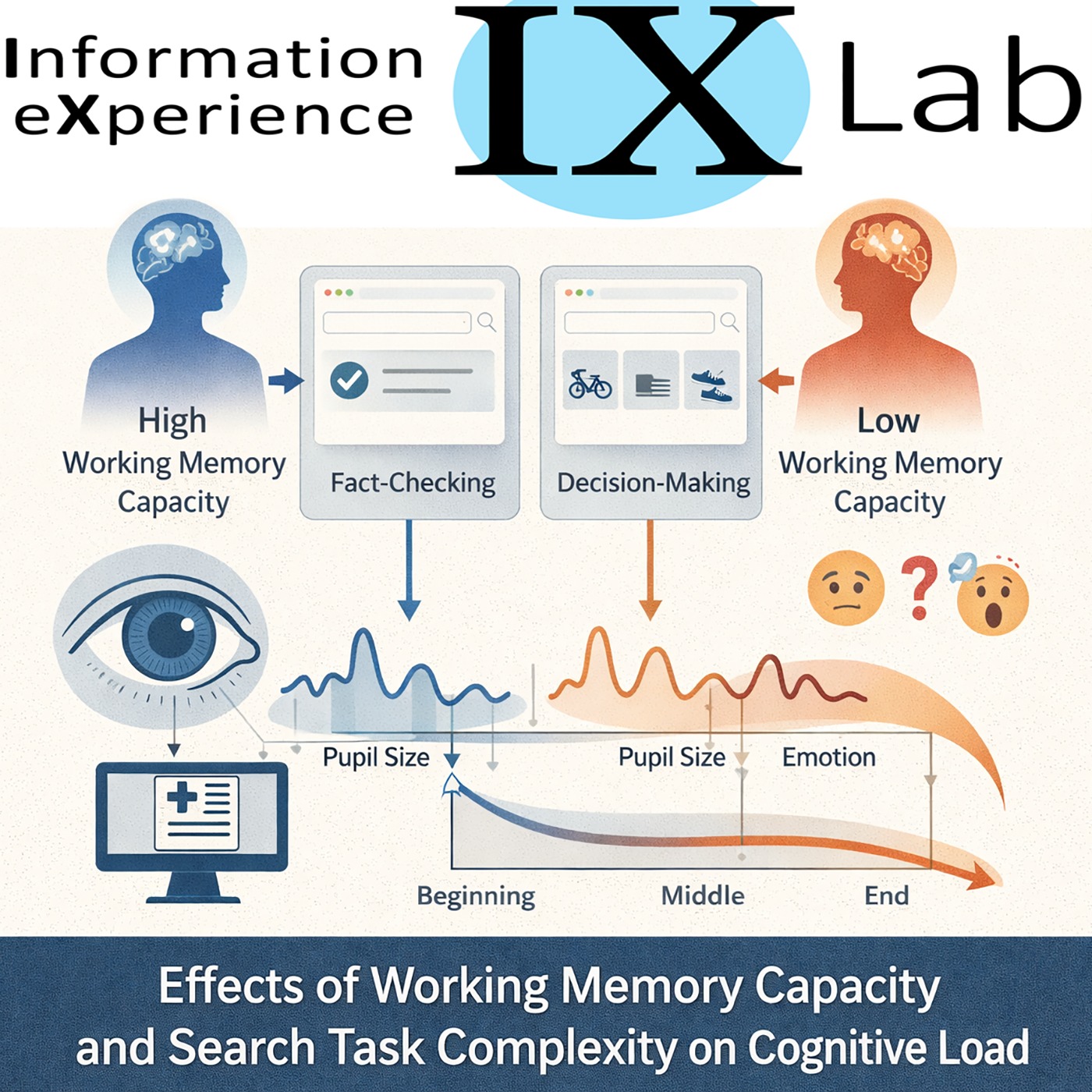
A recent study presented at the 2026 CHIR conference investigates how individual differences in working memory affect cognitive load during online searches. Researchers divided participants into high and low working memory groups and used RIPA—a real-time algorithm that isolates cognitive effort from visual stimuli—to measure mental strain via pupil dilation. Results show that while simple tasks do not differ in cognitive load between groups, complex decision-making tasks—like evaluating car options—cause a sharp spike in mental strain for those with lower working memory. These participants also exhibit confusion and negative emotions, whereas high-capacity users remain engaged. The data reveal that cognitive load peaks during the initial task setup, as the brain organizes information into a mental framework, then stabilizes after adaptation. This insight suggests future user interfaces could monitor users’ cognitive load in real time using eye-tracking and automatically simplify or restructure content to reduce strain. While promising, this approach raises concerns about long-term effects—specifically, whether overreliance on adaptive systems may erode users’ ability to build cognitive resilience through self-directed effort. The research highlights a critical balance between technological support and preserving human mental flexibility in digital environments.
[MUSIC]
>> This is the IX Lab Research Podcast.
>> Research, podcast, research, podcast.
[MUSIC]
>> Welcome to Today's Deep Dive.
Every time you search the web, your eyes are actually like
secretly broadcasting exactly how overwhelmed your brain is.
>> Yeah, it's pretty wild to think about.
>> Right, and so today we are looking at a paper called
Effects of Working Memory Capacity and Search Task Complexity
on Cognitive Load.
It was presented at the 2026 conference on human information
interaction and retrieval, which in the field is known as cheer.
>> Yeah, cheer.
And, you know, the research is behind this.
So, give Indy Jawordina Lishi and Yatsukfiska.
They really wanted to map out the exact physiological toll
of web browsing.
>> I mean, we all definitely feel that toll, right?
>> Absolutely.
>> The ultimate goal here is to figure out how our individual
working memory limits our ability to search.
That way we can eventually like design user interfaces
that step in before we experience toll cognitive overload.
>> Right, so let's clarify what working memory actually does here.
Because it's not just remembering where you left your keys
this morning. >> No, not at all.
>> It's more like your brain's RAM, right?
Like the temporary workspace where you hold active information.
>> Exactly, it's your mental RAM.
>> So, if you are doing a really simple fact-checking task,
like looking up the spelling of a word,
you're just retrieving a single discrete fact.
>> Which takes almost zero RAM.
>> Right, but a decision-making task,
like say researching which car to buy,
that requires evaluating safety ratings,
comparing prices, synthesizing all these conflicting reviews,
all at the same time.
>> Yeah, you're basically forcing the brain
to hold multiple tabs open in its own internal browser.
>> But that is a perfect way to put it.
>> So, to see how much RAM different people had,
the researchers divided 30 participants
into high and low working memory groups.
>> Okay. >> They gave them those two types of tasks
and then just watched their eyes.
Specifically, they used pupilometry
to measure the diameter of their pupils in real time.
>> Okay, wait, hold on, because I use dark mode on my browser.
>> Oh, yeah. >> So, if I click a link
and suddenly get hit with a glaring white page,
my pupils are gonna shrink instantly.
>> Yeah, they definitely will.
>> So, how can researchers possibly tell
if my pupil's reacting to a really hard math problem
or, you know, just a great screen?
>> So, that is actually the fundamental flaw
with traditional pupilometry.
But to solve it, the researchers use a specialized algorithm
called RIPA.
>> RIPA, like just one word.
>> Yeah, RIPA-poor.
It stands for real time index of pupil area activity.
And you can think of RIPA kind of like noise-canceling headphones,
but for your eyes.
>> Oh, okay, how does that work exactly?
>> Well, you know how noise-canceling headphones
listen to the ambient noise in a room,
and then they generate an inverse wave to cancel it out.
>> Right, leaving only the pure audio of your music.
>> Exactly.
RIPA does the exact same thing, just mathematically.
It reads the slow, light-induced pupil changes,
which is basically the ambient noise of screen brightness.
>> Oh, I see.
>> And it strips them away.
So, what's left behind are the rapid low-frequency fluctuations
that are purely driven by cognitive effort.
It totally isolates the mental strain.
>> Wow, okay, so if RIPA gives us this like pure signal
of cognitive strain, I'm guessing the high-ram and low-ram
groups had very different experiences
when the tasks actually got tough.
>> Oh, they definitely do.
I mean, during simple fact checking,
both groups handled the cognitive load equally well.
>> Makes sense.
>> But the moment they switched a complex decision-making,
the cognitive load just spiked massively
for the low working memory group.
>> Because they lacked the mental workspace
to integrate all that information.
>> Exactly, and we actually saw this
in their emotional data too.
>> Oh, really?
>> Yeah, through facial expression tracking,
the low working memory group showed measurable confusion
and negative emotions.
While the high working memory group
actually remained positively engaged.
>> That is so interesting.
But looking at the timeline of the data,
there's a really crucial nuance here, right?
>> Yeah, go ahead.
>> Because cognitive load didn't just stay high.
For everyone, it actually peaked at the very beginning
of the tasks and then it dropped and stabilized.
>> Right, the adaptation phase.
>> Yeah, which tells us the actual reading
of information isn't what exhausts us.
It's the initial organization of it.
Like the brain spikes its effort
trying to build a mental framework
and then once it adapts to that structure,
the load goes down.
>> Spot on, and that adaptation phase
is exactly what user interfaces of the future could help with.
>> So they could adapt to us.
>> Yeah, the researchers conclude
that future digital systems could literally read
your cognitive load in real time.
So if your webcam sees your pupils
indicating a massive spike in mental strain,
the interface could automatically adapt
to match your working memory capacity.
>> Like simplifying menus or summarizing text.
>> Exactly, or completely restructuring the page,
the very moment you start feeling overwhelmed.
>> Man, that is an incredible concept
for preventing that, you know,
fried brain feeling we all get after an hour of research.
>> It really is.
>> But it leaves you with a pretty massive question to chew on.
Like if our web browsers automatically simplify the world,
the second our pupils show we're overwhelmed,
are we eventually going to lose our natural ability
to push through difficult learning curves?
>> That is the big question.
>> Right, like will we lose the ability
to build cognitive resilience on our own?
Definitely something to think about.
That's it for our DIX Lab research podcast.
>> Until next time.
>> See ya.
Podcast Summary
Key Points:
The study explores how working memory capacity affects cognitive load during web search tasks using pupilometry and a specialized algorithm called RIPA.
RIPA isolates cognitive effort by filtering out screen brightness-induced pupil changes, revealing pure mental strain signals.
Simple fact-checking tasks equally engage both high and low working memory groups, but complex decision-making significantly increases cognitive load in low-capacity individuals.
Low working memory participants show signs of confusion and negative emotions, while high-capacity users remain engaged and positive.
Cognitive load peaks initially during task setup—indicating that mental framework building, not information processing, causes the initial strain.
The research suggests future user interfaces could dynamically adapt to users’ real-time cognitive load by monitoring pupil activity.
Such adaptive systems might simplify menus, summarize content, or restructure layouts when strain is detected.
A major concern raised is whether over-reliance on automated adaptation could weaken users’ natural ability to manage difficult learning tasks.
Summary:
A recent study presented at the 2026 CHIR conference investigates how individual differences in working memory affect cognitive load during online searches. Researchers divided participants into high and low working memory groups and used RIPA—a real-time algorithm that isolates cognitive effort from visual stimuli—to measure mental strain via pupil dilation. Results show that while simple tasks do not differ in cognitive load between groups, complex decision-making tasks—like evaluating car options—cause a sharp spike in mental strain for those with lower working memory.
These participants also exhibit confusion and negative emotions, whereas high-capacity users remain engaged. The data reveal that cognitive load peaks during the initial task setup, as the brain organizes information into a mental framework, then stabilizes after adaptation. This insight suggests future user interfaces could monitor users’ cognitive load in real time using eye-tracking and automatically simplify or restructure content to reduce strain.
While promising, this approach raises concerns about long-term effects—specifically, whether overreliance on adaptive systems may erode users’ ability to build cognitive resilience through self-directed effort. The research highlights a critical balance between technological support and preserving human mental flexibility in digital environments.
FAQs
Working memory is your brain's temporary workspace, like mental RAM, where you hold and process active information. It's crucial in web browsing because it determines how well you can handle complex tasks like comparing car reviews or evaluating multiple facts.
They use pupilometry to measure pupil diameter in real time and apply a specialized algorithm called RIPA to isolate cognitive strain from environmental factors like screen brightness.
RIPA stands for Real-Time Index of Pupil Area Activity. It filters out ambient noise from screen brightness by mathematically removing slow, light-induced pupil changes, leaving only the rapid fluctuations caused by mental effort.
Yes, during simple fact-checking tasks, both groups handled cognitive load similarly, showing that basic searches don't heavily strain the brain.
The low working memory group showed a massive spike in cognitive load during complex decision-making tasks, while the high working memory group managed the load more effectively and remained engaged.
The low working memory group showed measurable confusion and negative emotions, while the high working memory group stayed positively engaged during challenging tasks.
Chat with AI
Loading...
Pro features
Go deeper with this episode
Unlock creator-grade tools that turn any transcript into show notes and subtitle files.
 PodcastTranscript AI