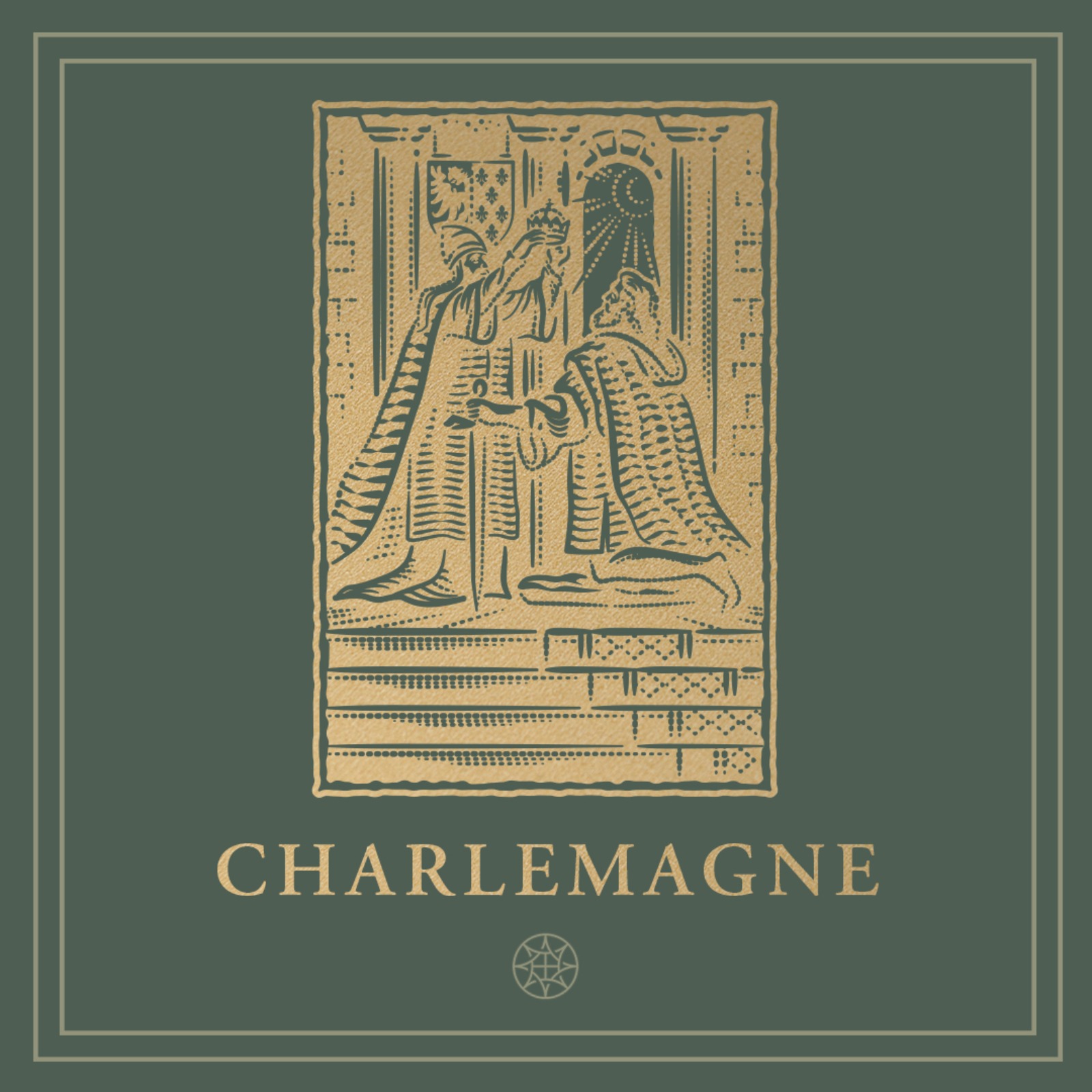
Charlemagne stands as a transformative figure in European history, uniting fragmented Germanic kingdoms into a cohesive Latin Christian civilization. Though his reign was marked by frequent warfare and strict religious policies, including forced conversions and suppression of pagan practices, he also implemented significant administrative, legal, and cultural reforms. He revived education through the Carolingian Renaissance, standardized Latin script, and promoted religious uniformity by enforcing Christian worship and banning pagan rituals. His coronation as Emperor in 800, though symbolic and lacking a lasting imperial structure, became a powerful symbol of a Christian Roman revival. Charlemagne’s legacy was deeply influenced by the religious and cultural ideals of the time, where he was seen as a pious, just, and chivalrous ruler committed to spreading Christian civilization. While criticized for authoritarianism and violence, he was widely regarded in the medieval period as the ideal embodiment of a Christian king—driven by faith, learning, and order. His influence endured beyond his reign, shaping European identity and inspiring later leaders who sought unity and cultural coherence. Through his reign, Europe transitioned from a fragmented mosaic into a shared cultural and religious space, rooted in the Bible and the Church—making Charlemagne not just a king, but a foundational figure in the idea of Europe itself.
[MUSIC PLAYING]
Europe, thanks to Charlemagne, had the chance
to become something cohesive.
Yes, plenty of rivalries, lots of bloody battles.
But might there be a common culture rooted
centrally in the Bible and in the church?
In other words, under Charlemagne,
Europe, for the first time, came to become another name
for Latin Christian civilization.
As Christians, we have a 2,000-year history
filled with stories to tell and lessons to learn.
The church history for everyone podcast
offers snapshots of key figures and consequential moments
in time.
In this episode, Kevin D. Young explores
Charlemagne and the beginning of Europe.
This lecture was originally delivered
at Christ Covenant Church during Sunday School on October 1, 2023.
In 622, an Arab merchant named Mohammed,
fled Mecca, took refuge at a nearby oasis,
what would be called now Medina, Medina.
There he founded the first Muslim community.
And he established the political and religious life
of this community.
Soon, his followers set out on a military campaign
to capture Mecca, and by the time Mohammed died in 632,
much of Arabia was in Muslim hands.
Under Abu Bakr and Omar, the Muslim Empire
expanded quickly.
Yeah, I don't have a map, but you can--
I can draw the Mediterranean Sea.
There it is.
And so you have Jerusalem, and here you have a nice Spain,
and then soccer ball in Italy and up here.
So in North Africa, yeah, that's pretty much
in Turkey, and the USA, there we go, we don't exist yet.
So quickly took over, up into Syria,
the city of Damascus, expanded and invaded Egypt down here
in North Africa.
And Alexandria would invade the Persian Empire over here
in the east, moving westward.
This is an excellent map, I know, and you can't see it.
But westward across North Africa--
oh, I didn't make Spain.
This is really, really close, actually.
So you just imagine that it is and made their way
into Spain and conquered and set up a Muslim caliphate in Spain,
which brings us to the beginning of the 8th century.
Muslim armies coming across here, North Africa, to Spain,
now to threaten the heart of what we would call Western Europe.
They were finally turned back in 732.
Any real history buffs remember what this battle of tours?
And there they were defeated by Charles Martel.
Do you remember his nickname?
The hammer, one of his mother gave them him that name
or something, but no, he was a military victor
and will hear much more about him in a moment
at the Battle of Tours in 732.
So push back the Muslim invaders out of Western Europe.
But by this point, the religious map
was altered immensely and in a way that we still live with today.
1,300 years later, you know from any kind of 1040 window
missions map, sub-Saharan Africa in the last 100 years or so,
it's seen a dramatic turn to Christianity.
But this northern Africa is still one
of the strongest Muslim strongholds in the world.
Turkey, which is where the seven letters,
so the seven churches, where Revelation went,
and where so much in Constantinople here,
the heart of the Byzantine Empire, the last remains
of the Roman Empire in the East.
Now Turkey is 99.9% Muslim.
And it dates back to these invasions, conquest,
in the 7th and 8th century.
Think about it, ancient Christian centers,
especially if you were here last fall,
centers like Jerusalem, Antioch, Damascus, Alexandria,
Carthage here in North Africa.
These were all centers of Christian learning
and now by the 8th century, their Muslim cities.
North Africa had once been the intellectual heart
of the Church, Augustine, Tertullian,
Athanasius from Alexandria.
And now this disappeared entirely.
The Byzantine Empire, which would last until the 15th century
as the eastern wing of the Roman Empire,
well, that would continue, but many of the cities
would become Muslim.
And even what remained would be, as we'll see,
at times effectively cut off from the Christian West
in what we now know as Western Europe.
This new Christian world, which had been
centered around the Mediterranean Sea, the Mediterranean,
so-called, because it was perceived
to be the middle of the Earth.
This was where, of course, there's a far Eastern civilization,
but as we think about Western civilization,
this is the heart of everything.
It's around this Mediterranean basin.
The Christian Empire, the Christendom, existed here.
And now with Islam closing in, Christianity
is going to exist on a North-South axis,
on a very small set of lands.
And what today would be France, Germany, Belgium, Switzerland,
the Netherlands, up into the British Isles.
But from this much smaller position would grow a giant.
This growth would take centuries, but from the heart
of Western Europe would beat a new Christian civilization.
And that civilization, Christendom, we might call it,
would not have been possible apart from the remarkable life
of today's subject.
It is called Charles the Great, or Latin,
Carlos Magnus, or in German, Carl de Große,
or more familiar to us in French, Charles Lamanne.
No, we'll say Charles Lamannez, which comes to us
in English as Charlemagne.
There is, I'm told, I won't pretend to know much about this person.
There is even an entertainer today called Charlemagne the God.
Any of you ever watch?
He has a show on Comedy Central.
I'm thinking I probably wouldn't recommend it,
but he has self-styled himself.
And says something about the importance of Charlemagne.
I don't think this person has probably
read many of the biographies, but to think of a name
that might represent world-be-striding greatness.
Come up with this name, Charlemagne.
One eighth century poet, or perhaps early ninth century,
dubbed this man Charles the Great, quote,
"The king and father of Europe."
So today's lecture is entitled Charlemagne
and the beginning of Europe.
But that's where we'll end.
Long before he was hailed as the father of Europe,
he had to become the king of the Franks.
The Franks, the Franks, were a Germanic people.
Of course, you think of France.
And as we'll see, the Frankish kingdom overlaid
what we now know as France, mostly in some of Germany.
And his heritage is celebrated by the French
and a bit more dubious among the Germans,
as we'll see at the very end.
The Franks were a Germanic people that had entered
the Western half of the Roman Empire in the fourth and fifth centuries.
Their first king, as far as we can tell,
was a man named Clovis.
Clovis converted to Christianity.
And as would happen sometimes in that day,
that meant that all of his subjects converted to Christianity.
Mass baptism, as they committed themselves,
turning away from PAKES.
to Christianity.
Descended from Clovis was a dynasty called the Mare of Engine,
Dynasty, so named after a mythical ancestor.
There was no one on earth with that name,
but they styled themselves the Mare of Engines.
And they ruled over this Frankish kingdom for much of the,
as you can see, sixth, seventh into the eighth century.
But in the middle of the eighth century,
this Frankish kingdom, including parts of France,
Germany, Belgium, the Netherlands,
as we know it today, would give way to a new dynasty.
One that is called the Carolingian dynasty.
Why Carolingian?
Because remember, I just had up here Carolus,
the Latin name for Charles.
So this is the dynasty of the Charles's,
the Carolingians.
Charles Martel, I just had his name.
He's still up there, the Battle of Tours,
the Hammer, who defeated the Muslims.
That was Charlemagne's grandfather.
Charlemagne's father, so the son of Charles Martel,
was Peppin.
Peppin was also a great military victor.
Peppin took over the Frankish government,
and together from Charles to Peppin,
they supplanted the Mare of Engines,
deposed those kings, and asserted a new dynasty,
the Carolingians.
In 768, Peppin divided the kingdom between his two sons,
Charlemagne and his brother, Carlemagne.
It was the practice of the Franks
that they would divide the inheritance
among the inheritable sons.
So this was thought to prevent any large concentration of power,
but it also had the effect of producing
many disastrous rivalries.
Charlemagne and Carlemagne were given each parts.
Carlemagne really a middle section,
and then Charlemagne around, kind of,
think of France and the edges of Spain and around up to the--
to Brittany and the area, to the English Channel.
They were given two halves of this empire.
They did not like each other.
Sons who were given rival dynasties
often did not like each other.
They likely would have gone to war,
but in 771, Carlemagne died of natural causes,
only 20 years old.
But he, of course, has some heirs.
Charlemagne has to decide if he is going to assert himself
to try to be the sole king of the Franks.
And so he convinces his army to make the dangerous trip
across the Alps, so moving south in order to fight those
who supported Carlemagne's heirs.
These would have been Charlemagne's nephews.
And all the map is gone,
but you remember the fierce warriors with the kind of riders
of Rohan helmets that we saw last week,
the Lombards in Northern Italy.
So he crosses the Alps to fight the supporters
of his nephews and to fight against the Lombards.
He is victorious as Charlemagne often was.
He defeated his rivals.
He either killed his family members
or sent them away into exile.
He deposed the Lombard king and he was now given the title,
King of the Franks and King of the Lombards.
And for the rest of his rule,
he would be sometimes first hand
as he would lead the troops and as he got older
through his instructions would be constantly at war.
He was often victorious, but not always.
He famously abandoned the siege of Saragosa in Spain
was ambushed by the Basques and the Pyrenees,
which was one of his worst military defeats.
But if you're going to have a terrible military defeat,
what you want is someone to write an epic poem about it
that presents you as sort of a star cross,
heroic champion of chivalric duty.
And that's what happened.
Maybe you've heard of it.
The old French epic, The Song of Roland.
The Song of Roland.
So he was immortalized in that even though it was a great defeat for him.
What we know about Charlemagne comes from a number of different sources.
There's something called the Royal Frankish annals,
which are the official military records that Charlemagne likely would have approved of.
It's kind of here's what he wanted you to know.
There's also something called the Lorsche annals.
There are papal biographies from the time.
And then two early biographies and you can go on Amazon and get this.
It's not very long, little penguin classics.
One, the first biography is by this man named Einhard.
Einhard was a member of Charlemagne's court.
And then the second, one of the great names you can see it here.
I don't think this is what his mother called him, not her, the stammerer.
So not her and he was reputed to have a stammer.
So the poor fellow is two whims, is come down to us on this penguin classic as not her, the stammerer.
So he wrote a biography a generation later after Einhard died.
And these two, as you can see, the two lives of Charlemagne give us a lot of contemporaneous
or very soon after his death information.
Come back to these two men in a little bit.
According to Einhard, the Franks waged war against the Saxons.
So I think these are another Germanic people.
You may know the Anglo-Saxons.
Well, these Germanic people, the Saxons crossed over and some of them went to England.
And that's where the people of the angles are.
And so as they mix the angles and the Saxons, they become the Anglo-Saxons, England named after the angles.
But at this point, these are Germanic people and they waged war the Franks against the Saxons for 33 years.
Without a break, Einhard tells us.
And it finally comes to an end when the Saxons agree to put away the worship of demons.
That's how Einhard puts it.
Give up their ancestral rights, kind of worship of ancestors, they submit to being baptized and they take up the Christian faith.
Good way to do missions, bad way to do missions, but that's just the way they thought of it.
Apart from the war against the Saxons, the greatest conflict was against the Avars.
Or we would know more familiar as the Huns, again farther east into Germany.
They also fought against the North's men or the Orsmen, the feared Danes.
And this is the time where you're beginning to have these fierce warriors from Scandinavia, we call the Vikings.
It wasn't any one particular ethnic group, but a group of people from the North.
And one of the reasons, there's many that Charlemagne was considered so great, is that during his lifetime there were actually few of these Viking raids.
Likely because they had heard of his great military prowess and they decided not to test their luck.
The Vikings, though fierce and we all know something of that history or at least the legends,
though fierce they were not stupid and they wanted to find rich soft targets.
And so normally that meant if you're a Viking raider and you want something that's going to have a lot of treasure and valuable gold or silver relics.
And it's going to be very poorly defended, you go after monasteries.
That's what you look for. Rich soft targets.
Well on the borders of Charlemagne's empire, there were relatively few Viking invasions probably because his reputation preceded him.
And so after his death, that just adds to his greatness.
Remember when Charlemagne was king, we didn't have these Norsemen coming after us.
He fought in the Iberian Peninsula, ruled by Arabs in Brittany with Celtic speaking people in the northwest.
He fought against the Saxons beyond the Rhine farther out against the Danes and farther east against the Slavs.
And then against the Avars or the Huns and in Northern Italy against the Lombards.
Everyone who touched the Frankish kingdom went to war or he went to war with them except for the Papal States.
He had much more to say about the Pope and Charlemagne in just a moment and they had something of an autonomous nation state.
Or at least a set of territory in land, but everyone else went to battle with Charlemagne and Charlemagne usually as the aggressor against them.
He waged war for 47 years, the length of his reign, and he doubled the size of the kingdom of the Franks, which led to, at some point,
this Byzantine proverb, and you might want to use this if you have any Franks in your life.
The Byzantine proverb, quote, "Have a Frank as a friend, not as a neighbor."
That was the Greek proverb.
It's good to have a Frank as a friend,
'cause these are war-like people,
and you'd like to have them on your side in the trenches,
but you don't wanna live next door to them
because they're going to take over your land.
Have a Frank as a friend, not as a neighbor.
It leads to the question,
why was Charlemagne constantly engaged in war?
And how should we view it?
He is, he has a very, shall we say, complicated legacy.
He was the quintessential Christian sovereign
for centuries, and yet can imagine that today,
among many, his reputation has fallen on hard times,
not least of all because he was constantly invading others.
So was there any case to be made
that these were just wars?
Well, on the one hand, you could certainly argue
that Charlemagne fought a series of unnecessary,
land-grabbing wars simply because
that's what strong kings were supposed to do.
And because there was, if you were a free man,
you were able to go fight, slaves were not,
but if you were a free man, you could go fight.
And so it was a kind of test of manliness
to prove your strength and your medal to go off into battle,
and he needed a way to deliver spoils
to his nobles.
How do you keep these people that you've conquered
in tribute to you?
You need to give them things.
You need to give them spoils,
and you don't wanna give them your spoils.
So the best way is to get stuff from other people.
So you can certainly make a case very plausibly
that Charlemagne was by any modern standards, a tyrant.
Banish his family members, kill off rivals,
especially early on, and invade other peoples
to give spoils to his aristocrats.
On the other hand, you could make a case
that there was just reason for Charlemagne
to fight these fights.
For one, he needed to secure the border lands
in order to prevent further invasions.
So every time he pushes his borders out farther,
then it makes it less likely that an invader
can come to the heart of this Frankish kingdom.
So it was a kind of defensive strategy
to keep pushing out farther and farther
to the next people to secure your borders.
He also saw himself restoring the lands
that had been under the dominion of the Roman Empire.
This is always tricky in history,
'cause history is, by its very nature, really long,
and a people can have a very long historical memory.
And so what they think is their land,
because sometime in the past it was,
you think, no, this has always been our land,
but Charlemagne, at least part of what he's thinking is,
this was all the Roman Empire.
And so as we tried to build something
like the old Western Roman Empire,
aren't we just taking back what should have belonged
to this empire and did centuries ago?
Most important, whether we agree with his methods
or not, he believed that he was subduing paganism
on the frontier, and he was introducing Christianity
and Christian civilization to the barbarians.
As we'll see, he wanted to bring uniformity.
Charlemagne was almost obsessed with people
doing the right thing in the right way, as he understood it,
and getting people to all do it together.
He was sufficiently flexible to understand
what he was up against with the disparate people,
but he did want to bring uniformity of belief
and practice and law to this people,
these peoples who had once all been a part
of this glorious thing we call the Roman Empire,
which brings us to one of the most famous dates
in history.
And this is one of the dates you should love
because it is about the easiest date you can remember.
The coronation of Charlemagne took place
on December 25, Christmas day, 800.
If you can't remember that, then you just need
to keep it in your phone or something.
December 25, 800.
Now remember, in 768, his father Peppin died,
and by 771, his rival brother died,
so he had been king of the Franks
and of the Lombards for quite some time,
but on Christmas day, 800, this very dramatic scene took place.
Pope Leo III placed a crown upon Charlemagne's head
and gave him the title of Emperor.
Now remember the history that we've looked at.
There had been no Western Emperor since 4.76
when this barbarian general, Odoachar,
deposed the last Western Emperor, Romulus.
There's continued to be an Eastern Emperor,
but there had been no Emperor in the West
for over 300 years.
This is quite an audacious claim,
particularly when you have in Constantinople
and the Byzantine Empire, they claim that they are the empire
of Rome and that they have an Emperor.
In one sense, this coronation,
which has such a famous reputation and famous date,
actually changed nothing.
Red some historians call it the most significant non-event
in history because there was no imperial capital.
There was no imperial administration
and there was no imperial people that said,
"Hey, everybody, did you hear who the new Emperor is?"
They even had one in the West for 300 years.
So I like to know then they went off to Washington DC
and they had the whole apparatus of government and state
and no, it was a non-event in a way.
And yet, what it came to symbolize
and all that it set in motion comes down to us
and we're right to remember
as one of the most significant events,
even a non-event in history.
So how did this happen?
Pope Leo had been severely beaten in 799.
I hope one of those things these church history lectures do
is remind you, "You think we live in crazy volatile
polarized times?" (laughs)
Yeah, there's been a lot of crazy times.
So Pope Leo had been accused of fornication and perjury.
He was not popular among those who still remembered
his successor who was Pope Hadrian
or sometimes written as Pope Hadrian.
So he died and Pope Leo III is the Pope
but there's still people who are loyal to this regime
and they don't like Pope Leo.
Whether the charges were true or not,
there were rumors about his sexual life
and that he was a bit of a womanizer
and he had committed fornication.
But that may have been just a pretense
to try to attack Leo.
So as Leo is in this elaborate papal procession in Rome,
two men from Hadrian's administration assault the Pope,
they mutilate his face.
They attempt to rip out his eyes and cut out his tongue.
We don't know how far they got,
but it was enough that he was disturbingly mutilated.
They stripped him of his garments and they proclaimed
he was no longer the Pope.
Somehow, almost miraculously, he escaped this assault
and he was able to flee to Charles for help,
to a place called Patterborn,
which is today in sort of north central Germany.
And so he goes there to seek help from Charles,
Charlemagne, and Charles sends him back to Rome,
but eventually, then Leo sends for Charles
to come to Rome where he is.
Because Leo knew Charles Charlemagne
was the only one who could give him the protection he needed.
He was the only one strong enough to push away these rivals
and to do something with these other Romans
who were attacking the legitimacy of Leo's pontificate.
And so he sends for Charlemagne.
On December 23, a bit of a trial for Leo.
And he swears under oath that he is not guilty
of this fornication.
Again, it's hard to know who was telling the truth,
but he swears that he's innocent
and that's good enough for Charlemagne.
Charlemagne orders to death all of Leo's attackers.
Leo asks for clemency.
This whole thing was probably orchestrated by Charlemagne
because he says, yes, I will grant mercy.
They shall only be banished.
So he gets to be tough on crime.
He also gets to be merciful.
And then two days later, as Charlemagne is attending worship
on the feast day that is Christmas,
there is this fateful occasion
where he is given the crown and acclaimed to be the emperor.
It sets into motion and raises this question,
perhaps Europe would once again be the emperor.
unified empire, not as it had been for at least 300 years, a disparate set of kings in kingdoms.
Yes, there was still a Byzantine empire, which thought of itself as the Roman empire, but there was,
you don't want to say an accident of history because we don't believe there are any accidents,
but there was certainly an event going on in the east that made this coronation possible.
At this time, in 800, in Constantinople, so the empire in the east, the Byzantine empire,
they are depending on who you ask without an emperor. Why do you say depending on who you ask
because they are ruled by a woman? Irene, it's her name. Now, unless you want to say yay,
and you're really excited for her, she was not a great person. The reason why she was on the throne
is her son when he was young. You know, this happens in the Bible too. You have a very young son,
and so the son and the mother are co-regions for a time until the son is old enough to rule on his own.
Well, mom didn't like it when he was old enough to rule on his own, and the son says,
mom, I'm ruling, mom, she goes away, she comes back, she deposes her own son, either banishing him
or killing him so that she can have the authority on the throne. Now, for the Romans and for the
Franks, as she was 797 to 802, during this time, as she's the impress, they do not consider
Byzantine to have an emperor. So, for example, here's this annals of Lorsh, which is a sort of
government document telling about what's happening in the time. Here's what it says, since the title
of emperor had been extinct among the Greeks, and a woman claimed the imperial authority,
it seemed to Pope Leo and to all the Holy Fathers who were present at the council and to the rest
of the Christian people, that Charles, King of the Franks, ought to be named emperor, for he held
Rome itself where the Caesars were always accustomed to reside and also other cities in Italy,
Gaul, France, and Germany. Since Almighty God put all these places in His power, it seemed
fitting to them that with the help of God and in accordance with the request of all the Christian
people, he should hold this title. Certainly there's some shrewdness involved, because they realized
this is an act of, could be tantamount to civil war. We haven't had an emperor for 300 years,
they have one in the east, well they say, ah, well they don't, now do they have an emperor?
They don't, they have this usurper, they have this queen mother, they have Irene. So, since there's
no emperor, now might be the time, not in the east, but in the west to claim finally an emperor.
So, Charles travels to Rome, he enters St. Peter's Basilica on Christmas Day, and here's how
Einhard puts it, who was there, but again he's giving his certain slant to it. He says, Charles
traveled to Rome to restore the state of the church. So, interesting that Einhard depicts it as,
this was to restore the state of the church, which was extremely disturbed, and he spent the
whole winter there. It was at this time that he received the title of emperor and Augustus.
Now, here's where historians debate what Einhard says next. Is this accurate, or is this Einhard
just trying to shine up Charlemagne's reputation? He says, quote, "At first, Charles disliked so much
that he said later, he would not have entered the church on that day, even though it was a great
feast day, if he had known in advance of the Pope's plan." But he bore the animosity that the
assumption of this title caused with great patience for the Roman emperors were angry about it.
He overcame their opposition through greatness of spirit, which was without doubt far greater than
theirs, by often sending ambassadors to them and by calling them his brothers and his letters.
So, according to Einhard, Charlemagne just, whoa, there's a crown, and what's happening here?
Everybody, there's a party, and I'm the last person to know, a little hard to believe,
but perhaps he didn't have, or maybe it was a don't tell me, but we all kind of know,
"Wink, wink, what's going to happen?" But Einhard says, he was very upset about it. He was very
upset because he knew this would make the Roman emperor. He saw his thinking, "The rest of Byzantine,
it would make them very unhappy, but he bore it with great patience, and he was actually more
patient than they were, and he often called them brothers, and so Charlemagne is going to seek peace,
even though he is now declared the rightful emperor in the West. Whether he was truly surprised,
and whether he genuinely objected, we don't know, but that's how Einhard wants us to see it,
that he was, at the moment of this glorious coronation, still a model of humility.
It is interesting, even if it's not 100% accurate, it is important. It tells us what they thought
was virtuous, what they wanted to see, and better to make up that he was very humble,
than to make up something that he was very vain. The assembled throne cries out,
impedatory, vita, victoria, long life and victory to Charles, the most pious Augustus,
the great peace-loving emperor crowned by God. He was hailed, emperor, Caesar, Augustus,
emperor and defender of the Roman Church, and he ruled then as emperor, though he was
already the king of the Franks, so nothing demonstrably changed in what he had authority over. It was
the ceremony that sends to us centuries later something of symbolic significance. He dies on
January 28, 814. So he rules, as emperor, for those 14 years dies January 28. Einhard says,
Charlemagne died from a sudden fever. He says he was, at the moment of his death, correcting a Latin
manuscript of the Gospels on his deathbed. He received the last sacrament. He made the sign of
the cross, and then he sang Psalm 315 into thy hands, O Lord, I commit my spirit. He died at 72
years old in the 47th year of his reign. This is what was inscribed on his tomb. "Under this tomb
lies the body of Charles, the great and orthodox emperor, who gloriously increased the kingdom of
the Franks and reigned with great success for 47 years. He died in his 70s in the year of our Lord,
814, in the 7th Indiction." An Indiction is a Roman tax season, it was a way of marking time,
on the 28th day of January. He died undoubtedly a famous man, probably the most famous man
in that part of the world, and yet in the years ahead his fame would only grow. So this book,
and it's only half of this book, from Einhard, Life of Charlemagne, which was written probably
around 826, 827, so within a decade of Charlemagne's death, became one of the most popular medieval
Latin texts. It survives in over 123 manuscripts. This Einhard, who was born of noble parents,
educated at a monastery, he was sent to the court of Charlemagne in the 790s. He was reputed to be
very short. Some people think he was a dwarf. The contemporary referred to him as a little man
who grew great in glory. He was a friend of Charlemagne's and his family, so he gives an insider's
account and also a very pro Charlemagne account. It doesn't mean it's not historical to say that Einhard's
life of Charlemagne was a bit of political propaganda. Because when he writes it, he's serving in Charlemagne's
successor, a man who became known as Louis the Pius, and so he wants to show that Louis the Pius
is very pious, and that he descends from this great man, Charlemagne. According to Einhard Charlemagne,
was my lord and foster father, most excellent, most famous, greatest of men. Not to be outdone,
however, is this second biography by our friend, Notker, the stammerer, Notker, Baubullus.
He was born in 840, the year Einhard died, near the St. Gaul monastery in Switzerland, and he wrote a
book, this one, The Deeds of Charlemagne. And I read through it, it's not very long, and I started
underlining all of the magnificent epithets, the descriptions that are given of Charles.
Here they are, at least I probably missed some. The most illustrious Charles, most far-sighted,
most pious, most learned, most famous, tireless lover of divine service, most clever and religious
and moderate, most wise, most merciful, most honorable, most careful, most just, most shrewd,
most warlike, that was a good thing, most religious, unconquered, Charles, dread, Charles.
rigorous seeker after justice, most liberal of monarchs, most careful, most glorious, most
observant, most devout, unwirried, most gracious of kings, Charles, who could never endure
idleness and sloth, the undaunted hero, most prophetic, magnanimous, I like this one, most
energetic of all the energetic Franks, so just share that with the Frank in your life.
You are the most energetic of all the energetic Franks.
You'll be glad to know that Barry Peterson, if you don't know Barry, how can you not know
Barry, his middle name, is Frank.
I said you are an energetic Frank, most cunning, most agust emperor, Charles, wow, now that's
not in one paragraph, that's pulled from the whole book, can hardly think of anything
that Charles wasn't awesome at.
Starting to not cure, Charlemagne even knew cheese better than anyone else.
Quote, here's a story, "Then Charles, from whose penetration and skill nothing could
escape, however new it's strange, or strange it might be, spoke thus to the bishop, who
from childhood had known such cheeses and yet could not test them.
He even knew cheese better than all the cheese experts.
And when he sinned, he was penitent.
This is a fascinating story, not curtells.
There was a deacon, he says, who followed the custom of quote, those beyond the elpes.
Now who resisted the course of nature, resisted the course of nature.
So not curts, probably trying to tell us, he thought these men were effeminate.
So here's what he describes of these men, this one particular man.
He went to baths, he had himself closely shaved, he polished his skin, he cleaned his nails.
Oh, boys, don't do that.
He had his hair cut very short, as if it had been cut by a lathe, he wore linen undergarments
a very white shirt, and he desired to put on a fine show as he read the Gospels.
So here's this man, he said, he's like the people beyond the elpes, he's a bit contrary
to nature with his fanciness.
And so he gets up, he says, to read the Gospels, and he says to put on a show, but not curses
his heart was unclean, and a spider descended from the ceiling and landed on his head.
And it happened several times, and the man thought it was just a fly buzzing about, and
he didn't do anything about it.
But Charles observed that there was a spider on his head, and yet he said nothing.
And later that man with all of his finery was bitten by that spider, and he swelled
and died.
And Charlemagne felt very guilty of manslaughter, and he did public penance for he did not
do anything to save the man from the spider.
So even when Charles sins, he repents.
While was Charlemagne like as a man, let's say a little bit about this before we close
by talking about why he's so significant.
According to Einhard, he was talkative, made friends easily.
He educated his sons and daughters in the liberal arts.
He refused to give his daughters in marriage, which was very strange.
Einhard says he just couldn't bear to be without them.
He loved them so much, that's probably a half truth.
He most likely did not want to multiply potential heirs and rivals, and he had kind of been
burned early in life by one of these marriage alliances, and he thought, this is just simpler
if I don't give my daughters off, and then I have to have all of these tricky alliances
with these other kingdoms.
However, the daughters had rather openly a series of paramores.
They had children out of wedlock, and Einhardt kind of tis-tis Charlemagne just says,
"Ah, his love was so great for them, he kind of overlooked it."
Einhardt said his body was large and strong and well proportioned.
His height was seven times the length of his foot.
We don't know how long his foot was, know how tall he was, but that was the perfect proportion.
You can measure it out later, are you seven times the length of your foot?
And then you can hear Einhardt, may we all have a biographer who tries to help us out.
He says his neck was a little short and thick, and his stomach seemed to project.
It was an illusion, quote, "but the symmetry of the other parts hid these flaws."
So you might have, you might have, but no, the rest of him was so flawless.
He exercised regularly by riding and hunting.
He was, and he swimmers in the group, maybe Charlemagne, for example, he says he was the
greatest swimmer in the land.
He liked to eat, but he was moderate in drink, which was probably unusual for the king.
He did not like to see others drunk, and he did not want anyone to see him drunk.
He loved the books of Augustine, in particular the city of God.
Imagine he saw himself doing something like that in his own day.
He learned Latin well enough to pray in it, probably spoke old Frankish.
He could understand Greek better than he could speak it.
He loved to study, he loved learning, though he may not have been able to write.
His family life, we need to say something about this, was not a model of Christian virtue.
From a Christian perspective, once we try to make sense of all of his conquests, this
was certainly the worst part about him.
He had five wives and four concubines.
Now Einhard tells us he did not have them at the same time.
So Einhard wants us, unless assuming it's true, he was not a polygamist, and Frankish
law was not always very careful between what's a wife and a concubine.
But Charlemagne certainly is not a great example.
He dismissed his first Frankish wife, him military, because he had to marry a Lombard wife,
but we don't even know her name, and he dismissed her very quickly.
And then in 771, 772, he married his third wife, Hildegaard.
His first wife was still alive.
His second wife was probably still alive, and no formal divorce proceeding.
So you could say, technically, he was a bigamist or a trigamist, though he wouldn't have seen
it as such.
He put away these wives.
Hildegaard, this just makes me shudder.
She was even in keeping with the standards of the time, and what was normal.
Hildegaard was only 12 or 13 when she married Charlemagne, and she had nine or ten children
over the next 11 or 12 years, amazingly all, but one of them survived infancy, which is
very rare.
She died around the age of 25, then he married Festrata.
That would last a decade before she died.
His fifth and final wife was Leuthgaard, and Einhart also mentions four concubines.
Gersuida, Regina, Adelina, and another one whose name he cannot remember.
Charlemagne has always been controversial.
Is he everything that is right with European civilization or everything that is wrong with
Western civilization?
As I said by our standards, he was a tyrant.
He killed rivals.
He conquered lands that weren't his.
He forced people to convert.
He was hardly a model for treating women well.
But why is he considered by so many to be the great already in his day and in subsequent
centuries?
Well, just think of a list of things, some of which I've already mentioned, one, certainly
his military victories.
But also, he was an administrative reformer.
He organized well.
He was responsive to people's needs in his kingdom.
He put good people in charge.
He provided order out of chaos, and if you can do that in the ancient world or the
medieval world or let's be honest, in our day, if you can give order out of chaos, you're
going to have a lot of people who are thankful for you.
He sought legal reforms.
He reprimanded courts for favoring the powerful and the wealthy.
He forbid murder.
He convened assemblies that though this was not democracy, they provided much more of
a kind of check and balance than a usual king would have.
In fact, Montesquieu, do you remember Baron de Montesquieu from the American founding?
Of course, he's French, but many American founders looked to Montesquieu and his spirit
of the laws.
Montesquieu saw in Charlemagne someone who first practiced these kind of checks and balances
that were necessary in good government.
He also had the wisdom to know when to accept flexibility and when to give up on some projects
and reforms.
He could respect and accept local laws and customs when they didn't run counter to his larger
Christian vision.
Something is happy to allow you to keep doing your own thing and he knew what he couldn't
do.
He had great building projects.
Most notably, the palace chapel and other buildings at Aachen.
You've never been there, I've not.
It's now Aachen is right in the corner.
It's in Germany right there at the border with Belgium and Netherlands.
It's one of the first cathedrals and it was one of the first 12 world heritage sites.
Is this palace cathedral that he built at Aachen?
That was kind of his de facto capital.
He opened diplomatic relationships with Arab Muslims.
He was much more concerned.
even though I started with Islam,
he was much more concerned about paganism
than he was with Islam.
Because when he ruled, the Muslim invaders
weren't knocking on his doorstep.
It was the pagans at the frontiers
that were a pain and that he wanted to convert.
People as far as Persia and India had heard of him
and they thought of him as some kind of Frankish super king.
He encouraged growth and trade and production.
Many historians comment that he benefited
from circumstances he could not control.
There was a particular warming period
in Western Europe,
which allowed for greater crop production.
There was also the abatement of the plague
which destroyed so many people for centuries
and yet in Charlemagne's time
for whatever providential reason,
the plague seemed to disappear.
He was a patron of what's been called
the Carolingian Renaissance.
The Renaissance, you know, it's spell, it's a long word.
Would be in Italy in the 14th and 15th centuries,
but this has been called the Carolingian Renaissance
because he was a patron to many scholarly endeavors.
He had at least two famous court scholars,
Alcuen from York and Theodolph from Spain.
He believed in the pursuit of learning and the liberal arts.
He had his own daughters educated as well as his sons.
And this is fascinating.
He was surprisingly tolerant toward the Jews,
which is not something that would be true
centuries later in Western Europe.
Not Kerr tells a time when Charles and a Jewish merchant
stuffed a mouse full of spices
in order to trick a greedy bishop
into paying an exorbitant price for it.
It's a very strange story.
But the fact that he would tell a story of Charlemagne
and a Jew tricking a bishop tells you something.
In fact, not Kerr and Einhardt both have lots of story
about greedy, worldly, lavish bishops.
So already having said in great worldliness in the church,
Charlemagne's religion.
Say something about that before we close.
His religion was selective at times,
as we've seen with divorce and remarriage
and his daughters not getting married,
but having children,
Charlemagne himself was born out of wedlock.
So his Christian religion was selective,
but there's no doubt he was devout.
He was genuinely concerned for the spiritual welfare
of his subjects.
Einhardt says, quote, "With great piety and devotion,
he practiced the Christian religion
in which he had been reared from infancy."
He went to morning and evening mass.
He also did the night offices.
Remember from Benedict?
So he was often in church much more than was required for him.
Not a politician who just,
I got a show up on Easter to church.
He was much more than was expected.
He built a beautiful chapel at Aachen.
He supplied the church with relics
and with vessels of gold and silver.
And he was obsessed with making sure things
were done in the right way.
So he wanted to correct the singing
and the reading of Christian services.
He wanted to make sure people were following the liturgy.
He was the one who said in motion
that the Benedictine rule would be the rule
over all of the monasteries.
It was really his son, Louis the Pius,
who put that into practice,
but it starts with Charlemagne.
He also, through his monasteries and his scribes,
developed something called the Carolingen Minuscle.
It was a script.
So how do people communicate?
How can they read?
Not only are there some different languages,
even if they're in Latin or some version of Latin,
everybody, you can't, you would have thought
they had times new Roman, come on.
But they didn't have, you know, an agreed upon script.
And his scholars come up with something,
now we call the Carolingen Minuscle.
And it took hold across his lands.
And as people started adopting it,
it became a way then that you could read
what people and other parts of the empire were writing
because now finally you have a script
that you all agree on.
He also had the innovation we can all be thankful for
of not just putting all the words together,
but putting spaces between words.
He had no patience for areas.
He opposed the adoptionist heresy coming out of Spain.
Interestingly, especially as Protestants,
he was opposed to the use of pictures and icons in church.
But Pope Adrian, before Pope Leo,
told him the decisions of the Second Council of Nicaea,
was that 787, which were pro iconography.
He said, no, no, no, these are good.
And so one of the times where Charlemagne is flexible,
we might say two flexible, he says, okay, all right.
I won't make a big deal of it.
I won't have my scholars argue against it anymore.
Though he himself was not pro icons, images, and pictures.
He saw his life bound up with the eradication of paganism.
In one of his first legal decrees, he forbade cremation,
which was considered a pagan practice of the Saxons.
He required burial in Christian cemeteries.
He outlawed human sacrifice.
He outlawed making vows in the presence of groves
or trees or springs kind of pagan mysticism.
He forbade baptizing inanimate objects,
which he considered superstitious.
He did not allow the erecting of poles
with written invocations that were supposed to chase away
demons and thunderstorms.
So he did much that moved in a Christian direction.
So in closing, how do we think of this Charles the Great?
He was a central figure, perhaps these central figure
in many epic poems across Europe.
He was made a saint in 1165.
His bones were placed in a golden box at Aachen in 1215.
He appeared in Dante's sixth heaven.
Crusaders, as you can imagine, took him as their example.
So did Napoleon. Even in the 20th century,
there has been a Charlemagne prize given to whoever considered
to do the most to work for unity in Western Europe.
Until recently, the French have usually considered him a hero.
Germans have been more ambiguous,
even though the Franks were a Germanic people
and Aachen is today in Germany.
He did wage war for 33 years against the Saxons.
And so Hitler, for example, did not like Charlemagne.
In many ways, his example, or at least the legend
of his example, came to define the Middle Ages.
Here's what Charlemagne meant in the Middle Ages.
Someone who was just fair, chivalrous,
who could win new lands and new people to Christ,
who would push back the infidel,
who could bring about true worship, civilized life.
He was a warrior king, but he was also an idealist.
Again, I'm saying how they viewed him.
We might be more realistic,
but they said he was a passionate supporter of learning,
of culture, of religion, of innovation,
of architecture, of administrative efficiency,
of law and order.
He was full of unbounded zeal and confidence.
So put that all together and you can see
why the medieval man or woman looked upon Charlemagne
as a great, as the great exemplar.
And you can see how so much of what he came to represent
would be the embodiment of Western Europe itself.
Learning, culture, religion, innovation,
architecture, efficiency, law, order.
What Charlemagne was, or at least what they remembered him
to be, is what Europe became.
Of course, it also further sets in motion.
This enduring tension between church and state,
as we would call it, who was superior at the coronation?
The pope or the emperor?
We could say, well, the pope was
because the pope crowned the emperor.
So you need the pope.
So if the pope is the one crowning the emperor,
the pope must be superior.
But everyone knew the emperor, Charles had strength
and the pope was mutilated and bloody.
He was doing this because Leo needed help.
Charles appointed the bishops and the priests
and the abbot.
And after the coronation, the pope bowed before Charles.
But both can make a claim that this represented their primacy.
It was a rebirth of the Roman Empire,
but under Charlemagne, it was meant
to be a Christian Roman Empire.
And so I end where we began.
At some point, between 800 and 803, an anonymous poet,
who was a part of Charlemagne's court, wrote a poem.
Today, it's called the Patterborn Epic.
And in this poem, Charles has called many flattering names.
In the one that stuck, his pattern, Europa, father of Europe.
Europe was not a common designation at the time.
And it had been around for centuries.
But it didn't have a very exact meaning.
Europe was just sort of what's in between--
what's north of the Mediterranean before you get to Asia?
It's just that was called Europe.
But here, it became something else.
It became a land, yes.
but something of an idea. Something of a civilization. Europe, thanks to Charlemagne,
had the chance to become something cohesive. Yes, plenty of rivalries, lots of bloody battles,
but might there be a common culture rooted centrally in the Bible and in the Church? In other words,
under Charlemagne, Europe, for the first time came to become another name for Latin Christian civilization.
So, Notker begins his book by noting that when Charles began to rule in the western parts of the
world, he says the study of letters was almost everywhere forgotten and worship of the true God was
weak. So that's how Notker begins. When Charlemagne came on the scene, there was no learning and the
church was weak, but here's what he says in the very first sentence. And now let him have the last word.
The omnipotent disposal of all things and the director of kingdoms and of the ages. When he had
destroyed the wondrous statue with feed of iron or of clay among the Romans, set up the golden head
of another no less remarkable statue among the Franks through the illustrious Charlemagne.
Whether we agree in every respect with all of the epithets put upon Charlemagne,
we can't understand church history unless we understand that in his own day and in the centuries
that would follow, he was considered all that was right and all that was possible in this new
Christendom. Tive deeper into this biography and others by reading Kevin DeYoung's book Church
History for Everyone, published by Crossway. On the next episode, Kevin explores Anselm and the
Rise of Scholasticism. The Church History for Everyone podcast is a ministry of clearly reformed.
You can find more resources like this at clearlyreformed.org.
Podcast Summary
Key Points:
Charlemagne played a pivotal role in uniting Western Europe under a shared Latin Christian civilization, marking the beginning of a cohesive European identity.
His reign saw extensive military campaigns against the Saxons, Avars, Vikings, and Slavs, driven by both defensive needs and a vision of Christian conquest and expansion.
The coronation of Charlemagne as Emperor by Pope Leo III in 800 symbolized a revival of the Roman Empire in the West, though it had little practical imperial structure and was more symbolic than functional.
Charlemagne promoted administrative reform, legal fairness, and religious uniformity, establishing checks on power and reinforcing Christian doctrine through monasteries and education.
He initiated the Carolingian Renaissance, standardizing Latin script, supporting learning, and fostering cultural and religious unity across his realm.
Despite controversial actions—such as political purges, forced conversions, and polygamy—Charlemagne was seen as a devout, pious, and idealistic Christian sovereign who sought to bring order, peace, and faith to Europe.
The legend of Charlemagne evolved into a powerful cultural symbol of unity, chivalry, and Christian civilization, influencing medieval thought and later European political ideologies.
His legacy helped shape the idea of Europe as a Latin Christian entity, rooted in shared faith and culture, rather than fragmented regional identities.
Summary:
Charlemagne stands as a transformative figure in European history, uniting fragmented Germanic kingdoms into a cohesive Latin Christian civilization. Though his reign was marked by frequent warfare and strict religious policies, including forced conversions and suppression of pagan practices, he also implemented significant administrative, legal, and cultural reforms. He revived education through the Carolingian Renaissance, standardized Latin script, and promoted religious uniformity by enforcing Christian worship and banning pagan rituals.
His coronation as Emperor in 800, though symbolic and lacking a lasting imperial structure, became a powerful symbol of a Christian Roman revival. Charlemagne’s legacy was deeply influenced by the religious and cultural ideals of the time, where he was seen as a pious, just, and chivalrous ruler committed to spreading Christian civilization. While criticized for authoritarianism and violence, he was widely regarded in the medieval period as the ideal embodiment of a Christian king—driven by faith, learning, and order.
His influence endured beyond his reign, shaping European identity and inspiring later leaders who sought unity and cultural coherence. Through his reign, Europe transitioned from a fragmented mosaic into a shared cultural and religious space, rooted in the Bible and the Church—making Charlemagne not just a king, but a foundational figure in the idea of Europe itself.
FAQs
Charlemagne helped establish a cohesive Latin Christian civilization across Europe, laying the foundation for what would become Western Europe. He promoted uniformity in religion, law, and culture, and is credited with initiating the Carolingian Renaissance, which revived learning and literacy.
The coronation on Christmas Day 800 symbolized a revival of the Roman Empire in the West, marking the first time in over 300 years that a Western emperor was named. Though it had little practical impact, it became a powerful symbol of Christian unity and the idea of a unified Christendom.
Charlemagne expanded his kingdom through military campaigns against the Saxons, Avars, Danes, Slavs, and Vikings. He also conquered the Lombard kingdom in Italy, doubling the size of the Frankish realm and securing borders against external threats.
Charlemagne was both admired and criticized. He was seen as a just administrator who promoted legal reforms, built institutions, and supported learning. However, he also executed rivals, forced conversions, and engaged in prolonged wars, leading some to view him as a tyrant by modern standards.
The Carolingian Renaissance was a cultural revival under Charlemagne that emphasized education, literacy, and the arts. He encouraged scholarly work, standardized scripts like Carolingian Minuscule, and promoted the liberal arts, helping to unify knowledge across his empire.
He promoted Christian orthodoxy by banning pagan rituals such as cremation, human sacrifice, and idol worship. He also enforced Christian burial practices and supported the spread of the liturgy, making Christianity central to daily life and governance.
Chat with AI
Loading...
Pro features
Go deeper with this episode
Unlock creator-grade tools that turn any transcript into show notes and subtitle files.
 PodcastTranscript AI