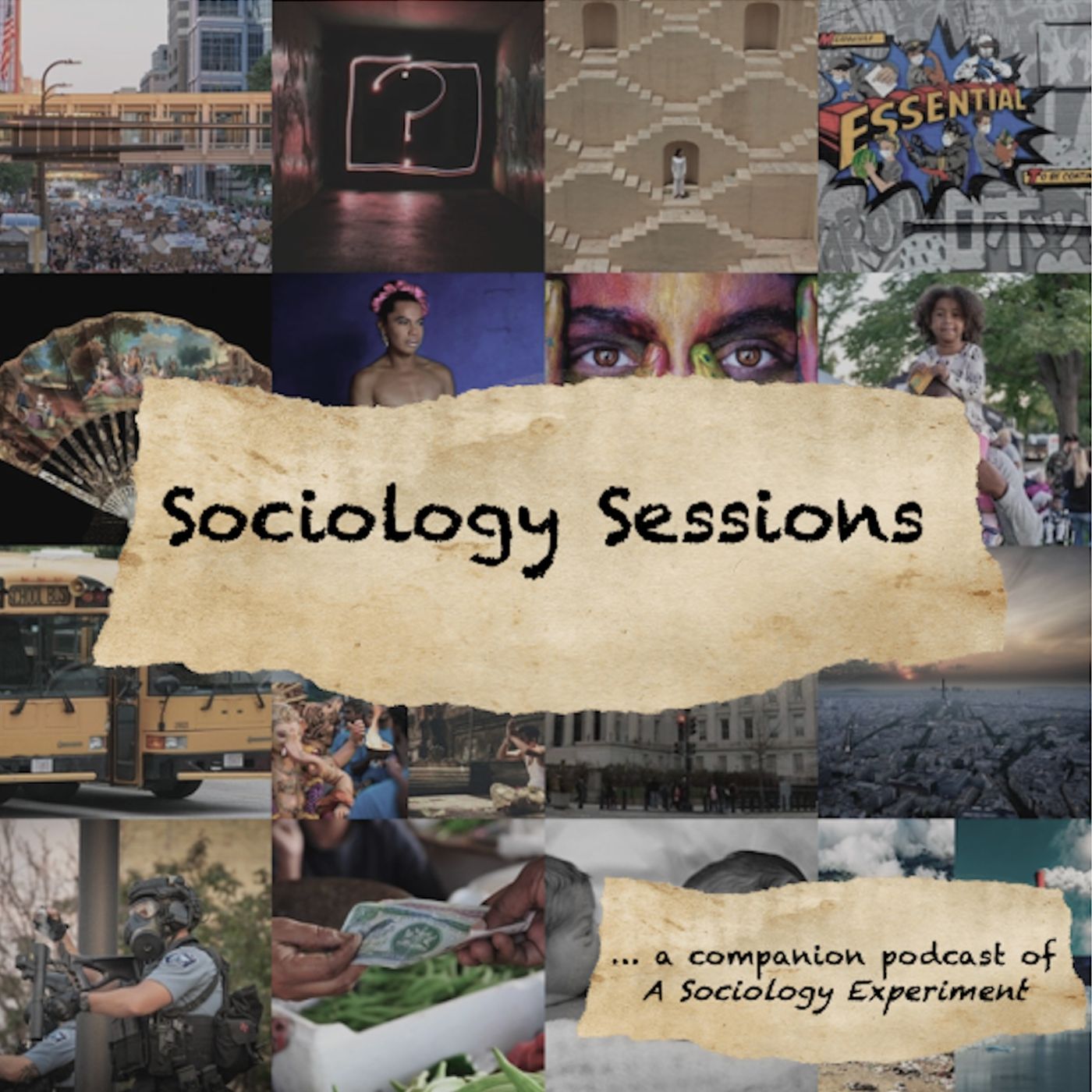
Welcome to episode 1 of Sociology Sessions, a series of conversations with professors
and students on introductory topics from the field of sociology.
This podcast is a companion to the online textbook, A Sociology Experiment, which consists
of 16 different chapters on different topics, each one authored by a different set of sociologists.
Every episode here corresponds to one of those chapters.
Each time, we'll hear from students and professors who have studied the chapter as well as one
of the authors who wrote the chapter.
If you're currently a student taking this course, you should think of this as a virtual
substitution for a college discussion section, where you would meet with students and maybe
a teaching assistant to talk through some of the material.
Whether you're following along with the course or just interested in the field, this podcast
should be a chance to listen to introductory concepts from sociology thought through by
students and elaborated on and articulated by professors.
My name is Zahan Das.
I graduated last spring from Columbia University, majoring in political economy and minoring
in classics.
I didn't take a single class in sociology, so if you're totally new to all of this,
consider me your voice here.
Okay, let's get into it, because this intro is really starting to stretch the limits of
like a modern day attention span, so sorry about that, I've been watching a lot of like
old movies recently and they really take their time.
For the first episode, we looked at chapter one of the textbook, an introductory look
at some of the founding figures and concepts of the field of sociology.
My guests included one student in her first year of sociology, and another a few months
out from completing the entire major.
My name is Alize, I'm from UCSB, I'm a first year and my pronouns are she/her.
I'm Andrew, I just graduated from Columbia undergrad last year.
My pronouns are he/him/his, and I majored in sociology and African-American studies.
I also spoke with Seamus Kahn, one of the founders of a sociology experiment and co-author
of the first chapter.
He teaches sociology at Princeton, and you may have heard of one of his books, such as
"Privilege, The Making of an Adolescent Elite at St. Paul's School" or more recently "Sexual
Citizens, A Landmark Study of Sex, Power and Assaults on Campus".
He wasn't there for my conversation with Alize and Andrew, but I've added his voice at various
points throughout the conversation to go a little deeper on some of the points that
get brought up.
We'll start by looking at different types of solidarity in the way that social groups
function.
This is a concept from the work of Emil Durkheim, one of the founding fathers of sociology
from late 19th century.
Mechanical solidarity versus what's the other one called, if you remind me again?
Organic.
Organic.
Yeah, yeah, yeah.
Right?
So kind of like thinking of our networks, you know, that the people around us in our
circles as either being, say, like in our family, like really super tight-knit or being
very spread out and maybe less essential but broader in some ways.
Mechanical solidarity is when everybody is tied to everybody else.
A family would be an example of a mechanical subgroup because everyone's tied to everybody.
So like your parents are tied to one another, you are tied to your mom and to your dad and
your mom and your dad are tied together.
And so that's kind of what a mechanical system looks like.
And an example I sometimes give is like a watch.
Like a watch is a mechanical system, at least a mechanical watch is a mechanical system.
And if you like remove one of the screws from a watch, you know, one of the wheels from
a watch, the watch doesn't work anymore, right?
Like the whole thing is affected.
Bodies are organic systems.
And like if you were to remove my pinky, I'd be fine.
Like it would hurt a little, but like turns out my body would continue and it's kind like
bodies are really kind of robust as organic systems.
I think over the last year or so a lot of our networks have been challenged and changed
in certain ways.
Like on one hand, maybe my mechanical solidarity is higher now now that, you know, I just maybe
have like one or two friends in the city that I can kind of safely meet or if I'm home and
with my family.
Whereas before, even just a year ago in college, I'm like, yeah, I have like these friends
from these circles, my friends from class, people that I'm networking with like meeting
and it's like everybody is everywhere and then all of a sudden it seems to be a lot
more mechanical.
So I think that idea really, really stuck out to me and I felt especially timely.
They mentioned the chapter that if you look at American society, that's very organic as
a structure in the fact, in the idea that like we don't have, we have no idea about
the people who make our food, but we're incredibly dependent on them.
And so in these kind of large scale ways, things are very organic and spread beyond
what you can really think about in a coherent way.
But are there pockets that you guys feel like in your life that feel like they're a little
bit more mechanical solidarity?
Because yeah, when I think about that, I think about family, I think about like student clubs
maybe that I was in college, you know, everyone has an assigned role.
Everyone had, you know, it's a small community that goes to a few different spaces.
Like, do you guys feel like you notice other pockets of your life where there's a little
more that feeling of mechanical solidarity where everyone's an important piece?
I would say, yeah, I noticed it a lot at work.
Hmm.
Yeah, like an office culture kind of thing.
Yeah, I wonder, right?
So it's definitely clear that like your family, where everybody knows everybody, that's definitely
mechanical solidarity.
Right.
And you know, I could see that like in a workplace too, like where you're supposed to be close
with everybody.
Even in a club, like you said, like it can feel mechanical in a lot of ways.
Because you have similar norms, right, like you're regulated in the same way, you're integrated
in the same way.
But at the same time, I know there was this part about how with organic solidarity, people
can kind of be replaced in a certain way.
Like in mechanical solidarity, right, like, like knocking on wood, but like, if I lost
my sister, like our whole family's like, yeah, yeah, shambles, but in some ways, I guess like,
even at places I worked, in some ways, and this may be like ties to marks a little bit.
It's like, if we lose one employee, like, you know, I'll be sad because my friends gone,
but to our manager or to our boss, in some ways, they might be thought of as replaceable
or the system wouldn't suffer as much to some extent if, you know, an employee is kind
of removed and then replaced.
So I don't know, I almost wonder, like, there's an extent to which like a workplace or a club
definitely can have mechanical elements, but maybe it can also have have organic elements
if I'm if I'm reading this, this correctly, maybe what it is, is that a lot of jobs present
the idea that like, we need to have like a mechanical solidarity, like that type of energy
on the workforce or whatnot, but when reality is like organic, because it's like, we don't
actually need you.
We want you to think that we need you to work hard.
Right.
Like we're promoting like a family culture.
We don't really want a family culture, but if it gets you to work, it works for us.
My job, we have like this company model, like we want you to be true to you.
And so because of that, it's like, you can dress how you want it's supposed to be appropriate
for work or whatnot, but I feel like those are all components that are like supposed to
entice you to do the job, like aren't necessarily working for the company.
Interestingly, like there's no individuals in mechanical societies.
And what that means is that like, nobody occupies a unique position because everybody's tied
to everybody else.
So everyone's position is basically the same.
That's not a quality.
It just means that like people being in these unique positions is less likely.
And so organic systems are ones where people aren't all tied to one another and they're
less like intricately bound together.
Durkheim argues that it's super important within organic societies to have, you know,
these little mechanical substructures.
So the idea there is like, if you exist in a world where like, you know, you're not actually
tied to everybody else.
It leads to individualism, but also can lead to a large degree of alienation, like where
you just feel or in Durkheim's terms enemy, you feel just super removed from the world
and from everybody else.
And so what we try to do then is to create like a dense little click.
So think about high school for a minute.
Like if you go to a big enough high school, like not everybody knows it, everybody else.
They're kind of new people, you can encounter them.
And that is both a system of like, there's something great about it because there's always
a sense of potential of being able to meet somebody new of, you know, being able to disappear
from view, but there's also something terrifying about it, which is that like you constantly
feel like you're missing out or that there's something else going on that you don't know
about or other people who are like, you know, doing interesting things and maybe you feel
super alone.
And so what happens in a high school like, well, clicks form, right?
So people create little mechanical systems within the organic body of a high school.
So they create like subgroups that are pretty tightly organized, like friend groups of like
three, four, five, six people.
And those people create, you know, the benefits of a mechanical system, which is that like
you're tied to everyone else and you have this sense of belonging and position within
that group with the benefits of an organic system where like people are, you know, there's
still this potential of meeting new people, you know, you have a potential for individuality
to some degree, you can disappear from view.
And so that's what sort of Durkheim sees as like that positive, positive thing.
But as you've asked, like there's also negative things to this, like there are times where
if you're in some of these systems and they like, just don't help you out enough, like
they don't, you don't have enough ties to other people, or you don't really know how
to act, you can feel totally lost.
The other day I read this New York Times article from like a year ago or something called wealthy,
successful and miserable.
And it was trying to make sense of why there are people making like $100,000 a year.
But they're still, they're still unhappy.
And it's like why, right?
I think Marx actually has something to say about that.
I was thinking like, okay, a lot of these people are unhappy because, you know, their
labor is still being exploited.
Like a lot of times, even if a company pays you say, you know, a decent sum like a hundred
thousand a year, you might be producing much more in value for them, or maybe Marx would
be talking about alienation, right?
This is a job that makes you like compete and not form bonds with your coworkers, right?
Because their success could be your downfall, for example, or maybe, you know, I'm producing
something that I don't get to enjoy, like, you know, in the same way, like unlike artists
who say like, you create something, you're like, hey, like I have this product.
Or even if you're like an artisan or whatever, you're like, okay, I just made this thing.
A lot of jobs, you're creating something that is totally like kind of invisible to you, not
not able to be like appreciated by you.
And that that can be alienating that that can make you unhappy.
And there was this kind of foil to this article, right?
At the end, it was like the contrast, they were contrasting with with the janitor.
And they're saying that this janitor had a different framework than some of these like
young wealthy successful people, which is that he thought of his work as healing the
sick.
Right.
And it's like, oh, hey, like maybe this is how you'll be happy.
You have a different framework.
You're like, you're not cleaning the floors and sweeping, you're healing the sick.
And maybe that's what we need for jobs.
And I think if you think back to Marx, Marx would be like, that's that's kind of BS because
maybe you can think of your job as healing the sick, which perhaps might save you from
some sort of alienation.
But at the same time, like that, that relationship between, between capitalists who sort of like
own the means of production and you like a worker, that still exists.
Right.
Right.
It's still and in some ways like, like that's also the relationship with those people who
are making more money.
Right.
If that if that categorical relationship still exists, then Marx would say it needs to be
resolved and there's going to be that conflict until it's resolved.
So it's just like an example that that's helped me think of Marx.
I definitely agree with Andrew.
I feel like Marx's whole take on the situation is like a harsh truth that like a lot of people
don't want to believe in because then it's just like, well, if you're not like in the
top position, they're literally just there for the bigger person.
And that's like a really cruel way to think about the work that you do.
But I think that this is true in a lot of jobs and especially in situations where it's
like, this used to happen a lot at my job.
I don't know if you guys have ever been in the situation, but like we were always under
staff.
And so the managers would always try to make different people like come in during their
days off or days if they requested off.
And the fact that they were able to do that and like they're in like job security, like
if you weren't able to make those shifts, just shows like how much the power dynamic
is in those types of situations, regardless of whether or not you and your manager are
like on cooler terms.
And kind of just like going off that a little bit more, just, you know, there's obviously
like a lot that I have to clarify about marks because there's sort of marks as you read
him, whether in sociological texts or whatever.
And then there's sort of a lot of marks in popular culture as well, you know, in some
ways, in some ways, yeah, and you know, I'm kind of like trying to try to separate which
is which and sometimes I make mistakes as well.
So maybe, you know, I was listening to this, like I might be saying something totally wrong,
but the way that I understand it is not so much that Marx is like politically necessarily
a socialist or a communist in the way that we might associate those terms at least popularly
today.
You know, I remember learning that he was more a sort of critic of capitalism.
And I think when we say somebody is like socialist or communist today, one thing that we're doing
is we're also maybe ascribing like virtues upon that, like, you know, I think Marx is
like more saying, you know, your position in society determines your interests, right?
If you are, if you're the boss, you own the means of production, right?
That's your position. So you have interests in saying like driving wages down.
You have interests in de-skilling workers, right?
So that, you know, sorry, de-skilling work so that more and more workers, right, there's
a bigger pool of workers competing for the same jobs, which means that wages are going
to go down and you have to pay them less.
And, and you know, if you're if you're a worker, you're a proletariat, you sort of gain this
class consciousness because it's in your interest to do so.
And maybe that's different from like ascribing certain virtues to even this dynamic, like
saying, if you are a boss, you are you're evil, or like if you are a worker, you are
virtuous, you're you're pure, like, like you're good.
I don't know if Marx would say that, at least like Marx himself, I feel like it's he's taking
a more like a very rationalist view that's like within this social structure, depending
on who you are, you're going to support these these interests.
Yeah, I mean, it's super interesting with Marx because like Marx is known as this, you
know, theorist of communism, except that he had almost nothing to say about communism.
You know, and it's it's partially that like, professors teach a manifesto to the Communist
Party, which is one of the things he wrote about communism.
But like, Marx, almost all of his writings are about capitalism.
Like, and they're partially a critique of capitalism.
But Marx thought that capitalism was like a necessary stage in human development.
Like, he's not and and he spends all of his time thinking through how capitalism works.
And so, you know, the first thing I'd say is that it can be really eyeopening to actually
read these people, rather than to think about like, what people say they say to actually
read them and be like, Oh, you know, and the kinds of things that Marx is interested in,
you know, people's experiences of alienation.
I think that those kind of will speak to a bunch of people.
The other thing I would say is that like, most theories are wrong, right?
I mean, most theories are not right about everything.
And so, for me, the important thing is to think about theory as like useful or not.
Is it helpful for making sense of something?
And so, you know, is class a helpful concept?
And for me, class is an enormously helpful concept.
And that's not just because I feel that way.
It's because I can look at the world and see how class explains a lot of things.
So your class position explains, you know, roughly how old you'll be when you die.
That's a pretty big explanation.
It explains who you're likely to marry if you get married or partner with.
That's a pretty big deal.
Your class position that you're born into has a big impact on your education.
Like, that's a pretty big deal.
And so, all of these things point to the real importance of the concepts, but also just
like, you know, thinking with concepts as a way to try and understand the world.
So that like, when you are reading sociology, it's not so much, and when you're reading
these theories, it's not so much about like, who do I believe?
It's not a boxing match where you're like, you know, trying to say like, oh, I believe
Marx and not Weber.
Instead, I think it's helpful to think about them as like a toolkit, right?
You get from Marx one tool, and it can be useful for solving particular practical problems
as you're thinking your way through the world.
You're going to get different ones from Du Bois, you're going to get different ones
from Weber, you're going to get different ones from Adams, you're going to get different
ones from Durkheim, and then from all the contemporary thinkers.
And so, you know, with all of these concepts, I think it's super helpful to be open and
to say, okay, you know, it's not about what I believe or don't believe, but can I learn
something here that is a useful tool for me to draw upon to understand different situations
in the future?
So I don't know if you guys have ever read Brave New World, but it's a book, and every
time I think about my life in like the bigger picture, I was thinking about one quote that
he had there, he's basically saying like God doesn't change, but men do, which means just
like over time, people have come to like interpret different things differently, as long as humans
like grow, they always interpret something a certain way.
And I think that's really important, because we don't have that much like knowledge or
education, you tend to only look at things a certain way.
As you expand your knowledge and education, then you start to grow and you get to like
learn and think about more perspectives.
I think for me, that's what a lot happened because I've noticed a lot of things that
happened in my life, but I've never known that there's actual like, words that attribute
to that or like words that explain things that have happened, or like my place in society,
I haven't realized is there's actual like things that explain those, if that makes sense.
This has been Sociology Sessions, a podcast companion to the online textbook, Sociology
Experiment.
To learn more about the materials covered in this episode and future episodes, you can
go to our website, sociologyexperiment.com, where you can purchase materials at the price
of $1 per chapter.
You can also go to our YouTube page, Sociology Experiment and listen to Seamus Kahn lecture
on each of the 16 topics.
If you have any questions, comments, concerns, or things you'd like us to discuss in the
podcast next, reach out to us on Twitter @asoc_experiment or shoot us an email at
[email protected].
Next episode, we'll hear from Professor Gwen Sharp and a new set of students in a conversation
about research methodology, the topic of chapter two.
Until then, thanks for listening.
 PodcastTranscript AI