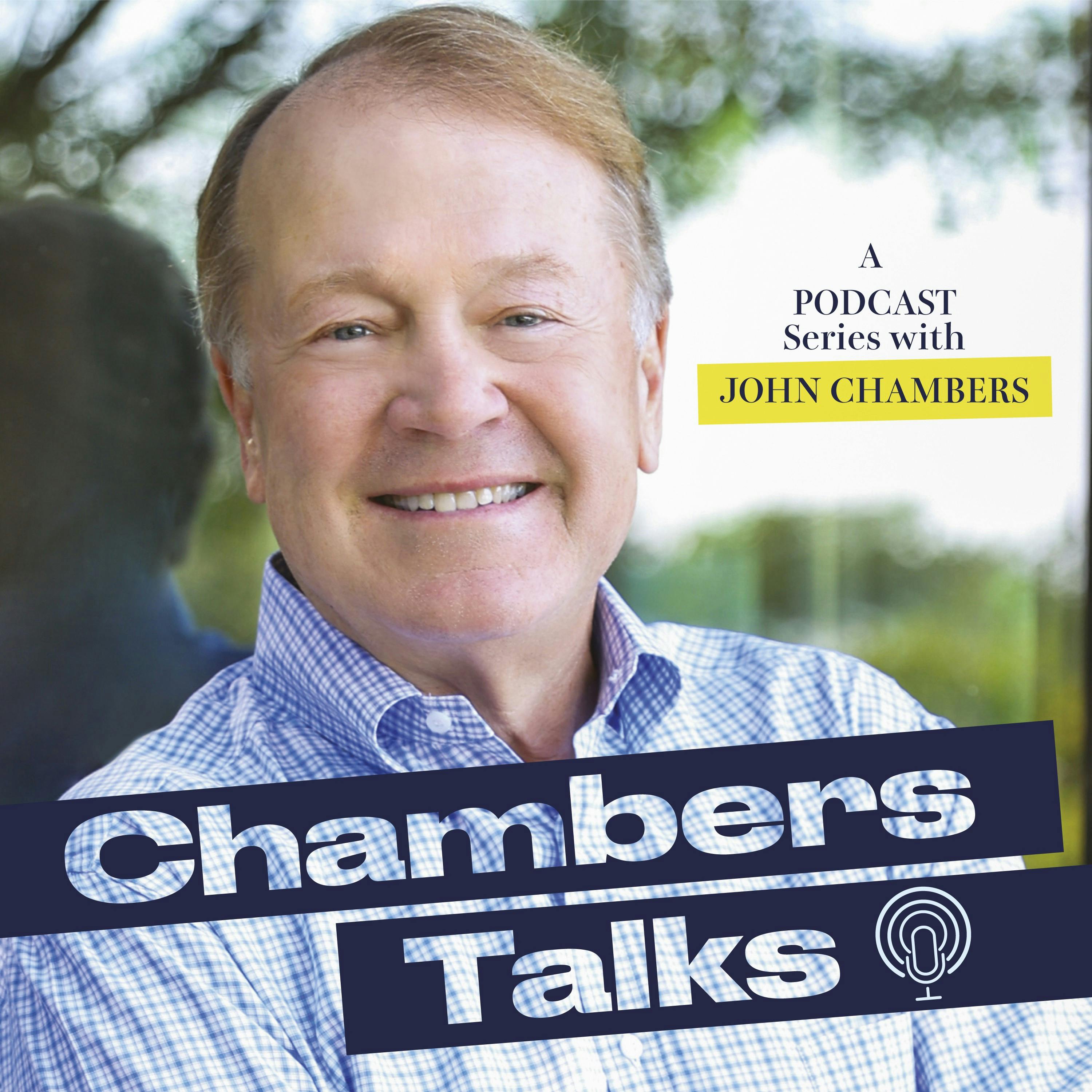
Chambers Talks Episode 38: Concerned Optimism in the AI Era with Jim Snabe, Siemens
40m 24s
In this conversation, John Chambers and Jim Snape discuss leadership in times of rapid technological and geopolitical change. Snape, a self-described "concerned optimist," argues that while current uncertainty is unsettling, it signals an inflection point where technology offers unprecedented opportunities to create a better future. He emphasizes that leaders must avoid daily distractions and focus on long-term trends, using a compelling vision to inspire followership. Central to his philosophy is "Dreams and Details": leaders must articulate a burning desire for what the company could become (the dream) and then master a few critical capabilities (the details) to make it a reality, particularly when reinventing from a position of strength. Snape highlights the importance of vulnerability and humility, noting that sharing mistakes builds authenticity and trust, which is essential for unlocking human potential. He introduces "micro leadership," which involves asking the right questions to develop the organization's skills in key areas, unlike micro management. On transitions, he advises successors to challenge the assumptions that drove past success, as seen in his work at Siemens. With AI accelerating change, Snape argues that leaders must shift from detailed planning to purpose-driven leadership, imagining what could be and asking "why not." For employees facing disruption, he recommends starting with pride in past achievements, then painting an inspiring future, and finally connecting current strengths to a pivotal role in that future, thereby turning change into an opportunity rather than a threat.
[music] Hello, I'm John Chambers and welcome to Chambers Talk. Today is the 39th episode of our sessions and it's with a great friend, Jim Snape. He has been the chairman of Siemens, the CEO of SAP. He's been a great friend of the industry and I've also served with him on boards where we've had a chance to watch companies grow and scale such as Blue Energy, where K.R. has done an amazing job there and changing on site power generation. I've also watched these communication style and I'm fairly comfortable with my communication style, Jim is even better. Today, if I do my job right, we'll share a lot of views on the industry, lessons learned, his books since he's written, but you'll find that he's a teacher at heart as well as somebody that can dream and then many through those dreams so very effectively. Jim and I share the same view about how AI will change an industry and how uncertain these make these times where it gives a chance for companies or countries to break away or it could be really challenging for them. That Jim's one of the most thoughtful leaders I've ever met in my life and Jim, it's a joy. Thank you for joining us today. John, thank you for having me. It's always a pleasure to talk to you and to learn from you as well so hopefully we can create a session that can inspire us as well. I'm sure we will. You describe yourself as a concerned optimist and I think that kind of captures how we all feel around the world. It seems like things change not every day but every couple of hours in terms of the direction and yet as business leaders whether we're individual contributors or CEOs of companies, we have to manage through that. What gives you the confidence that you have in terms of being that concerned optimist and educate us a little bit what that really means to you if you would, sir? I'm happy to, John. Obviously, concerned because the, let's say the geopolitical environment we're in right now is there's a lot of uncertainty and uncertainty is not a good thing. It's a good thing for business. But you know, as leaders, I think we need to take a step back and not get distracted by the day to day and look at trends and the big picture. Often in history we've seen these conflicts arise when there's an inflection point where the old world is changing and there's a new world in the making. That causes typically two reactions, either conflict. Yes. Because some want to keep status quo or innovation because that's what accelerates the future. I am a technologist as you know. I am an optimist because of that and I do believe that this is an inflection point where we have maybe the biggest opportunity ever to create a better future if we use the technologies at hand in the best possible way. So I lead with that and I think that's obligation we have as leaders as well to inspire people to be on a journey to accelerate a future that could be much better. You know, we're going to talk a little bit about your views about AI and how that plays into the comments you just spoke about. One of the toughest things for leaders today is how can you be a realist and talk about the world as it exists and an optimist at the same time without losing credibility on either side or misdirecting your team. How do you do that and what advice would you have for the listeners? Well, I think it starts with an optimistic point of view because that is what leads people through difficult times. If you don't have a strong positive belief in the future, you know, how are you going to navigate? And for me, the present turmoil is more signals of change rather than fundamentals. And the best way to lead through that is maybe a band on the plan because the plan will always be wrong, but be insisting on the future vision that you have for the company and for the world. And with that, inspire followership, so to say, around that vision and your leadership. And with that, you can accelerate the future rather than being distracted, as I say. I tend to not even want to read too much of the news every day because it's full of distractions. And I think as a leader, we have to inspire people for the longer term. I would completely agree. You wrote a book and I want to thank you for that. I love the concepts in dreams and details in your book. How can you walk us through that philosophy and share it a little bit because when I first heard it, it took me a little while to digest it and then I realized the power. When you share with the audience what that philosophy really is and how it would plot of them. Yes, of course, I reflected a lot like I know you do, John, about leadership and what makes leaders successful or not. I actually used to give a lecture at the NCAT Business School in France about all my mistakes as a leader. And that is a very smart way of learning. But eventually I began to reflect when was the leadership successful. And it turns out that in my review of leadership, the hardest type of leadership or the hardest moment to lead is when a company is doing really well. If a company is in trouble to create change, it's easy because the alternative seems worse. So people are willing to change. And we often talk about a fundamental necessity for change is this burning platform that you have in a challenging moment. And I asked myself, what if we could create as a leader a burning desire, a burning optimistic view of what the company could become and have that as the burning platform, so to say, for the change necessary. And I think this is the hardest part in business is how do you reinvent a company from a position of strength. The Andy Groh story around only the paranoid survive or this innovator's dilemma is all about that challenge of how do you change a company that is successful. So if you wait too long, you may never have the chance. So that was the inspiration for this type of leadership. And the dream is the burning desire. And what you do is even bigger. You could say the purpose of the company becomes unfolded even more. And with that, inspire people to challenge some of their assumptions. And I also learned from some of my mistakes that when I was only dreaming, it's a dream, it never got implemented. So I learned that you need to master a few details. And this is where leadership really shows its effect is when you focus on few things and have a very high ambition level for getting those capabilities world class. And that's how you drive change in the day-to-day business in order to enable the organization to deliver on that big dream. So it's almost like the dream to inspire, but then the details to enable the dream to come through. You know, a couple of general comments for our audience. One of the comments that I've heard from several of your counterparts when I talk about what's one of the most underappreciated attributes of great leaders is being humble. And I know you practice that and you walk the talk. And I want to emphasize that to the audience. It's amazing how often so many of us lose track of how important that is. But the second I was what you said in terms of vulnerability. For me, it was being open about my dyslexia for you. It's lecturing one of the top business schools in the world and talking about the mistakes that you've made. That vulnerability I originally thought people would interpret as a weakness. I was wrong. People actually view it as a strength and they trust you more. Is that too simplistic? No, I do believe that is true. I mean, as a leader, I always believed, first of all, that to become a better leader, you need to identify the areas where you need the biggest progress. And so that requires an honesty in front of the mirror, so to say. But then if you really want to improve, you are willing to share that. You're willing to compensate that with other people in a team that may be really good at that. And I think the vulnerability you talk about opens up a level of authenticity in the leadership, which I think is more important today than any time in the past because it's due to the authenticity in your leadership and the inspiration of the dream that you can create for the organization that you can unfold the human potential, which is so big if we just let people use their full capability in a direction that makes even more sense. Makes all this is the world to me. Thank you. On it. One of the concepts that you have, and again, I hadn't thought about it this way and I'm becoming a believer and going to the world.
to quote you when I use the concepts in the future is you describe the idea of micro leadership and many of us would initially be waiting a minute is that micro management when in fact it isn't at all. Can you share with us how you interpret that and how senior leaders can practice it effectively? Yes, it's a very important concept because I do believe that true leadership is not just about creating followership but it is also our ability as leaders to develop the organization and the people to be capable of even more and that's how you multiply your leadership you could say into an organization if you can accelerate their capabilities then there is almost nothing that can't be done and that is a little bit what I mean with my micro leadership I deliberately don't call it micro management. Micro management is often the the leader goes in and shows how a thing is done and from that of course people can learn. For me micro leadership is about spending the time and not necessarily having the answer IE I you don't have to be the expert but you have permission to ask the question and by spending the time and asking the right questions you unfold the organization's own ability to master that area, that detail as I call it, to perfection and so it's a very much a philosophy taken by from the world of sport where a team in a sport they will train a certain capability you know every day and then use it in the match in business we tend to play match in the game all the time we don't train so much and and for me the micro leadership is about dedicating your leadership to the few one or two or three things that need a radical change and by spending your time and asking the right questions you unfold the capability of the organization to play the game at a whole new level in the areas that are most critical to an unleashed the dream. You know part of a transition for a company and Siemens has been so successful over hundreds of years is how transitions occur between leaders and yet especially in the US and especially in Silicon Valley are transition from leader to leader has been really poor and often the leader who got the company on top the company never gets past that and the transition to the next leader goes rough and often the company loses its ability to be a differentiated approach in the market. Steve Jobs did a good job at Tim Cook even though they were night and day different. The advice that Steve gave to Tim and Tim said he's probably going to give to his successor is he said Tim don't try to figure out what I would do and just do that just do what is right. You did a very smooth transition Siemens extremely well what was your advice to the person who followed you? Yeah for me this challenge has always been maybe the most important role of any leader is actually to hand over in a way where your successor can become even more successful than you were at what you did and and of course there's a lot of teaching you know what's going on in the business but but I actually think if I would boil it down to the one thing that matters the most is to encourage my successor to challenge the assumptions of the organization. I think that's the key to unlock the reinvention because organizations that are successful tend to believe in certain things that made them successful but eventually some of these assumptions are no longer true like you know a combustion engine is the best way to move a car forward. Maybe that's not true or the assumption that there needs to be a driver in a car may not be true and if you challenge both of these assumptions maybe it's electric that's better because it has less moving parts and it's much more efficient in converting energy to movement and its autonomous then the whole industry transforms to be less about producing cars and more about transporting people and I think that is the learning that I have is as you transition you want to encourage someone with a fresh pair of eyes to challenge some of the assumptions that made the organization successful and make sure that that challenge becomes the fuel to imagine the next opportunity for the organization where you benefit from the past but at the same time you reinvent to be more relevant in a future that will be dramatically different partly because of the technologies we now have at hand so that would probably be my my most important thing is to allow and inspire for challenging the assumptions that made the company successful so far. You know if we look back to the internet air that it occurred over the last two and a half decades it became a realistic view that being a CEO for ten years was very difficult to do because the point that you made it's hard for the CEO who kind of built the culture and the success to reinvent it and know that you must have to yet in the internet air most leaders failed at the four to five year space or actually would go from one company to the next and use their experience there by give of tricks etc. on the next one very successfully. Now in the new AI world where my startups and K.R. does this pretty well at bloom almost dramatically evolve their strategy every 12 months and it first is a little bit unnerving because I used to think it took two to three years to drive a successful strategy through and yet in this new world we're going into you're almost in constant reinvention. First do you agree with the premise and secondly what advice would you give each of us listening to how you do that as a leader. So I think this is a very very important observation John and very much this is the the base for my dreams and details in the past it was almost like you you you recruited a new CEO to take the company through the next phase and when that is over you eventually then shift to a next CEO and that CEO has permission to reinvent and I ask myself why why do we need to change the CEO to make radical change and so if you ask that question and you look at the speed of technology and innovation the reinvention that may took maybe 10 years between these cycles I was grown up in the IT industry it was maybe seven years or five years cycles now it's on a almost like an annual cycle and AI speeding this up even further so then we can't stick to the old model that we need a new CEO every time we need to reinvent we need a new leadership model we need to not plan everything out for the next five years because who knows what the world will look like in five years we need to imagine that and then lead with purpose and a dream like what can we become without too much details in the plan there is a beautiful quote from Bernard Shaw who kind of encapsulates that and I know John F. Kennedy used it quite a lot he says most people see things the way they are and ask why I imagine things that never were and ask why not and for me this is this dual dilemma of optimizing the current that's looking at the world the way it is and ask why then you optimize it but once you start imagining things that never were and asking why not that's when you reinvent and I expect from a leader the ability to do both otherwise you will get replaced by the next one that has the big dream and with the speed that you addressed we can't keep changing CEOs we got it and inspire them and create by the way room in the boardroom as well you know we're trying that you know in the boardrooms where we are together to inspire for the combination of optimizing the current business and have the courage to reimagine it at the same time we talk about speed of AI and without getting into the actual technology it it basically using the terms that I use it's going to move at five times the speed of the internet and three times the results are output if a CEO would have bring you in and often you and I approach things similarly bringing in a outside expert who's been there and done it before even though they might say very similar things what the CEO does it gives that level of confidence to the employees as you embark on a change that you know is going to make them very uncomfortable so if a company were to bring you in and I know they do regularly including something we work with and you were speaking to the employees on the behalf of the CEO to re-emphasize the Transition and the Speed.
they're about to go through. What would be the key message to the employees knowing that all of us when we ask do we like change, everybody raises our hand as long as it happens to others. Here you're preparing them for the biggest change that they've ever seen, including their jobs going to change dramatically with AI, and they've got to constantly reinvent themselves, even at the individual level and structure level. What would be the key points that you would make in a message to that group, helping the CEO re-emphasize the point that she or he made, and really saying, "This is what your advice would be to the employees." John is super question because at the end of the day, this is about inspiring people to drive change rather than limit the level of change. I often start with praising where the company is. Companies that last long, they've done incredible things, and we're standing on the shoulders of leaders from the past that created the company there. Siemens is 178 years old now. It's an amazing journey of a company. It starts with the recognition that there's an incredible success and capability in the organization, and that helps you convey the message of pride of what we are. Now, that doesn't necessarily change minds, but it does set you on a base of something to be proud of. Then, I think the Bonature quote comes in, because now it's about imagining the future. So, I often take a point of departure in that I try and describe what could happen to this industry, if the industry were to deploy technology at its full capacity. Example, autonomous transportation systems, and describing the beauty of that, that we don't have to sit and waste our time in transportation systems. It will be sustainable. It will be very cheap because we will utilize the capacity 10 times more than today. There will be no accident. So, describing that future world, which is an inspirational moment. And then my third step is always to say, which relevance does our past and current capability give us to play a significant role in that future? And that's where you create the inspiration of, you know, we should be part of that, but obviously we need new capabilities. If I take the analogy of the autonomous vehicle, suddenly it's more about collecting data. It's about sensors. It's about software. It's about AI more than it's about the perfection of a physical vehicle. And so, these are new capabilities which we don't master to perfection today. And that's where I would then insert my micro leadership, as we spoke about earlier, to ensure that these areas, we need to become world class at so that we can become the transformational company, the one that transforms that future and delivers on that rather than a victim of it. You know, you've made three or four points that I'm going to use again in my leadership and in your expanding mass skills. As I knew you would, Jim, I want the audience to focus especially on the concept of when you start to talk about change, whether it's to a small department, a whole function or to a company, start with talking about the accomplishments and what people have done. It develops a level of credibility and trust and then allows you to do the transition to, but here's why we have to change. Where if we start with, you're not exhuming right, productivity is bad, you're not prepared for the speed of AI change, and get used to it. While there are a few people that can do that as leaders, I don't think it's your style or mine, but it allows for that transition to occur with credibility and direction. I'm going to hit an equally as tough topic and I hope I'm wrong in this one. The bell shaped curve that we were all taught, where you know, right in the middle, where 50% of the companies are doing good, but not great, on the far right of the bell shaped curve, it drops down, 15% do very well, far left, down 15% do very bad. With AI and the speed of change, unfortunately I'm becoming very convinced that bell shaped curve gets compacted and unfortunately the majority of the companies go to the left and fail, or don't execute, just to be that a rising tide would carry that middle part of the yeah, the team very well. The companies to get pushed to the right are going to accomplish amazing things and this will occur not just in business in general, but even the magnificent seven, my view is that probably at least two of them will move to the far left and a couple that continue on the right will get even bigger, but it's something that I see in startups and in the market as a whole and it concerns me a little bit now, I've got to think through that, but your thoughts on this and is am I way too far out there? I'm not dreaming here. I'm doing with practicalities. I'm good at getting data. I analyze the data and make sense of it and then say here's the transition that's going to occur pattern recognition if you will. Your thoughts? Well, I think that is also a very strong capability for a great leader is that pattern recognition. Again, you don't get distracted by the detail you look at the patterns and I think you're right. It's actually a very natural consequence of these inflection points. The inflection point is almost like at the top of the belker where some will fail and some will succeed and when you have these inflection points, it accelerates the tendency to either win or lose. It's almost like there's no way in between and and in times right now where we some people say that we have low growth rates, we have maybe a recession coming. For me, it's an average point of view. Low growth rate means an average low growth rate. It doesn't mean that everything has a low growth rate and so it means that you need to get out of things that are becoming less relevant and i.e. have a negative growth rate and into things that have a future and an AI will be a lot of that future. Not the AI itself. Right now, a lot of value is going into the production of AI and I think that the end game, it's the use of AI that creates the value. It's not the production of it. It's the same like electricity. It's not the production of the electricity. It is when we use the electricity to create a new opportunity where the real true value comes and so this value creation will move up the stack and the consequence of that is that the winners and losers game we see in the IT industry right now will move into every industry. Wait a minute. And this change will happen fast. Now we often overestimated at the beginning and get disappointed and this is where AI is right now but then we underestimated a little bit later because it's an exponential curve and that's where we can't be late. So I see it exactly like you. I think this is an incredible opportunity for every company in every industry to become a winner but the risk of becoming a loser is equally big or maybe even bigger and hence my you know our conversation around the importance of leadership. I think this is a leadership moment. This is about having the courage to imagine that future and then microleeded there because if you just continue as you have done there is a much higher likelihood of losing out and maybe the biggest opportunity in the lifetime. I believe it absolutely is the biggest opportunity in the lifetime. Jim you and I like to teach and share views. We both take very complex concepts and brought down to here's the practicality of it which makes tremendous sense and in many ways it is innovative and revolutionary but it often helps if you can then translate it into a story that you did that ties these points together. If you were taking the several of the concepts we've talked about today and apply how you apply this dream if you will and the details and the concepts give us an example at Siemens because we'll remember the story and then it's much easier to remember the component parts of it or at least I think it is. Maybe I would if you allow me to take maybe the biggest example of the power of a dream from my time as chairman of mask. Mask the large shipping company in the world. We had this transformational moment where we transformed a conglomerate to a basically logistics company and so that in itself was a huge transition but the big dream that inspired everyone inside the company and around the company was the dream that we articulated in 2018 to commit to zero carbon shipping. It's a very difficult thing to
do because, you know, container vessel consumes a lot of, of, of a, a bunker oil, mask consumes 10 million tons of bunker oil every year, which is more, you know, pollution than Denmark as a country where the headquarters is. So it's very significant. It's still the least polluting way of transporting goods. So in that sense, you can be happy. And yet we had the courage to declare an intent to do zero carbon shipping. And when we made the commitment in 2018, we had no idea how to do this. And yet we went to market and said, we the leader in the industry declared an intent to figure out how to do zero carbon shipping. We don't know how to do it. There was no business case. There was a big dream. Now fast forward two years from 18 to 20, we figured out how to do it. It's green fuels. We ordered the first vessel. It sailed two years before the original deadline. And then we moved the whole thing 10 years earlier. So, so, so it's an example of how a, a dream, which seems totally impossible, inspires people to figure out how to do it and do what seemed impossible way ahead of an impossible timeline. So, and right now, this has caused the industry to begin this journey. And I think there's more than 140 vessels now ordered globally that can run on green fuels. Wow. So, it's an example of how you don't need a plan. You need to have conviction and courage as a leader to imagine that there will be a future which is going to be better. It's going to be a good business. And we're going to lead the transition. And then everyone will follow. And I think it underpins one of my key assumptions in my leadership is that human beings are capable of much more than we allow them to do when we tell them what to do in a very detailed business plan. What if we could unleash that potential by not telling them what to do, but inspiring them to become something much more meaningful? Along that line, the question I like to ask each time, oh wow, it sounds like it, yes or no answer, it's not at all. As a leader, are you more a product of your successes, or are you more a product of your setbacks, your failures, if you will, and how you handled them? Well, John, to be honest, I have been very lucky in my career to engage in industries that were growing rapidly, that were defining the future. I started my career at SAP as a trainee. And, you know, 20 years later became the co-CO with my good friend Bill McDermott. And that was an incredible journey of growth and opportunity. I came to Siemens, which was a big conglomerate. We had 12 different businesses. And now we have this focused technology company with the highest growth rates since 20 years. And so I am probably more a result of my successes. It's almost like my leadership is about finding the opportunity. And then fueling that opportunity and focusing around that opportunity and creating change faster by inspiring people. Yet, at the same time, coming back to my, you know, teaching at INSEAD, I learned most from my mistakes. And willingness to spend time on that mistake. And I think this is key because we're going into a future now where the speed of innovation is so fast. Nobody can tell what AI looks like just three years out, maybe one year out. And so having a plan is not going to be the right solution. It is the ability to drive rapid, iterational projects that each allow you to maximize the learning. That's how you create exponential change. And most of those learnings will be when projects fail. And you don't lead by figuring out who's to blame, but what's it to learn? Yes. Because then everyone learns from those mistakes. It's a little bit like the autonomous vehicle that they all learn from the mistakes, but they learn from each other. And if you can create that environment, you will be able to unleash the full potential of an organization, full of brilliant people, because you allow them to learn. You don't blame them. You make sure that they maximize the learning. And so in that sense, I'm also a result of my failures because I actually took the liberty to learn every time I failed and even tell about it. Yes. And when you tell about it, it shows the understanding of you understood the implications quite occurred and what you'd potentially do different. A similar question, what do you wish you knew 30 years ago that you know now? For me, I tend to just, I'm a sales guy at heart, as you know. And I focus on, let's just get it done. And and processes like bureaucracy, it just gets in the way of me getting to orders and getting the success for the company. And yet I was wrong. I learned that developing a playbook that you innovate constantly allows you to move with speech you never can without that type of process. And then I learned to get really good process people around me who took me the next step. What would be your lesson learned that you wish you knew earlier? It's such a beautiful question, and John, you know, there's a Danish philosopher, Sarenkegergaard, who says, you know, life is lived forwards, but understood backwards. Yes. And this is the question, you know, what would you have like to know then which you know now? What and so so so two answers to that. 30 years ago, I was naive. And I'm happy I was. Because it didn't give me the limitations that I might have now later in my career where I know things this will never work. I was naive enough to try things out. And and so that I would keep. Yeah. I would and I would wish that I'm still a little bit naive because it gives this openness where if the world is changing so radically, it's very dangerous to assume things won't work. Because honestly, the last three years of AI, things happened that I never thought possible. So I need to become a little bit more naive again. That's actually the other side of the question, which is what did I have 30 years ago that I would love to have more of today? naive points of view because then maybe I believe that things can be done that otherwise I would expect not to be possible. But what I would have loved to learn, no 30 years ago, was the true potential of human beings. I came out in a very early leadership role in my career at SAP and and I thought that the more accurately I plan and ensure execution on the plan and that's often what we do even in a boardroom that we execute the plan, that we meet the budget. Yes. And I realized today that that is the best way to limit people's potential. Because we tell them what to do or we tell them what to achieve. And I asked myself, well, isn't that a limitation that we should not have? What if we would allow them to unleash their full potential? I did not have the courage to do that 30 years ago. So I thought my leadership was about the execution of a perfect plan. Yes. And in today's world, that plan doesn't exist. And I wish I knew how brilliant people are when we let them. And we lead them with clarity of direction and with willingness to invest in their capabilities. You know, Jim, as you know, I've had one or two more questions in mind for the closing, I love that answer. And I think it's a great one to close on because you know, how you answer the first question and how you summarize the last one, the bookends or how people remember and part this great 40 minutes we spent together. I want to thank you personally. I've got a number of things that I will take notes on after the session. And canley, I continue to reinvent myself as I'm encouraging everyone who is watching this podcast to do the same. It's a joy working with you. I want to thank everyone for listening. I would like to encourage them to rate and review the chamber's talks and leave us a five star if we've earned it about the value. But Jim, thank you. A true friend. It's an honor. John, let me just extend my thanks as well. I've seen all of your podcasts. They are truly inspiring. So I learned a lot. And I think this conversation we had about, you know, imagining the future in a better way is more than just about reinventing companies. I think that's what the world needs right now. In the turmoil that we have, we need to create people's mind. We need to change people's minds to the opportunity that we have. It's never been bigger. And we need to inspire them about how we can with innovation rather than conflict, create a much better future for everyone. And I think the opportunity couldn't be bigger. So thank you for your leadership. And
and for sharing with so many leaders so that we can inspire the rest of the people around us to believe in that future and get us there fast.
Podcast Summary
Key Points:
Jim Snape describes himself as a "concerned optimist," balancing geopolitical uncertainty with a belief in technology-driven innovation as a path to a better future.
Leadership requires focusing on long-term trends and a future vision, not daily distractions, to inspire followership and navigate change.
Snape's "Dreams and Details" philosophy uses a burning desire for a better future (the dream) and mastery of a few critical capabilities (the details) to drive reinvention, especially from a position of strength.
Vulnerability and humility are key leadership traits, as sharing mistakes builds authenticity and trust, enabling teams to unleash their full potential.
"Micro leadership" differs from micro management
Successful transitions, like at Siemens, hinge on encouraging successors to challenge the assumptions that made the company successful, fostering reinvention rather than stagnation.
In the AI era, reinvention cycles are shrinking from years to annual, requiring leaders to lead with purpose and imagination, not detailed long-term plans, to avoid constant CEO turnover.
To inspire employees during major change, Snape advises starting with pride in past accomplishments, then painting an inspiring future, and finally connecting current capabilities to a significant role in that future.
Summary:
In this conversation, John Chambers and Jim Snape discuss leadership in times of rapid technological and geopolitical change. Snape, a self-described "concerned optimist," argues that while current uncertainty is unsettling, it signals an inflection point where technology offers unprecedented opportunities to create a better future. He emphasizes that leaders must avoid daily distractions and focus on long-term trends, using a compelling vision to inspire followership.
Central to his philosophy is "Dreams and Details": leaders must articulate a burning desire for what the company could become (the dream) and then master a few critical capabilities (the details) to make it a reality, particularly when reinventing from a position of strength. Snape highlights the importance of vulnerability and humility, noting that sharing mistakes builds authenticity and trust, which is essential for unlocking human potential. He introduces "micro leadership," which involves asking the right questions to develop the organization's skills in key areas, unlike micro management.
On transitions, he advises successors to challenge the assumptions that drove past success, as seen in his work at Siemens. " For employees facing disruption, he recommends starting with pride in past achievements, then painting an inspiring future, and finally connecting current strengths to a pivotal role in that future, thereby turning change into an opportunity rather than a threat.
FAQs
Jim is concerned about geopolitical uncertainty but optimistic because he believes current technologies, especially AI, offer the biggest opportunity ever to create a better future. He leads with optimism to inspire people through difficult times.
He advises starting with an optimistic view and focusing on the future vision rather than daily distractions. Leaders should 'band on the plan' since plans are often wrong, but insist on the vision to inspire followership.
It's about creating a 'burning desire' or optimistic vision of what a company could become, which acts as a burning platform for change. Leaders must then master a few key details to enable the organization to deliver on that dream.
Micro leadership is spending time asking the right questions to unfold an organization's capability in critical areas, without necessarily having the answers. Unlike micro management, which involves showing how tasks are done, it focuses on developing people and multiplying leadership.
He advises encouraging the successor to challenge the assumptions that made the company successful. This fresh perspective helps reinvent the organization for a future that may be dramatically different due to technology.
Leaders should move away from long-term planning and instead lead with purpose and a dream, imagining what the company can become. They need to optimize the current business while having the courage to reimagine it, as reinvention cycles are now almost annual.
Chat with AI
Loading...
Pro features
Go deeper with this episode
Unlock creator-grade tools that turn any transcript into show notes and subtitle files.
 PodcastTranscript AI