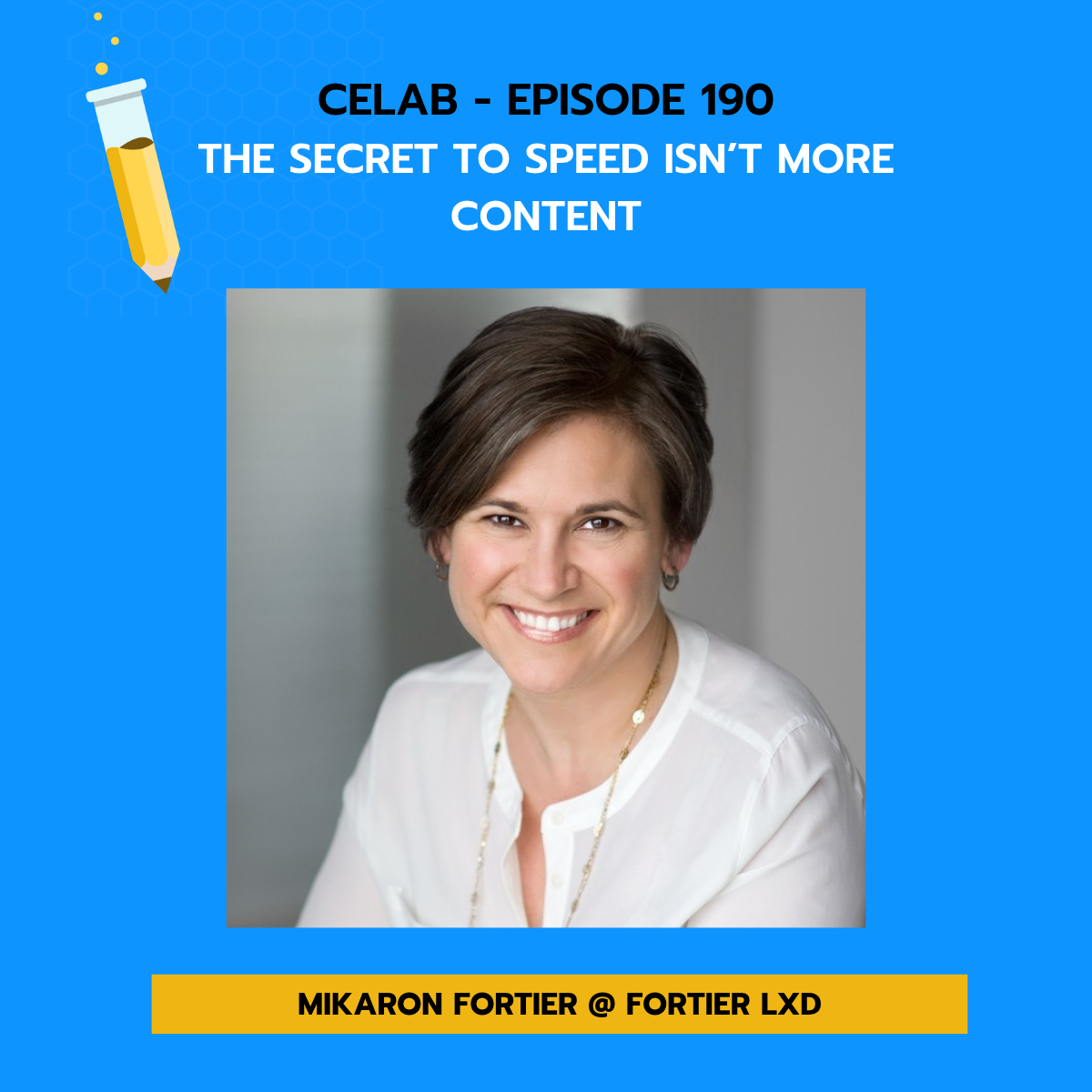
CELab - Ep 190 - The Secret to Speed Isn’t More Content: Mikaron Fortier on Customer Education Through an OD Lens
from CELab: The Customer Education Lab
53m 38s
The conversation highlights a paradigm shift in customer education: from being a reactive, content-driven cost center to a strategic, adaptive, and revenue-generating function. Traditional models that prioritize content velocity and completion rates fail in fast-moving, high-growth environments where leadership, products, and customer needs evolve rapidly. Instead, success hinges on organizational resilience and adaptive capacity—driven by organizational development (OD) principles. The core insight is that customer education must align with the dynamic nature of business, fostering cross-functional collaboration, transparency, and shared learning. Tools like AI enhance this by making verified content accessible where customers actually seek answers—search bars, chatbots, or help centers. The discussion emphasizes that education’s true value lies not just in delivering content, but in enabling real-time, responsive, and co-created learning experiences. This requires a cultural shift: moving beyond silos, embracing reflection and knowledge capture, and recognizing that organizational learning thrives on complexity, not control. As companies accelerate innovation, customer education must evolve from a static program into a living, breathing component of the business—supported by OD practices, continuous feedback, and a deep understanding of human dynamics and system complexity.
I want to put an uncomfortable idea in front of you.
You've spent what?
A year, two years, or more building your academy.
You branded it.
You structured the learning paths.
You've thought for the budget, and you measure its success.
By how many people show up to it, thought industries are arguing that that's backwards.
Their line is, the academy has the source, not the destination.
Think about where your customers actually go when they're stuck.
It isn't your academy.
It's the search bar in your product.
It's your help center.
It's a Slack channel.
And increasingly, let's be real honest about this, it's Chatcha BT, Claude, or Gemini.
So their bet is that your job isn't to drag people to the portal.
It's to make your academy the verified source that feeds all of those places.
They built the plumbing for it, conversational AI that answers from your actual content
with citations.
And what they call, answer engine optimization, AEO, pushing verified content out to where
questions are actually being asked.
Now, I've spent real time inside thought industries over the years.
I know this platform, and I'll be honest with you.
What they built in the last year is different enough that I want to take another look at
it.
The new CEO, a whole new AI layer, and this argument on top of it.
So no, I'm not going to tell you they entirely get this right yet.
It's the real debate at hand, and we should have it on the show.
But they've been doing customer education longer than almost anyone in the space, and their
headline is still the truest four words in our field.
Trained customers don't turn.
MongoDB, Salonis, Gong, and Synthesia run on it, so go argue with them, thoughtindustries.com.
Hello, everybody, and welcome back to sea lab, the customer education laboratory, where
you explore how to build customer education programs, experiment with new and pro approaches
and exterminate.
I'm going to try that again, because usually I don't have that.
Hello, everybody, and welcome back to sea lab, the customer education laboratory, where
we explore how to build customer education programs.
We experiment all the time with new approaches, and we exterminate the miss and the bad advice
that stops growth of our business, deadness tracks.
Today, I'm joined by McCarran, say hello today, I'm really excited about this conversation.
Hi, Dave, thank you for having me.
This is great.
Mrs. Go ahead.
Yeah, McCarran, 40-year here, I am excited to be here and dig into this topic around
or development.
Yeah, this is great.
This is great.
I'm just thinking with you, yeah.
Definitely.
We've been thinking about this and talking over the last weeks to months, and it's great
to have you on the show.
Before we get into it, I'd like to have a little fun.
First thing we do is the International or the National Day of, where we pick a couple
of things.
I know today one that struck my fancy was its World Ameritime Day, so if you're out there
looking for what date we actually record this, you can go check it out.
I like that because I'm in Seattle, kind of tongue in cheek for me is sea lab.
You've got the, it is CE, but you know, SEA is our airport handle and the ocean is right
here too.
Oh, nice.
What you're picked for the day.
Double meaning.
I, a huge fan of Hobbit Day, just this week, I think.
And then I am also a new follower of Dot Day in my OD practice, dots have very significant
meaning.
When you're working in a room full of people and you have flipcharts everywhere, those
dot stickers become super powerful.
You're talking about like the voting on the book, or something like that.
Yeah.
Dots can tell you a lot.
So I'm all about celebrating Dot Day.
Cool.
Already picked.
Oh gosh.
I'll go with the flow.
Yeah.
Yeah.
Whatever anybody else isn't going to take and you go for a sticky nose.
Right.
All right.
So now to get that out of way, let's, let's dive into things.
This is a really interesting conversation that I think we're going to have that's been developing
over the last week's months.
And it's something that I'm going to get into the frame up in a minute.
It's something that we got connected through a mutual friend, Karen Byar.
So I, Karen, thanks for making this connection because we're going to talk about organizational
development, organizational design.
And I want you to introduce yourself and the work you do.
The programs that you've been involved in, you're doing some learning right now.
You've got a really interesting story arc for your career progression that I think
our audience here will benefit from your background.
So tell us a little bit more about where you've grown up, you know, how you've come into
the field where you're at today.
And then we'll dive into some deeper topics after that too.
Sure.
Yeah.
Well, today I put myself in the category of OD practitioner, but prior to all of that,
I came up through a path which a lot of L&D people can identify with where you didn't
really predict you'd end up in learning and development somehow.
I started out thinking I was going to be an education and become a teacher, that quickly
pivoted to ending up in the software industry in the early 2000s in Seattle.
And I was working in a startup.
It went from 12 to 150 people while I was there.
It's where I kind of earned my stripes in software as a service and customer education.
I was out there training, got thrown into some really significant clients while I was
there, big companies that were at this time, it was a legal technology and so these were
companies that were trying to figure out how to use our software.
So I was the one standing in front of everybody, getting them to adopt some new technology.
But morphed into me really enjoying learning and development in corporate environments.
And I was all about how do I help adults figure out their path in their company and ended
up in forming my own business, working as an instructional designer for a while and
in that all, then led to the threads that got pulled in those experiences working with
companies were the ones that led me to the OD table, where I think a lot of people experience
as you're trying to not just be kind of the first responder in these instances, you're
really trying to understand the strategy and the why's in the house of being more strategic
and learning and development space.
And so inevitably that means you don't just want to be the person who is asked to sit down
at the table, you wanted to sit there yourself and kind of be the one probing and asking questions
as well.
So that, to me, translated as OD and I decided after a lot of consulting and contractual
learning and development work to go back to school and get my master's degree in organization
and development at Pepperdome.
Congrats.
Yeah, yeah.
So I just finished that in August and it's been an amazing journey.
I highly recommend a master's degree through this program and even for people who are
considering it later in life, I think it's still something really powerful about the
connection that you gain in the work in academia.
Absolutely.
Something we're watching Wayne right now, isn't it?
As we all figure out how to learn through the technology in front of us, yeah.
Maybe.
No, maybe not.
Maybe.
I don't know.
I mean, that's what the next 5, 10 years is going to tell us.
For sure.
Yeah.
And it might change and flash back.
We don't know.
I mean, I didn't personally think that when we went through COVID and we started doing
a lot of remote training and being like all online that we would have this snap back
into instructor led motifs where right now I'm finding myself leading classroom sessions
on our products in person, on site and I go, wow, this is, it's back.
Yeah.
Yeah.
What do you think contributed to that?
Why do you think that happened?
I think it was a human thing and it may relate to our discussion today too because I would
always in the past say, oh, you're going to go here, travel here, go do this thing on
site.
I wasn't doing it. There is the second order distancing from the people that you don't
get the social queuing, you don't get the nuances, you can't see anybody roll their
eyes.
It's like, it's, well, you can't if there are videos on, but then, oh, often does that
not happen?
What I'm seeing with the companies I work with is that there's actually a transformational
role in being there.
And now that I've flown all over the place done all these different things, the value
I get now is at immediate feedback loop, if I'm teaching something that doesn't quite
land, I see it, but it's beyond that, the side bars.
I've had conversations in the break room or we go out to lunch together and just hang
out and get to know each other and then I've got people to talk to after because I've
made a personal relationship with them.
So it goes back to, you know, like you have a master's degree on a weird field's computational
chemistry.
So it was, I transitioned from chemistry and I'm still a scientist, right?
I didn't that degree, I used it every day in that, but that teaching is something that
I was missing.
It's kind of like, you know, I'm a musician too and if I'm not playing, I'm not in that interactive
space with other people and we're enjoying this.
It's cultural.
It's a, I think it's where I want to get you talking more about what it works.
organizational development,
how can we frame up this discussion
with the experiences and the things
that you're working on today?
We don't talk about it in our field.
So tell me a little bit more about,
can you step back, talk about organizational development,
talk about maybe your program,
what you studied, and then we'll build on that.
- Yeah, of course.
So I attended a program that has been around for about 50 years.
And this OD itself is something that is a way
of companies integrating the strategy
and the business mind and the experience of human beings
into a really integrated type of way of operating.
So all those big words to say that it's what happens
when you bring thinking about the variety of ways
that I can define this.
So it is about the health of a system.
And OD people are there to kind of help diagnose
what's going on in a system and how the strategy
and the human beings are kind of integrating all together.
So that's a very short version of it.
What I can say about the program I participated in
is that it worked us through a range of looking
at all the different layers of how organizations develop
from the individual all the way up to, you know,
through teams, through an entire organization,
and then even how organizations work with one another.
And it probably can get even bigger than that.
But there are a lot of different layers of how systems work
and OD gets really good at looking at all those different layers
and how they all kind of come together in a moment
where you're looking at how does a team overcome
some kind of conflict it's dealing with.
Or when, where do leaders need to be playing up
have it all role in how people make decisions or behave
and how they adapt the culture of an organization?
It touches on, you know, just a lot of the health,
if you're looking at how the health of a humans
get diagnosed, it's a little bit of the therapy for an organization
is where OD practitioners can play a role.
Like how do we diagnose and address the challenges
that organizations are dealing with?
- That's okay.
This is what I want to open up and explore heavily today
because here's been my experience.
There is one or two formative experiences
that I've had over the last decade.
So I deep-dived into customer education.
About 2015, I started working at Keynes High.
I've been in education in different places.
I was in academia, I taught at the university,
I've done all this other stuff.
I find myself in these organizations that are startups.
They're moving at light speed.
We talk about building their plane in flight motif
and that's real.
And because the felt experience of being in a company
that's just emerging is very different
from I'll go back to my pharmaceutical or healthcare days
where I'm in a 100,000 personal work.
And it's so dramatically different
because you don't have this harness or structure
that's built yet, it's just evolving.
Then add onto that, the progression of technology change.
Now AI, it's hard out there, right?
I'm struggling with certain things all the time.
And there's no finger point.
There's no blame.
There's no anything.
It's just like we're moving so fast.
Hey, we need to slow down.
We need to think strategically.
So I'd say what, we want to go on here
but let me dig into the hypothesis today.
We'll get back into more scientists stuff.
The promise that came out of conversations with you
also with our mutual front Karen.
And also there was a, we had an OD coach
at when it worked at outreach
that was brought in to help us with this kind of stuff.
And this blew my mind.
I go, this is part of what I do in customer education
that deeply impacts my ability to succeed.
A lot of the times, there's times
that I fail with certain things just because
I couldn't penetrate a certain part of the organization
to get a collaboration or understand what's happening.
So in fast growing companies in particular,
customer education programs don't stall or have trouble
because the content is bad or the tooling is wrong.
My premise here or thought is that they stall
because the organization around them
is changing faster than we can keep up, right?
We got reorgs.
We've got new products.
We've got a shifting ICP.
We've got a new leader every few quarters.
The lever that lets education keep pace
isn't shipping more courses faster.
Right?
I have this all the time.
Hey, just put a bunch of stuff out.
Oh, well, why?
It's the organizational development,
the management of team dynamics,
the complexity of the content we have, the chaos we have,
and that cross boundary learning
that means boundary outside our company
even or cross organizationally in certain internal.
But we have to do all this other stuff
so that the program stays aligned to a business
that's not going to hold still and it won't.
So that's a tension to dig into today here.
And if it's true, most custom teams
are optimizing the wrong thing, output and content velocity,
when the real constraint is our adaptive capacity.
So how does that resonate with you for today's discussion?
Mm-hmm.
Yeah, I feel the tension there of their needing
to be away for leaders who understand the progress
and have the metrics in hand to understand the impact
that their customer education teams are creating.
What does the value of this team is creating
for our organization and for our customers?
And that can look like take rates and time
with the customer or the survey results.
But I would also argue that there's a both
and kind of the way of thinking here, which
is to your point about the need for just how complex things
are right now and how fast everything is moving,
there needs to be a counterpoint to that.
The top down kind of command and control
of our learning and development work,
just as learning development professionals
and as the leaders of organizations are looking at these--
the effects of learning is not the one way to go about it.
I think there's a place that learning and development
professionals can make for there to be more emergence
to happen with customers, to be looking
at not staying so rigid in all the metrics,
but also saying, hey, wait, stuff is changing so rapidly.
If we try and invent something and set it in stone now,
it's just going to be different tomorrow.
And why start building all of these loops?
Why build in this waste when we know
it's going to be unusable next week?
Then what do you do?
And how do you approach that?
And I think there needs to--
there's maybe a mindset shift.
I love your take on where this budget is.
But things are just so turbulent that learning
and development people, I think, could start
to play a role in how they facilitate customers learning
and emergence in spaces that aren't hard-coded.
It doesn't necessarily have to be about concrete deliverables
going to the client.
What if it was about making spaces for there
to be collaboration and some co-creation of ideas
about how the product moves or what the customer
and the home organization are learning together?
So that, to me, might translate into just more
cooperative working environments or time
where people can be holding conversations
and getting ideas generated that might contribute to,
but can also be let go of when things pivot tomorrow.
So I guess what I'm talking about is acknowledging
that there's chaos theory and complexity theory
apply these days.
And that means that we can't commit ourselves
to these long range linear, forecasted concepts with learning
because stuff's going to come along and disturb it.
I don't know if you've heard about the butterfly effect.
Oh, yeah.
Right, so the flap of a wing in Brazil
might cause a hurricane in Japan or something.
I mean, it's-- the same thing holds true.
I imagine for a learning experience designer
and instructional designer that the concept of spending
a lot of hours on building out really concrete learning
solutions, they know that anything could come along
and kind of jostle how effective that is.
And so how do you create more nimble, more agile learning
experiences?
And I think that it's going to--
I mean, I'd be interested to hear what you think
that looks like, but--
Oh, you frame this up really well.
It's something more open.
Sorry.
You framed this up really well for this discussion,
because I would say, I don't completely--
I don't put words in Adam's mouth.
Adam was co-host here with me.
Ian, I've had this interesting journey together
where we've been at a lot of different companies
over the last decades, large, small--
Exited big big companies very very new ones and what we're coming back to is this this point
We're living in these fast growth high-growth companies things are changing so quickly and then you throw introduce AI into that and now it's even faster
so
Let me ground this in reality because one of the things that's really important to me about doing this show and we've done it eight years now
Is that this is an active learning experience for me and everybody
I hope all of you in the audience are breaking forth wall this is as you're listening to me is that this is us working out loud to learn
That's why I wanted to talk with you about this
So the experiences that I've had have been stultifying sometimes where
Let me give you an example now and I don't mean stultifying in a way that we're not gonna make any progress
But now in this point of time 2026
I am in a company that's moving really at the speed of light we're small. We're growing. We're not exited yet
We are all over the world and the pace of change it within us is felt by everybody because we launched something today
I didn't even hear about that now. We've got to educate on it
But it's not out of our you know
I understand it we can get content out there
But I can't approach this program as a
Formula a cookie cutter type thing that an L and D professional could come in and get to work and build a program so the experience that I've had here is because of the pace of change
I'll shout out to my Chris my manager Kristen
We've taken a completely different spin on how we produce content
So internal enable man is doing one thing. They're like kind of touching on the key important parts and how do we pitch this or how do we use this or how do I onboard my
Interim team was I'm doing a lot more webinars and live engagement because I can do quicker loops on that content
But change happens. I'm merely updating my scripts and I'm putting that into the next thing
I'm not canonizing this into an on demand to kind of self-service motif yet and even to present to to counteract that
Because of the velocity I'm doing things more like using YouTube and architecting playlists and things like that
So that I could just keep on top of the work generate content really quickly and then you know
It might be years down the road by that before we baked everything and it may not even be ever
And I'm trying to lever J.I. To float on that by looking at the delta to content
You know, I'm seeing platforms like continuity intelligence emerging to help with that content drift and how do you keep things up to speed?
I can't do it. That's why we've got AI
And then all this stuff is just absolute chaos. He's talking about chaos theory. I was a physics major in university, too
And I'm thinking about all this even more that you know example is somebody even build some kind of content and some other
Team that I didn't even see and I find that and I go, oh my god, now I'm okay
I can take that lift it spin out some other content material
But been working in a social menu on on LinkedIn and other places. I I can be really I can mean nimble
But that's not what you're at our education teaches us to do and we're in academics
I you know, I had a classroom where like show up every week and we do these activities
We have this is a structure and it doesn't change so fast
This is a completely different part of the world and what amplifies the
Complexity is that at the same time that the content is changing the people are changing the philosophy is changing
Leadership is changing people turn out of the company
Yeah, and it is just absolutely
Absolutely changed everything that I've ever thought about learning
Yeah, I think the the need for
Everybody to start getting good at self-organization and continuous innovation is part of the answer there
Right that we just have to
Get on board with the fact that things are complex and
And that our role in in that one of the key roles we can play as learning designers
as managers and team
You know team members is that we're working together to recognize what patterns are going on in our organization
You know if you're finding that there are you know, there's duplicative work happening and there's silos of
Customer ed that are you know, we're all kind of doing the same thing. Well, that's that's valuable information that that
Learning designers can start to to wave a flag around not in a competitive way
It's like look we're all doing this. This means something. How do we work with this? Um, so
Yeah, I think that's that's an acceptance of the idea that there's a complexity is here and um it
and and and there is space for there to be um
The some of the more
Hard-coded things is the word I keep using but but
There needs to be room for both and I think looking for the balance of those kinds of ways of operating is
Gonna be more advantageous than then um, you know sticking to one or the other
I want to say something that I think a lot of you have felt but haven't been allowed to say out loud in a QBR
Customer education keeps getting treated as a cost center and every year
You go into planning and you defend your budget with completion rates and C set and every year
Somebody's senior nods politely and then ask what else could you do with that head count
Think of Xeo said something last year that I haven't stopped thinking about that is education is no longer a cost center
It's a business model
And here's why that isn't just a nice slogan from them think if it plus that's our enterprise product the customer education one not the creator platform
ships a full commerce stack natively
Subscriptions payment plants be to be invoicing group orders actual checkout in your academy
You've ever wanted to sell certification or licensed training to enterprise accounts or turn your academy into something that shows up on a revenue line
Instead of an expense line the plumbing is just there. You're not filling a ticket to integrate a payment processor
The other thing worth knowing no per active learner fees which if you've ever been punished like me the bill for a successful onboarding quarter
You really appreciate it moves fast too plus customers go live in a median of 64 days
Look, I've worked with this team a couple years back
I did a whole webinar with them on measuring the ROI of customer education
So when I say they think about education as a revenue function and not an expense line
That's not me reading their marketing back to you. That's the conversation. We're already having
Take a look at it today at thinkevic.com/plus.
Yeah, let's dive into that a little bit more. So this is one of the second points we we were going to discuss is
The secret to speed isn't necessarily working harder
It's managing how our team the team our team our company works where let me frame it up in in my context
I've always seen this this clutch this pearl clutch of siloing
And sometimes I've entered into an organization as a manager leading a team
And that's come with its own sense of friction where I go well, okay
We're you've been doing this and are you talking these people over here? Are you connecting with these people over here?
Are you like how are you?
Kung-fuing or you know
Trying to think of that martial arts. We're using the energy of the organization to reflect back to it to create a feedback loop
And into and I've seen people like again, I'll I'll give our friend Karen some praise because one of the things that I saw her do
That was transformative and at at outreach where it worked was that she was able to break up and build relationships across boundaries
That while I was out kind of like outward bound working on and this is like the
L&D and customer education super power that I was working on okay, we got the training we're talking to customers
Around in the field we're doing all this stuff and then she was working to foster
Deep relationships and partnerships with other teams like our product team and then once we start working together
We're like oh my god. We can do we can do the hat. We can make this little thing. You had to only take a week
Oh my god now we were moving away from being a
order-taker into a true learning consultancy
That work both internally and actually the things that it was actually interesting to us that I've say I've seen
Enable in teams that don't work together. So and when I'm in my link lingo
I'm talking outside of L&D more
We have a constellation of different units that do different learning activities pre IPO a lot of time
So internal enablement not quite L&D. They have kind of a different feel a lot of the people there are technical
SMEs or they know the platform and they moved into that then you have customer ad which is like that outbound
And when and when we don't work together
It's really weird because we're making things that we can share and do the foundation and and have this emergence off of
But then there's that okay now we have a guard in us. Oh no, I built this is my program
Like I can't open it up to you and it's for for no other reason than job security sometimes and then there's conflict like when I enter a company
The way that I and others like me have evolved their thinking we built this thing called the customer education manifesto
But it biases for delivery and execution it biases for not worrying about perfection it and these things are
Terrifying to some more consent and I'm saying this with love. Okay conventionally trained
You know L&D and customer ad leaders that have done things the old way we have a problem
out some seats. We do the thing. No, no, no, we've got to change faster than anybody.
And us as educators have, we need an understanding and a cognizance of how organizations grow
and the psychology and the things that are happening underneath to be able to flex with
that to have, I've moved away from the concept of the having to see that the table,
because I just don't think it's realistic anymore for learning and, and companies, but it's
the leadership should know this company is changing and we have to address that directly.
So I'm going to get you talking a little bit more about that idea and some of the things that
you're doing with, you have an alumni council, you were talking about an engine for alignment
and success. These things are really, I think, interesting for you to talk out about with the
audience, like what is it that you've been doing lately that are kind of breaking things up and
helping deflect conflict and guardedness and things like that? Yeah, so, so the, I have seen really
talented teams of professionals within organizations who are extraordinarily bright, capable,
doing everything they're supposed to be doing in their silos, kind of trying to figure out,
how do we break this down and what do we, what do we do to get ourselves more in tune with
the customer, making a more customer-centric organization? It can break down at the point of,
people just simply not knowing they needed to have a conversation and being given the space and
given the, I mean, use an OD word, the container for them to work these things together and to explore
together. The conversations, I've heard a client I was working with in Japan just recently say we,
we just didn't, we had just never talked about this before. We just didn't have the space to
figure out how we would combine these kinds of things so that we could come up with, you know,
more robust solution-selling approach. And so, if the commerce, if people sometimes need,
you know, someone to help them kind of target the known unknown, like a friend of mine.
The known unknown? Right. This is something a friend of mine, Mo Lawson has said to me that
the magic of OD is that it tugs on the known unknown. And I love that because it's, it's oftentimes
you just need an observer, a facilitator, an external person who can enter the system that people
are working in. Where they're all doing everything they can, the best they can, to poke and ask a
question or to nudge it a part of the operations that has been that way forever and no one's thought
to, to, to question it. And so, and so that's where I think OD can play a really powerful role.
Not only is, you know, bringing in someone who may have years of practice in OD, but where people
internally can start adopting a bit of an OD mindset themselves. And that's, I think, something that,
that every organization could start, you know, upskilling their people on is how to,
to think more environmentally and more systemically about what's going on.
There's certainly a lot of practice that comes along with, with, with being someone who's
advised an organizational development capacities of, you know, being able to facilitate these
kinds of conversations. These are not easy conversations to have, especially if conflict exists in
a team. Then you're really having to navigate a lot of dynamics, a lot of layers for every person
who walks in the room, a lot of the layers for the organization itself, a lot of layers of
complexity for the problem they're trying to solve in the market. So, that's a lot to, to try to,
either pair away so conversations can happen. And that's where I think you get the benefit of
someone who's really familiar with OD practices who can come in and understand a system holistically
and drill down into the areas where they're hearing, the tensions exist or hearing that there's
conflict or I, I, I think there's also this ability for teams to kind of focus on the, the very
basic foundational things that make teams work. And with, with a lot of the, the, the demand placed
on, on, um, sales teams and, and customer education, people to just get the innovative new idea
to market, um, and, and the amount of, of intelligence and, and expertise it takes just to do that.
Those foundational layers of, um, are we making decisions in the right way? Are we identifying our roles
clearly? Have we really established a cadence of communication and normal behavior in this group
of people that works well together? Um, those are very foundational layers of team dynamics that, um,
that sometimes having a third, you know, a third party come in and say, hey, I'm seeing, I'm seeing,
you know, I'm sensing some conflict over here with this, what's happening in that? And how do we,
how do we, do we take time to understand what, what's contributed to that? Um, it can, it can,
uh, really make the difference in how a team functions. I've seen very, uh, very experienced OD people
who understand these kinds of dynamics still struggle with just getting norms and decisions made
as they work together in teams. So it's, it's not easy. And it, it, it, um, the benefit of having, uh,
that, uh, that how do we organize and how do we develop as a team, uh, question from, um,
someone who can kind of like objectively probate these things without having to be
operating in it, um, has a lot of power and can often shift and kind of get a team out of
some of these stuck places they get in. This is really neat. This is what I really
hope to get you talking about too, that in, in my experience, one of the things I've done,
I've kind of organically come up against a come up to the surface area of organizational
development, um, by merit of it. How do I even describe this? I like to put customer
education in a different kind of framing where there's an opportunity here to fit into the ecosystem
of our organizations in my job isn't just to make content. I've always looked at myself as a
consultant. So when I come into a business and I've been a management consultant as well,
I will go through an audit like I will go do a cultural audit too, which is a lot like what
you're talking about. We're the teams who are the players who knows what where are they? What do
they do? How do they work together? When I go and do a consultation, I do that in addition to
talking about what are we going to market with? How do we need, how do we work together to get it
there? How do we do that of velocity? How do we do that with, you know, an eye for getting
something where the customer is hurting? And where we say this is a cross-functional sport is that
what I get blocked by our other people with they're doing their job. But the job that I do is,
look, Aaron, I need what's in your head. I need to put it in pixels and paper. You are really
important. Now there's that pearl clutch. You go, whoa, wait. Now I'm important because I have
this knowledge. But if Dave, if I give that to you, what you're not saying to me is that that makes
you scared. In some ways, particularly wrapped up in this pace of change is a massive turning of
human capital, right? We're important to the lifeblood of business. We need to stick around
longer. We need to be felt, we need to have security, psychological safety. The ability to ask
questions and get answers and, you know, the corrupt developments of leadership that have strong
egos and things like that can really scare a company up. And I've seen it. But my angle has been
like, it's different from OD, but like, I need everybody to help me, right? And if you block me,
I'm not going to get my job done. One of the challenges I have now, this is a good challenge.
I'm working in a company vast data that is so cool. The technology is the cool thing of everything.
I see. And it brings together all of this learning I've done over decades of my career from,
you know, I was a DBA for a while. So we talked about databases. So I've been in IT. So I've installed
and servers and racked and stacked. I've been done networking. We've done all these little things
in it. And that is so complicated because, well, we don't, we, we have a lot of smart people that
know so much. And if I can get them cornered and get let's in their head out, shake them loose,
that I can grapple together as this thing that transcends all of us and channels both the excitement
and the depth of knowledge to do really powerful things. That's all pretty smart.
Yeah. I wonder if what you're describing is this, in this phenomenon we have right now of,
you know, too much competition within our own organization. And, because what I'm hearing you
describe is the need for collaboration. I mean, imagine that you want your, your organization to,
to work like an organization. Like, that you want there to be collaboration and trust within your
organizations. So if that's not happening, they
you just describe, you get these more competitive mindsets of like, "Oh, I'm not going to share
that too much with this. I'm not sure I can entrust this colleague of mine. I don't know where
he's going to go with this. I don't know what he's going to do with the, my own intellectual
capital right now, right?" So that's happening in organizations. I've seen it in the last 20 years
in the work, the consulting work I've done especially. So in fact, in my research, I was just doing
with high tech organizations, I was looking at how to, what is the experience of an individual
as they're involved in partnerships that happen between two companies or two or more companies?
Sorry. Tell me more about this. This happens all the time, I see it constantly.
Yeah. And so this is a fancy word and O.D. speak culture well. And technically, I started out
wanting to explore trans-organizational networks and trans-organizational development, which
means you have multiple parties guided by some kind of defining challenge, and they're trying to
solve that challenge together. What was interesting is, I invited people to come to my study.
Who I ended up talking to was not necessarily people involved in those kinds of settings, but
definitely involved in cross boundary types of partnerships that looked a lot like sales
enablement, or sorry, product integrations or product sales, or they knew they were working
with companies outside of their own, which isn't a true trans-organizational relationship, but
that's me being O.D. nerdy. So what I mean, what I learned from this was, first of all like
understanding what these kind of, understanding what those kinds of organizations are is one
challenge. But then once, when you know you're working outside of your company, when you've been
asked to go out and learn something about another company or innovate on something or build partnerships
with, there's something in that experience for an individual that gets skipped over a lot. And
that is that there's really, if there's not room for that person to come back and reflect on what
they've done, then they've lost this kind of step in the learning process, and it really, the
organization starts to kind of lose the knowledge that's accumulating in that kind of partnering
process. So oh my goodness, I'm going to tie this to what you were saying. But what I think it leads,
this leads into this whole notion of, you know, when you're building these kinds of partnerships
externally or even internally, like what gets lost. So that was one part of what I learned as I
was doing my research. And a lot of knowledge kind of slips through the cracks because there's
just not a lot of time spent to do the retrospective or get the the scrum meetings happening or,
you know, take time to really reflect on what has gone on in the process of partnering with other
people. So what do you mean by mentioning the nose knowledge leaks, where it's not like a leak,
and I'm leaking information, it's more like I'm losing the knowledge, it's leaking out into the
nether because we didn't have that slow down that intentionality to say, okay, well here's
something very practical I think I can use to connect back to what you're saying. So one of the
coolest things I've seen at Vast is we have this team called Octo. It's the office of the CTO. So
everyone on that team are super incredibly smart. They've got pedigrees that are blow me away,
and I just like sitting down with them and just geeking out like just keep talking. I want to learn.
And we send these folks out into the field because there's just some of their most important
people we have. They're the people are going to make and break a deal. They can demo things on
the fly. They can, they're nerdy as heck because they'll sit down and do something and build this
whole infrastructure out of complicated technology and effortlessly at that. And then go out into
the field and people are like, whoa, but what you're saying is I'm not in a part. I'm not in any of
those meetings. Just in somebody somewhere and they go sit down and do a demo and they come back
and then they do it again and they come back. Maybe they're recorded, maybe they're not. I've
actually had the opportunity to shadow some of these folks and go, look, every time you do this,
record it, tell me what you're doing, get it back to me. I will transition that or I will modify
or take that content and abstract it, generalize it to some degree and then that becomes training material.
You don't have to keep meaning this. But at the same time, oh my god, if I'm doing that,
I want to keep doing that because it's this is the thing that we've had in other parts of our field.
If I connect back to customer success, customer success managers are kind of like everything. They
teach, they help, they promote, they coach, they do all this stuff. But what I found over the
years is that these these folks have often kind of proclutched to and build their own curriculum
and do this stuff. And now we're in, but they're out there doing stuff that we're not sharing with
everybody. So the this ability to slow down, think cross organizationally, render organizationally,
internal external, bring all that back together to say, well, what did we learn? We don't spend
any time to do that generally because we're moving so fast that I like to use the phrase,
sometimes you have to slow down to speed up. Exactly. Yeah, we've said that a lot in our program.
I was in, sometimes you had to slow down to speed up for sure. And yeah, knowledge leaks,
like that's the kind of knowledge I'm talking about is leaking away. But I, I think there's also
this element of like your octo group. I mean, these are the people that can go out and establish trust
quickly with customers. And that was a piece of the puzzle in my research too, that came out,
which is that whenever IP is a concern, it breaks down the effectiveness of what you're learning
in a whole different way. And so to the extent that attention can be paid to establishing trust
upfront, the better the, you know, the better the outcomes are going to be, the extent to which
you can take time to reflect on what's happening in those moments, the more, the more learning is
going to have an impact. And I mean, I would, I was looking at all this, all the learning through
an experiential learning lens, which is a particular learning theory, where it kind of breaks
learning up into several phases, one of which is reflection. Reflective time is important in
when you're learning, especially in these very highly experiential environments of partnerships
and frontline sales or, you know, perhaps getting education out in front of a customer for the
first time. It's very experiential. And if you don't have that time to come back and reflect
and gather the thinking of the people and the reactions of the people who were there,
you're just not making, you're not taking time to make sense of what just happened. And in a world
of complexity, sense-making is everything. So you've got to take time to look for the patterns and
understand what's happening in these very intense concentrated moments of interaction or there's
going to be that knowledge leakage. There's also another, one other aspect to this that came up in
my research was that there's a layer of invisible work that's going on, too. There are people
and it's a little different from a knowledge leak. It's just that there's a lot of effort that
goes into these partnerships and into innovation that can be very hard to quantify or describe.
And if you're an individual in a little startup and you're being asked to go out and build partnerships,
that is all work that is very hard to bring back to the organization and say, "Cut,
here's what I did to make this happen." So I think invisible labor is an interesting term in this
stage. I think it comes up in a lot of settings, but in the world of technology organizations,
I wonder how people think about whether or not their labor is visible or invisible and what they
could do to whether or not people are interested in nudging that one way or the other.
That's really cool. I think I've seen a lot of that invisible type of work. I mean,
I even think my work that there's a lot of stuff I'll do to say, "Hey, I'm going to have a
conversation with this customer," and then I'll document it, but if I don't get that back and
share that, what did I learn? One of the cool experiences I had recently was we did a training
on site and I met somebody there that was super bright, cool. They were the one person to call
you over during the break and say, "Hey, I want to show you this," and then you nerd out,
and I've used those kinds of opportunities to gather more information that I wouldn't have had
otherwise. We're running low on time here, so let's do this. This has been really cool. I want
to learn more about organizational development. I'm really thankful that you joined me today.
I think this whole journey of education and high growth is also an OD problem. What I'm
sharing with you audience is that folks like Karen here are really important assets,
like a third-party asset, to come in and break things up. If you're having a problem like I've
had in many different cases, sometimes you just can't work it from within, and you need a different
lens. You can do workshops and figure stuff stuff out. We've talked today about the vocabulary,
I loved getting into complexity and chaos theory. The inner organizational thread,
this is something that I think we all need to
study more. One thing I'll ask you later and you don't have to answer today is if there's
resources, some books, podcasts, things like that, we can do like if there's a book I need
to have on my desk that will really help me out. That's something I'm looking for and others
will too. So, any other thoughts, you know, you do ongoing research, you're out on LinkedIn,
what else do you want to share with the audience before we walk out the door?
I'm still working through all of the reading from my graduate program on OD. There's no shortage
and there's some amazing thinking out there in the world, in the world, on organization development,
reading careers. I think that Auto Sharmer and the Presencing Institute does a lot of really
interesting work around complexity and how to operate in a world today with just the ecosystems
we're in and the way in where transformation happens in this complex time. I think there's
I can send you a link to some of the things that I reference in his body of work.
I'm a big fan of Meg Wheatley and the work she does. She has a book on leadership
that we read in my program and that will crack open, a complexity theory for someone who's
very interested in learning more about it. And one other concept I'll drop, we may need to have
another podcast about this day, but it's cool. I'm learning myself about dynamic capabilities
and what that means for organizations to hold line of business theory on how organizations
approach building a company's competitive edge and there's there's a lot of work out there on
that that is done by I believe it's David Tees. So I could go on and out there's there's I
I am a huge explorer of the work of these people and also encourage people to learn about
these things. I think it would benefit any learning and development person to understand how
OD plays a role in their work because you're just constantly called on to think in those terms
but then often very specifically asked to do something else. So when you know what you know what
you're operating in and you know the larger picture, I think that makes you a more powerful
learning and development person. Yeah, I think so too. Okay, well Karen thank you so much for
joining me today and audience if you want to learn more remember we have our podcast website at
customer.education but we put a lot of content there. We're also out on LinkedIn and you know just
reach out to us. If you want to talk you want to learn, go along with us. We're out there actively
learning all the time with a shifting landscape of technology and theory and yeah this is great
stuff. Another another tool in our toolkit is going to make us do more powerful. Special thanks to
Alan Cotto as always for theme music and if this helps you out you can help us out by subscribing
to our show and any of the pod catchers Apple podcast overcast ditch your Spotify. They've
a positive review on Apple podcast that helps spread the word and get more people to see us. We've
been doing this for eight years now and we're not going to stop. So thanks again for joining us.
Get out there, educate, experiment, find your people. Thanks everybody.
Podcast Summary
Key Points:
Customer education should not focus on driving users to a portal but on becoming the verified, authoritative source for content consumed across tools like search bars, help centers, and AI assistants.
The rise of conversational AI and answer engine optimization (AEO) shifts the role of education from destination to foundational content that feeds into real-time customer interactions.
Fast-growing companies face organizational chaos due to rapid product changes, leadership turnover, and shifting ICPs, making traditional, linear learning models ineffective.
The real constraint in customer education is not content velocity but adaptive capacity—how well organizations evolve with change, requiring better alignment with organizational development (OD) principles.
Education is no longer a cost center; it can be a revenue-generating function through native commerce features like subscriptions, certifications, and invoicing.
Collaboration across silos—especially between customer education, product, and sales—is critical, and OD practices help uncover hidden tensions, enable trust, and foster co-creation.
Knowledge leakage occurs when experiences and insights from field work or partnerships are not captured, reflected upon, or shared, undermining organizational learning.
Organizations must embrace complexity and chaos theory, adopting agile, iterative, and reflective practices to remain responsive in fast-moving, dynamic environments.
Summary:
The conversation highlights a paradigm shift in customer education: from being a reactive, content-driven cost center to a strategic, adaptive, and revenue-generating function. Traditional models that prioritize content velocity and completion rates fail in fast-moving, high-growth environments where leadership, products, and customer needs evolve rapidly. Instead, success hinges on organizational resilience and adaptive capacity—driven by organizational development (OD) principles.
The core insight is that customer education must align with the dynamic nature of business, fostering cross-functional collaboration, transparency, and shared learning. Tools like AI enhance this by making verified content accessible where customers actually seek answers—search bars, chatbots, or help centers. The discussion emphasizes that education’s true value lies not just in delivering content, but in enabling real-time, responsive, and co-created learning experiences.
This requires a cultural shift: moving beyond silos, embracing reflection and knowledge capture, and recognizing that organizational learning thrives on complexity, not control. As companies accelerate innovation, customer education must evolve from a static program into a living, breathing component of the business—supported by OD practices, continuous feedback, and a deep understanding of human dynamics and system complexity.
FAQs
Customer education is now seen as a revenue model because platforms like Thought Industries offer native commerce tools—such as subscriptions, payment processing, and licensing—that allow academies to appear on revenue lines instead of expense lines. This enables direct monetization through certifications and enterprise training.
AI is transforming customer education by powering answer engines that deliver verified content directly to users through chatbots or search, ensuring accurate responses from the organization's own content with citations. This supports 'answer engine optimization' (AEO), pushing content where customers actually ask questions.
OD helps diagnose and align internal systems, leadership, and team dynamics so that customer education keeps pace with rapid organizational changes, such as reorganizations, product shifts, or leadership changes. Without OD, education programs struggle to adapt in fast-moving environments.
In fast-paced, high-growth environments, small changes can have large ripple effects—like a customer’s question leading to a product pivot. This unpredictability means rigid, long-term learning programs are unsustainable, requiring more agile, flexible, and adaptive approaches.
Siloed education teams miss opportunities for cross-functional collaboration, leading to duplicated efforts, lack of shared knowledge, and poor alignment with product or sales teams. This reduces innovation and hinders the ability to respond to market changes quickly.
Knowledge leaks occur when valuable insights from field experiences or partnerships aren’t captured or shared. Organizations can prevent this by implementing reflection rituals, retrospectives, and documentation practices that capture lessons learned and transfer them to training content.
Chat with AI
Loading...
Pro features
Go deeper with this episode
Unlock creator-grade tools that turn any transcript into show notes and subtitle files.
 PodcastTranscript AI