🔬Causal Models Need Causal Data - Xaira’s X-Cell model for Drug Discovery (Bo Wang & Ci Chu, Chief Discovery Officer & Chief AI Scientist)
89m 47s
In this podcast episode, Bo Wang and C2 from Zera Therapeutics discuss their AI-driven drug discovery platform, which aims to transform drug development from an artisanal, trial-and-error process into an engineering discipline. Zera builds three interconnected AI platforms: protein design, virtual cell models (specifically Excel), and patient representation models. Excel is a virtual cell model that predicts how cells respond to genetic perturbations, such as knocking down a gene, and can be extended to chemical or drug perturbations. The conversation highlights the evolution of virtual cells from early mathematical models to modern data-driven AI approaches, noting that while foundation models like SCGPT excel at descriptive tasks (e.g., integrating batch effects), they fail at causal tasks like perturbation prediction. This limitation stems from the lack of causal data in public datasets, which are mostly observational. To address this, Zera invests heavily in high-throughput experimentation systems to generate large-scale, causal data in the lab, enabling models like Excel to predict gene expression changes accurately. The team emphasizes the importance of integrating dry-lab AI with wet-lab biology and clinical data to improve target identification, molecule design, and patient selection. Ultimately, Zera aims to accelerate drug discovery and increase success rates by connecting all three AI platforms, moving from basic research to clinical applications, with the goal of delivering effective drugs to patients faster.
and well, really blew my mind away. So when I saw the model make prediction, just print out the he-map of the James Brown Hanger's. Look at the actual raw data and line up the linear baseline prediction, the ground truth and the Excel prediction altogether. It's visually very clear to see that Excel prediction is much more similar to ground truth than the linear baseline. This is a wild moment I was talking about in the beginning. It is the first time that someone can put together not just one proturbsy, but seven general wild proturbsy campaigns together. Something that jumped out to us biologists right away is that some of the perturbations are contacts universal. - Hi, I'm RJ Hanuky, CTO of Miromix. This is Brandon Anderson, who builds RNA therapeutics at Atomic AI, and this is the latent space AI for science podcasts. One of the themes that has run through the podcast is how the lab and experimentation and the real world have probably the biggest impact and have the most relevance to whether something is AI for science or something like B2B SAS. We're really happy to have in the studio with us today, Bo Wang and C2 from Zera Therapeutics. At Zera, they're building with a bunch of other people, a AI drug discovery platform. They're using high throughput experimentation system to collect very large data sets and then training AI models that can predict the way that your cells in your body will respond to drugs and therapeutics. Really happy to have you, big fan of your work. Why don't you two introduce yourselves to the listeners? - Hello, everyone. My name is Bo Wang. I'm SVP and head of my many co AI at Zera Therapeutics. Join Zera about eight months ago and before that, I was a social professor at the University of Toronto in Canada. And I'm so true. My first name is incredibly difficult to pronounce unless it's a sweet Mandarin, so I go by true as in true back or pica true. (laughing) Favorite fictional character. I'm the SPP of AI Inable Discovery at Zera. I joined about one and two years ago when I was still in stealth mode. And here I lead the high throughput biology group generating the kind of data that will feed our AM models and also think about their applications. Before this, I spend about a decade in the intersection of AI and big data and biology. So I previously worked at in Citrole, leading the Invitro Discovery platform there. And before that, I was at Verly, which spun out of Google X. - Okay, so you're at Zera. The company, which is on the Prado Frontier of confusing names and mega rounds. So Zera's, I think, kind of came out of stealth like a few years ago and just really big or kind of out of nothing. So I'm curious if you can explain a little bit about what is Zera's mission? What is their thesis statement? Like what is special about Zera and kind of where you're going in the future? - Yeah, Zera is AI enabled a drug discovery company and at the core of our mission, we're using AI platforms to generate better therapeutics to advanced patient care. And so we will be making drugs using different AI capabilities. There are three main AI platforms that we're building here. The first one is protein design, worked as spun out of our co-founder, Dr. David Baker's group from UW. A lot of the current generation of protein designers are here in the company. So there, the thinking is to use advanced AI technology to develop molecules against previously undrugable targets. The second AI platform, I guess, will span a lot of time talking about today is the one that, blowing up and working on for quite some time and just release the preprinon. That's the Visual Cell or Foundation Model of Biology work. There are the hope is to build a AI model to predict biology, exactly like you said, and predict what genes and drug molecules will affect cell biology. And the third piece which we're beginning to build now is patient representation models. And the goal there is to have AM models that can understand which patients will respond to which therapeutics. So hopefully together, these platform technology will help us make better drugs faster and with a higher success rate than previous technologies to transform what is used to be artisanal, trial and error in the past, into more and more into an engineering discipline. I think what sets there a different, is not just the one billion, (laughing) for the around, but also, I think there is one of the very few AI native companies for drug discoveries that works from end to end of all sections of drug discovery. From as early as target ID and the operating designs, more molecules and two, phase one, two, three clinical trials, we aim to use AI to accelerate every part of the drug discovery. So they're not only, we increase the success rate of developing drugs, but also greatly reduce the cycle time so that we can have new drugs instead of every 10, 20 years. So hopefully we can have the cycle time so we have more useful drugs for patients. - That's really interesting. I know there's a lot of interest right now in that third thing, maybe called translation from the lab to the clinic. Where are the bottlenecks? You have these three models. What are the bottlenecks that you're addressing and sort of like, how are you doing that? Why are you doing it that way? - There is AI native company. Almost every part of the sections of drug discovery, we're trying to use AI to revolutionize how we develop drugs. So the early part, we build causal foundation models or sometimes we call it virtual cell. Proteins, we have state of our protein engineering models and we have also patient representation learning models. And I think what there is trying to do is not only we develop AI models, but also we create the right datasets to empower these models. And I think what's really make me excited to work at Zera is we always aim to connect three AI models together instead of letting them work individually by their own. So when we design virtual cell models, we look for connections to that, can we find targets that is easier to apply the protein engineering models? And then even when we design the cellular causal models, can we connect to patient representations? What are the right patient data to connect to the cellular models so that we have something to show clinical utilities? So I think what really make me excited is, before I join Zera, I'm kind of a professor in computational biology department or computer science department, where we mostly working on computers, we look at the data, look at arrays, et cetera. Once coming to Zera, what really excites me is that I get to talk to people like two, lots of drug hunters, extremely experienced drug hunters to really understand the opinion point. So when we design AI models, we think about questions that really excites biologists. So later maybe we can talk about how one of the rewarding signals I receive after we develop X-Zero is that the wild moments from biologists that this is the first time biologists actually find the model can predict exactly how these un-sincere lines respond to different perturbations. So that's kind of the part really excites me is the integration of dry level AI models to wet lab or the biology, or even eventually to the clinical site. With this clinical model, I know you guys are aiming to take a drug all the way to FDA approval and beyond. Where do we stand now? I don't know if you're able to talk about this, but are you able to collect data from clinical trials and tie that back yet? As both of us are, I think if you think about drug discovery process, it's easy, right? You just need to find the right target, make the line more like you, and find the right patients to give them to. Of course, each of those steps are incredibly difficult to get right. And so far, like I said just now, it relies a lot of on trial and error and guesswork. And the main issue, I think, is that we don't have the right biological data, really the power of the training of a predictive model. And in protein design space, I think that's where we have seen the most rapid progress so far. That's partially because we have a lot of data, high quality data, over 70 years, curated by the entire community, people deposit protein structures into a database, where we call PDB. We also have a lot of sequence data collected over the years from different genomes that can help inform the model as well. And it's these high quality data that are collected and accumulated that are shortening this revolution in the protein design and alpha-fold and other folding models. In the other domains, such as clinical model prediction, such as virtual cell, we are nowhere near the same kind of massive data that are high quality. And I think it's mainly a data limitation issue. So to your question,
and that's where we're very invested in generating these data, particularly causal data in cell biology in a lab. And that's I think what made it possible to innovate on the algorithm side as well to usher in virtual cell models. On the patient side, it's a very interesting question. Perhaps that's one of the hardest data to get because getting access to high quality patient samples is difficult in a cell. Getting it matched to the right clinical annotation so that you can actually learn the difference the bridge between molecular data and clinical response, that's even harder. And you might be able to do that across their friend disease severity, but it will be harder to collect the right data to predict which drug treatment will or will not respond in a particular patient or not. And so that takes a lot of thought and a lot of careful curation to generate data out of. So we're beginning to go into the area, but hopefully we'll be able to share more soon. Awesome. Maybe we should switch gears. Now you just released Excel. Why don't you guys describe? I'll butcher it. Excel is Zera's first virtual cell models. It is a AI model that can predict the response to genetic perturbations. Suddenly, we can extend it to other type of interventions, such as drug perturbations, chemical perturbations, et cetera. So can you just describe for the nonbiologists in the-- that are listening? What is a perturbation? What do you mean by that? In ourselves, when both talk about genetic perturbations, our cell humans typically have 20,000 genes. Not all cells express every gene equally. That's why your eye cell, your skin cell, your heart cell, even though they share the same genome, they function very differently. A lot of that is determined by selective gene expression that determine the type and the state of the cell. So what we do is to build a model that you can incelicle a blade, certain genes from the cell, that is a incelicle perturbation. That's to say, if I reduce the expression of this gene in the cell, what is the implication for the rest of the cells, what's the biological consequence? This is basically turned a knob down on one gene. And then what happens to all the other genes in that cell? Correct. And the whole list, of course, to predict the effect on all the other genes, but maybe even more things than gene expression, such as the function of the cell. And that's important that they're critically relevant because a lot of drugs are inhibitors. And they function through exactly that, turning down the activity of a protein or a gene. And so we can start with gene perturbation protection. The hope is that we can also go to pathway inhibition prediction, so on and so forth. So pathway is just a set of genes that all kind of talk to each other by this gene expression of protein. That protein has some impact on another gene, and so forth and so on. There's this long chain reaction of genes and proteins. And then so that's called a pathway. And so if you interrupt that or somehow change it, then that has an impact on the larger phenotype of the cell. What the cell looks like does, et cetera. That's exactly right. Yeah. So you have what you call the virtual cell, or you're creating a virtual cell. And virtual cells are very popular. There's a lot of people are interested in this concept. But I think your approach is somewhat unique. There's several from other people are doing. Can you explain what do broadly people mean when they say virtual cells? What are some of the distinct other strategies? And then what is your specific strategy that you're going for? Certainly, virtual cell is a very high level term to describe an AI model that is able to predict or describe what cell looks like or predicts the cell expressions or cell functions after certain interventions. It's a very high level concept. It was-- first of all, it was not a novel idea. We had virtual cell project almost 20 years ago. But back then, sometimes we call it virtual cell 1.0, is that people are trying to derive differential equations to try to use mathematics to describe what's a response for certain pathway interventions, as you just mentioned. And by feeding these equations to different observations, and largely speaking, that was a failed attempt. In the sense that the biology is just way too complicated to write in a few predefined set of differential equations. We've forwarded with the rise of language models, I think the idea of using AI models to mimic how cell responds to different interventions by data-driven approach, start to get popular. And I think three years ago, almost just four months after the video was released, our lab at University Toronto published one of the early foundation model of single cell genomics called SCGPT. It can kind of interpret it as a GPT-like model for single cells. And it quickly become very popular, in the sense that, for the first time, we have a foundation model that is able to tackle different downstream tasks using the same model, such as we can use the same model to integrate different batches of single cell RNs, like we can use the same model to predict multi-omic integrations. Let's define those things. So batches integrate different batches of RNA-seq. So you have different equipment. You're all collecting-- Oh, data collecting the same labs. Yeah, different labs, different time of day, different phase of the moon, whatever. And those actually have a big impact on the data that you collect. And so there's a big problem of how do I even compare this data set to that data set when there's all this other differences that have nothing to do with the gene expression and just how I measured it. We call that batch effect. We certainly want to remove the batch effect while preserving the cell types, which are more important biology that we want to reserve. So this is sort of analogous to the tank problem and image classifiers, for example, is sort of the models pick up on these crazy spurious features, which have nothing to do with what you actually care about, underling biology. Exactly. So the core idea of integrating different batches is to keep the biological signals while removing the batch effect. And before these foundation models, what happens in single cell domain is that for every task biologists have to choose the so-called specialist state of arts approaches. And with foundation models such as SCVD or gene formers, what we hope to bring is that one model that solve all the tasks in single cells. And with the popularity of foundation model, lots of researchers come together under CDI, chance-to-care institute, and we published a perspective paper at General Cell for the first time in the term virtual cell, almost virtual cell 2.0 in a sense that let's use data-driven approaches if we cannot describe, let's learn it. So that's the idea of virtual cell so that genus being can build a language model or language type of model to predict what the cell type looks like, how the cell responds to different interventions. And eventually, we can replace all the cellular experiments by simply running simulations on computer without even running the actual experiments. Maybe for a bit more context, you can think about this as-- so a virtual cell is just a general concept. But you think cells have 20,000 genes in them. And in most human cells, I think what, roughly, four to 5,000 are usually active at any given time, or expressed at reasonable levels. So you look at a normal cell, you might have four to 5,000 genes doing things. And so your question is, in many cases, the way medicine works is you target a protein or you target some sort of something which makes proteins more common or less common, or they stop the protein from doing something. And your goal is, given this some number of genes, which are in a cell, every cell has a different composition of genes, what is going to change? Will some pathway die off, will some pathway grow? And from this, you could predict how medicine is going to work by just understanding how changing one specific gene or some cluster of genes could change everything. Is that correct understanding? Yeah, that's a quite high level understanding about virtual cell. What's happening for this field is that we are lacking a concrete definition of virtual cells. And people almost equate foundation model with virtual cell. But in my view, virtual cell is probably a much broader concept than just foundation models. Foundation models mostly provide a reliable semantic meaningful representations of cells. But I think virtual cell is more dynamic in the sense that can we build AI models, even predict the development of the cell states across different times? Or can we even describe the spatial changes at different cellular resolutions? In my understanding is that we are really at this early stage today.
develop such comprehensive virtual cell models. The foundation model is really just the starting point. AI models always begin with the data. You are building a high throughput experiment or have built and are continuing to develop a high throughput experimentation system. Can you that sounds really cool and really complicated? Can you tell us what that entails? What are you doing? What are the experiments that you're running? How does that inform the building of an AI model? Why do this rather than pick up the select gene database, which is a collection of gene expression data that has been aggregated over the public data systems? Great question. I want to pick up where Bill left off. I think Bill says something pretty profound going from a representation model, the foundation model of biology to a virtual cell. The key difference there is perturbation prediction or dynamic processes in biology. That's a causal concept for that. I think we need causal data. If you look at cell by gene, that's a fantastic data set that curated at the beginning more than 33 million cells, now a lot more than that. At the time when SCGPT was trained on that data set, coming out of both lab and Toronto, that was mostly a observational profiling data set. It's a descriptive data, not causal, and mostly profiling healthy human donors. The model that was trained on this data set is very, very good at doing descriptive tasks such as harmonizing across batch effects, moving effects from different labs, different technologies. But I think Bill and many others in the field have found these models that are trained on descriptive data do not yet perform linear models on causal tasks, perturbational tasks, or we call kind of factual tasks. If I did this to the cell, then what would happen? That makes intuitive sense to a biologist because the correlation data in the descriptive data set can be fit with many, many possible causal structures. In a very simplistic case, let's say you observe gene A, B, C, all go up and down together in your descriptive data set. You can infer that A regularly B and C, that's why when A goes up B and C also go up, you might also say that B regularly A and C, and that will be perfectly reasonable as well. You could also say that A regularly B and C is completely regulated by something different. You see the problem there. And there's N number way to fit a causal regulatory network into the descriptive data. Fundamentally, we believe observational data are underpowered to learn causality truly. This is why we realized pretty early on that we need to really start training building causal data set to training causal model. So what are the ways to do that? I think the field has come off age to do this at scale technique that we call hypo-propiology. There are many ways to generate these causal data at scale. The technique that we have focused on is something called perturbacy. For the listeners who are not familiar with that technology, it combines hypo-proportivation together with single cell RNA-sick technology to build 2D data sets. Let me bring it down. Yeah. So we just talk about in a cell, there are at least 20,000 analyzed to measure. These are the genes. These are both the features to measure. These are also the lever to perturb the cells with. So for clarity, let's call them perturbations and gene expressions. On perturbation on one axis and the features that you measure that describe the cell in the other axis. Porturbacy is a technique that leverages the latest breakthrough in lab biology, CRISPR-Cast9. These are bacteriaally derived enzymes that allows you to disrupt gene expression in mammalian cells, in human cells, for example. And we can do so in one at a time fashion, so I can take out one gene at a time. Of course, that would be incredibly difficult to scale if I want to do all 20,000 gene expression neck out in one single experiment. Probably need a huge factory, a lot of robots to do that. Or you can do them in a pulled fashion, and I love pulled experiments. These are hyperscalable. So we have lap tricks that allows to disrupt one gene per cell, but do all 20,000 genes across many many cells in one single pulled experiment. Perfectly scrambled, so there's no batch effects, there's no play to play differences. So that's off the perturbation throughput. Basically, use some sort of commutinational trick to first perturb all the different genes in different combinations, and then you can read them out and do some math on it, and you basically pull out a whole bunch of different experiments in one experiment. Correct, it requires barcodeing technology, and that barcode is actually achieved by directly reading out what kind of CRISPR-GythRNA is presenting in which cell. So for CRISPR-Cast9, this spectacularly derived machinery to work in many cells, you just have to deliver two things to each cell. You have to deliver the protein in the cast iron protein that does the job, and you have to deliver an address barcode encoded by a short piece of RNA called a gythRNA. And the gythRNA tells the protein where to go in the cell, purely via lots of quick base pairing, ATCG. So it matches a part of the gene. It's sufficiently long to say this will match the correct gene, and then that guides it to connect to the right and reduce the expression of that particular gene in the cell. Correct, we designed this guide to go to the promoter part of the gene. That's the beginning stretch of every gene before the transcription starts, and if we bring the cast iron protein to there, arm with the right effector, the silencer, that promoter will get shut off, and that gene will never be transcribed out of again. So we effectively would tune down the expression level of that gene. And so all you have to know is figure out which gythRNA is in which cell, and that can be done using genomic readouts. That's the barcode, and you can then infer which gene is being silenced in which cell. So that's the way you scale throughput on the perturbation side. On the readout side, it's a 2D dataset, right? So we just talk about one of the dimensions. On the readout side, we leverage single cell RNA-6 technologies. So these are also recent technologies in the last decade that have been scaled, that can let you read out expression level of all 20,000 genes simultaneously from each cell. So arm with both high throughput, CRISPR perturbation, and high throughput single cell RNA-6 technologies. All of sudden, we can generate these 2D datasets where we systematically perturb our knockout, knockdown, every single gene in the human genome in the cell type, and we read out this impact on every other genes in the same cells. So we generate these 2D-rich dataset, not that different than the size, at the type of PDB data that trained outflow models, right? If you think about that, that's hundreds of thousands of protein entries. If those are the rows, columns are the xyz coordinated of every single amino acid, that's also a 2D dataset. And I think it's this type of rich 2D datasets that powered the training of foundation models of biology. I find it really fun how you have turned a fairly straightforward assay in using, this is NGS sequencing, right? Next generation sequencing, very high throughput. You've used this to scale a simple perturbation response, which is individually, maybe not all that interesting, to this massive scale of basically a arbitrary number of cells. I think you did 25 million or something. So there's actually a lot more than that. So 25 million is what came out of the most stringent quality filtering. It's actually as much of a scientific challenge to figure out how to do CRISPR and CynosRNA as it is an engineering challenge. In the first part of the experiment, oftentimes we have the harvest tens, if not hundreds of millions of cells, and they go through various quality funnels to arrive, to give both in-team the highest quality data at the end. That's incredibly difficult to do, because as you can imagine, all of these techniques have been published by academia before, and they work very well in small scale experiments. But when you think about scaling them to a genome-wide perturbation, we're talking about handling hundreds of millions of cells, techniques that are publishing after they may used to be all about handling fresh cells, cells are still alive. And that may be okay if your entire experiment takes only an hour or two. It's not quite easy to handle cells across a 14-hour day that's hundreds of millions of cells. And so by the end of the day, it's the jokuna team. You can easily detect stress signals from the cells and from your scientists in a lab. And quickly we realized that's not the way to do the state of the generation. Machine learning is very quality dependent, and we want to make it the highest quality data to our AI teams. So we're putting a lot of engineering thought and industrialize the whole workflow step-by-step, introduce chemical fixations so that we lock the state of the cells in at the beginning of this experiment. But figure out ways that it doesn't disrupt all of the biology, molecular biology steps afterwards. It doesn't impact the quality so that we can do all of these data generation in a time-shifted operational manner.
that's very not prone to bad effects. - One thing that you didn't mention is that you're using some sort of stem cells. And so obviously you don't have brain cells or blood cells, or if you did, then you would have a big common tutorial effect on that. So why are you convinced that working on stem cells, which are, my understanding is that there are actually blood cells that have been sort of the stem cell behavior has been unlocked on them. And that causes some sort of stress on the cell as well. So you have these, like, sort of not quite blood cells that are stressed and then how, why are we convinced that that is a good proxy for a brain cell or whatever you're studying? - Yeah, not quite. So we didn't actually start with the stem cells. That was more of a later development. When we started data generation, so we put out the method that I talk about as well as the first two data sets, which is the world's largest perturbacy data release at the time, last June in the preprint, we call it data set, XLS Orion. That was actually generated from two cell lines. A lot of this feels early work started with cell lines. These are cell cells. - Cell cells are cell. One of them is at cancer cell line. The other is just a cell line. These are immortalized cells. Some of them are derived from cancers, hence cancer cell lines. Others are just derived from primary cells but have been immortalized. Many times grown for many, many years in various labs. People start with these six cell lines to, in the beginning, as you can imagine, because those are easy to do. It's easy to scare, easy to grow a lot of cells out of. Turns out the ability to grow many of cells is actually critical for doing these large experiments. So we started there first and they actually still capture the characteristics of the cell types that are derived from colarctoc cancer as well as chymelopoietic cells. But later on, in the most recent preprint, we actually expanded to many more cell types. Now, some of these are still cell lines or T cells, we chose to use cell lines, but some of these have now gone into primary cells. So we did one experiment in IPSE. These are induced pluripotent stem cells and another experiment in, and we think this is the most ambitious and coolest screen with that we've done to date. This is a pen differentiation multi-cell type stem cell project. So effectively, we differentiate IPSE into 10 different cell types in one single experiment with our restriction, and we did a genome scale perturbation across them. So you can imagine, instead of just generating 10,000 different biological experiments, we did 10,000 by 10 cell types. So it's almost a library and library experiment. Why are we doing this? We think that in the beginning phase of data collection, as both said, I think we're just in the early days of virtual cell building, contacts and diversity and richness of the data matters. It's not just a total number of cells or total number of sequencing reads. It's about bits per dollar and information content. So we want to scale not only in the genetic perturbation landscape, but we also want to scale across biological context so that we can give our AIR teams the best rich dataset to build a generalizable model on. Is there any thinking about, so you say context, but obviously these cells and these experiments have been sort of the, I forget the term, but they've been separated from their cohorts, right? Is there thinking about using spatial transcriptomics or other sort of technologies, imaging-based technologies to build models with perturbations, but in the context of the cells that it lives near? Great question. So we're thinking about that in a couple of ways. Number one, that's actually exactly why we want to build a virtual cell model in the first place. You might think that, well, you can already do exhaustive screening in these cell lines. Why do you still need a model? You can just do the experiment and generate the data. Certainly, if your query is just about cell biology in cell lines, you're right. We don't need a model, right? At least if for genetic screening, we can just do the experiment. But you're also correct that oftentimes good targets, biological insights are not about cell lines. These are about primary cells, about cells in their native physiological context in organs or even multi-organ coming together and have some emerging properties, a lot of emolological disease are that way. You cannot do exhaustive high throughput experimentation in animal systems or in organs or in all of these complex translational models. You can do some experiments and these are expensive and high stake. The ability to build a model that can be trained on massive data where it is possible to scale and be trained in a way that can be fine tuned and transferred to make high quality causal predictions in these complex models so that we can go into the lab and have the highest quality hypothesis possible to validate. I think that's the whole point about building a virtual cell model. But from AI side, I think you're absolutely right that I believe the future virtual cell model should be able to incorporate multiple modalities, not just RNA expressions. Spatial single cell RNA stick is already a popular technology. Even for SHBT, we actually have an extended version. We call it SHBT spatial. That is specially designed for spatial single cellomics. And we also have papers on early attempts to try to take the H&E images, trying to predict the zinc expressions. There's already some signals you can find. So eventually what I predict is that virtual cell model will be able to integrate not only RNA stick, can you integrate more functionally related, for example, pruningomics or other regulatory a sign ofomics such as a tactic to overall combine all your descriptiveomics data sets to predict the future states of the cellular functions. I think that's probably the future for virtual cell model. We had Ron Alpha and Dan Bear from Noetic is guest recently. And viewers who want to hear a little bit more about that, I think they go, we go in quite in depth there. So if you want to get some background, you can go to that. But can you explain a little bit about what spatial transcriptomics and spatial proteomics are? So maybe a bit of a history lesson here. Before we had signals RNA seek, we had RNA seek. And before that, we have micro array technologies. What RNA seek and micro array used to do is take a chunk of my tissue, grind it all up, put in a blender, imagine make a smoothie out of it, and take all of the RNA from different cells in that piece of tissue and measure all of their expression levels. It is great. For the first time, you can measure gene expression all 20,000 at a time. We used to do them. We used to have to do them one at a time. But it is not great in that we don't know which RNA came from which cell. And this is particularly a problem if you're dealing with a multicellular piece of tissue. You want to attribute RNA to the immune cell, to the skin cell, to the fibroblast, to the keratinal side, but you can't because you've gone everything up in the smoothie. Well, single cell technology allow you to do is analyze them cell by cell. So now I can attribute RNA gene expression to the cell that they originate from. But there's still a problem. I don't know especially where this signal comes from. And for many disease, it matters, right? In immunoncology, for example, you want to know when T cells are close to a tumor cells or when a T cell is not able to penetrate the solid tumor, well, there's a difference between them. Or when a T cell is attacking the tumor cell, when a T cell is not, what is the difference about that? And for that, you need spatial information. You need to observe in situ in their context. And so now there are different technologies that solve that problem. Essentially, take that chunk of tissue. I don't have to grind it up anymore. I just make a cross-section, lay it down in a piece of slide. And I can measure it's morphology using standard techniques like H&E staining. I can then also measure many protein expression using multiplex IF assays, in the first instance assays. Ultimately, I can also look at the gene expression up to genome-wide in all of these cells in their native spatial coordinates by using some of the latest spatialomics assays. So you have the xy coordinates of every cell, but also all of the molecular analyze that we talked about earlier. And that's an exciting new direction for genomics field. Personally, can you imagine that the spatialomics adds more difficulty to AI modeling? Because instead of looking at individual cells, you have to look at the neighboring niche cells to better learn the representation that is spatially cohesive. That is the challenge that current spatial foundation model are facing. But that context is going to be crucial for-- I mean, understanding let's say cancer where the interaction of immune cells and cancer cells and non-immune organcer cells-- Yeah, that is absolutely vital. --for a genomics field. --to get spatial aware biomarkers to predict some of the clinical response. I think that would be extremely important to build such models. Getting back to Excel, this presumably can inform a spatial model as well, right? Because you have one cell in one place. You can imagine, OK, I can just throw away the coordinates and just do inferences on one cell.
at a time and now I can create, I can create a more complicated model that does that, but it also knows who its neighbors are, I mean. >> You're absolutely right. But the current version we were releasing were not dealing with spatialomics. However, yeah, for our ongoing work and the next version of Excel, we'll be able to infer the spatial aware representations for different sales. >> I see. We've talked about the data collection a bit. Let's talk about the architecture, get some red meat for the AI engineers listening in. >> Sure. Let's get to the history of virtual sales model in particular, virtual sales 2.0. I think our SCGV kind of sets the foundation for most of foundation models of single sales, is that we adopted kind of auto regressive training. Extremely similar to how chat GVT is trained on languages, right? We use its next token predictions. So we mimicked the way how chat GVT is trained on languages to train the single sales foundation model on sales. By doing that, we have to assume an inherent order of genes, right? The way we assume the order of genes is by attention mechanism. There's many other methods that are using different orders of genes, some as simple as just rank the genes based on the expression values. It's also more complicated kind of methods to rank different genes, but in Henry, you have to have assume a order of genes. >> Just to be clear, so when you talk about genes, those are intrinsically ordered, right? There are sentence spelled out in ATG-C, right? So genes themselves have this, the nucleotides and there's this long chain and that makes a lot of sense to have an order to them. But what we're talking about is something different. That's the expression data. >> Expression levels. >> So the expression level means how it's just account for each gene of how many of these genes did I say when I was measuring? >> Yeah, I'm sure you're right. >> So the sequence is the order of ATG-C, make total sense to us, right? But for expression data, they're literally just matrices. So it's really hard to assume an inherent order of genes. You might be shuffling the order of genes. I see the biology done change much. However, because of the way language model is trained, everybody has pre-set tricks to train such models. So it's easy to adopt as how all the foundation models are started for single cells. And then I quickly realized that with diffusion language models, we actually don't need to assume the order of genes. Instead, we can have a bi-directional diffusion process to generate such long, high-dimensional gene expression data sets. So just to think about it, what's the difference between all the regressive training versus diffusion language models? Is that you can sync all the regressive training as typing. For example, I like coffee, I have to type I and then I like coffee. There's inherent orders. But diffusion language model, you can treat it as editing. You iteratively generate a sentence from a very vague, very rough sentence and then you can iteratively refine it. So same thing with gene expressions. You can generate a very rough representation of the gene expressions and then iteratively from no easy representation to more refined representations. So you can iteratively edit the gene expression predictions until it minimizes the losses. So this is a very different philosophy to generatively predict the response after the perturbation. And turns out it actually fits more to a single cell RN-SIC. So that's why we switched it from SDGVT-like model to the current Excel model which you're using diffusion language models. When I think of transformers, they're fundamentally objects which operate on sets. The community spends a lot of time trying to make them things which have some sort of causal ordering to them. But if you just naively take a transformer, it's a set operation. So given that why think about this in terms of diffusion or autogressive LLMs, why not have your initial prediction strategy be something like take just a set of genes, each of which has its own kind of one-hunting coded identity and then use that as sort of a prediction. That seems like a much more natural architecture to me and it's not just your work, a lot of people work on things like this. And I have been somewhat confused why there's this bias in the community about this. So I think what you were referring to is more related to representation learning where you can take sets of genes and try to project to low dimensional latent space. But what we care about for building a generative model for virtual cell because you want to predict the dynamics of cells. You want to have a generative model. So that's why we mostly using decoder-only architectures in order to generate the four transcriptomics instead of just a pretty defined small set of genes because you want to model the whole gene, gene, gene regulatory networks which are extremely kind of high-dimensional. So just to be clear input is genes plus a perturbation. But is new gene expression levels, is that gene expression levels plus perturbation is input output times cells. Oh, like for each cell. Correct, that is correct. And so the way that I think about the way I think about diffusion language models and that you can correct me here because I don't know a lot about them. But the way I think about them is they're like Bert but you do it over and over again. Is that kind of a good thing about this? Yes, that is a rough understanding of how diffusion language model works. So you just apply the diffusion processes like basically unmasking or editing over and over again, the similar to how like an image diffusion model kind of refines the image over and over again in this case, I'm using Bert. So it is a transformer basically. It is a transformer. But it is like repeatedly updating the sort of sentence in this case which is a bunch of expression levels over and over again. That is correct. Actually in our paper we show that as the number of diffusion steps goes on, the loss function keeps decreasing the fineness of the partition to the ground to keep increasing. So this which means the model starts to understand how it's relatively refined the predictions. I see. We're talking about diffusion versus our regressive. There I noticed in the paper there's a bunch of discussion of preconditioning using a whole bunch of stuff. Can you want to talk a little bit about that? Another major innovation we made in Excel is the way we incorporate prior knowledge into the model. So incorporating biological priors has always been a good idea in biology in general because biologists spend decades to understand some of the biologists already. How do we tell the model some of the prior knowledge, some metadata about the cells? Before Excel, what people do is they try to incorporate a single type of priors. For example, gear using gene recognition as a prior to predict the predictions. As each of you did sometimes trying to incorporate PBI as prior as well. Excel to my knowledge is one of the first models and trying to incorporate extremely diverse sets of biological priors. So in our preprint, we incorporate five types of priors including literatures as simple as just ask chat to be detailed. Everything about this gene. And then we embed the output as they embedding. So gene PT? Exactly, that's a gene PT. And we also incorporate PPI protein-protein interaction networks. We also incorporate dev map, which is cancer related essential gene information, morphology information. We even try to incorporate acid-gbiting embeddings, which is basically cell types. So we set up prior knowledge as the conditions to the model. The model starts to have more accuracy in terms of context specific predictions. And what's more interesting to us is that by looking at the weights of different priors, we can actually understand which prior knowledge are more important to these particular cell types. So it adds more interpretability to the models. So we find that combining diffusion language model plus a very diverse set of prior knowledge is excel does much better in generalizing to unseen context. So this is some of the AI innovations we made for excel. Do you now need to provide all of that context in order for the model to work? Or that those are like preconditioning that it can also do without if you want? We don't need to incorporate these prior knowledge anymore because these are already learnable parameters inside the models. However, what you suggest is more prompt or in context learning for virtual cells. We can do that as well. Basically by adding more conditions into the prior knowledge so that to prompt the model to predict towards certain directions. In other words, the model now takes advantage of the learning using the priors that you provided during training and doesn't need them, but has some advantage because you provide them during training. but you can even get more advantages.
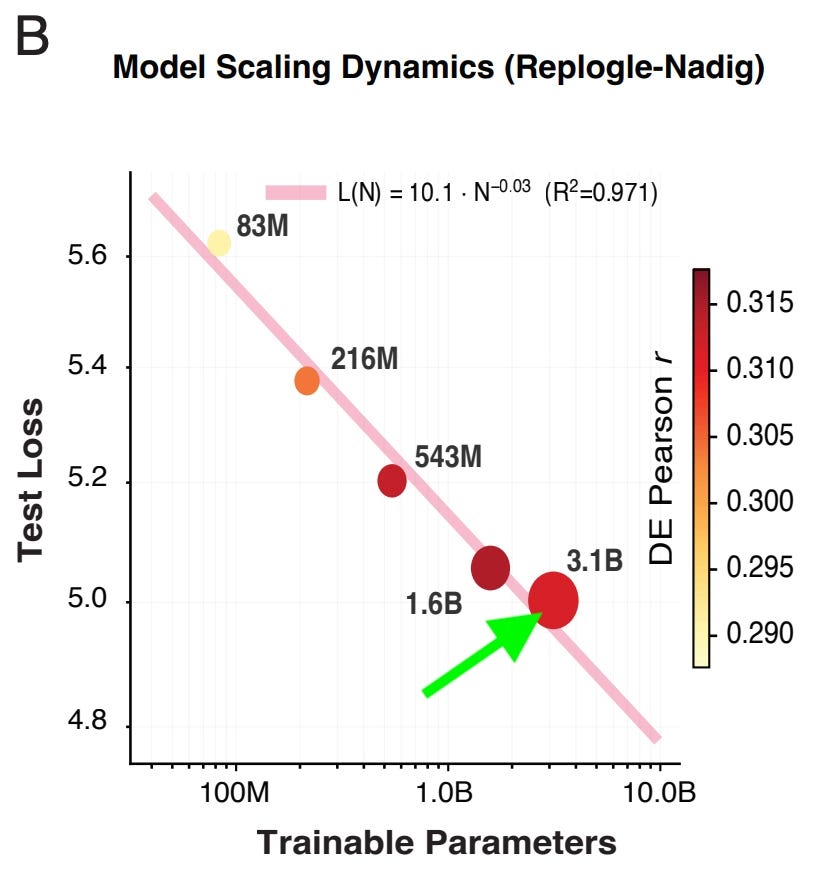
if you were able to provide those prior tests. - Exactly, in-ference. - Yeah, yeah, wow, nice. - Yeah, how much does that matter? I mean, whenever I see big machine learning papers with tons of things thrown in, I'm always wondering, where's the big alpha? Where's the little alpha? How much are, you know, is this just some, are these adding this little bit of incremental performance boost? Or, I mean, are all these actually crucial to generalization? - So there's multiple factors we have to consider. How much contribution the data contributed? How much of the contribution, the AI, architectures contributed, even for the architecture, what's the data from switching to other regressive, turning to different languages, what's the data from the prior knowledge is? So all of these needs very specific, Appalachian studies. From empirical experience, we find that the qualities, the amount of the data sets matter the most. This is why we were extremely excited to publish the PICES data sets, which has 16 different cell types and across 25 million cells. And it's genome wide. It had kind of a huge tensor, if you really think about from computer perspective, genome wide perturbation, genome wide transcribed comics, plus number of cells, plus a times a number of conditions. So it's a massive tensors. And because of the post screening technology, we don't have batch effects. So you don't need the model to climb the hill of batch effect. So that's already advantage. So we find that trend on perturbation data sets, high quality perturbation data sets, already gives a big boost to the models. We also did an application that if we trend all the virtual cell models out there, including state, cell to send this original sdgvd on the same data sets, what's the data we are observing. We reported the results there as well. We find that switching from other aggressive training to a definition language models give a significant improvement over some of the harder tasks, particularly generalized to unseen tasks. And the prime knowledge, more or less conditioned specific, for certain cell types, some of the prime knowledge make a huge difference, but for certain cell types, the delta seems to be marginal. We are thinking about how to better incorporate the prime knowledge. We still believe that that the model know a big chunk of existing biology should be helpful. But maybe it's the way we incorporate the prime knowledge through cross-attention, limited the scope of the metadata, but I think it's certainly a research topic. But overall, if we have to give an order, my order would be the quality among scale of the data sets and then the architecture and then the prime knowledge. But certainly this is only applies to our Excel. I'm sure there's different choices of architecture and have different ranks of contributions. First of all, this is really fascinating, very cool model. I hope everyone has a chance to look at the paper. There's obviously a lot of resources that we're put into doing this. I don't know if you guys can disclose how much. It's a lot of money, whatever it was, operating wet-lab, probably very complicated training runs. I think there's a couple four billion parameter model, is that right? Four-point library. Four-point library. Four-point library. Four-point library. Four-point library. So much larger model probably took a lot of GPUs to train. What's the lift that you get from this effort versus let's just put the money into wet-lab work and the traditional pipeline that basically has been the status quo up until now? Biology is a multi-scale discipline. There are cells. There are DNA sequences on the most wonderful cell level. There are cells. There are multi-cellular pieces of tissues, co-cultures. You have tissues, you have animal systems, and finally you have human. I think we would like to be able to do causal protection towards the right of the spectrum. Ultimately, do causal protection in human? Know what drugs will work in which patients. But that's very difficult to collect high-spirited data on. And so the whole vision of virtual cell is the generated data where it is possible, so that we can transfer the causality protection towards the right, towards the more translational, the more complex systems. The certainly you can mind the data already. We generated a lot of data as both said, seven screens, six inter-frame biological context, genome-scale perturbation. There's a lot of good ideas in that already. There is a figure that we put out in a preprint that just looking to inactivation of T cells. We already saw some, you know, we saw a known biology, TCR complex. We also saw some piliative new biology, which were very excited to develop in the lab. Some of that were actually also caught out in a very recent screen last December, published from Alex Martin Lab, also in the Bay Area. So very excited to see that. But the hope is to not just mind existing data. The hope is that the model can generalize and we will be able to do in silica experiment into the future. Nobody knows before how much data and what kind of data are needed to do that. With the whole field is waiting for the demonstration that the model can be linear baseline in perturbation prediction, and it can generalize out of context. Not just within the sound line you have trained data on, but out of that context. That's why you need a model. So what's very exciting for us is that in this preprint, we saw that generalization capability. A few demonstrations. We first did in T cells. We actually generated the data expressly for this purpose. We generated the resting T cell perturbation screen. So these are T cells in their baseline condition, not activated. And now we have an activated T cell perturbacy. So just T cell activation means I'm trying to kill something. No, these are regulatory T cells, but yes, we activate their receptor so that they're starting to proliferate. They become more active. They can do their surgical job. And we only, critically, we only train the model on the resting T cell. And we told the model, hey, this is how the active T cell look like now go and predict what all of the perturbations are going to do in this active T cell. And the model have not seen how perturbation working active T cells. And we set up a couple of rigorous tests. One, linear baseline. Took the perturbational delta in the resting case, just transposed that linearly onto the active T cell. And that's our linear baseline. Essentially, think about this as a common total perturbation prediction problem. One of the perturbations is activation of the cell. The other is all of the genome-wide perturbations. Can I just linearly add the two effects together? That would be a linear baseline. And second, we apply other models from the field. And last, but we applied XL. Critically, XL has not seen active cell T cells. And it's able to make accurate prediction not only on the nonbiology, the T cell complex, predicting their effect accurately that these are going to inactive with T cells, which is exactly what we would expect to see. But also, it predicted the punitive T cell inactive is that we found in the screen correctly as well. So that's very exciting to us. And that suggests the possibility that we might be able to use these virtual cell models completely out of context in the unseen context and predict new biology. And so we're very excited to follow up on those heads and validate them in the lab. Just very briefly, a couple other cases that we saw exciting, generalizing capability of this model. Remember, we did a multi-cell type differentiated IPSC experiment. There we specifically held out one cell type from training. So the model has not seen that cell type. Train on the other cell types, as well as the rest of the data sets. The model made very good prediction across thousands of genes, thousands of perturbations in that unseen cell type. So again, suggesting the model's ability to generalize out of cell type. And the last experiment, I think we're very excited is that we trained this on T cell cell line. But there was just very recently a primary T cell protripsic published from Alex Martens lab. That's an impressive amount of work. It's not easy to do this scale screening in primary cells. Very few labs have that kind of capabilities. Much easier to do that in T cell lines. Again, the model is able to generalize out of cell lines into primary cells and make accurate predictions there. So they actually perturbed primary cells, not cell lines? Primary T cells harvested from donors. And we were for multiple donors. And XL, train on just one T cell cell line is able to make predictions across multiple donors from primary T cell experiments. This is a validation of the whole theory, right? That you can train on these slightly weird cells and that it will be good because you're covering the domain well enough for whatever it is that you're able to actually predict in real cells that come directly from real people. That's right. Yeah. I think building virtual cell is not to replace biological experiments, as you mentioned, what we trying to do really
is a holy grail of virtual cell is to have a model to generalize to unseen contacts that is harder or even impossible to conduct biological experiments on. So far, excel focusing on cell lines and eventually we want to extend to more complicated biological systems such as animals, organoid and eventually as we mentioned before to patients to human biology. And very few numbers, 90% of disease has no cure and most of the drug failed at the phase three clinical trials on patients and the success rate of these three trials is as low as 5 to 10%. And phase three means the final stage on the patient trials. So that's when you generalize from toxicity in phase two to efficacy in phase three. From a small cohort or if you're small into a much larger cohort. Oh sorry, toxicity is one. First one, second, second. So a large cohort. So the generalization problem, okay, this drug, I very carefully selected my patients and it works pretty well and now I get a bunch more patients and suddenly it doesn't work very well. And that's the big problem that you're. The still is a promise of virtual cell is that can we build such a model that learn all the causality or biology so that can be grounded to predict the response on eventually on patients so that we can for certain drugs, we can select the right patients to conduct the clinical trials on. Right. So this is a long-term vision but we are already seeing some early hopes that excel trend on diverse set of causal datasets can already generalize to some some unseen cell types. So certainly there's a lot of experience to be down to validate this model. So even continuously finding this model but I think that we certainly see some early hopes. So you were talking about linear models and this brings up this famous or infamous arc challenge about perturbation and there's been this theme about complicated foundation models oftentimes not beating linear baselines and I'd like to get your take about that as terms of what is this? First of all, is this different? I think some of maybe your own models might also have had trouble beating linear baselines in the past. Is there something different about your current data strategy or where you're going and where's the field going and what is the role of foundation models versus or in virtual cell models versus you know these simple baselines? Yeah, a few things. First of all, those benchmarks as you mentioned are conducted on reprologo datasets which are very small datasets and the metrics people report are mostly MAE. Certainly you can imagine if the because single cell dataset are so sparse the average profiles of all the cells certainly you can imagine is a great minimum kind of local optimum to minimize the MAE. This is why sometimes the average profile of cells has lower MA's even then technical replicates which are considered of ground choose for kind of perturbation experiments. So that itself shows that that metrics not reliable. However, most of these benchmarks are still comparing foundation models that trend on static expression datasets such as cell bi-games. Asgb is often benchmarked against internally we also find that when it comes to MAE sometimes asgb kind of fail to outperform linear models just because of the reasons I just stated. And what sets excel different from these static expression models such as srb or g-formers is that we actually instead of trend on g-spressing datasets we trend on causal datasets we trend on massive amount of genome-wide perturbation datasets so that it learns better about the dynamics of the interventions. And in our preprint we extensively compare with linear model as well. And as you mentioned linear model totally failed to extend to unseen cell types. You can quickly imagine why. And I believe that foundation model or other more complicated AI models that trend on the right data will outperform these linear models in harder tasks particularly in generalization tasks. And that's why I keep mentioning the right data set with the right AI model will lead to huge improvements. But I think the field still needs to see more biological validations to be more convincing that the virtual cell direction is the right one. Yeah I think the field suffer from a lack of consistent and unifacted benchmarks what gets measured will get improved. And in our paper we measured I think that one of the measures that we hold a lot of thought into and saw the model really shine is metrics around gene expression changes. So you know Pearson Delta the similarity between predicted changes and ground truth changes upon the perturbation that's very hard to cheat on you have to really get the changes right and what really blew blew my mind away. So when I saw the model make prediction just print out the he-map of the genes for the changes. Look at the actual raw data and line up the linear baseline prediction the ground truth and the excel prediction altogether. It's visually very clear to see that excel prediction is very much more similar to ground truth than the linear baseline. This is a while moment I was talking about in the beginning. That's right. And it's not hard to understand why when we put so it's the first time that someone can put together not just one perturb seek but seven genome-wide perturbacy campaigns together. Something that jumped out to us biologists right away is that some of the perturbations are context universal meaning that the genes do the same thing in regards to the cell types you experiment in might not be surprising to you that these are your housekeeping genes right. Of course they do the same thing every cell. And then there are all of these other clusters genes that have very context specific functions. They do different things in different cells. Again not hard to imagine why in IPS using our stem cells we saw developmentally relevant genes. Genes that are important for neural differentiation they only lie that in IPSC experiments of course right that makes sense. So think about biology it's so complicated that you have to capture these you know context universal perturbation effects you also have to somehow learn the context dependent perturbation effects. It's not hard to then see why it's very sophisticated. Nonlinear model is able to capture and learn all of those biology much better. Are your perturbations always single gene perturbations or do you have more because mind or standing at regulatory networks is oftentimes sometimes it can be a single gene does a ton of things. For example I think males are just differentiated due to one gene being enabled at like day seven of embryo development or something and that differentiates everything is this one gene. But then sometimes you have large networks of genes which are all very redundant which allows for more subtle feedback mechanisms and so on. So I could imagine a lot of single gene perturbations as being kind of irrelevant and that you might want to start having a more combinatorial strategy here. Yeah that's a great question and Bo and I have thought about this a lot actually it's interesting that you brought up a reproductive biology. I study a lot of in female cells the compensation the dosage compensation mechanisms. There are female cells have two excromasomes. Male cells have one excromasome to match the dosage output from the excromasomes. Strategy that the mammalian cells employ is one gene that produce a RNA that is not in code for any protein just a non-coding RNA that RNA wraps around one of the female excromasomes and turns down most of the gene expression from that chromosome shoved away in a corner of the nucleus and it's called a bar body. It is never heard from again and so absolutely agree with you one gene can do a lot but in biology you also have redundancy. You have compensation you have all kinds of mechanisms where knocking down one gene is not sufficient to always see a phenotype. What if forging is we don't only do the same thing right? Taking out one is not going to be sufficient. So where we started with one cell type at the time loss of function single gene perturbation and look at only RNA expression as the output we're expanding the platform along all of those axes. So that's what we do today to build the scaffold of the data for training models like Excel. We are now beginning to grow in all three axes of the platform going beyond transcriptomics alone to like a multi-model data. Going beyond just one gene perturbation alone to like also pathway activation and in the in the athlete's. Turning on and off entire cascade of gene uh trained reactions and also going beyond just cell lines, molecules into more and more complex, transparently relevant systems into primary cells, into organoids and doing even direct imbibyl perturbation swings. So we believe with all of that expansion the data will be all the more exciting to train models on. This is also why we incorporate PPI in networks as the prior knowledge into our model.
And, and, and although the model right now are trend on single-chain perturbations, but once the model is trend, you can actually predict combinatorial perturbations just on the model in only silicon, right? So in the sense that you can just perturb the tokens of two genes at the same time and see what's the response. Certainly, without training the actual combinatorial perturbation data sense, the accuracy may not be there, but at least with the existence of such models, we can start to generate high positives using in-sidical perturbations. How do you see the role of the scientists changing in the age of AI? And you may, because you're not using, your focus is not language models themselves in the agentic science and things like that, then you may have a slightly different take. You're building these very specific models. But still, one, how are you and your students able to maintain such a high pace? And I suspect it may have something to do with generated by AI partly. But also, and how do you see the role of the scientist, the academic changing? Yeah, that's a great question. So my official split of time is 80% on zero, 20% on my university affiliations. But turns out that reality is 100% on zero, 100% on the other. [LAUGHTER] You're admitted to time machine, that's the answer. So the way I try to keep up is, certainly, my lab use lots of agentic AI trying to monitor all the AI papers every day, and every week we have land meetings, we try to discuss different topics in AI, for biology, AI, for health care, et cetera. And it's to be very frank, even as a professor, I find it's extremely hard to catch up. The pace of AI is just so incredibly fast. And to the point that sometimes I feel anxiety waking up says, oh my god, this paper already so many people published and what happened to our existing unpublished work. And certainly, you can imagine students probably face 10x anxiety. So sometimes I try to encourage students to really kind of using different tools, trying to stay focused. And I find it's a niche area that we become experts on. But with the era of generative AI, now agentic AI, I find the way people, at least, academics, does science are extremely different now. Overall, most of professors or students in academics start to be very struggling in terms of funding, in terms of the pace of publications. And that's why you can see lots of major breakthroughs come from industry, like AlphaFold, for example. So how academics survive or even thrive at such era of agentic AI is certainly something everybody is thinking about. We see lots of faculties left university and joint industry, for simply for the reasons of resources. If you are doing research on AI, do you have enough GPUs at your school? It's the first question you should ask. When a student joined a professor's lab, the first question they often ask is how many GPUs do you have? So certainly, in that sense, industry has a major advantage over academic labs. But I think what academics labs have advantages on is really the kind of the pace of innovations and also the niche areas as this specific academic lab can be extremely expert on. So also having the freedom of thinking sometimes also make you easier to innovate on ideas that maybe industry people didn't even think about. Overall, I think the whole field needs to be a lot more innovative to catch up. And hopefully with the help of different tools and hopefully the government start to invest more into academic, because I still deeply believe that academic is the main source of innovation for the whole field and particularly when it comes to biotech. So hopefully we see more investment into academics so that we stay afloat. I agree with you, but why? Why do you think say why shouldn't the money just go to industry? Why should the government put any money into academia? I still believe the power of academic freedom. This is actually the original motivation we have, such the existence of academic professors who are the only we teach, but also we do research. And there's also benefits of teaching and research at the same time in the sense that when you teach a subject, you actually have to become the expert on. And that forced you to keep updating your knowledge base and then find easy ways to convey your knowledge to students. And by doing that, you actually start to innovate on different ideas. And myself, for example, I teach a big class in university Toronto about deep learning and neural networks. It's a gigantic class with 600 students every year. And by teaching that, it forced me to update the slides, lectures every year. And myself reading lots of materials trying to update myself so that I can find ways to convey some of the knowledge into students. So that's how I keep updating myself whenever I remember vividly. We have GV2, we update the lectures. And different language models, how the multi-stripe GPU communication is used in training, largest schedule, neural networks, et cetera. So I force myself to just update the models. And by talking to different students, we really generate lots of no ideas to apply the cutting edge AI models to very specific niche areas in biology or in healthcare. It's unique to Canadian academic system. By being a professor in academic, we also have access to lots of healthcare data sets, which are very hard for industry to access due to many legal reasons or regulatory reasons. And that's why you see some of the papers we published through academic hospitals in Canada, where we developed some of the state of arts foundation model for ultrasound images. So that's what I mean that there's certain level of freedom of academic sinking that really drives lots of innovations. And I still believe, maybe it's biased, but myself still believe that having certain level of freedom of academic sinking, we all need to lots of kind of innovations that is unsingable in industries. I 100% agree with the ball ball there. So just thinking about the lab workflow that we do, a lot of these are building upon innovations that were first pioneered in academia as well. CRISPR of course was discovering academia. CRISPR applied to my mainly and high-through screening, also demonstrating academia first. Synchroza RNA-SIC, this kind of drop in capsule, synchroza RNA-SIC first demonstrated academia, then different companies tried to build it up into commercial offerings. Building all of these together to do perturb seeking first, also pioneered academia, right? Chris Boxlabs, Jonathan Weissman, and Slab, Aviva Regeffs, Slab, many of the pioneers in academia. And then I think these, especially on the lab side, these innovation takes so long and the discovery process can be so accidental, right? That it's perhaps not ideal for pure industry to take on. But once they show early promise, scaling them, and robustifying them, and genuine data that's not only massive, high quality, especially for AI scale, I think that's something that can be very well done in industry, both the mindset as well as the kind of resources that we can support that sometimes can be hard for academia labs to match. There has been very generous with releasing your data sets and your models. You've been, seem to be very committed to open science. Given some of the things you were just talking about, and this discussion about what is the best, most important data strategies for virtual cells or understanding human biology, where do you think academia should go next now and next since Zara has probably a budget comparable to probably dozens or hundreds of bio labs right now. What do you think that if you are an academic, a professor, especially in a wet lab, what would you want to be focusing on? First of all, myself is a deep believer of open science. That's why all the models we talk about here, data, open source. You can find all of them, data, weights from my lab, GitHub. It's very thorough. Yeah, thank you. The reason I believe open science is that, as you mentioned, most of the time, academic lab, we started an idea and we proved how it is not scalable. It's not even a good product. Industry can take it to scale things up. This is also why acidity quickly becomes one of the most widely used single cell foundation model in former companies. That's very encouraging to us. This is why. Zerai also start to open source some of the datasets, some of the models. Part of the reason is that we believe virtual sales is such an early field and it doesn't help to withhold certain datasets or certain models because it's so early. A better wing wing situation is everybody gets to in this field, start to contribute datasets together, start to contribute models together to exchange ideas so that this field can move forward in a much faster pace. We see successful examples in protein space, because of the availability of open source datasets in PDBs. Therefore, we have models such as alpha-fold, Rosetta-fold. Again, alpha-fold to also open source, therefore we can quickly iterate different models. That's why we see kind of a booming situation in protein space. We want to do the same thing for virtual sales. Let's put all the datasets together. Let's have the same standard protocols to generate high quality datasets. Let's put all the resources together to generate next generation of virtual sales models. When it comes to academic labs, the next two can come on what lab, how what lab academics can survive. But from JILAP perspective, I do encourage all the JILAP AI researchers in universities start to collaborate with industries so that they can get more resources to develop their own ideas. With the era of agenda AI, now everybody can code. It's more important to have a right taste about your projects, so that you don't just let just burn tokens with our purpose. We want more academic students, academic professors to have higher taste of research, so that we make the right utility of agenda AI. As a professor, it's your job as to have taste, obviously. But as a student, how do you develop taste as in a world where so much of the thinking scientific process could be essentially outsourced to an LOM or a, there's not a world where you're forced to bang your head against something and learn taste by the hard way? This is why we need academic training, where you get into a field you know nothing about, and hopefully after you graduate, become the expert about this particular topic in the world. This is why you have to go through different programs to talk to your peers, talk to your professors to get an idea about what's a good research taste to begin with. But more importantly, I always teach students that the best way to learn something is to just to program it. By programming, you kind of know what's the details hidden in all the mathematical equations in the paper, which often you emit. But in the era of agenda AI, since a slightly different in the sense that we used to spend lots of time coding a little bit of time just debugging. But now, we let the agent do most of the coding, but we spend most of time debugging, which seems to be definitely interesting to me. And we had lots of discussion with the students that have what's the best way to spot bugs by AI's. So how do you find places where AI is particularly good at? Also, how do you find places AI are still limited at? It's kind of you need lots of China era as well. And in the end, you still need to kind of validate your model using real world evidence, right? So that's why collaboration with wet lads, collaboration with clinical teams to validate your model, provide a feedback signals to your taste as we discussed, is really a very important training program. On the wet lopsight, academic has extremely important roles to play. I think it will enter a field of an era of symbiotic innovation and cross-pollination of ideas. Just like in AI field, I think we have great ideas coming out of academia still all the time. But industry now increasingly are contributing new ideas on architecture on all of that as well. In the wet lopsight, certainly industry seems to be able to scale these type of data generation quite well. But biology is so much more than just cell-based perturb seek. Beyond RNA seek, we would like to measure many other analytes, right? Proteins, metabolites, lipids, protein-protein interactions. How do we do that? A scale beyond individual cells, we would like to be able to measure cell-cell-cell interaction, spatial cell in their native context, or even whole animal level in vivo perturbations. Again, how do we do that? A scale with lots of great innovation coming out of academia. Actually, it's just one great paper last week. And so how do we connect all of these together? I think we have many years of work ahead of us to fully crack data generation for all biology. And that, I think we need to scale the industrialization, the innovation from industry. We also need that from academia. I think we'll together move this field to the next level. One question that we've been trying to ask everyone is in your field, which you could say maybe is AI and sort of hide-through-put experimentation, or however you wanted to find it. If you could wave your magic wand and have a bottle that's removed for you or a key problem solved, what would that be? Protein. OK. If there is a way to do protein sequencing or high-through-put protein measurement, the same scale that we can do genomics, that will be amazing. I'm training genomics field. But if I can do that, I would incorporate that technology in a heart speed. RNA is amazing. For shadows, which proteins are going to get made, but protein by and large are the functional units in the cell. Not only does their abundance matter, their post-translational modification matter, their localization in the cell matter. If you can measure all of those things, their conformational states, their modifications, their abundances, their localizations at scale, single cell, or even spatially, I think such data as it would be incredibly useful to train the next generation of Indonesian models. I know there's a lot of innovations in that direction. Can we just become a couple of age? My hope is I hope to see a breakthrough in sequencing technology, not just the reduced cost, but sequencing technology that can sequence the same cells at different time points. I think this is much lacking right now, because in order to sequence the cell, you have to kill the cell. So can we have a technology that can measure the cell states at different time points for the same set of cells? I think that we'll bring a very different dimension to the data set so that we can start to measure the temporal dynamics of cells. So far, everything we measure, everything we model is extremely static. So can we have a technology that measure different cell response at different time points for the same set of cells will unlock massive opportunity to model the dynamics of cells? To me, that is the real virtual cell. That's a really interesting idea. I never would have thought about that. Well, would you be OK with even just partial, small snippets of genes or maybe three prime regions of a small number of transgressions? Yeah, we can start with a small set of gene panels to begin with. But eventually, if, since we are talking about the magic one, eventually, if we can have a system that observe how cell evolve at different time points and we have enough data to actually model such development, I think that would be real virtual cell model. There's small attempts in-- oh, sorry, earlier attempts in just, for example, sucking out portions of the cells, taking almost biopsies from the cell to do a fraction of the cell applause and measurements. So that might be similar to the idea you talk about. There's also work from a population in this lab to have the cells secrete little vesicles. And the hardest thing in the cell culture media to measure what the cells are producing longitudinally. But there hasn't been technology that can let you measure the entire cell's transphotome while still keeping the cell. You can't have the cake and eat it. Yeah, cool. Yeah, thank you for taking the time to chat with us. It's been great. We learned a lot. It was a lot of really interesting discussions. And I especially really appreciate your commitment to open science and all of the cool models. And if you're at least-- there's any last thoughts you have or anything you'd like the audience to know? Follow up with-- Overall, I think virtual cell is such a new and fast-moving field. We hope to have more and more people join us. And our Excel paper is out. And we look forward to receiving your comments in the feedbacks. And also, we're hiring. Yeah, we are always looking for talented engineers, technologists, biologists, drug contours, AI scientists, computational biologists. So look on zero.com. Look for the open rules. We'll be happy to chat with you. Thank you. Thank you very much. Great. Thank you. [MUSIC PLAYING]
Podcast Summary
Key Points:
Zera Therapeutics is an AI-native drug discovery company focused on using three AI platforms: protein design, virtual cell models (Excel), and patient representation models to accelerate drug development.
Excel is a virtual cell model that predicts cellular responses to genetic perturbations, such as gene knockdowns, and can be extended to drug or chemical perturbations.
Virtual cells are a broad concept, evolving from failed mathematical models (virtual cell 1.0) to data-driven AI approaches (virtual cell 2.0), with foundation models like SCGPT serving as early steps.
A key challenge is the lack of causal data; descriptive datasets (e.g., from public sources like the Human Cell Atlas) are insufficient for perturbation prediction, which requires high-throughput experimentation to generate causal data.
Zera invests in generating large-scale, high-quality causal data in the lab to train models like Excel, aiming to replace trial-and-error biology with predictive, engineering-like approaches.
The team emphasizes integrating dry-lab AI models with wet-lab biology and clinical data to improve drug target identification, molecule design, and patient selection, with the goal of reducing drug development cycle times.
Summary:
In this podcast episode, Bo Wang and C2 from Zera Therapeutics discuss their AI-driven drug discovery platform, which aims to transform drug development from an artisanal, trial-and-error process into an engineering discipline. Zera builds three interconnected AI platforms: protein design, virtual cell models (specifically Excel), and patient representation models. Excel is a virtual cell model that predicts how cells respond to genetic perturbations, such as knocking down a gene, and can be extended to chemical or drug perturbations.
, integrating batch effects), they fail at causal tasks like perturbation prediction. This limitation stems from the lack of causal data in public datasets, which are mostly observational. To address this, Zera invests heavily in high-throughput experimentation systems to generate large-scale, causal data in the lab, enabling models like Excel to predict gene expression changes accurately.
The team emphasizes the importance of integrating dry-lab AI with wet-lab biology and clinical data to improve target identification, molecule design, and patient selection. Ultimately, Zera aims to accelerate drug discovery and increase success rates by connecting all three AI platforms, moving from basic research to clinical applications, with the goal of delivering effective drugs to patients faster.
FAQs
Zera is an AI-enabled drug discovery company using AI platforms to develop better therapeutics. Its mission is to use AI to make drugs faster and with a higher success rate by transforming drug discovery from trial and error into an engineering discipline.
The three platforms are protein design, a virtual cell or foundation model of biology, and patient representation models. They aim to predict biology, design molecules against undruggable targets, and understand which patients will respond to which therapeutics.
A genetic perturbation involves reducing the expression of a specific gene in a cell to observe the biological consequences. This helps predict how changes in gene activity, similar to drug inhibition, affect the rest of the cell.
A foundation model provides a semantic representation of cells, while a virtual cell is broader and dynamic, predicting cell states over time and responses to interventions. Virtual cells require causal data, not just descriptive data.
Public databases like Cell by Gene are mostly descriptive and observational, not causal. Models trained on such data fail at perturbation prediction, so Zera generates causal data in the lab to train models that can accurately predict cell responses.
The main challenge is data limitation, particularly the lack of high-quality causal data in cell biology. While protein design has abundant data, clinical and cellular domains require careful curation and generation of causal datasets.
Chat with AI
Loading...
Pro features
Go deeper with this episode
Unlock creator-grade tools that turn any transcript into show notes and subtitle files.
 PodcastTranscript AI