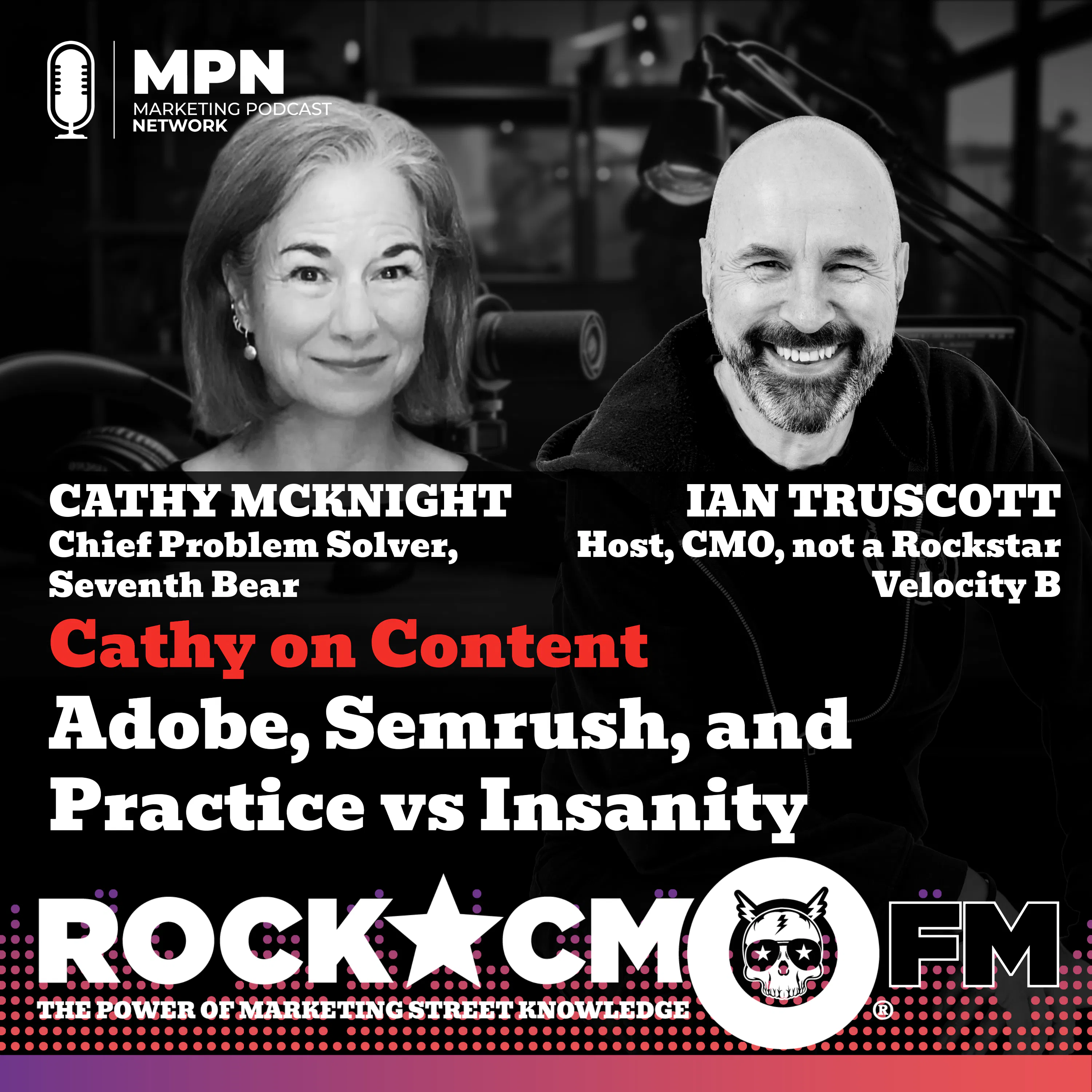
Cathy on Content: Adobe, SEMRush, and Practice vs Insanity
33m 18s
In the podcast episode, the host Ian Shuscott and guest Kathy McKnight discuss Adobe's acquisition of SEMrush and its implications for marketing analytics. They highlight that the acquisition could enhance Adobe's data set and analytics layer, providing better insights for brands. The conversation also delves into the significance of collaboration in content creation, stressing the involvement of experts from various fields from the outset. Moreover, the importance of breaking down data silos within organizations is emphasized to improve data accessibility and decision-making processes. The discussion underscores the necessity of integrating diverse expertise, sharing data effectively, and promoting collaboration for successful marketing strategies.
Transcription
5561 Words, 30886 Characters
Is that your concluding thought? We'll see. We'll see. Like any good analyst. That's great.
That's great. Bye everyone. Yeah, no, I'm excited about it. I love...
Hello and welcome to episode 296 of the Rockstar CMO effing marketing podcast. A proud member
of the marketing podcast network. Hope you're well and staying as sane as you feel you need to be.
I'm your host Ian Shuscott. I'm not a Rockstar by M-C-M-O and on this podcast I chat with a
band of marketing chums who share their marketing street knowledge which I hope will bring out the
Rockstar marketer in years. This was the night before Thanksgiving so it's time for my Canadian
chum, Kathy McKnight, Chief Problem Solver at Seventh Bear to make her monthly visit to the studio
and this week we chat about Adobe's acquisition of SEMrush and some new content Kathy has been working
but first we need to play the bar tab. I'll be back in a moment.
You may know you're listening to this show along the marketing podcast network but did you know
there are other great shows on MPN to help your business. Ennequatcus Porter hosts the
entrepreneurial you empowering entrepreneurs with insights on leadership business and success.
Ennequat tell us what to expect from your show. So we provide innovative business strategies and
practical solutions to common entrepreneurial challenges. And where can people subscribe?
Find us at EnnequatcusPorter.com as well as the marketing podcast network at marketingpodcast.net
or search for it wherever you guess your podcasts. You heard her, go subscribe.
Welcome back Kathy to Rockstar CMOFM, how are you? I'm well Ian, thank you for having me back.
Well you're very welcome anytime, anytime. How are things, how are things across the pond?
They are fine and I understand that what I expected to be extremely chilly Toronto is
actually slightly less chilly than it is here. How's the weather? Yes, we're sitting at a very
moderate temperature today that's not to discount that we've already had about five inches of snow,
the first three or four of which stage for more than a week. So this is just the slight peas
before the, can I say shit hits the fan? Oh, you can certainly say that on the f-ing marketing
podcast. I have to mark it as explicit every single episode, mainly because of me. So I'm,
I am taking advantage of the US holiday distraction because my inbox is pretty quiet and the warmer
weather today to, well this week to get Christmas lights up and to finish up the gardening and
get ready for the snow. Nice. Are you big on decorating the house on the outside with the
Christmas lights and stuff? I wouldn't say big, tasteful, but representative. We, we, we, we bailed
on it last year. It just was one of those things, there was a lot going on and so it was literally,
we had something on our front porch and I threw some twinkle lights into the, I do a big
Christmas display like urn with like ferns and, not ferns, but evergreens and whatnot and through
twinkle lights and that, and that was the extent of our lights last year. So I kind of feel like
I need to up my game because our street, people are very serious about it and I felt like I got
some shade last year. So we'll include pics next time. I love it. Yeah, no, we, for the last,
what a wheel, it'll be 25 years of, of, our Christmas doesn't start until the 15th of December
because my daughter's birthday is on the 14th. So we never, we don't put any decorations up,
we don't do anything like that. So there's all this debate in the UK at the moment about when
it's too soon to start with a Christmas and we've got this hard, hard stop. We, we, I, our house
very much at December 1st. So I'm taking advantage to get the lights up outside so that I'm not doing
it in the freezing cold, which is one of the reasons why it didn't happen last year because the cold
hit and never went away. But they will not be turned on until December 1st. No, no. And you're
enjoying Thanksgiving, like the rest of us, because it's quiet from the Americans and not
the Americans. Correct. Yeah. That's fantastic. Happy Thanksgiving to all those who are American.
Yeah, absolutely. And that's, so, well, the change of gears, really, I suppose. I'm going to talk to
you as usual as it's our Kathy on content section. We'll start off with one of the biggest players
in the digital experience space we can know is an expression you love, Adobe, who are acquiring
Semrush. And I thought I'd ask you about that. And then, and also when I was looking at the PR
and the press and talk about it, a lot of it is about GEO. I mean, we know Semrush from, I don't
know how long they've been around forever, right? Yeah, we've been using them. Robert and I use them
all the time. I love them. I love that. Yeah, yeah. And I actually got to meet some of them
once over in the Netherlands when I was working for a different vendor. And I agree with you,
really good tool. And I was quite surprised to see that Adobe and then we're going to hook up,
because again, it's a bit like when Acre acquired Wyden in the dance space. It's like,
these two things don't seem to go together as cultures. So I think that's quite interesting.
But it's seen that most of the talk was about GEO. And so, you know, it's all about AI these days.
And I just wonder what you thought. Yeah, so I love this. I think Adobe was really smart on this
acquisition. And for the, what was it, $1.8 billion that they are acquiring it for. So get on Semrush
for that. So I love this from a perspective of this really ups Adobe's data set and analytics layer,
which is something they've struggled with. You know, Adobe analytics have been around for a
long time. And if you're an Adobe client, then great. But if you've got like most organizations,
your data spread across a bunch of things, not so great, right? So I think this gives them,
it ups that layer for them quickly. They don't have to build it. It's, you know, and for customers,
this is better earlier insights into their brand. It absolutely gets them a step closer from a
GEO generative engine optimization, which everybody's a buzz about these days. And I think also for
it really improves their end to end content and marketing life cycle, right? From a creation,
true to discovery and optimization, you know, more platform access, scalable, that kind of thing.
So I think, you know, from those perspective, it's a really smart move in and looking and forward,
forward focused move, I'd say. I know you're close to these guys. And you probably know more about
the culture of Adobe than I do. My concern here is, based on their previous acquisitions, is that
the acquisition tends to sort of disappear, you know, as a service on its own, right? Whereas,
as you say, most of us know SEMrush and work independently with SEMrush,
is what is Adobe SEMrush going to be? I mean, is it going to go the way of their analytics
tool way back in the day? Or, you know, any of those other things? Or do you think it's actually
going to be something we all, as they maintain and we keep? I'm hoping it's the latter. This is where
so many acquisitions stumble. It's the bringing the culture and the product together from both sides,
right? So, you know, will SEMrush stay a standalone product? TVD, right? Is it going to be another
part of the sweet solution very specifically? I hope so. I hope they don't try and merge it
into something. I hope it is adjacent so that it works as its own. You don't have to have the
other bits and pieces or buy the other bits and pieces. Because, again, that's something that,
and this, you know, if anybody from Adobe is listening, this won't be news to them that I say
is it's one of the challenges that customers have with them, right? Is because they talk about
this integration. They talk about playing nicely in the sandbox. But they really don't. Like it's,
and that's, they do on some fronts very well and on other fronts they don't. And, you know,
whether that is an intentional go-to-market strategy, which, you know, guides people into the
Adobe suite of things. Or whether that's just a matter of, you know, getting out there and what
focus on, there's so many things, right? So, I mean, I'm assuming it's a business decision.
But it'll be interesting. I mean, it's $1.9 billion is a big investment. So,
Adobe's expectations are going to be high. This isn't just like, let's sort of fold this in and
see what happens. It's, they've got to have a plan for getting this out there and working for them.
Yeah, because as you're talking there, you know, there are different Adobe's, aren't there? There's
the Enterprise Adobe and the DXP and all that kind of good stuff. And that's a certain customer
experience some people have of Adobe. And then you've got the Adobe suite, which we were talking
about because you went to Adobe Max, right? The creative stuff. And then you've got some of the
freemium and close to freemium stuff about Adobe Express and their podcasting tools and stuff.
So, there's a whole, there's a real wide range, isn't there? Where SEMrush might fall in terms
of those commercial models? Yes, and I'm hoping that it will benefit both. One of the things that
Adobe has, you know, uniquely going for them right now is they are really the only vendor in our
space that can offer a solution from ideation through to archive and all the pieces, right?
Every little bit. Now, I don't know a single company that all they have is Adobe, right?
There's always something else. But they are unique in that position. I don't think that'll
stick around forever. I think that's going to change. People will figure that out. And whether
it's through acquisition, whether it's through formal partnerships, et cetera, that will change.
But it is a unique position. So, this just adds more to that offering from that perspective. And
I'm hoping that they integrate and make it available so that it's not, you don't have to be
an enterprise client, right? Like, you can, they're going to work this into things like
work fronts so that it can be part of the creative process. Yeah, that was exactly the
question I was going to ask you, actually. You know, knowing both these companies quite well,
and both these, and they're sweet quite well. Where do you see the, is there a big overlapping
use case where you can see, I can see where this will turn into this? Or do you think that SEMrush
will become, you know, like they've got the enterprise stuff, they've got the creative stuff,
will SEMrush somehow be another division, which is going to be about analysis and understanding?
Or do you think it's going to plug right in? I think it's going to plug in. I think they're going
to look to leverage it from, to provide a deeper visibility into the intelligence
elements that they already have. I don't see this as a standalone, separate, you know, now a third,
you know, plus, plus, plus kind of thing. So, I don't know, I again, you know, haven't spoken
with Adobe on it and it's still, it's not formalized, right? So, we won't, we don't get the inside
track on it. But, you know, I think, I think it's good. I think, you know, it helps with the
data fabric that everybody's so looking through weave neatly and smoothly and whatnot. It'll help
in terms of some readiness and operational gaps currently. And yeah, it's, people are, people
are going to be watching. Yeah, and I could also imagine that they've probably got a massive data
set of content insight that would be invaluable in the content, enterprise content operations
where you play, right? If you can tie those things together, which is, you know, and, you know,
nowadays we're using AI a lot more to inform our content production. Well, what better learning
platform than that that knows what are the key words and what are the things, what's the behavior
people are doing around their web stuff. So, could be, could be cool. Yeah, we'll see. All right.
Is that your concluding thought? We'll see. We'll see. Like any good analyst. That's great.
That's right. Yeah, no, I'm excited about it. I love, I love the concept of this.
I love the potential of this. Yes. And it's all about how it shakes out.
Yep. And it's good to be able to talk about some news in our little content,
in your content management and strategy space. Yes. So anyway, now we'll talk about you. So we're
going to move on to an article that you've just published on your seventh on your brand new shiny
seventh bear website, which, which Robert has been cock-a-hoop about in our, in our bar conversations
every Saturday, because he was telling me that it was he's been meaning to fix it up. And then
finally, the new version has got his now public. And also, and it gives you a platform on which to
play. And what I, I just picked up on your last, your last article, which is called practice versus
insanity. It's a matter of perspective. And I like the fact that you've made references that you do
something over and over again, expect a different result. Either that's good practice or you're
insane. So, and you were talking, and in that article, you were talking about how sending out
the same content on different channels, thinking or hoping it meets the needs of all your customers
equally is unproductive. What's that, you can see how what tell me about that.
So one of the things we find really interesting is, you know, Robert and I have
the privilege of working with amazing organizations. Some everybody would recognize the name, some of
them I'd never heard of until, you know, we started working with them. And all of them,
the fact that they trust us to help them do business better through content and marketing is,
is I love it. And the discussions that we have, but I find it so interesting because they're all
smart. Everybody we work with is, it's smart, right? They know what they're doing. They know,
they know the right things to do all of that. But yet, because of, you know, whether it's pressures,
whether it's fear failure, what I don't know what it is, whether it's path of least resistance,
some of the stuff they do is, is head scratching. So, you know, they'll create one,
you know, one primary campaign. He's like image or something. And then that's what they use
everywhere with, with no variants, right? And particularly in today's, then AI environment
where creating branded, brand controlled variants is way easier. And, you know, there's tools out
there that are not expensive, you know, it's not like you have to invest in the Adobe suite to
get those kinds of things. So it's there. It's, it's, it's right at their fingertips yet,
they're not. And then they're surprised that it didn't work. That's the funny thing, right? That's
the, oh, that's really weird. It didn't, didn't go as well as we thought it was going to go. Well,
is it though? I'll come with your experience. But, and you give four piece of advice in this
article. And the first one is you say that this experience excellence takes a village. Tell me
about that. So one of the things we are huge proponents of and in, in all things is collaboration.
You know, two is better than one tree is better than two in terms of input and insights. And,
and what you take from them is up to you. But so often the content life cycle is segmented and
siloed where the subject matter experts on things like channel and asset type and messaging and
segmentation and time, all of those things are brought in after the fact because the business
units, the brands, the, the, the products, the sales teams look often at marketing and content
as a function, right? It's a cost center. It's something they have to do. Everybody seem,
everybody who doesn't actually create content and good content thinks content is easy.
Why does it take you three days to write an email? Well, because you've got to do some research,
and then you've got to, you know, write it, and then you've got to make sure it's brand
aligned and it's in the right voice and that it aligns with the part of the journey that you're
targeting and the audience segment and it goes through review. And, you know, it's not a matter
of sitting down 20 minutes later, you have this killer engaging email campaign, right? So
they, they, they don't appreciate the expertise that this part of the business brings just as many
outside of even, even within marketing, don't necessarily appreciate the, what creative professionals
bring. So by bringing those facets in earlier and starting, we always have them start, you know,
we recommend you always start with the audience. Who is it that you want to reach? What problem
are you solving for them? So what's their need? Again, outside in, right? And how does it align
with your business objectives? And then what are your metrics of success? So don't ask her a video,
don't ask for acts. Let's talk, let's start there. And by, so by bringing the people in who can
contribute to that conversation at the outset, it just, you get so much better. But it's this
costing over the walls, it goes back to another post that I wrote about how processes is, is
creating this world of mediocrity, because it's ticking the boxes and throwing it over the walls
of the next group rather than looking up and downstream to see what could be better and how
more collaboration would make the output so much better. Right. So the key, the key piece of advice
there is you, I mean, this is always the challenge for any marketing team is come and ask me for an
outcome. Don't ask me for a video or that we need to be on tick face or the logo needs to be bigger,
right? What is it you're trying to achieve? And then you, yeah, what is success like? And then,
and it needs a team to put that together. And then I like your next point as well,
because you talk about data fiefdom. So I presume that's, that's the similar thing is that this
is about bringing people together, not just bringing data together, not just your people.
Exactly. And again, one of the things I iterate, often, the degree of oftenness depends on the
team that we're working with is the data isn't yours. It doesn't belong to sales. It doesn't
belong to marketing. It doesn't belong to the customer support team. It belongs to the company
you all work for, right? Everybody works for the same org. And you're all trying to make,
you're all working towards the same end to make that company as successful as possible. So
opening up the data layers, and I'm not suggesting that, you know, people can go into the data lake
and start messing with the original data, but give them a subset, let them, let them look at it,
let them dig to it, have a standard dashboards and reports for the different core groups that,
that need data, like, and truly need it so that it's accessible to them and they can dig into it.
It's on demand. They don't have to ask anybody for it. But the number of organizations where
we talk about data enablement, they're like, Oh, yeah, that would be awesome. But it takes me
two weeks to get a report from the BI team. And it's too late because everybody's coming to us
at the last minute to ask for something that we need to do, which we need the data for,
but we don't have two weeks to wait to do the thing to get the data to make it right.
Yeah, yeah. And that also extends to, I mean, your next point about permeable data silos. I think
we've been talking about that for two decades, as everybody's talking about
busting the silos, but you can't bust the silos. The silos are human nature and the nature of our
businesses, right? So, so explain what you mean by permeable. So again, I've never, this goes back
to way back to my days as an SAP consultant and, and, and writing code for SAP and building those
systems was you can't build an ERP like SAP thinking only about your silo and your function.
The information that's the whole point of an ERP, right, is to have the right information
flow easily in real time across the organization. So the best decisions can be made. So from 20
years ago, I've been an advocate more than that, an advocate for making information available. And
so in, in making it permeable, I'm not suggesting for a second that you get rid of silos. We are
territorial. We need boundaries. That's just the nature of human beings. And we've worked with
organizations that are basically flat and it is chaos. Now that might be my, my A type OCDness
coming through, but it is. So I'm, I'm all about parameters, right? That that's it makes things
work better. It gives structure. It's comfortable, all of those things. So don't break them down,
but make it permeable. Make it so that information, whether it's data, whether it's knowledge,
whether it's expertise, whether it's process, make it so it flows through the organization.
You know, I'm not suggesting we open up the HRIS system or the finance system, but, you know,
customer data, that's important to everybody. Yeah. And I like your point as well,
you when you're talking about data fiefdoms, because one of the things that I'm kind of
thinking about in marketing is sometimes I think we spend a lot of time on attribution and credit
and all that kind of stuff. And, and trying to do, and I think a certain point in that work no
longer serves the company anymore. You're just serving marketing or somebody in marketing or
sales to prove a point, right? It's not actually good for the company that you've got your members
of your team talking about with data reports and everything. So they can demonstrate their own,
you know, reason for being. So I think there's a, you know, like you say with that day-to-day
fiefdom thing, having it all open and available, absolutely. But let's not spend too much time
on that stuff if it's not to the service of the company. Does that make sense? Yeah. Yeah. And
then I think that, and then your point about, and the systems drives nicely to your last point,
which is that internal systems shouldn't drive the customer experience. It should be the other way
around, which actually made me chuckle as I read it because so many times. And I know that you're
talking about internal systems and the content operation side of things, but I think it's so
many times in marketing, our multi-automation solutions, our reporting solutions drive what we
do. And it sounds like it's the same in customer experience. Yes. Yeah, absolutely. So, you know,
understanding how the data can be leveraged, right? So who could, who could this be helpful for?
And I always encourage people to ask the questions, why shouldn't this be shared
or made available versus why should it? Yeah, yeah. Because the answer to the first question
is far less often. And you're starting in an open space, right? You're starting in a mindset
of transparency and equal access as opposed to, you know, the fiefdoms, this is mine, this is mine,
this is mine. And not to, but I will, not to diss the sales teams, but sales teams
traditionally have been the most challenging and resistant to this because a lot of sales
individuals feel that what they do and how they do it and the information they capture
there is a secret sauce, so they don't want to share that, right? But they don't, what they,
what they might not understand is that the conversations that they have, what they're saying
is so important in terms of data to be able to make accessible. So like all sales conversations
should be recorded so that they can be analyzed for keywords and reactions and that kind of things
because that is such a rich set of information that is available to nobody except for those
two people on the phone call. And it's unfortunate, right? So they, all sales calls should be recorded
and analyzed for, you know, what are the words and what are the triggers and commonalities and
not only to get that insight, but to be able to enable the other sales individuals as well
as the lexicon that is used within the organization to attract and engage audiences is aligned.
Yeah, yeah. And yeah, I do want to get to a final point, the other stuff you're working on on the
site, but one, but I've been, I recently was on podcast talking about sales methodologies
and I was astonished and obviously I was represented marketing and I was astonished
by the fact that how much time in my career I've spent not knowing what the sales methodology is,
you know, we have our marketing and our sales and the two things and, you know, are completely
separate. But the more you learn about these things, the more you realize that if there was
better collaboration between the two, you know, marketing can build into that. And I think that's
the same as what you're saying here, isn't it, is that these internal silos that are a part of the
problem. Yeah. Anyway, we won't diss sales. And I also think some of it is a complex problem,
because uniquely sales get individually rewarded, whereas the rest of us don't. Right. So,
no, that's what makes sense. That's a big issue until there is a shared
element of comp that is based on things like customer satisfaction and
engagement in terms of solutions, adoption, then, you know, it's very hard to get that change.
Yeah, absolutely. Anyway, so that's your latest article on Seventh Bear and it's called practice
versus insanity. It's a matter of perspective and I'll link to it in the show notes. So we move on
and we're still not going too far because we're staying on Seventh Bear. But what I kind of
I picked up on the fact that it seems that you've got a new feature format called bear essentials,
where you're going to do some quick takes by the looks of things. Tell us about that.
Yes. So, Robert and I are always, you know, we did our brand change at the beginning of
the year and, you know, everybody asks what Seventh Bear about and we're leaning into,
you know, collectively between us, we have more than 50 years of experience.
So, he's got most of that. He's got about 40 years. He does. He's way older than I am. No.
Thank you. And so we've, you know, we've been there. We've done that. We've seen it.
We've seen it again. We see it in a still. So there's a wisdom and a knowledge and
expertise that just comes with having done what we do for so long and we do it because we love it.
So we're staying up on what's new, what's changing. So it's not a matter of, you know,
we've always done it this way and this is the way we've got to do it. We've changed,
but there's a few things that we've seen persist. So that was the nascent of bear essentials. I
wanted to create something that are pretty consistent, right? Is what are we seeing over
and over? What are some common challenges that we see from our, our client base and the people
we talk to when we, when we're speaking at conferences and running workshops and whatnot?
What are, what are the questions? What are the, oh my God, we're, you know, this is happening
and I can't, and the common thing. So the essentials that people need to know. So that's
where that came from. So, you know, what we're hearing. So the perception. So, you know, whether
it's feeling overwhelmed by not having enough content, whether it's a communication or collaboration,
that kind of thing. And then our take on it, right? What the reality of the situation isn't X,
what you're saying, it's actually this. And why it matters. What we see most commonly that
teams get wrong, where they go astray, why they're not able to correct the wrong or the challenge.
And some alternative things to think about as far as what to do instead.
Yeah, I think it's cool. I mean, we love 5F and things on this podcast anyway. So you've
got their perception reality, why it matters, what most teams get wrong and what to do instead,
which I think is splendid. So that's all on 7thBear.com. So I'll encourage again, as I do,
seem to in every podcast episode, encourage people to go on to some other property other than any of
my own. Drive them away from your site, yeah. Really good marketing. And also, I mean, you're
still on a long hiatus from your podcast. So I can't even promote your podcast.
Yeah, and that's going to stay that way. I'm not sure what to do with it. So
anybody has some great ideas on Uncharted Journeys, go check it out. Unchartedjourneys.net.
And if you've got some ideas on how that could evolve and what I could do next,
I would love to hear from you. Nice. Yes. That was a podcast that celebrated women's success,
wasn't it? You interviewed successful women in the world. I mean, there's a lot of that about
successful women. So I'm sure there's plenty more. All right. And when people want to connect with
you, Kathy, where best to find Jeff when they spin the dial on the interwebs?
LinkedIn, Kathy with the C McKnight. And I'm on Instagram. That's not only personal,
but feel free to follow. And 7Bear.com, of course. Nice. And I'll see you again in a month or
whenever it is that we run across each other. Absolutely. All right, I'll speak to you soon.
Thank you, Kathy. Always a pleasure to catch up with Kathy and sharing with you the work they're
doing over at 7Bear. So that's a wrap on episode 299, the Rockstar CMO FM marketing
podcast. Thank you for dropping a dime into your podcasting jukebox, selecting our track
and driving along with us. I've been your host Ian Chuscott and you can find links to me,
Kathy, our blog newsletter and all of our previous episodes in the show notes at RockstarCMO.com.
Coming up for us here on Rockstar CMO FM, having enjoyed all the turkey and maybe a bit of football,
Robert will be back in our virtual bar on Saturday and Jeff will be back in the studio next
Wednesday as we continue to celebrate prediction season. Speaking of celebrations,
I hope you American chums have a splendid holiday and for the rest of us, have a happy Thursday.
You may know you're listening to this show along the marketing podcast network, but did you know
there are other great shows on MPN to help your business? Robbie Samuels hosts the On the Shmoos
podcast. Robbie, tell listeners what to expect from the show. Since 2015, I've interviewed
entrepreneurs who overcame challenges to achieve success in their field or industry.
Tune in to On the Shmoos to listen as I asked deep questions to elicit untold stories about
leadership and networking. And where can people subscribe? Find the show at ontheshmoos.com
or on marketingpodcast.net or just search for it wherever you get your podcasts.
You heard them. Go subscribe. This podcast is heard along the marketing podcast network.
For more great marketing podcasts, visit marketingpodcasts.net.
Podcast Summary
Key Points:
Discussion about Adobe's acquisition of SEMrush and its potential impact on marketing analytics.
Importance of collaboration and involving various experts early in the content creation process.
Emphasis on data sharing and breaking down data silos within organizations for better decision-making.
Summary:
In the podcast episode, the host Ian Shuscott and guest Kathy McKnight discuss Adobe's acquisition of SEMrush and its implications for marketing analytics. They highlight that the acquisition could enhance Adobe's data set and analytics layer, providing better insights for brands. The conversation also delves into the significance of collaboration in content creation, stressing the involvement of experts from various fields from the outset.
Moreover, the importance of breaking down data silos within organizations is emphasized to improve data accessibility and decision-making processes. The discussion underscores the necessity of integrating diverse expertise, sharing data effectively, and promoting collaboration for successful marketing strategies.
FAQs
The episode featured a chat about Adobe's acquisition of SEMrush and new content.
The show offers innovative business strategies and practical solutions for entrepreneurs.
The acquisition enhances Adobe's data set and analytics layer, providing better insights for customers.
Collaboration ensures a holistic approach to content creation, leading to better outcomes.
Data should be shared across departments to improve decision-making and overall company success.
Chat with AI
Loading...
Pro features
Go deeper with this episode
Unlock creator-grade tools that turn any transcript into show notes and subtitle files.
 PodcastTranscript AI