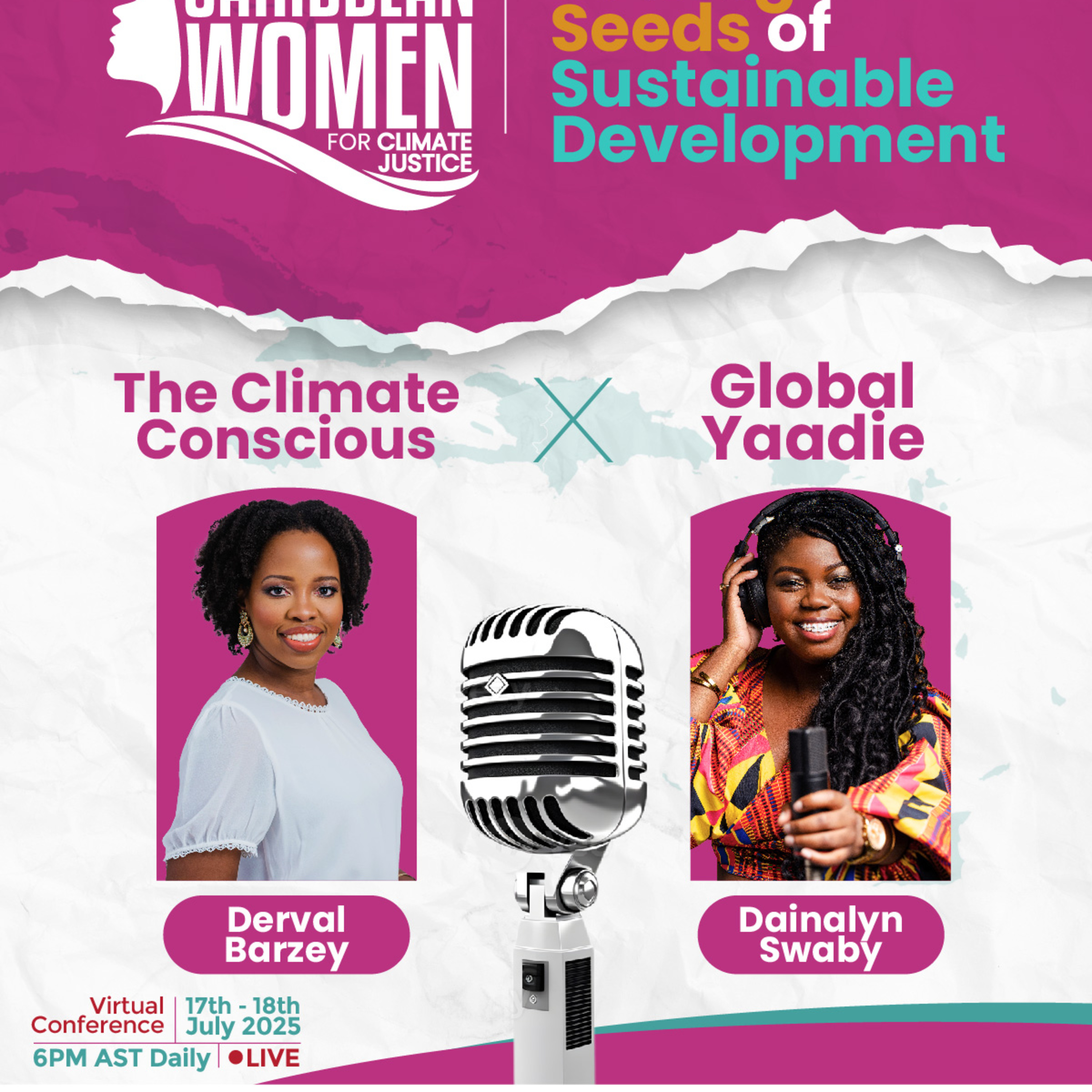
Caribbean Women for Climate Justice: Sowing Seeds of Sustainable Solutions
31m 22s
The transcription discusses the collaboration between The Global Yardee and the Climate Conscious Podcast in co-hosting the Caribbean Women's Climate Justice 2025 Virtual Conference. The conference aims to solidify community, promote knowledge, and insights in the climate action and justice movement in the Caribbean. It focuses on gender and climate justice, homegrown solutions, and community-driven resilience building. The event includes live case studies from the global South, exploring various focus areas related to climate resilience and health. The speakers and panel discussions aim to inspire action, validate existing efforts, and provide a proof of concept for individuals looking to contribute to climate justice. The inclusion of speakers from Kenya and other parts of the global South signifies a broader perspective and engagement beyond the Caribbean region.
Transcription
4945 Words, 28759 Characters
- Hi, Daenalyn.
- Hi, Denevol.
- So, we're getting together today to talk about something
very exciting that we've been working on.
- Absolutely, I can't stop smiling, yeah.
- I feel like most of our followers should be aware by now,
but if you are not,
the Global Yardee and the Climate Conscious Podcast,
we are co-hosting Caribbean Women's Climate Justice 2025
Virtual Conference.
How excited are you, Daenalyn?
- I'm very excited for so many reasons,
not just because I get to do this in this capacity this year,
but whether or not people have been following our story,
it's just to see the evolution of our collaboration
because, I mean, I think we started off as
island innovation ambassadors,
and we knew that we were gonna have some collaboration,
and so we would have moved from exchanging messages
to being on each other's podcast episodes.
So, we've had several pod-to-pods over the years,
just exploring each other's backgrounds,
and even for CW4CJ,
and I've been involved in this conference since 2025
as a performer, as a host,
as a member of the planning committee,
and now, you know, I've got my ultimate promotion
as a co-organizer, so I'm really excited
to be working with you in this capacity,
and already, I've seen, you know, behind the scenes,
I've already gotten a different kind of experience,
connecting with co-sponsors,
engaging with our potential speakers,
and even crafting what we want CW4CJ to look like this year.
- You know, when you mentioned,
and important with evolution, you know,
I've seen both of our protesting careers evolve
since 2020, our advocacy with climate action,
and now, I've also seen the evolution
of Caribbean women's department justice.
We first started in 2022, and we were also a part of that,
and, yeah, now we are here today, 2025,
we did have a break for 2024, but we're back,
the energy is back, and we're back again, ever.
- Absolutely.
One of the things I want to do is also mention,
and give you your flows, CW4CJ, you know what?
I'm always gonna be blundering with it.
I'm not organized, I should get it right.
CW4CJ, Caribbean women for climate justice.
One of the things I appreciate about,
I'm gonna call it in this context,
this product or this event,
is that it has solidified community,
not just for the climate conscious podcast,
but what it means for the climate action,
climate justice movement in the Caribbean.
And I know other organizations have their own version,
but for a podcast, this is important.
It's not just to say, while it's a very important
awareness-raising component,
I really love how each year we are able to bring together
different people working in this space,
and give them a platform.
So it's about the knowledge, the insights
that we're able to promote.
And I think, as I said, I can't stop seeing
that I'm really excited to be part of the movement
in this way, solidifying community,
and that's exactly what we need
every time we face increasing challenges
in relation to climate change.
- Yes, it's definitely all about community,
focusing on the Caribbean, but also the diaspora,
and now the Sierra Global South,
which we'll get more into,
but yet the platform of the climate conscious podcast
is built on community,
and not just awareness, but also getting into action.
And I always emphasize an important first step
for action is awareness,
but then we need to take it further, right?
- Yeah.
You know what's also interesting, Durval,
no matter how many, and certainly from your seat,
you can see how the conversation around the gender
and climate has evolved over the years.
And still, you know, we have to not,
we have to ensure that we're not just operating in a bubble,
because sometimes you end up preaching to the choir,
because people are still,
we have to, I don't want to say outside this space,
but climate change is everybody's business,
but some people still don't get it.
Why this focus on gender and climate?
If you ask the average person to say, you know,
what's the connection there?
People still struggle.
So are you, I don't want to ask if you're tired of explaining,
but what do you say to people each time when they ask you,
why these focus on gender and climate?
How do you answer that?
Yeah, so that's all the facts that you shared.
Even the concept of climate justice is still being unpacked.
But what I like is that people are showing an interest,
even if they're not at that level of understanding yet,
but we're seeing more and more people interested
in the issue of not just climate change,
but all the other dimensions of it, right?
And what I say to that question, you know,
why the focus on gender, the intersection of gender
and climate is that we have knowledge.
I think for the most part, everyone acknowledges
that climate change is a critical issue
for the Caribbean region, but for the world at large.
However, given the level of action and activity
we see on the global stage,
I'm not seeing that level of impact on the ground one.
And also I recognize that if we don't address
the existing disparities, the existing inequalities,
all our efforts and investments in climate action
will be ineffective if we do not address gender,
we do not address economic status,
if we do not address the entrenched,
the systemic inequalities that, you know,
make up our Caribbean life.
So I like to highlight that climate change
is not gender neutral, right?
Women, girls, and other underrepresented
or marginalized groups who are already at a disadvantage,
climate change just meets that 10 times risk.
So when we want, if we want to address climate change,
if we want to really achieve sustainable development
with climate action being one aspect of that,
we need to address those issues.
We need to not leave anyone behind,
including our women and girls,
including indigenous people, youth,
through different variables.
You know, it's really about understanding
the value of inclusion.
Through inclusion, we get better solutions.
We get more buying.
We get more bang for buck, whatever we are investing.
You know, we can really see the impact,
not just in signing agreements,
but in having community-led and community-engaged action
that really changes life.
So we focus on gender and other dimensions of climate justice.
It's really about transformation,
changing the way that we do things
so that we have a greater impact.
- Yeah, you know, obviously I'm with you
all the way on that response.
And I also, you know, listening to you,
I like that we've chosen the solutions
focused approach for this year,
looking at the theme,
sowing seeds of sustainable solutions,
because no matter,
while it's important to understand the problem,
I feel like everybody has a greater grasp.
And even nowadays, there is less pushback,
certainly from a Caribbean standpoint,
where we're no longer caught up in the debate
of whether climate change is real or not,
because the impacts we're facing
is suggesting that things are happening
and people are affected every day.
And no, one of the things that we may need to step away from,
like I'm having conversations with people at the market,
in my community,
and you're surprised to see how much climate discussion
is flowing into the conversation, so that's good.
And so I love that we are now looking
at the solutions-based approach,
still centering women.
So it's not a poetic thing,
it's a call to action because the droughts,
the floods, the hurricanes we saw
from Hurricane Bay last year that more and more,
we need the homegrown solutions.
We need the people-centered solutions
and we need future-ready solutions.
And so I love that we're in a space
where we're spotlighting the bold actions,
the practical things that women in agriculture,
women in energy, women in health,
women in advocacy and organizing,
women in policy are doing.
So we need people to kind of understand
that this is not just a scientific exploration
because we're living climate change,
and so we want to connect our audience
with the people who are working in this space,
the people who are experiencing some of the things
that we don't think about.
I'm kind of excited.
So one of our speakers, I see,
I'm excited to hear from Dr. Paula Henry from EarthMiniq,
and I was exploring the work of that organization
and it brought me to some research or articles
they were doing around climate and mental health.
And while I do know, obviously,
that we have frontline workers,
honestly, when we were thinking about climate,
when we talk about climate and mental health,
I for one wasn't, sometimes I'm thinking about whole,
it's obvious how if climate affects you,
or you have a climate impact,
like a hurricane or something on your house,
it causes distress to the individual.
But I wasn't even thinking about it
from the standpoint of the healthcare worker,
the people who have no,
have to be managing understaffed institutions,
they strive for resources.
You know, have to leave your home in the time of disaster
and put somebody else's needs before your home.
This is not the conference people, I'm just...
But I'm saying, you know, so these are,
so just doing the research around the people
who are coming into our room virtually,
it's already expanding my perspective
when we have conversations around the different issues
and different intersections of climate change.
What about you?
- I like that you highlighted this year's focus on solutions.
- Yeah.
- We spend the time building our foundation
from CW4CJ 2022 and 2023,
and now we're about highlighting what can be done,
what is being done,
and maybe that can inspire others to get involved.
And I am particularly excited
about the 2025 keynote, Ms. Kendria Ferguson,
a PhD candidate and an expert in sustainable development,
as well as climate resilience.
So what I love about our keynote
is that she is able to bring lived experience
as well as academic research, right?
And that is a good mix
because we always talk about homegrown solutions
and recognize that we often look externally
for an expert to come in and tell us what to do,
come in and save us.
But CW4CJ is all about recognizing our local and indigenous
and homegrown experts who are well-placed
to develop workable solutions.
And she's gonna tell us more about how we can make disaster
resilience and disaster recovery more effective,
more relevant to our local conditions,
acknowledging the different people,
the different groups in our societies,
and again, not leaving anyone behind.
And I know then, Alain,
you were also involved in disaster recovery.
Tell us a little bit about work that you did
following Hurricane Barrel.
- Right, so following Hurricane Barrel in Jamaica,
I'm from St. Elizabeth, the southwestern side of Jamaica,
and one of the hardest hit parishes.
St. Elizabeth is actually called the bread basket harsh
off Jamaica because of its food-producing capabilities,
meaning it's one of the parishes
that produces the largest volume of food.
And also, it's not just because of the volume,
but I think also in the condition.
We're located in the rain-shadow area of the country.
So it's the ingenuity of the local farmers
that make what they do so impressive.
On the extreme drought conditions,
these people have tapped into for years
the traditional farming practices
that they've been able to do,
the grass mulching and how they do their thing.
You know, that's what basically keeps the island,
well, that's what puts people in awe
how we're able to produce so much
under the restrictive conditions.
That being said, as a podcast,
as a development, communication, practitioner,
I've been working in this space for years.
For, you know, my first year at university,
this was my exposure from the lived experience side
because, you know, I'm daughter to a small farmer,
but on the professional side,
getting the insight into these communities.
So it was kind of hard for me to sit on the sideline
seeing all that was happening.
So my friends and I, you know,
we got into raising funds to go fund me.
Some of my other colleagues saw what we were doing.
Shout out to GirlScare as well
because I would have reached out to them.
There are one of our sponsors coming into this year
and they, you know, I would have reached out to them
to say, "Hey, my community doesn't have water.
We need some assistance."
So it started out from getting trucked water
into the community, to raising a go fund me,
to also applying for a resilient disaster recovery grant.
And so we were able to mobilize 1.5 million Jamaican dollars,
that's, I think, over 12,000.
And bad at math, around 12,000 U.S. are so in total.
And so that went into providing infrastructure support
for people who lost their roofs or their homes
and, you know, sustained a lot of damage.
So we had to clear packages, you know,
to assist households back to school assistants
because burial happened in the summer in Jamaica,
which also meant that after that was a back to school period.
And so when you think about the people who are farmers,
people who are informal employer,
otherwise that affected their income generating capacity
because now everybody's focused on recovery.
And so we had to give people assistance.
And we also provided livelihood assistance as well.
So persons who are small farmers,
like poultry farmers, we were able to assist people with feed
and input supplies.
And also, aside from the structure grant,
again with Girl Scare,
I had an interview with the Minister of Agriculture
and they felt compelled again to reach out
and to identify two female farmers.
One, an ailing 60-odd-year-old woman,
who we were able to reconstruct for a poultry house.
And then another middle-aged farmer
who has no assistance, you know?
And we were able to provide like a de-feathering machine
to help her chickens because she has no help
and she has all of parents.
So we were surprised to see a woman at middle age
I don't want to call her old,
but having two parents at their in the 80s,
they gave her help.
But they can only move so slow or do so much.
And so what we also were able to do
is not just about the financial and in-kind support,
but ease of burden of work.
And so that also links back to what we are exploring
with two Caribbean women for climate justice.
It's about how is it that we improve social protections
for women.
And so even for that, we saw the community from all,
because aside from just my efforts
and with my friend shout out to Jodie Bernard Carr
and Girl Scare through Rotoract as well.
We're able to mobilize Rotoract and clubs with Jamaica.
We are able to mobilize support.
And so the different elements of support came together.
And so resilience building is community driven.
It's community led.
And there is power in that.
And so sometimes we have a formal conversations,
the academic conversations,
but I loved how it played out in a real sense.
When we were distributing care packages,
you could have, you had people just coming
or doing their own version of community mapping
to ensure that the shot team laid it down the road,
the shot team manned on the road,
the lady who was pregnant
and that lady would find children,
make sure that they get a package, they get a bag.
And so, and I even saw that when you had other institutions
who were doing their canvassing,
had to rely on the knowledge from the people
in the community.
And so we speak about that a lot in podcasts
and presentations and otherwise about relying
on local knowledge.
So there are a lot of lessons learned and insights.
However, I feel like I should have probably participated
in the case study workshop of this conference.
(laughing)
I'm kidding, there are other people
that we want to learn from.
Yeah, I mean, yeah, it was a wealth of experience
and insights coming out from that situation.
- And I think what's important in sharing these experiences
is showing others that you don't need
to have a senior position or a public student position
to have an impact, just start where you are,
look around in your community,
you'll best understand your needs.
There's something that you can do,
whether it is having a conversation,
whether it is mobilizing your network
to address a need, there's something to be done.
So a big part of CW4CJ is inspiring persons
to get involved, to expand their worldview
of what they can contribute
by seeing what others are doing in their swing.
Big shout out to Girls Care.
- Yes.
- And also to the Clara Lai Foundation
who has so generously sponsored
Caribbean Women for Climate Justice 2025.
And I must acknowledge our previous sponsors,
the Open Society Foundation,
as well as the previous partner, the Bread Food Collector.
- Yes, so much, everybody.
It's the building on the foundation
of what occurred before,
and of course, we have to pay for much to that.
Somebody said, I saw, we shared a fly,
and somebody said Carolina,
as in Rihanna's Carolina of Valdezha.
So I'm like, yeah, I'm like, okay.
So I'm like, you know what?
If that's what it means,
is name dropping is gonna pay a rolling people joining,
by all means.
But Durval, I wanna go back to the structure for this year
because we spoke about it,
but not giving people the context.
And so circling back to the fact that on day one,
we speak about the solutions-oriented approach.
And so we want people to know
that we're doing live case studies.
And so this segment, Dimensions of Resilience,
live case studies from the global South,
we're exploring different focus areas
from agri-food systems to climate and health,
women's health and disaster resilience,
the impact of climate-induced migration.
So we're having the International Organization
for Migration, Nicole Joseph Chin from Graffit.
And Dr. Paula Henry from EarthMedic,
as well as going all the way to the global South,
well, we're sitting in the global South,
but all the way to African continent to Kenya.
So we're having a scholar, a researcher,
and development practitioner exploring
and giving us a contrast with what's happening
on the African continent.
And so it builds on everything.
I'm big on what I call self-efficacy
because once people dedicate the time
to come into this room, this virtual space
and listen to some of these speakers,
it's a eureka moment.
It might validate some of the things
that you're already doing
or give confidence to the ideas
that you thought about whatever action to take.
I can do this.
Sometimes, so what our speakers are going to provide,
whether it's day one or day two,
the panel discussion and they spoke about Kendria,
our keynote speaker, which I'm very much looking forward to
because I've heard her on your podcast as well.
It's a proof of concept that some people need.
You know, it's a proof of concept
and sometimes you have people who feel like they wanna
be involved, what can I do?
So we're hoping that the presentations
answer these questions for people.
There's gonna be certain things
that comes out from the presentation
that will give people ideas
or provide further motivation
for what they can do in their own space.
- Yes, and before I get into day two and day three,
you know, it's Caribbean women for climate justice.
So naturally, the focus has been on our Caribbean region.
But this year, we have expanded our focus
to the global South.
So I'm really happy that we have included in our agenda,
Ivy from Kenya.
We've also had a highlight on our social media
from Korea, from South Africa.
And we also have Marion, who is the founder
and host of the award-winning Black Earth Podcast,
who will be moderating the panel discussion on day two.
And that panel looks at power in her hands.
What does that mean?
It means that as the saying goes,
women belong in every space.
They should have a seat at every table.
And especially when, you know,
decisions are being made that can affect us.
So it's good that we have a lot of activity
at the grassroots level,
but we also want there to be gender equity
in leadership in different spaces.
We have a sponsor of that panel,
Ms. Rani Atwal, who is a youth advocate
and attorney at law,
and also a very powerful advocate for gender empowerment.
She's also the lead of the Gears of Impact
that runs a mentorship program for young girls.
You know, so I'm really excited to hear
what she brings to the conversation
around that connection
between climate resilience and gender equity.
We were also very intentional to include indigenous voices.
So we do have Ms. Jacinta Rialine
from the Wapichan Women Association based in Diana,
as well as Dr. Theresa Rodriguez Moodle,
the CEO of the Jamaican Environment Trust.
So we see the environmental policy is coming in there,
and she has been doing some amazing works.
I'm really excited to hear her perspective
as part of this conversation.
And we'll also bring it in the technology part of it
in the form of the Sustainable Energy Transition
with Ms. Steffi Hira,
the chief customer officer
at Renewable Power Caribbean Limited
based in Trinidad and Tobago.
So one of the things I'm very proud of considering,
see that before CJ is the level of diversity
in terms of having that wide representation
in terms of geographic locations,
areas of focus,
striving for the inclusivity that we advocate for
and embodying it in our...
You know, it's not an event, you know, and it's some movements.
- It is, it is a movement.
For one second, I was like,
"Whoa, I want to be there."
And I'm like, "Dena, you're already a part of it."
Global Dan is already a part of it.
And so even just this conversation,
exploring what is to come,
I'm already proud of the product
that we've put together collectively.
And so it's just a matter of people knowing...
I'm sure people listening are gonna wonder, you know,
how can I take part?
How can I sign up?
And so... - And that's not even all.
Also have a grant right in reach up.
So can I get any better than that?
- Yeah, thanks for pulling that out there
because that's, again, self-efficacy,
building the confidence in mobilizing and organizing.
Because people see, "How do you get grants?
"How do you do this?"
And I think once you build people's capacity in applying,
then, you know, the more, the merrier.
And so I've already even tried to pitch the grant right
into certain community groups,
but also my roots are at community,
to say, "This may be of interest for you."
And so when you bring new people into that space,
it means that they're also gonna be on the lookout
for more grant opportunities.
And the more successful they are,
is the more that they can do.
Because while we're not exclusively having a conversation
on climate finance, but that's a didactic approach,
you know, ensuring that more people can access financing
to build resonance in their communities.
So I'm looking forward to that session and everything.
But certainly I'm happy that people will not only
walk away with the new expanded knowledge,
but increased or enhanced capacity as well.
So...
- Yes, Ms. Karen, fellow of Kynos Consulting,
brings a lot of experience in the non-profit space.
So I'm really excited for her to equip us
so that we can move forward.
Sometimes you have an idea,
but you don't know where to go
in terms of getting resources.
Two things that CW4 CJ 2025 brings to you is a network
that you can tap into.
And now the skills to access grant funding.
- Yes, absolutely.
So I feel like we've explored.
I mean, is there anything that we didn't cover?
Like in terms of what are we hoping to come from this year?
What would you say if you haven't exploded on that already?
- Yeah, so the theme is sowing seeds off.
- Sowing seeds off, that's what I said before.
- Yeah, I mean, like I'm having a gram of conflict
in my mind at each time I talk about this.
- Yeah, so we're sowing seeds of sustainable solutions, right?
So the outcomes I'm hoping for is that CW4 CJ
really stimulates some region-wide
as well as some salt-salt collaborations
on some projects that would really take our resilience
to the next level and gender-responsive resilience.
I mean, there is work being done to boost resilience,
but is it gender-responsive?
And that's what I'm hoping for
by bringing all these different stakeholders together,
policy makers, activists, academics, our allies as well.
Yeah, that's what I'm looking, most looking forward to
from CW4 CJ.
What about you, Dana-Lynn?
- Right on the money with that as well.
And I think just going back to what I said about the self-efficacy,
but more to put it in another way,
I'm hoping that it inspires action.
So through the lived experiences that we'll be sharing
and from the other insights,
I want the audience to be inspired to take action in their own way.
And it's fostering solidarity,
how they connect with the people that they've been introduced to
because even after,
if they've never been exposed to these speakers before,
it's giving our speakers a new platform
and it's building visibility for what women,
for women-led solutions, women-led innovations and policy
around across the Caribbean and beyond.
So I'm most looking forward to that.
- Yeah, and also,
I hope that more policy makers and decision makers tune in
because our speakers, our panel discussions always bring forth
real solutions and those that are in spaces
and in positions of power to implement and effect those changes.
I hope that they take away those solutions
and work towards implementing it,
even inviting our speakers who are experts in their own rights
to contribute to building more robust solutions.
As you said, I hope it inspires action at all levels.
- Absolutely, and no doubt what this will be is a resource,
Durval, you've done it before where you're able to...
Why do I love using big words?
I was gonna immortalize the experiences of the past
because you've converted these into podcast episodes
so people can go on YouTube and see them,
people can go on your podcast and see them.
And so sometimes you have to understand the space that we work.
It's not lifestyle content, even though it's a lifestyle.
And so I'm proud of the fact that what we're doing
is a living resource that people can go back and refer to.
So it means when you have questions about climate and justice,
climate justice and gender justice
and climate action in the Caribbean,
here is a platform that you can reference and refer
to answer the questions that you may have
if you're now starting to confront certain issues.
And I'm really proud of that.
- Absolutely.
Yes, so I think after all that we have shared,
if you're not already registered,
you need to be in the room virtually.
- Virtually?
Oh, should I say that in sync?
I'm sorry.
Just kidding.
Well, yeah, absolutely.
So I hope people by now should be following Global Yadi
and Climate Conscious, so Yadi, Y-A-A-D-I-E.
So Global Yadi and Climate Conscious on Instagram.
So both our bios have all the information that you need
to register, sign up, and also share.
Share with your other colleagues
who you think should be part of this conversation also.
- Yes.
Tap into our platforms on Instagram, Facebook,
LinkedIn, and YouTube,
and definitely sign up to the mailing list
so that you will get all the updates related to CW4CG.
We have an exciting program lined up for you,
and we can't wait to see you there.
- So I guess the last thing I'd say is
come learn, grow, and connect with us
because the C's that we plan today
will shape the solutions for tomorrow.
- Yes.
Seeing CW4CG 2025 come to life is amazing,
and I want to thank you for your partnership,
your support, your contributions.
- Thank you so much.
From the bottom of my heart,
I appreciate the opportunity to collaborate,
and I appreciate the opportunity to even grow
in this friendship, this sisterhood,
and trying to make soul sisters and part friends.
So it's absolutely amazing and appropriate,
I'd say, that we've been able to culminate
through this kind of collaboration.
- All right, folks, so remember to subscribe
to the Climate Conscious podcast
and the Global Yardley podcast.
- Thank you, everyone.
So if you're listening, we really appreciate it,
but we really need to see you in the room
from July 17th and 19th at C4WCG 2025.
Podcast Summary
Key Points:
The Global Yardee and the Climate Conscious Podcast are co-hosting the Caribbean Women's Climate Justice 2025 Virtual Conference.
The conference aims to solidify community, promote knowledge, and insights in the climate action and justice movement in the Caribbean.
The focus is on gender and climate justice, homegrown solutions, and community-driven resilience building.
The conference includes live case studies from the global South, exploring various focus areas related to climate resilience and health.
Summary:
The transcription discusses the collaboration between The Global Yardee and the Climate Conscious Podcast in co-hosting the Caribbean Women's Climate Justice 2025 Virtual Conference. The conference aims to solidify community, promote knowledge, and insights in the climate action and justice movement in the Caribbean. It focuses on gender and climate justice, homegrown solutions, and community-driven resilience building.
The event includes live case studies from the global South, exploring various focus areas related to climate resilience and health. The speakers and panel discussions aim to inspire action, validate existing efforts, and provide a proof of concept for individuals looking to contribute to climate justice. The inclusion of speakers from Kenya and other parts of the global South signifies a broader perspective and engagement beyond the Caribbean region.
FAQs
The conference is a collaboration between Global Yardee and the Climate Conscious Podcast, focusing on climate justice and community building in the Caribbean.
Gender and climate justice are crucial because climate change affects women, girls, and marginalized groups differently, and addressing gender disparities is essential for effective climate action and sustainable development.
The theme for this year is 'Sowing Seeds of Sustainable Solutions', emphasizing a solutions-focused approach to address climate challenges.
Participants can expect live case studies on various topics, including agri-food systems, climate and health, women's health, disaster resilience, and climate-induced migration from the global South.
Speakers aim to inspire individuals to get involved, expand their contributions, and take action in their communities by showcasing examples of impactful initiatives and solutions.
Recognizing local experts and community-driven solutions is crucial for developing workable and relevant solutions, ensuring inclusivity, and empowering communities to address climate challenges effectively.
Chat with AI
Loading...
Pro features
Go deeper with this episode
Unlock creator-grade tools that turn any transcript into show notes and subtitle files.
 PodcastTranscript AI