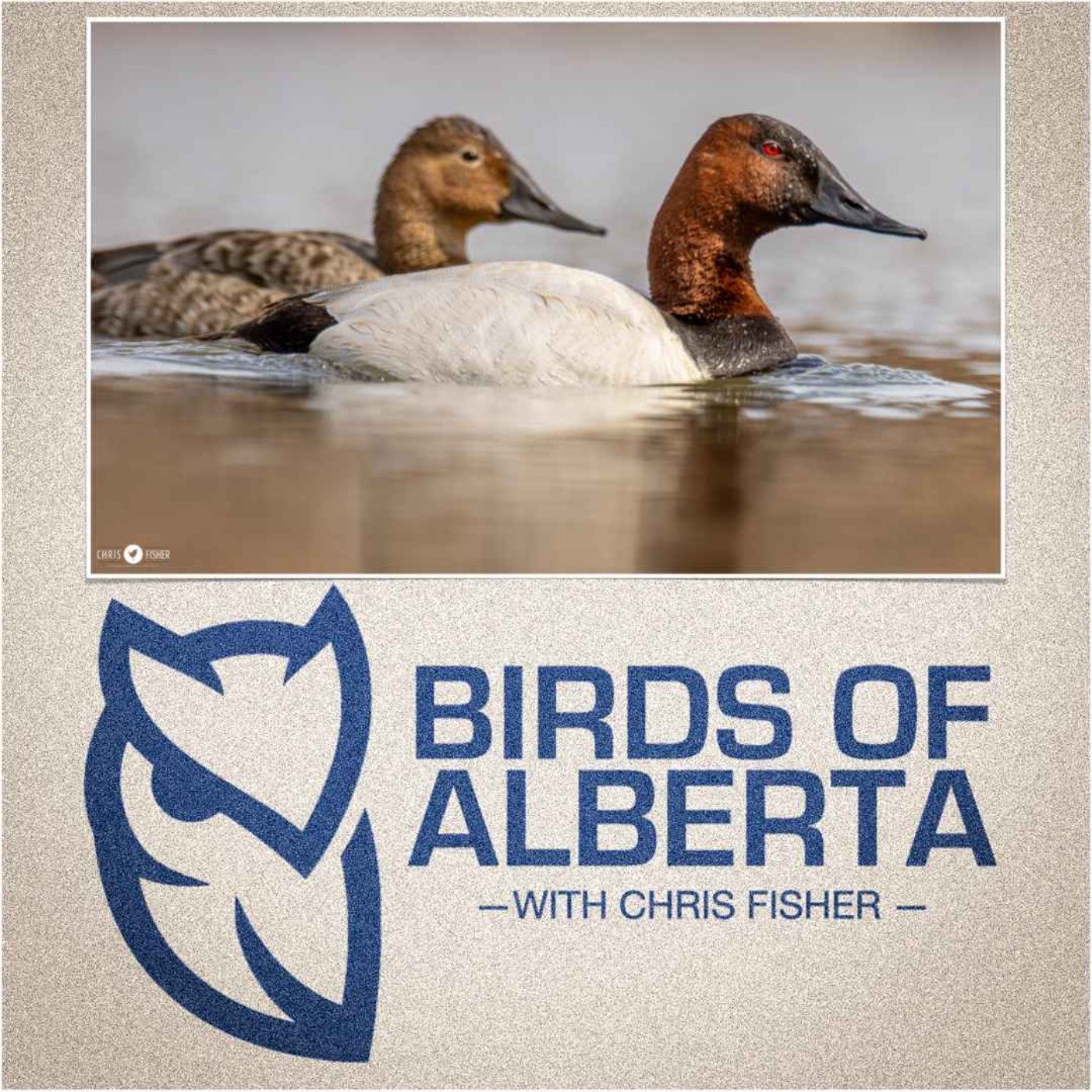
The Canvasback is celebrated as a majestic waterfowl emblematic of Alberta's diverse landscapes. Males are visually striking with rich chestnut heads and white backs, while both sexes share a distinctive sloping bill, ideal for uprooting aquatic vegetation. This duck excels as a diver, thanks to adaptations like rear-positioned webbed feet and red eyes equipped with a pectin structure for enhanced underwater vision in low light. It nests in mid-sized prairie wetlands, known locally as "slews," though these habitats are often undervalued and threatened. Canvasbacks migrate to wintering grounds such as Chesapeake Bay and San Francisco Bay, with populations rebounding to around 750,000 after mid-20th-century declines. Their red plumage, from phaeomelanin, aids in camouflage, thermoregulation, and social interactions. Interestingly, their resemblance to Redhead ducks stems from convergent evolution. The podcast emphasizes the ecological importance of Alberta's wetlands and encourages greater public engagement to appreciate and conserve these vital ecosystems and their avian inhabitants.
Welcome to the Birds of Alberta podcast. I'm Chris Fisher, co-author of the best selling field guide birds of Alberta. Now Alberta is viewed as a bit of a boastful place but one area where we have the greatest right to brag is in our landscapes. We have world-class scenery, the Rockies, the Badlands, our lakes and our major rivers. These are our great walls. Our pyramids are Roman coliseums and innatelyably linked with these places we have a most enviable assortment of wildlife. Populating these coliseum landscapes with gladiators, senators and even emperors. Our wetlands in particular host mesmerizing crowds of life, that mingolin mix that fight tend flux. But among those bobbing birds there is a standout without equal. An emperor that rises high above the rest of its waterfowl empire. It rules these waters, crowned in ruby splendor and is elegantly draped in a pristine white toga. Like a Caesar among the unwashed, this is a bird that holds court high above the rest of these birds of Alberta. It's the canvas back. Well we really can't begin this podcast without talking about the looks that the canvas back has. The males in particular just pop off the surface of the wetlands drying your gaze, whether it's through binoculars or on your screen. One of the most striking features of the males in particular is the rich chestnut mahogany heads contrasting with sleek black chests and tails. They of course have their tail tail white canvas backs in the middle. They make them very easy to recognize and distinguish whether they're on the surface or flying through the air. And while the females lack these bold colors, they have an elegance all their own as their body contours seem to be dipped in tasteful butterscotch. But while both males and females may look slightly different, they share an utterly unique profile. You see it's really that bill that makes canvas backs, whether they're male or female, stand out among the riff raff of the other ducks that they share wetlands with. It is an elegant bill running straight line from the top of the forehead to the bill tip. It's a sloping wonderful bill and specializes well as it's an adaptation to efficiently forage deep underwater on submerged aquatic vegetation, particularly tubers and roots of plants that they dislodge by yanking and pulling them free from the very bottom of our wetlands. And in this way they feed more similar to swans than to any other ducks and look closely at that wonderfully sloped bill and you'll see that it is a duck perhaps but with the bill of a trumpeter swan. And like swans the edges of the bills are slightly serrated with little comb-like structures that allow them to filter in and out the most desirable things that they would like to eat. And while this sloped bill is a spectacular one for feeding, it doesn't do much in its vocal repertoire. They really only have very soft nasal calls that really don't compare favorably with the loudmouth ducks that have to resort to loud verbosity in order to get a little bit of attention on the wetland stage that they share with the mighty canvasback. But for canvasbacks it really all comes back to their great looks, particularly the red featured on their heads. And red color is a little bit unusual in ducks. It comes from a pigment known as fio melanin which really serves multiple functions in these birds. For instance it can provide camouflage and there's certain environments. It's involved in thermal regulation, helping birds absorb or reflect sunlight as needed to maintain their optimal body temperature. It also may play a role in in social signaling certainly influencing the mate choice or territorial defense or even hierarchies among competing males within the bird community. So it perhaps shouldn't come as a surprise that the canvasbacks, truly outstanding looks, are replicated by another duck on Albertas wetlands and that duck would be the aptly named redhead. However, if you were to think that these were each other's closest relatives you would be wrong. The mirrored like plumage that both birds have is probably the result of convergent evolution which is a process where two entirely different species evolve similar characteristics. Think of the eyeball in homo sapiens humans and that of the octopus, both highly effective but obviously arrived to at independence. So that is how the color patterns of both the redhead and the canvasback were achieved and not as a result of one mimicking the other. So after hearing me talk up canvasback I'm sure you're eager to go out and try to find some for yourself and you may want to head out to those big northern lakes throughout Alberta but that is not your preferred area for canvasbacks rather. Head to mid-size wetlands known colliquely as slews which is a great Alberta term but don't look it up in a dictionary because the definition will not be what Albertans think of as a slew. It really is a middle-size wetland almost always wramed with vegetation like cattails. Not really somewhere where you think it'd be deep enough to float a boat but it's certainly plenty deep to float a raft of ducks. This is the perfect habitat for nesting canvasbacks in Alberta. One particular study found that 65% of canvasback hens they nested on wetlands that were one acre or less in size. That's just a little bit larger than a tennis quarter the infield of a baseball diamond and these are extraordinarily numerous through the Prairie region of Western Canada. And just on the edge of these common place slews that we have all over Alberta that is where the hens build their nest. Just barely crossing the terrestrial Rubicon you see canvasbacks aren't very good walkers so they just flop several meters onto the shoreline into flooded vegetation oftentimes where there's lots of growth for them to build a well concealed nest and they incubate their eggs. Well these nesting scenarios are not too different to those preferred by their red-headed relatives. Only that red heads are perfectly happy to be nest parasites and what this means is female red heads will flop around looking for other nests containing eggs and it doesn't have to be even the same species. In fact they're well known of dumping their own eggs within the nests of canvasbacks and leaving the canvasback hens to raise the entire clutch. Oftentimes as you might imagine at the expense of the canvasback's own young canvasback have never been the most common waterfowl in the Great Plains or in Alberta. That on our falls to species like Mallards and Northern Pind Tales. Back in the 1950s there was about three-quarters of a million canvasbacks in the North American breeding population. Those numbers declined quite a bit in the 1960s and 1970s but fortunately they've rebounded to about that three-quarters of a million population estimate today. Being a migratory species well canvasback conservation that only relies what we do here in Alberta but on their overwintering grounds as well and the birds that nest here on the pothole regions of Alberta they will migrate in the winter to both coasts the southeast area of the United States around Chesapeake Bay as long been a famous overwintering site for a population of canvasbacks. It's in fact in that region that their scientific name comes from that's valesonaria which refers to the genus of a plant an underwater plant known as wild celery which doesn't actually look much like celery at all. On the west coast there's a sizable population that overwinteres in and around the San Francisco Bay area. These areas have salty brackish estuary bays and marshes with just a whole loads of submerged
aquatic vegetation and also some invertebrates, I suppose, that just make ideal winter habitat for these canvas backs. It is there that about 250% of the west coast population of canvas backs tend to over winter with a recent survey in the estuary, tallying about 36,000 birds at Sunsignificant Marshes in that area. And it's also why we have a very interesting connection to this region. You see about a hundred years ago, all waterfowl, including the canvas backs, were in a significant decline. And the Pacific Rod and Gun Club must have taken notice of this decline because in 1942, they threw some money together to Ducks Unlimited Canada, who went ahead and excavated a piece of Alberta prairie just to the west of Brooks, Alberta, and created a large wetland. And that wetland every summer has been home to many canvas backs and dozens and dozens of other species of migrant waterfowl and other birds. And that wetland is known as San Francisco Lake. If you happen to find canvas bad ducks at San Francisco Lake, many other places that they are populous through through the southern half of the province, you spend a little bit of time with them. You'll notice that they are a tremendous diving duck, not the only diving duck, but they when they go down will spend more time diving deeper and longer than the other species that are diving amongst them. Their bodies are just perfectly designed for long, prolonged dives, their webbed feet are a little bit longer than most other ducks, and they're positioned way on the back of their bodies, allowing them to really propel themselves very effectively, like torpedoes through the water, but makes them very sloppy on land indeed. And going back to that famously sloped bill of theirs, it's almost as it's designed to be aqua dynamic, allowing them to cut through the water at great pace and efficiency. These features no doubt allow canvas back to have access to food resources that are only in the dreams of other diving ducks. But there's also something else that helps them in these underground ventures, and it's something very subtle, but very eerie indeed. You see canvas back have red eyes. Now they're not the only species of birds that have red eyes. It is a common feature of many of the birds that inhabit our wetlands. You see diving birds and the deepest of our diving birds typically have a specialized vascular structure behind the retina in the eye called the pectin. And this structure supplies a lot of oxygen and nutrients to the retina, which enables these birds to really maintain top visual acuity, even in the lowest of light conditions that they encounter when forging deep underwater. The blood vessels behind the retina are so densely packed with red blood cells that it results in a reddish hue being visible through the translucent retina making the eye appear red. And this of course gives it not only an eerie look, but it's also a great adaptation when foraging in the low, low light deep underwater in our freshwater wetlands. Well, you know, I'm so glad to have Alberta's canvas backs out there looking so good and representing their undervalued homes, you know, so many of our quintessential prairie wetlands are honestly, grossly underappreciated. They've been drained and destroyed in favor of more arable acres and more sprouting subdivisions. And in spite of having some of the very best prairie sluice in the entire world, we have very, very few boardwalks of any meaningful length to take us into our marshes or any other way really to get to know and love them. But if you give a sluice chance, maybe by pulling up alongside one out on a lonely gravel road and peeking over top, the cat tail spires that rim these wetlands. Out there in the dead center, you were likely to see a canvas back. Haley and its Roman nose up high, ruby-eyed and elegant as it holds court over its ephemeral empire. And you will then realize for yourself the entirety that makes the canvas back one of our most idolized birds of Alberta.
Podcast Summary
Key Points:
The Canvasback is a distinctive and regal waterfowl species in Alberta, notable for the male's striking chestnut head and white back, and both sexes' unique sloping bill adapted for foraging on submerged vegetation.
Its specialized physical traits, including a swan-like bill, rear-positioned webbed feet for efficient diving, and red eyes with a pectin structure for low-light vision, make it an exceptional diver compared to other ducks.
Canvasbacks nest in mid-sized prairie wetlands ("slews"), face conservation challenges, and migrate to coastal wintering grounds like Chesapeake Bay and San Francisco Bay, with populations having recovered to historical levels after past declines.
The species' red plumage, resulting from phaeomelanin pigment, serves multiple functions such as camouflage, thermal regulation, and social signaling, and its similarity to the Redhead duck is due to convergent evolution, not close relation.
Alberta's prairie wetlands are critically important yet underappreciated habitats for Canvasbacks and other wildlife, facing threats from drainage and development, highlighting the need for greater appreciation and conservation.
Summary:
The Canvasback is celebrated as a majestic waterfowl emblematic of Alberta's diverse landscapes. Males are visually striking with rich chestnut heads and white backs, while both sexes share a distinctive sloping bill, ideal for uprooting aquatic vegetation. This duck excels as a diver, thanks to adaptations like rear-positioned webbed feet and red eyes equipped with a pectin structure for enhanced underwater vision in low light.
It nests in mid-sized prairie wetlands, known locally as "slews," though these habitats are often undervalued and threatened. Canvasbacks migrate to wintering grounds such as Chesapeake Bay and San Francisco Bay, with populations rebounding to around 750,000 after mid-20th-century declines. Their red plumage, from phaeomelanin, aids in camouflage, thermoregulation, and social interactions.
Interestingly, their resemblance to Redhead ducks stems from convergent evolution. The podcast emphasizes the ecological importance of Alberta's wetlands and encourages greater public engagement to appreciate and conserve these vital ecosystems and their avian inhabitants.
FAQs
The canvasback is a distinctive diving duck found in Alberta's wetlands, celebrated for its striking appearance and unique adaptations. It stands out with its elegant profile and specialized bill, making it a symbol of the region's rich wildlife.
Male canvasbacks have rich chestnut-mahogany heads, sleek black chests and tails, and a white back. Their sloping bill runs straight from the forehead to the tip, aiding in underwater foraging.
The canvasback's bill slopes directly from the forehead, resembling a trumpeter swan's, and is adapted for pulling submerged aquatic vegetation like tubers from wetland bottoms. Its serrated edges help filter food, similar to swans.
Canvasbacks prefer mid-sized wetlands called 'slews,' often vegetated with cattails, rather than large northern lakes. These areas provide ideal nesting habitats, with many hens nesting on wetlands one acre or less in size.
Canvasbacks and redheads share similar plumage due to convergent evolution, not close relation. Redheads are known as nest parasites, sometimes laying eggs in canvasback nests, but the two species evolved independently.
Canvasback populations declined in the mid-20th century but have rebounded to about 750,000 in North America. They migrate from Alberta to overwintering grounds like Chesapeake Bay on the U.S. East Coast and San Francisco Bay on the West Coast.
Chat with AI
Loading...
Pro features
Go deeper with this episode
Unlock creator-grade tools that turn any transcript into show notes and subtitle files.
 PodcastTranscript AI