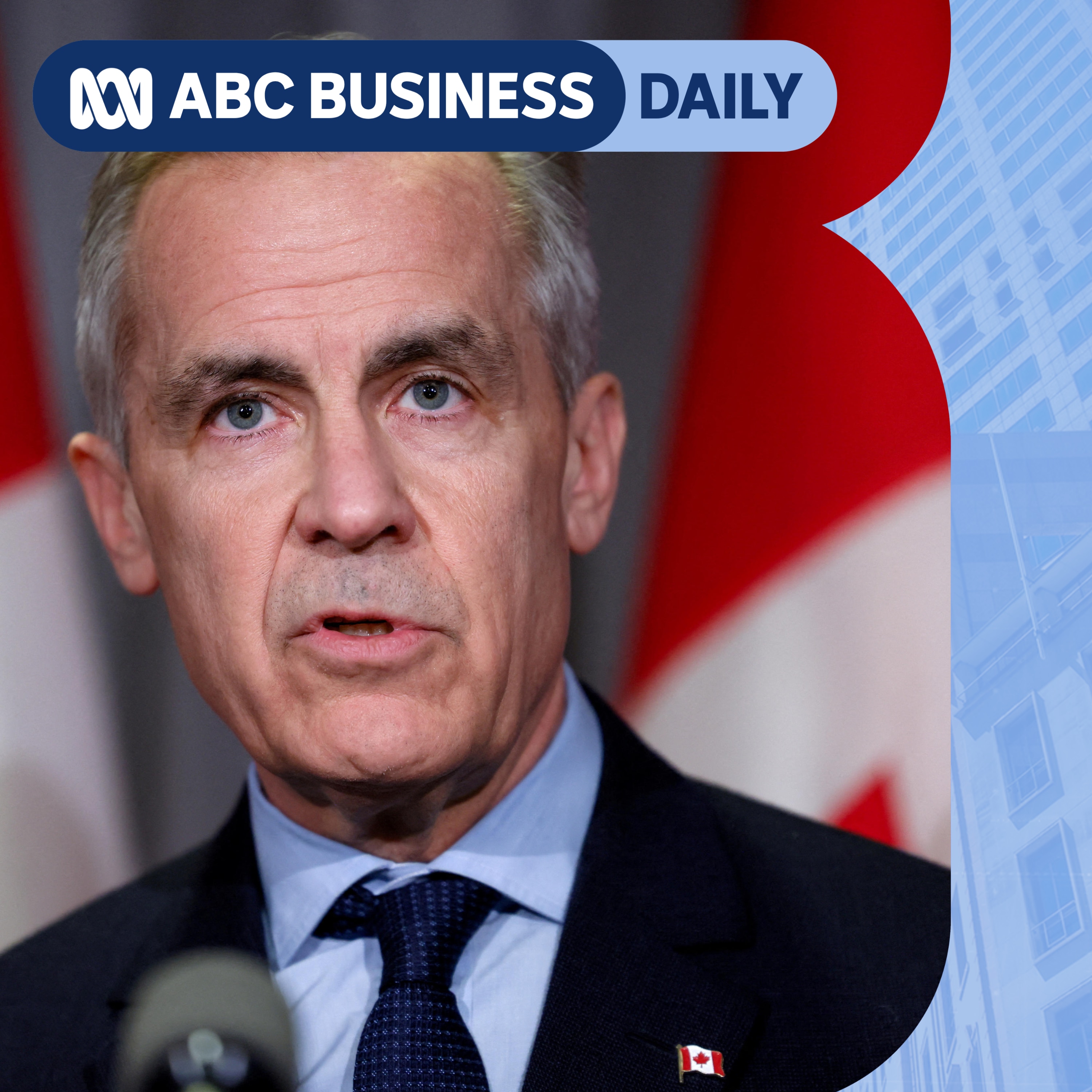
The podcast episode covers three major economic and geopolitical issues. First, US-Canada trade negotiations broke down, resulting in new US tariffs on $20 billion of Canadian goods, including liquor, plywood, and hockey gear. Canada, led by Prime Minister Mark Carney, plans to retaliate dollar-for-dollar starting September 8, but the delay suggests openness to a last-minute deal. The tariffs could hurt the US by raising construction costs and inflation, while Canada holds energy leverage that could impact border states. Politically, Carney’s tough stance is popular domestically, and the timeline may pressure the Trump administration before midterm elections.
Second, the US-Iran ceasefire has expired without a long-term agreement. The US is now pursuing economic coercion, targeting Iran’s already strained economy with high inflation and fuel shortages. However, pressuring Iran’s allies like Russia and China is difficult, and Iran’s threat to close the Strait of Hormuz could disrupt global oil supplies. Analysts doubt a clear resolution soon.
Third, the Australian dollar’s recent appreciation is attributed to US dollar weakness rather than Australian strength, driven by US fiscal deficits and bond market concerns. The upcoming Jackson Hole symposium, featuring new Fed chair Kevin Warsh, is critical for signals on US interest rates, which could influence the RBA’s policy. Overall, the episode highlights interconnected trade, geopolitical, and financial uncertainties.
A.B.C. Listen, podcasts, radio, news, music, and more.
Hi, I'm Alicia Simmons.
And I'm Lee Boucher.
As historians, we've spent years digging into the lives of people who've changed history for better or for worse.
So naturally, we are extremely qualified to gossip about them.
And because they're dead, they can't sue.
In our podcast, we sift through Australia's most notable and notorious characters giving you our unfiltered takes.
Search the Dead Cancer Podcast wherever you get your podcasts.
Trade talks between the United States and Canada broke down over the weekend,
meaning a raft of Canadian products are now facing a higher tax slug.
Canadian Prime Minister Mark Carney says Canada will retaliate dollar for dollar, and meanwhile the Australian dollar has been gaining value against the greenback for eight weeks in a row.
But is this about the Australian dollar really getting stronger or is the US dollar just getting weaker?
Welcome to A.B.C. Business Daily.
I'm Carrington Clark.
And I'm A.B.C. Business Editor Michael Yonder. Michael, thank you for joining us here on a Monday morning. Always a joy.
Always a joy.
We come in without all this news from the United States, both at the end of last week,
and particularly with Donald Trump, a lot of the question comes on the weekend.
It keeps on giving.
Unfortunately, the gift that keeps on giving, but not so generous towards his Canadian neighbours.
So really since Donald Trump came back into office for his second term, he's had a bone to pick when it comes to Canada.
Now this was, should point out, this was an issue in his first term as well.
Remember he renamed or he will claim remade the NAFTA agreement, North American Free Trade Agreement, rebranded it, put the US at the start, calling it USMCA.
He said it was a much better deal, but seemingly once he got in free second term decided it was also a terrible deal.
So that now is on a kind of rolling basis where they're updating it every year because he refused to lock it in for a sustained period.
But he's also going after Canada on different particular products, perhaps because they don't want to become the 51st state of the USA.
I think this is definitely part of it, but putting all that aside, Mark Carney, he's a former central banker, both in Canada, but also in the United Kingdom.
He came to power in part because he promised to take a tough line against Donald Trump.
He said he was the best credentialed person to be leading the country at a time when economic uncertainty was part of the course.
But he does seem to have changed his tone when it comes to this issue.
So we thought, I think last week, most people thought a deal would be struck that this was a serious thought a deal would be struck.
Yeah, which he said publicly a few times, but the Canadians said what they were offered just wasn't up to scratch.
They would need to give up too much in order to get a deal across the line. So they said no.
Yeah, and they were talking about last minute amendments from the US side that were unacceptable to the Canadians.
And not just economic, you know, not specific terms around tariffs or whatever, but perhaps some cultural amendments to any agreement that they just found unacceptable.
We don't know what the details of those were at this stage, but enough for Mark Carney to just say no deal.
And not only that, we're going to take you on dollar for dollar with our own tariffs on US imports.
Now that's a pretty brave move from a country that's a fraction of the size of its large neighbour.
And one would think the Canadians are going to feel a lot more economic pain from the US tariffs than the Americans will from them.
But there are some pinch points for the US that Canada can hit.
Yeah, absolutely. Let's work through what has now gone into effect because this isn't just bluster.
The tariffs on the increased tariffs on some Canadian products have gone into effect.
So this is 50% tariffs on some US $20 billion worth of Canadian goods.
That includes liquor, plywood, electrical equipment, and I think interestingly from a cultural perspective, hockey gear.
Now they represent about 5% of the country's shipments to the United States.
Canada says it will respond dollar for dollar, but theirs won't kick in until the 8th of September.
And that's an important date.
It does seem to give them some wriggle room potentially to come up with another deal before the pain is felt on the American side.
They're going to be looking at US dairy farm equipment appliances and steel.
Now, I think the fact that Canada has delayed the implementation of its tariffs is important.
I think Canada does still want a deal.
Obviously America is its most important trading partner and even though Mark Carney has been saying for a while now that they need to diversify to new markets.
And he has been going off and trying to do deals with other places, other economies like the European Union, also doing deals with trade deals with Australia for example.
Looking at those middle powers and how they can join together.
Yeah, he still recognizes how obviously important America is as a trading partner.
And remember the whole idea of NAFTA was to really integrate these two economies.
And you have situations particularly up against the border where it was supposed to be basically seamless.
Well, the auto industry was previously extremely integrated.
There was supply chains and Donald Trump found out when he tried to impose tariffs on Canada.
The US automakers were like, this will be a disaster for us because we can't just shift these supply chains that we've spent years developing overnight.
And this goes to part of it.
I mean, in some ways Canada doesn't even have to retaliate to inflict damage on the US.
The US still has an inflation problem.
One of the big areas targeted by the tariffs are wood products which are essential for housing construction and building construction.
And the US cannot make up the shortfall from effectively pricing out Canadian wood imports into America.
So what it's going to do is push up the price of construction and contribute further to the inflation problem that the US already has.
The other warning we saw from Mark Carney was pretty clear.
I mean, it was implicit but it was pretty clear.
He points out that Canada fuels, as he says, American grow supplying 99% of their natural gas imports, 85% of its electricity imports, and 60% of crude oil imports.
Now, those numbers can be slightly misleading because obviously the United States doesn't import electricity from many places because you need to have a direct border with it in order for that.
And OK, the US is an exporter of many of those other energy products itself.
But if it lost access to the Canadian imports, it would have to keep much more of its production at home.
And lose that export revenue that it's currently generating.
And again, it affects border states much more than it does other parts of America.
But if you are a border state that has previously been relying on electricity generated in Canada, then obviously a short term dislocation of that could be very, very painful as well.
Now, Mark Carney is on saying he is going to cut it off. He's saying, but of course America wouldn't want us to.
But I think part of the betting at the moment or the reason that Canada has decided to say no, is that Donald Trump, or Donald Trump's party, is going to be facing an election a lot sooner than Canada is facing an election.
Well, and this could go to some of the retaliatory tariffs. So you look at something like dairy, and it's the case with other agricultural goods.
You know, they're probably targeting particular rural areas in congressional districts where there will be a lot of heat on any Republican representatives who are seeking re-election, if suddenly local farmers have lost access to what was a significant market for them.
Canada and China are the two countries that have taken, have been willing to take on America when it comes to this trade war.
We saw the European Union effectively roll over in the end when it came to Donald Trump's threats to impose tariffs. They've done their own, but it really, they allowed America to kind of roll over the top of them.
But I think China obviously took the battle up to America and managed to get the tariff level down, though it is still much higher than it is for most other places.
Canada is different to China in that you have a leader who obviously speaks English as his first language is very media savvy and is able to take this argument directly up to the American people through the American media.
Speaking of the politics, I mean, in a way, Mark Carney didn't actually have much choice here because he was copying a lot of flak when this still was expected to be signed that he traded off too much with the US.
Because Canada was still going to be hit with much higher tariff rates on a lot of these goods anyway, and some of the metal exports that makes to the US, and these were going to be locked in as part of a deal.
So basically he's taken the smart political approach in Canada, which is at the moment Canadians are willing to wear a bit of economic pain because of their dislike for Donald Trump and his policies towards them.
At a certain point, they may feel that pain is too much and things might start to turn, but the US is much closer to that point with inflation still quite high, no sign of the interest rate cuts that Donald Trump was promising, a lingering war in Iran, which as we'll discuss soon looks set to get worse again.
And you know, we've got an administration there that's already deeply, deeply unpopular. Yeah, and I think if you're the Canadian administration, you're thinking, okay, so we've done deals on multiple occasions just in the last couple of years, you know, in a bit.
In addition to the re-negotiation of the trade deal the first time around, and it's like, at what point will this end?
And Canadians are pretty well thought of in most parts of America, right? This is a country who more. Most Americans have thought fondly of,
think that their partners have been long-term allies.
It always seemed like a strange fight to be picking to me,
except if you are just trying to put pressure
on them in the hope that you can be member.
- I mean Canadians are kind of to Americans,
what New Zealanders are to Australians.
Like there's a friendly rivalry
and Canadians might be the butt of some US jokes
and Americans no doubt are the butt of many Canadian jokes,
but there's a deep respect and friendship
between the two countries,
in the same way there is between Australia and New Zealand.
So it is kind of like thinking,
if the Australian government went on a major trade war
against New Zealand, you know, tried to close off the borders,
tried to restrict exports and imports
and really hurt New Zealand.
People in Australia would be scratching their heads
wondering why.
- Yeah, exactly.
- It's very similar.
- Yeah, it is similar.
I think it has good analogy.
And I think most people are not buying this idea
that Canadians were somehow ripping America off.
Now, maybe there was some sympathy
to the Donald Trump argument
that Canada wasn't paying enough when it came to.
It's protecting itself through military spending, et cetera.
But Canada has, on a lot of these issues,
been willing to renegotiate
so that they're going to be spending more money
when it comes to military or to renegotiate certain terms.
But I think at this point, as the Canadians point out,
there's kind of an incoherent changing argument
going on about, well, is this have to do?
The original terrorists were about fentanyl
claiming that fentanyl and other illicit drugs
were coming through the northern border
where the facts just said that there is a tiny proportion
of the drugs traveling into America.
Recently, he's been criticizing Canada
because of wildfires causing pollution in Canada
and said that that's a reason why we should go
after the Monteras
or that they've just had unfair trading conditions
and Americans have lost jobs.
Now, yes, I think a lot of Americans were frustrated
with NAFTA and thought that a lot of jobs did move away
from particularly the Rust Belt states,
but I think the criticism was more about going to Mexico
with lower labor costs than it was about going to Canada,
which has a pretty similar level of income.
If anything, probably higher minimum wages
and conditions than the US.
It feels like a political loser for the United States,
but I do think it goes to the heart of Donald Trump's politics.
He genuinely believes in tariffs.
He genuinely believes that America as a continental economy
can get away with basically being isolated
from every other country on Earth
and that he wants basically everything
that Americans consume to be built in America.
And he's willing to unpick decades-old alliances
in order to do that.
But I think the political necessity to put a line under this
to finish this argument before the midterms
will mean that we probably get a deal by September the 8th.
But let's see, it's impossible to predict exactly
what's happening with Donald Trump.
Let's turn to another issue of perhaps incoherence
when it comes to geopolitics
and that is what's happening with the Middle East.
So last week was important.
We had the official end of a kind of ceasefire agreement
that was in place between the United States and Iran.
60 days, that was the period, remember,
that we're going to get a piece in--
Memorandum of understanding to create the space
to get a long-lasting deal.
Well, there's no deal.
There's no deal.
That has ended.
Donald Trump doesn't seem to be in the mood
to continue military action.
There are real questions over whether or not
America has the necessary firepower in order
to do that without putting it at risk
in other areas of national security.
It now seems the focus is going to be on economic coercion.
But it's hard to see how you can force a country who
has faced, face sanctions for decades.
Suddenly, America is going to discover
the economic bulls eye in order to put pressure on Iran.
The claims from the US backed up
by some independent analysts as well,
like we're seeing very high inflation in Iran.
I believe some of the figures quoted
are around 90% plus annual inflation.
So it's bad.
The Iranian currency also towards record low levels
and has fallen substantially this year.
The damage to refining infrastructure
in Iran from those US and Israeli strikes
is really biting.
And there's talk that there are potentially fuel shortages
and that the heavily subsidized fuel
that Iranians have been used to is now
becoming hard to get and more expensive.
Food prices with pressure upwards leading to this inflation.
So I guess the US hope is if we go all in
and cut off those last remaining trade ties
and effectively what there's three main areas
they'd be targeting here.
There's the Gulf states themselves
which still have some relationship with Iran,
although the Emirates recently cut off a lot of those ties.
And so the US will be putting pressure
on other Gulf states to follow
and completely sever all ties with Iran.
There's also Russia of course
which has been doing a lot of military cooperation
with Iran as well.
That's probably a less successful avenue
given that Russia's already under sanctions
from the West itself.
And then there's China.
And how much can the US leverage China
into completely abandoning Iranian oil
and other goods and the trade in reverse
in terms of supplies that China's sending through?
I mean, there are peripheral countries
that might be easier for the US to leverage like India.
For example, I think they've done a pretty good
from the perspective when it comes to India.
It does look like India is buying a lot less Iranian product
than they were previously.
Yeah, so I mean, this is where they're trying to get the leverage.
But again, it's assuming that Iran
has no economic leverage of their own.
And of course, as we've seen,
they've already shut off the state of Hamuz
which has locked out at least 5% of global oil supplies.
They're now threatening in some quarters of the regime
to completely close off the Persian Gulf region
from oil exports.
The difficulty with the Trump administration in all areas,
particularly though, the military and the economy,
is that they use such hyperbole
that it's sometimes difficult to know
whether or not we are on the cusp of something massive
or whether or not it'll be a damn squib.
But the US Treasury Secretary Scott Besson
describing this as economic D-Day,
the greatest single greatest
to financial offensive ever marshalled against an adversary
in this op-ed in the financial times.
I mean, I think trying to pressure China and Russia
becomes very difficult for the US administration.
Russia already has a raft of sanctions
on many parts of its economy.
They don't seem to have much to lose
what else America could do
and why hasn't America done it previously
when it comes to the war in Ukraine?
If they're things that left up their sleeve,
why haven't they already used them?
And when it comes to China,
China has a geopolitical interest
in America being bogged down in the Middle East.
And also has so much leverage
as we found out the last time last year
when Donald Trump tried to go China economically
and they're just like rare earths.
Yeah.
And amongst other things,
but like, you know, US supply chains
are not genuinely independent.
The US is not yet an autarky
where it can produce everything it needs.
A lot of the raw inputs are coming from China
and US industry would shut down
if China completely severed those connections overnight.
But it does leave us in this situation
where I think most analysts now looking at the situation
think that we're probably not going to see any agreement
and that it's just going to continue on
as we currently are with maybe oil hovering
between somewhere between 70 and 100 US dollars of barrel.
Maybe stops and starts.
Donald Trump doesn't have a clear plan to get out.
Iran doesn't have a clear plan to get out
and maybe it would take a change of administration
in order for a deal to be done.
Well, a change of administration in one or both locations
and I think the US is pinning its hopes now
on crippling Iran's economy so much
that the revolt that started earlier this year resumes
not so much even against the ideology of the regime
as against the living conditions
and, you know, rising unemployment, rising living costs
and an economic dysfunction in Iran
that becomes too much for people to tolerate.
But how long that will take
and whether the West is also willing to bear the price
that that will come with is the key question.
I want to also turn our attention to the Australian dollar
which has been on an absolute tear
compared to the US greenback over the last couple of months
up three cents.
That's a substantial increase.
Now, this has both positive and negative consequences
for the Australian economy.
On one hand, it makes it more difficult for Australian businesses
to sell their wares overseas
because they've become relatively more expensive.
But it makes it cheaper for people to buy things from overseas
and that's good news if you're the reserve bank of Australia
and you're most worried about high inflation.
This helps the inflation piece.
But what's going on here, Michael?
Is it about the Australian economy looking more attractive
or is it about weakness in the US
and particularly about the outlook for the US interest rates?
Yeah, well, when you go onto a currency,
we have access to Refinitive,
which is a market data provider,
but you could go onto any of your online currency exchange rate
services and look at graphs over the past few months
about how currencies have been moving.
And there's a neat little graph of the Australian dollar
ticking steadily up against the US dollars.
You say around about three cents over the past seven or eight
weeks or so since the end of June.
But if you look at that same period against, say, the Yen, or it's a bit fluctuating because of the Yen doing some crazy things and the currency deal that they did with the US and so forth, but if you look against the euro, the pound, even the Kiwi dollar, there's not much movement.
There might be a few minor fluctuations, but broadly we've been pretty steady. So this is really a story about US dollar weakness, more so than Australian dollar strength.
And the US dollar has been weak not only because it's bogged down in these conflicts and has an erratic president, but also because they've had a huge rise in their bond yields, the interest rate that the US government's having to pay on debt.
They're desperately trying to push those long-term bond rates down by buying with the US government having to sell short-term bonds to buy the long-term bonds, increasing the price of those long-term bonds, which pushes the interest rate down.
But the markets on to them because they know they've got a debt ceiling legislated and that's running out early next year on current trajectory.
So the US treasuries pretty constrained in what it can do.
So unless the Fed wants to come to the party and start printing more US dollars to buy those long-term bonds effectively quantitative easing, there's a limit to how much those interest rates can be pushed down.
It's all about concerns about how big the US deficit is and the financial sustainability of what's happening in America, which have been ramping up since the global financial crisis, but people are getting seriously worried.
So it is a story about US weakness rather than Australian strength. We may have a trillion dollars now or just under a federal government debt outstanding.
And its economy is not that much bigger relative to Australia's. They have a huge debt burden. It is becoming a problem.
It was always on my list. People who haven't heard of Jackson Hole before, this is a symposium held annually by the Kansas Federal Reserve.
So the US has different regional Federal reserves as part of its Federal Reserve system. They've held this since 1978 and its permanent location has been in this mount and resort town of Jackson Hole, which is on the border of some of the most beautiful national park in the US.
And it's been held there since 1982. The reason was the Federal Reserve chair at the time that Kansas Fed was setting this up was Paul Volcker, who is a mad keen fly fisherman. And this is some of the best fly fishing country in the United States possibly in the world.
And they knew that if they held it there, he would come for sure. And it's been there ever since.
This will be the first one where Kevin Wash is center stage Donald Trump's hand picked successor to Jerome Powell. There's been a major question mark about whether or not he is willing to go against the will of Donald Trump and raise interest rates.
We haven't got to that point yet where the Federal Reserve has done it to see how Donald Trump will react. This question about the Treasury intervention in the bond markets, the question about American debt.
Kevin Wash actually wants to get the Fed out of owning as many US treasuries as it has. So, you know, he's facing a real potential conflict given that US governments trying to manipulate treasuries by buying the long dated ones to push those interest rates down.
So central bankers from around the world are gathering. I'm told that the RBA is sending deputy governor Andrew Hauser. It is a hootie. I wonder if he's a fly fish fan or maybe a hiker.
It is a hoose who have global central banking, all the big powerful central banks, including our own, which is fairly significant globally, will be there and discussing the outlook for monetary policy.
And as you say, the real focus is always on the Fed governor and what he will say. And in this case, Kevin Wash's last press conference left a lot of unanswered questions and kind of spooked financial markets because he doesn't like giving forward guidance.
So he's been very careful not to offer hints about what he thinks the Federal Reserve should be doing with interest rates. That's really unnerved people. And so they will be closely watching his speech to see what he says. If the US does find itself forced to raise interest rates to steady the fall in the US dollar, that will have implications for whether the RBA is under more pressure to raise rates here.
There will be a pitch for ABC business daily to be hosted out of Jackson Hole next year. I'll be putting it to the business center of the ABC shortly.
Unfortunately, I think I have to refer that up because I'd like to come to your delegation. That is it for today's episode of ABC Business Daily. We'll be back with another episode tomorrow. Make sure you are following us on ABC.
Or wherever it is that you get your podcasts. And if you'd like to send in a question, you can email ABC business daily at ABC.net.au. And if you'd like to send in a friendly suggestion that we should be doing it from Jackson Hole, feel free to add that to the bottom of your email.
Michael, catch you next time. See you in Wyoming next year. See you later.
Podcast Summary
Key Points:
US-Canada trade talks collapsed, leading to new US tariffs on Canadian goods (liquor, plywood, electrical equipment, hockey gear), with Canada promising dollar-for-dollar retaliation starting September 8.
Canada’s delayed retaliation suggests it still seeks a deal, but Mark Carney faces domestic political pressure to take a tough stance against Donald Trump’s tariffs.
The US tariffs may backfire by raising construction costs and worsening US inflation, while Canada has leverage in energy exports (natural gas, electricity, crude oil) that could hurt border states.
The US-Iran ceasefire has ended, with no lasting deal; the US is shifting to economic coercion, targeting Iran’s economy, but faces limits with Russia and China, and Iran could disrupt oil supplies via the Strait of Hormuz.
The Australian dollar’s recent rise is driven by US dollar weakness, not Australian strength, due to US fiscal concerns, high bond yields, and market uncertainty ahead of the Jackson Hole central bank meeting.
Summary:
The podcast episode covers three major economic and geopolitical issues. First, US-Canada trade negotiations broke down, resulting in new US tariffs on $20 billion of Canadian goods, including liquor, plywood, and hockey gear. Canada, led by Prime Minister Mark Carney, plans to retaliate dollar-for-dollar starting September 8, but the delay suggests openness to a last-minute deal. The tariffs could hurt the US by raising construction costs and inflation, while Canada holds energy leverage that could impact border states. Politically, Carney’s tough stance is popular domestically, and the timeline may pressure the Trump administration before midterm elections.
Second, the US-Iran ceasefire has expired without a long-term agreement. The US is now pursuing economic coercion, targeting Iran’s already strained economy with high inflation and fuel shortages. However, pressuring Iran’s allies like Russia and China is difficult, and Iran’s threat to close the Strait of Hormuz could disrupt global oil supplies. Analysts doubt a clear resolution soon.
Third, the Australian dollar’s recent appreciation is attributed to US dollar weakness rather than Australian strength, driven by US fiscal deficits and bond market concerns. The upcoming Jackson Hole symposium, featuring new Fed chair Kevin Warsh, is critical for signals on US interest rates, which could influence the RBA’s policy. Overall, the episode highlights interconnected trade, geopolitical, and financial uncertainties.
FAQs
It's a podcast where historians Alicia Simmons and Lee Boucher discuss notable and notorious figures from Australian history, offering unfiltered takes on their lives.
The talks broke down because Canada found the US's last-minute amendments unacceptable, including cultural changes, and Mark Carney refused to agree, leading to retaliatory tariffs.
Canada plans to impose dollar-for-dollar tariffs on US goods like dairy farm equipment, appliances, and steel, effective from September 8th, leaving room for potential negotiation.
The tariffs could push up construction costs and contribute to inflation in the US, as the US cannot easily replace Canadian wood imports for housing and building.
The gain is primarily due to US dollar weakness from concerns about US debt and deficits, not Australian economic strength, as the Aussie dollar has been stable against other currencies.
It's an annual central bank conference held in Wyoming since 1982, where global monetary policy is discussed. This year, focus is on Kevin Wash's first appearance as Fed chair and potential interest rate signals.
Chat with AI
Loading...
Pro features
Go deeper with this episode
Unlock creator-grade tools that turn any transcript into show notes and subtitle files.
 PodcastTranscript AI