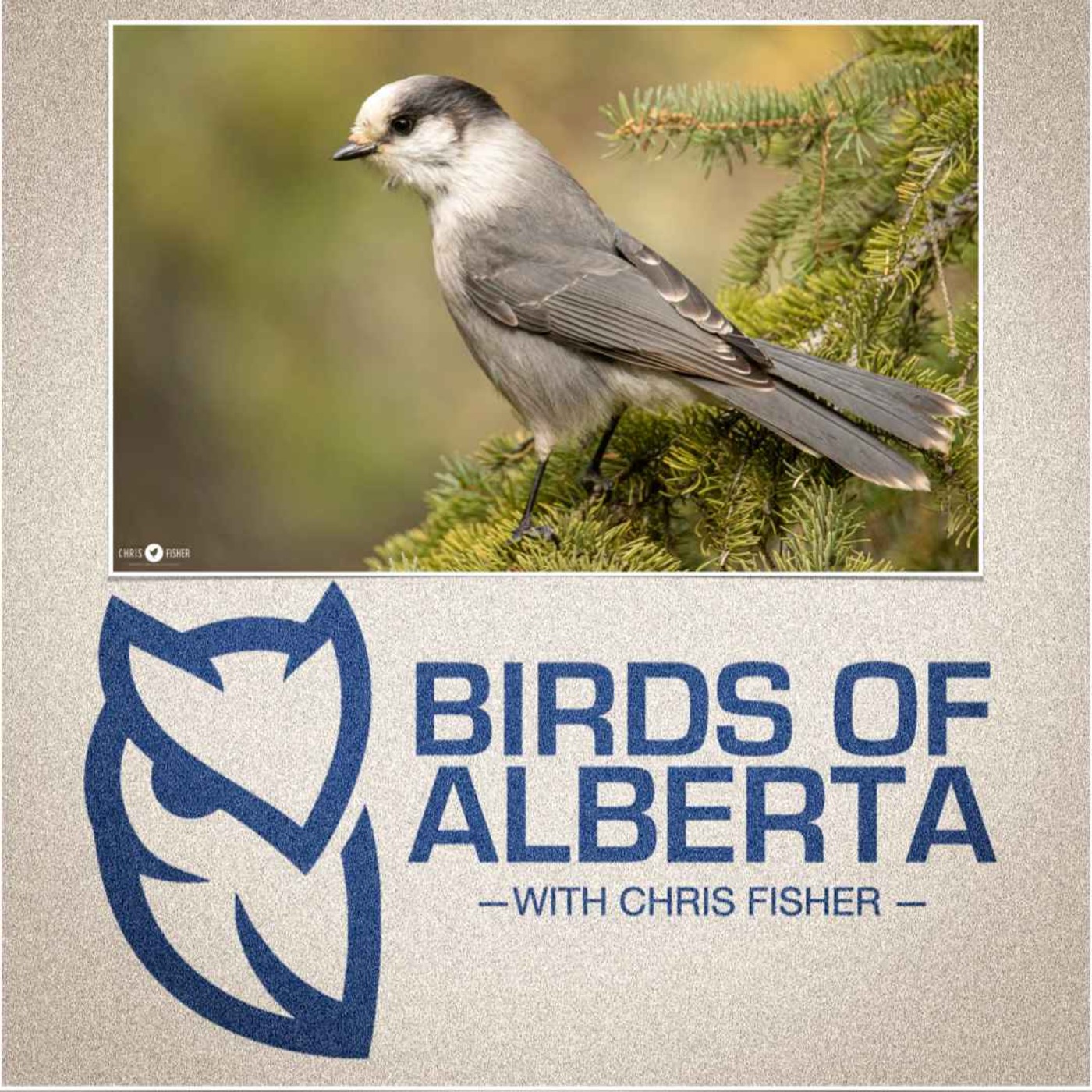
The Canada Jay is a highly intelligent and curious bird native to Alberta's boreal forests, known for its problem-solving abilities and exceptional memory. It survives harsh winters by caching thousands of food items coated in sticky saliva, retrieving them later when resources are scarce. Unlike most birds, it nests very early, in late winter, to allow its young ample time to learn foraging and caching skills from their parents. Culturally, the Canada Jay holds a significant place in Canadian folklore and history, with nicknames like "whiskey jack" and associations with lumber camps and Indigenous stories. Despite its iconic status, populations are declining in southern areas, likely due to climate change and habitat loss. The bird is celebrated as a national symbol of Canada, representing resilience, intelligence, and a deep connection to the wilderness.
Welcome to the Birds of Alberta podcast. I'm Chris Fisher, co-author of the best-selling field guide, Birds of Alberta. Now, no matter how much love and affection we extend to them, at best, at very best, almost all our birds are ambivalent to our presence, with most species quite honestly timid, suspicious, or even rightfully fearful whenever we show up. And you know what? I'll do it that. The wildness is no place for complacent beings. And sure, sure there's some friendly ones like the chickadees, they'll approach us and even land a branch or whisk her away from our faces. But these friendlies have all terrier motives, and have almost certainly become food conditioned. Yeah, that's a fancy phrase, meaning that these individuals have had previous contact with us and have been sunflowers seed-tamed through their empty tummies. But with all rules, there are exceptions. And here in Alberta, we have an exceptional exception. So take a walk in the northern forest, or ride there on horseback, ATV, or snowmobile, if you must, get way back there. Far from the highway, the cabin life and the noisy well-sights to where you are fairly certain, no one has stepped foot in years. And there, in a nowhere-albert forest, and especially on our drearious winter day, you'd think that you're all alone there with your thoughts. But almost inevitably, from the snowy silence, a spirit is likely to appear. And it is from the shadows of these spruce, noises, strange noises that are neither familiar or threatening, or they filter through the branches. Well, you'll hear chatters and clips and giggles, more monkey-like than anything else, but these are sounds that you tend to have trouble orienting to among all the deep cover. But then, in your periphery, a movement. And then, another. The ventriloquism act seems to up its game just to throw you off of it. But at last, the source of the calm commotion is revealed and floats down to a nearby branch. And it turns out that there is life here after all, a bird with bright inquisition, and one that is seemingly formed from the fresh powdery snow over which it sails. And because of this, and so so much else, this bird of Alberta has a soul and a spirit that is the true definition of our North country, this is the Canada J. The personality and the likeability of the Canada J really starts and ends with their braininess. Well, that's admittedly a bit of a reflection of a highly revered human attribute. And something we obviously admire in ourselves, it isn't often seen in most of our wildlife. So ahead, ask an owl to solve a puzzle and you'll get nothing and have to pick up all the pieces. It is really only in social wildlife, like wolves, dolphins, and chimpanzees, that we see problem solving on full display. And this intelligence is also a showcase of the Canada J, especially in two standards of smartness, their curiosity and their memory. One of the most identifiable traits of the Canada J is its curiosity, known in scientific circles as being knee ophillic, which means attracted to new things. This just makes them absolutely superb problem solvers, like many other knee ophillic birds. Oh, think about parrots and think about the other corbids because they're all all the time investigating new things in their environment. And one of the best things to do when you are on the lookout for something new is to trail the top dogs, the keystone predators in their territories. And today for Canada J's that involves trailing grizzly bears, wolves, and cougars because they often lead you to a lot of action. Now Canada J's have been around for a very long time incorporating this same technique that we see in them today. They go back about three million years in the fossil record separating from a very similar bird that is now known as the Siberian J. And there are plenty of fossils from the place to scene period dating back to 18,000 years ago. So they weren't necessarily trailing grizzly bears and wolves back then, but even more formidable place to scene mammals, such as, you know, saber tooth cats, the smiley dons, American lions and giant short-faced bears and dire wolves. So it's pretty cool to imagine the cute and adorable little Canada J of today showing up at feeding time just when one of these couch-sized carnivores are plunging their canines into the belly of a mastered, honor other extinct mammal. And just as today, no doubt the J's just hopped over to steal a scrapper too while managing to perfectly negotiate the safe zone between eat and be eaten like the true pro that they are. This might very well be their superpower since in the threat level and opportunity costs of their thievery. Now with all the North American megafauna all but gone, they showcase this same superpower whenever we show up with a snack. So it's no surprise that they can still manage to make off with a Doridor too from our unintended packs of the megafauna that's us that remain to this day. And while their curiosity really gives them a wing up on many of the other birds and wildlife that's found in the northern boreal forest, their braininess is expressed also in their intense memory. But this smart is ironically best realized through something not normally associated with being all that clever and it's their association with spit and drool. And normally we think of drool associated with dumb things, you know, like zombies or associated with dogs drooling or bisons drooling. Surely birds don't drool at all, but Canada jays while they don't necessarily drool, they are slobbery things and the important facet of that saliva is not necessarily in a pre-digestive mode such as our use of saliva. It is the stickiness of the saliva that comes into play after the food is swirled around their beak and crop for a little while because this saliva is sticky. The glob that they form is called a bolus and once it is nicely coated with the sticky saliva juice of the Canada J, it is neatly deposited on foliage or the trunk of a tree and there it sticks. And it's usually placed well above the layers of snow so they don't place many, many on the ground at all. By stashing way up high in the trees, they'll be able to retrieve these boluses, thousands of boluses over the course of the winter and by doing so it allows them to survive the harshest periods of a Canadian winter by relying not only on the food reserves but their intense memory to relocate all these bolus bundles. And so because of this great ability to recall, Canada J's do something that pretty much nothing else and certainly no other bird in the north can do and that is nesting in a time when there is not maximum food abundance in order to feed their young. That is usually of course occurring in the spring and that's the reason why most of the mammals and most of the birds and frogs and insects rely on springtime for the peak of their reproductive duties. But the Canada J's are just so awesome that they don't need to rely on a season, they only need to rely on their own habits of nature's best preppers. You see, Canada J's don't store their food in a single location like a dumb red squirrel would do in their middens. They're spreading these bolus bundles over a territory of about a hundred soccer fields. And in doing so they outsmart most of their neighboring species not only as they demonstrated great ability to plan ahead but sometimes other species watch what they are up to in particular other corvids such as American crows or common ravens and the wily. Canada J will incorporate a little bit of misdirection with other corvids watching where they're going. They'll pretend to place food in one area only to sneakily place it in another area to ensure that nothing is stolen over the course of the winter. They'll do this not hundreds of times but thousands of times for food items because they really need to have access to this freeze dried food when the stomachs really begin to grumble. You see breeding pairs of Canada J's will often start building their nests in the depths of February laying their eggs at the end of the month and they start to hatch in March when temperatures as we well know can still be minus 30. The parents can keep the eggs warm by having a very very well insulated nest complete with all sorts of twigs and grasses but feathers as well but it's still very cold outside in the rely on all this cached food to feed the rapidly growing young when there is still snow on the ground. Now it's a real fair question to ask why Canada J's would would need to start nesting so early when if they incorporated a typical nesting pattern they would hatch out when there was a bunch of juicy insects to feed their young but it's thought that they need a bit of a head start in order to learn all that they need to learn to survive year round in the deep dark Canadian forest, all the foraging and caching skills that they must acquire. Take several months to learn from their parents and they do hang around their parents. We often see family units later in the summer and into early fall the parents are easy to identify with those lighter gray plumages with a little bit of white on the top of their head. This gives them a bit of an appearance of having male pattern baldness and that may be one of the other things that biases my view of them. Young birds don't have that head coloration their head and their entire body is a much darker gray, much sooty gray so they easily stand out among the family units that we see pungy and about. They are all very very cute looking and their cuteness actually makes them a little smart looking too. They don't have the big heavy bills like blue jays and crow's and ravens and even magpies do they have a little tiny blunt little bill and nice little black eyes and a round head that really give them a characteristic baby face. Look at this may be another reason why we really like them. Stephen Picker calls it the geometry of the juvenile face, Conrad Lawrence. He called it baby schema or in German kinschen schema and that means that there are a set of facial features, a large head, maybe round face, a nice bowl forward facing eyes and a domed head. Well these all kind of look like human babies and those sort of characteristics trigger an innate mechanism in our own guts for caregiving and affection and that probably also extends to the baby face canada jays that we know and love. And there's yet more evidence that these are birds that we have great deal affection to and that's all the nicknames that we bestowed upon them from coast to coast to coast. They're just like the most popular kid in high school. They're just loaded with various nicknames over 30 have been tallied from the various cultures and various regions of canada and the upper United States where they are found. I like the name cap robber that's a pretty good one and good description of one of its main habits and trends particularly when we had a lot of lumber camps in the back woods. Albert and many of these names come from those times. Those lumber camps didn't have much internet or TV so they spent many of their days probably drinking way too much but also spending a lot of time in the company of these camp robbers who no doubt took advantage of their drunkenness to steal some of the foods that were lying just within their grasp. Corby meat bird, venison hawk, moose bird, timberj, which I actually kind of like, they are all attribute to their relationship with rugged outdoorsmen on the frontier but there's really one name that stands out that has really infused itself into canadaiana and that is of course the whiskey jack which is a perfect name for this bird in Alberta. Elsewhere in Alberta we have of course jack pine and jack fish, jack rabbit, jack bird, hump jacks, there's place names in Alberta called no jacks and two jacks so whiskey jack is a nice common moniker that really has a good connection to the Alberta landscape but funny enough it has really nothing to do with grain based alcohols but it's rather an anglicization of the crea whisky jack which actually translates to the little blacksmith which is an old to its city gray plumage and by knowing it as the whiskey jack or whisky jack in its common form throughout not only in Alberta but throughout Canada the canada jay or whiskey jack is about the only canadian bird who's got a name that is commonly referred to by a traditional indigenous name. But the official name and the wondrous name that it still holds to this day is Canada jay and it has been known by that since at least the 1830s but not continuously since the 1830s as there was a dark period of time beginning in 1957 when Canada jay was stripped of its Canada and was named the grey jay by the American ornithological union not only stripping the canada way but replacing it with the decidedly uncanadian spelling of grey gr a y but fortunately all canadians all proud canadians oh damn Strickland a naturalist over in Algonquin provincial park in Ontario and someone who studied Canada jays for his entire career well he investigated why the ornithological society made the shift in 1957 and found that their reasoning was not all that solid so he very politely petitioned this organization to reconsider the name and as luck would have it in 2018 the name officially reverted back to the Canada jay and let us hope that it remains thus evermore. This association with the Canada jay and Canada runs much deeper than just a name quite frankly there's a great tradition of these birds interacting with people I mentioned previously all the lumber caps and there were many many folk tales that emerged from this time and they typically evolve around the bird being a camp companion usually a positive camp companion a hero hunter a vessel for the souls of the dead probably as a result of their curious and smart nature it always seemed to be with the various folk tales that it was always best to treat the bird well anyone who mistreated the bird often ended up very poorly in these legions of folk tales that were told around the fire this was true not only of the woodsman on the frontier but also of first nation folklore as well there are many places to go for these particular tales that are in trance and very sacred to first nations culture one of the highlights is that the star at the tip of the tail of the big dipper also of course known as the bear in North American indigenous culture and also European culture the very last of those stars on the end of the handle of the big dipper was known as the grey jay or the Canada jay and it was a tribute to the story that the creed told about the bear and its association with birds and other forms of wildlife that the grey jay the Canada jay receives such an aspitious end point of that particular constellation Canada jays not only have a strong connection here in Canada to past activities but to present ones as well including in Alberta the Christmas bird count famously the Edmonton Christmas bird count was the very first of its kind anywhere in this province in 1906 Sydney Stansell legend in these areas did the very first Christmas count in and around what was Edmonton at the time and he tallied ten Canada jays and that was a record that stood for 84 years and this is in spite of the fact that there were dozens and hundreds of birdwatchers that would go up on subsequent Christmas bird counts while Sydney did it all by him self. It's probably no surprise that Sydney Stansell saw more Canada jays on his count than pretty much any other count has recorded since the changes not only in Edmonton but the development that we have seen throughout the province is probably contributing to fewer and fewer Canada jays showing up certainly in Edmonton well they're lucky to get one grey jay showing up every other year and Calgary over the last 20 years it's even fewer than that but occasionally one does fly in from the foothills the vamp can more Christmas bird count is probably getting about half the numbers that they used to get about 25 years ago and this long-term trend is echoed by population studies the main one was conducted by Dan Strickland who he mentioned earlier in Algonquin in Ontario and he noted over the fast 30 years or so that there has been about a 50 percent decline in that population I had to look at the breeding bird survey data from 1971 to 2015 here in Alberta and we've noticed a 35 percent decrease in the population as well and this may be due to climate change or it may have something to do with the bird's behavior you know certainly we fed more Canada jays previously and they became food conditions and would probably show up whenever a car pulled off to the side of the road to do a breeding bird survey so they were detected but it also is pretty reasonable to suggest that owing to climate change and development particularly on the southern edge of the boreal forest that there's less habitat for these birds and there were back in the 1970s or 1950s or 1910s it's not well known if there is a corresponding population surge on the northern end of the boreal forest is climate change impacts the southern edge of the boreal forest where most of our parks are and most of our encounters with Canada jays are it'd be curious to know whether the population is shifting just a little bit to the north which would be a good thing but sad thing also because those areas would be further and further away from population centers that can go out and enjoy these wonderful little birds so in my way of thinking the Canada jays is really the near perfect icon for Canada as a country and as a people and I am thrilled I'm beyond thrilled that this was also the conclusion that was reached by a project led by the Royal Canadian Geographic Society back in 2016 and while the Canada jays not officially been declared our National Bird by an act of parliament it is clear that there is quite widespread agreement for this as the contest winner and and while it fits perfectly a Canadian perspective inhabiting every single province in territory and it's a year round residence it's smart to plans ahead it's friendly it's cute and it's cunning all at the same time and certainly all these attributes make sound arguments for a standout provincial status here in Alberta as well so obviously I am a big fan of these birds and really most bird watchers who have got to know them are and so are all nature lovers and while I'd like it when they appear right out of the sprue shadows and glide into day use areas at some of our most common national and provincial parks and even some of the roadside pullouts to oh so cheekily steal our lunch I am more filled with meaning in fact in our more remote encounters now now every so often I'm fortunate enough to find myself driving through the foothills or boreal forest on a frost brittle January day when when all life and all wildlife seems to have been frozen out of the landscape those days are the depressing counterpoint to the crazy spring abundance days that we so enjoy and it has been precisely on wintery days like this that I sometimes pass the time by tracking each and every hopeful bird that I drive by which which usually is not that tough as the daily tally rarely exceeds like like 20 individuals I remember one typical outing last winter I saw only 10 birds that's it but six six were candidates all slow gliding overhead from neighboring treetops to meet my own and when and when you meet a candidate on one of our coldest days of the year you realize that that you really share much in common with these cold champions they are they're perfectly Canadian they're low-key so I've spoken resilient and most of all enduring they are a companion with whom we share a landscape and as a reflective symbol upon ourselves they are much talked about survivor that plays by the rules of the bush and they win by always being up to something even if it means getting the best of us every now and then all this makes the Canada J one of our most perfect birds of Alberta
Podcast Summary
Key Points:
Canada Jays are exceptionally curious and intelligent birds, exhibiting problem-solving skills and strong memory, which allows them to cache food using sticky saliva to survive harsh winters.
They have a unique early nesting strategy, breeding in late winter to give their young time to learn essential survival skills, relying on their cached food reserves.
The bird holds deep cultural significance in Canada, with numerous nicknames and folklore, and is strongly associated with the Canadian wilderness and identity.
Populations are declining in southern regions, likely due to climate change and habitat development, raising conservation concerns.
The Canada Jay is widely regarded as an iconic national symbol of Canada, embodying resilience, intelligence, and adaptability.
Summary:
The Canada Jay is a highly intelligent and curious bird native to Alberta's boreal forests, known for its problem-solving abilities and exceptional memory. It survives harsh winters by caching thousands of food items coated in sticky saliva, retrieving them later when resources are scarce. Unlike most birds, it nests very early, in late winter, to allow its young ample time to learn foraging and caching skills from their parents.
Culturally, the Canada Jay holds a significant place in Canadian folklore and history, with nicknames like "whiskey jack" and associations with lumber camps and Indigenous stories. Despite its iconic status, populations are declining in southern areas, likely due to climate change and habitat loss. The bird is celebrated as a national symbol of Canada, representing resilience, intelligence, and a deep connection to the wilderness.
FAQs
The Canada Jay is exceptionally curious and intelligent, with strong problem-solving skills and an impressive memory for caching food. It is also one of the few birds that nests in late winter, relying on stored food to survive harsh conditions.
The Canada Jay forms sticky saliva-coated food boluses and hides them high in trees across a large territory. This caching strategy, combined with its excellent memory, allows it to retrieve thousands of food items during winter.
The Canada Jay inhabits every province and territory, is resilient, smart, and friendly, and has deep cultural ties through Indigenous folklore and historical interactions with people. It was also chosen as Canada's national bird in a public contest by the Royal Canadian Geographic Society.
Common nicknames include Whiskey Jack, Camp Robber, Grey Jay, and Moose Bird. Over 30 nicknames exist, reflecting its interactions with outdoorsmen and Indigenous cultures across North America.
The Canada Jay shows intelligence through curiosity (neophilia), problem-solving, and deceptive caching to avoid theft by other birds. It also plans ahead by nesting in winter, relying on cached food to raise young when resources are scarce.
Populations have declined due to habitat loss from development and climate change, particularly at the southern edge of the boreal forest. Reduced sightings in urban areas like Edmonton and Calgary reflect these long-term trends.
Chat with AI
Loading...
Pro features
Go deeper with this episode
Unlock creator-grade tools that turn any transcript into show notes and subtitle files.
 PodcastTranscript AI