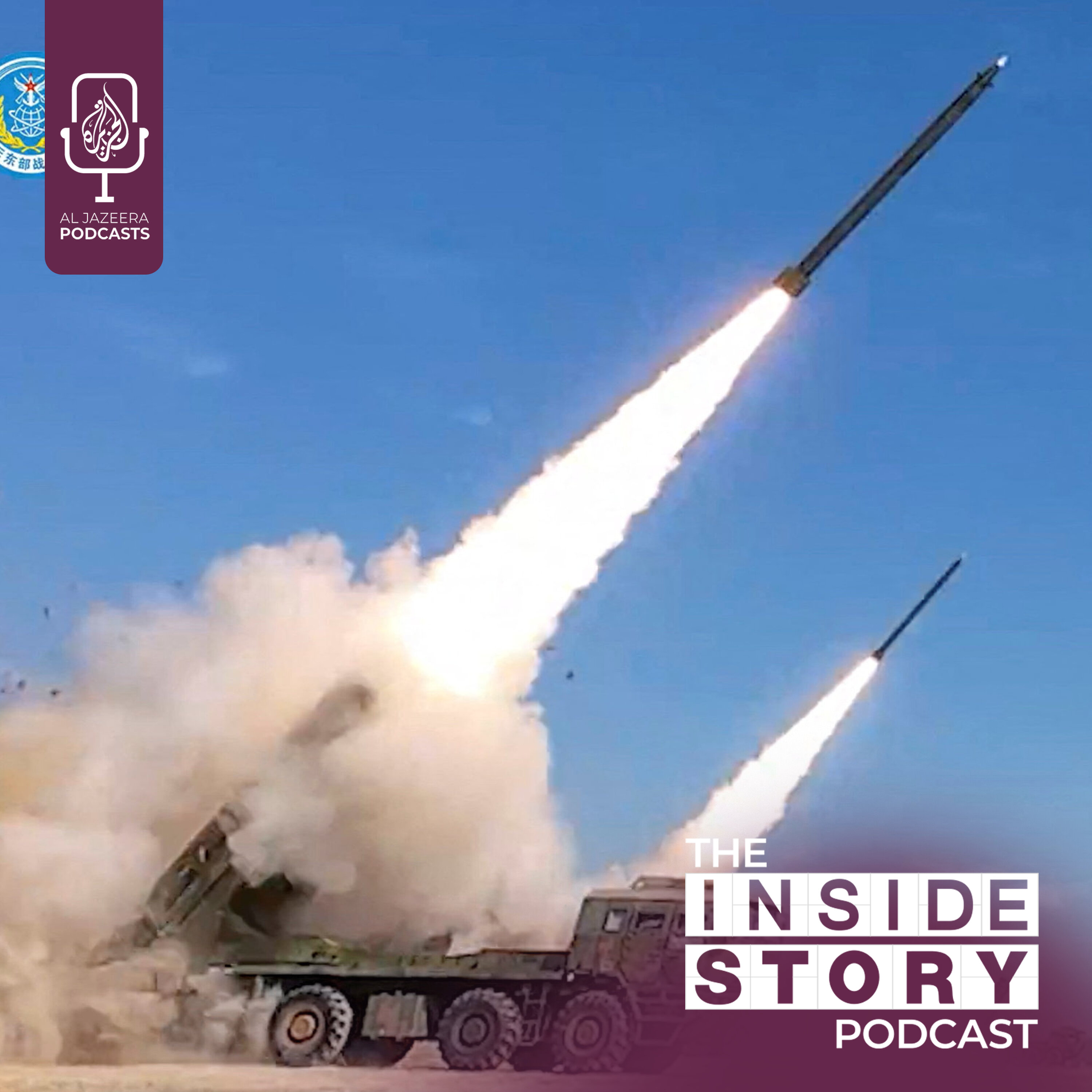
Can the growing tensions between China and Taiwan be contained?
25m 38s
Tension is running high between China and Taiwan. Beijing is carrying out its biggest-ever military drills off the island, saying they're a warning to what it calls separatist forces. So what's behind this show of power? And would China use force against Taiwan? In this episode: Shaun Rein, Founder & Managing Director of China Market Research Group. Chen Shen Yen, Research Fellow Institute of International Relations. Ja Ian Chong, Associate Professor of political science at the National University of Singapore. Host: Adrian Finighan Connect with us: @AJEPodcasts on Twitter, Instagram, Facebook
Transcription
3703 Words, 20968 Characters
[MUSIC PLAYING] Al Jazeera, podcasts. Tension is running high between China and Taiwan. Beijing has carried out its biggest ever military drills off the island, saying that they were a warning to what it calls separatist forces. So what's behind the show of power and would China use force against Taiwan? Hello, I'm Adrian Tennigan, and this is the Inside Story Podcast, where we dissect, analyze, and help define major global stories. So let's bring in our guests. From Shanghai, we're joined by Sean Ryan, founder and managing director of China Market Research Group. From Taipei, it's Chen Chen Yen, research fellow at the Institute of International Relations. And from Singapore, we're joined by Jayen Chong, Associate Professor of Political Science at the National University of Singapore. Gentlemen, welcome to you all. Sean, let's start with you. What message were these drills intended to send and to whom exactly? Well, it's great to see you, Adrian. Well, October 7th didn't start on October 7th, and these drills were not a provocation by mainland China. It's really Chinese government is trying to send a strong signal to three groups. The first is the Taiwanese. Second, and perhaps most importantly, is the new prime minister of Japan, Taikaiichi, who has taken a very warlike, aggressive stance towards China's rise. And has said that Japan will consider Taiwan to be a national security issue if there is armed aggression between Taiwan and China, and that Japan would have to get involved. You have to remember, Japan is doubling its military budget over the next five years. People within the Prime Minister's office have said that Japan should rearm with nuclear weapons. And then the third group that the Chinese government is trying to warn is Donald Trump and the Americans saying, you know what? It's not good that you sold $11 billion worth of arms to Taiwan. We're not going to allow you to contain China's economic growth and impinge on China's sovereignty. So it's really three groups, Adrian, that China has won such a large blockade, naval exercises against Taiwan over the last two days. Because China feels that it's being oppressed, and that the Americans and the Japanese are bullying China, which I agree I think they are. And so China is going to say, we're not going to be bullied. We're not going to go back to the World War II era. We're not going to go back to Imperial China era, where the Western powers in Japan really hurt China and impoverished them and caused tens of millions of people to die, Adrian. So China, I don't think, wants war, but needed to show and send a very strong shot across the bell. Chen Chenyei, a Taipei, what do you make of that? These, what, the sixth round of large-scale military drills around Taiwan since 2022, when US House Speaker Nancy Pelosi visited the island, was Taipei taken by surprise by the sheer scale of these military drills? Well, I think we are surprised, you know, this is at the end of the year, you know, we are reaching out to 2026, and people always worry about 2027 or 2035 or even 2049, you know, so this is such a live drill, so close to Taiwan before 2027, at the end of 2025, yes, that was a surprise. But just like, you know, Chen mentioned, it is not a surprise when you see, you know, Japanese Prime Minister Takaichi Sanei Takaichi comments about Taiwan contingency, which Taiwan is really, doesn't even have diplomatic relations with Japan. And we don't have so-called security aligns with Japan. So why is Japan involved in this one? And that's why China is very sensitive to Takaichi's comments. And also, we have purchased weapons, you know, we have procured weapons from the US in the past. Yes, China, all, every time China protests. But this is the first time we act with a strong military exercise. So that was a little bit of a surprise to us, but, you know, overall, I think we are not surprised because since you mentioned Pelosi's visit, this exercise around Taiwan's water, around Taiwan's territorial water or air space have been tightened and tightened, you know, every time, you know, we lost our midline between, you know, in the Taiwan Strait, between Taiwan Island and mainland China. And then, you know, we even lost the 24 so-called territorial water. And then the contingent's water right now is also being violated sometimes. So this is almost like a land, in Vietnam war, between Vietnam and the French. It's an encirclement of Taiwan, but not on land, but on the ocean as well. All right, Jay-en, I want to come back to the comments by Japan's Prime Minister in just a few minutes. But in the meantime, let's pick up what Sean was saying, pick up on what Sean was saying. Is China being bullied right now by Japan, the US, and Taipei? China's a big power. It is the second largest economy in the world. I'm not sure that China's being bullied, certainly, it's facing pressure. But, you know, it has a lot of capabilities to bear. Of course, it's very common that the PSE will claim that it's bullied and claimed that it's angry. But you know what, you know, coming from a much smaller country in Southeast Asia, many of us are all of us smaller than the PSE. It's somewhat strange to hear this bullying language. Okay, Sean, do you want to come back on that? Beijing, of course, has sanctioned around 30 US defense firms after this 11.1 billion dollar arms sale to Taiwan. Are those sanctions symbolic? Do they meaningfully change anything that the cost calculus, for instance, for Washington? Yeah, no, this is basically very symbolic. So they first slap sanctions on subsidiaries of companies like Boeing. So China might still buy Boeing airplanes for commercial purposes, though there was a four year moratorium starting in 2020 when China didn't buy any commercial airliners from Boeing. Because they wanted to sort of punish Washington DC for what is clear bullying to anyone with a pragmatic mind. And instead they bought airbosses from France. But they also did symbolic sanctions on people like Palmer Lucky, who's the CEO and founder of Anderl, one of the largest drone companies. Because Palmer has said he is getting his entire company, his drone company, everything ready to be able to defend Taiwan in case China were to launch armed aggression against Taiwanese to really push for reunification. So people like Palmer Lucky, a lot of the other executives on the list or heads of other drone companies are part of this new force of weapon technology. So it's no longer just the Lockheed Martins and the Raytheons of the world. It's now the drone manufacturers like Anderl. And so China wants to make sure that these people and their companies can't get access to China's ecosystem of drone manufacturing. Because for a lot of these companies, 60-70% of their parts are still sourced from mainland China. So it's a symbolic push, but it's very clear to me and I think to most Chinese that America and Japan is trying to bully China, even though it is the second largest economy. You can see over the last nine years, China's put export controls, sanctions on China. You know, they've pushed companies like ASMR from the Netherlands not to sell their equipment to the United to China. They're banning companies like Huawei from the United States. They're stealing TikTok in the United States. So it's very clear that there's this containment policy under starting first under Joe Biden. It's certainly lessened under Donald Trump, but the Chinese feel that they're under an assault. Again, October 7th didn't start on October 7th. The Americans are provoking China. A lot of people in China feel that the Americans want to start a proxy war over Taiwan. The same way that NATO and the United States started a proxy war with Russia over Ukraine to sort of impoverish and bog down the Russians and also to send a signal to China. So Xi Jinping has said, "I don't want to get into a proxy war in Taiwan with the Americans. I'm not that stupid. I'm not like what Putin did." All right. Chen Chenyein, please feel free to come back on that. But I wanted to talk to you about reaction there in Taiwan. In a statement on Tuesday, Taiwan's defense minister Wellington Koo said that Beijing's highly provocative actions severely undermine regional peace and stability. And also pose a significant security risk and disruption to transport ships, trade activities and flight routes. Koo described the exercises as a form of cognitive warfare that aimed to, quote, "deplete Taiwan's combat capabilities through a combination of military and non-military means and to create division and conflict within Taiwanese society through a strategy of sowing discord." In what way could they so discord among people in Taiwan? How do most people feel about China right now and about these drills? Okay. Right now, I think this military exercise is only for two days. But we get a taste of what kind of blockade might imply. For example, the you mentioned about transportation also, you know, just not just ships, but also airlines. They have to change their, you know, court routes to avoid this exercise. So we kind of feel if this really happened with Taiwan's energy supply, especially the gas, liquid by gas and also the oil. From Middle East going through the South China Sea through Taiwan straight, if it's blockade, you know, we only can have about two weeks of, you know, reserve. So do we have enough? So that is going to be a consideration. And the other one is just being, you know, being a regular travel traveler that you go to other country. And now your flight may be cancelled, maybe delay. So this is the first, but also it's intimidating because it is so close to Taiwan. And then they even shown a drone with a picture of our, you know, a footage of our 101, which people said that might not be real. But still, they are trying to intimidate Taiwan, not just military, but also economically and psychologically as well. But the problem with Taiwan is we have, you know, heard the world is coming for, you know, this is, you mentioned the six times since Nancy Pelosi visited Taiwan. So people might feel so let off leaving off their guards. That is not a good news for Taiwan. We are not our toe sometimes. But this time, I think the military, our, you know, the defense department is more alert than before, but still for ordinary people. We didn't take it very seriously because even before this one we have a lot of drilling of emergency drill, but not a single time that we have a actual drill of make sure everybody know where the bunkers are. Where do you hide? It's just one hour of, you know, not being able to go out to just stay in your home or if you are in a restaurant, you just stay until from one 30 to two o'clock or two 30 something like that. I think we need to have more, you know, I would say almost like war like type of preparation instead of the government worried that if you they actually mobilize people to prepare for war, it will be chaotic. I think that's the mentality right now is like keeping it a low profile and then everybody would be okay. And that's not the best way to prepare for your conflict. I would have come back. Are we jumping around a little bit here? But I want to come back to those comments by by Japan's Prime Minister in November, who said that an attack on Taiwan would be a survival threatening situation for Japan. What's behind those? Why were those comments made? Those comments were made in the Japanese diet in response to a question by a bandage colleague. Now, if you look at ceilings of communication, air routes, submarine cables connecting Northeast to Southeast Asia, they could go around Taiwan, you know, either mostly on the eastern side, but, you know, some through the street as well. In fact, a lot of shipping goes to the street. So if there was a major disruption of conflict, what we would see is a disruption to supply chains, we would see a disruption to the import of energy for places like Japan, but South Korea as well. We would see a disruption of traffic and potentially this, you know, the submarine cables coming under under threat from one side or the other. So what that would mean for Japan is that it's access to financial markets. It's access to fossil fuels, it's access to global markets, it has the trade will be severely hindered, if not disrupted, that would be extremely costly for Japan and any sort of domination of those areas would potentially put Japan in a pretty vulnerable position. So I suppose she was responding to that. You know, so yes, I get the whole point about bullying, but you know, looking at these big powers potato potato, these big powers, they're always going off at each other saying one thing or the other, but they have these concerns. China has their concerns and they're just going at each other. That's all it is. Sean, on Monday, President Trump said that he wasn't worried about the drills and that he has a great relationship with China's president Xi. How's that going to be read in in Beijing with reassurance in difference? What will Beijing see that as weakness perhaps? It's reassurance that Trump is changing his playbook, right? It was very clear under the Biden regime that Joe Biden would defend Taiwan and was trying to contain China with sort of the high fences strategy. And that was very clear that it was a George Keenan 2.0 contained China. But Trump, he's not an ideologue. So I think he's sending a signal to Xi that he wants to sort of lower the temperature on the trade war with the United States, because China at the time was saying we wouldn't export rare earth materials to the United States, which America needs to power iPhones or to power their weapons. I think Trump was trying to, in a good way, sort of lower down the temperature. Now, I'm actually not that concerned about a full armed conflict from Beijing's view, Taiwan, our friends, their cousins, and they don't want to have armed conflict. What's really important is that you look at the Camt, or the Guangdong, the opposition party in Taiwan. They have really come out and said we want closer relations with mainland China. Taiwan's former president Ma has visited China several times in the last couple of years. He's been treated as a hero, big welcome crowds. He's met with President Xi. Now, the current chairman of the Camt, a woman, has said that she would like to meet President Xi. So I think China will bite its time. It's going to show armed aggression and a muscular power through these exercises, again, to warn the DPP, warn Japan, and warn America not to go too far, not to cross a red line. But at the end of the day, I think China wants to reintegrate peacefully, reunify peacefully by hoping that the Camt wins the next presidential election a couple of years and can try to merge through one country, two systems like they've done with Hong Kong. So I'm kind of aligned with Trump. I'm not that scared. As your other guests said that you have these sort of exercises six times in the last couple of years. Nothing has ever happened. People become complacent because I think the reality is if you're on the ground, neither the Taiwanese nor the mainland Chinese want to have armed aggression. The big wild card is would the Americans provoke something that was my fear with Biden. I'm not so scared with Trump. Chen Chenyan, Sean says he's not that scared Taiwan, though, says that these drills, at the very least, risk a serious miscalculation. What would that look like in practice? How close are both sides perhaps? You talk about the level of preparedness there in Taipei. But what would a miscalculation look like and how close are both sides to it given the frequency of these drills? I think we have been very restrained in terms of trying to not to provoke even when China was having this exercise, maybe crossing the line or we might have some warning about them crossing the line. And nothing really aggressive from Taiwan, no aggression from Taiwan. So what I see is, in the past, people said China had a time table of 2027, but in 2025, this year earlier, the ruling party DPP started a big recall campaign. Because they are the minority right now in the legislature. So they felt that a lot of agenda they want to implement cannot be carried through because they don't have the majority. They want to recall a lot of 30s to we call the KMP legislators, but not a single one was successful. So it's almost like a response of Taiwan voters to Xi Jinping saying we hinge our hopes on the Taiwanese people because before if something happened if the recall was successful and the KMP became a minority. And DPP became majority and then from Beijing's view is that the peaceful unification is no longer possible and then the military preparedness should be ready there. And then anytime they feel it's ready, they might want to attack Taiwan. But right now, just like Sean said earlier, maybe they can wait until 2028 when KMP might come back to power, which is not a sure things right now. But still, it's it's a delay. At least I don't think 2027 is a time table right now is at least beyond 2028. Jay, Sean says he's not worried. President Trump says he's he's not worried. What about what about some regional actors, the Philippine South Korea, we've already discussed Japan is the current tension likely to be able to be contained through signaling deterrence diplomacy. Or are we entering a more dangerous phase where an actual confrontation becomes harder to avoid? So with the specific specifically to the military exercises, I think there isn't that much concern right now that there's generally sort of, you know, there's generally calm towards it, although there's concern that there's there's going to be escalation, unintended escalation, you know, if some accident happens. But of course, there is concern that over time, you know, we could get a situation where all sides feel that they can, you know, pull, you know, they can get what they want. And as in Sean's words, armed aggression from the PRC might happen. So there is that investment, you know, in the military. But at the same time, you see the PRC also investing significantly in its own military has the largest navy right now. And so I guess if we're in a situation where everybody thinks that deterrence might work, that investment in the military might not necessarily be a bad thing. But, you know, the question is whether you get the signaling signaling right, whether there's going to be any miscalculation, whether there's going to be any issues with deterrence failure. So those are really the things that we have to be concerned about, perhaps not right at this current moment, but as things develop, those would be trends to keep an eye on. All right. Sean, final question to you. I've got about a minute left. So I need a relatively short answer from you, please. Beijing, of course, frames reunification as its historical mission. Does that language suggest a certain inevitability, do you think? From the mainland Chinese side, it's inevitable that Taiwan and China will reunify. The hope is peaceful, but Taiwan, Tibet, Hong Kong, Xinjiang, these are the red lines. China will go to war if the Americans or the Japanese try to end China's sovereignty because they remembered what happened in the 19th century under the Qing dynasty when they were bullied. So I think China will push back very hard. Hopefully there won't be any actual armed aggression and that it's more deterrence and that you can have pragmatic minds come together. But Taiwan is China's red line. China is making that very clear to Trump and the rest of the world. This edition was produced by Muhammad Aliqi, Imogen Kimber, Lawn Peter and Paul Taylor. Studio Sound was by Renjith Kourian, the program was edited by Anabhan Saka, Zeynabada and Jodafrias. You can catch every episode on the Inside Story podcast, but don't forget to subscribe and review us on your favorite podcast to app, share the episode and leave a comment too. We'd love to hear from you. Thanks for listening. Tune in again on Wednesday for our next edition. Hi, Halemahir Dean here. We've just wrapped up our first season of True Crime Reports, a global crime show from Al Jazeera. Over season one, we've taken you inside the darkest corners of humanity, exposing how the wealthy hunted civilians for sport during the siege of Sarajevo, uncovering the shocking rise of a pedophilic cult in Chile under dictatorship, and tracing the downfall of Asia's most infamous drug lord. And here's the good news. Season two is already in the works. We can't wait to share what's coming up, but more on that soon. For now, don't forget to follow or subscribe to the show to stay up to date with the latest updates. And while you're at it, leave us a review and tell us what stories you'd like to hear next season. I'll be reading your comments. See you soon. [Music]
Podcast Summary
Key Points:
Summary:
Chat with AI
Loading...
Pro features
Go deeper with this episode
Unlock creator-grade tools that turn any transcript into show notes and subtitle files.
 PodcastTranscript AI