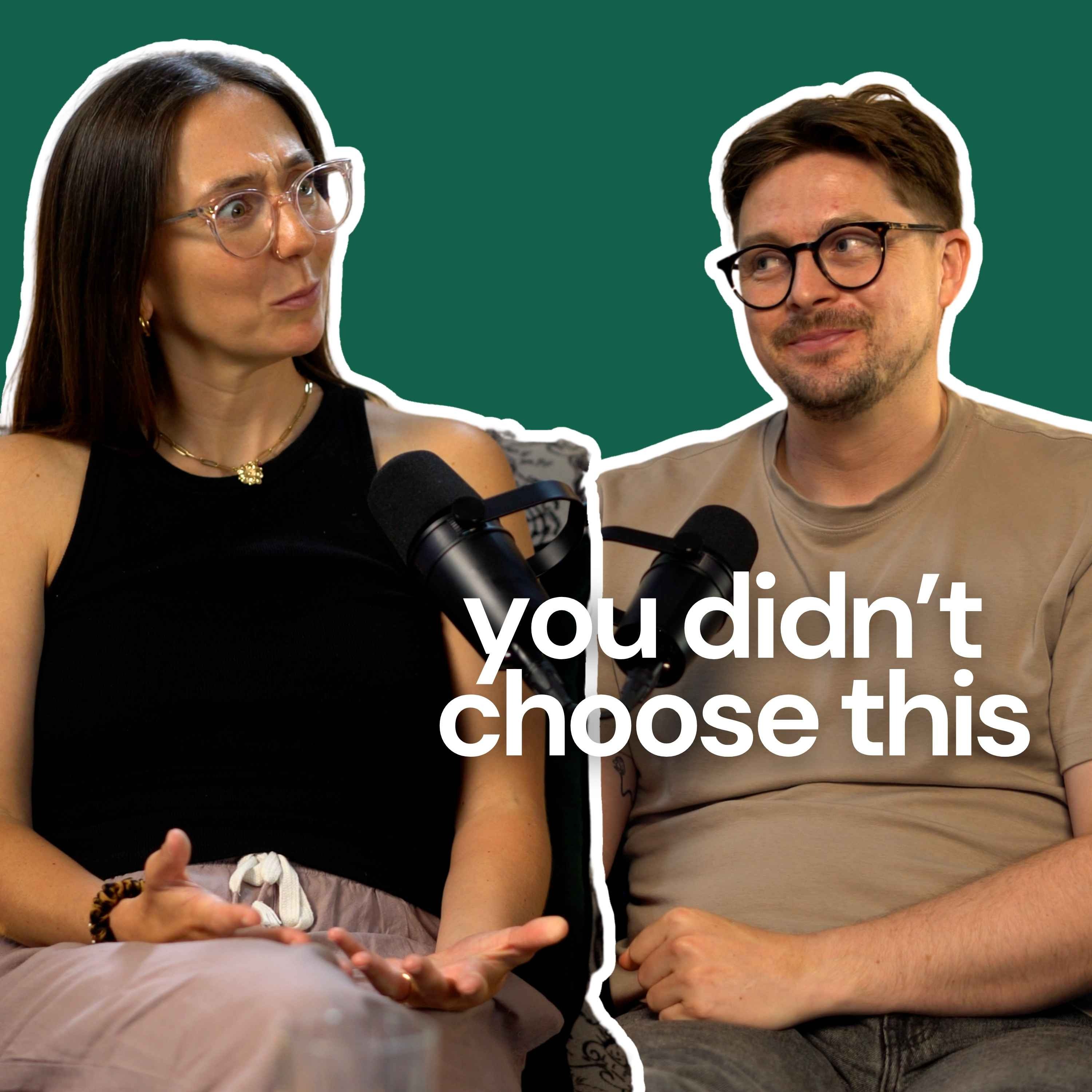
[Music] Hello and welcome to the Figuring Out podcast, the new Doctor Alex George. And me, Doctor Catherine Bates. We have had a fascinating, actually the first few parts are pretty long because we've just been talking away and debating away on this conversation and free will, which has been fascinating. But in part three we're actually going to be doing this myth fact and it's complicated, I can say that because it's written on the page and we'll learn it eventually. Where this stuff is adjacent to obviously the topic that we've had. But quite interesting and there's a few ones here that I think will be debated somewhat. Anyway, let's get into it shall we? Yeah, so we're basically going to take statements that you've always wondered about. Like, is that true? What does that mean? And decide if it's a myth or a fact or whether it's complicated. Okay. So let's get into the first one, pretty deep. You can't and do the effects of a difficult childhood. I mean, this is literally what your research is on. So I'm definitely going to let you answer this one. Yeah. This is your specialty. There's research showing adverse experiences, which is basically a potentially traumatic event. Like losing a loved one abuse could be discrimination bullying. This shapes who we are. So it contributes to our, it shapes our brain development, mental health, cognition. But so do many other factors. And there's things like post-traumatic growth that we covered in the heartbreak episode, which is this idea that you can experience something traumatic and you can come out stronger and you can grow from it. So not just returning to whatever your normal is, but actually growing from it. So in terms of it being deterministic, the effects of a difficult childhood, I would say no, but everything that we're experiencing is shaping who we are. Yeah. And it's clear answer. Yeah, I think that's, that makes sense. It is one that I would agree. It is complicated. I think you can't, unless you were to forget something happened in your life, you can't remove its effects. And even then, because our tissue responds to trauma, like our brain tissue, even if you couldn't remember it, say you generally had amnesia about the event, at a later point, it's still going to affect you, right? Because it's happened. But yeah, the effects of it in terms of like, does that mean that you're always going to be sad or angry? Or, you know, those kind of things. I do believe that you're able, well, neuroplasticity exists. I do believe that people are able to grow like post-traumatic growth from an event. But it doesn't mean that's easy, of course. Yeah, change is possible, but it doesn't mean that it's not difficult. And it also can be different for different people. Yeah, absolutely. That's, it's an interesting one, though, isn't it? Because fundamentally, going through something hard or bad or difficult stuff. Yeah. You know, shit, things affect you. That's life. That is what happens. Right. Number two, you don't really have free will. You were brain-designed before you do. So this is obviously linked to what we've talked about. Yeah, so we've talked a lot about free will in part two. But this is an opportunity to bring in a little bit, some cool science. So it says, so your brain decides before you do. There's basically some evidence around unconscious decision making. So this evidence comes from a range of studies. And some, I've pulled out some like, tidbits of findings. So for example, some studies show that distraction is often associated with better choices than conscious thought. Unconscious thought is thought to have better capacity and the ability to way up information than conscious thought. And this is thought to be because of like the additional processing that goes into conscious thought. Yeah, that can affect that. And a nice example of unconscious thought is like, do you know this about Paul McCartney? He said that he was asleep when the melody for yesterday came to him. And that he just like rolled out of bed and played it on the piano. But then is this like when we talked about deja vu that actually he thought about a different point of the car number and therefore it's like feels that he's linked to three. I think potentially. But it is unconscious thought. Like whether it came from when you're asleep or like the point is is that you consciously don't know what your unconscious thoughts are. Well, but I've had I would say a lot of my thoughts or ideas have often come at very random times, often where I'm completely relaxed. You know, like when I go off and going for a walk is when an idea will come for me when I'm really not trying to think about it. So it is that unconscious like appearance when I do that's come to me. I guess maybe it is. Yeah, definitely. Mine is when I'm cycling. I have like my best ideas or if I'm yeah, when I'm cycling is the best example. So it does kind of hurt my head to think about because like what is unconscious thought if we can't label it. But basically some of your best decisions might not be the ones that you're consciously working really hard at. Problem is that if I'm sat on delivery for example, the unconscious thought might end up with the wrong take away versus the conscious brain going. Probably not the right thing to do. So maybe maybe there's a time and a place for the conscious versus. Yeah, that's true. So that's why maybe it's complicated. So yeah, sometimes your brain does decide before you consciously decide. Almost as a reaction fascinating. Let's do another one. If your parents are extroverts, your destined to be as well. That's fascinating because of course there is a genetic component and it's I mean, extroversion is thought to have around 40%, heritability. So obviously that shifts the likelihood of it. But of course, as we've said in the previous parts, there are so many elements to what will then go and shape that person. I'm also getting good about that clay and pottery analogy. You might have the clay that is there. But then what you brought up with is going to kind of impact that. What are your siblings like? How do you interact with them? Do you have siblings? You know, are you brought up going to like sports in different classes that like encourage you to be extroverted and give you those people skills, for example. So yeah, I think with that one, I don't think you're destined to be so because it might be the other way around. You might have very loud parents and you're someone actually that just wants to go to the bedroom and chill on your own, you know? 100% and I think if we're going to be black and white about it, which is the importance of this concept, we're going to go myth because you're not destined. Not destined to be an extrovert if your parent is an extrovert. Should you do another one? Yeah. Therapy can change your personality. I mean, I've seen this myself. I think that's a fact because again, when we're looking at, you know, you mentioned that the people please the inside of things, right? That is something that you can change. It can be quite a strong personality trait. It can be something that people recognize and you recognize yourself as being part of who you are. You can of course, you know, use methods like CBT to change that process, to change that cycle, to a point where it becomes unconscious, it becomes the norm for you. So I do believe that. I've witnessed that in myself. You know, I've certainly changed not only because of life experiences, but because I've done a lot of therapy and I've looked at decisions that I've made or not made and I've learnt from why did I do that? Why wouldn't I do that? I don't want to live my life. I don't want to interact with other people. And that has definitely shaped me. Yeah. It happens to me as again, I am, there's a core of me who I am, but there are other parts of me that are definitely changeable. Yeah, and I think like learning that our personality does change and is not like stable, is quite freeing. Like it feels like we have space to grow and especially with my like, was it 93% of agreeableness? But that is something that I've been working on and I think I'm getting better at like recognising the people pleasing in myself. And yeah, I think it's quite freeing to kind of accept that things like that do change. People are not in boxes as well. No. Like for example, you'll have it a lot within our fields where like if you're medical, well you've got a medical, you've got a science brain, you're not going to be creative. Like this is idea of like mass of creativity. It was actually like, you can be both like I'm both creative, but also I have a scientific mind as well. I don't some people might be on the extremes or one of the other, but you don't have to be. And I think you can genuinely be someone that's lived a life in a very science where and become creative. Creativity is a muscle. There's something you can build and grow. It's not a finite resource. It's not something that's either there or not. I genuinely believe you can become these things. So like mass, you might say, I'm not good at maths. What if you practice maths half an hour a day for six months? You're going to be good at maths. A lot of these things are actually skills. They're like muscles that you grow. Yeah, definitely. I know so many scientists that are also brilliant artists, which is quite cool. There you go. Multi-mati-talented people as you scientist. Right. Right. This one I'm going to direct towards you because it's a hard one. I think you can. Actually, it's because you're a bad person. Is it difficult? Alex, can bad people change? Yeah, Alex. Okay. A bad person can never change. I don't believe that to be true. I also think the definition of a good person and a bad person. What does that mean? All human beings are complex. Everyone will have good moments and bad moments. No one would like to hear the worst mistakes. Everyone has had moments that they would go back and do differently. Conversations you've had with people.
you've reacted in the situations, eras of our youth, for example, that you would definitely do differently as the whole point of maturing and growing up, the whole concept of growing up. So, you know, I believe that everyone has a mixture of, you know, to quote Harry Potter, when Harry Potter is talking to his godfather, Sirius Black, and he says to Harry, because Harry's worried that he's a bad person, he said, well, Harry is, you know, it's called Harry, you know, people are not divided into death eaters and good people, you know, there's a good dark, there's light and darkness in everyone, and I genuinely believe that, I believe that to be true. So, can bad people change? First of all, what is a bad person? You know, good people do bad things, bad bad people do good things. I think people can learn and change and grow if they decide to do so, if they, you know, like a moment in their life, they go, I'm not going to continue to repeat the same pattern because it's led to this outcome. You can change to do that differently. It does require empathy. It requires humility, it requires a sense of like self, I guess, an awareness of impact on others. So, there are people say, for example, if you're a psychopath and by definition, you completely lack empathy to the point where you're happy to do illegal things or criminality, whatever it might be, but that becomes very difficult because you lack, you're going to lack that driver for change perhaps, or it's likely, whereas that's a very small percentage of people. Most people who do stupid things or make mistakes or do bad things are capable of change if they decide to do so. That's my opinion. And I think as an extra point to it in general, I think that people should be given grace to change. I think that we should allow people grace. It's not the same as exoneration or not having accountability. That's not that conversation, but going back to the prison stuff, half the people end up back in prison or reoffending. I think because we're so focused on punitive punishment, you are bad person, you've done bad. Of course, it's not about not having accountability. That's not the point here, but I think there has to be a belief and a pathway for change. You allow people back into society to be different. So for and resources. So bro, there's people out there, I've come across people who have been gang leaders and now go into schools, talking to young people and helping people not to end up in knife crime and in gangs, and literally saving lives, changing communities through their work. That is redemption, that's change. So that leads really nicely onto the next one where there's a will, there's a way. Okay, go on. So I think that's a myth. Yeah, why? I think that this is like that manifesting thing that everyone talks about. Do you all like manifestation? Do you not believe in manifestation? Let's get there. This is going to be interesting. Motivation and intention are real and important, but they are affected as we've said a few times by everything else, biology, environment, mental health, like everything that we're experiencing, genetic makeup. So I will power, never acts alone. And there's also, I think quite a lot of the time in these conversations we don't think about inequality. So some people experience systemic racism or discrimination. Some people are locked into a cycle of poverty, for example, and that makes things very difficult. I think sometimes it's difficult, you can have a lot of motivation and intention, but there's structural things against you that make something very difficult. So the blanket statement of where there's a will, there's a way, I don't believe is true. Yeah, I agree with that in terms of that statement for sure, and that's why we have the statements is the habit clear back and white. If we're going to say there's a world as a way, then no, because you know, with the greatest will in the world, I would not be beating you saying, "Bolt in a hundred meter race, even if I trained for a thousand years, it's just not going to happen." Right? You know, for example, I, when I was young, I was very young, I dreamed of being a fighter pilot, when I was really young, I was before, you know, when I was talking about my single digit years, but I've grown up to be some of the sixth foot four, so I would not be able to fly fighter jets. I am too tall. There isn't height limits. I can't remember what it is, but there is an effect. Yeah, because essentially in the fighter jet, you've got an eject, this is what I've been told, anyway, correct me from wrong. There's ejectors, seats. So if you imagine the ejector seat coming, blowing, you know, shooting off, so the lid flies off, then it blows you out. Well, if you're female length is too long, what's going to happen? I said, "Core on the frame, you're going to lose your legs," right? So you've got to have a height limit to be able to do that. The other job I'd love to have done is being a Formula One driver, and now George Russell's pretty tall, but at six foot four, it's pretty unlikely. You've got to be light and small and all those things. So, you know, there are physical limitations. Lateral owners, you say, the systemic issues, not just racism, sexism, if you look at about social mobility perspective as well, you know, if you are born in a in a private school with fantastic contacts, you're much more likely, clearly, to end up getting a great job in law and the magic circle in London or working for a business and having an opportunity, right? That's just absolutely obvious. So I don't believe there's a will as a way. What I do kind of think is that within the confines of your limitations will power and determination and almost relentless
ness can help. So I can't become 100 meter runner. I can't fly a fire jam. I won't race a Formula One car, but given the skills that I have and in the setting I am in and with the confines that that will bring, I can definitely do better than I would do if I didn't have strong willpower. Sometimes I could definitely can do better if I'm determined and really give things a go. So I think, you know, you can change your life, basically. You can do things. It doesn't mean that you suddenly, I can't miss to side. I'm going to be the president of America. I can't do that, right? I want to be. I think as well, so what you're touching on as well is like, is attitude and approach. Like, maybe I don't really understand what manifesting is, but it's part of, I think earlier in my 20s, I got into, you know, talking about like moving to London, having regret or whatever. I was in like a certain negative mindset and I do feel like things kept going wrong because I expected them to go around. That was manifestation. And I was putting myself in these situations and it just, I couldn't understand what was going on. And I do think, yeah, having a different outlook and a different attitude. Maybe it doesn't lead to more things, but it leads me to see certain things as opportunities or it leads me to like make the most of my choices. Like I was talking about, like Lauren said. So yeah, what is that manifesting? Well, if what have changed the title slightly and said that do you believe in a, do you believe in the idea of self-fulfilling prophecy? The idea that if you say I'm going to fail, that you will fail or that if you think I'm, you're going to succeed, that you go to succeed. I think it's unlikely to be like absolutely clear cards because it's like no matter again, me thinking I'm definitely going to be a fantastic footballer will not help me. Well, we'll should we come back to that. Let's have a look at it. Oh, I'm thinking of mindsets. But we'll definitely come back. Let's come back. We're going to have to do one. So this set of three parts, we're going to definitely do gut instinct. We're definitely going to do manifestation because actually loads of people believe in it. So again, interesting points, but let's all go to our office. But I think the idea is that clearly that it's a myth. Well, there's a world as a way that's not true. But don't let that stop you from thinking that you can, that positivity, that optimism and that hard work within those confines of that, the challenges will, and I believe it will lead you to a better life. I think that you, you can improve your life through that mindset. I don't know. You can just entirely shape it or change it entirely. Yeah, and there is evidence that I definitely want to bring in over in its own episode or one of the other ones you talked about about mindsets in health and how put simply positive mindsets can actually change health outcomes. Well, put it this way, optimists live longer than pessimists, which makes sense. And a lot of it is because your decision making as an optimist will align with someone who's going to live longer with pessimists won't see the value necessarily in those activities or decisions that align with along the life. Fascinating. Guys, we'll come to that end of the part there. It's been, it's been great enjoying this with three episodes in now. Yeah, and this one was like way more, it's just so difficult to answer. It does hurt your brain, but it's so, it does hurt the brain a bit. Interesting. I feel like I've learned a lot just through having a discussion about it. I remember guys, we are figuring it out. We're not pretending to be here the oracles of all answers. So if there are perspectives or even research you've seen email,
[email protected]. We obviously can't reply to everyone, but if you send those in, it might be useful. We can reference stuff in the future or kind of loop back to some of these topics if new evidence comes up. Then that's what's exciting and interesting. And please do send in your questions at the same email because that obviously becomes an anchoring point of the podcast in part 2. We'd love to hear from you. And just a reminder as well, you know, we come back every single Monday Tuesday Wednesday with three parts. You can watch all of it visually on our YouTube channel, my YouTube channel, Dr Alex George, just search it. Everyone's day that video will come out so you can watch it in full and enjoy it. And then my final part I was going to make as well is that if you want to have the audio version with no advert over the top all in one part and early, you can access that with Apple Podcast if you click the link in the bio on a free trial and then it's a monthly amount to keep accessing that. Check it out. Thank you so much, Catherine, for the wisdom and the research. We'll see you all in the next episode. Next week, goodbye.
 PodcastTranscript AI