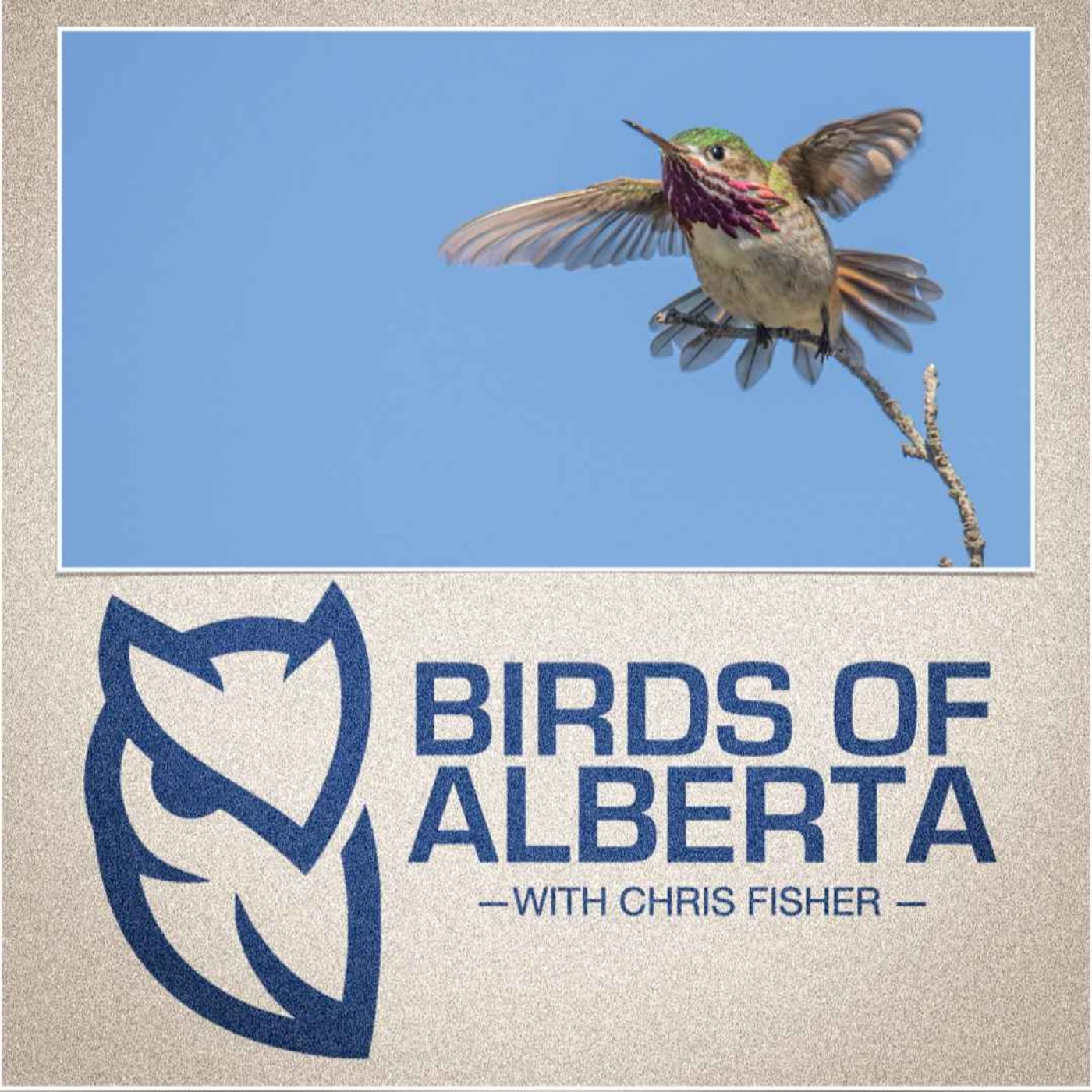
The podcast focuses on the Calliope Hummingbird, the smallest bird in North America, found in the subalpine regions of Alberta. These birds inhabit open areas like avalanche slopes, where they feed on nectar from specific wildflowers such as paintbrushes. Despite their stunning magenta and green plumage, they are exceptionally hard to spot due to their tiny size and elusive nature. Males gather in open "lek" areas to perform dramatic aerial dives to attract females, while females build tiny, camouflaged nests in dense conifers. They are remarkable long-distance migrants, traveling thousands of kilometers annually. In late summer, they may visit urban gardens during migration, offering a rare chance for observation. However, finding them in the wild requires understanding their habitat and behavior, especially as artificial feeders in mountain communities are often banned to prevent attracting bears.
Welcome to the Birds of Albert, a podcast I'm Chris Fisher, co-author of the best-selling field-guide birds of Albert. Now, there's a lot of reasons to take a hike up into our Albert or Rocky Mountains, and if you're like me, as much as I enjoy pushing to the very top, I also enjoy frequent stops along the way. Lots of frequent stops, in fact. One of my favorite areas to stop in these sub-alpine routes are open areas like avalanche slopes and other clearings, where willows and alters are really the tallest thing around. They can endure the regular flows of snow that happen throughout the year as avalanches come down. These areas are great to register your progress by being able to look off in the great distances undeterred by a forest canopy that can close in around you. But they're also a great place where certain wildlife and wild things can be found here and nowhere else. Wildflowers, of course, are here in great abundance in late May and early July. You'll find paintbrushes, police chowllies and anemones. They of course attract pollinators and all sorts of nectar-loving life. You'll find some of the best concentrations of summer butterflies up on these high slopes. And of course bees. Large bumblebees dig in into the flowers and then rocketing purposefully off to find another pollen plunge. But here too is another nectar lover, whose amazement rivals any other in the worlds of birds and all creatures. It is only a trifle larger than these bumblebees that are buzzing around, with which it shares its lunch counter, and they dart and buzz using a similar direct flight path. But it's their color and radiance. And always on the go lifestyle. That makes these birds one of the most mesmerizing birds of Alberta. It's our colliopeie hummingbird. Now hummingbirds are some of the most intriguing birds in the entire world, quite frankly people in the old world, Europe and Africa and Australia. A revered these birds because they simply do not have members of this prestigious group that flit among the flowers in those parts of the world. It's only in the Americas where hummingbirds are found in the tiny colliopeie, the smallest hummingbird in all of North America, stands out, stands small in its own way among this wonderful crowd. They are very tiny, weighing in at just two or three grams. That's about the weight of a penny, only about a third of the weight of other tiny birds, like wood warblers, really to a colliopeie hummingbird. A wood warbler is what to a grizzly bear is to us. Their looks of course are superlative and very important and distinctive. In a crowded field of true beauties, the male colliopeie stands out from the other hummers that we have in Alberta and throughout North America with its vibrant green plumage, but really it's unique, splaid and streaked magenta gorgeous. It's a bib painted on, seemingly by a psychedelic artist from the 1960s. The truth is that finding colliopeie hummingbirds is really rather difficult in the province of Alberta. Now the range maps. You know from books and apps, they'll indicate that they're found in our foothills and mountains and that's true, but to find something so very small, so very small in a landscape so very large puts really all your observational skills to the tests, you know, colliopeies. In the Rockies are kind of the ornithological version of a needle in a haystack, but it does help to find if you know where to look. They're habitat, but also searching out food sources. Typically they like smaller flowers that are growing closer to the ground. The ribies, flowers like grow on bushes that eventually give rise to things like raspberries and other berry plants are particularly important in the early spring as are lark spurs and beards, tongues and paintbrushes. In fact, if you look at the range maps of colliopeie hummingbirds and the various paintbrushes, those beautiful red, but sometimes orange and sometimes yellow flowers that we have in the foothills and Rocky Mountains of Alberta, you'll notice that they almost perfectly overlap with one another. So hanging around places where they need to eat is a pretty good first step in finding these little birds because they have big appetites. They need big appetites. They do eat this nectar, but quite frankly, a meal of nectar travels through the little hummingbirds digestive system in less than 20 minutes. So they are snackaholics if any bird fits that description anywhere in the province. And quite truthfully, not every patch of wildflowers in our mountains will contain a hummingbird, either a colliopeie or it's slightly larger and slightly more common cousin species, the roofus hummingbird. In fact, if you search all summer long, you truthfully might only catch a fleeting glimpse of one hummingbird, colliopeie or a roofus buzzing by and getting lost up in the summer sky as it flies away. Now for these reasons, most birders, particularly in pastwood, would hang out at hummingbird feeders that are set up in mountain communities for their hummingbird show. And sure enough, both roofus and to a lesser extent, colliopeies do show up and provide tons of entertainment for their simple ounces of life. Now in the past, we've been able to seek out these shows from Waterton Townsite, which is really good, all the way up to the Jasper Townsite, with just a little bit of patience would be required to sit and wait for a hummingbird to show up at its hotspot. But and isn't there always a but? Well, this isn't as helpful as it used to be since many of our mountain communities have been banning bird feeders, not because they're anti-hummingbird, of course, quite contrary most residents, love having these vibrant and colorful little birds around. That bird feeders also attract other wildlife, particularly bears. And the sugar-rich water is attractive to black and and grizzly bears as honey is to any the poo, so understandably this is not a great combination to have in our mountain communities. And so while there are still a few hummingbird feeders hanging out in some of the communities within our Rockies and foothills where you can still reliably spot them during June and July, you almost have to go old school sometimes to find them and hang out where they live. But contrary to logic, you usually don't find them where they feed. The nesting site is chosen exclusively by the female and the tiny little nest, like it's the size of a loony, it's a little cup-nast, usually sits on top of a small branch with always larger branches overhead of it to protect it from rain and other weather and reduce its visibility to potential predators. These are almost always chosen in fairly dense conifer stands, things like white spruce and subalpine fir, even sometimes some of our pine species. They are often built really on the spot where a cone, either spruce cone, or a pine cone, would have fallen off, so there's a little bit of a base that was previously attached that they can attach their nest site. The delicate and really tiny little nest is constructed largely of downy plant materials, but also other softer plant materials and often adorned with lichen and sometimes moss on the outside to camouflage it. But most interestingly, they use a lot of spider webs, or quite active in building webs in these late spring days. And spider silk is a strong fiber that binds not only coliapenest together, but many other types of hummingbird nests. Now I'll be honest, I've never seen a coliapenest in Albert, almost nobody has. And one of the reasons is not only that it's really tiny and cryptic in the female, really does a marvelous job of not betraying its presence. She really is the only one that comes and goes not only to incubate, but later to
feed the young. The male is much more conspicuous and much easier spot, but he stays well away from these nest areas. In fact, they don't even go anywhere close to the nest. They hang out in entirely different habitats, adjacent habitats, but entirely three different needs and duties. The males have no part to it. Their duties are quite frankly as shomun. They spend, oh, more than three quarters of their time, perched on on bare willow branches that extend upwards from the shrubs. So they're pretty obvious when you are around them. Typically, these little willow open areas are surrounded by the conifers that are being chosen by the females, but these conifers can be over a hundred meters away and then you kind of have this open air stage where not only a single male, but multiple males will be hanging out. When you do see them, the males are a little bit like a star on a Christmas tree. I guess if the star was a shimmering and nervous emerald and magenta gem and the Christmas tree was just a sickly and scraggly willow brush, but it is impressive and fairly easy to spot all the same. They're constantly moving back and forth. The males will choose upwards of about three perches that they like the most. They'll move from perch to perch to perch. If there is a rival male within the area, well, they'll be vocalizations, little twittering things that really aren't that impressive, but the displays of the males that are impressive are these massive parabolic arches and dives from 40 meters high right down to the tops of the willow so that they are perching in. They'll dive at not only rival males, but they will also perform elaborate aerial dances for any females that come to check them out. That is the function of these open area dance grounds. They are serving remarkably like lex, which are much more calmly thought of for other species of birds. We almost instantly think of birds. Well, if you think of you come up with that opaque word, birds like grouse and in Alberta we have sharp tail grouse. We also have sage grouse that the males perform elaborate dancing routines on these stages that really have no nesting habitat. It's just like a nightclub where birds gather for short periods of time to the males with display and then the females arrive at these areas and select typically the best dancing, the best performing males. This also happens in a few shorebirds, though none that found in Alberta. And incredibly enough, it also happens with our wee little calypy hummingbirds that use these open areas perched atop of willows where two or three might congregate perform elaborate dancing aerial displays. These lexites just as it does in grouse and the males remain displaying against one another. Essentially for the attention of the females, there's typically no valuable food resources on these lex. Either it's just a disco tech where you show your best. Once copulation and courtship is finished, well, the males are pretty much finished as well. And they will shut things down quickly and in fact in many cases they will turn their attention and often head south. And if we're lucky, some of these vibrant males may stick around through July and even into early August. But because they have no parenting responsibilities, leaving it all to the overworked females, they are a real short time visitor to the province of Alberta. When people begin birding, they often are little flutters by some of the names, understandably so there's over 300 birds that each have, sometimes unusual names and pronunciation can be a little tricky things like pylea, it versus pylea, or plover versus plover. And the calypy hummingbird does fall into this category. I love the name calypy. In fact, I was trying to make an argument to my wife when we were pregnant that if it was a little girl that we could possibly name her calypy, it just sounds so elegant, but not surprised at the I lost out on that one. The word itself, calypy itself, for those of you who know Greek mythology, will know that, oh, calypy was a Greek muse, a singer who presided over music and poetry and harmony using her voice. Why it got that name, even though I love it, it's quite unclear because certainly this hummingbird's voice, it would be generous indeed to describe their squeaky and twittering voices as beautiful. So the calypy hummingbird is a really fairly temporary visitor to Alberta, but an important one. An Alberta, of course, is an important territory as is British Columbia and other areas in the northwest of North America for breeding grounds for these particular birds. They are, in fact, long-distance migrants, some of the longest distant migrants that hummingbirds have logging a very impressive 8,000 kilometers round trip each and every year. That's about a fifth of the way around the circumference of the earth. It's for a bird as heavy as a paperweight that is a very, very impressive feat indeed when they migrate up into Alberta, they typically take the west coast route because things warm up a little bit faster on the coast so you have more flowering plants, which allows them to fuel up regularly on the way up, on the way down, in the Rocky Mountains and in our foothills starting in mid-June and persisting, well, all the way into July and August so their route south typically is through the Rocky Mountains both here in Canada and down through the United States. Everything about this calypy hummingbird of ours is deeply major. It's the smallest bird in all of North America. It's undeniably just gorgeous, particularly male, but not just the male and it's on a real green image, but also the female and also non-green birds too. They always hold onto that that electric green plumage on their backs and heads and it dances in front of our eyes in the summer sunshine. And if you happen to have a mountain hummingbird coming to your yard over the course of the summer well, simply stated you are one of the most fortunate nature enthusiasts in the province. I mean enjoy your encounter, share them with friends and celebrate these wonders because frankly the rest of us are all jealous of you, but there are opportunities for us all to chance upon them particularly on hikes up in the mountains and foothills often really spotting busy males buzzing to and fro in early June hikes and they shimmer up in the sun atop their perches while the females quite frankly and they stay well hidden deep into the shadowy conifers that encircle that willow patch where the males hang out. Now recently there has been one such patch that has become fairly well known in the Calgary area. It's worth a visit for anyone interested in the natural world for for our beauty and behavior or boldness. And while I'm not going to share its specific location with you right now so face to say if anyone is sufficiently motivated, a little bit of detective work will only enhance your discovery once you make it in the field. But but there is another way, a very special way for us Albertans to discover these birds and it is actually on their own terms. You see every August the hummingbirds that nest in our rockies get on the move and begin their migration but rather than turning their internal compasses straight south and beligning to Mexico these migrants veer off ever so slightly to the east through our foothills and find the ornamental bouquets that grow in city yards that are now in full bloom. In fact any city or towns that are within view of the mountains has a pretty good chance of having a hummingbird visitor at this time of year. So by August 10th or so I usually see my very first of the fall hummingbird migrants here in my backyard in southeast Calgary. And while the most common visitor to my backyard flower patch is a roofless hummingbird very so often a teeny tiny collyope pops in for a taste of the lark spur and bee balm particularly those gorgeous red bee balm flowers that I have been nurturing for months in anticipation of these very special
These momentary but special visits are really a marvelous payoff and reward for all the gardening labor. But also it is a small way that we can help out something so fiercely fragile for a day or two as they live their incredible and unbelievable lives in North America. For me and so many that live in their fall flyway, these late summer visits by our hummingbirds like the Kaliapi are the quintessential poetics sent off to the summer by one of our most joyfully surprising birds of Alberta.
Podcast Summary
Key Points:
The Calliope Hummingbird is North America's smallest bird, notable for its vibrant plumage and high-altitude habitat in Alberta's subalpine regions.
They are difficult to spot due to their tiny size and specific habitat preferences, often found near willow patches and specific wildflowers like paintbrushes.
Males perform elaborate aerial displays in open "lek" areas to attract females, while females build well-camouflaged nests in dense conifers.
They are long-distance migrants, traveling up to 8,000 km annually, and may visit urban gardens in late summer during migration.
Finding them often requires patience and knowledge of their behavior, as traditional hummingbird feeders in mountain towns are increasingly restricted to avoid attracting bears.
Summary:
The podcast focuses on the Calliope Hummingbird, the smallest bird in North America, found in the subalpine regions of Alberta. These birds inhabit open areas like avalanche slopes, where they feed on nectar from specific wildflowers such as paintbrushes. Despite their stunning magenta and green plumage, they are exceptionally hard to spot due to their tiny size and elusive nature.
Males gather in open "lek" areas to perform dramatic aerial dives to attract females, while females build tiny, camouflaged nests in dense conifers. They are remarkable long-distance migrants, traveling thousands of kilometers annually. In late summer, they may visit urban gardens during migration, offering a rare chance for observation.
However, finding them in the wild requires understanding their habitat and behavior, especially as artificial feeders in mountain communities are often banned to prevent attracting bears.
FAQs
Calliope Hummingbirds are typically found in the foothills and mountains of Alberta, particularly in open sub-alpine areas like avalanche slopes and clearings with willows and alders. They are also attracted to wildflowers such as paintbrushes, larkspurs, and bee balms.
The male Calliope Hummingbird stands out with its vibrant green plumage and unique magenta streaks on its throat, resembling a psychedelic bib. It is also the smallest bird in North America, weighing only 2-3 grams.
Hummingbird feeders are often banned because they attract bears, as the sugar-rich water is highly appealing to both black and grizzly bears. This poses safety risks in mountain communities.
Calliope Hummingbirds are long-distance migrants, traveling about 8,000 kilometers round trip each year. They typically migrate along the west coast in spring and through the Rocky Mountains in fall, stopping to feed on flowering plants.
A lek is a display ground where male Calliope Hummingbirds perform aerial dances and dives to attract females. These open areas, often atop willow shrubs, function like a nightclub where males compete for attention.
The best time to see Calliope Hummingbirds is from mid-June through July in the mountains, and in August during their migration when they may visit urban gardens. Males are more visible in early summer, while females are harder to spot.
Chat with AI
Loading...
Pro features
Go deeper with this episode
Unlock creator-grade tools that turn any transcript into show notes and subtitle files.
 PodcastTranscript AI