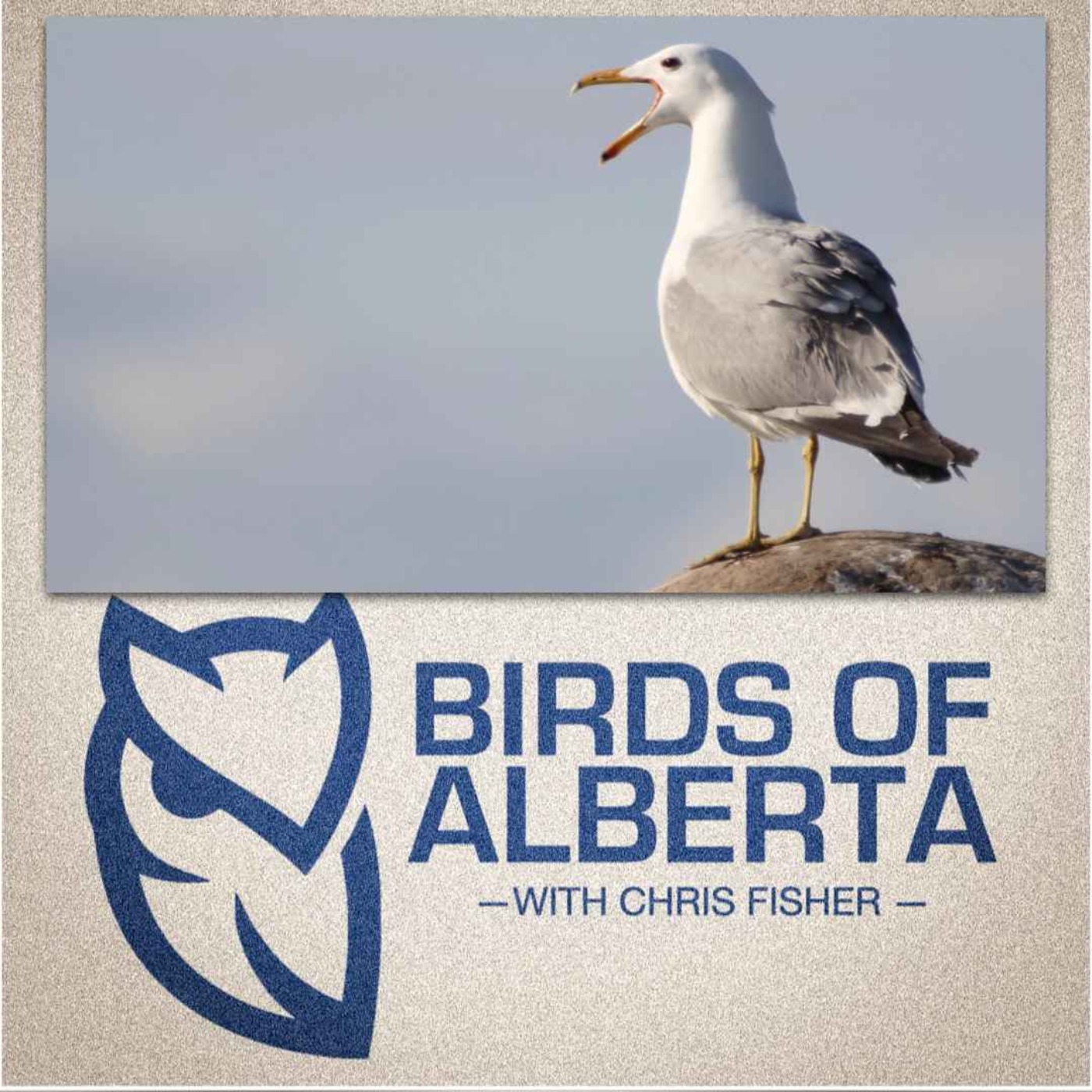
The California Gull serves as a heralding sign of spring in Alberta, arriving in early March when winter's grip loosens. This medium-sized gull is identifiable by its dark eye, white breeding plumage, yellow bill with a red spot, and athletic build. It migrates from Pacific coastal wintering grounds to breed inland in Alberta, showing strong fidelity to nesting colonies. As colonial nesters, they gather on islands or shorelines, using communal strategies for protection. Historically named for California due to early specimen collection, the gull has deeper ties to Utah, where it is the state bird following a celebrated 19th-century event where flocks saved crops from insects. In Alberta, they thrive in both rural wetlands and urban settings, adapting seamlessly to human landscapes. Though often perceived as noisy or opportunistic pests, their boldness and adaptability reflect resilience, allowing them to prosper in environments reshaped by human activity. Thus, the California Gull embodies a successful species that navigates natural and anthropogenic challenges across western North America.
Welcome to the Birds of Alberta podcast. I'm Chris Fisher, co-author of the best selling field guide, Birds of Alberta. Now there's a particular moment in late winter on the Alberta prairies when the snow has retreated into hardened dirty gray patches along the fence lines when meltwater begins to pool in the low spots and you can't keep your truck clean even when driving just over to collect your mail and then you see it. That bright, clean flash of white that embodies the hope of spring. It's the death blow to the winter season and remarkably the season that brought darkness, starvation, stinging cold and social deprivations is killed by an underwhelming buoyant bird. There I say this site is almost biblical. But in spite of its grandiose implications, say for a few kooky Alberta birders, no one puts any importance on this penultimate spring event for the bird itself, along with all others of its kind are viewed with, well, at best, disinterest and at worst, a pointless and tagonistic animosity. What bird could be deserving of all of this? Well apart from a species with precise punctuality, this species is a model of adaptability. The prairie in its messy thaw offers opportunity and they are here for it. They look super sharp against the muted grounds of the early spring and their vocal, very vocal as if announcing not just their arrival, but the spring season itself. It's that first arrival in early March that always catches my attention. Because when these birds return, winter is no longer in charge. The prairies are waking up and the air. Well, it suddenly feels alive with possibility. And for those of us who see the seasons change by watching wings and water, well that's one of the sure signs that spring has truly begun. It's both bewildering and beautiful. That's somehow the combination of day length and temperatures has triggered hundreds of birds to fly north on the exact same day. And in doing so, they act like the head of the class, a drum major for all the birds of Alberta. This is the California Goal. The California Goal is one of those birds that at first glance you might just dismiss as another go. And if this sounds like you, well just take a moment and slow down and really look because there's a lot going on here with this bird. This is a medium-sized goal but noticeably larger and longer wing than the most ubiquitous goal that we have around, which is the ring-build goal, but slightly smaller than the also quite common herring goal. There is a kind of athletic build to the Cali Goal. They got long wings and a fairly flat back when they're standing and a nice little rounded head with a dark eye, a feature, which makes it stand out from the rest of the white-headed clan. This gives the California Goal a bit of a softer look and a little bit different than the pale, piercing stare of some of the other larger goals. It also gives them a calmer expression, less severe and more approachable, kind of like wearing classic oval ray bands on a sole cowal beach. Now in breeding plumage, the head is crisp and white, clean, bright, almost glowing against the soft pearl gray mantle. See, the gray on the back is slightly darker than the gray on the ring-builds and even the herring when you see them standing shoulder to shoulder, but isn't all that dark and brooding. It's smooth and even, kind of like our classic rundle rock from the Rocky Mountains. And now the build. Now this is where Goal Watching gets kind of interesting. The bill is yellow, but it's not a loud screaming yellow. It's a little bit more subdued and right near the tip. In breeding plumage, there's a distinct small red spot on the lower manual. Now that red spot is a key feature to find and if it is there in the spring, your pain, good attention to these goals. The light color, well it's green is yellow, not bubble gum pink like on the herrings, but a nice olive-type green that is seen in certain lights, kind of like the croplands of the fertile central valley of California. Now like most migratory birds, the fresh face look of the California Goal in the spring time sadly doesn't last for their entire stay in Alberta. See by late summer, a more practical though unfashionable feather molt will have them turn their snowy head into a gray brown stain. See during their time in Alberta, California Goal seems to they seem to transform like someone who was once a fresh faced adolescent in high school to a motor cycle gang recruit at your 10 year reunion. California Goal is often among our very first of the colonial water birds to return to their breeding grounds here in Alberta, often returning, beating returning geese and swans and certainly besting the arrival of American Robbins who tend to be claimed as the harbingers of spring. The Goals arrive not when the winter is done and dusted, but actually when it's loosened its grip. The very first arrive in the earliest days of March and the south of the province where you might spot 'em circling over half frozen reservoirs or standing resolutely on the ice edge of the old man's self-suscage when war bow rivers. Then they arrive here in Alberta with a purpose. These birds have spent the winter along the Pacific coast from the American state of California of course, but also down into the Baja California states of Mexico. It is obviously from these areas for which they bear their name, but in February right on cue with the lengthening of the daylight, these wintering birds they start to make their way back north all the way to here in the prairies of Canada. There's a fidelity to their movements, many returning to the very same colony year after year here in the prairies, sometimes even to the very same stretch of shoreline where they nested in years past. These birds breed well in land across the prairie provinces of Canada and in the Western United States. Far and away from any source of saltwater. Now these birds have stagnant slu water in their newborn veins, not the briny drink of the Pacific ocean, but come September and the impending autumn, the counter to the springtime cues, compel them to drift south and to drift west. Following river valleys and agricultural fields and prevailing winds in their southern travels, many of these Alberta breeding birds will they'll funnel back towards staging areas in the northern Great Plains and big reservoirs and lakes before continuing on to their wintering grounds and the Pacific coast. A few even will remain inland wintering in the northern states around reservoirs and landfills of course and wherever there is open water and where conditions allow. But this of course makes us think that will we someday find some California girls eventually choosing to eke out a winter here in Alberta. After all we've seen an increase in winter waterfile numbers such as Malloritz and Candigees and even trumpeter swans in recent years and decades. Well I'm not quite so sure about that but I am reasonably confident that we will continue to see a dwindling of our Alberta Gull Free Days. Typically now lasting between late November and early March so I kind of predict we will see more and more sightings of individual goals lingering through December and becoming some of the earliest birds in late February in the years to come. So while California girls may not cross vast oceans or even vast continents they do knit together an enormous swath of Western North America all the way from Alberta and Saskatchewan's boreal lakes and prairie potholes to the Pacific surf. It's an annual journey that is a a reminder that Alberta birds are part of something much larger.
a continental rhythm of departure and arrival courtesy of a bird with prairie roots and a bit of a western wanderer spirit. Now as many people are aware, frankly has become one of the premier birding destinations in all of Alberta. While much of that I suppose is due to it being located within really about an hour or so of well over a million Albertans, it also must be said that frankly is also a really good place to see and enjoy birds, particularly waterbirds. And much of this is very intentional as frankly is the result of a lot of hard work and hard money spent on creating top notch wildlife habitat. And if you've ever stood along the shores of frankly can mayor June, you've likely heard California goals before you've actually even seen them. And while they're generally quite noisy birds, the decibels amplify when you get around their nesting grounds. See, California goals are what we call colonial nesters like many of the goals and waterbirds. They don't tuck themselves away in a solitary secrecy kind of like some woodland songbirds. No, they gather in groups on mass. Sometimes in the huddrens they tend to choose low flat islands as their prime real estate investments. These are often windswept. There's sun-burning places with gravel bars and exposed mud flats. Very little vegetation typically. They'll find safety in the numbers of eyes and alarms that are around and through geography as well because they use the water as a protective moat against potential predators. So by late April and into May the pairbons are usually well established. The courtship is subtle, but meaningful. They'll toss their heads upwards and down accompanied by long, long calls. And there is a really interesting sort of gagging display where the birds will stretch their necks downwards and give a rhythmic series of notes looking and sounding a little bit like a hurl. You see if a human were to behave in this way, you'd feel compelled to enact a first aid training and probably perform a series of abdominal thrusts and even take up the hind look on them. If a predator say a fox or overly enthusiastic raven comes a little bit too close, the entire colony will erupt. There'll be alarm calls. Birds will take to the air, they'll dive bomb, they'll scold, they'll even defecate with mid flight accuracy to deter that internal. It's it's a coordinated chaos and it works remarkably well. They form a community that comes together to face a challenge head on. So so the next time you hear that raucous call of a go overhead, remember this? Somewhere nearby on only islands or wind swept shoreline, there will be an entire community of California girls engaged in one of the most communal and cooperative nest strategies on the prairie landscape of Alberta. Now there's something wonderfully and ironically misleading about the name California girl, especially if you're standing beside an Alberta slew in May watching hundreds of them wheel overhead. Now many times I can tell you I've been out at a southern Alberta reservoir watching these birds out on a jetty or something and some of the boat launch folks would come over to me with my binoculars and long camera lens and inquire about the birding scene and it seems a bit weird quite frankly for me to be talking about California girls in the heart of an Alberta summer. But why the word California? Well the name date dates back to of course the mid 19th century when European naturalists were coming to North American formally describing the birds and at the time well the specimens that were collected were came from the California coastline during the winter season so as often happened in those early days of taxonomy the birds were named for where they were encountered not necessarily for where they breed. So not only here in Alberta do we have a California girl that nests and does really really well here in this province we also have a trio of boreal nesting warblers. One that's named after tropical palm trees one after a city in Tennessee and even another after that very same southern state. But for these girls there is something even weirder going on because California isn't even the state in America for which they're most closely associated. You see in 1848 there was a massive grasshopper infestation that threatened the crops in the Salt Lake Valley of present day Utah and flocks of California girls came out of nowhere and descended to feed on the insects saving the crops. So to the faithful Mormon settlers of that particular area it was nothing short of providential. The event became known as the miracle of the goals and in 1955 well the California goal was designated as the state the state bird of Utah and there's even a golden monument in downtown Salt Lake City featuring a pair of goals commemorating this very story. And while there does seem to be an inordinate amount of American connections with this particular bird folks it is with great pride that I can say the subspecies that nest here in the province of Alberta goes by the subspecies name Larus California alberta and sis. Now while California goals are found widely across Alberta throughout rural landscapes particularly where there is a wetland within an easy flight distance frankly there are more often associated and observed in our largest cities there's simply just more eyes looking for them in those areas. They will nest in wetland colonies on the outskirts of Calgary and Edmonton and Reddier but they will follow our morning commutes into the urban juggle for their day time fixes. So take a stroll through downtown Calgary for instance on a windy May morning the Bo River will still be shrugging off the winter and there'll be grits on the sidewalks I suppose but echoing through the glass towers you'll hear goals and California goals among them. In these urban centers these birds have masterfully adapted to the rhythm of our human lives when in a natural setting like at a lake or reservoir well that same sound it dissipates much more across the water and through the cat tails but but in the city well it ricochets around it amplifies it becomes theatrical and and actually it blends in in a way with the sirens and the signals and the screeches that are a common part of city life and I suppose that is kind of the story of the goals in Alberta cities they're not exactly exotic visitors California goals are not coastal castaways they're native prairie birds taking advantage of a landscape we reshaped and they've done it entirely on their own terms. All right like like I know I have been talking globally for almost like 20 minutes on how wonderful California those are but but I know the score I am a realist I really don't think this will change the fact that quite honestly this is a bird that will not win too many popularity contests in this province now when people reach out to me about birds they're kind of frustrated with in Alberta cities well it's almost always magpies but right after the magpies it's almost always the goals they're noisy they're aggressive they stole my fries and yes if you've ever tried to eat lunch well near a landfill or a school yard or by a stampede food truck you've likely locked eyes with a goal now I'll be the first to admit that goals well they're not flashy like come on Bluebird and they don't inspire poetry
the way a loon does and they certainly don't have an underdog charm the way that a chickety does in a January snowstorm. But like goals are bold and they're opportunistic they'll they they walk around with that slightly forward leaning confidence that says I've survived worse than you and here's the thing the very traits that make goals unpopular are the traits that make them successful. You see our Alberta landscape has changed dramatically in the last century. We built crop lands in reservoirs and landfills in industrial parks and sprawling sunbirds and the goals have looked at all of that and said all right yeah I can work with this. So next time a california gold gives you that side eye look from a light standard or drops a white dollop on your sunroof maybe don't see it just as a nuisance see a bird that figured out how to prosper in the world we built without asking our permission and in a province defined by resilience and resistance california goals take a top spot among the birds of Alberta.
Podcast Summary
Key Points:
The California Gull is a key sign of spring in Alberta, arriving in early March and symbolizing the end of winter.
It is a medium-sized gull with distinctive features
These gulls migrate from wintering grounds on the Pacific coast to breed inland in Alberta, often returning to the same colonies yearly.
They are colonial nesters, using islands and shorelines for breeding, and exhibit cooperative defense behaviors against predators.
Despite being named for California, they are strongly associated with Utah (state bird) and Alberta, adapting well to both natural and urban environments.
Gulls are often viewed as nuisances but are highly adaptable, thriving in human-altered landscapes like cities, farmlands, and reservoirs.
Summary:
The California Gull serves as a heralding sign of spring in Alberta, arriving in early March when winter's grip loosens. This medium-sized gull is identifiable by its dark eye, white breeding plumage, yellow bill with a red spot, and athletic build. It migrates from Pacific coastal wintering grounds to breed inland in Alberta, showing strong fidelity to nesting colonies.
As colonial nesters, they gather on islands or shorelines, using communal strategies for protection. Historically named for California due to early specimen collection, the gull has deeper ties to Utah, where it is the state bird following a celebrated 19th-century event where flocks saved crops from insects. In Alberta, they thrive in both rural wetlands and urban settings, adapting seamlessly to human landscapes.
Though often perceived as noisy or opportunistic pests, their boldness and adaptability reflect resilience, allowing them to prosper in environments reshaped by human activity. Thus, the California Gull embodies a successful species that navigates natural and anthropogenic challenges across western North America.
FAQs
The California Gull is a medium-sized gull that is one of the first colonial waterbirds to return to Alberta in early spring, signaling the end of winter. It is known for its adaptability, nesting in prairie wetlands and urban areas, and plays a key role in the ecosystem as a colonial nester.
California Gulls typically arrive in Alberta in early March, often before geese, swans, and American Robins. They return as winter loosens its grip, with sightings starting in southern parts of the province.
A California Gull is medium-sized with long wings, a flat back, a rounded head, and a dark eye. In breeding plumage, it has a crisp white head, a soft pearl-gray mantle, a yellow bill with a small red spot on the lower mandible, and olive-yellow legs.
California Gulls breed inland across the prairie provinces of Canada and the western United States, often in Alberta's wetlands. They winter along the Pacific coast from California to Baja California in Mexico, returning north in spring.
The name dates back to the mid-19th century when European naturalists named it after where it was encountered during winter—California. It was later discovered to breed inland, including in Alberta, but the name persisted.
California Gulls nest in large colonies on low, flat islands or shorelines with little vegetation. They use safety in numbers and water as a moat against predators, engaging in coordinated defense like alarm calls and dive-bombing to protect their nests.
Chat with AI
Loading...
Pro features
Go deeper with this episode
Unlock creator-grade tools that turn any transcript into show notes and subtitle files.
 PodcastTranscript AI