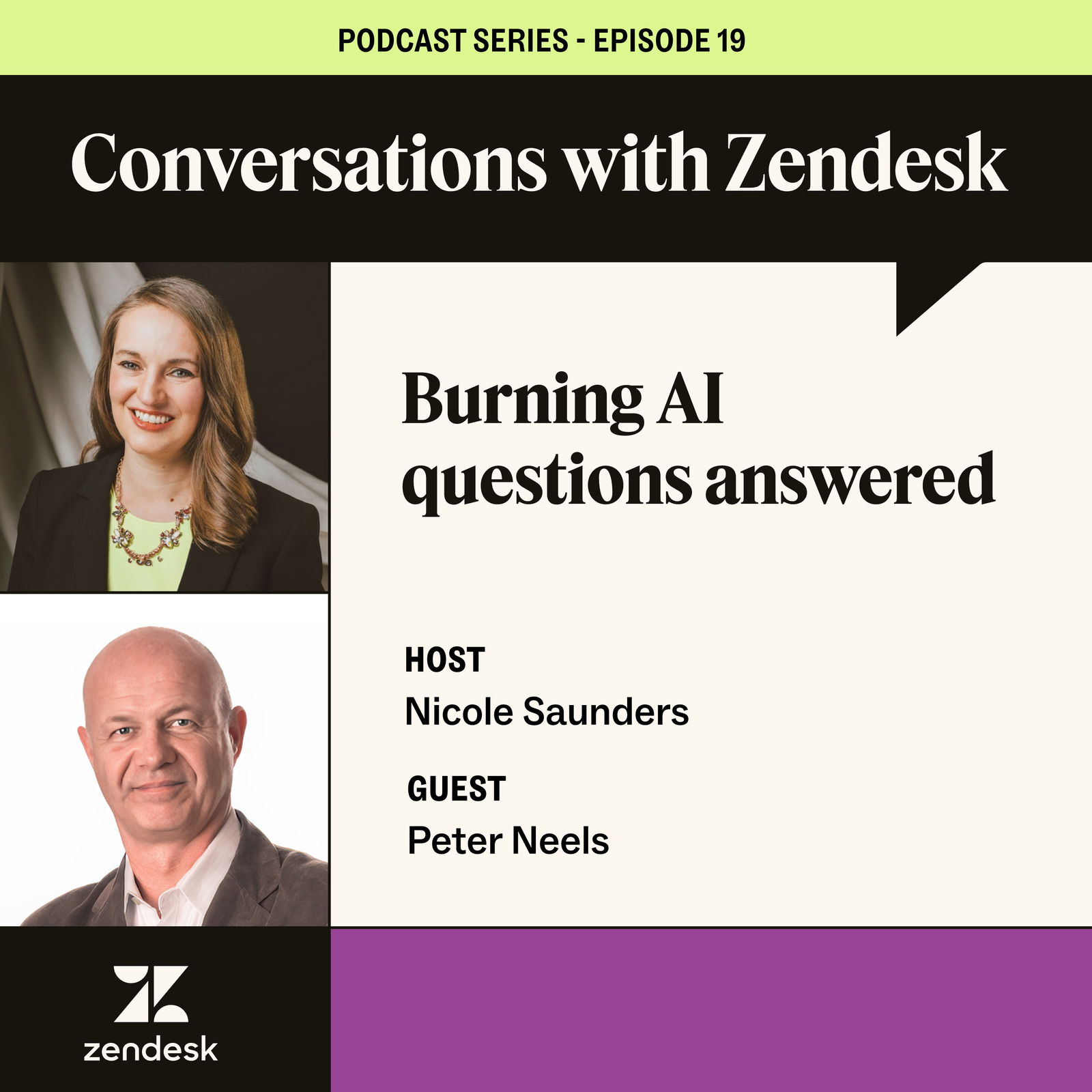
Try not to solve the entire journey, look at some key areas today, and then build from that and continue to enhance that customer's experience. Hello, and welcome to Conversations with Endus. I'm your host, Nicole Saunders. Today, we are talking about burning questions in AI. Obviously, AI is a topic that we have discussed in depth for the last year, and we will keep talking about for many more months to come. We've had a lot of great experts on to talk with us about where the technology is going, predictions for the future, challenges, and pitfalls, and as people are starting to implement the technology, we've started to see some very common themes and questions coming up. And so we've rounded up questions that we've heard from our own customers and from other folks in the industry, and we wanted to bring in an expert to speak to some of those things today. So my guest today is Peter Neils. He is the senior director of customer experience, innovation, and strategy here at Zendask. He and his team have a really interesting set of responsibilities. They get to advise our customers, talk to them about their business challenges, and then help them become a plan to how to implement their technology to achieve their business goals. Peter is an amazing expert with a ton of experience in CX. For the past 30 years, he's worked with businesses all the way from startups to enterprises, and a variety of different kinds of tech and telecom companies, and we are so excited to give you access to his expertise today. Before we dive into that conversation, though, I wanted to remind you that our big flagship user conference, Zendask Relate is coming up in Las Vegas April 16 through 18. I am so pumped for this. We have been making all sorts of plans. The agenda is now live on the website. If you want to go check it out, I really hope that you'll join us. I think it's going to be a great time. It's going to be a really wonderful opportunity to connect with other customer experience and customer service professionals, and hear about the latest things coming from Zendask. Head over to ZendaskRelate.com to secure your spot today. All right, without further ado, let's dive into our conversation. Peter Neils, welcome to Conversations with Zendask. How are you today? I'm doing great, Nicole, and it's great to be here. And also very excited about Relate. I think it's going to be great opportunity for our customers to really get some major insights on where we're headed with a lot of our product, but also around the AI. Absolutely. I know that we've got some really amazing speakers and panelists lined up for that. So everybody, I hope that you'll come join Peter and I there. So, Peter, as I was sitting in the introduction, we have been talking a lot about AI, right? It's been the hot technology for a while. It's going to be the hot technology for a while to come. This is a really big sea change for the industry. And as people have been really starting to get into it, it's not just a dream anymore, but it's something that people are really starting to implement. One of the things that I've been hearing a lot is people are really curious about how this is actually going to impact their customers experience. And of course, this is right in your wheelhouse. So, I was wondering if you could tell us a little bit about what you're seeing and how this is going to roll out for the customers that are interacting with the AI that all of these companies are implementing. Yeah, love to Nicole. I think one of the biggest things that we're starting to see is really focus surrounds. They phase the approach. So, when we talk to our customers, well, we're trying to help them with this. I know this technology is going to be amazing, but from an operational perspective, there are some use cases that they may want to trial and try and see if it actually works the way they are thinking about it. So, our focus really is from a branding perspective in their customer experience. Like, what's important to you? What's important to your customers? Instead of, okay, AI is going to solve all our problems. Well, let's take a step back trying not to solve the entire journey. Look at some key areas today and then build from that and continue to enhance that customer's experience. Something I love that you just said is what customer problems are you trying to solve? Because I think a lot of the conversation that we've had has been around, how does this solve business problems? How does this make the business more efficient? How does this save us time? How does it save us money? But I think it's important to think about what problems are the customers having where AI might actually be the better solution. I think with a new technology like this, it can be easy to get excited and want to throw it at everything and not be super thoughtful about the nuances of it. Where does it make sense? Where is it the right place to implement that? And where do you need those exit ramps to keep humans involved? Where are those personal relationships going to be the most important and impactful? So speaking of human relationships, there's been so much conversation about how AI may evolve the role of the agents. But I don't know that we've really seen exactly how that's rolling out. What are you seeing for agents and the agent experience and how is this impacting their day to day? So I think one of the things that we're starting to see as we do agent shadowing is that the agents want to feel fulfilled and when the customer does get to them that they've got the available information, providing the agents with the connection of okay, the customers already come through this journey. Here's where they've been. What information do I need to bring forward to the agent to make that conversation seem seamless and very much kind of more on a relationship basis? But I think from an agent perspective though, I think where AI is really going to come in and play a differentiator is since the agent will be able to focus on that relationship piece. As time goes on, the agents will be able to do things that they're really good at, which is talking to customers, engaging with the customer, building that rapport with the customer. From a career perspective, I think what this does too is it allows the agent to specialize in a certain area that they're really good at and build their portfolio and training can then be built and customized based on the actual needs because now you've got that customer engagement, you've got the agent experience, you can really build training so that the agent can grow within their career or even get more exposure to potentially helping the AI be more effective or helping the business processes be more effective. Now the one thing we ask our customers all the time is, so how long does it take for an agent to become proficient in your business? Well, in most scenarios, it tells us well three to six months, they become really proficient. So the expectation on your bot should be similar. They will take some time to learn the business and you have to feed it, train it, groom it just like you would an agent. That's really interesting. It's funny as you're talking about how you train and groom and feed the AI, I'm picturing those tomogatches from the 90s, the little computer pets that you can take care of, which I guess that's a very early version of AI, right? Yes. But I think it's a really great point. There is sort of this expectation that these bots are just going to be perfect out of the box. We don't expect human agents to be perfect on day one, right? They're going to take months of learning. It's why we do QA, it's why you have managers that do all of this training and development. And yet we're expecting these AI to have that level of expertise and experience just from day one. And so it is probably an important level set and expectation to reset with people of, yes, the AI is going to be super powerful, but you do need to plan some sort of on ramping time for that experience to really develop and get to the level that you're imagining these bots and this technology to perform at. Similar to what you were just saying around the expectation that you plug it in and it's going to just take off. I think what people are realizing is that they do need to take a step back, have more of a phase approach that if they put it in their entire life cycle, it's not going to solve everything. What it might even highlight is some major holes or gaps within their business processes that they will need to work on fairly quickly, right? So one of the things I think that really good moves, especially someone from the business side is, okay, let's take baby steps. It's almost like what we're seeing is customers are doing it all and then going, oh, whoa, whoa, wait, this is too much. Then having to take a step back and re-analysing, re-evaluating. And so the phase approach tends to be probably the more stable one. Now, it does mean that it's go slow to go fast, but if you can go slow and then you can go fast, your fast will go incrementally faster than if you go all in and then you have to back things out because now you're re-engineering something that hopefully you didn't want to re-engineer in the beginning, right? Absolutely. So it sounds like people need to keep in mind that this is like any kind of big business or digital transformation. And while this technology may feel magical and nearly instantaneous and it does scale really rapidly, it's important to make sure that as you're looking at implementing your AI, you are building in that time to identify other gaps in your processes and maybe patch those holes before you can even implement the technology. But something I heard you call out there is that, yeah, you have to start out with some of those slower phases, but then once you get it implemented, it does scale more rapidly than a lot of other kinds of digital transformation or business processes. Is there a common phase one that you're seeing? Is there something that businesses should be looking at as this is probably going to be my first step or the first area that I'm going to implement things? Or are you seeing that it varies a lot business to business based on their strategy? I think it varies from business to business and even within B2C to B2B, I think there are some significant changes. Not every business looks the same. I think if you keep that in the forefront, which is what do my customers expect from me and what is their expectation and then built in word? I think that
resonates with your customers, but also your adoption will be much faster, much quicker. And then on the agent side, the same thing, what do my agents need? And how does that look like? Do I really understand what that day and the life of an agent looks like? So really, I believe that those are the two big things that, as you venture into this, those are some of the key components as you move into this amazing technology, which it is. The key about that day and the life of your agents. One of the things that we called out in the 2024 CX Trends report, and we talk a little bit with Joey Edwards-Labar about this on our previous episode. I'd love to get your perspective. We uncovered there's kind of a concerning disconnect between executives who are like, yes, we're going to embrace AI. We're so excited about it and they're agents that are going, uh, yeah, we're not really sure how to do that or what that's about. Well, what are some of those best practices for staying connected with your front line? How do you get that feedback? How do you make sure you understand what their day to day looks like and that you're on the same page about all of that? So I think there's a couple of ways to do this and we've talked to customers about this before. And as we actually do our work with our customers during the session, one of the things we ask them is, do you have a voice of the agent? I know you've got a voice of the customer. I'm sure within your ecosystem, but do you actually have a voice of the agent? Do you have the agents that build you to tell you what's not working? What's working for them? And how are you taking that feedback? I mean, I know some folks use QA as their platform to kind of measure things, but are you actually sitting with your agents? Are you allowing them to be part of the process and give feedback? So I think the key thing for especially where we're headed with AI and in the fear that I believe a lot of the agents have is like, oh my god, my job's going away. Is how do you bring them into the fold? How do you get them to buy into and be part of the solution? First is, well, here's what you're going to be doing. So I think from that perspective is, you know, really understand kind of what that agent experience is, what they're going through. And especially in today's world where a lot of the agents are also remote, right? So you need to actually make an even bigger effort to try and understand what are those agents doing that are remote? What are some of the things that they need? What do they need to make sure that they feel very comfortable when they're talking to their customers? If you engage them early on, you show them the benefits, they are part of the solution. I think that's where you really get the excitement of the agents, which then will automatically give you what the execs are thinking is going to happen because once you get thereby and then things again, you know, crawl, walk around, you will get them on board much faster, the whole methodology and platform and business process enhancements will kind of fall right to play. I think he just created a new job function, Peter, the voice of the agent team. I know I love our voice of the customer team and I love working with voice of the customer teams. They always bring such amazing and important insights and whenever I've worked with those teams and really listened to what they were telling us, the projects have always been more successful. I want to ask you a question about something that you talked with me about last week when we were kind of preparing for this conversation. You said that often there is a disconnect between what the technology can do and what the business can and should absorb. Can you tell me a little bit more about what you meant by that and really how businesses need to be thinking about this? I think it ties to the phased approach, but I want to dig into it a little bit more. Sure, yeah. So I think one of the key messages that we tend to, as we engage our customers and this, we see this across the board and whether it's B2B, B2C, SMB or enterprise. What tends to happen is the technology is a lot more advanced than what the business can handle. So what we try and do, as we talk to customers about this, is let's make sure we understand your end-to-end life cycle again from outside in and then agents how? What are some of the critical pieces? What are your data elements? What are you trying to do? And then how do you then enable that from all the features and functions that you already have? Because one of the things we tend to see, and this is with both customers and also from my experience, from spending 30 years on the other side, buying software, is that you really truly don't have a good understanding from a business perspective, all the features that come with it. So as someone on the business side, the more questions you ask, the more you truly identify, here's what I'm trying to measure. Here's the outcomes, then working with your partners, which sometimes is internal IT or someone like Zendes, to say, "Here's what I'm trying to do. Here's what I'm trying to fulfill. Tell me how all your features and functions and technology maps to these things. And am I really taking advantage of everything that I've got in my portfolio with you guys?" So I think that's one of the key things as an executive. Just ask lots of questions. Here's what I'm trying to solve. How can you do this for me? So in thinking about those questions, what questions are executives not asking that they should be? I think a lot of it has to do with what if the customers want? Like truly trying to understand the outside in, we tend to really be focused on that agent experience, the numbers, and the KPIs and all that. But truly, what is that customer's experience? And what information are we collecting along the way that I can make even more strategic decisions on? And what can I offload to the front end versus the back end? How can I help the agents be more proficient, more effective? But then on the other side is, how can I work with product? How can I work with legal? How can I work with the internal organizations that also in some way are capacity we all do actually have an impact on that end customer? What does that look like? And what information do they need to make sure that we're making the right decisions, designing the right strategy, looking at the overall end-to-end kind of life cycle? That is such a great call out that we've talked so much about how this is going to impact primarily support works, right? And the conversations that they're going to have with end users, but there are a lot of internal stakeholders that can be benefiting from all of this as well. And so we need to be looking at both the internal and the external use cases. All right, we have to start wrapping up our conversation, but I have just a couple more quick things for you. So first, I would love to hear what are your top three recommendations for anyone that's getting started? We've covered a lot of different things to think about in questions today. We're going to distill that down into three quick things. What would those be? The big one would be really kind of what's the customers experience, so really understanding, like what's your brand? What are you trying to have the customers go through? The second one is really to focus a lot of time around what is that agent doing today? What is that experience? How can we optimize it? How can we make their lives easier and they're really enjoying that relationship they have with the customer? And then the last one is let's look at things from a holistic perspective, really truly go from the outside in and then also all your other partners internally that are engaged with this. So I think those are the key things, but at the end of the day, I think the big one for me is truly understanding what are your key business objectives and how does that drive that customer experience that you're trying to create? Got it. So look at your customer experience, look at your agent experience and look at the holistic CX altogether and really be strategic about it. Exactly. All right. And then one question that we love to ask every guest that comes on, because we love talking about really customer service and great customer experiences. Have you ever had a particularly standout customer experience that you can share with us today? Sure. The one that comes top of mind right up the bat is because I'm going to be heading out here to vacation here in about a week or so. So my wife and I cruise on Carnival at least twice a year. And one of the primary reasons we really cruise with them is because it feels really personal. Before we even get on the ship, there's so much information that they share with us that is very custom to us and who we are, what we enjoy doing. They track all the offshore experiences we've done, all the things we like to do when we're on the ship. So to me, that is really just kind of like the epitome of what I think customer service is, especially with, I mean, when there's 5,000 people on the ship that they treat you as an individual and someone really special for them. That's really impressive. I mean, there's a lot of people to create personalized experiences for. And you know, I love that you gave the very analog experience, right? This isn't about technology, it's not about a chatbot or AI, but it's still about how important it is to know your customers, be able to personalize things at scale. And clearly, that's created a lot of brand affinity for you. Yes. Your repeat customer, you keep going back because of that. So a key thing for us all to keep in mind, and something that hopefully for many companies, AI can really help everybody implement that level of personalization of knowing your customer and creating a really meaningful experience that will keep them coming back time and time again. Well, Peter, I have loved this conversation. Thank you so much for taking the time today to share your experience and your thoughts with us. You're welcome, Nicole. It was my pleasure. All right, everyone. That is a wrap for today. We would love to hear from you in the future. So we are planning on doing some mailbag style episodes. If you have a question that you would love to hear us answer or a topic that you'd like to hear us cover, or you just want to tell us what you think of the podcast, please shoot us an email at
[email protected] and that's
[email protected]. You can always follow Zendask on LinkedIn. That is our primary home where we're sharing all of our big news, highlights from the podcast, information about our upcoming conference, all of that kind of thing. So please join us there. Of course, we would love it if you would subscribe to the podcast so you don't miss a single episode. And if you really like us, we wouldn't mind a little review on Apple podcasts. Those do help other people find us. Until next time, I'm Nicole Saunders for Zendask.
at the Intelligent Heart of Customer Experience. [MUSIC PLAYING]
 PodcastTranscript AI