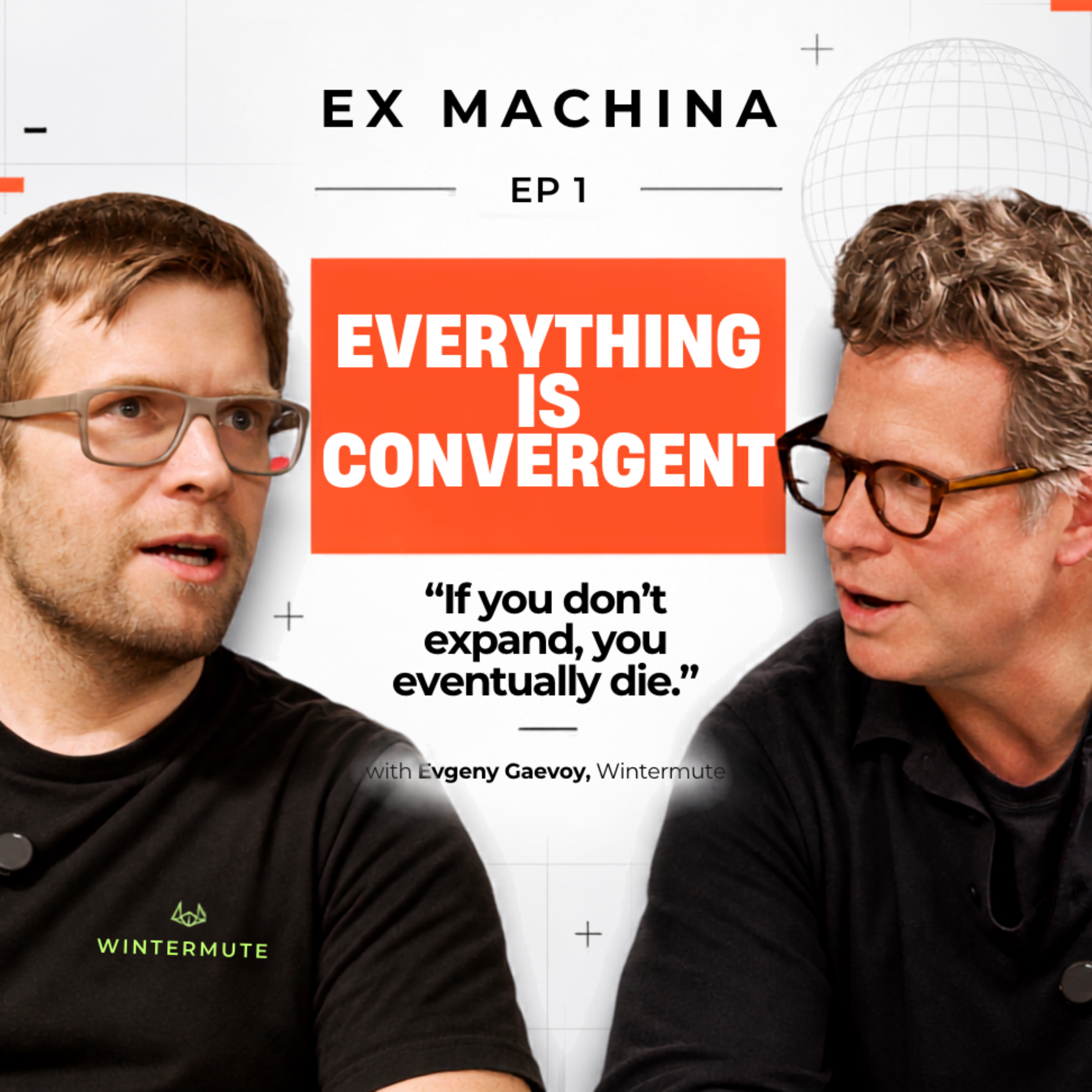
Built for Uncertainty: Evgeny Gaevoy on Wintermute and the Future of Markets
from Ex Machina Podcast
62m 33s
Yvgeny Gayavoy, founder and CEO of WinterMute, shares the journey of building a resilient algorithmic trading firm in the volatile crypto space. Starting with a cautious, niche-focused approach in 2017, WinterMute pivoted multiple times after initial failures, including abandoning early liquidity strategies for ICOs. The firm’s survival through bear markets, a $160 million hack in 2022, and the FTX collapse was due to strict risk controls, diversified liquidity across exchanges, and a flexible, experimental culture. WinterMute’s success stems from its multi-pronged business model—covering centralized exchanges, DeFi, and OTC—offering access to liquidity that competitors lack. Leadership remains hands-on, with a flat structure and a culture of transparency, especially during crises, where the firm openly shares setbacks. The company learned critical lessons from market events like the October 2022 flash crash, which revealed flaws in perpetual exchange mechanics that can trigger cascading liquidations and destabilize market-making strategies. To remain future-proof, WinterMute is actively expanding beyond crypto into stocks and commodities, ensuring long-term growth and resilience. This strategic diversification and risk-aware culture position the firm not just to survive, but to thrive in an increasingly complex and interconnected financial ecosystem.
the fact of life in people, like you might get hacked.
- To me, to me there's to read as the hack.
- So I was like almost like waiting for it.
So then like that day and 20 spins to I woke up
and I actually had to like I woke up
because somebody was calling me
and I like people don't usually like wake me up
because like everything is usually fine
and so like I got this call and you're like
yeah, something's wrong
and then like there's something very wrong.
- Whoa, whoa, whoa, stop.
Everything you think you know about tech, it's wrong.
No one has anyone.
No serious is building apps or sass anymore.
Devices themselves will be ambient.
They'll be all around us.
Code will be a femoral.
Gone as quick as it's compiled.
Our very intentions will be anticipated
before we know them.
Welcome to the machine economy.
This is a world where AI agents act, earn, span, learn
and God knows what on our behalf.
An entirely new financial infrastructure
is being built to support them.
The machine economy's impact will transcend
near bits and bytes
and ultimately invent entirely new molecules and atoms.
I'm Richard Muahed, managing partner of Fabri Ventures.
We've been on the front lines of this shift
as it has been brewing for a decade.
We exist to serve the founders building it.
I don't wanna say this is your entire track,
but it is.
You're gonna get raw, technical, gritty,
emotional conversations with the players going
from zero to one, shaping what comes next.
If you wanna understand where the opportunities lie,
you're in the right place.
Let's go.
So diving right in, I'm gonna introduce the nature
of this kind of series of chats that we're gonna have
and then introduce you again, Ian,
went to mute a little bit and then we'll kind of take it
from there, but thank you everybody for joining us.
So, and I have not memorized these intros yet.
Maybe I never will.
Maybe that's not important.
Maybe we'll get an auto queue.
Anyway, we'll see what happens.
So as Peter Till has said, starting a company
to be an entrepreneur is possibly as misdirected
as wanting to do something just to be rich or famous.
So why do the great entrepreneurs found a start off?
What keeps them going?
And what are the deciding characteristics
between success and failure?
This fireside series is Fabrics Initiative
to try to get to the kernel of that, the nitty gritty,
the joy and pain of the founders struggle from zero to one.
We are talking to a range of true fires starters
in front of a small, highly curated audience.
In this exponential age, the significance of these founders
is arguably greater than it has ever been.
Fabrics spends much of its time talking to founders,
both freshly minted ones and seriously seasoned ones.
These conversations are intended to be both an inspiration
and perhaps a warning in equal measure
and make their own contribution
to the vital role of this ever evolving set of characters.
You might recognize this type of introduction
is a fireside chat with Yvgeny Gayavoy.
He's the founder and CEO of WinterMute,
one of the largest and most sophisticated
algorithmic trading firms in crypto.
Since founding the company in 2017,
he's built an organization that provides liquidity
across hundreds of tokens and dozens of venues,
processing over $15 billion in trading volume.
You may correct me or update me shortly.
In crypto, the average lifespan of a trading firm
is measured in market cycles, of course,
by maybe perhaps even less than one market cycle,
but WinterMute has endured through multiple bear markets,
a $160 million hack in 2022,
the systemic collapse of FTX through ours capital
and so much more.
So today we'll attempt to explore
what it actually takes to survive in crypto,
how to win amidst fierce competition
and the principles that separate institutions
that are built to last from those
that ultimately will fail.
Yvgeny, thank you very much for joining us.
How are you?
- Yeah. - All good.
- Thank you so much. - Fantastic.
So I'm keen to get to it at some point,
but I was fascinated to notice
that turning off notifications somehow was on.
Never is.
I was fascinated to notice that
you actually, I spent some time in Moscow back in the day
and where you studied at the high school of economics
which was like 10 minutes from where I was living.
And then you went on to do an executive MBA
at the London Business School
and then you found a win to beat back in 2017.
So if you had a chance to talk to your own self
at that point in time, what would you say?
- Yeah, I think the number one scene would be
to move faster and number two saying would be
not to be afraid of competition.
I'll say that would be like the main two things
because yeah, for me, like I would say
the first two years of intermediate existence
we definitely were like much more on the cautious side.
Which part of it is just my personal,
like at least how I used to be.
And part of it is,
I guess basically just limited beliefs kind of saying
which yeah, you just need to overcome
as a founder for sure.
Like I think that's like one of the top things
you need to overcome as a founder
is yeah, not to be overly afraid
of like who you're competing with.
- So well, maybe if you take us back to that,
that you know, moment of inception or inspiration
and do two things perhaps.
Describe what it is that was meant to be then
and has become now.
And then, you know, what was the catalyst for that moment?
What, where did the inspiration come from?
What actually caused you to take action and get up from,
you know, a traditional role within trading
and do something new.
To take that first risk,
even if you wanted to take more risk now at hindsight.
- Yeah.
So I'll guess yeah, I'll do like a whatever.
Self, like hit myself and basically admit that
it was not like as glamorous as like a lot of founders
you hear that, okay, I decided to drop everything
and step into the void and fight everything.
And like it was, it was not such a like super risky decision
for me in the first place.
Like I was quite financially well off after trading
and I have to be in intrat5 for like 10 years.
So I had like a bunch of bonuses behind my back.
Like I was, I was fine.
I also knew that like if I start this I can always go back
to Trat5 working in a bank or a TFA shore
like somewhere boring basically.
Well, how I perceived it then and still perceived it to be.
But like there was a safety cushion for me like definitely.
So like this was not like really jumping into something
unknown and risking my whole career.
It was seen by me as a safe bet.
And I think that was also what actually,
that was another thing that caused us not to move as fast
in the first two years because I do think I was too cozy.
I was too, I don't know, like I knew like, okay,
I can just like, yeah, for fallback I was too comfortable
and only like, I would say only in 2000,
like we started in 2017 and only in 2019.
Like, okay, some of the bonus money started to like
slowly run out and also like we had a few people
and like I started to feel responsibility
for people around me as well.
And I also started to see, okay, this,
like I actually have a shot on this and I would be,
like it would be sad if I don't give it all I can.
And that's when we really started moving faster as well.
- So look, you may have had that comfortable fallback
and that made it easier to take that first step.
But nonetheless, you must have had some clarity
on how you were gonna compete.
I mean, it was a much more wide open market right then.
Maybe you could give, you know, a some insight into
what were the first capabilities you wanted to,
how did you start?
What were you putting into place?
What, you know, what were the assets you were dealing with
just walk us through those first steps?
- Yeah, I actually dug out our first, like,
investor pitch deck to check like what we were pitching
back on Zen.
And so we raised our first round to 2018
and what we were pitching back then
was providing liquidity for ICOs,
which seemed like still a okayish idea
in the beginning of 2018 because ICOs were still a sign.
But by the time we raised, which was that same October,
2018, like ICOs were dead.
So we actually raised an idea which was pretty much
like dead right away.
And so we had to pivot pretty much right away as a result.
What did that entail?
What did you pivot to?
- Basically, we, like, okay.
So I guess my limiting belief was I entered,
like, we were definitely not the first mover back then.
So, Cumberland was already, and so DRW was already,
and jump trading was already in from TREDFI side.
There were all kinds of names that, like,
most people, most of you don't know anymore.
Like, I don't know, GLOWA capital.
Well, okay, Ember, like, they started, like,
rather the same time as us, but they moved much faster.
GSAR was like pretty, pretty big name by the end.
They still big now, but like, now we are bigger.
Well, Alameda.
- Yeah.
or also started around the same time.
So they were quite a few very formidable competitors.
And a lot of films are dead or gone by now.
So it was not a green field.
Well, it was not perceptive by me as a green field by any means,
but it still actually was a green field.
But in my limits and belief was, OK,
there is so much competition already.
I'm going to focus on some niche that nobody else is playing in.
And that niche initially was making markets for ICOs,
which we had to scrap.
And then the second niche was that we went.
Basically, my assumption was, OK,
perpetual markets are like the biggest thing,
like BitMax and everything else.
So we're going to focus on spot,
because it's much harder.
So people are much less likely to actually go and do this.
And then actually we went into even more niche things.
But for example, basically, for example,
we were first market make on coin list for the beginning of exchange,
like RFQ product.
And the reason we were there was because nobody else,
like not so many people wanted to integrate with them,
because it was just too much effort.
And but it's a small startup.
Like, you always just jump on those opportunities.
It's like a program, it's like do things that don't scale.
That was basically my mantra for the first years.
We just jumped into those integration opportunities.
Like, Dividex was another one.
Like, one of the first market makers
could integrate into Dividex.
And like, it was definitely too small for, I don't know,
jump, for example, or like some of our big competitors,
because yeah, like they didn't want
a boss of his integration on them.
So yeah, like doing those like very niche things
to basically get the first, I don't know,
products of the ground, that was very important.
Yes, niche thyself is a phrase we've used over the years.
I think that's a fantastic advice for anybody.
So okay, great.
So you've kicked off, you've iterated a little bit
to kind of getting some traction, a little beach head going.
It's presumably not just you.
How did you get like half a dozen people to join you?
Who might not have had the comfortable fallback that you had?
So you must have been out, had to convince them
in some way, how did that play out?
Yeah, I would say like the founders was easy.
So like my, I have two founders, like one of them
brazier left already, but brazier like the first two
founders were from the same company
as I started the thread fight before, observer.
And they were easy because, okay, number one statement,
picking, picking founders for me was basically trusting them
that they're just not going to like do bad things.
And both of them worked for a top-tier for a lot of years.
And up to is basically like, hey,
if you work at up to four, four, five years,
you are like definitely smart enough to survive that.
And also like I knew those people with trust force here,
just because like I knew I worked with them,
I worked with somebody who worked with them.
So that part was easy, but like the part was that wasn't easy,
it was yeah, to get other people in that who I didn't know.
So think of first five employees, or maybe even 10.
First seven, yeah, like I checked today.
First seven employees were like all very junior guys,
or very like some of the experience,
but like not necessarily like in an HFT way, for example.
So I know the first five, I'm definitely just sold on like,
okay, you know what we are doing?
You just join us and get like equity.
And then. - How generous were you with equity?
- Two generous, probably, is the right topic.
Which I still strongly believe is the right approach.
Like I know so many startups, so many like training firms
as well who are not generous.
And I'd rather be generous and like deal with secondaries
like many, many years from now when it matters.
And like not because it just gives people a lot of agency,
especially the early stage, especially the employees
who just joined you like on the first like few years.
So I would say like first four years,
we're just giving equity pretty much every year.
Which was tough because in UK, especially like
for as a financial services company,
it's much more like you're a lot constrained
into how you can give equity.
Like there is no like proper option scheme
that you can give compared to years, for example.
So like we had to big, they actually went out of the way
to be creative about like devising something
that actually would work for employees.
So yeah, like that, that basically given the magnitude
on one hand and basically yeah,
since we're a training company,
really promised that they will be bonus pool
at some point in the future,
which they had to wait for like a few years.
Yeah, that also was quite important.
- So now, you know, you go this experience
to the team that's great.
Were you leading a team when you were at Optiver, Optiver?
Were you doing that?
- So basically at Optiver, like I started as,
well, I started very junior.
So I basically inherited the desk that was not like making
that much money and was like semi-experimental,
semi like not making much money desk.
And great thing about early Optiver was,
it was very entrepreneurial.
Like if you had a desk, like you could grow it
as much as you want.
And I think that was like the number one
saying that I learned that was yeah, growing businesses.
So by the time I left Optiver, like I realized the cake,
like money is nice and like it's nice to have like few,
like well, some money behind a new bank account
and be comfortable with it.
But I realized that you're like, I don't need like fancy cards,
cards or yachts or watches.
Like I'm like, I definitely have,
if I have a cozy job at a bank, like I'll be fine.
Like I'm like pretty low maintenance.
My wife has pretty low maintenance.
Like kids will have to deal with me
being low maintenance, that's fine.
But what I really enjoyed is actually building things.
So like I build this desk from like single person desk
to well, now it's like I'm still checking on them.
It's like 20 people team now.
So it's a pretty significant desk as well.
And it's like it's pretty cool when you build something
and then it actually runs.
Yeah, it's also very cool when it actually runs without you.
By the time you leave and it still runs and makes money.
So there is actually a saying that to one of the key ingredients
a successful management is to try and design an organization
where you are actually superfluous
that you can just remove yourself and loving changes.
And ironically, the better you do that,
the more essential you become
because that's actually a rare talent
'cause you're empowering other people.
So it sounds like you'd already had that experience.
I had this experience, but like Vintramirt
is a different sign because I'm very undecided on that.
And like, okay, like any team at Vintramirt,
like I'm very fine with them running on their own,
like because I trust them and like it works.
But I do believe in founder let organizations.
So I don't believe in this like hiring professional CEO later
and like kind of being like a founder
who is like looking from the side
and like gives maybe some general directions
to being like on the board or something like that.
Like I don't really believe in that.
At least in the growth stage
and I do believe Vintramirt is still in the growth stage.
Like I don't think we are ready yet.
Like so I think once we hit the point
where there won't be any growth left,
then I think it would be time for me to like step out
and hire some like proper professional CEO
and like do something else.
But until this growth stage is not finished,
like it's yeah, you cannot live further.
- Yeah, I think we definitely support that philosophy.
So I'm getting a picture here
and I understand you're in this niche
and you've got a team that you already understand
can work well individually and probably collectively as well.
You know how to lead them to some great degree,
you're gonna carry on leading them.
And I understand you've gone, you know,
it's super tight in your focus.
But still, you know, whenever there's great profits,
there's great competition.
And just put aside the Peter Teele argument
about seeking to create a monopoly.
But how did you create,
what did you do in order to win at that point in time?
And how did, you know, is it the case that, you know,
hopefully you would never find yourself in a situation
where you, you know, have the same fate as Alameda,
that's perhaps a different category.
But other people, as you said, have not made it.
Have you come close to not making it
in any point of time as a firm?
- As things are closest, we weren't like,
calls away back in 2019, actually.
So after that, basically we started making money
in January 2020 and afterwards like, we were never. - So you were not profitable until Jan 2020?
- Exactly, yeah.
So yeah, 2019 was like probably the most money,
and that was funded from, you know, venture dollars
or from you and venture dollars, or how did that work?
- It was, no, it was mostly like angel investors.
- Right.
- Yeah.
So we raised like, yeah, like almost a million in 2018.
And then 2019, like we started hiring people.
And at some point in 2019, we had to raise,
well, we called it offensively, like institutional seed
round, but it was like really a bridge extension.
(laughing)
- Marketing seed extension.
So it was, yeah, like we tried to be offensive about it,
but like it was really like, if you would not raise
like an extra round to 2019,
you would have been that basically.
- Why was it getting so tough?
I mean, it was a bear market, it was a bad time.
- And I think that was still like,
it was still like the most depressing bear market for me,
and I think,
for a lot of people in industry, like who actually survived until now. Like I keep talking to like
a few people who were around that. And then 2019 was way worse and like 2020 is free, for example.
Yeah. Because 2014-15 was pretty bad, if I remember. I wasn't around that.
So, okay, I wasn't around like that. So like I started to. It's not my story, but I can tell you
that it was pretty bad. But you know, it is in those moments you really have to kind of master your
emotions. Did you ever just think perhaps it wasn't going to work out? Well, what did I do this?
Like, to me isn't. Yeah, I mean, I wasn't that worried about myself, but like I did feel
responsibility for. Well, all the people gave me money and I did feel responsibility for all the
employees. Yeah. Whoever is asked for like six months, 12 months by then. So yeah, like from that
perspective, it just felt scary. Yeah, for sure. But so why did you manage to win? I don't know
exactly which other firms went out of business at that point in time or maybe gave up because it
was looking to bleak. Was there something distinct you were doing in terms of your product offering
at that point in time? I think it was spot with coin lists. I think it was basically. Look,
as a trading firm, you're continuously like trying. Basically, you're trying 10 things at the same
time. And you know that one of them will work out, but you don't know which one of them. Or maybe
like you. You can work in 20 things in theory, but realistically, you can work in 10 and you know
like only one of those 20 is actually going to hit and make your money and then make all your strategies
magically work. So for us, it was very. I think it was pretty random, like if I'm being honest,
because basically what happened is we integrated an exchange back in 2019 and we integrated that
exchange because. Which one was this? It was the exchange called PIT by blockchain.com,
which I don't think is operational anymore. But basically, we had a deal with blockchain.com
with an idea that they would effectively invest in us eventually, which they did.
And so we integrated with that exchange. And we had to make markets on that exchange as well
as part of the deal. And there were like bunch of tokens that we already tried it. And most of those
tokens were like a very simple elbow, which was basically priced all the tokens from Binance.
And so it worked with Bitcoin, it worked with Ethereum. It was like very simple, like all the HFTs
who will like listen to this talk, like they'll laugh me off, like all laugh of WinterMute in 2019.
But yeah, it was like a very simple strategy. It worked sort of like, okay, we were making money
on the PIT. But then in November, December 2019, blockchain.com wanted to list Algorand. And Algorand
didn't have a liquid market on Binance for whatever reason. So we had to pivot and build a new
Algor, which would incorporate not just one exchange, but multiple exchanges fees. And
basically, this Algor magically made all our strategies profitable in January 2020.
So it was very random because of that. Because if not for this, if not for blockchain.com,
invest in us on the premise that we market make on the exchange. And because of the market
make on the exchange, we had to market make Algor token. Like we would have delayed like
buildings this Algor and would have died basically. Potentially. We all need a little bit of luck.
So you create that luck through the people you've chosen and making those experiments effective.
Was there anything in terms of your culture, the way you behave, your habits, how you
went about your everyday work, that through those bleak times allowed you to continue to roll the
dice on these different experiments and have people keep their mood positive when they weren't
working it out. I think it's like some sense that I mean, it's lovely office you have here and
right now. But I imagine back in 2019, it wasn't so lovely. But it was we work. It was still
like nice and cozy. But yeah, I think like some sense that and that's part of the culture we
still retain to this day is well, basically being hands on for everyone. It was a manager's like
being very hands on like, I mean, I used to code that right up until like 2020 basically.
Like stuff like that. And I didn't code before the interview. It actually never coded at the top
to where like I had to start coding at winter mute to actually like make things go fast on the
trading site. So basically being hands on like whether it's coding or trading or like BD,
basically doing pretty much everything. I mean, leading from the front in some sense.
Pretty much. And but also given enough agency to people at winter mute to actually like do things
and try things their way. So yeah, basically, yeah, just just allowing people to do this thing.
Yeah. And so if we sort of skate forward to now when the market is much more mature,
can you give an idea of your view of the market today? You know, what is working? What is
not working? Is it a high functioning, fairly liquid market out there? Who your biggest
competitor is? How are you thinking about winning today? Has that picture changed?
Yeah, I think it's helpful just to give like kind of overview like what winter mute does today
because yeah, like yeah, all people, well, most people have like very, I mean, it's like this
elephant that people see like different parts of. Yeah. So we have, we basically have three core
businesses that we do. So one is basically training on centralized exchanges, Binance, Coinbase,
Cracking, like basically pretty much all of them. That's basically, yeah, bread and butter,
yeah, prop trading, like various standard, like HFT stuff and market making stuff.
Second is DeFi. And we've been, yeah, I mean, we've been in DeFi since, yeah,
basically 2019 since we started working with Divide DX. We've been like through the DeFi
sum of 2020. And yeah, generally, we are, yeah, one of the biggest players on DeFi, if not the
biggest. And the third pillar is OTC. And that's basically something we started in, yeah,
2021 or so, like I think our first, like first, like big clients were Filecoin holders,
who we onboarded like a MassFold to see our friend when the Filecoin was.
Tell us more how that works because actually, I think a lot of success stories, big success stories
from our space have actually made it through the winter through OTC. I think that's true of
circle, for example, you know, took us through some OTC deals that happened and how you set up
that, that desk and what does that mean? Well, basically, like for me, the idea from the onset,
I knew we were going to do some niche things, but I knew already back in 2017 that eventually
we will arrive at the, at the basically doing, basically building a very diversified business.
That will focus on multiple things at a time. And OTC was already new back then that OTC will
be like one of those pillars because it's, it's just something like, for example, Optiver works,
very similar, similar, it's basically a very diversified machine like, okay, Optiver is primarily
focused on options, but it has a pretty active offering like on OTC site, on top of one side,
it's basically doing a lot of things and basically all those different parts they're reinforcing
each other. And so for me, with WinterMute, it was the same, same idea that I wanted to build something
which, which would be pretty important for us to basically being everywhere and basically having
access to as many liquidity pools as possible instead of focusing on one niche and like being really
big in one niche. And where we are now, for example, with a lot of our competitors is like,
we have a different set of competitors in OTC, different set of competitors and on C5,
different set of competitors on D5, but like pretty much nobody is doing everything like we do,
which is bail out of main differentiator. So why is that a main differentiator? If you,
you got different competitors in each space, but the same customers typically?
Different customers, different competitors, different everyone. Like some, some competitors,
what does it give you an edge to have? Because we have access to liquidity that nobody else has,
yeah, like I don't know, we are market-make on Robinhood, like there are only other, like three,
ours are competitors who have access to the same flow, and they, like most of them, for example,
are not on D5. Yeah, yeah. So, I'm intrigued by a few things. Well, first of all, it sounds like you
had a pretty good idea what you're doing, notwithstanding the fact that you were happily benefited
for some luck, like you knew you wanted to have these different lines to get the liquidity,
OTC was part of it. What is one of the things that you wish you hadn't done in the beginning?
That we turned out to be a cul-de-sac, a dead end. Yeah, wasted time on.
Wasted time. I mean, we didn't, I'm not sure, like there is something that I'd been
point, like I mean, I did mention not moving fast enough, but that's like decision-wise,
I wouldn't say like we did something like really wrong at any point, like sure, like maybe some
people were hired, like we're not the best fit, but it so was, I could still, like it all made
sense, like in the grand scheme of things. Like I said, like one very early wrong decision was
probably like my founder who is not with us anymore, like our first CTO, he was basically like
yeah, definitely not the right person for like for the first like two years instrumental
as that's also why we like moved slower. So if he had somebody like more, I don't know,
also like faster moving in more like, I don't know, more hungry and ambitious, like I think
it would also help. But then again, like we did move relatively fast and basically replaced him
like when they when I realized okay, like it's time to move on. And that's like one
like big advice. In general, I would give yeah, be like don't delay heavens, those conversations
with your founders like when they work out because like they might be like great people and like
this guy, he was like a great great guy. But yeah, like if they don't move the company forward,
like you need to make a decision and yeah, move on without them. And so it means sounds
charmed so far apart from that decision, luck, you know, good intentions and decisions most of
the way you're in a very strong position now. But there must be something that you're concerned
about in the current market that could unseat that would remove this edge through liquidity,
you get through the different kind of product lines. There must be something that's giving you
some, I mean, it's basically generally okay, like we have very good encryptor. Yeah.
Um, but everything is conversion, right? So like try to find crypto conversion a lot. And to me,
basically the main worry is okay, like if you continue doing what we do and don't do,
like don't expand outwards, yeah, we basically be going to be like a nice niche crypto business
in like two, three years. Yeah, because I know more volumes will go to see me, more volumes will
go to other trade five venues, like they'll be more convergence and like defy my discipline or it
might like evolve into something that we have no access to. Yeah. So basically a pretty big focus
for us this year is to basically use the same model, which is basically try to have access
to all the liquidity rules, but like apply it much broader. So we want to have access to stocks,
we want to have access to commodities, we want to have access to effects and basically expands
back into trade five and basically back from where I started. Because otherwise like it's
basically existential for us. Like if you don't expand, we will eventually die or we will become
like a small niche business like we might still like make enough money to like make people happy,
but they are not going to be growing. I mean, in a sense is the industry being a victim of its own
success, interestingly at this point at this time. And how do you, maybe we can dig a little more
into that. For example, we saw the New York Stock Exchange announcements, the surface level,
well they said, you know, are you going to be building an entirely new platform, tokenize assets,
or are you going to be tacking them onto your existing one and the answer seems to be sort of both.
There's still I think some questions out there as to exactly what technology stack they're going
to be building things on. How do you see that evolving? What are the current challenges,
which is a stack that looks like it's got the greatest sort of becoming the center of gravity?
How do you work to deliver your edge, as you said, in the face of that convergence back with
traffic? So basically, our strategy is not to bat on the single signs that might work. So that's
like another saying like, okay, we have like tactical sign, which we actually frame internally as
like from the musical from Hamilton being a being a room where it happens. So like our internal
motto is, okay, if you want to be in every room where it happens, we want to be in every liquid,
like wherever liquid it is, we want to be. So it's like a tactical sign. And then the strategical
sign is basically, okay, like we don't want to bat on one future happening. Like we want to bat on
like multiple futures happening simultaneously. We don't want to bat on Solano winning,
or up to swinging, or I know some other blockchain winning. We want to like be flexible enough to
deploy multiple chains to multiple exchanges. We want to have like OTC business like, okay,
see me wins. We want to trade on see me. If crypto dies, we want to at least trade commodity
sign effects. Stuff like that. Like we want to be prepared for all possible futures as much as
possible. And that's quite important for us. And that's how we also, well, not just survived,
but strived over the years. And so when you're doing that, how do you energize everybody to keep all
of those balls in the air? And what, to start organization, what does that look like on a day-to-day
week-to-week basis? Duals that just operate async across Slack, or telegram, or, you know,
what do you sit down and have a kind of warrior in power? What, you know, what does that look like,
sort of concretely? Well, generally, first of all, we are, we always were office first company.
So like we do have a few remote people, but like primarily everyone in the office. So we have
three offices and London, Singapore, New York. It's quite important for us to have that even during
the COVID. We're still like, I mean, in London, like people like, yeah, it's really super important for
you guys. You can work from office and we're like, yeah, it's important for us. So we're going to
work from us. So office first was, it's quite important because I think it's much easier to build
culture like this. Like I remember like, it's much harder like if you're like over 100 people, but like
early on, we would just socialize almost every day, for example, especially during the weekdays,
like it's just really important to bond with your colleagues and it's so so much easier to propagate
like your values, your vision of like how the company works. If you do it, then basically
making sure that again, like early on, it was much easier. Like I remember like first two, three
years, I would just have like basically one-on-one sketchups with pretty much everyone like on the monthly
basis, like even like even like more frequent listen to that. Now it's again like harder, but I make
sure that I say, okay, like if you don't talk to me, you can just talk to me. So we're trying very
hard to be a very flat-term organization like people can just DM and Slack, like I have regular,
like three, four times a year, like I have CORs that people can just come to me and talk and talk.
And then we also do four times a year basically, they're like all hands meetings where I try to outline
either things that are like on top of my mind, how companies doing, what you want to achieve,
like things like that. How many people in the company now? About 145-150. How many direct reports do
you have? Or do you know, do you have a reporting structure like that? Yeah, no, I have like,
yeah, they have big fans of tailored solutions. So like I do have basically management team,
which manage like, well, they manage those, they report some engine like most of the company,
and then I have a bunch of people who also report directly to me even so they're not like in the
senior management for like special things, like I don't know, head of ventures, I had a research
because I do find it's fun to have like more visibility into their work. But generally,
yeah, I don't know how many reports do have something about like nine. And the metrics that you use
to kind of support that, those one-on-ones, whatever, you know, whether it's a kind of a key result,
you're delivering or, you know, trading volumes, whatever, they're obvious. I mean, I've seen
plenty of organizations who sort of actually agonize are trying to make sure they've got the right
metric. What's the North Star? I think particularly it's been problematic in the kind of L1 space
where you're building like an ecosystem and there's, you know, I think it's always, when you deal with
KPIs, people will figure out ways to game the system. And so honestly, we're still working on it.
Like, I mean, always like being a trading company, very obvious metric is just how much money you make.
But then like having a lot of people working in different like functions, like
they use start to have like discussions of who is actually responsible for this like million
dollars that we made somewhere. So like that's already quite challenging. So I would say honestly,
we're still working on it. Like it's a really interesting challenge to overcome. Like I don't really
think any trading company actually nailed it because you have role models like firms out there that
you admire. I mean, yes and no, like I definitely admire a lot of my competitors, but like they all
structured like differently to us. And generally, like to give you visibility, there are generally two
two structures for crop trading. One is basically a port model where you have basically one like
flagship and they basically have multiple ports. And those ports basically very often compete with
each other as well. So they basically, well, not just compete for resources, literally like might
be in the same order book training against each other. And then you have another like more like
crop model where basically it's just one team one dream sort of. And that's basically how
optimal works. That's how Jane Street works, for example, as well, where you effectively have like
basically combined bonus pool. And then basically you know that okay, if another team makes money,
you're like actually like it will feed you as well, not just them. Where are you on this page? We are
on like on the Optiwa Jane Street site. Yeah, one team one dream.
And it works, but, yeah, like you never know, like I know that's like basically internal
competition can be healthy, it's just a question of like how to stimulate it to stop being
healthy and become unhealthy, and that's basically like a very tough balance.
So like currently, yeah, when is it gonna, when is it gonna a little bit steamy and heated
is it?
No, for us, for us it's mostly like being an attribution, like it's a problem, well,
like, you make like, no, no, no, no, no, no, I mean, like the way we make money is right,
I don't know, we, I don't know, we trade on D5 for example, so, and then business development
somebody wants to sell our market making services to a protocol, and they say, okay, like,
oh, you see, like, we are like doing so well on D5, and we might market make you talking
on D5 as well, and then, I don't know, we are number one on, I don't know, Coinbase,
one advice or something like this, like, basically, everything helps this BD person to sell
the market making services, because like, we are so great everywhere, and we have a vent
charm, and, and basically, but then D5 guys can say, oh, like, it's because of us, we want
this market making deal, or like, whoever trades on Coinbase can say, oh, it's thanks to
me being best on Coinbase, we want this deal, so it's like, everyone can claim credit
or like, part of the credit, which is, yeah, like, good, and that's exactly how the system
is supposed to work, but, yeah, it can create some tension, something.
So, yeah, everybody can say they've credibly claimed to have touched the ball before
it gets to that, but, so how do you resolve that? Like, you just, you know, does the striker
of the salesperson get 80% or, you know, your, the back office gets five, or, or equals
split, what, how does it currently work? So, we have a very formal AX system for our
bonus. So, basically, the first ball, where it's very clear, like, how much bonus, like,
basically, it's certain percentage of net profit originates in from trading that goes
into a bonus pool, like, it's like, set percentage every year, exactly the same percentage.
And it's always been the same. It's always been the same since 2020. Well, they've actually
been increasing it since 2020. Do you pass on losses ever? So, 2022 was a different,
so was a tougher year in that regard, because, like, well, we were not profitable in 2022,
because of the hack and FTX. And what we did, we basically introduced, like, a sort of,
like fake bonus pool to still pay in place. Only in place, like, management team, like,
went with zero, but, like, giving myself, but to in place, we actually paid some bonuses,
because we felt it was fair to do it, because, well, it was not most of the effort that,
like, we had a hack called the FTX. Tell me through those 28 hours of the hack. Can
you tell, like, what was the inside story of how that went down and how you dealt with
it? Well, I'll start with, like, until that moment, like, right up to, you know, like,
afterwards, it magically became, like, much simpler. I just had, like, well, not the
nightmare, but, like, I was continuously waking up every morning and thinking, well,
not every morning, but, like, every now and then, I would wake up and think, like, oh,
like, what if it got hacked? Like, literally, like, since 2019, or even earlier, like,
like, it's just a fact of life in crypto, like, you might get hacked. So I was, like, almost,
like, waiting for it. So then, like, that day in 22, I woke up and I actually had, like,
I woke up because somebody was calling me, and not only, like, like, people don't usually,
like, wake me up, because, like, everything is usually fine. And so, like, I got this
call, and you'd, like, yeah, something's wrong. And then, like, it was something very wrong.
Can you talk with me in the specifics just for the people? Not just, like, okay, yeah,
yeah. Okay, I've gained you, like, yeah, bad news, like, we lost 160 million. Well, basically,
like, okay, I would just find out how, how do I defy all that got hacked? And, like, that gave me,
like, enough information to, like, X. So one thing that we, like, always did right pretty much
from the onset is, like, we have a pretty strict security, well, not security, but, like, risk
parameters around, like, where we keep our money. And that's basically, like, we set it
the way so that, if one, like, wallet or one exchange or even two exchanges go down, like,
we make sure that we stay solvent afterwards. So it's basically okay, not not the total capital,
but our equity capital cannot be, like, more than 30% constraints on one exchange or one wallet.
And so, basically, of the course of next 48 hours, it was basically communicating that main line
to both internally, to employees, to make them, to make it clear to them that, okay, like, it sucks,
but, like, nothing changes for us in a way. And also externally, because, which was also important.
So, like, externally, yeah, I guess, basically, the main message was to say, okay, like,
carry exact numbers, like, the good hack for this amount, this is how much we have an equity left,
we'll be fine. Like, we're not going to go out of business, we're not going to shut down,
we're going to be, like, finance will figure out, like, how, like, it will impact your bonus,
but, like, it will figure out. It shows a lot of composure to be looking up to the team,
you know, waking up to find that you, you know, had a missing $120 million.
What actually happened? How did that come about? And what did you change afterwards to make
sure it didn't, the hack itself? I mean, that particular hack was on the DeFi side.
So, yeah, we basically just changed a lot of protocols on, like, how we, like,
we spent next six months or so, basically, rebuilding the, like, the security stack and
introducing, like, was it a technical fault? In the end, do you think was it a personal fault,
a process fault? That one was, like, person/process fault. So, basically,
we knew that that was a vulnerability, we saw that vulnerability was fixed, but it wasn't.
So, it was, like, a process fault, but, like, we saw that it was fixed, but it actually wasn't.
It was, like, as Dama is, like, there was a flag in the smart contract, we saw that meant one
scene, but it actually meant another scene. So, it was, like, very embarrassing mistake.
If you do use any sort of special or enhanced approach to spotting that kind of thing today,
I mean, there's a kind of a strange movement now that you've got, you know, AI can find all sorts
of attack vectors, sort of inexhaustible enthusiasm for doing that if you let it rip, but at the same
time, you can fight with AI as well. You've gone down that route once? Not really. I think, like, for us,
we, we basically, it's like, okay, one scene we learned to kill, like, yeah, we need to make
sure our processes are better, but, like, we also just really critically assessed, like, okay,
like, if we didn't know about this vulnerability, so we knew about this vulnerability, but, like,
if we didn't know this vulnerability, we'd definitely get hacked still, and we wouldn't even, like,
have anyone to blame for it, that, like, instead of what happened in reality, so, like, we sort of
get, like, what extra things we can put on top of our smart contracts to, like, prevent this from
happening, like, even, even before that. Using AI tools, like, I think we have a bit still a bit
skeptical about that, like, I don't think they can, like, cover enough grounds from that perspective,
yet, like, they're very open to experiment with them, but, like, it's not something we are using.
Maybe you'll get some mail now, but, so, you're cool as a cucumber, you look after your crew,
your team. What happened with the customers? Did you, did you, the next calls from them saying,
"We've heard that you've been hacked"? No, basically, our business development team was super busy,
and so, because we, like, the number one thing we needed to communicate is, okay, like, we had
a bunch of boroughs, for example, from, well, from, like, unsecured boroughs from, like, all kinds of
people, so we had to communicate to them, return some loans potentially, like, we had some unsecured
loans and some protocols on DeFi, I've got to name already, truth, I think. Yeah, so, like, we had
to return some bunch of those, so that actually, like, also brought, like, quite confidence in the
markets, but, like, the challenge, the most challenging thing was, like, the wallet that got hacked
were had quite a few protocol tokens, so we also went to all those protocols and told them,
like, "Look, guys, if you don't recover this money, and, like, it's unlikely we'll recover this
money, like, quick, we'll just buy bags of tokens." So, like, you guys are not on the hook for those,
like, we will take, like, we'll, we'll take the hit. Did you leap in with tracing what happened
to the tokens, and did you? Yeah, but, basically, is there, like, they know it's going to work
within that, or your own systems? No, we worked, like, with both internally, externally, like,
we do the few things, but, like, they know insane, where, like, the hacker moves the funds, and then,
just stop. So, they, like, they move stablecoins, and there's, like, a street pool on the curve,
and, ever since then, like, nothing changed. Like, not saying the 120 million was moved, then,
it hasn't moved since. Yeah. Interesting. Okay. Yeah. Yeah. To the state. That's kind of
interesting. Yeah, yeah, that doesn't, like, yeah. And that's saying, like, usually, yeah,
when things moves, and that's when you, like, can start doing more things, but, like, it's
nothing moves, then, that's been, that's been going to, yeah. They're biting their time.
It's a kind of retirement plan, I guess, isn't it? So, okay. So then, what about the next level of
crisis management? The kind of buzz? Did you, did you, did you get ahead of it and, like, you know,
work a press release? Yeah. So that's, that's, that's another, like, that's generally, like,
they approach with Duke, like, we had the smaller, sort of, like, hack back in, like, I said,
in July 2022, as well, like, when we accidentally, like, move some optimism tokens to,
on the wrong chain, to, to wallets that they actually didn't have access to.
Like, our approach always was to just like be very transparent about things, so I just like write things on Twitter and say like we had this hack like that was going on was the same way with the like optimism was the same way with like our big hack that was the same with FTX.
Bybit hack like we always went out of the way like very unlike most of our competitors like who just prefer to like just be silent about this thing.
They were kind of a bit of a paragon of real-time handings.
Yeah, like by the bybit did it handle it really well. No, I mean like I'm talking about yeah most training firms are just not going to say.
Yeah, yeah, what's going on? But like we always and that's basically our kind of like promise to the market that like whatever bad things happen will always tell how it is.
You might not believe us, but and like I get really annoyed when people like reply on my Twitter always as was like as BF would say.
But yeah, like blue guys we've been doing it for years like every time big shit happens like we're just very transparent about things.
So I want to talk to you about the October 9th, I think it is flash crash from last year and you know what it was like writing that and what it revealed about the market.
But you mentioned SPF went free there and before you mentioned Alameda.
Did you you were kind of deep in the market? Did you have what suspicions did you have? I mean normally things look like they're too good to be true.
They kind of are too good to be true. Just curious in your.
Yeah, no, I was actually I was like very shocked about the whole thing to me because we've seen Alameda like being profitable in quite a few places.
Like I also seen like like this general structure that they build that they don't chain and they're like bunch of tokens that they were market maker investor.
And that's the exchange that would list those tokens like it seems like a perfect money making machine to me. So to me, I was like, yeah, it doesn't make any sense like when the first reports about the balance sheets were leaked, I was like, yeah, it doesn't mean anything like they should be fine.
Like maybe do some money from FTX, but not definitely not everything.
And like, the only reason with this drew money because we sort of get a little bit like a short term liquidity crunch and we'll just get some money stock. It's not nice to have our money stocks there. How much did you end up getting stuck on? I think they're like 65 million or 60 65, which we just wait it out.
And then we go like, how much do you know how much do you get back in the end? All of it. I mean, plus interest because that's that's right. Yeah, is that mainly from the end for picking investment? I can't remember, but it was a few different strange sources.
Yeah, but I mean, that was another thing like we still had this security like this we still had this risk approach like okay FTX when it goes down like it was a like some share of our equity, but like nothing that would kill us.
So again, when FTX happened, I again like went on Twitter and internally said like, okay, guys, nothing changes for us for our strategy because if anything that was like it's weird to say, but it was kind of not positive.
But like I was I remember I was almost like semi depressed in the summer of 2022 because after three hours collapse after like block fire and everyone like was going down like mine, my own worry was that all immediate FTX will just buy the whole crypto.
Yeah, they'll just buy every sentence and basically like it will be so hard for us to compete anywhere because they will just be have the hands everywhere.
And once it collapsed, I was like, okay, now it's actually again, let it lead field. Yeah, it's fair. Exactly. Forest fires can be good, you know, at least in retrospect.
And so flash crash October the ninth could have in a sense your flash answer to that we kind of one could argue still in the kind of downturn that was triggered at least by that in the market, maybe a degree.
And what did we learn from from that took us through your perspective and what happened there was talk of manipulation, this talk of kind of API failures.
But you know, DeFi in a sense came out, you know, quite positively.
I would say the main learning is just about the ADL mechanics for pretty much all perpetual exchanges is that how it works is just not very conductive to business, especially for market makers.
Expand on that a bit. So basically like everyone knows you can get liquidated on birds. Okay, that's not controversial. Like, okay, I mean some people say that they've been hunted and like liquidated.
Like because they, but ultimately you get liquidated if you operate on too much leverage like that's pretty straightforward.
But as a market maker, you usually on the other side of it. So most mark like vast majority of market makers will always be short perpetuals because that's how you get inventory. So basically short the perpetual you buy sport and then you have like the sport and they can like moves this spot around and buy and sell it and basically you can trade it.
Like that's how majority of market makers get the inventory. And then sometimes you also sell perpetuals because fund is positive. So that's that's another way like just just to make money from fund number trash.
So vast majority of market makers are short perpetuals and you usually are like cold some spot on exchanges. So like you don't expect to be liquidated on those shorts.
Even the market goes up because like you either manage your you either manage your positions on exchanges properly or just have like one to one relationship with the spot on that exchange. So you just never get liquidated. So usually like very sure about your positions.
So what the ideal is is basically when they exchange doesn't have enough money in the basically doesn't have money enough money in the insurance funds. They basically instead of basically liquidate in somebody through the books. They basically can cancel out some of the shorts that those market makers typically are running.
So as a market maker you think that you have a short perpetual position and loan spot. But suddenly some of your short position or all of your short position is canceled out against the longs who are about to be liquidated.
And so if it's some like I don't know very liquid token and some point like you think you're short it's going down like you have like you don't care because you don't doubt the neutral. But suddenly your short disappeared and you only have long spot somewhere maybe on the same exchange maybe some else. But you suddenly along the token that is going down which is not great.
And so you suddenly need to like hedge you suddenly need to sell it further contributing to market going down and that particular token and basically this flash crash was like really exacerbated by.
Well, first of all like people trained on higher leverage and all this like different tail coins or mean coins that got liquidated and then all this adls cascade cascade and leading to market makers actually also selling as well.
And that was very challenging well for us but I like from what I know it was super challenging for a lot of other market makers who just never accounted for this possibility in the first place because like nobody expects like everyone uses mechanic existed but it was not like very well used by exchanges until that moment.
And then suddenly like yeah suddenly like a bunch of market makers along and they lost a lot of questions now about how you then take that learning and sort of codified and put into organization and so forth.
But I want to kind of jump to another couple of final questions and maybe one from the audience that in some sense as you could say and maybe this is an example that liquidity is a bit of an illusion that is there until some moment of stress and then it kind of evaporates.
And so how do you try and gauge whether you're actually achieving real liquidity and a given asset resilient looking of liquidity and what's the measure of that and you know when you're working with founders are designing that token but also designing maybe the besting schedule for taking whatever.
Do you have an idea of what are the right ways of designing that structure and what are the wrong ways what any thoughts for I mean that's like a whole another one hour one hour conversation.
We can come back and do we can come to another.
I'm like I have this radical ideas that best info investors shouldn't exist for example okay I think best invest in for I might want to agree with that but maybe not.
Well basically like if you look at how like traditional markets work like there is no such an investment for investors right like you invest in the company goes public you get all your stock like maybe like there are a few months whatever until it's unlocked but like you can sell your stock like you don't need to wait for like for years until you can sell your like stocks that went that IPO.
And it makes sense because like you want to actually get as much liquidity as possible out there all at once and what's good what's happening now with tokens is okay like.
You create this like artificial signs that those tokens will be like unlocked and so you kind of like delays them selling but in reality first of all people anticipate like we see using like other selling secondly like people still sell perpetual for example yeah.
Like there is still this downward pressure but it's just like less efficient so basically you just give a lot of money to all kinds of intermediaries including like market makers to like who are like trying to capture those different inefficiencies because.
I don't know you might sell lock tokens with the without consent of foundation and like stuff like that it's and market maker will charge like extra fee to beyond other side of this or like some other desk will charge some extra fee some broker will charge some extra fee exchange will trade charge fees on the perpetual side so like you'll end up the same place on the talking side but just in very much less efficient market structure so I feel like why not just like grip the bandaid off and like make all the tokens.
best.
right away for investors. So it sounds like we should dig into that another
occasion if you'd give us the chance. And my final one is, is, you know, do you
trade against your peers currently or you're more focused really on the
kind of the retail market? And if you, you know, my understanding is that it's
a latter really, is there a reason for that? As a market maker, you want to trade
against retail as much as possible. You want to trade with other market makers
only when they're wrong, but it's not always possible. So like, it's like, you
design your systems to basically be the fastest or smartest on the price
inside. So you can like take out slower or dumber market makers. But reality is
like, you're not always like this. Sometimes you are the slower or dumber. And
it's continuous like arms race, both encrypting a thread fight to be both smart
and faster or ideally both. So, and that's why like you try it like OTC
business is great because you just face counterparty directly and you are in
charge of that flow, for example. Yeah. So yeah, like we wish we trade it only with
retail or only with like on the phone flow, but yeah, it's just, yeah, such as
life. You're forced to sometimes. We'll give Danny. I want to thank you
enormously for taking the time to talk to everybody here today. And I'm sure
providing the audience here and hopefully online with some pretty juicy
anecdotes to think about. And you know, again, it's obvious that you've been
very successful in. I think what has most impressed me is showing the strength
of character and integrity actually to be to face up to the challenges, you know,
to even crypto Twitter and be open and honest about and transparent about what's
going on. But also, you know, the judgment around kind of people. And as you
said, assemble the team that means you've got the best chance of making,
making your own luck and being, you know, better and smarter or at least less
dumb than your competition as you have to keep on going faster and faster. So
thank you so much for, you know, for joining us. And I hope we get a chance to
dig into some more of those token design and economics characteristics on
another session. Thank you very much. Thank you for joining us. If you enjoyed
this episode, then please like, subscribe and comment so the algorithm can do
its thing. The machine economy podcast is brought to you by Fabric Ventures and
I am Richard Muay. See you next time.
Podcast Summary
Key Points:
Yvgeny Gayavoy founded WinterMute in 2017 with a focus on niche trading opportunities, pivoting quickly after initial failures to stay relevant in a competitive market.
The firm survived multiple bear markets, a $160 million hack in 2022, and the collapse of FTX by maintaining strict risk controls and liquidity diversification across exchanges.
WinterMute’s core strength lies in its diversified business model—spanning centralized exchanges, DeFi, and OTC—giving it access to liquidity that few competitors match.
Early success relied on agility, hands-on leadership, and empowering employees to experiment in small, high-impact niches rather than scaling large, monolithic strategies.
The company prioritizes transparency during crises, openly communicating failures and security breaches to build trust, unlike many competitors who remain silent.
A key lesson from market volatility is that perpetual exchange mechanics, especially liquidation cascades, can destabilize market-making strategies and require deeper risk modeling.
WinterMute’s culture emphasizes decentralization, flat hierarchy, and daily team alignment through one-on-ones and all-hands meetings to maintain morale and cohesion.
The firm’s long-term strategy involves expanding beyond crypto into stocks, commodities, and other asset classes to ensure sustainability and avoid becoming a niche player.
Summary:
Yvgeny Gayavoy, founder and CEO of WinterMute, shares the journey of building a resilient algorithmic trading firm in the volatile crypto space. Starting with a cautious, niche-focused approach in 2017, WinterMute pivoted multiple times after initial failures, including abandoning early liquidity strategies for ICOs. The firm’s survival through bear markets, a $160 million hack in 2022, and the FTX collapse was due to strict risk controls, diversified liquidity across exchanges, and a flexible, experimental culture.
WinterMute’s success stems from its multi-pronged business model—covering centralized exchanges, DeFi, and OTC—offering access to liquidity that competitors lack. Leadership remains hands-on, with a flat structure and a culture of transparency, especially during crises, where the firm openly shares setbacks. The company learned critical lessons from market events like the October 2022 flash crash, which revealed flaws in perpetual exchange mechanics that can trigger cascading liquidations and destabilize market-making strategies.
To remain future-proof, WinterMute is actively expanding beyond crypto into stocks and commodities, ensuring long-term growth and resilience. This strategic diversification and risk-aware culture position the firm not just to survive, but to thrive in an increasingly complex and interconnected financial ecosystem.
FAQs
WinterMute survived by focusing on niche markets, being highly flexible in its product offerings, and maintaining strict risk controls. Their early success came from integrating with exchanges like blockchain.com's PIT, which led to unexpected profitability with Algorand. They also emphasized diversification across DeFi, OTC, and centralized exchanges, giving them access to multiple liquidity pools and reducing reliance on any single market.
WinterMute responded with transparency, promptly communicating the incident on Twitter and internally to employees. They maintained composure, ensuring operations continued without disruption. The company had pre-defined risk parameters that limited exposure to any single wallet or exchange, helping preserve equity and prevent collapse.
Transparency is a core principle. WinterMute consistently shares bad news publicly, unlike many competitors who remain silent. This builds trust with customers and employees, showing accountability and commitment to honesty during crises, which strengthens long-term credibility.
The company fosters a hands-on culture where leadership is deeply involved in daily operations, from coding to trading. This creates a shared sense of ownership. Additionally, employees are given autonomy to experiment and innovate, which keeps morale high even during market downturns.
WinterMute is expanding into stocks, commodities, and traditional finance markets to avoid becoming a niche crypto player. This diversification ensures long-term survival, as market convergence and shifts in liquidity could otherwise threaten their edge in crypto-specific areas.
The company uses a formal bonus system where a fixed percentage of net profits goes to a shared pool, ensuring team-based rewards. While team members often claim credit for deals, the structure prevents unhealthy competition and promotes collaboration.
Chat with AI
Loading...
Pro features
Go deeper with this episode
Unlock creator-grade tools that turn any transcript into show notes and subtitle files.
 PodcastTranscript AI