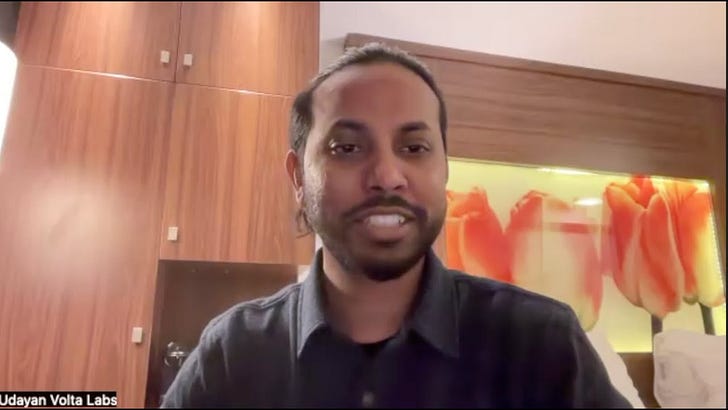
Building the Front-End for Every Sequencer with Volta Labs CEO Udayan Umapathi
26m 49s
Volta Labs, emerging from the MIT Media Lab, aims to transform biological sample preparation through its Calisto platform, which employs a novel digital fluidics architecture. In its first year of commercialization, the company successfully launched over 10 applications compatible with various sequencing technologies and began global shipments. A significant surprise was rapid adoption in clinical settings, driven by Calisto's exceptional consistency, quality improvements, and cost reductions. The platform enables true walk-away automation, allowing labs to process samples with minimal hands-on time and achieve rapid turnaround. Its app-based model lets customers deploy pre-validated workflows quickly, reducing the typical months-long setup to just days. This reproducibility across locations is facilitated by software updates that ensure identical results worldwide. Demonstrations include doubling sequencing yields and reducing redo rates, particularly in applications like whole-genome sequencing and pediatric oncology. Additionally, Volta emphasizes sustainability by cutting plastic waste. The vision is to make Calisto the universal front-end for all sequencing technologies, advancing automation in genomics.
Why is every sequencing company talking about Volta Labs next on the show? Welcome to Mendelssohn, everyone. I'm Theryl Timpson. Volta Labs was founded in 2018 out of the MIT Media Lab by today's guest, Udayan Uma Pathie. He's a mechanical engineer by training who became obsessed with the idea that biology shouldn't have to depend on fragile hand-built automation, much like early computers before the transistor. Volta emerged from that idea, a company reinventing sample prep using digital fluidics and a new architecture that blends electric, magnetic, and acoustic and thermal manipulation of droplets. Their platform, Calisto, is built to handle any chemistry, any sequencer, and to minimize hands-on time to the point of true walk-away automation. It's an ambitious vision backed by names like John Stolpe-Nagle and George Church, and now it's moved from theory to scale. Udayan, so great to have you back on the program. Welcome. Thanks for having me, Theryl. I'm excited to be here. The last time you were here, Calisto had just entered the world. You'd commercialize. You had those very first apps and were beginning, you know, to share this vision of a universal sequencer-agnostic platform for sample prep. But now let's fast forward a year. I have to say, I heard you were the hot company at AMP a couple of weeks ago. So there's been a lot of buzz. How would you summarize this first year? Yeah. It's actually been a super exciting year for us. We said we wanted to be the front end of every sequencing technology. We've actually done that. We've launched a 10 plus application and, you know, we're actually starting to ship globally. We are in North America, we're in Europe, we're in Asia. We did not expect to do that. And we're starting to see customers pull and get our machines worldwide. So that's been super exciting. And additionally, this is somewhat of a big surprise for us. The quality improvements in the consistency has propelled our growth in the clinical segment. We did not expect our customers to adopt our platform in the clinical segment such in such early stages of the commercial trajectory of the company. But that's just not because of the consistency and quality. There's also dramatic reduction in cost that we've also given to our customers. What can you share about these recent placements? What are you hearing back? Yeah, I think, you know, when we launched, and I think when we talked about the platform last time, I think something we said is, you know, when customers start using the platform, they're shocked by the walk away nature. And so what we are hearing from our customers is that we've actually been able to deliver that across applications, across sequencing technologies, across chemistries. So that's pretty exciting. And so we're able to reduce the cost of ownership dramatically. And when customers buy our system, when we talk about all of the sequencing technologies, they're able to simply buy a kit and run software, and then they get the results without having to a learn sample prep. And so that's also been very exciting. And, you know, that's something our customers were excited about. And the last thing I'll say is, and, you know, we thought it's an automation platform, and what we've realized, you know, with these customers worldwide is, it goes far beyond being a standard automation platform. The significant improvements in quality, and that quality shows up across applications. If you take Illumina Library Prep as an example, we're the most consistent library prep on the platform. And so on and so forth. To just kind of like samurai. The most consistent library prep for Illumina. That is correct. That is correct. Oh, that's great. Yeah, so we're excited to see the type of feedback as well. So there is a long list of that type of feedback we're starting to hear and learn from our customers. But, you know, going back to your question though, it's this sort of walk away automation nature across application, simply having the ability to buy a kit and run the workflow, and the quality improvements. These have all been things that our customers see as significant improvements. Yeah, I mean, I'm a total believer in this. We've featured sample prep over the years because it's a major part of what's going on in the lab. You know, and as sequencing improves and diversifies, it's become cheaper and cheaper. You know, we just had Rochon talk about their new unit. And they had, they had again, this world record, right, for how fast they're doing genomes. But then you could see that actually sample prep is now taking more time than sequencing. That's right. So there's the time. But then as you just mentioned quality, so could you go into both of those a little deeper? Definitely. And I think like cost is not to be ignored as well. I think you and I have talked about this many times before. And you know, Guilard at Ultimals or talks about the cost decline in sequencing. And which also starts to become important as we have these AI driven models and closed loop feedback type systems cost also starts to become even more important, which we'll touch upon. But we have a question on the speed of sequencing. You know, congratulations to the Roch and the SVX team. I actually listened to Mark Cochorus's podcast on the plane the other day. Oh, okay. Wonderful. Yeah. I called him a late bloomer. He's been working on that since 2007. I hope he didn't get offended by that. No, he didn't. Yeah. So he's a good friend and I've known him. And you know, and these technologies take a really long time. But it's really exciting to see that you can, you know, I think Mark said that you can see sequencing takes only about 20 to 30 minutes. And they they had a real time interpretation. And you know, I have a slightly different view on this. I think even if sequencing can be done really fast, I think depending on the application, you know, and the workflow needs, you may not always require that sort of fast speed. I do think this sort of the ability to sequence really fast is going to enable and open up a new applications. But you know, and we are while we've not optimized for speed, the platform is capable of meeting the demands and the requirements of, you know, speed that is required in the market today, whether it's the NICU or the PQ use cases. That's the main case. Yeah. Right. So, but what we find though, as we've launched the platform in the market is there is a need to be able to process multiple batches of small samples. And so when I say small, I'm referring to four samples I'm talking about, you know, 10, 20, 30 and so on and so forth. And so we're actually able to do that and provide the sort of rapid turnaround time. And second is our system is also able to run overnight. And this is something hard to do with traditional liquid handling technologies. And so it's just to walk away at this point. That is correct. And that enables a different type of turnaround time. You can set up your run at 4 p.m. and 5 p.m. go home. The samples are ready to be processed next day. And that's sort of a different type of experience that we've created to our customers. And to your question and quality, I think I touched upon the Illumina Library prep. And it also ties back to our wanting of commercialization. One of the key things we've learned on the platform is if you take something as simple as Illumina Library prep, you know, what is there to be done? You know, that workflow has existed for the past 20 years. The cost is nearly at the bottom, right? But what we've learned is that's actually not true. And particularly in the clinical segment of our customers, they're starting to push us further. So we have customers who need very quality. And quality in this case means having pipe distribution and fragment length and having uniform distribution and fragment length. We're actually able to achieve this and our clinical customers are actually pushing us to achieve that kind of consistency and reproducibility. And that's just for Illumina Library prep. And if you look at other sequencing technologies and other workflows, you know, we've actually doubled the yield of sequencing, we've doubled the yield of library prep. Oh, that's big. That's how it's been the promise of sample prep. Yeah. That's right. You know, without touching the sequencer by simply improving the quality of sample prep, we've kind of doubled the yield on the sequencing. That's a big deal. And the second is, you know, with hybrid capture type workflows, we also reduce the redo rates on sequencing. And we enable that by allowing our customers to get uniform coverage across their targets. That's another way of improving quality that reduces redo rates and hence reduces, you know, sequencing costs. And so there's a long list of these things. These are things we've accomplished. We're still learning and we have other quality improvements for CFD and EWD. We have quality improvements for our new workflows and so on and so forth. When we talk last year, we're going to be able to do a lot of work.
your goal over the next year or two was to develop the apps. And you mentioned those here at the beginning of this interview. Can you say a bit more about the apps that you've been working on this year and what that means? Does that mean doing it from your iPhone? Not quite, not quite. But I think one day, there are sequencing technologies that can fit in your pocket. I think we still have the vision while on the one hand, our vision is for biologists to not think about developing workflows. We'd also like to miniaturize sample prep. And so we'll see how far we can push this technology. Oh, okay. Yeah. So the last biologists have to think about those workflows and the more they can just do biology. But what we have accomplished though in the past year or two years is we brought this concept of apps. It's not quite running in a pocket size device. It's not running on your iPhone. However, what these apps have enabled our customers to do is they don't necessarily have to go through the method development effort and the validation effort. Usually, you know, labs spend anywhere from six to nine months in developing these apps and taking them through validation. And this has for every app, every application at every lap. So what we've done is we've cut the time that it takes for a customer to get to production from nine months to our customers are able to get to production in three months. So that's a pretty bad production in a time. And once we have the app or the method, the same learning translates from one customer to another. And this is not being, you know, the same recipe is being replicated. So that's one. The second is our, you know, I remember I told you about the shock moment when customers experience the complete walk away, the other shock moment that we've our customers have experienced is our systems are up and running on day two or in the first week. They've not had such an experience before. So this is actually enabled by the app based model. Yeah. I see. You've had some press releases. There was a doctor Leonard Kaster and his lab had tried other automation systems for months and couldn't get him to work. And yours was up and running in a couple days. That's right. So how do you get that advantage? Why is it easier? Right. Why is it easier? The technology is fundamentally different, which I'll come back to, but the story that you've heard from Leonard is not, is not unique to Leonard. This happens everywhere. This happens in the most mature diagnostics labs in the world. The largest labs with the largest fleet of novosix. This happens in small labs in Asia and developing countries. This happens in fairly sophisticated diagnostics labs with some level of automation. And so the reason for this is the traditional automation technologies, they have, they're very complex and they have many degrees of freedom. And manipulating these machines and getting them to work for each method requires a lot of finagling. Requires a lot of programming and requires a lot of expertise. And you need to do this for each workflow across weather conditions and humidity and temperature and so on and so forth. What the color stop platform offers is if you look at the internals of the technology, previously we talked about manipulating these droplets using electric magnetic acoustic and thermal fields, that combination dramatically reduces the complexity of developing these workflows. And I would think it would increase because there's so many different technologies there. It doesn't some ways, you know, and that's part of the reason why we don't allow our customers to program the device. And so that's why we have the app based on. Okay. However, once you've developed these workflows, a protocol or a method or an app developed on one color, so we can put it on any color, so that sitting anywhere in the world, it'll produce nearly identical results. And that's not been possible with the traditional technologies. And so what this means is when we develop apps at our labs at HQ and Boston and we have a system sitting in, let's say Europe or somewhere in the US or in Asia, we can push these apps, via software update and those apps will produce identical results. And so going back to your question on Leonard, when I met Leonard for the first time, I actually walked into his office and then I told him, like, hey, you know, when we install Kallisto, it's going to work right out of the box. And at first he didn't believe me. And he, in fact, he got offended. He got offended because they've been using his other liquidating technologies and they've spent like, you know, nine, nine to 12 months and they've been struggling to get these apps up and running. A month later, we installed a system and the machine was up and running on day two. And it's up and running on day two because our system is able to get this off from HQ, run the method and produce nearly identical results to what we were able to produce at our HQ. Okay. That's interesting. Where you're basically kind of networking the results of different labs and you're able to share that in a way, in a way, that's exactly right. Because right now the networking happens through so you can think of how our aluminum has done this with other customers for years. Right. That's right. That's right. We are doing that for sample prep and you know, the technology to enable this reproducibility has never existed before. It exists now in the form of Kallisto. Exciting. Let's drill into one of these applications, which is I think you've had a good result that you're in pediatric oncology. Talk to me about why the children's hospitals are adopting Kallisto and why it's making it so meaningful there. That's a great question. Yeah. I mean, I think we've succeeded in many, many customer segments. What I'd say I think maybe even taking a step back, the whole genome sequencing is a particular area where our customers are most excited about. And we've launched about seven applications that span shorted sequencing and long-read sequencing. And we have quality improvements and so on and so forth. But it so happens that a good number of our whole genome sequencing customers happen to be in pediatric oncology. To some extent it might be a coincidence. But given the success that we have seen in that particular sort of type of our customers were also trying to drive our adoption in that particular segment. But with whole genome sequencing, while we are succeeding at pediatric oncology, you know, we have other customers in the Rarity Disease Diagnostics. We have other customers using whole genome sequencing for oncology as well. And remember in hybrid capture, we have superior quality. So we do have hybrid capture applications also being used in pediatric oncology. Princess Maximus is a good example. UMC U-Tract is another sort of a customer. And there is large diagnostic labs in the US that provide services to pediatric oncology hospitals that are also using our system and using Callisto for whole genome as well as hybrid capture and target workflows. Princess Maximus talked about how they're using Oxford Nanopore. Right. It's working really well with Calesto. Yeah. And I have to say this one of the things I've been pretty amazed at all year is, you know, on LinkedIn or whatever, I'm hearing from element Oxford Nanopore, Pac Bio. And that was your goal to be sequencer agnostic. That's right. Yeah. And you've achieved it, I guess. We've achieved it. And we're super excited about that. Yeah. And we've done it for DNA for whole genome. We're starting to do that for hybrid capture. And we're going to start doing that for RNA. We're going to do it for other analytes as well. You've made some adjustments to your business model this year. What's that? Yeah. Yes and no. The highest level, you know, the, the color source business model is to be able to, you know, bring the color stop platform and customer access various apps. That's generally been our sort of business model. And the apps are, they buy the platform, they buy the platform. It's an instrument. It's an instrument. Yeah, that is correct. That is correct. And what customers are not used to is when they buy traditional liquid handling technologies, they'll also have to buy an automation engineer. They don't need to with our platform. They get all of these apps for free. And the other thing that's evolved for us is our customers going back to sort of our launch in the past year or so. What we've learned is our customers require various chemistries. And so for whole genome sequencing in particular, we enabled any beast chemistry, Kappa, roast, you know, Illumina, DNA prep watchmaker, Tygen and so on and so forth. There is a long list of those. So to question about business model, generally speaking, I think we offer the platform the instrument to our customers. They access these kits in the form of apps. However, the thing that's evolved in the past one year is
We have partnered with the reagent providers as well as sequencing companies and we have partnered with customers as well. And so we've gone one step further where in addition to bringing these apps, many of these apps are now validated with our partners and sometimes with our customers as well. You've emphasized sustainability. I remember this from our last interview. It's an important thing for the company culture. How's that tracking against your ambitions? Yeah, that's a good question. And I'm glad to ask that also because sustainability is important to us as a company and it's also very personal to me for various reasons, for personal reasons. And you can argue is it good or bad? I think there's a lot of debate about the climate change, real. I think we are working in a fairly sophisticated and complex environment. But on the sustainability piece, we've actually delivered on the promise and we've upheld that in the product and we've upheld that in what we've delivered to our customers. The technology itself renders to significantly reduced usage of pipette tips and plastics that is inherent to the technology that comes for free with electric magnetic manipulation of the liquids. But more tangibly, when we launched the product, some of our kids had a lot of waste in packaging. We've actually dramatically reduced the waste in the past one year by redesigning the package. But however, I think what I wanted to draw our attention to is I think as we start to increase the scale of sequencing as we start to increase the scale of omics, I think it's going to happen, not just because of the proliferation of sequencing into new use cases on the clinic. I do think I think there is going to be a lot more biology we're going to do to train the new AI models and so on and so forth. Our traditional technologies are just not going to scale with plastics and all of the waste. And so I'm pretty excited about where the world is headed with AI. But more tangibly though, we've also delivered on that promise by reducing reagent usage and by reducing plastic usage and being conscious about packaging and things like that. So what about AI? Does that impact your business? It does, and it has. And we're a pretty heavy user of AI internally. And in fact, we use AI tools internally to drive various efficiency gains to have productivity gains and so on and so forth. Our software team internally is using some of these tools and trialing some of these tools to edit the code and so on and so forth. But what I find most interesting and somewhat relaxing also when you look at the life sciences tools industry is I'm waiting for some of these tools companies to see what they're doing with AI. A particular initiative that we are taking is use some of these tools on the product. I can't share much quite yet, but we are starting to use some of these tools to increase the robustness of the product and use them for troubleshooting, for developing new customer success tools, for us to be able to develop the apps faster and so on and so forth. Those are some tangible ways in which we are using AI tools today. But I am a little bit perplexed that there is not as much activity from what I've seen personally in the life sciences tools industry. There are many companies in the space looking at protein discovery, a lot of work that's gone into increasing the scale and building foundational models for creating new molecules and so forth and for downstream whole genome sequencing analysis. And so I'm excited about where where it's headed and I'm excited to continue to increase the scale of our product to track that type of scaling as well. Okay, and so finally, let's look forward a bit. The sequencing instrument space has been amazingly dynamic. I was pretty surprised that we had a whole new type of technology come out this year. I thought it was pretty mature instrument space, but there's still dynamism there, but ultimately the price is coming down and the sequencing is becoming more standardized. How much opportunity do you think is out there for the sample prep side of things? Do you think you're just getting going on making this more efficient and taking less time and better quality? Or do you think there's just a lot more room to grow? I think we're in the very early innings of sequencing in general. But it's super exciting time to be in. I'm sure Mark would agree with you, Mark Okoris, you know, Guilard from Ultima and Molly at the element as well. These are the disruptors and we are a disruptor as well. And so I think what we've seen in the market in the past year is they used other solutions because they've not had an option. We're the first platform on the market that's actually delivered on the promise of, you know, much like a sequence of right. Like when you load a sample, you get data. But that's not the case with sample prep. When you load a sample, someone is sitting and watching these robots. You know, so we've actually eliminated the people watching these robots problem and we've reduced cost and we've improved quality. And you know, as these new sequencing technologies come in, you know, it's one platform. One platform to do, you know, alumina, one platform to do odds for an apple, one platform to do an ultima, one platform to do any B, one platform to do long range. So we do it all. And so this is a long, long, long way to go from my perspective. We die in Uma Pathie CEO of Volta Labs. Hey, great talk to you again. Thank you. Thank you for having me, Tharo. Today's show was produced by Vicki May Comer and is a joint production of Mendelssohn and Genome Web. Happy Holidays, everyone.
Podcast Summary
Key Points:
Volta Labs, founded in 2018, developed the Calisto platform to automate and revolutionize biological sample preparation using digital fluidics that manipulate droplets with electric, magnetic, acoustic, and thermal fields.
In its first commercial year, Calisto achieved global deployment, supporting over 10 applications across major sequencing technologies (like Illumina and Oxford Nanopore), and saw unexpected early adoption in clinical segments due to superior consistency, quality, and cost reduction.
The platform's "app-based" model allows customers to quickly deploy validated workflows, drastically cutting setup time from months to days and enabling true walk-away automation, which improves efficiency and reproducibility across diverse labs worldwide.
Key benefits demonstrated include doubling sequencing yields, reducing redo rates, lowering operational costs, and enhancing sustainability by minimizing plastic waste, positioning Calisto as a universal, sequencer-agnostic front-end for genomics.
Summary:
Volta Labs, emerging from the MIT Media Lab, aims to transform biological sample preparation through its Calisto platform, which employs a novel digital fluidics architecture. In its first year of commercialization, the company successfully launched over 10 applications compatible with various sequencing technologies and began global shipments. A significant surprise was rapid adoption in clinical settings, driven by Calisto's exceptional consistency, quality improvements, and cost reductions.
The platform enables true walk-away automation, allowing labs to process samples with minimal hands-on time and achieve rapid turnaround. Its app-based model lets customers deploy pre-validated workflows quickly, reducing the typical months-long setup to just days. This reproducibility across locations is facilitated by software updates that ensure identical results worldwide.
Demonstrations include doubling sequencing yields and reducing redo rates, particularly in applications like whole-genome sequencing and pediatric oncology. Additionally, Volta emphasizes sustainability by cutting plastic waste. The vision is to make Calisto the universal front-end for all sequencing technologies, advancing automation in genomics.
FAQs
Volta Labs is a company founded in 2018 that reinvents sample preparation for sequencing using digital fluidics. Its Calisto platform automates sample prep by manipulating droplets with electric, magnetic, acoustic, and thermal fields, aiming to minimize hands-on time and work with any chemistry or sequencer.
Calisto offers true walk-away automation, reduces the cost of ownership, and improves quality and consistency. It enables customers to run workflows quickly by simply buying a kit and using software, without needing to learn complex sample prep methods.
The platform provides superior consistency, such as uniform fragment distribution in Illumina library prep, and can double sequencing yield. It also reduces redo rates in hybrid capture workflows by ensuring uniform coverage across targets.
Calisto uses pre-validated apps (workflows) that customers can deploy via software updates. This cuts the time to get a workflow into production from typically 6-9 months down to about 3 months, and ensures identical results across systems globally without extensive programming or validation.
The platform is designed to handle sample prep for any sequencing technology, including Illumina, Oxford Nanopore, and PacBio. It supports over 10 applications across different sequencers and chemistries, allowing labs to standardize prep regardless of the sequencing platform used.
The core technology reduces plastic waste by minimizing pipette tip usage through digital fluidics. Additionally, Volta Labs has redesigned packaging to cut down on waste, addressing environmental concerns as sequencing scales up.
Chat with AI
Loading...
Pro features
Go deeper with this episode
Unlock creator-grade tools that turn any transcript into show notes and subtitle files.
 PodcastTranscript AI