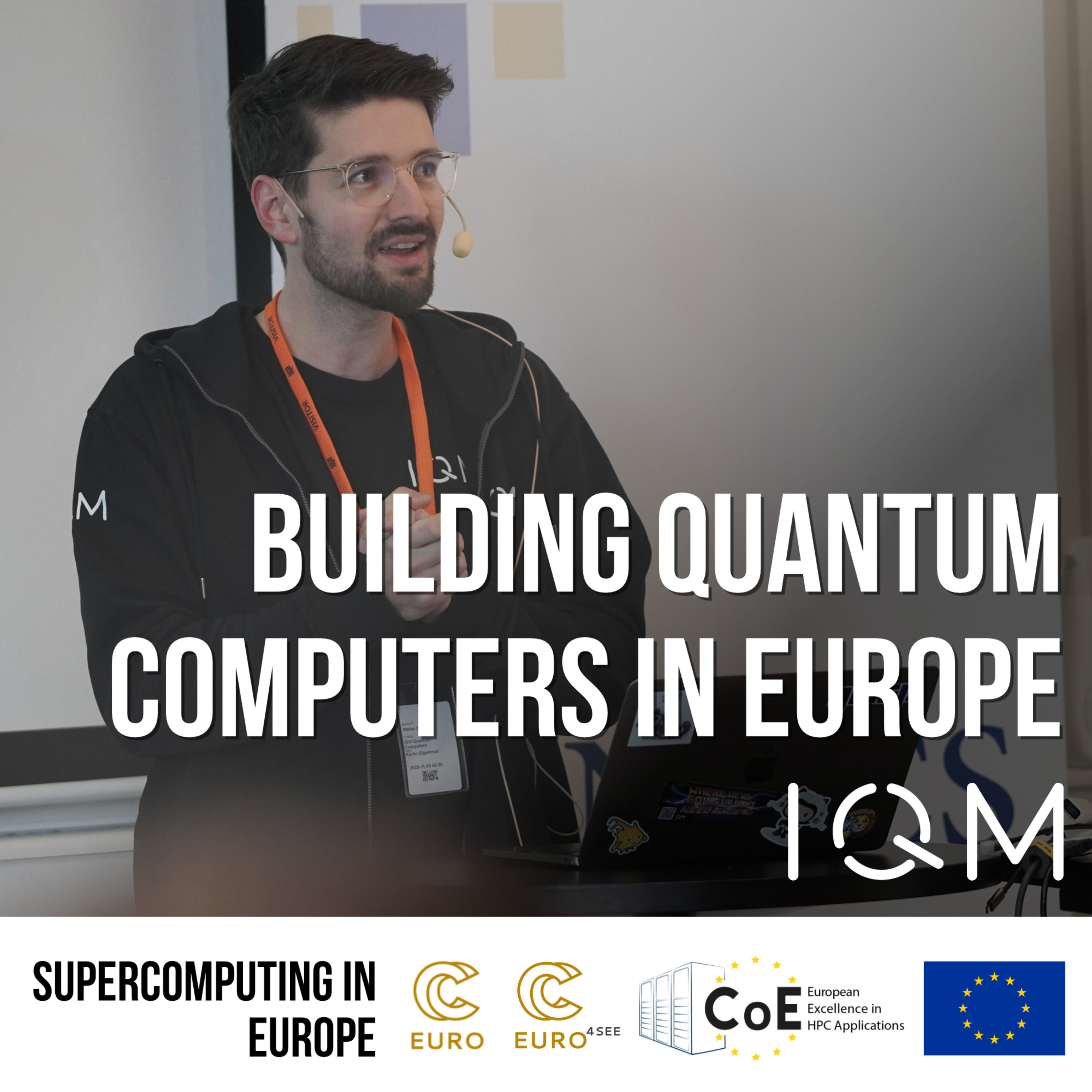
Building quantum computers in Europe - A conversation with IQM's Stefan Seegerer
24m 25s
IQM Quantum Computers specializes in superconducting quantum hardware, focusing on increasing global access to quantum systems to drive regional innovation. In this podcast, Stefan Ziegler explains that quantum computing tackles complex problems—like molecular simulation and optimization—that classical computers struggle with, even at scale. Unlike classical computing, quantum approaches use unique quantum-mechanical operations to reduce computational steps, offering potential breakthroughs despite slower operational speeds. Current users are largely researchers developing algorithms and supporting technologies, with IQM providing cloud platforms and educational tools to broaden engagement. Challenges include scaling devices, minimizing errors, and shielding sensitive qubits from environmental noise. Looking ahead, IQM aims to advance error correction and enable practical applications in fields like medicine and materials science, anticipating gradual industry adoption as hardware and algorithms mature.
[MUSIC] IQM is building superconducting quantum computers. Our place in the world of developing quantum hardware is that we, according to a recent publication by Quantum Insider, we have placed the most devices out there in the world. This is part of what we want to do, like giving as many people, regions, and institutions access to quantum computers. Those innovation hubs, they center around a focal point, and a quantum computer can somewhat be that and can really bring forward a whole community, a whole ecosystem regionally. And this is what we want to support with the work we're doing. Welcome to Supercomputing in Europe. The podcast where we discuss various interesting tech topics with Supercomputing at their core. My name is Apostolos Liatis from PNCCS. The EuroCC National Competent Center in Sweden, and I will be the host for this episode. Stick to the end to learn ways you can access free computing resources in Europe for HPC and AI projects. Today's guest is Stefan Ziegera, head of product quantum platform at IQM Quantum Computers. He works with shaping how the next generation of developers and organizations, access and hardness quantum computing. Stefan, thanks for joining us. Thanks for having me. Can you talk briefly about your background? Sure. I'm actually computer scientist by training. So he started out becoming a teacher from math and computer science and then gradually or by accident stumbled into quantum computing for one project as a PhD student or at the end of my PhD student time at university. And then I happened to move to industry and started to work for IQM Quantum Computers. I started out doing training, explaining people how to use and operate a Supercomacting Quantum computer and then transition into a product role at IQM, though. What is IQM and what is your role there as a head of product? IQM we built Superconducting Quantum Computers for research institutions, Supercomputing centers, but ultimately obviously to create the compute platform to solve all those problems we currently cannot address or solve. And my role there is to define how we built our products. What are the features that go into it? For example, we do have a cloud platform called IQM Resonance that we use to enable others that are not going beyond Prem route, which is something that for example is relevant for HPC centers, but others like institutions that are more on the compute side of things that want to access quantum computer resources, then we figure out what's the right features that we put into the product. So they get the most value of our quantum compute. And as kind of the head of product, the team I'm in is we want to make sure we build the best possible product for our customers and our users. Let's go back to explaining quantum computers. What is the failure or limitations of classical computing that brings us to the need of quantum computers? The need of quantum computing really is motivated, but the fact that there are some problems which might seem like a classical computer like my smartphone, especially the HPC infrastructure that you guys have really feels like it can do everything. Like they are very powerful, but there are still problems which are so hard to tackle that we can't really address the independent of how much compute we throw at it. So it's not just that the current compute is not capable of like solving these problems, but even if we have 10 times the compute power, 50 times the compute power, we are still struggling to solve these problems. Now, the other lesson I might wonder what kind of problems are those? And those problems lie in simulation of materials or optimization problems or some things even like make sure that our secure communication is really secure. Like the fact that we believe that for classical computers, it's really hard to do prime factorization, figuring out which two numbers were multiplied to form a new number. That's pretty hard to do. The other way around like multiplying them is pretty easy for any classical computer, but not like factorizing them. And very similarly, simulating how molecules behave figuring out what their acidity is or other types of questions that are related with material research or chemical research or solving very complex optimization problems such as figuring out the best train schedule for all trains running through Sweden after they've been delayed. One train has been delayed or five trains have been delayed. Those are problems which are very hard to address. Obviously, we apply heuristics or simplifications to make them manageable. But for all of these profits problems, we can profit of having a different way to approach them. And quantum computers here are not about solving these problems faster. Like it's not about having a chip that is 10 times the speed or something as a classical computer. No, it's about that by harnessing the concepts of quantum mechanics, not classical mechanics, we can get to new ways to approach this problem. So I love to compare it to the spaghetti computer and that might sound really strange. But let's figure out how we could solve a number sorting exercise. And with a classical computer, what we would do is we line them up in a row and then we go through the list and always select like the biggest number. So we need to go through this list multiple times, always selecting the biggest number. The first step, we go through all of them that are in there, take the biggest one, put it to the front. And the second iteration, we go through them again, still select the biggest one that's left and so on and so forth. This is one way of doing a sorting algorithm. And this was one of the examples you typically do like, I don't know, in C as one lectures and stuff. So obviously, it's like for those who have this notation in mind, this is something like a quadratic problem size. So for every element that is in the list, we need to go through the list ones. Obviously, the list will get smaller, but kind of the overall, all part is a quadratic problem size or step size to solve the problem. And with a spaghetti computer, we can address this problem differently. Obviously, spaghetti allows new types of operation. We could cook them, we could, I don't know, throw them against them, but we can also cut them. And how we could solve this problem with a spaghetti computer would be, we encode all the numbers we have into the lengths of the spaghetti. And then we take the whole pack of spaghetti and the same thing that I do before I throw them in the water is I put them on the table to align them essentially. And this way, I've already sorted them essentially. And now I only need to take the biggest straw first and start from top to bottom and line them out perfectly. And this way with like going through the list twice and doing one operation in between, I have solved this problem with less steps. Sure, each individual step might have taken way longer than the step of just looking at them and going through the list. And the same principle applies to quantum computing. We have new or different types of operations we can perform. This means we can tackle the problem differently, leading to solutions that take way less steps and be are therefore fast, even though and that might come as a surprise to it to many people. A quantum computer is not operating like at multiple hundred GHz or something. It does not. It's actually operating slower than most CPUs that we have like any notebook CPU or smartphone CPUs. I don't know, two gigahertz or something per core. And a quantum computer is somewhat in the megahertz range. So way, way lower. But by enabling us to approach the problem differently, we can still get a huge, huge advantage. This is why quantum computing is such a cool feel to be in. And such a promising technology to solve all those problems, we can hardly tackle right now because independent of how hard we scale classical computing will not be able to solve them in a meaningful time. You gave this example of sorting algorithms. What useful things can quantum computers currently do? And who are the early adopters? Obviously sorting algorithms is not something that we would want to throw a quantum computer at. They're pretty good things on how to do that. But problems in simulation of molecules or solving optimization problems are things that are much more interesting to be addressed by a quantum computer. Current day quantum computers are used by research institutions to investigate how the technology can help to solve these kind of problems, like developing the core algorithms. There is a website called quantum algorithms, Sue or something. And it kind of lays all the quantum algorithms that have been developed.
have been published in research. And currently what early adopters do is developing new types of algorithms, creating estimations on what are the hardware requirements needed in order to solve problem sizes, which are the ones we are really interested. And we are currently like seeing a rapid or an increase in the size of problem people are able to solve with a quantum computer. So it's mainly adopted by researchers both in private sector and in public sector. But it really means in order to profit early from quantum computing, you both need to scale the hardware, but we also need to learn a lot about the software. And that's one thing people do with it if you come from the computational side. And the other thing is that obviously if we look in the classical computing space, there is a lot of things going on in value creation and things that are needed to build classical compute infrastructure. I believe the same is true for quantum, that there is a lot of supporting technology that we can make better that can profit the development of quantum computers. And this is also something that that early adopters do like figuring out the connectivity to the device, thinking about new types of electronics to control those. And all these kind of things, kind of one is to help the algorithmic side of things and the other is to make quantum computing advantage a reality sooner. At the moment, what is IQM's place in the world in development quantum hardware? What sort of architectures are you mostly working on? IQM is building superconducting quantum computers. And for the listeners to explain what that is is there are multiple modalities on how you can physically realize a qubit kind of the unit you use to store quantum data and process quantum information. The way we do it is we rely on the processing technologies we know from chip fabrication and from microwave engineering just using different materials, superconducting ones. We then kind of we create those chips, that's some of the stuff we do, then we integrate it into a whole system that you can readily set up somewhere and it then continuously operates, it's calibrated by our routines that are because the quantum computer, unlike for example a classical GPU or something that's factory set with some calibration information, a quantum computer due to like changes in the environment needs to be regularly recalibrated. This is typically done through automated scripts, but these need to be part of the overall package to make the quantum computer useful. And then obviously the for me most interesting and most important part as as I have this background in like HCI human computer interaction and stuff is how then people access these devices, so the access layer which frameworks you use to connect to the device, which APIs you provide to make this useful. Our place in the world of developing quantum hardware is that we according to a recent publication by quantum insider, we have placed the most devices out there in the world. And this is part of what we want to do, like giving as many people, regions and institutions access to quantum computers. Because I think this is shown also in innovation research that those innovation hubs they they center around a focal point and a quantum computer can somewhat be that and can really bring forward a whole community, a whole ecosystem regionally. On the technology side, this goes a little bit deeper now. We built on a well known technology being superconducting on transmon qubits. And we have two specific topologies there. One is a square grid topology, we call it crystal where one qubit is physically connected to four other qubits on average. I like at least in the middle, not in the corner of the chip, because you need to imagine that a QPU like the quantum processing unit is essentially residing in a 2D plane. Obviously you can stack up chips and then use the third dimension as well. But it's somewhat a two dimensional topology. So you can't easily have an all-too-all connectivity between any qubit. That's why you need to think about how to design that. How do you connect those qubits physically on the chip? And we have two ways of doing that. And the other one is going for an even higher connectivity. It's called iQM star where we have used a different computational element in the middle of the chip to connect, effectively, all qubits on one chip. That's something we've recently or that will be inaugurated for the Czech supercomputing center IT for INOS-TRAVA. And going forward, both of these topologies will merge into one. And this is our way to tackle the next big challenge in quantum computing being enabling quantum error correction, like using redundancy multiple physical qubits to correct errors when they occur. You mentioned the community building around quantum computers. What initiative does iQM take in this field? And what interesting opportunities are there for software or quantum developers? Because as you mentioned, it's the use of those computers that's going to bring change in many fields. This has multiple dimensions. So we do work with our customers that have acquired an iQM system such as LRZ, IT for i, VTT in order to enable the local ecosystem to work with those devices. We also have educational offerings with a iQM academy that's our online platform where we share tutorials and learning materials on quantum computers. And we've, like this year, started to give out free accounts to our iQM resonance cloud service. For people, can try small things with limited access to those devices, obviously in comparison to to owning a device or having paid access to iQM resonance. But this allows everyone who's interested to experience and play around with a quantum computer. So this is also invite to you. Just feel free to to try it out. It's free registration takes like two minutes, I guess. And you can start experiencing how the next generation of compute might look like. Can you tell us how many systems currently are operational in Europe? Within Europe, we operate three systems for our cloud service, which are publicly accessible. We also have a bunch of stations internally, like roughly 10 times then what we offer in the cloud we use for internal testing, developing those things further. And then we have devices at multiple customer premises, VTT, UL-S, LRZ and Munich or Gauhing near Munich, then Italy, the links foundation, there is one in France and IT for i. So there are a bunch of systems around already from iQM. And then there are some other modalities or other devices that are available throughout Europe, which if I would comment now, I guess I would still miss one or two and that's why I would rather not do that. In your opinion, what needs to be done so that quantum computing gets adopted massively from industry to regular people? So in order for quantum computing to be adopted massively, we need to get to that level that really provides utility on an industrial scale. So currently it already is providing value in the research space and the HBC space, but for industry adoption obviously it needs to be clear that now you can use it for solving this or that specific industry problem. But this will not happen overnight, I think it will be a gradual process and it also requires those actors to be active before it actually is like fruitful. You need to develop those algorithms, get like an understanding of the problem types and that's why already now there are a lot of companies that are investigating quantum computing and how it can impact their ways of working, the problems they face, and as it say, gradual process, I think we will see more and more problems being at least meaningfully solved with a quantum computer. Can you also mention some challenges for this massive adoption? As I'm working in the hardware business, obviously the challenges we see here are in scaling up those devices. This is not just true for IKM, but this is an engineering challenge that is faced throughout the industry. But that's ultimately what keeps us motivated every day to solve these engineering challenges.
challenges and to get those devices to higher cube it counts, but also to higher what we call fiddalities, which means less error rates. So because the thing with a quantum computer, I think I might repeat myself is they are based on quantum phenomena, quantum phenomena typically describe or quantum mechanics, typically describes the things that happen with the smallest pieces of our universe, like atoms and electrons and photons and these kind of things. And they are pretty small and that's why they're obviously pretty sensitive to everything that happens around them. But if we want to do compute with them, we need to keep them controllable. So we want to control them from the outside, but we also need to protect them from the environment. So they keep their quantum state for a long enough so we can do our computation. And this is the constant challenge you're in. Protect them pretty well from the environment, cooling them, adding magnetic shields and these kind of things. But also allowing to still control them. And in that conflict, it's about getting the errors as low as possible while increasing the size and obviously adding more elements to something increases the complexity. Unless we have more crosstalk, more sources of potential, more sources of potential errors that come from the environment and things like that. Looking ahead five to 10 years, what would you say it's your vision for quantum computing or what's possible? We've started out speaking about the problems that we currently console with classical computing. And looking ahead five to 10 years, I'm very, I'm very, very confident that we'll be able to solve some of these problems, which will then enable us to create better medicine, better materials, maybe better batteries for our electric cars or homes and other things. And that alone would be already exciting. If we in addition can solve some optimization problems better, even greater, like portfolio allocation problems or routing challenges. And if we see quantum machine learning, it also being fresh and well, that would be the icing on the cake. So finally, what should we expect to see from IQM in the near future? Give us sort of a teaser. What we are trying to achieve with our devices is we want to give researchers and educators the right tools to make use of quantum computing now and to really advance science. And what you can expect for us in the near future is that we really extend this vision we have for our products into the face of error correction. So enabling researchers to work on error correction algorithms, error correction part problems and these kind of things. I think the future is excited. So please feel free to follow us and learn more about quantum computing. Stefan, thank you so much for being with us. It was a pleasure. This episode was brought to you by ENCCS. We give super computing training and support to businesses, academia and public administration. If you're interested in super computing access visit ENCCS.SC and contact us at our email info at ENCCS.SC and LinkedIn. You can find all relevant links in the show notes. The super computing in Europe podcast is made possible with funding from the European Commission and specifically from UHBCJU, the joint initiative between the EU European countries and private partners to develop a world class HPC ecosystem in Europe. The podcast is sustained by the UCC project, the AI factories and the Center of Excellence Network that provides super computing training and support for industry, academia and public administration. If you want to learn more or contact your local Compton Center or AI factory, please visit HPC-portal.eu.
Podcast Summary
Key Points:
IQM builds superconducting quantum computers and has deployed the most quantum devices globally, aiming to increase access for diverse users and foster regional innovation ecosystems.
Quantum computing addresses problems intractable for classical computers—such as molecular simulation, optimization, and secure communications—by leveraging quantum mechanics for fundamentally different problem-solving approaches, despite operating at slower clock speeds.
Current adopters are primarily researchers developing algorithms and supporting technologies, with IQM offering cloud access (IQM Resonance) and educational resources (IQM Academy) to engage developers and the public.
Key challenges include scaling hardware, reducing error rates, and protecting qubits from environmental interference while maintaining controllability.
Future goals involve advancing error correction, solving practical industry problems (e.g., in medicine or materials science), and expanding quantum utility over the next 5–10 years.
Summary:
IQM Quantum Computers specializes in superconducting quantum hardware, focusing on increasing global access to quantum systems to drive regional innovation. In this podcast, Stefan Ziegler explains that quantum computing tackles complex problems—like molecular simulation and optimization—that classical computers struggle with, even at scale. Unlike classical computing, quantum approaches use unique quantum-mechanical operations to reduce computational steps, offering potential breakthroughs despite slower operational speeds.
Current users are largely researchers developing algorithms and supporting technologies, with IQM providing cloud platforms and educational tools to broaden engagement. Challenges include scaling devices, minimizing errors, and shielding sensitive qubits from environmental noise. Looking ahead, IQM aims to advance error correction and enable practical applications in fields like medicine and materials science, anticipating gradual industry adoption as hardware and algorithms mature.
FAQs
IQM builds superconducting quantum computers for research institutions and supercomputing centers, aiming to create a compute platform for currently unsolvable problems.
Classical computers struggle with problems like simulating materials, complex optimization, and secure communication, even with increased power. Quantum computers offer new approaches using quantum mechanics to tackle these differently.
Quantum computers are used for simulating molecules and solving optimization problems. Early adopters are researchers in both private and public sectors developing algorithms and supporting technologies.
IQM places devices globally to give institutions access, offers educational resources through IQM Academy, and provides free cloud access via IQM Resonance for hands-on experience.
Challenges include scaling hardware to higher qubit counts with lower error rates, protecting quantum states from environmental interference while maintaining control, and developing practical algorithms for industrial use.
IQM envisions solving problems in medicine, materials, and optimization, leading to better batteries and medicines. They aim to advance error correction technologies to enable more reliable quantum computation.
Chat with AI
Loading...
Pro features
Go deeper with this episode
Unlock creator-grade tools that turn any transcript into show notes and subtitle files.
 PodcastTranscript AI