(upbeat music)
When I first saw the Avalanche review
back in the newsprint days,
back in probably the '90s in the Knowles Library,
I was immediately entranced.
This is an aspect of a world that I value
and I wanna be part of this.
It means that our industry and community
are evolving and aging.
And it helps us to think on whose shoulders we stand.
This area is the hardest to pin down,
but it's that willingness to step in and be a connector.
To be like, yeah, I am proud to represent
the A3 brand, I'm proud to be part of the history,
the new history of the Avalanche review.
You are tuned in to another episode
of the Avalanche Hour podcast,
your source for great conversations
within the snow and Avalanche community.
I'm your guest host, Brooke Moushend.
The Avalanche Hour podcast is proudly presented
by Visa and Avalanche Control.
Safety through innovation.
With additional sustaining support from Gordini.
In business for the love of snow since 1956,
a Vermont-based, family-owned outdoor brand
committed to building responsible, purpose-built gloves
and gear that keep you outside longer.
And open snow.
The Essential Weather App for the mountains.
Compare 10-day snow forecasts for your favorite locations,
read expert analyses from your team of local forecasters,
track storms with 3D weather maps, and much more.
Get started with a free trial
or receive 50% off their premium subscription
by going to opensnow.com/buy
and enter the promo code Avalanche50.
The goal of this podcast is to create a stronger community
through the sharing of stories, knowledge, and news
amongst people who have a curious fascination
with avalanches.
The sun is getting higher in the sky
as we approach the end of May.
Many of the snow professionals I know have retreated away
for packrafting trips on their nearest waterways,
headed down to the Utah desert for some biking and running
or traded in their ski boots for climbing shoes.
A select few might be found skiing
on the glaciated peaks of the Pacific Northwest,
but I think there are a larger majority
enjoying a brief reprieve from the season.
One of my favorite parts of the off season
in the Northern Hemisphere
is the return of Drew Hardesty's semi-regular newsletters.
Drew's a veteran forecaster at the Utah Avalanche Center,
as well as having spent 15 years
as a genuinely climbing ranger in the Tetons.
He offers thought pieces and perspectives on life, death,
risk, reward, avalanches, and simply what it means
to be human.
If you're curious, you can check out his past essays
and sign up for emails on his website,
drewhardesty.com.
Not an ad, just appreciate his writing.
Speaking of veterans in our industry
who know how to craft with their keyboards,
we have a pretty special episode lined up today
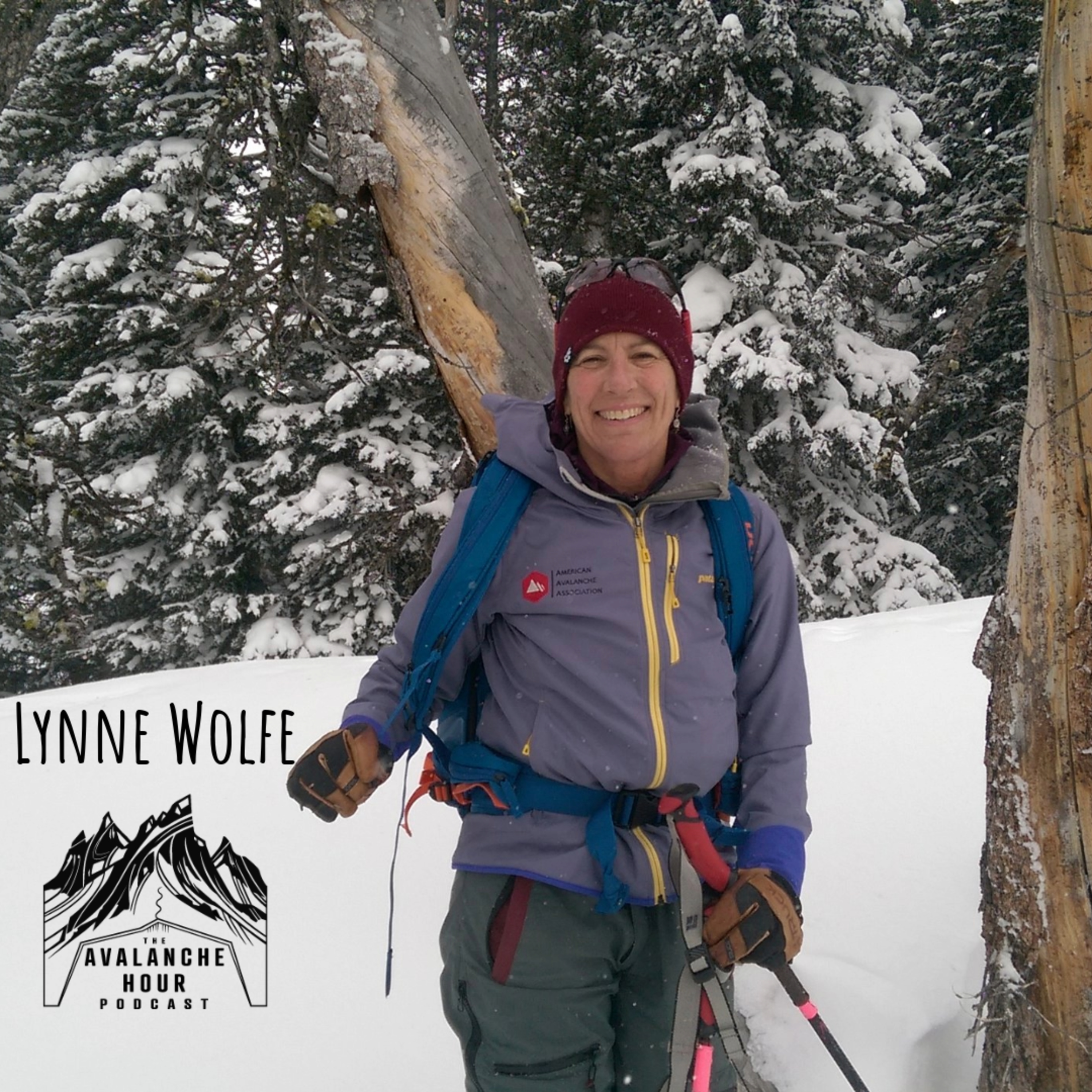
with the one and only Lynn Wolfe.
Lynn was previously on the show during season two
to chat about her long history as an Exim Guide,
Avalanche Educator, and many other accomplishments.
So if you don't know the basics about her,
maybe give that a listen first.
We asked Lynn to come back on the show for this episode
as she is retiring as the long-time editor
of A3's flagship publication, The Avalanche Review,
otherwise known as TAR.
With the job listing up at the time of this recording,
we dive into Lynn's path to becoming the charismatic
connector for the industry that she is.
From changes in the nuts and bolts behind TAR
to lessons along the way,
Lynn gives us an inside scoop of what it's been like
to put out everyone's favorite Avalanche publication
for multiple decades.
Without further ado, Lynn Wolfe, everyone.
Hey Lynn, thanks for coming on today
and making the time to be on the podcast.
Do you wanna tell folks where you're tuning in from?
- Hi friends, hi Brooke.
Great to talk to you.
It is kind of rainy, kind of gray.
Here in Driggs, Idaho.
Yeah, and tell folks a bit about
what you've been up to this spring.
Let's see, we got our final issue of The Avalanche Review
to the printer and that was, I think, March 16th.
And I think the next morning, we went down to Salt Lake
and flew out to Geneva and spent three weeks in the Alps,
mostly skiing, eating really good food, drinking wine,
rode a lot of poma lifts,
which for my old school friends out there,
you'll be like, yeah, get those inner thighs tightened up.
That sounds dreamy little escape at the end of the winter.
Yeah, it was great.
And then, of course, maybe like 10 days after we got back,
it snowed, I think, a meter over there.
It sounded crazy, everything shut down.
So, always interesting.
Yep, always a new lesson to learn.
And for those of you that don't know Lynn,
though, I would imagine that most of you do,
she was on the podcast earlier during season two,
episode 11, if you wanna learn a bit more about Lynn
and her wild career in the mountains.
We're having Lynn back on here today
because she's had a long and very fruitful career
as the editor of the Avalanche Review, TAR,
and the position for the new TAR editor just got flown
and Lynn is about to take a step back.
So, we're gonna dive into her time as TAR editor
and how she got there
and the lessons she learned along the way and a lot more.
So, Lynn, why don't you just start out
with kind of just getting to tell us a bit more
about the role of TAR that you see in the community
and what really is TAR for folks
that may not know too much about it?
- Well, I'll break it down kind of the same way
that I talked about it at your Eastern Sierra Avalanche
workshop, which was fairly entertaining,
is that TAR is the Avalanche Review.
So, one never correctly says the TAR.
So, it's always TAR and TAR is published
by the American Avalanche Association
A3 and we're just about to enter
our 44th year of production.
So, Sue Ferguson founded the Avalanche Review,
boy, well, 44 years ago,
and at the time,
boy, Sue was an incredible,
powerful voice researcher,
publisher in the Avalanche community
and even back then,
people didn't get paid for writing for TAR.
It wasn't called TAR back then.
It was, yeah, but it was still the Avalanche Review,
but Sue would sort of bully them,
sort of browbeat them, sound familiar,
into writing for her.
And she was smart enough to
hand it off to Bruce Trimper
and Trimper handed it off to Conger
and there was a couple other folks in between
and Conger handed it off to
Jeff Brown and Farthin Felix
and when they decamped for parts elsewhere,
Blaze Reardon ended up basically holding the bag
and he with his English degree
and his Avalanche chops really stepped up to the plate
and did it for a number of years.
Blaze made some deals with Russ Johnson,
president of the, it was back then the AAAP,
American Association of Avalanche Professionals
with the board there.
Let's only do four and not six issues.
Later when I joined, thanks to a little bit of bullying
and by Blaze and a little bit of posturing on my part
after a couple of beers, that story is elsewhere,
but I won't go too much into it.
But I had such a good time working for Blaze
and then working with him as the co-editor
that when he went off to grad school
and handed it off to me, it felt so natural.
And over the years, I mean, I think that happened in like '07
but over the years, it was this wonderful blurring
of Tar and my identity.
You know, I was Tar, Tar was me, you know,
maybe people would run when they saw me coming.
I did, in fact, take that personally.
I see you, I know who you are, (laughs)
but I think I had a really good ability
of knowing what to ask people to write about.
Tell me about the thing you know
better than anything else on the planet.
I mean, wouldn't that push play for you, Brooke?
- Yeah, I mean, everyone has these thoughts, right?
That they kind of spend a lot of time with
and I think you've done a really good job of,
you kind of get to poke folks
and you kind of can tell what those thought trains are
and it's really cool to see what comes out
on the other side, published in Tar.
- Well, that's some of my favorite part.
As someone writes me, I have this idea,
I've had this idea, would it maybe be possible
to write this up in Avalanche Review?
Or somebody says, hey, I was just talking to say,
Mike Craig at Park City
and he did a really cool presentation
that he's gonna do at USaw.
That would come out really well in the Avalanche Review.
And so, Mike's like, oh, oh, I don't know.
I don't really know you very well, Mike,
but this is kind of how you seem to me.
I don't know about this.
This seems a lot like work.
And I think I helped make your story better,
which helped you understand it better,
which helped you present it at USaw,
the ProSaw version better.
And it paired with some other stuff we had going on
in that same issue.
And for me, I mean, sure, it's a hell of a lot of work,
but it's win-win-win all the way around.
And to me, that's really fun in a weird twisted way of fun.
No, I think for all the times that we have gotten
to connect briefly here or there,
you've always kind of identified yourself as a connector
in the industry and being a catalyst for others
to talk to the other right folks
that are getting to think through certain ideas
to the place where not only you understand it more,
but the person who came up with it does.
And I think that's a lot of the value
that we can get through writing.
And speaking of kind of the role of you in the industry,
what do you see kind of as the role of tar in the community?
And how do you think that's kind of changed over time?
- Well, just as we were getting started,
myself and Blaze, there came this little thing
called the internet.
Perhaps you've heard of it.
Sorry. (laughs)
But no longer were stories sent to us over the transom.
I mean, sure, I had a few things
that would get sent in the mail,
but we'd have stories sent in the email
and you wouldn't have to print them out,
highlight them with red ink, send them back in the mail.
It was much quicker communication with the authors,
much quicker fact checking, much quicker.
Hey, you know, Brooke, you wrote the story and bing bing,
I need a profile photo of you, I need a mug shot.
And so we were able to include a lot more depth
in our stories, 'cause things could come in a lot faster.
You know, I could have your bio and your mug shot.
And oh, Brooke, do you have a higher resolution of this photo?
It's not quite good enough.
And Blaze will tell you that our graphic designer
when I came on board was this guy, Kevin maybe,
and he would disappear for days on end,
maybe even weeks on end, 'cause I wouldn't stand for it,
in raves in the Utah desert.
And Blaze, I'm like, Blaze, what is going on here?
And he'd just throw up his hands and he'd say,
oh, you don't wanna piss this guy off.
You know, don't ask for this change.
And I was like, okay, the first thing that I need to do
even as your assistant editor is to get rid of this guy.
We can't do this.
And so we installed my soon-to-be amazing friend,
Karen Russell, a fall-line design here in Driggs.
And she was wonderful.
She had this wonderful Midwest sensibility,
but she's a skier.
And so her jokes were kinda like hoity hoity hoity.
So she was just cute as she could be.
And she got us.
And I mean, we all know how wonderful it is to be seen,
but for a magazine to be seen, it's another level entirely.
And so Karen, she saw us.
And we were with Karen for gosh, 10 years.
Her health became such that our deadlines,
our hard work deadlines,
it just wasn't working for her anymore.
And so, yeah, Karen was wonderful
and she took us out of the dark ages.
And I remember the first issue that I did with her
as when I was this whole editor, she printed it out for me.
And I looked at it and I was like,
I'm just going to the PDF.
And so I learned how to edit a PDF.
And all of a sudden, her work became so much more streamlined.
And yeah, so things that have changed
since I came on the Avalint Review,
let's go with the internet for 400, Brooke.
(laughs)
And yeah, you keep coming back to this point of Tar
being a bit of a connector itself in the community.
And you felt like you were Tar at one point
and Tar was you.
And how is the role of Tar in the community,
do you think changed over time as well
as just how things were run behind the scenes?
Well, the way I like to look at it is initially,
it was a matter of,
oh, would you please, please write us an article, please?
And now it feels like it's more like,
I'd like to invite you to submit an article.
We're seen as the connector.
We're valued as the connector.
See, we, I'm still the Avalint Review.
We haven't hired anybody quite yet,
but we've gotten, yeah, and I don't mind,
I don't mind at all.
So repeat your question.
You had some cool add-ons in your question
about Tar being a connector.
Yeah, I just was asking,
I think we were talking the other day,
you mentioned that the role of Tar in the community
got refined and kind of clarified during COVID.
And it was a connector is what kind of brought people together.
And in the year since you say you've seen the community
become more of a, more than just like an industry, right?
More than just a group of people
that do similar types of jobs.
And that you saw that Tar in A3
kind of helped bridge the gap there.
Oh, that's a great reminder.
Thanks for the prompt there.
'Cause you know, when I first started this,
especially when Sue first started this,
all of the avalanche professionals in the country,
you know, including Alaska,
and you know, Canadians, Europeans,
we all kind of knew each other.
It was such a small group.
It was well under a thousand that would come to ISSWs.
And it really was, in fact, a community.
And the bonus, the benefit for me of having been
in this hot seat for 23 years
is that I've certainly seen us become an industry.
You know, I really saw it when we implemented
that pro rec educational split,
you know, bringing professional courses online
and having professional requirements.
You know, that came really from the Canadians.
I remember at Banff ISSW in 2012, I think, 14,
the Canadians telling us if we didn't regulate ourselves,
then the government was going to do it for us.
And we were all like, oh, no,
we don't want someone who doesn't know what we do
to tell us what to do.
That's inappropriate.
So we kind of jumped on the pro rec split.
So we've been pushing being seen by outsiders as an industry.
You know, the army needs to see us that way
because we use artillery.
Yeah, the educators, the highway people,
being known as an industry is not a bad thing.
But for me, the important thing has been
to keep us as a community as well.
To know about one another.
Like, I love putting these little things
in the early tar issues, you know,
the October, the December,
you know, welcome to the new forecasters
at the CAIC, for example.
You know, they're wonderful about getting me bios
and mugshots, so thanks to Kelsey Bean and Brian Lazar.
'Cause they know how important it is.
Like, oh yeah, didn't I see your picture
in the avalanche review?
It's wonderful.
It's community and professionalism and industry.
So yeah, we've been doing that.
And then kind of a different answer to this question is,
you know, I love the little forums that are kind of dumb
where people will post a question,
post a, hey, I saw this, what does this mean?
And people pile in in the forum
and people often write before they think.
And so I like to take that and kind of turn it inside out
where we have these round tables
and I'll come up with a topic
or I'm paying attention to what are people talking
about at ISSW and I want them to think before they write.
So there's that inversion.
And so these round tables, like,
let's talk about going one at a time.
Let's talk about, I mean, Cush,
what are some of your favorite round tables?
Any of them jump out at you, Brooke?
- I mean, I think talking about there is a couple,
maybe a couple of issues ago
and also in a past volume of tar
and just like hearing about different round tables
at the last ISSW that I went to and Bend.
I think forecaster like uncertainty
and folks talking about the kind of the exactitude
of like snow pits and snow science
and trying to talk about what are we really trying to get at?
- Oh yeah, yeah, that was the issue
that was coupled with Mike Craig's case study
with a bunch of different young forecasters,
young, very smart forecasters.
So that was fun because in that particular round table,
they came to me.
They said, hey, we have this topic.
Can we run this as a round table?
So I said, you bet.
So anyway, so the round tables have been wonderful
and I think people appreciate them
and I'm also very adamant about we do obituaries.
I'll pursue certain obituaries.
I'll do obituaries that I'm sent.
It means that our industry and community
are evolving and aging
and it helps us to think on whose shoulders we stand.
I'm like, oh, wow.
They were thinking about wind effect on snow
back in, you know, 19, whatever.
And oh, I built on their work.
So I adore that and, you know, I have a not so secret thing
in my heart for some of these crotchety old guys.
They let me in, which is very fun.
- Yeah, that's a good kind of segue, I think.
We were talking before and you were talking about
how some early folks kind of ushered you into the industry
and helped you find your way, especially as your early days,
through your early days as tar editor.
Who were some of those people who kind of helped you out
in the early days?
- Well, I want to tell just the little anecdote about 26/4.
So it must have been like spring 2005, maybe.
Blaze and I were co-editors
and we had gone around ISSW 2004 in Jackson
around the posters and there were some really interesting
posters about human factors.
And we, I think we got summaries of those
and we asked questions in our editorial about
was this valid?
What do you think of so-and-so's premise?
And later that spring, maybe June of 2005,
Blaze and I concurrently received in our inboxes
an email from Edla Chappelle with the essay
The Ascending Spiral, that if you look carefully at it,
he answers some of the questions that we posed
in that editorial, I think of 26/4, maybe.
Anyway, so that gave us this huge validity.
Like, wow, we are doing something right.
If Ed takes the time to craft this essay and write us back,
we are on the right track.
I also really want to give a specific shout out
to Janet Callum who was a huge mentor of mine
when I first came into these board meetings
and there is no offense, my dear friends who are,
in fact, old white guys, I love you,
but it's a little intimidating, you know,
to walk in that room and be not to be young and female
and like knew it, knew it, what I was doing.
Okay, and Janet and Faye Johnson, they saw me,
they waved at me, they said you come down here,
this end of the table I consume right now,
you come sit between us, we are so glad that you are here.
Isn't that wonderful?
So, and Janet went on to be such a dear friend.
I mean, I know she's out there listening to this
and cheering me on, she gave me a couple of things
to think about in my own,
I'll tell you about them in a little bit,
but yeah, so those are some amazing people,
Dawn Sheriff, who can give you the most feedback
in the fewest amount of words, how about that?
And then this wonderful, wonderful parade of executive directors
at Triple AP and A3, without whom,
my text wouldn't be signed for one,
but who have become amazing friends,
Mark Mueller, you and Sandy, oh, people of my heart.
And Jamie Musnicki, Dan Keveney, gosh, Jamie,
who's just a firecracker.
So, dear humans, dear humans, thank you for your service.
I know you do it for money, ha ha, but never enough.
So how's that for a short list?
I'm sure that it's a mile long, but it's really,
yeah, it really means a lot when someone takes the time
to reach their hand down when you're feeling small in a room
and be like, no, you're gonna come up here
and sit up here with me.
And I think enough of those interactions
throughout your career, especially in this industry,
and now look where you are, and that's who you are now
for a lot of us.
Well, and it's terrifying, to be honest,
I taught avalanche education for decades,
ran the avalanche program at Yoast Mark,
and then worked for AI thanks to another one
who should be shouted out is Rod Newcomb,
and who took a chance on me.
And I hoped that I, in my career, was good enough,
and I tried to be.
But the thing that I hear 20 years later,
people come up to me, you taught my level one,
you taught my pro one, you told me this,
and they'll pretty much quote me word for word,
and I'm like, that's freaking terrifying.
I should maybe be more careful about what I say,
but then I'm not.
And I just talk about things that matter,
try to be a straight shooter, try to be honest,
try to be, well, I won't say not,
try not to be snarky because I'm a little snarky,
especially with, as Blaise knows, a couple beers.
But try to be brutally honest,
and that's my reputation, I don't have time for,
yeah, blow and smoke up your ass.
Any of my friends that are listening
are like rolling their eyes right now.
So.
I'm super excited to partner with Peak Visor
and to share a little bit about Peak Visor
with the listeners of the Avalanche Hour.
I've been using Peak Visor for the last year
in conjunction with some other mapping apps,
but I find it to be the best way to visualize the terrain
when I'm planning a tour or presenting a tour to clients
or sharing a track or a tour that I've done with clients.
It's a really cool way to use the 3D flyover feature
to share that tour with folks
after they've had a big accomplishment in the mountains.
So I'm gonna tell you a little bit more about Peak Visor
and I hope you go check it out.
There's some great offers right now from them
with a lifetime membership.
Peak Visor offers some of the most accurate
and visually stunning 3D terrain maps available,
making it easier than ever to analyze complex mountain terrain.
From slope angles to summit ridge lines.
Even better, all maps are available offline
so you're never without access in the back country.
Make smarter decisions in Avalanche Pro and Terrain
with dedicated slope gradient and sun exposure layers.
These features support planning
and real-time decision-making,
giving professionals and recreational users
a better understanding of potential hazard zones.
Build and visualize custom routes with elevation profiles,
time estimates and 3D flyovers.
Then export your GPX tracks for navigation with other devices
or to share with clients and team members.
You can also import existing GPX tracks
into the app for analysis.
Identify every peak around you
with augmented reality technology
that works even without a cell signal.
Perfect for guiding, orientation training
or just satisfying your curiosity on a bluebird summit day.
Certified professionals can join
the Peak Visor professional program
and get free lifetime access to Peak Visor Pro.
In return, we ask for only occasional contributions
such as GPX tracks, photos or feedback
to improve the platform.
Peak Visor offers two-way Garmin integration,
allowing you to export planned routes or sync waypoints
directly with your Garmin devices.
Great for those using Phoenix or GPS map units in the field.
Peak Visor is a self-funded project
by a small international team based in Italy,
dedicated to building intelligent, respectful tools
for mountain exploration.
No gimmicks, just great maps, advanced features
and a passion for the outdoors.
Check out a link in the show notes
for a discount for the Adlanche Hour podcast listeners
and check out more at peakvisor.com.
- Yeah, I think you sat down with a different podcast.
I think maybe the higher out.
I was listening to a month or so ago
and I think you used the word,
you were always trying to be impeccable, right?
That was the word when I came out west in 1981
to take my Knowles spring semester in the Rockies.
You know, I was terrified, I was from Tennessee,
I'd never skied before,
but that's how I wanted to conduct myself, was impeccably.
And it's to try as hard as you can
and if you try as hard as you can and you can't fail,
then you don't get to apologize.
You only apologize if you didn't try as hard as you could have.
And so I ended up being somewhat of a model
for the kind of person who's going through life
trying to take up less room
because I'm very unapologetic and I take up a lot of room.
I make a lot of noise.
I laugh a lot, I laugh really hard.
I try to have a great time.
Well, it seems like you're succeeding at that
despite all of the peaks and valleys at life.
Well, I'm married well.
I am sure married well.
Most of you have only known me as married to Dan Powers.
We've been together almost 25 years.
This will be our 20th wedding anniversary in June this year.
And if you knew me before that,
then let's just skip to the next topic.
And circling back to Tar,
I think when we were chatting the other day,
you're kind of chatting about how Tar evolved
from more of this like newsprint,
like black and white addition to more of the color,
big print magazine, right?
And how did that change Tar?
And yeah, what was your role in that?
Oh, we'd been, even before I came on board,
Blaze had this vision that he wanted it to be in color.
And so we were actually after he left to go to grad school.
Russ Johnson gave us the money to experiment with some color
and yeah, we popped,
but we're still on this muddy newsprint.
And so we ended up with McKinsey as our graphic designer.
And A3 had a little money and McKinsey helped mock it up.
And all of a sudden,
I mean, we'd been getting these fabulous photos,
but then, you know, they don't look like much.
And the photos just exploded.
They just popped, they're just amazing.
I mean, y'all have seen the editor for hire from A3.
I think McKinsey put that together
and it's just a remarkable memory prompt to me
of all the wonderful, wonderful photos.
And that's what made us become so much more valuable.
And as I alluded to earlier,
that's what gave us the ability to,
I'd like to invite you to submit because the product,
even to people who didn't know anything about avalanches
was just drop dead gorgeous.
You know, and our examples were what?
Like the surfer's journal and the skier's journal.
And so, you know, and we're,
since we're aimed at the ski patroller,
we're aimed at the coffee table
of your high-end recreationist.
Little-known fact,
we're sized to fit on the back of a toilet,
but we're, we want people to go ooh, and pick that up.
What's the story here?
And that's another theme
and maybe we were getting to this brook,
but that's where I'd like to go next.
And I think that's where we've had so,
why we've had so much success.
Is my focus on having captions and photos
that tell a story.
You know, not just ooh, pretty avalanche, nice mountain,
but here's why this thing went so big.
You know, we had a layer of surface horror a meter down
and nothing was going big
until we got another a quarter of an inch of water.
And then we threw a two-pounder on it and boom.
You know, I want people,
you know, my people are gonna read,
go through it three times, right?
Tell me you don't do this.
And on the first time through,
you look at the pictures and you read the captions.
Second time through,
you look for the short articles
that are the ones you flagged.
First time through saying ooh, I wanna read that.
Ooh, I wanna read that one next.
And then the third time you go through it,
you're like, okay,
now I have to make sure I read every word in here,
except the ones I don't understand.
And so I want this first round,
I want these photos to tell a story,
which causes people to come back
for the second and third times.
So am I right?
I think you hit the nail on the head, right?
We only have so much time in the dead of winter
as professionals and it's kind of a process
of like elimination.
What am I gonna, what like little snack in here?
Am I gonna like chew on for like a bit
until I get to a main course later when I have more time?
And I want there to be things in there
that appeal to people who can actually do math,
people who wanna dig deeper into the human factors,
people who want to know about, I don't know,
all different things.
And that's the way that my outline is set up
and you might not understand that,
but that's what it presents as by the time it gets to you.
Yeah, and just getting to report some facts
about Navalanche that occurred
or some sort of close call, that's one thing,
but getting to organize an entire public occasion,
not just like a story with an arc
is definitely more of an art form
than you could probably try to describe in a podcast, huh?
Oh, well, let's just say
that a person who manages the outline,
you have to be ruthlessly organized.
Okay, and I've finally just this year started the practice
of let's say I have an article, a story of yours,
then he would send me your mug shot
and I would, no matter what it was titled or numbered as,
I would call it, tell me how you say your last name
one more time.
Mao like Pao and Shun like Bergschrunt, so Mao Shunned.
Mao Shunned, okay, so I would title your mug shot,
Rook Mao Shunned, mug shot 2025, crazy, right?
Then I could search your name
and there it would be mug shot 2024, 2025, yeah.
So crazy little tips and tricks like that.
At some point, I think that
you could take the contents of my hard drive
and we've been putting all the bits and pieces
from each issue onto the A3 hard drive,
but I think we could have, oh geez,
what do they call it in newspapers?
They call it a morgue for better or for less,
but where I wouldn't even, I could just go to,
you know, mug shots, crown profiles, stories.
So I think we're headed that way, but yeah,
I have a lot of really important information,
both on my hard drive and in my two separate,
external hard drives.
'Cause if I don't back up my computer and,
oh, anyway, we won't, makes me sweat.
And speaking of some of the behind the scenes magic,
that's not just involved with writing and editing,
but just kind of the organization of things.
Do you want to kind of walk through folks
what it's like for you during like a season
and to put together tar and kind of what the deadlines are
and how that works with you being outside in the winter?
- Well, it's very much ebb and flow
and I was able to make it work.
This might be like a little ad for anyone
who was thinking of putting in for being editor,
but I was able to make it work really well
for, you know, 23 years.
A number of them, like the ones in the fall or the winter,
like one came out from different places.
Like, oh, one came out from the Caribbean.
Many have come out from the desert Southwest,
but let's just start like this time of the year,
one of my best friends and co-conspirators,
at least for now, is Alex Marienthal
of the Gallatin National Forest Avalanche Center.
And Alex has taken on the big job of corresponding
with all the different Avalanche centers,
not just the Forest Service ones.
And we send out a query, send us your season summary,
you know, often we'll have a question,
you know, how did you make it through COVID?
We haven't really had a specific question
for a couple of years now, but in our descriptors,
like what made this year different, storm-wise,
funding-wise, you know, and not just that,
but how did you get through it?
'Cause I think that these can be great advice
for other Avalanche centers.
And so Alex sends out this query in the emails,
he says something like, I don't know,
what do you say, Alex?
Mid-July is the deadline,
and so they send all of their stuff to Alex,
and Alex organizes it, puts it in a Dropbox,
and then gives me access to the Dropbox.
I've got an outline coming,
well, on a podcast I can't really show it to you,
but, you know, as things come in,
if I'm smart, I add them to my outline.
I have it color-coded,
things I'm waiting for, red, blue, they're in the works,
black, they're done, and the word counts are done.
And so that works out fine until August 1st,
when everything else is done,
or at least provisionally done,
they send it to me, like, say, Brooks sent me an article
about the Eastern Sierra snow climate.
She'll send it to me, we'll save it as V1,
and then I'll turn on track changes, make some changes,
send it back to her as V2,
and say, hey, look at my proposed changes,
and maybe I'll just do grammar,
but maybe I'll throw in a question,
like, how about you do this here?
How about you do that?
Let's reorganize.
Have you talked to so-and-so?
If you didn't talk to Mace,
then you're missing a big part of the problem, right?
And so we'll go back and forth and back and forth,
and I've got, oh my God,
anywhere up to, like, say, 900 of these joke going at one time,
and I'll say, okay, like, to Joe Stock,
who's working on a thing about avalanches and science,
like, oh, that will fit really well in the February issue.
Let's go for a December 1st deadline,
and this is when I get to say to him,
oh, why don't you go talk to Carl?
Why don't you go talk to so-and-so?
And so now we're in big picture planning, you know?
Anyway, so back and forth, back and forth,
and I really insist that the author
gets to look at the changes.
You know, it's not fair to spring stuff on somebody.
Let's see, what else?
I'm always cultivating people who take great pictures.
You know, I do spend a little bit more time
than maybe I should, I mean, should.
Where did that work come from?
Then I want to, in the social media, Instagram especially,
you know, I'm looking at stuff from my buddy,
Jed Workman, up in Alaska,
who he gets to look at things from an airplane
or from a helicopter,
and oh, y'all have seen his stuff on the cover a bunch,
or, oh, I don't know, all kinds of people.
I know if you're smarter than me,
then you might be able to run down the keyword avalanche,
or maybe you get like the whole photo dump
from Mark White out of the Wasatch,
and, or Ben Vanden Bose, you know,
some people I've been cultivating relationships with,
so, I don't know, the photo stuff is super fun.
So, and so I'm working on,
I'm working on, let's see, the October issue,
and meanwhile, I'm doing development for
the December development for the science one,
which is February, oh, it makes me tired
just talking about it.
- Okay, that's what I got, is that helpful?
- I think that's helpful for us,
and I'm sure anyone who's listening
has a better idea of what it's like,
but behind the scenes, right?
For us, we just get to send you an email
with some pretty photos or some bits of words,
and maybe we get some feedback,
and then all of a sudden,
it's in a magazine in a few months,
so it's nice to get a view back behind the curtain,
and kind of switching gears,
but along the same vein,
the job description for the editor just flew,
I think last week,
and how do you see that transition process
going after you get that person hired,
and as you onboard them,
and essentially get to pass the baton,
but I think when we were speaking earlier,
you're not gonna totally pass all of the duties on,
just quite yet.
The question is a great one,
and I want to be helpful to the next editor
as much as possible.
A3, Janie has budgeted for my help
in training this new person for the October issue,
and I've got an outline started for them,
I've got a bunch of story ideas, you know, I'll,
for the right person,
and how are we gonna know who's the right person?
That's a different question,
but for the right person,
I mean, it might be a little terrifying
to have Lynn there sitting over your shoulder,
but I think for the right person that they'd be like,
oh, this is great, I can learn from a mentor,
and they can slowly give me the reins,
the car keys, whatever analogy you want,
and you know, we wanna hire someone
who has expertise in really three areas,
and who are the first and in some ways the easiest,
but the one that I want it to be.
Second nature is the writing and the grammar.
I need, you need for that to be easy,
because otherwise you're taking way too much time on it.
The next part of this writing component,
I think is the funnest part,
and I'm not gonna give it all of it away initially,
and that's the working with each author
and helping to clarify your points and your questions,
and that's wonderful, a developmental editor.
Okay, and the next big category is someone that has,
who has some expertise in the avalanche world.
You know, a forecaster, an educator,
you know, I'd like to see someone
who had at least taken the pro one,
so they'd been trained up, right?
And so, yeah, they know what an ECT is.
And then the third, it's,
this area is the hardest to pin down,
but it's that willingness to step in
and be a connector, to be like, yeah,
I am proud to represent the A3 brand,
I'm proud to be part of the history,
the new history of the avalanche review,
and I know a bit about who's who in this world,
and so I know who the,
so that this person knows who to ask next.
Oh, we need some feedback on Dick Torraworth's
piece about climate change and a snow pit.
Like, oh, I'll ask Ed Adams, he's retired,
but he knows about this stuff,
everybody else is too busy,
but anyway, making those connections,
it's, yeah, put yourself out there,
and so that's who I think we see,
the new person having strengths in is those three areas.
And so, yeah, I'll be here to help them,
especially for the first issue,
but when I'm retired,
I'll still be like a huge champion of tar end of A3.
When I first saw the avalanche review
back in the newsprint days,
back in probably the 90s in the Knowles Library,
I was immediately entranced.
This is an aspect of a world that I value,
and I wanna be part of this.
And it's really amazing, you know,
at least 25 years later, I still believe that.
So, people are scared, they're like,
oh, you got clown shoes,
clown-sized shoes to step into.
So it's like, yeah, but once you get trained up
on kind of how we do,
then I couldn't be more enthusiastic
about setting someone loose.
Like, go make it yours, go do orange and green,
go do whatever you and McKinsey come up with.
I mean, how do you say I'm tired
without saying I'm tired?
I'm tired.
You know, I'm tired, I've got some health issues.
It's when you start losing enthusiasm
and you're like, oh, this is a lot like work.
I mean, I won't say I get paid the most in the industry,
but you do a lot of it for love,
and because you love the product and you love the people.
Yeah, Tar seems like, you know,
while it's a professional publication,
it's also a passion project,
and it really comes through and, you know,
the thought that's put together,
that's put into each issue.
But, you know, as you pass the baton to the next person,
whoever that might be,
like how do you see yourself decoupling from Tar?
And, you know, that process,
moving ahead as a new author gets,
or the new editor, sorry, gets their feet under them.
Oh, I mean, it's not gonna be, you know,
rainbows and unicorns for the new person.
I can anticipate getting some of those last minute texts
and calls, and, you know, initially I will be like,
oh, I'm so glad you called.
And I think over time,
I'm gonna be more like Paul Horton at Jacksonville
Mountain Guides in the '80s,
like you're the guide, figure it out.
Yeah, a little bit of tough love
sometimes can go a long way.
Well, I mean, Blaze and I figured it out.
You know, I asked Janie, asked McKinsey,
or just make something up.
We're all making it up as we go,
at least to an extent, right?
Well, I better keep my mouth shut.
I have certainly in my career asked for forgiveness,
rather than apologize for then for permission.
Although, one time we did have to stop the presses
for Manuel Genswine.
You all out there listening who know Manuel will laugh at that.
Hello, Lynn, this cannot go to the printer the way it is.
Anyway, yeah, you do your best,
and I'm actually a little bit superstitious.
I believe that there's a typo in every issue.
And so I'm a little bit on edge, like, okay,
where's my typo?
Oh, okay, there it is.
Oh, okay, we gotta walk this back 'cause I did it wrong.
Oh, well.
You live and you learn, it's okay.
It's a great example for anyone who's teaching
or trying to be professional to embrace.
And for us to embrace as professionals,
like, people make mistakes, you know,
they were like, what reasons as our normal accidents,
but what are your systems in place?
I don't, do you have a way to catch it?
Do you have a way to buffer it?
Do you have a built-in apology?
I will throw this out, this is in small print.
For those of you who are still with us,
that if you want to use a story and article or photo
from TAR in your education,
then you may certainly, certainly do this.
You don't have to ask permission.
If you want the electronic files,
then gosh, just write
[email protected].
That's kind of the generic TAR email address.
So we are so happy to share that with you.
Let me throw one more thing out there.
And this is a bit of a red flag,
like waving the red cape at my dear,
dear executive director, Janie.
It's been a project of mine, gosh,
since we started coming up with PDFs as our issues,
is I would slice them apart and send them to the authors
and I would slice them apart and send the products
to educators, whoever.
And then I keep kept a drop box that I call TAR library.
We had it online for a while, thanks to Cowboy, Brett Kobernick,
Utah Avalanche Center put this together for me.
When we upgraded avalanche.org, it went away.
I don't know where it went.
But anyway, I have the TAR library as a drop box.
It's shared with like 50 people.
And I have so many issues broken down.
I have accidents, beacons.
I have mechanics, I have case studies, people, and places,
all as PDFs.
And Janie has promised me that one of this summer's tasks
is to get this loaded onto, not sure if it's gonna go
on avalanche.org or on the avalanchereview.org,
which is the digital TAR, which we in the industry
are at A3, call DTAR.
So if you look on DTAR, then you'll see the pull down.
That's publications.
And you'll see all the full PDFs that we have on hand.
But I want in there the TAR library.
And apparently many of you do also.
So yeah, give Janie,
[email protected].
Your vote, do you wanna see the TAR library online?
Oh, wasn't that evil of me, huh?
Anyway, what's next, Brooke, what we got?
I think what's next is just if you have any parting words
or words of advice for folks out there
who are kind of staring at the TAR editor description
on their computer and thinking about it,
but maybe thinking, I don't know, that's a big job.
I don't know, that would be awesome.
But you know, Lynn is Lynn, I can't be Lynn.
Like what are your parting thoughts for those folks
who are thinking about sending an application?
Darling, there's only one of me.
There's only one of me.
You gotta have some skills, some skill sets
like any other job, but just learn how to do the job.
And then I have no concept where you could take it.
Stand on my shoulders, I'll help.
It's just, it's a shit ton of work.
I can't lie to you.
But please stand on my shoulders, I'm thrilled to help.
Well, thanks for taking the time to come on today.
And yeah, Lynn, it was a really big honor to have you on again.
- Oh, Brooke, I couldn't be a bigger cheerleader
for you personally.
The more I get to know you, the more like girl,
there's so many amazing things that you can do
in our industry and community.
And it's taken a little bit for this next one
for me to kind of leave my ego behind
and really to give a boost to the next generation.
You know, you get some ego, you wanna,
you want to have done all the things,
but then you're like, there's things
that I haven't even thought of yet.
And so my greatest regret is that
you know, our lives are too short.
I wanna see what's next, what are they gonna think of next?
I wanna in closing also give a huge shout out
to my dear friend, Drew Hardesty,
who's been one of my greatest cheerleaders,
my greatest critiqueers, is that a word?
One of my greatest spiritual advisors.
And who calls me up.
Like I have a question and I call him up.
I have a question.
So you asked me about my mentors earlier
and I just had quite gotten to Drew yet.
And so thanks to Drew.
And thanks to the rest of you all out there
for humoring me, you know, for letting me pick on you,
for letting me bully you, and for dragging you behind me
into all my different curiosities,
which is where those themes all come from.
I tend to think if I'm interested,
then by gum you're interested too.
So.
- All right Brooke, you're the best.
Talk later.
- Yeah, thanks Lynn.
I hope you get some more time outside biking.
(upbeat music)
- What a rich piece of history Lynn has created
through her time as tar editor.
And what a joy it is to get to document
some of her behind the scenes magic through this episode.
Music on today's episode was provided by Ketza.
You can find more of Ketza's work at their website,
Ketza.uk.
Artwork for the show is created by Mike T.
You can find more on his website,
Miketea.com.
This episode was produced by Caleb Barrell.
You can find us on social media
at the Avalanche Hour podcast on Facebook and Instagram.
Subscribe, rate, and review the show
on whatever podcast platform you listen on.
And if you like what you're hearing, tell a friend.
If you have any feedback for us,
or have some ideas of good folks
who might make great guests,
send us an email at
[email protected].
This very well may be the last episode of season nine
of the Avalanche Hour podcast.
Whether you're a first-time listener
or have been tuning in for years,
we appreciate you being here.
We'll see you next season,
but until then, as a mentor always said to me,
have fun, be safe, take chances,
and make sure to laugh along the way.
(upbeat music)
(upbeat music)
 PodcastTranscript AI