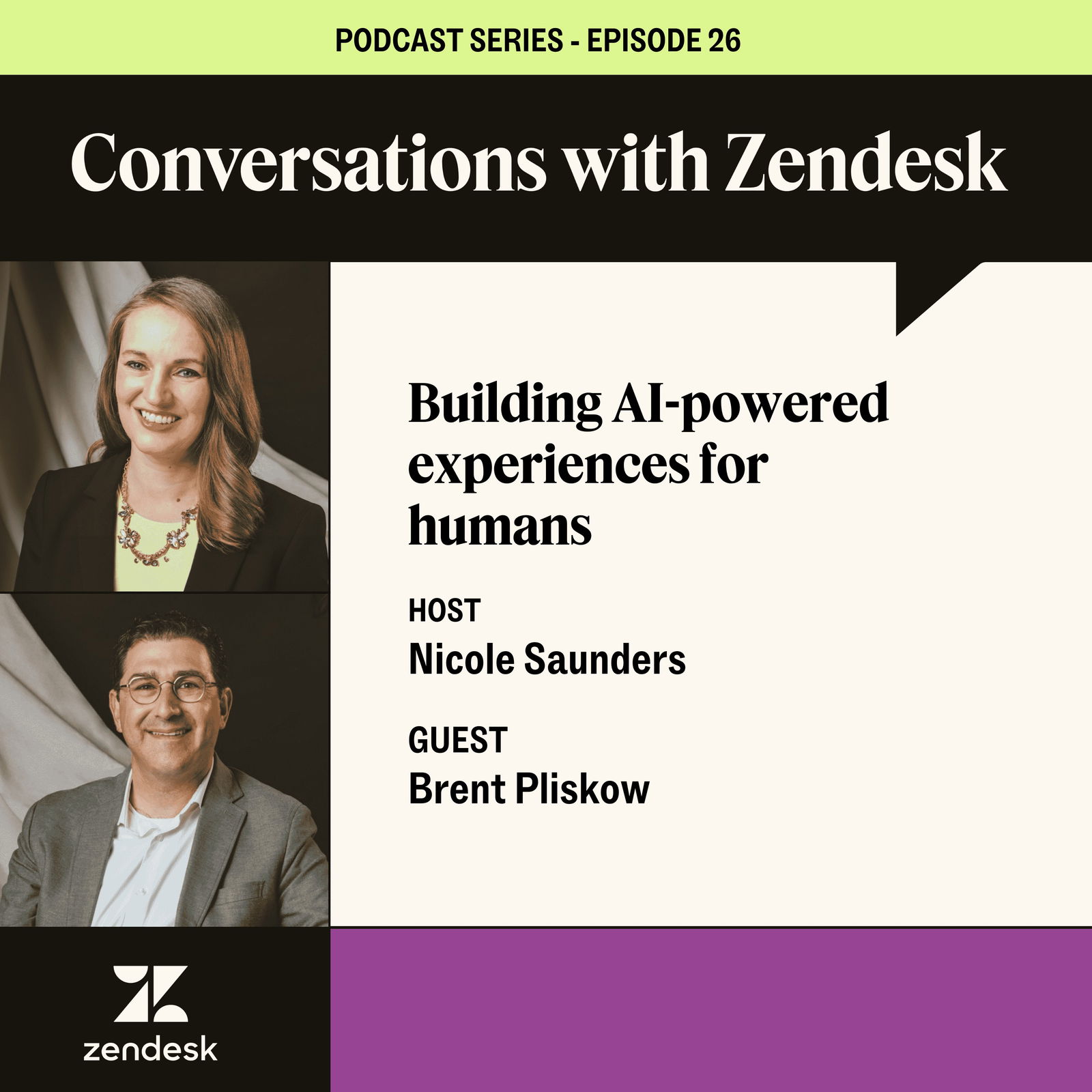
I think over the years, a lot of people have been talking about mobile first or this first or that first. And yeah, I could say AI first for sure, but I feel like there's still that human element that we have to consider. And so I feel that when you're working in collaboration both with the AI and with the human pieces, then it becomes more adjacent to your strategy. Hello, and welcome to the Conversations with Zendes podcast. I'm your host Nicole Thunderst. Today we are talking with Brent Fisco, GM, VP customer support at Upwork about how they are providing support for their customers because beyond the usual technical requests and how AI is really helping them to optimize and become more efficient. Brent is an expert in this area, with over two decades of expertise in customer support and operational excellence. He has a genuine passion for technology and innovation and he has successfully navigated support teams through some major transformations that we'll hear a bit about today. In his current role at Upwork, Brent leads the global workforce with an AI adjacent strategy and they have yielded some truly remarkable outcomes and cost reduction while elevating the quality of the direct customer interactions that they have. I can't wait to have him tell you all about the cool things that they've achieved with AI. First, I wanted to shout out a few exciting resources that are available for our listeners. We've just released a new guide for CX leaders covering best practices and tips for AI implementation and it is free and available at zendesk.com/intelligentcx. If you're looking to dive deeper into that topic, you can sign up for our upcoming webinar unlocking the power of AI for CX, which is coming up on June 4th. We'll be teaming up with experts from AWS and IDC to discuss everything that you need to know about AI for customer experience, from trends to challenges and much more. The link to register is available in our channels. You can find out about all of these events and other zendesk news anytime on our link within page. Visit zendesk.com/li. And of course, as always, we would love to hear from you. If you have questions that you'd like to hear us answer or ideas for an episode or you just want to tell us what you think, please reach out to us at
[email protected]. Again, that's
[email protected]. All right, without further delay, Brent Polisco, welcome to the Conversations with Zendes Podcast. How are you today? I'm all right, Nicole. Thanks so much for having me on. Yeah, absolutely. I am so glad that you are here. You've done some really cool things with AI so I can't wait to dive into that. But first, let's set a little bit of context. A work has a really unique business. Can you give us a quick overview for those that maybe aren't familiar with your brand yet? Yeah, absolutely Nicole. So first and foremost, upwork, we believe we are the world's work marketplace. Not only that, our mission is to create economic opportunities so people have better lives. And so what that means is that we are providing a platform for people looking for work to come with their skills and look for jobs that are posted by people from around the world who are looking for work to be done. We're really working to empower the work of freelancers and real humans that are working outside of that typical nine to five work day. So obviously, there's probably some basic technical issues that you end up troubleshooting as a part of your support org. But what other types of support do you provide for your customer base? That's a great question. So of course, we're doing the run of the mill support, getting people unstuck and helping them be successful in our platform. But in addition to that, we have some niche areas that are required by the needs of our customer. For example, we provide this platform so that clients and freelancers can connect. And when they connect, sometimes the contracts and as they go through the work that needs to be performed, those contracts don't always result the way that either party expects them to. And so we have an entire function dedicated to resolving disputes and mediating outcomes between the parties. We also are taking payments. We have a $1 billion GSP that transactions through a platform every quarter. Wow. And so that is a tremendous amount of money that's floating between parties. And we need to make sure that money is getting to where it needs to go. We also provide our community platform where our users can come and interact with one another, either through community groups or in general forums. And then we have our Upwork Academy team. Our Upwork Academy team is an extension of customer support in which we're educating our customers how to use our platform successfully. So it sounds like you've got a fairly complex support structure in that you've got a bucket of things that are technical issues, a bucket that's around financial things. And of course, I love that you mentioned community. I'm a community builder myself. And so I'm always a big fan of those kinds of connections. And then you've got your Academy, which sounds really interesting. Tell me a little bit about what prompted the creation of the Academy and why initiatives along those lines are really important to your ecosystem. Yeah. So our Academy in its current iteration is not what it originally was. Originally our Academy was born out of necessity where customers were joining our platform. And they were having a hard time getting started. And so what we did is we created a coaching program offered it to freelancers where they could come in and connect with the coach and learn about being a freelancer and learn about how to be a freelancer specifically on Upwork. What we found over time is there was a lot of core education being created out of that function that would be much better suited at scales so that we could reach a broader audience. And so the Academy was born from that. And what the Academy team is doing is they are building education content. Maybe that a course or a learning path to ensure that people coming onto our platform can be successful. This is like some truly amazing support. So given that you've got all of these different elements and aspects and you really empower your user base, talk to me a little bit about your channel mix. Do you have very differentiated experiences or you kind of meeting people wherever they are? What's your strategy on that? Yeah, so everything today as much as possible begins with AI. So that's the first channel of engagement. You want to contact us. You are going to experience in my opinion an exceptional chat about experience, which not many can say that. And certainly there's things that we're still working on to improve there. Certainly for some customer segments, we do position other channels of availability. So we do have the traditional phone channel. Do you have limited the email channel availability? Yes, we have live chat too, but we really want to position it before front the ability to self serve. And so the point of entry often is the chatbot experience. How long have you had that AI experience in place? The AI experience in its current form has been in place just over a year. But we have actually been using some sort of chatbot experience as part of our support operation strategy for the better course of three to five years. It's just that the latest evolutions that have come about have really allowed us to advance it quickly. So what led you to make that decision to put the AI right up front as that first point of contact? Just over a year ago, our CEO came to us and said, look, what you're doing is fabulous. But how do you 10x your results? And this was right at the cusp of open AI coming on to the market and really starting to make a wave. And we said, we have a chatbot capability already in place. We know that they're working to integrate with chat GPT. Let us go unlock that door and see what it can do for us. We talked a lot about balancing the human side of things with the technology side of things. Obviously, you've got a very human centric business. You're dealing with individuals, life and livelihood. And a lot of freelancers are working their personal area as passion. How has the customer response been to that AI? Have you seen that be a positive thing? What feedback have you gotten? Yeah. So we've received feedback, certainly all over the map, but in large part, it's been very positive because what we believe as we introduce this technology is that what our customers wanted was answers quickly. And they didn't want to wait in a queue. They didn't want to wait in a backlog for information that was going to help them unlock their experience and help them get them on their way. And so overwhelmingly, what we've seen is that as we have adopted AI into our chatbot experience, we have seen a 20% increase in our self service rates. So what alone says to me, there's something here. Our customers are actually getting something out of it if they don't need to connect with an agent to have their question answered. Now what does that translate to 20% increase or current self service rate is right around 74% and we're continuing to inch that higher month after month. I can see why people, especially in your field, wouldn't be really quick answers, right? Maybe if they're struggling with the technical issue, it's going to reflect on how they engage with their clients and the business they get. So that increase in self service rate, that's huge. That's really impressive. What other impacts does it have on the business internally? What is done is it's really unlocked opportunities, particularly for our agents. So what we really focused on with AI was making sure that we could get those quick answers to our customers.
as fast as possible. One of the metrics as a support leader that I've been tracking for years upon years is first contact resolution rights. 20 years ago when I got into this, I would have celebrated really high rate of first contact resolution. When I came to Upwork and I looked at our first contact resolution rate, and I looked at the technologies that were available to us, when we were trending between 80 to 90% first contact resolution, it said, wow, we're spending a lot of time answering things that could be answered before an agent is engaged. How can we translate our service offering so that when you engage with an agent, there's extreme value provided in that experience so that the customer is coming and interacting with an agent for more than just a question response, but for a more meaningful conversation to hopefully drive that customer outcome even further. So for our agents, what that's meant is that the contacts that they are now receiving, they're not the run-in-the-mill questions that they were getting before. Now they have to think more critically about that customer's experience and all the elements of it and engage with them in a way that really builds their skill set, maybe flexes it for some, but makes it more exciting so that they're not just closing a ticket and moving on to the next. - It sounds like it's really improving the agent's experience of their own jobs. We've talked about that as a prediction in a couple of our previous episodes that this is one of the potential outcomes of AI. So it's really wonderful to hear that you're actually seeing those results where it's helping them level up, it's helping them have a more engaged and more exciting experience. And it's bringing greater value to the actual conversation and the actual use of the humans where you're not just saying, "Hey, human, "can you go find the right article "and your knowledge is based and read it to me?" But you're saying, "Hey, support agent, "let's have a consultative conversation "and help me think through this problem," or something like that. And it's interesting is that parallels what you were saying about the way that you help build skill sets for your freelancers. So it sounds like inside and out, upwork is really helping people up level in their careers, which is just absolutely amazing. I think that's exactly right, Nicole. - What kinds of things are you doing internally to help upskill them and how are you sort of imagining those career paths shifting in a long term? - Yeah, so I think right now it's naturally occurring. So as the agents are receiving different opportunities presented to them, they're taking that challenge and looking to learn from that. And certainly we're providing them with coaching opportunities as well to ensure that they succeed in the support of our customers. I believe that there's always going to be a need for human interaction to some degree for some percentage of concerns that are raised. But for where we still have opportunities to leverage self-service to help that customer get up and on their way quickly, some of those agents, we can then look to say, maybe you actually are now working with the AI to coach it and train it the same way that you were trained. Not with the interest in eliminating your role, but because you know so much about this space and you've been really in tune with our customers' problems, we can stay on top of the next issue that comes up and ensure that the technology with the chatbot can answer for it. - So as you're implementing all of these AI pieces, what were some of the biggest challenges you faced and how did you work through those? - We really set a high bar for risk. We are risk-takers as a value for our company, we build and break fearlessly. So with that value in mind, we didn't have too many roadblocks to get often on our way. As we continue to advance, where it's 74% self-service rate today, as I mentioned, every percentage point more that we gain in our self-service rate is going to require that much more effort to achieve, because we've taken a lot of the simple stuff onto the equation. So our biggest roadblock right now, and not even roadblock, but our opportunity, is to now look at the more personalized experience for the customer. Moving beyond the basic question answer to saying, "Oh, we know who you are, we know information that is privy to you as well, regarding your interactions on our platform. Let us go and dip into that and surface it to you so that we can provide more directed support within that experience." - It's so critical to be able to do that. One of the things that we've repeatedly found in our CX Trends reports is that customers really want those personalized experiences, right? They're comfortable with a company tracking all their activity and having all this data about them, but only if the company is actually using it to provide a faster, more personalized, more specific experience for those users. What were some of the discussions or decisions internally when you started implementing the AI? How did you approach it? What were some of the things your organization was thinking about? - We approached it by looking at what audiences we could target first, and certainly we looked at audiences who were having a little bit easier time on our platform, but maybe just needed some simple help to get them over a hurdle that they were experiencing. So that was some of the early conversation. In addition, we were looking very closely at what content is actually going to help train the AI. We have a tremendous amount of content in our help center. And so that was a very easy way for us to go and point the AI engine and say, "Hey, go out to the help center and learn from that." In addition, we have other resources that we started to say, "Where would we prioritize that next?" If we're training our agents with certain knowledge, why don't we take that same knowledge and train the AI? Because what we want to do is really make the two inseparable, almost, at your human interaction to buy interaction is seamless. And you as a consumer may not ever know where the separation exists. Now, certainly there's controversy in that as well for those who might not prefer working with. Sure, there's got to be a level of transparency there. But I think you can have a seamless experience and be transparent about my interaction with a bot or a human that's being augmented by a bot. Yeah, exactly. And it's not hidden to our customers that, "Hey, this is a bot." You can see what engine is powering this. So going forward, you talked about analyzing what were some of the low-ehanging fruit questions, training on your help center and your knowledge base and information, how are you continuing to stay connected with the needs of your customers as they evolve and optimizing for those new things that come up? Yeah, so this is where we have a very close partnership in collaboration with our customer insights team. We call them our C368 team. And what they are doing is they are taking feedback that's surfaced from our platform, insights that are surfaced from the tickets that are being routed either through a chat or direct customer interactions with our agents, as well as other external sources, Reddit forums, and so on. And they're consolidating that and actually applying AI there, too, to pull forward the categories of where customers are having concerns. They take that and then map that against what we're referring to as experienced debt. Now, this is something that I didn't have an understanding of prior to recently, but being a technical person by training, there's technical debt or tech debt that every company continues to collect over time because you're really iterating quickly. You don't have time to go and clean up the things that were left behind. Right. The same thing goes with experienced debt. And this is where you look at the actual interactions within the product. And you say, oh, wait a second, we missed something there. And so combining the data that's being surfaced out of the sources I've mentioned with identifying these key areas of friction on the platform, compile into an experienced database. Recently, right around Valentine's Day, our team in collaboration with the C360 team, sponsored a week-long customer love week. And we used that week to go into the experienced debt database and meet with our product partners. And review the items that our customers were saying, hey, we could do better. Out of that, we've received more than a dozen commitments of items that will be fixed on our platform in a forthcoming fix it week. There's interest now in making this art of the way that we operate and not an annual event, which is super exciting. And it's a win situation. Our customers are better equipped with a better experience. And support is not receiving the contacts that were just frustrating our customers for which there may be some workarounds. And in other cases, there weren't. And so it wasn't leaving them with the delightful experience that we would want. What an amazing way to show your customers that you're really listening and you really care about their experience, and you're making sure that you are taking some time to pause and. work through those pieces and really make sure that they're getting what they need out of that experience. I would love to see every tech company do that. I think it's just such a brilliant idea. As you look to the future, what are you most excited about, whether it's with AI or innovation more broadly? What are you looking forward to? I'm a technology person, as I mentioned. And so I'm excited about the future of where the technology is heading. And so we'll be looking to continue to invest and explore new technologies as well as approaches to how do we really focus on the customer experience and the agent experience too. I think there remains a lot in an AI adjacent approach where we can continue to optimize by adding other elements, including automations to the experience. I talked about the personalization of the experience. I think those are the things that really get me excited. Beyond that, we are running a very large-scale support organization. And so really looking closely at workforce management, looking closely at QA, and oh, by the way, where can we apply AI to those disciplines too? Because once you apply that layer on top, so many more insights rise to the surface than they could before when you were doing it manually. Absolutely critical to be looking at those pieces. And those kinds of recent acquisitions around workforce management and QA, and tying that together to AI. So we're right behind you. We're right in line with all of those pieces. I want to ask you about a term that you've used, which it is AI adjacent. I'm seeing a lot of companies talking about how they're being AI driven and their AI strategies. Why do you choose to call it AI adjacent strategy? And this is something that I recently gave a lot of thought to. And I think over the years, a lot of people have been talking about mobile first or this first or that first. And yeah, I could say AI first for sure. But I feel like there's still that human element that we have to consider. And so that's why more recently I've adopted that phrase. Tell me how that aligns with your company values and maybe your company mission statement. This is a world's work marketplace and we're creating economic opportunities for individuals. And so a very core component of that are people. Absolutely. If I'm not thinking about how I work with the team, how I support them, then I feel like I'm doing injustice. And when you're coupling AI, my belief is it's not going to take over the world. It's certainly going to drive a lot of enhancements, but we still have plenty of people who are doing the work. I'm just really hit through this conversation by the way that you really beautifully navigate that balance of human and technology. In each item that we've talked about today, you've told me how you're thinking about the human approach and then how you're also moving very quickly and you're not risk averse and you're trying out technology. And it seems like you've just got a wonderful balance between the two sides of that and you're navigating that really well. Which makes a ton of sense for the kind of business that you're in. So thank you for sharing all of those insights today. It's been very inspiring. My pleasure Nicole, thank you. Yes. And I've one last question for you before we hang up. One of the things that we always love to ask you to our customers is what is a great customer experience that you have had in your life? Is there a time that you've received some amazing customer service or something that stands out in your memory or something that you think of when you're considering how could we opt for better service to our customers? Do you have any examples of long-lived lines? I do. In fact, it's a recent one. So for spring break, my wife and I took our family down to Disney World in Orlando. Oh, how fun. Right the place to go to the happiest place on earth. Right. It was happy most of the time. Except when there were the long waits to get back to the resort at the end of the day. Sure. But one of the things that I really thought was remarkable is that Disney really has a way with customer service. And I knew this going in because we've gone to Disney properties in the past. But this time our kids were so enthralled with the little souvenirs that they would get. And so when we went to Epcot, we went on the Ratatouille ride. And afterwards our eight-year-old really wanted this little remy doll that sits on the magnet on top of your shoulder and it just walks around the park with you as you. For sure. It's adorable. He lost it. Oh no. So we were trying to console them. And at the same time, I looked up and I saw a cast member. And I said to my wife, we should go ask the cast member. They're really good at this. So we did and she's like, oh I'm really sorry about that. Here, let me help you. Go on to our website on your app and fill out a lost informed form. It's okay. Lost in phone form. Great. How many items get lost in Disney World every day? Probably thousands. Within two days we had received an email from Disney saying, we have found your item, your little remy doll and we will get it back to no cost for shipping. And it was like my eight year old when he heard that he was going to get that item back. So happy. It was just he had a great time on vacation, but that one experience really left him Mark and for him to get the remy is going to come back. It was awesome. I bet, he'll remember that forever. They've made a really lasting impact on your whole family and especially your child. That's amazing. Brent, this has been a real pleasure. Thank you so much for joining me today. It's been wonderful to hear about your use of AI, your technological innovation as well as balancing that with the human side of your customer service. So keep up the great work. Thanks to cool. Upskilling agents and managing change is such a big topic right now, no matter where you are in the evolution process. So to that end, we thought we would share how Zendesk is approaching and thinking about AI integration for our own support teams. What lessons we can share at this stage of our journey and what we're excited about for the future. So we'll be joined next week by Stephen Warfield, our new VP of customer service. Here's a teaser for that conversation. Having that ability and a carved out predefined space to talk about these things, I think has been one of the biggest parts for us and that's still early in the evolution. It's moving really fast, but sizing a space for people to deliver feedback and really defining what are we looking for. What are the things that are working really well and what are the things that need to have improvement being really specific and I would say purposeful in the type of feedback you're looking for is really critical and leaders need to be trained on how to do that. Be sure to join us in two weeks for that insightful discussion and make sure that you're following the show so that you don't miss it. As always, if you like what you're here, please consider giving us a five star rating on your favorite podcast platform, sharing with a friend or colleague or leaving us a review. We really appreciate your support. Until next time, I'm Nicole Saunders-Frazandesque, the Intelligent Heart of Customer Experiments.
 PodcastTranscript AI