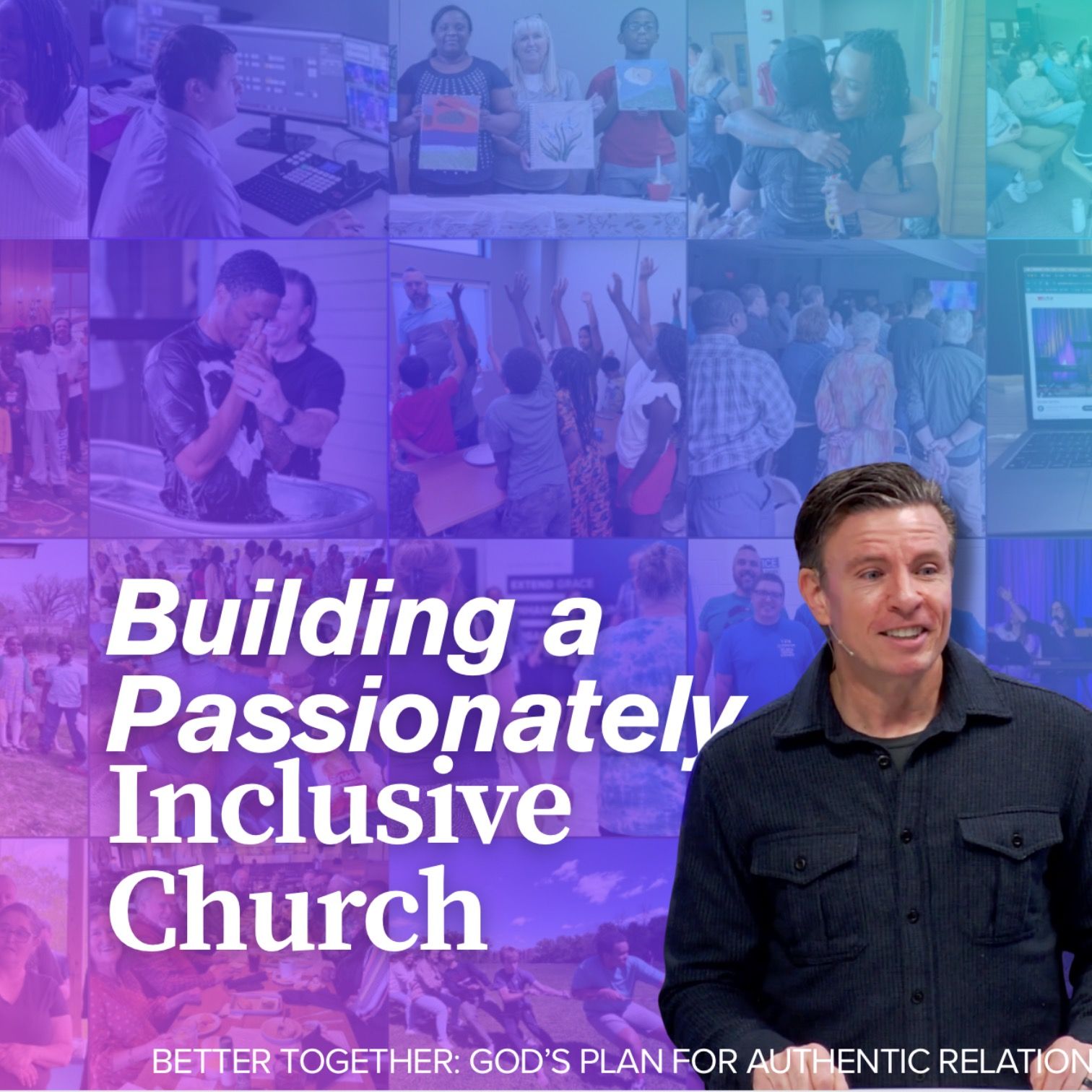
Building a Passionately Inclusive Church | Better Together | ECC
53m 34s
The podcast begins with a fun visual exercise highlighting human tendency to focus on differences. This serves as an analogy for how people often react to differences in real life, especially on social media or within communities. The central theme is the call to intentionally become an intercultural church. This means creating a space where individuals from diverse cultures—defined broadly by ethnicity, background, experience, and tradition—come together with mutual respect, a willingness to learn, and an appreciation for different perspectives. The speaker acknowledges the challenges, using personal marriage anecdotes and regional stereotypes to illustrate that unity doesn't require uniformity. Growth happens by staying in relationship through disagreements, leaning into conversations with humility, and not reducing people to labels. The biblical vision from Jesus, Luke in Acts, and Paul prescribes this unity, which is not something to create but to live out through patience, love, and making allowance for each other's faults, thereby demonstrating God's love to the world.
Welcome to the Experience Christian Church Podcast. We're so glad you're here. Experience is a growing church in Exynpensiveania, passionate about helping people find a fresh start with God. Our mission is simple. To help you experience God's love in a real practical way, no matter where you are on your journey. Whether you're joining us in person or online, we love to stay connected. Find us on social media at Experience Christian Church on all social media outlets or visit ExperienceCC.org to catch up on messages, explore our YouTube channel, give online and connect through groups, both in person and virtually. We're so glad you're tuning in. We hope today's message will be an encouragement to you and inspire you along your journey. Now let's dive in. So who wants to begin with the fun exercise? Raise your hand. Everybody that's great. Turn to a friend. Get a friend right now. Get a partner and we're going to have a fun exercise. So pair up, introduce yourself and then we'll start in about 20 seconds. Everybody needs a partner. Okay, okay. You're now best friends. That's great. Here we go. We're going to bring out the chickens. But before we do that, I don't know. Oh, oh, oh, oh, oh. Before we bring out the chickens, here's your assignment. You're going to choose and identify which chicken is unlike the others. Whits your partner and you're not going to shout your answers out loud. You're going to make them a secret because this is a big competition. You got 30 seconds to solve it. Okay, bring out the chickens. Here we go. Okay, all right. All right. Starts calling it out. What's okay? Wait, wait, wait. Organize three. What's wrong with three? What's going on with three? What's different about that chicken? The tail. Okay, three in the tail. All right. Number five. Number five. What? Top of the right leg is one line. Top of the right leg. What? Five. Five. Okay. They're all different. Okay. Two. What's wrong with two? Yeah. Got that extra talent, right? Extra two. All right. So here's the answers. Let's look at them. So they're not all different. One and four is the same. Some people have said four's got a thicker neck. I layered them on top each other with transparency. They're the same. Don't argue with me. Two, we got that toe going on. Three, we have that feather that's split. Five, we have that little leg. He's missing poor guy. He doesn't have an armpit. Six, there's a missing feather thing. Seven, he's looking up to the right. Eight, there's one less back butt feather. Now, it's so fun watching you guys feel like you were tricked, which you were. And in social media world, it's really fun to watch people respond like our friend Darren here. Look what he had to say. He goes, oh, Frank, excuse me. He goes, everyone is so misled here. The answer is number one. The reason being is that number one is the only chicken that stays consistent with its features. Every other chicken has something wrong with them basically making them all the same in theory. Number one is different than the rest because it's the only one that stays the same. Strong opinion, right? He just lays it out there. And so in social media world, look what someone else replies. We have this response from Darren. Okay, wise, one, I may have edited that one. I see each individual difference in two, three, five, six, seven, and eight. Please point out the unique differences between one and four, which makes number one the prototype. Dorothy, she has the chime in. Yes, please. I'd like to know the reply to Darren's question too. The difference being one and four. L, O, L. Is that lots of love or is that laugh out loud? Which one is that? Okay, thank you. That's laughing at them. How do you know that number one is not different from any of the others? So things get heated over chickens, right? Like it's just like what? It's an exercise that's supposed to be fun. And now we got Darren ready to throw down. So it's cute when it's chickens, but it's not cute when it's our family, our friends, our fellow church members that throw out a random comment on social media that we're like, what in the world is going on? It's a pretty good analogy isn't it? Because we're really quick to point out differences. And then almost like we have it all figured out. Like we've identified a difference. So now we know. And so then we can decide who we're close to, who we're back and away from. And there's some wisdom in that. But if we want to be an intercultural church with just today's theme, we have to look past some differences and look at the beauty of God designing a church that is intercultural, right? We're hitting it again this week, we're hitting it again. And this is week six of our better together series. And it literally is called the importance of intentionally being an intercultural church. Pastor Eustel's definition comes up a lot lately. I want to read that again. If you're new here, it's as locally that in our window out front always. But I'd like you to read this regularly to just process it. Because intercultural churches bring people from various cultures together with an intentional openness to learn from one another. And so I'll pause there and say, "Cultures not defined by ethnicity. Cultures defined by where you're from, who you interact with, your previous experiences, all that impact your culture doesn't it?" And so we're willing to listen to someone else's story to learn. It's an intentional openness to learn from one another, give equal value and power to each culture, preserving cultural differences and celebrating multiple cultural traditions. They are defined by justice, mutuality, respect, equity, political understanding, acceptance, freedom, peacemaking, celebration, mutual trust, grace and growth. And in this last line, people must be willing to leave the comfort zones of their own traditions and embrace different styles of worship, community engagement. And as intercultural churches build relationships and move from an us and them to a we existence. They grow together in spirit and are transformed by Jesus Christ. I was sharing this with someone today how this can become messy even from a theological perspective. I was in an act study and I shared how many of you have the prayer life and speaking in tongues and six people raised their hand. And I said, "How many of you are scared to death? That's six people raised their hand." And six people raised their hand. And we said, "How do we do church together?" Both have a solid biblical framework for how they see this issue, right? They're not pulling this out of the sky. They see a solid theological reason for both their experiences. And so if they're willing to listen and learn, they can stretch beyond their personal convictions. So boy, is it challenging, right? So we're going to be willing to lean in, not back away. We have to allow room to agree to disagree on things, especially things that aren't essential. I'm going to talk about a woman that I'm married to, that will remain unnamed because I've been using her too often in sermon illustrations. I was banned for six months. So I'll leave it to you to determine if you know who I'm talking about. The wife who remains unnamed, which I happen to have only one of them just for clarification on my biblical framework that I'm operating on. So we are entirely different. I mean, we were raised differently. We see the world differently. Our personalities, our Myers-Briggs temperaments, ENFP, ISTJ. If you don't know what that means, all you need to know is there's nothing in common, right? And so we see everything different. And I come from a long history of argued to win people, right? Convincers? Is anybody else a convincing in the room? Sometimes it's cute when I try to convince her to try something. Like, oh my gosh, you've got to try a sheets. Kill her dog, right? Like, I mean, a death dog. These things are amazing. Like, I'm talking a hot dog with cheese and sourcrow and relish. Am I losing anybody? Onions? Who would love the death dog, right? Raise your hands. You are people that appreciate culture. That's all I'm saying. You understand. All that coming to get on the hot dog is good. Carrying out so much. It doesn't matter how much. Come on, try it. Come on, try it. You like it. I promise you like it. She doesn't convince. There's no convincing. But it's also proven itself to be more challenging when the topics not as cute. Like, how many nights should I be out of week doing ministry? Right? Like, babe, I'm serving Jesus. Yes, but you have a family. And what I learned is all conversations don't have to end in agreement. We can actually agree to disagree. And because we love and respect one another, then we can actually separate and not be necessarily angry. We can be mad at the situation. And then we go and we pray and we process. And over years, we've come to different convictions. She still hasn't eaten a hot dog. And that's okay. God's going to give her that in heaven. It's going to be amazing. It might be vegan, depending on your theological position. But, you know, we'll figure it out. But over time, I have learned to trust my partner and say, yes, Jesus is bigger than me in my ability to be out every night of the week. I can actually, if I serve Jesus and neglect my family, then I'm nearly not serving Jesus well, right? So, it's less than you learn, but they're not solved in one particular fight and argument. And so, I'm firsthand evidence that people can actually change. Some change quickly. Some change over months or years, but staying in relationships with tension is how we grow. It's how we actually change into better people, into more of Christ's like in this character, right? We've learned over time that we don't need to demand. You've heard the phrase, do we want to be right? Or do we want to be in relationship? And so, when it comes to being in our Trial Church, this is essential to live out. Because we have to realize right can be defined differently.
Especially when it comes to our perspective, the right way to pray. Have you been blessed by the different prayers that are said here today? And just in general, like when you hear someone from a different background pray and you're like, "Wow, that's amazing. That's just one way that we're blessed." And again to be clear, culture transcends race, faith backgrounds, hobbies, geography, all this matters. I'm from West Virginia and some of you know that. Some of you don't know that West Virginia is a state. They think it's just the western part of Virginia. But after we get over that, I'll be honest. There are a lot of words that are shared about West Virginians if you haven't heard it, depending on your regional. They'll say we're all from the hills that were barefoot and toothless, poor and uneducated, backwards and simple, disconnected from the world. And near the butt of a lot of jokes in certain regions. And if you're from West Virginia, it's not that funny. Because you recognize that certain places seem to be okay to joke about because they can't necessarily defend themselves. And sometimes appellation culture fits in that category. People will say hillbillies are mountains. And some people can wear that with pride, but it's always a little bit of tension, right? They don't love West Virginia like I do. I wish my kids got the experience more of West Virginia. So, yes, there's some economic issues there. There are some opioid issues there. There's some education issues there, but it's not broad and all the time. But there are some beautiful things there. It's the most mountainous state per square mile, so the landscape is beautiful. The culture, the people that love each other and are committed to family. And so it taught me an issue on hospitality. But it means to be hospitable. What it means to be hardworking? What it means to serve your neighbor well? When I would go and knock on a door and say, can I fish in your pond? And I'm like, sure, get your rod. Come on out. There's just a spirit of generosity that I don't always find in other spaces. And so each place has its unique gifts and challenges. But to be reduced to a statement, he's from West Virginia. He's isn't good. And all of us bring a culture, a history and a background. And so if we're in our culture, we have to be willing to fight against reducing someone to a phrase, a joke. We've got to be willing to lean in and talk about things. And this isn't because, hey, we want to be cool. We want to be something that's like, no, this is how God actually designs the church to be. When I mentioned I was going to be preaching this message, I had a few friends of color saying, did you forget you're a white pastor? I did. I went and checked. I'm white. So there's a level of believing or assuming I don't get certain things. And there's a reality that I don't get certain things. There's attention that when I stand up here, I speak from my experience, but I will say there's a genuine openness to see others' experiences. In West Virginia, our high school was I think 68 percent white. So we weren't just a white school. When someone shared that they were accepted at our school, but when they traveled to the county over, which was less than 1 percent, and they were on the football field and they were called things and things were set about them. And I had to listen to them, talk about how angry they were and how frustrated. I understood that reality too, makes sense. There's a chance to get a chance to experience other cultures. Not that you understand and learn and see everything and you never want to assume that you have it all together, but I think there's something about being vulnerable up here that I hope you appreciate. It is more comfortable bringing up Pastor Ertel, who's amazing and understands cultures and has dug into it and say, "Hey, can you teach that?" But I also want you to know, Pastor Ertel is wise and has a lot more topics than just this one to teach us on, right? So you understand the tension. And so I'm going to say things that are good and probably things that are awkward, things that are authentic and you might read my facial expression and be like, "I don't know if he means that." Or I don't think he grasps that all the way. Maybe I do, maybe I don't, but it's worth a conversation because I'm committed to learning, if that makes sense. And you don't have to take my word, I want to just let it give me a chance to prove it. The stakes are high, but the missions worth the risk. We do recognize that one word can wound someone's story, but I want to say again, "Jesus envisioned this kind of church." A church that was intercultural. We went to this verse before, John 1723, "I am in them and you are in me." In other words, when Jesus is in us, it calls us to live differently, doesn't it? He's in us, we live differently than the world around us. "I am in them and you are in me." May they experience such perfect unity that the world will know that you sent me and that you loved them as much as you loved me. We see Luke describes this kind of church in the book of Acts. And you can read the book of Acts at the beginning of the church and you can think it's a long weekend or a couple of months, but it's 30 years of navigating, spreading the good news of the gospel around the world. So despite Jesus walking around and caring for Samaritans and doing things with tax collectors and bringing people together, they still didn't understand how to live it out practically. They had, they gifted the Holy Spirit and you see, it's like five to seven years depending on the commentator before they actually leave Jerusalem in terms of really spreading the gospel. They established this church in Antioch and I want to read a verse of what happened there. This is Acts 131. It says, "Among the prophets and teachers of the church at Antioch of Syria were Barnabas, Simeon called the black man, Lucius from Sireen, Manian, the childhood companion of King Herod Antipas and Saul. Why would they talk so much about culture in the Bible? Because it's a constant challenge, isn't it? A constant challenge." And so when you look at this, what you're doing is when you go to the Church of Antioch's website, you know, back at 8060, you would see diversity and that's intentional and that's important. I actually wanted to read how my life application Bible spelled this out. It says, "Who were these men? They were of different races, an economic standing, Greek, African, Roman and Jewish. Lucius was from Libya and North Africa. Simeon was a man of African descent. Paul was both Roman and Jewish. Barnabas was Greek and Jewish. Manian who brought up with King Herod the common thread among these five men was their deep faith in Jesus Christ." As in the early church, if believers today do their part to reach out to all who are lost, churches will resemble the heavenly congregation consisting of all races, income levels, education levels, and language backgrounds. The men mentioned here represent the social, geographic, and racial diversity in the kingdom of God. The Holy Spirit moved through them all to appoint Barnabas and Paul to their next mission. We exclude people or treat them differently because they are not like us. We are not representing the teachings of Jesus. Clearly at the root of these tendency is the ugly sin of prejudice. The more we understand the gospel and embrace God's vision for the body of Christ, the more we begin to appreciate and understand these differences, not allow them to divide us. More than merely getting along, we will be able to authentically say from our hearts that we love each other. It's powerful, right? It's a difference between sitting next to someone and saying hi and beginning to love them, to hear their story, to appreciate their story, to allow it to impact your life. As we said, Jesus envisioned a church like this, Luke described it in the book of Acts and we see Paul continues to prescribe how to live it out all through the New Testament. He has to constantly re-envision what it takes to get along. Hey, Jews and Gentiles, you're now one, you're united because of Jesus. Stop trying to divide your churches, Jews and Gentiles. Every city got their own letter, right? They were unique, unique challenges, unique frustrations and so they had a lot of work to do. And so Paul really says it this way. He says, "Therefore I," this is Ephesians 4, "therefore I a prisoner for serving the Lord." In other words, I have to do with the Lord once me to do. Beg you, plead with you to lead a life worthy of your calling for you've been called by God. Always be humble and gentle. Be patient with each other, making allowance for each other's faults because of your love. Make every effort to keep yourselves united in the spirit, binding yourselves together with peace. See, Paul doesn't tell us to create unity. He says, "Live in it. It's been given to you." You not have unified you because of his sacrifice. You are brother and sister. You are part of the family. You are part of the same body. So live like it. Do everything you can. Don't just fight for unity. Live in the unity that you've already been given. Make sense? It's a powerful reminder. But this is when it gets hard. When we start saying things like, "I think Jesus is four," or, "Jesus is against our president." I think Jesus is four or against immigration. I think Jesus is four the second amendment. Should I stop there? Yeah, I'll stop there. Because it's a part of you that might not be able to focus on the message. You'll start playing that out. It's not fun when our differences seem to cause us grief and affect people that we love and care about, right? So then we have to actually be willing to say, "Okay, God, that's what you wanted. I don't know how to navigate this." And you start saying, "Maybe I'll have a conversation with somebody." And you'll state seemingly innocently.
I think Jesus is blank. And you know what they say? Yeah, but. And they say they're peace. And then you say, yeah, but. And it becomes this whole conversation that becomes really awkward and strained. And so if we actually agreed to disagree and pray for one another, we can see God move the needle because we don't want to be a church who says, "Hey, you belong here if you believe because we don't shift in posture. We isolate ourselves. We build up walls around our beliefs. And we start shooting at other people rather they're believers or not. That's insignificant. We want unity at the price of everything. That's hard. Do you know why this is week six? And not week one? Can I take you through? If you've missed some of these series, go back and watch it. But let's look at the progression of the first five weeks. First, we said, this is a friendship. And it says, that's not it. Maybe we missed it. Okay, there we go. This is a friendship. Friendship involves the mutual exchange of knowledge, kindness, service, and celebration. It is a growing commitment among peers to seek the well-being of each other. Like, that's just laying the framework. This is what a friendship is, right? The following week, it was love pays attention. Remember this one? I want to slow down enough and pay for my attention and I'm going to pay you to listen. In other words, we're going to listen to one another. I'm focused in on you, not what's next on my calendar, not my rebuttal, but I'm listening to what you have to say. Love pays attention. It's not just worried about what do I get. It's your worth, my love, because God loves you. I'm going to pay attention to you. Then we said, hey, knowing and being known. If someone's willing to give you their attention, are you willing to take your mask off and show who you really are? Are you going to answer what's really going on? Are you really going on or are you going to say, I'm fine? I'm good. Because if you're willing to take off your mask, we already know what happens, right? There's a violation. Someone will say, I'll be there for you and then they won't be. Someone will say, hey, I will show up and then it will be they won't. They'll say, I won't tell anybody and then they'll tell someone. And they almost can't help it because that's just their sin, right? And so we take through these concentric circles here. We realize that there's a healthy way of navigating this. Like we shouldn't go from a large gathering to best friend in a weekend. Like I don't go from, hey, great to meet you. Can I tell you my secret sin, Brian? Do you mind? We take sometimes years to get this progression. A small group is a great step because then you can actually have a voice. Here you don't get to share a whole lot. It's the brief thing. You evaluate which chicken is wrong. But in a small group you get a chance to share your perspective. When you feel you can share a perspective that's valued, right? Because you can sit in a small group for three years before ever speaking what's really going on. You can keep a mask on that you think and act just like everybody else. Yeah, that's great. But inside you're dying because you don't feel connected to God or anyone in that circle. So we understand that this progress of depth. So then we have to deal with when community breaks down. We have to have a plan to resolve conflict. When you let me down, am I willing to go and share it, right? And then we have to work through something called forgiveness. And so do you understand why this is week six? Because if you're actually going to live out being an intercultural church, you're going to use those first five things on the regular. Because you're not committing to an easy church life. I know what a lot of you give up by being here. So many of your preference are given up now because of the vision for what is to come. We are not the church God wants us to be yet. We're working towards it, but we'll have more opportunities for people to believe in exist. More people to dive in. More people to feel heard and valued and seen and cared for. And so we're on this journey. And so part of what we do is we're willing to lean in and listen. I want to share just a couple things I've learned from individuals of some of their struggles. I called a couple people and talked to them about where I feel this message was heading. And one person said, hey, I want you to know this is really tricky where you're heading. She's an Asian American and she's Japanese and she said, hey, just to give you a little sense of how I've struggled with this. And one, I'm Japanese, so I don't like talking about this. I'm not supposed to talk about my feelings, but I'm doing this because I think some people deserve to hear it. She said, I was, I learned in 11th grade in 1972 about something that happened to my parents. After World War II, they were shipped off to live in an encampment against their will. They were one of 120,000 Japanese individuals living in a holding incarceration section, one of 10. She goes, I learned about that in one sentence of all my years of education. It was taught in one sentence that that happened. Then the teacher looked at me as the Asian student, did that happen to you? I said, yes. And then he moved on. Never addressed again. And so she has said, you know, I don't know if you've thought about it, Matt. But America has been at war with an Asian country for a very long time. Think of all the battles that have fought on Asian soil. Think about the economic battles that still exist in the way China is used to address so much. And imagine what it was like being Asian walking around after the pandemic when I actually lived in fear. I'm still not comfortable going out at times because I wonder if they'll see me. That's a deep wound that affects how you see the world, right? And so I thank her for sharing that. You know, I know what it's like. I've heard her story and I've gained appreciation. There are people that talk about the army in 1968. In the military, this is several stories, not just one, was called the inward while serving as country. Not by just fellow troops, but from people with authority. People he was called to respect. That's damaging for a lifetime, isn't it? It affects how you see people, people that have been pulled over because they were driving through the wrong neighborhood. And they realize I have to have the same kind of talk with my child. That's difficult to walk into a space wondering if people believe your story. Do people actually accept it or that, oh yeah, but that's not everybody. Or that doesn't affect you. That bad does it. I wrote just a few more down because I want to make sure you know it. When people talk about the war in Gaza, they don't understand that they're talking to people in this room that have Jewish and Palestinian heritage. When people say I just don't understand how Africa is a place of genocide. They don't know that people in our congregations, family members were affected greatly in the genocide in Africa. People don't understand that the way, the awkward nature it is to sit in a room where English is your second language. So that everything I say, they have to translate in their mind to their own language. And then the small group setting, they then have to translate from English to their language. And then speak and it's oftentimes followed by, did that make sense? That's insecurity and vulnerability, right? Do we think about what that's like? And then there's universal problems that really don't have a whole lot to do with race, but they're just people feel the pressure to perform. People feel the pressure of getting it right, the sting every objection. People want to be married and they're not. People want to be single and they get really cool with questions. What's wrong with you? Why don't you want to be married? They live in challenging marriages, but they want to keep Jesus at the forefront. So it's changing. It's challenging. Several of you deal with debilitating pain that keeps you from fully living and working and you're wrestling with that. Some of you have a kid who's a prodigal and you just went in to come home. Some of you have kids that you're taking care of and you're caring for your aging parents and you don't feel like anyone gets why you're exhausted all the time and doesn't understand why they don't want you to come out. You have a troubled past and it has consequences for you today. Women in leadership who aren't treated with respect. People are nervous about visiting family this week because they know any given topic could erupt and the table can be explosive and it can cause big division. Challenge of older adults trying to find community in a church that's full of young families. People wrestling with addictions, wondering whether faith hasn't fixed it. People have been accused that their mental health issue is a faith issue and they wonder if they can trust the church again. People who have been hurt by the church, they're wondering if it's worth trusting God again or the church. People who've lost big or trying to rebuild, people have been lied to or trying to trust again. I miss some, but you get the enormity. There's so much intersectionality of who we are as people. We're not just a West Virginia guy. We are intersectionality, so many different things and we have to be willing to slow down and pay attention if we actually want to be a church that's four one another. It's easy to be a church that just says, "Hi, let's pray and worship Jesus together." But it's intentional to be a church that slows down and say, "Let me hear your story because I believe hearing your story can do some of the healing that God needs to do in you and in me." I want three people to come up and just share their perspective. Jay, can you come up? So a couple of quick questions. Jay, how many places have you lived? Three continents. Three continents. Five countries in 15 cities. There you go. Jay gets around. So you've seen a little bit of the world, Jay. How many languages do you speak? Five. And probably another three to four if you give me a weekend over there.
(laughs) Jay has a great brain that can take on things. All right, so you're passionately committed to an intercultural church vision, and you're aware we're just scratching the service, what keeps you plugged into this mission? - One of the good things that happened as I traveled was in spite of all the differences. I could see one thing which is constant, and that was how much we try to prove that we are different without realizing that we are uniquely created by God in his only match. So oftentimes people don't realize this, and we all want to prove just like have you said earlier, I am right, or what I see, or how I see God is the right thing, yet all of our pains obviously. - So much, you look for the commonality, thank you. What do you think are some of the unique challenges when we know the Indian population is so high in our area? What does it take to reach that group effectively? What have you seen? And what do you think we need to focus? - So I believe the first time this actually hit me was when my daughter Joana came and told me that there's a nation kid in her school, and his name is Shamuka, and I'm like, what? That's not an Indian name. And I asked, is it like Bazuca? Yep, until I went to her school, and I saw this kid, and the penny dropped that moment, because he come from an opposite side of India, and his name was Shamuka. I called that kid by that name, and he was sitting across on the other end, and the way his face turned, who on earth found out my name? That hit me really hard. And when I realized that there were more than 35%, Indian kids alone in Marisi House School, made me realize that we do not have an active way to engage with that community. You would rarely find talkative Indians like me. And partly it is also because there is that issue with language, while many of the Indians are either bilingual or trilingual, they still have to, like I've said, process what you hear, turn it into English, and then again, return it back into, and then come out. So a lot of it gets lost, and I have had friends from India who ask me, "What do you go and talk to all these white people?" (audience laughs) And I'm like the same stuff that I'm talking to you guys. And I could see that, like the first time, yes, somebody really killed them, they're like, "Oh, right, the second time, the third time, they go back into their own shells." In fact, they have a parallel social communal life, which we don't even see. - Yeah, we were talking about, there's specific neighborhoods, the reason Marisi House is 34% is because if they can move in the same community, to actually have community, it does demigrate service, right? Like it's just, it feels safer, more inclusive. Yeah, one thing I wanted you to say, when you say there's not a lot of Indians who talk as much as you, your wife just beamed. She's so thankful. (audience laughs) - Well, hey. - And then the other thing I want to point out is, when Jay mentioned that about the language and names, how many of you typically give an Americanized name to avoid the headache of your given name? Can you raise your hand just so we can see it? So, I know there's some more individuals that do that. You give a name that's easier to understand. So, Vomoyan, for example, he gives everyone the name Chris. So, okay, we're not gonna raise our hands, but I know there's a lot. That's the reason why we have our pronounced name on our name tag, right? So we can work hard at calling each other by our real names, our given names, because there's something powerful about seeing someone in their name. So, man says, "Matt, M-A-T-T, "salt-A, 'cause too many people call me mate." (audience laughs) It's disrespectful. - Well, that could be Australia. That's right. (audience laughs) - Told you I'd say things that are dumb. All right, Jay, one last thing you'd have for us before I have Ivan Elk, come on up. Anything you'd like to close with us to champion us on? What's one of your favorite things about the journey you've seen us on? - So, one of the things that, over the last four years, many of you know the challenges that I had to go through with my health, but partly what helped me travel and be at home at all these different places was at a very young age I had learned to mask my mental health issues. And the same gifts that you talk about, the gift of languages, the gift of playing music, all of it we realized was because I had undiagnosed high-functioning autism, because of which I struggled my whole life until that God diagnosed and then God started that process of healing. And I am sure that there are quite a lot of us who struggle partly because we are not even strong enough to go and confront it. Many of us fear what if it is actually true? How do I restart my life? - Thank you, you're welcome. - God is faithful. So thank you, Jay. - Thank you, give him a hand. (audience applauding) - Thank you, Jay. I said, you've been a part of a few churches, each with its own culture, what's something unique and maybe something even challenging about experience for you? - What is unique about experience is that we are striving to become multicultural. And to me, that is important because the church of God is multicultural. It's not something like that is all of one race or one culture, it's multi. And that brought hope to me that we could have a church that was what God called us to be. So. - And I know that I bring a different leadership style into your world. (audience laughing) - Okay. Yes. - I bring a different leadership style to your world. What's the most different or stretching for you and working with me? - Matt has a different style of leadership and of administration in that he is very hands on, very detailed and is in every aspect of the work. I was not used to that. I am still not very used to it because in my world you give somebody something, you let it go. And if they fail, okay, then you know that they're not able to handle that. In his world, he was like, well, I'm going to manage it until it comes to fruition. And then we'll determine how far I can let go. I wasn't used to it at all and it frustrated me. So yeah. - Yeah. One of the things I like in it, this is, experience is my baby. I planted it. And before I give it to a babysitter, I want to make sure that they're capable of caring for my toddler. And that's not personal. I went to, and I've been challenged, Darryl and Laura. You can't do everything. Stop it. I have an L, other people. And so continuing to release that. But it's a challenge because it's the baby. Thank you. You were one of the people I called last Friday or Thursday to talk about this message with, but our conversation can unexpected turn. Can you share what you were feeling before that call about me and our relationship? - Okay. I wrote this down because we had a conversation and he said something that truly caught me by surprise. He mentioned something along the lines of, there's something between our relationship. And I don't know what it is, nor how to fix it. In that moment, the moment that he said that, I felt the Holy Spirit nudging me, telling me to tell him the truth, be honest, and share what was on my heart. So I did that and we had a good conversation about it. He was telling me about how, not his past, but growing up in West Virginia and some of his experiences. I shared with him my experiences with different pastors and there is a cultural difference. Whether we wanted minute or not, there is a cultural difference. They may be teaching from the same Bible, but Matt is very,
outgoing and genuine and tries to have integrity most times. I love you dear. He does have integrity. We about to have another conversation. I'm not smart. I do have integrity. He has integrity. And so with that being said, coming from where I had worked with other pastors, some of them were more non-relational. They tend to be more reverent. Especially on Sunday mornings. You just don't approach your pastor on a Sunday morning like we can here. They were more reserved. Now I may be able to go to them because I worked with them but as the congregation you weren't able to really do that. So that was a big difference that I found. And they just tended to I am the pastor. This is where I am and here is where you are. To speak a little bit to that because I've been honest with each other. We've loved each other for a year now. And I could see that whenever I would give her a compliment, she would back off. Almost like she said up here initially. And I knew there was some kind of disconnect. And she took a breath and she said, "Okay, I know you love everyone but do you actually wrote it down because it was so good. I know you love everyone but are you really in love with them?" And what she meant by that is I can generally spread love very easily but it can feel like you're overlooked because literally I'm assessing when I talk to you on Sunday morning I'm assessing who's new, who might need me and it may feel hurtful like I'm dismissing you because I don't spend a lot of time with you. But the better I feel about us, the less time I feel I have to need to spend with you. Does that make sense? Yes. Yes. This is really complicated. She said this. You can say things ingest and then act like someone is your best friend. There's a disconnect by saying something ingest and actually loving them. And so what she shared is like you started saying things that I didn't think were, I thought they devalued how you saw me basically what you'd said. And she goes, "I appreciated when you were authentic and you were very measured and then you felt like you were very relaxed and I had a problem wondering if you actually love me because you're talking that way. If you've seen me, I use humor to diffuse everything. I don't do a wedding or a funeral without humor. I think humor is the best medicine." And when I share the things I mentioned to you, like there are parts of me, I just can't stand. And like it or not, I see parts and other people that they might not recognize as a problem. And so when I get to a place where I feel like I can joke about it, it's because I feel so secure in our relationship that I feel like I can joke. And so every time you said, "I love you," I'm like, "Sweet, I can joke around." But it was actually causing distance for her and I. And I didn't know it. I began withdrawing. We worked together, but that was it. Our relationship was really strained. He didn't, he felt it, but he didn't say anything. So neither did I. We just rooted out. And then when he, when we were talking on Thursday and he mentioned it, I was like, "Okay, this is the moment. Holy Spirit said, you got to work this out." And so that's what we did. Yeah. And she said, "I knew I loved you. I didn't know if you loved me." And I felt the same way, right? So there's this level of vulnerability we have to be willing to do with one another because I even told her, it's like you're one of the voices that I care about more than anybody. Like, I'm going to call six people and I got a big situation and you're one of them. She goes, "Oh, there's plenty of people you can call." Like, that's the point. There are plenty of people I can call and I choose to call you because you have such a pulse and a wisdom and a knowledge of our congregation. Your opinion is invaluable. And I thank you for that. And I love you. All right. We discussed this message on Thursday and shared our personal experiences with the topic. Like, we actually navigated some of how we grew up and how this topic has affected us. You shared your experience growing up and as well as Eastern working hard to bring diversity to its campus. And so can you share with us your journey? Yeah. So I grew up in the downtown area, which is about 15 minutes from here, but our address is actually Coastal School District. So I went to Coatesville. And I think I had a really good experience there. I was very diverse. And so after high school, I went to Eastern for my degree in business. And it was completely different than my experience in high school. At Eastern, I was maybe one of three black students in all of my classes. Sometimes I was the only one. So it was just very different going from a Coastal Village, very diverse to now in Eastern. That wasn't very diverse. And I don't think that changed my experience there. I think I still had a good experience. It was just a really close knit with the black community that was at Eastern, which I appreciated. And during my time at Eastern, I got an internship at an insurance company right down the street. And it was to get experience and thinking I was going to go into corporate. So when I was there, the intern team that they had was very diverse. It was a lot of black students that went there. But the people that we worked under were predominantly white. So a lot of times, me and my friend, it was me and one other black girl. I can remember that we're on a team. And I feel like we always felt like we were being singled out and called out for little things that we would do. That we would see the other white students do and they wouldn't get caught or singled out for it. So I think that kind of shaped my experience there. But I've really valued the friends that I did make there. And so as my time at Eastern came to an end and I was graduating, I told myself I didn't want to work at work full-time at that insurance company just because of my experience. But they were the only job that offered me a position after college. So I ended up working there. And it was a little bit better experience as a full-time employee. But I remember around the time where DEI was really, I guess, happening a lot in different companies. I remember one of my leader at the time asking me, I can't remember word for word, but basically asking me like, hey, do you have any black friends that want to work here? So it just felt like they were trying to reach a quota. And that conversation was awkward. I just ended it and just left it. At that, definitely didn't recommend any of my black friends. But so eventually I left that company and I worked full-time at Eastern. And in my transition from that insurance company to Eastern is a whole testimony in itself that I have to share at another time. But coming to Eastern, it was as an employee was also the first year that they had the football team. They started a football team there. So the diversity was completely different. It brought in a lot of black students to Eastern. So as the year went on, I was learning the culture of the university again. And I could just feel that the school wasn't really prepared for the students that they were bringing in. I feel like they didn't have a lot of resources or just things for these type of kids that they may need to feel supported and seen and just to be successful at the school. So that was a little discouraging, especially walking so closely with the students because as a resident director, we're living in the building with them. So we see them kind of in all different times of the day. So me and my co-worker there, a lot of the RDS are a lot of the RDS at Eastern are black. So I think it helped to make the students feel seen. So me and one of my co-workers, we had started this group, one for the guys and one for the girls. For the guys, we caught up hoody conversations and for the girls creative conversations. I think it just opened up a space for students to be able to come and feel seen. And it was predominantly the black student style would come, but it was open to all students, which I think was important and yeah, just created a good space for them. And then just to talk a little bit about my church experience growing up, I grew up in predominantly black churches. And after college, I really wanted to find a church for myself, because I was going to church with my mom, so I wanted to find a church home for myself where I could really learn and understand the Bible better. So I went to a church in Coatesville where that was my first time going to a church where the lead pastor was white. I didn't think anything of it and I had a really great experience there. And walk through a lot of different stages in my life with my family and my husband and our kid during that time. And just with the timing of the service and the location, we ended up looking for a different church and that's how we ended up here at ECC. This is where my family was coming. So we tried it out and we loved it. And I think to just being black and in my husband, he's a child.
and so then we have a mixed son. I think just the first year of marriage, we didn't realize a lot of different things that come with being an interracial couple. So I think just being a part of a church that values all the things that Matt's talking about is really important for me and my family. I really appreciate it. - Yeah, thank you. So, appreciate it. (audience applauding) It's just one of those things. I hope you see this not as a social movement, but of a Christlike movement. The Christlike nature is the foundation which gives us permission to get it right and to get it wrong and to stick around and keep developing and just stay with it because it's easy to walk away but we miss what God's trying to do in us and through us. And so we wanted to end with communion which is the reconciling work that God has done. Galatians 3.28 says there is no Jew or Gentile slave or free male and female for you are all one in Christ Jesus. It does not erase our individuality but it reminds us how we're commonly united. We get a chance to share a table or in other parts of the world they cannot. Male and female, different races, different socioeconomic classes, different. And so when we look around the room, we realize we were sharing a table with individuals who aren't just like us. And we do this because of Christ's work which reconciled us all. Jesus didn't just preach unity, he died to make reconciliation possible. And so the beauty of the gospel was that God doesn't ask us to be perfect people but to just open our hearts. And so let's first take this bread which represents Jesus' body. - The cup represents the blood that Jesus has shed for our sins. - Bigot, I would just thank you. - Thank you for this opportunity just to be forgiven for us. - And we pray that you just continue to be with us as we grow as a church and as we recognize each other's differences in love on each other and just understand what it truly means to be a community and what you see for that for us God. And we just thank you and we glorify you and everything you do. And we pray this in Jesus name, Amen. We hope something you heard today encouraged you and helped you draw closer to God. If this message was helpful, we invite you to like it, share it on social media or send it to someone who may need to hear it. You can also visit experiencecc.org. There you'll find giving options to support our mission of sharing Jesus with the world. If there's anything we can do for you whether if it's a question, a prayer request or if you just are in need of someone to talk to, don't hesitate to reach out. We truly believe we're better together. And we'd love to connect with you. God bless you and we hope that you have an amazing week.
Podcast Summary
Key Points:
The speaker uses a lighthearted "spot the difference" chicken exercise to illustrate how people quickly notice and fixate on differences, which can lead to division.
The core message emphasizes the importance of intentionally building an intercultural church, defined as a community where people from various backgrounds come together with openness, learn from each other, and give equal value to different cultural perspectives.
Practical application involves moving beyond needing to be "right," agreeing to disagree on non-essential matters, staying in relationships through tension to foster growth, and actively fighting against prejudice and reductionist stereotypes.
Biblical support is drawn from Jesus's prayer for unity (John 17
Summary:
The podcast begins with a fun visual exercise highlighting human tendency to focus on differences. This serves as an analogy for how people often react to differences in real life, especially on social media or within communities. The central theme is the call to intentionally become an intercultural church.
This means creating a space where individuals from diverse cultures—defined broadly by ethnicity, background, experience, and tradition—come together with mutual respect, a willingness to learn, and an appreciation for different perspectives. The speaker acknowledges the challenges, using personal marriage anecdotes and regional stereotypes to illustrate that unity doesn't require uniformity. Growth happens by staying in relationship through disagreements, leaning into conversations with humility, and not reducing people to labels.
The biblical vision from Jesus, Luke in Acts, and Paul prescribes this unity, which is not something to create but to live out through patience, love, and making allowance for each other's faults, thereby demonstrating God's love to the world.
FAQs
Experience Christian Church's mission is to help people experience God's love in a real, practical way, regardless of where they are on their spiritual journey.
You can connect online by visiting ExperienceCC.org to access messages, explore their YouTube channel, give online, and join groups, or find them on social media as Experience Christian Church.
An intercultural church intentionally brings people from various cultures together, promoting openness to learn from each other, preserving cultural differences, and celebrating multiple traditions while fostering unity in Christ.
Unity is important because it reflects Jesus' vision for the church, demonstrating God's love to the world and allowing believers to grow together in spirit, despite differences in background or perspective.
You can handle disagreements by being humble, gentle, and patient, making allowance for others' faults, and focusing on maintaining unity through love rather than demanding agreement on non-essential issues.
The church in Antioch, described in Acts 13:1, included leaders of diverse races and backgrounds, showing that the Holy Spirit works through all people to advance the gospel and unify believers.
Chat with AI
Loading...
Pro features
Go deeper with this episode
Unlock creator-grade tools that turn any transcript into show notes and subtitle files.
 PodcastTranscript AI