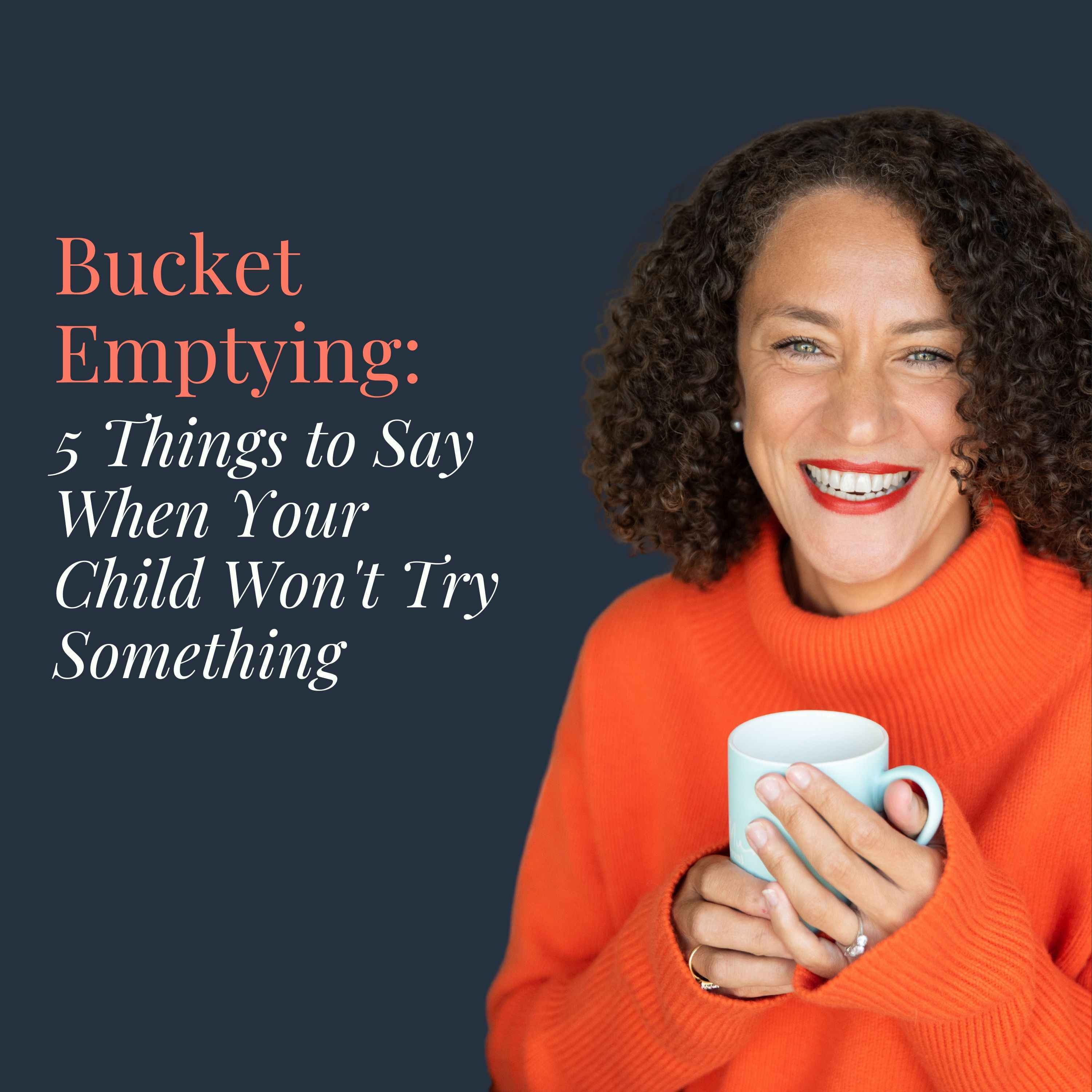
Speaker 1Hello and welcome back to the How Not To Scrap Your Kids podcast, the bucket emptying episodes. I'm Dr. Mary Han and this is your Monday bucket emptying, the short practical episode where we turn Thursday's big ideas into something you can actually use this week. Now on Thursday we talked about why children will not try new things and that was this fear of failure, the perfectionism trap, the resilience gap. And if you have not listened yet I would really encourage you to go back because it's a good one, it goes into lots of detail because today is the practical follow-up so that will give you context about why and some of the common things that underpin it. I think it's probably helpful that we begin with a bit of a quick reminder. of the bucket emptying metaphor. For those of you who are new to the podcast and for those of you who've been listening for some time it's always helpful for a little bit of a recap. So we all have a bucket and that bucket fills throughout the day. What goes into our bucket in terms of the actual volume of the bucket that it occupies is very different for different people but in essence what fills the bucket are all of the things that are challenges, irritations, frustrations, setbacks during the day. And if you think about it in the context of children starting something new we can think of it that when they're facing something new, when a child's facing something new, a new sport, a new group of friends, maybe a new food, a new subject, that the fear of it, the worry about it, the contemplation will begin to fill that bucket. And fear of getting it wrong, fear of looking silly, fear of not being good enough. And as we know when the bucket is too full, of that particular fear or a culmination of fear for that plus other things throughout the day, there literally isn't any room left for bravery, for curiosity or the willingness to have a go. So what we're going to be doing today, what I'm going to be giving you are five things that you can say which help empty that fear out. Five broad approaches in terms of things that we can say, they're going to be practical, they're going to be practical, they're going to be practical, they're researched, and most importantly, they're actually usable when you're standing in front of a child who is absolutely refusing to step onto a football pitch, pick up a paintbrush, pick up a pen, walk into the room, make eye contact and have a conversation. So should we get on with it? Now, these are the five things that we can say. Number one, now listen really carefully because there's something very subtle in this one. I'm not asking you to get it right. I'm asking you to get started. Now, this one small reframe changes everything because here is what happens in your child's head when we say, I'm not asking you to get it right. I'm asking you to just try it. Yeah. The word try implies an attempt and an attempt, implies a result, and the result implies that failure is possible. And so their brain hears something bad might happen. I know it sounds odd and it probably doesn't make any logical sense, but our brain doesn't operate in a logic. It operates from that perspective of keeping us safe and keeping your child safe. When we use get started instead of, I'm just asking you to try, it removes the end result into, entirely because it's not about trying something. It's about starting. So there's no finish line. There's no outcome. There is no performance to measure. There is only the first small action, holding the racket, putting on the shoes, walking through the door. So I'm not asking you to get it right. That is all. So we can use this when our children are frozen at the starting line. So they just, can't take that first step. And then crucially, what we need to do is stop talking. So we don't coach beyond that as such. We just make that statement. We say that and then we give them space to move. So that's number one. Number two of the things that we can say, tell me the worst thing that could happen. Now I know it sounds hugely counterintuitive. And for me, when we talk about mantras, which I often talk about, for me, the mantra that works effectively for me when I'm facing challenges is what's the worst thing that could happen? Because it's a strategy that I've used so often that I can quickly get to what's the worst thing. And the worst thing is very rarely, very rarely, so bad that I'm not prepared to have a go. What I will say is that using it as a mantra, we're going to talk a mantra for some children is literally like Marmite. I've done this in schools when I've ran workshops with children. Some absolutely love it because it's really super tangible. Some hate it because it's literally like, well, let me tell you, Mary Han, I can reel off all of the worst things that could happen. And that's really what we want to tap into. So when we say, tell me the worst thing that could happen, go there. Tell me, what it does is we're inviting the worst case scenario into the conversation. Because fear thrives on vagueness. It lives in the space between something might go wrong and the specific reality of what that actually means. And it hides in the darkness. It lurks there. But when we bring it out to the open to examine, it can then be a really highly effective tool. So when you ask your child to say the worst thing out loud, most of the time, not all of the time, but most of the time, they will say, well, I don't know. I don't know. I don't know. I don't know. I don't know. I don't know. I don't know. I don't know. I don't know. I don't know. I don't say something that is actually often survivable. They may say things like they might laugh at me. I might drop the ball. I might not know anyone. And first of all, I would say that just articulating it out loud means that they almost question it in their mind as well, because there's a difference, isn't there, when we're ruminating on something and it's going round and round in circles in our head with our voice, making it sound like it's a truth. But when we get it out there and we expose it to the sunlight, quite often, we look at it in a slightly different way. So once we've exposed it to the sunlight, we put it out there and we've asked them this question and they've told us the things, you know, maybe they might laugh at me. What we then want to do is we want to ask them to probe into that a little bit more. And we ask the follow-up question, and what would you do if that happened? So we're not dismissing it and we're not going to say it wouldn't happen. But what we do is we build the connection of knowing that they can cope. You know, the bucket empties a little when a child realises that they have a plan, even for the worst case. So tell me the worst thing that could happen. Now, what would you do if that happened? So that's question two. That's what we can do with that. Question three is, watch me do something I am not good at. Now, this one requires something from us. So we have to be kind of prepped with that. It requires us to demonstrate and to be imperfect in front of our children on purpose. And I know that that can feel a little bit uncomfortable, but here is what the research consistently tell us. Children who watch adults attempt, remember it's attempting, not doing, but attempting difficult things and struggling and then carrying on anyway, those children are much more willing to try. And we're asking the child from the very first things, we're not asking them to try, we're asking them to get started. So we do not need to be dramatically bad at something, draw a terrible horse, attempt a cartwheel, try a word in a language you don't speak. And while you do it, say the words out loud. I'm a bit nervous about this. I might not get it right, but I am going to try, or I am going to give it a start. So, you know, children are watching us all of the time. I say that regularly and it's, you know, in the longer episodes, you often know that one of the points I'm going to make is about us, you know, what are we modeling to our children, but they're watching us all the time. And they're not just listening to what we say about failure. They're watching what we do when we face it ourselves. And so we want to, it's super helpful if we can be the evidence of trying imperfectly and for our children to see that that is safe. So that is number three. Number four, question number four is what's the smallest possible version of this you could try? I love this one. Yeah. The new thing in its full form might feel overwhelming. Yeah. So going into that football activity, maybe saying hello to somebody or engaging with people in a party that in itself in its full form might feel overwhelming. And the bucket is likely to fill up just looking at it, just contemplating it. So we make the new thing smaller, you know? Small enough that the fear does not have a chance to build and doesn't have a chance to overfill the bucket completely. So new sport, okay, you're not asking them to play the match. You're asking them to just hold the racket, maybe. New food, they don't need to eat it. They can just let it sit on the plate next to their other foods. New class, they do not have to join in. You know, maybe they just walk in and sit down. So, you know, the question is, and again, it's us asking and then creating that silence is, what is the smallest possible version of this you could try? Just the tiniest step to get started. So we're building up these sentences with these prompts into longer ones where we kind of want to sort of use different ones. You know, each tiny step empties the bucket a little. And success, remember, success is not doing it as in being successful with it, but success is starting. However small builds the evidence that taking a step first, having an attempt is survivable. And that evidence is what builds that resilience, not pep talks, but evidence. And that bridges the resilience gap, the skills gap, whatever the gap might be, because the brain operates on evidence. And if the brain builds that evidence that I have got started, and it actually hasn't been quite as bad as I thought it was going to be, then the threshold to get started again for another attempt is not going to be quite so high. So that's number four. And number five is I am proud of you for thinking about trying, even if you decide not to. Yeah. And this is the one that people push back on. Now you might be thinking, but she didn't actually try. Why am I praising her? Why am I praising him? You know, what's the praise for? But here is why. For an anxious child or a fearful child or for a child in whom the fear, bucket fills so quickly, even the contemplation, the consideration of a new thing takes huge amounts of courage, even sitting with the discomfort, because that's the skill that comes even before starting. And then an attempt, you know, sitting with the discomfort of I want to do this, but I am scared is a step in the right direction. And if we only ever praise the doing, we go back to teaching and reinforcing that our approval is conditional on their performance. You know, their sense of belonging bucket, which is just as important as emptying the fear bucket stays half empty. So separate your pride from the outcome and make it really super, super clear that you value the attempt, not just the achievement and the attempt to contemplate to get started before they then make a. proper try. So I'm proud of you for thinking about trying, even if you decide not to. That took bravery. And you will find over time that a child who knows your love is not conditional on their performance is a child who is considerably more willing to try. And here is the bonus one. The phrase to remove from your vocabulary entirely is I want you to stop saying I know you can do it. I know it feels like encouragement, it feels like belief, but your child hears it as the expectation is that I do it. And if they cannot, or if they try and fail, they've not just disappointed themselves. They believe that they've disappointed you who said you knew, you know, because you said you knew that they could do it. So instead, replace it with this one. Whatever happens, we will figure it out together. No pressure on the outcome, no expectation to meet, just the certainty that they are not doing this alone. That is the most important thing what we can put into our children's bucket or use to empty our children's bucket. This week, I want to point you to the holiday rhythm card. It is a free resource in the free resource library, www.drmaryhand.com forward slash library. And it's designed to help you create a simple, flexible structure through the summer holidays that helps your child's bucket, from filling with too much change and too much unstructured time. Grab it, it is free. And if you found it useful, please do share it with another parent who might need it too. And on Thursday, I'm tackling one of the most requested topics since the podcast launched, screen time, specifically the connection between screens, sleep and your child's mood, that most parents are missing entirely. It's not the conversation you expect. So I'll see you then and thank you so much for being here. If this episode helped you, please take a moment to leave a review. It takes literally two minutes and it genuinely helps other parents find the podcast. Share it with someone whose child is in full. I'm not doing that mode right now. They'll thank you. I'm Dr. Mary Hand. Have a brilliant week and I'll see you on Thursday.
 PodcastTranscript AI