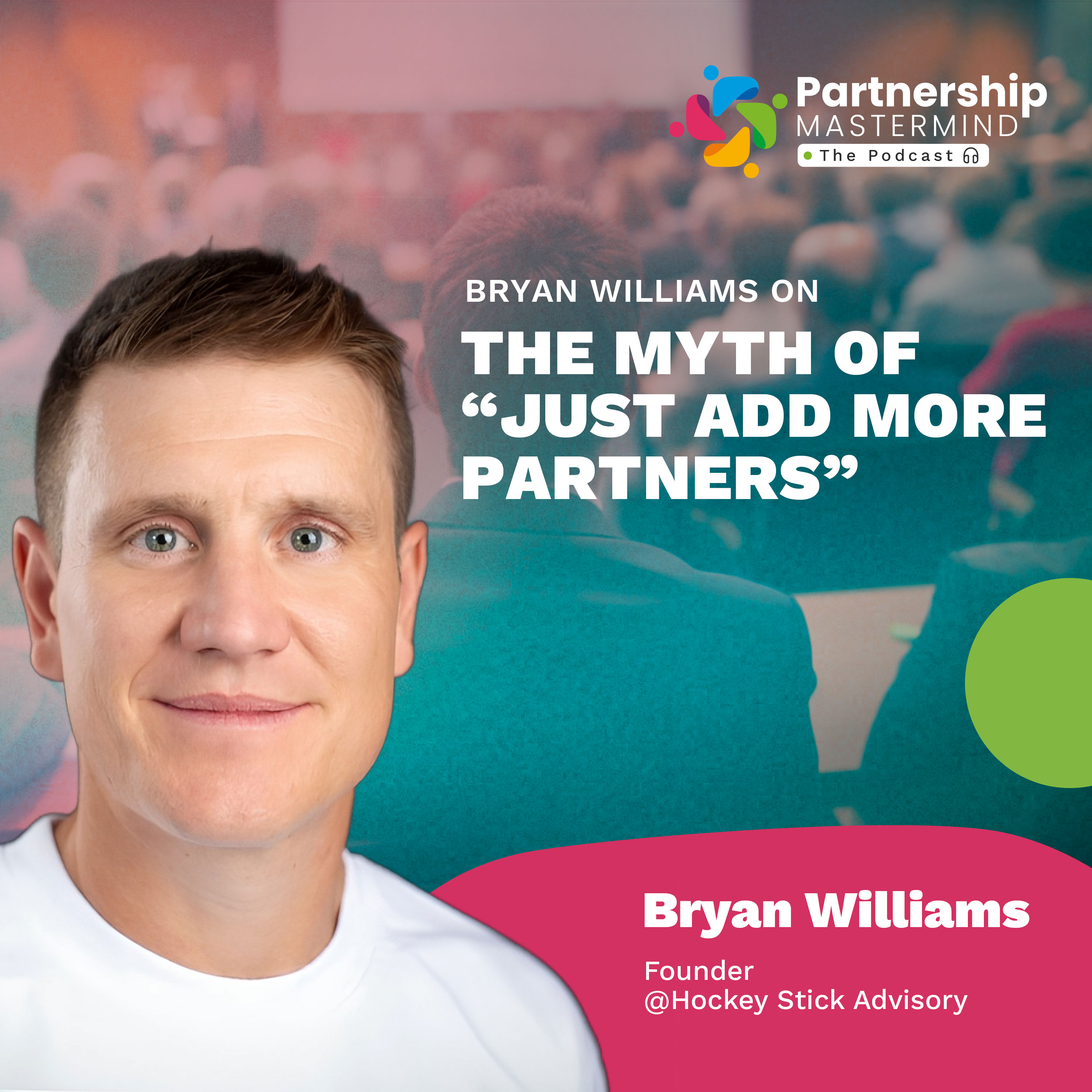
Bryan Williams on the Myth of “Just Add More Partners”
from Partnership Mastermind Podcast
48m 7s
In this episode of the Partnership Mastermind podcast, host Chris Lovoy interviews Brian Williams, a partnerships expert who transitioned from turning around UK gyms to scaling global SaaS ecosystems. Brian shares his journey, emphasizing that effective partnerships require leading with value and understanding the partner's goals, rather than a transactional focus on immediate revenue. He debunks the myth that partnerships can instantly deliver a flood of customers, noting that this misconception often leads to misaligned expectations with leadership. A key lesson from his early career was the power of referrals and ecosystem thinking, where he learned to identify who has access to target customers and build deep relationships with a few key partners. Brian criticizes the common mistake of spreading resources too thin by recruiting many partners, arguing that it's more effective to "squeeze the sponge dry" with existing partners, similar to how companies focus on retaining and growing existing customers. He stresses the need for a structured partnership framework integrated across sales, marketing, and customer success, and emphasizes that partnership leaders must educate their C-suite on the broader, long-term impact of partnerships beyond just revenue generation. Ultimately, Brian advocates for quality over quantity, operationalizing partnerships, and aligning the entire organization around a strategic ecosystem approach.
[Music] Alright, welcome back to the Partnership Mastermind podcast. I'm your host, Chris Lovoy. In this episode, we're going to cut through the noise and get real about building partner ecosystems that actually move the needle. Today's guest has been in the trenches from turning around struggling UK gyms to scaling Venn's APAC growth to running zeroes at marketplace. And now advising 60+ companies through his own firm, Hockey Stick Advisory. We have Brian Williams with us today. Brian, welcome to the show. Thanks, Chris. Good to be here. Amazing. We'll look. We start each episode off with five quick hitting questions to warm you up, especially since it's early for you. And get the audience a chance to get to know you a bit better before we get into the meaty stuff. You ready for that? Yep, that's good enough. Okay, cool. So first things first, it's 6 a.m. there, right in Melbourne. And you've got a big client call. What's your, what's in your coffee mug? Oh, well, yeah, I'm absolutely caffeinated right now. Ready to go. So long. Yeah, oh, good mate. Okay, well, so then what's your, okay, then tell us about your, is it just standard coffee or anything fancy? Nothing fancy this time of day. It was something quick and easy. And you know, I'm working from a back office at home today. So I also got to keep the kids from waking up as well. So it's not going in fair enough. Fair enough. Cool, cool. All right, next question for you. In a few words, how would your old gym colleagues describe you back then? Oh, yeah, you had a question. Long time ago now. Curious, growth-monded, aspirational, I suppose. Well, that paid off. Well, it seems like they have foresight then. Give them where you're at now and your career. Next one is, and I love asking this question, what's the most repeatable, boring, but effective partnership play you've seen work over and over and over again? That is a, that's a great question. I'd say it's the ability to show and lead with value ongoing and lead with that. Just yesterday I was working with a client call and I skipped asking the question, why would that person partner with you? Beyond the community, what would that person, you know, what would it look like, keep drawing it out? You've got to make sure that you're showing value to them, them to achieve whatever they care about, whether in-month KPI, okay, or what it could be. Make sure you're nailing at time and time again. And this is an aside, not the next question, but in your experience, that sounds so obvious to people like ourselves, but why is that not more obvious for a lot of other partner leaders now that they're building their program? Everyone always thinks about what's in front of them and what they care about. As in, I need to go, hit partner source revenue, partner influence revenue. I need to do that today. I need to find some, I need to do folks to go find business right now. And so people in the world, especially individual contributors, always going with mindset and kind of forget the other side of it, which is also the opportunity for you and I to go out to an edgekate market that is better way to do it, right? I love that. Yeah, no, I totally agree. I think it's a really difficult skill to develop this like foresight and like zoomed out strategic thinking. We're always thinking transactionally like, hey, we got to hit our quarter cycle this quarter. So I'd rather do that, you know, instead of like kind of pursuing a longer term strategy. So we're going to unpack that a little bit more later today. The next question for you is what's one partnership myth you wish would die already? Oh, into a leadership team that there's a fire hose of customers willing to send us all of their business next week. It's that's the default. The got a market, the CEO, you know, the CEO, they've got a revenue gap, go chat to the company next week and bring it back immediately. That's the day thought unfortunately and we're all going to work together better in the industry to rework that around what is the role of Palm Supes and how to go better. Yeah, I'm glad you said that and we'll dive into that a bit later on of like the relationship between the partnership leader and the kind of the C suite and certainly the CEO like managing up expectation setting, you know, training them basically on like what this role really looks like. It's critical otherwise they're going to get frustrated impatient and probably move off of you. So we'll definitely impact that a bit later. The final question, it's a light one to get get done this quick hit around is if you weren't in partnerships running your own business, you could do anything you want, right? Not in the corporate business world. What would you be doing? Well, like any sort of drink things. Anything. I always like getting a nature and adventures. So some sort of adventure company traveling more of the world, which have pleasantly been able to sort of stay a lot of, but yeah, just keep that just keep that going now with my kids. Amazing. Love that. Cool. Well, now we're the training rules are off. Audience now has a better sense of you. So now we're going to get into the to the meat of the conversation. And the way I typically approach these interviews is I really want the audience to kind of get to know you kind of linearly like from your kind of journey so they can see kind of that path. Because I think we both know and then the training market. People want to understand how people they admire got to where they got to. Right. So let's start in order. So let's go from gym floors to kind of global sass right in rewind for a second because your path is like a lot of others. It's not typical right. And so take us back to the UK, the gym turnaround, the finance referral plays. And then that jump into vend and eventually leading ecosystem growth at zero. So like just kind of take us back like what was your journey like? Yeah, origin story. So you know, if you're on the working gyms in the UK, Chris, I sort of want to know I had the opportunity to work in a pure outbound role in starting off in Germany and Luxembourg and Middle East and outbound role being commission only. Where she's a box of a list working with companies who set up all around the world where expats are and the goal is that expats typically own 30 to 40% more revenue than your wooden home country, which is why you moved there. So you've only got some money. What do you do with it? Where do you spend it? So these financial advisor companies would set up with like, well, let's go set up retirement planning, superannuation. Let's put that money to good use. There's a captive market here to do it. So in the foreign country, like how do you go find these people? So you know, these are days before Apollo, you know, Lucia, Firmable and everything to sort of go out of no drip flows inbound. So it was a boiler room course that I was working there for years at university with the Gold Drones, much commission money as I could and work my ass off. So I could travel more back to my point earlier. That you know, making 100 plus calls a day gets pretty old pretty quick and you know, the man made up make enough calls, this manual answer, you get this many rejections, objections for it. And I thought I was going to be a bit of a way to do this. So when it all to every referral strategy book, every kind of management book around how can we generate referrals, women through partners, what can we do around events. And the baptism by fire of a learnt, you know, through grinding and working, figuring it out that there's a way that I could fill diaries, I could book meetings without banging the phone. Right. This was, you know, in terms of building in our course scripts and our events, things, things like, all right, well, we're going to spend time today to look at your financial advisory situation. If that's a value, Chris, there's only one way we're going to ask for some help. If you can provide two or three referrals at the end of this meeting, if you state of value, would that be okay? And I went through a methodology and got a sales process in the framework. We could actually unlock referrals at the back of the, and then what we did, we got a good at it. Then we started to build compounding referrals out the back of every meeting. So then the next meeting would build as well. And then all of a sudden the diaries are overflowing, we're working with few advisors. We had deep respect and within huge organisations. And we really wanted to market with doing that. And so I think we've got just sort of basic evolution there to your point before. Everyone falls in the partnerships. You come from sales, marketing, customer success, as you're very typically. And that was where I was a real light bulb moment for me, which has followed me throughout my career today. That's where into the, you know, expanding a gym in the UK from a time and air, I used an ecosystem player around looking at, you know, the essential ecosystem definition of who has access to the customer you want to go after. So what a deal was we got in that era. We got everyone who could have influenced the more gym owners into the gym themselves. So from talking about from the pub manager to sports shop owners to the nutrition companies, I got them all in the come into the gym. I got them a part of it. We got them PT going. They becoming huge evangelists for it. And so every time someone going to one of his shops or touch points around it, people would notice them like, hey, you're in crochet. What do you do? And I'm working on this. Genie has been great. Fantastic. Check it out. I've been, well, you're great. The age of over time was, you know, like, hey, can you put up this little sign about what this is? Oh, yeah, you're no worries. And the next month later to have this huge billboard in their shop. And so I ended up with this gorilla marketing tactics that we've complete amplification across the whole area around this evangelism to drive in with zero marketing budget. I mean, love, love hearing that story. And I was, I was fascinated by people's kind of unique journeys. And one thing that's like clear and listening to you is that the skill of recognizing people around you in your ecosystem that you can work with so you can all
be elevated, seemingly is a natural skill. Like you were an outbound SDR type role beating your head against the jump and you got everyone's got to go through the ringer. Like with those entry level jobs, you learn a lot in those rules. But then you quickly are like, well, this is an efficient way to scale, right? What is? And you recognize pretty early on the concept of like referrals from partnerships and tapping into their customer base. So I'm curious for anyone listening who, you know, maybe struggles to understand how to like look at their ecosystem and understand how could we all work together to be elevated? Like do you have any advice for people to think that way? Because it's it's candidly not a natural skill to develop. Yeah, a good question, Chris. So I present to the sales journey organization. We worked with Dan here last week to to say it to sellers, right? And like what could you do? And I'll come back to a point I made just earlier around, you know, who has access to the customers that you want to go after? And if you think two to three organizations who are close to the core of what you offer, you know, build those relationships alongside them. We'll just feel free to sort of get going. Like as an initial right and work out, you know, if you're selling this, who else is in market? But it's also targeting the same audience, the sales, something, complimentary, and go go those relationships bilaterally. It's it's such a low use of your time, but they are doing the same role or very similar. Find out what they're trying to achieve and and make those connections and build them deep because I always say to people, well, if you can get these two or three relationships alongside you, strong, deep, you're offering back to themselves, you need to think of them like they're part of your team. Like that, you know, they kind of not work for you, but they're the ones open up opportunities and provide, you know, but Adi, you know, Jared just had gone to their like, you know, Intel, influence and intros. Like just do that with two or three people and you've three X, the opportunities around so a Dureka system just as a starting point. Yeah. We're going to unpack that later on, but I think that's a really important call it. I love how you kind of simplify what that really looks like, because I think people overcomplicate it. But let's get back to kind of continuing on your journey, right? You walk just through those early moments where you realize like, okay, partnerships done right can be a growth engine, not just a kind of a side hustle for sales. So let's talk about the kind of the first kind of pain points that you had to go through. And I know in particular one of them was like going too broad too fast, right? So like what happened there and how did that ultimately shape how you think and focus now? Yeah, well, you realize it's you get really busy being busy, right? Like what is the impact you're doing? You're going broad and weak. You're not going deep and meaningful. So one thing we sort of work on a lot of companies, we're working with is you know, you know, quality of a quantity. How can you 10X those that are close and tight to you to help each other win? And it seems to be like something which is easily forgotten. So many companies like go recruit more partners. Well, why? You're going to have a partner sitting on bench with ghost agreements, you know, it's so common. Yeah, I mean, my years are lighting up. If you can see us right now because if you're to ask me, Brian, hey, what's the single only one biggest mistake partner companies are making that's costing them the most? And if I get only pick one of the hundreds, it's trying to work with too many partners, right? We're working with the wrong partners. And like, and I really want to dig in in this, right? Like help the audience understand just how costly it is to focus on too many partners versus, you know, doing the right thing of like, hey, have we really squeezed the sponge dry with those other five partners that we spend a lot of time signing and onboarding? Or like really help us understand Brian because it's it's crazy. How at every level CEO, CRO VP of partnerships, head of partnerships, partnership manager, they all seeming a lot of people sorry are confused and think the path to growth is more partners. So few people actually say, you know what, how about we squeeze the sponge dry as much as we can for our most promising partners? I really want you to help us debunk this. Yeah. I was like, companies always look at tame same sum for their customers, right? But if you're doing a flat plan looking at your term same sum for partners, then what is the sum of the partners for it? Now, if you've got to go produce partner source revenue of a certain amount or whatever the impact of it is, which partners can go deliver that? Now, it's not a case of more volume of partners to sort of say, oh, we've got this huge Sam, which you never convert to some to never get your actual bottom up plan to achieve that. So recently, I've been chatting to HubSpot down here across the region. You got two levers. We want to drive more partner source to grow from our solution partners. Now, we've got two levers to do it. Very simple. Let's go and build the capabilities of our existing solution partners or we're going to recruit a bunch more to do it. Now, the thing that people forget very quickly and needs to be over communicated back up into the business is no one really cares about your partner program. And the more you go on your crew more and more and more, what you're actually doing is you're promising all these benefits to a bigger pool of partners. You're downloading them. You're downloading it massively. So as a company, finance, amount of opportunities of what you can offer back through partner program strategic partners. So if you go deep with a select few, we can fill out, you can rinse it like you sort of said and unlock the partners on within them. Go do that. Just go deep with a select few. Yeah, I love this. This is honestly one of my favorite topics to have. And I agree with everything you said and Brian, maybe you'll resonate with how I put it when I teach this problem to like, like see sweets that I advise and VPs is like, hey, look, in a SaaS environment, let's just focus there. What are the two levers for like revenue growth? Acquire new customers and get more revenue from your existing customers. That's those are the two levers and they say, yeah, yeah, I agree with that. I'm like, okay, cool. Which one is more expensive to do? Right. And then like, well, of course, acquire a net new customers because you got marketing, you got sales, et cetera. So I'm like, well, that's the same thing with your partner program, right? Which should you want to invest in? Do you want to go acquire net new partners or do you want to get more revenue from your existing partners? And they're like, oh, I get it now. Right. So it's like, if it's so obviously understood when you talk about customer acquisition from a company level, everyone seems to understand that. But like, it's baffling to me how when you apply that same logic to your partner program, seemingly everyone forgets first principles, right? Where it is more expensive to acquire net new partners than it is to then get more value from your existing partners. Does that kind of resonate? Yeah. Yeah. Absolutely. I think that's, it's clearly articulated. It's a good way to envision the other thing I would add to that, Chris, just building on it is companies will go set up a very standardized sales organization. I'm talking outbound sales, right? SDRs, we've got MQS on top from marketing, driving or events and whatever the things we're doing. And with SDRs, we've got AES account managers for it. And then they say, well, let's just leave the partnership I start individual contribute over on the side and rather than this whole process and sales options and all the things to flow through in the CRM, you just go deliver everything by yourself and just contribute that 20, 30% of that. And can you do that next week? Right? So there's no partnerships framework around how do you actually operationalize the partnership flow to go with that? Right? And that, you know, that is the opportunity for all of us to, you know, there's one thing to grow, deepen, build relationships with partners. But if you're an individual contributor, it's so critical that you overcommunicate internally of the role of partnerships, the impact of it and the breadth that they can do to make an impact. Like, where, you know, I've got a presentation to a C-suite next week. We're just finalizing some work on and, you know, marketing, you know, reach with partners is significantly more than doing it all yourself in your budget for customer success. It's a case of you don't have as much support to man. You don't have to hire as many people. The more we can bring partners, sales, we can, you know, we can co-sell and bring emotions in all the things that you and I know. But you need, you need everyone across the business board into around what it is. It's not all about partner source and influence growth. It could go so much wider. I totally agree with that and appreciate that that breakdown. I'll ask you, like, this was not in the interview script. Let me ask you a question related to what you just said. Who in your opinion, you have to pick one person, Brian. Who in your opinion is it their job and responsibility to unite the whole organization around partnerships, right? Because this is a polarizing debate. You got the rise of the chief partnership officer as one candidate example. Maybe it's the CEO. So in your opinion, where does the buck stop? Who ultimately is most responsible for, let's just focus on like mature companies like product market fit and beyond. Who is responsible for you nighting the company around that ecosystem strategy, right? Because it seemingly every company is looking at each other like the spider-man meme, like who's responsible. So we'd love to hear from you and who you think that is. It's whoever's in charge of revenue up the top, right? Like it's interesting. I like that. And the reason why is that firstly, no one's trying to fail, right? Let's start with that. Like a real like jockewilling spook where he talks about streamer. And you go think like love. Anyone who gives you a leader like, Hey, he's 30% of revenue. Go do that. They don't want to fail. Like I spoke to a CFO last week. And they're like, when there's some strategy workers, well, we need you to deliver this amount of revenue. That person is
CFO does not want to report to the board that partnerships didn't deliver and I didn't deliver on that number. However, a secondary person to that. So whoever owns the revenue number up top across all channels is the person. However, if someone's in a partnership's role, individual contributor, VP of partnership, whatever, it's up to them to be accountable to go spread that message far and wide to manage up accordingly to it. Because at CFO, I'm telling you, all of a CRO is not going to go sit in that board meeting and sort of say, we missed our number and then they try and all we'll just go fight a person because they didn't deliver. Fair. I appreciate you taking a firm stance on that and I tend to agree that it really should be the foremost responsible person on the revenue org. I think that's a sound answer and I'll be interested in what our community thinks about that. So let's keep going down the journey, right? And you had a really great stint in kind of like corporate kind of biz dev partnerships, etc. And then at some point you decide to make the leap, ultimately start your business, hockey stick advisory, which I love because you didn't just go, hey, I'm going to do freelance partner consulting, which that's a great path for a lot of folks, especially as a side hustle. But you've ultimately built a business and a model around it, right? So my next question for you, Brian, is what was the gap that you saw in the market that made you think, you know what, companies need this and they're not getting it anywhere else? What did that look like for you? Yeah, great question, Chris. So it developed over a few years of a, you know, building on curiosity. So when I was a vend point of sale, which got acquired by Lightspeed in 2022, you know, started early sales and account management and growing the book of business. And you know, we saw that companies which were using all connected apps and technology players that they were growing, they'll, you know, all the benefits we know of staying with us longer, bigger accounts, happier, and it was like, hey, okay, so this is flowing on from what I'd seen earlier. And then we're, I got to go work at zero as ecosystem as a sort of scale up mode and grow from 100 partners through about 1200, throughout about a five year tenure. And so I had the opportunity to sort of see the lens of like what was working or what wasn't working. Who are a lot of these upcoming companies. And I think as an industry, we always talk about the halos or like, oh, let's look at what HubSpot's doing, what's at last year and sales force, the hyper scalars, but surrounding each of these ecosystems and, you know, following either like, you know, Jay or Roman staff, 16 plus tech ecosystems, they've all got thousands of apps working around building point vertical solutions, which are vying for the attention of the ecosystem. So right, my experience is zero. The farming apps would say, hey, can we do an EDM out to everyone in farming? You know, hair and beauty apps would say, hey, we got this conference next week. Can you just pay for most of it? You know, the next word of reporting uptake and we just do a presentation to your sales team next week. We've just dropped a new feature at BeGrade. And so I saw this time and time again of these upcoming companies who were maturing in their own product features wanting to partner. And the effectiveness of it was just was nascent. And so I've been based in Melbourne. I started finding myself doing a lot of consulting presentations to other boardrooms. You know, zero down here across the APAC region is really revered in the same way HubSpot is in North America. So we're going to board like this is how built the ecosystem over time, started to spread this general knowledge. And I thought this is really interesting that other companies are trying to figure it out in a way. Can it is a case study? We're seeing all these upcoming companies have a goal at partnerships. But I would see that the partnership people turn over in a small way that we know as well. And we'd have these running jokes that like hey at the next conference that we're in a different, you know, tech t-shirt. They're over there now. Last year over here, what's going on? And so what it was, where the companies go and learn partnerships to be more effective. And so that's where I made the strategic move. It over three years ago to go launch this. And there wasn't, there wasn't people out there like yourself, Chris, or out of educating the markets around be able to do better. And so that's what we've been doing. We've been building the the capability of companies to how to build towards partnership ecosystem. But also, instead of leadership level around what is the role of partnerships, how to play, and how to structure alongside your, your go to market methods that you've got today. Well, love here in that story, Brian. And I have a ton of respect, obviously, for the business that you've built, you know, being in the same kind of category, so to speak, and building my business. So ton of respect for you as a trailblazer. And I think it's inspiring for anyone listening who is following in a similar path where it's like, hey, look, like you're becoming a highly competent kind of operator in the confines of a full-time corporate environment. But if you sense this gap is in the market that you have a niche that you can fill, then Brian's giving you a really good roadmap to kind of branch out, at least start a side hustle and then potentially into a full-time hustle. So that was a great breakdown, Brian, of kind of how it started. But how did you validate it early, right? Was there a first client or a first project where you thought, shit, this works, right? Like I can, like we can really, there's runway here. Yeah, I mean, I started at Walls. I was still in Mozilla role for what it was. So I had two or three clients to sort of get going, Chris. I was very fortunate that I had a public facing role at zero. So I had a ready network for it. And I was already on the speaking as sort of a part of that role. So yeah, we've a label that I'd sort of emerged through sort of lockdowns and consulting and people paying, because I was like, hey, this works, there's demand. And I then I had a profile. So I already had an audience. And the third thing I know, just from a row, a lot of venture capitalists in Australia. And so, right, 10 of them in email. Hey, I'm looking to go start out a bunch of ecosystem, really for our big tech companies, would there be some within your network that I could catch to? And a few of them, which I'm still very grateful to today, provide me introductions to the CEO and founders to about half a dozen. And you know, without really trying, I suddenly had discovery calls. And I had, um, we've vetted down the funnel companies who are interested. Like, yeah, I would love to work for you. And so having done a few works around it, I had an active pipeline already to launch with and build behind and go at it right. And so from now, I basically haven't, um, haven't stopped and haven't looked back. And you just as always, and as you're going through it, Chris, you're always building and, you know, thinking about the next thing, you know, from those early days of in Europe, and outbound the referrals, like it's, you know, where I met today and where we're going is continue to evolve. Love that. I love that break down. There's a few key things to unpack there. For anyone, perhaps who's interested in following a similar path as Brian and then myself of hey, like kind of starting your own kind of service type business. I think a few things there. I think I do advise people like, hey, like, you know, I would encourage you to get something started while you still have a full-time job, right? You know, just to kind of protect yourself against cash flow. Like, you know, you can take it or leave that advice. But then also the importance of building your network, right? Like network, Google's network is cheesy, but I do think it takes years to kind of get that going. So you want to start, you know, the best time to plan a tree was 20 years ago. The next best time is today, right? So like get started. But to continue on that evolution, Brian, right? Like, from you doing strategy solo, then you go full-time on your business. And then building a team that actually execute the full partnership framework, like help help those listening who might be inspired to kind of build their own kind of business and brand. You know, what did the growth phase look like? Like, you know, you leave zero now your full time on this business. Like, what did that kind of transition look like going into growth mode? Yeah, so I'm always, I'm a big believer in that learning from both ahead of you, you know, the saying of course, you know, or so careful where you get your advice from is firstly, be mindful of toxic positivity in a good way. That in what I mean by that is, career's great job. You know, I love what you do and keep at it from someone who sits in a corporate cushy row. Like it's, it's, it's, well, that doesn't help me. And it's a pain on the back and you're like, that's nice. And then they just take a paycheck and go home early. You know, rather than speaking to someone who's two to five years in of operating this model in, you know, what is cash flow? How do you have runway? What is, you know, your tax, your P N L? What is your three month? What is your burn rate to actually understand the mechanics of operating business? So that for anyone thinking about this, you cannot underestimate that. It is a quantum gap to go from a full time employee, you know, to running your own business in this model to do it. So that's, that's an ongoing learning. So to mention questions first year, I had a personal brand coach who was a few years ahead of me who provided ongoing guidance and most importantly, accountability. What are you working on here? What is this? What about this aspect? And like any good coach or guidance mentor, it helps you see around corners and we still have a business coach today, which I was on a call with last night around how we're evolving our offerings and how do we do more and be more? Because in a full time role, you got responsibilities here, but, you know, it's a different game. It is a different game. Yeah, love that. Going through similar stages myself. So I think that's a, that's a great framework for others to kind of follow in the footsteps, like get as much advice as you can, but also be careful and kind of parse that advice to kind of qualify it. So that's kind of how you got the business rolling. Now let's get into the good stuff, which is the partnership framework, so that you're becoming famous for now. So let's dig into that, the partnership framework itself, because I think that's where a lot of people can steal value from. So the next point blank question for you, Brian, is what are the main stages of your kind of partnership framework itself? And what are you diagnosing in those
first 30 days of the client. - Yeah, sure. Yeah, so we're breaking into five pillars, which is nearly about over six month period. And the goal is is that we're building the partnership foundations alongside your other go-to-market motions in a very intentional chronological way. So the first phase we kick off with, which we call a line. And what the hell does that mean? We spend a lot of time thinking about what is the, it's not about building a strategy playbook and then off you go. Because companies would just go back to, like, where's the leads next week, right? So it's got to start with that leadership level. Now, when we say a line, we're talking about it on two sides of the coin. What is the partnership to mean internally? Like, what do we actually want it to do? What resources do we have? What is the size of the ecosystem? Where are we going to play? What does our partner categories look like? And then starting to have a model of around like, okay, we're ready to go. We're not partnerships is and then get everyone boarding on the bus around what that is. And so during that phase, it's pretty cool. We always start off with a leadership workshop, which we mandate for a half day of, you know, what is the role of punch? And no surprise, Chris, you go around the room, the head of sales will say, I want partnerships that fire me, consistent leads. I don't really have time to talk to them. And we want them to work with us. - That's bigger. - We're awesome. That's like, it's foundational. And it's some of those light bulb moments, which you mentioned before of getting into a CEO, founder and MD's head of like, why would someone partner with us? And they'd like, oh, I don't know. Well, I hang on, I don't know. And then we kick into what we call the validate phase, where we run a sprint, where we go pressure test our partner value proposition, which we've rebuilt and done some market research and learnings and we've done surveys to our customers. What else do you need around side it, which I think you should always be custom-led. We'll check our partners around, what do you want from us? From the top partners, the ideal partners, for his validate phase. So then before a partner program or rebuilding a partner program, we've actually got something on the table, which is of value. Because if I say, I always put it to you, Chris, if I say to you, like, hey, I want a partner of you, I can we get on a call and do something like, well, I've got a hundred things to do. But if you're not throwing something over the table, I think a really good one for an individual contributor partner manager is, both find out who are your partners partners. - Yeah, Matt's ecosystem of your ecosystem effectively. - Yeah, yeah. - Because they're spending their time and we've just been going on about like, hey, you should make sure it's critical work with less partners and go deeper. Well, if they are actually doing that, then unless you bring something to the table, which is attractive of value, it helps them win personally in the company win from the get-go and validate that. And that doesn't stem the basis of a great partner program. - 100%. I love that line. And going back to, like, I love how you kind of have that like mandated, like, have to workshop. And then you kind of hear people's perspective of kind of relationship with respective partnerships. The sales thing, I love the sales and we need sales. Don't get me wrong, but I have always have a bit of perplexity when it comes to sales, especially once you're actually delivering quality pipeline that closes, right? Like pre-pre that happening, sales can be as skeptical as they want, right? 'Cause they haven't won yet. Their bank account hasn't benefited from you yet. But once we're driving in that pipeline, it's crazy to me that AES and sales managers are so slow to like really buy into us. Because in many cases as Unibrine, we have the same exact quota model, right? Closed one cash hitting the company bank account. And by the way, we're the ones filling up your pipeline, top of funnel, we're helping those deals close with the influence, we're filling up your calendar. So I'm curious, Brian, this is an aside question. Why is it that the relationship between partnerships and sales is so slow to develop, given that of all the other functions that we collaborate with? We have the closest parallels. Like we have same quota model, same comp models, right? We're both connected in the funnel, so like help us understand what's missing. - Yeah, it's as simple as KPIs drive behavior. And so for a sales team member, I've got to hit my number and do this right now. And with my targets, transactional, and then I go home. So, - Right. - Unless, do I want to chat to that partner over there? Well, that's not my KPIs today, right? So we mitigate and solve that by a fruity align phase and getting the leaders saying that partnerships will not deliver what you want to, unless we have top down support to do that. In order to do that, we need to put an OKR into the top of your sales and to drive it. One project we're working at the moment, we're mandating for all new business renewals that are growing partner attach of the sales team ongoing over the next few quarters. So we're changing the sales DNA to be a partner led company. And going back to that transactional nature, AE's got a role, SDR's got a role, sales manager for it. What I find as it grows, exactly what you said Chris, there's usually one or two AE's that get it, and then like the penny drops, and then all of a sudden they're like killing it compared to the others. And this is quantum upside once they get it. And then there's a tailwind of everyone else like, "Oh, how do I do that? "Or how do I do that to go with it?" But it's a crazy matter. - It's a matter of that. - KPIs drive behavior, mandate it from the top down, which is why you've got to get that buying from the leadership level early in. - Yeah, I love that. So two great takeaways from that segment there, from Ryan, the KPIs drive the behavior. So it's not enough to just have aligned quota elements. Like the fact that our quotas are basically the same, close one revenue, and we're both on like contingent commission structures. That's not enough is what Brian's saying. You really need to kind of align the KPIs. And I've lived that experience, like on the customer success side. Customer success reps are typically the ones who refer leads to your partners, 'cause they're in that like important relationship on their role. So I remember one break, you always finally able to have with their head of CS was, "Hey, look, "can you like RCSM's had a KPI of like three cross cells "in a quarter?" So to speak. And he agreed to retire that quota if they were to refer leads to partners. So we basically were treating partner referrals, almost like a cross cell, right? And once he did that for me, Brian, to your point, that was a game changer, 'cause then all the CS are like, "Wow, like I can just press that button." And it's actually easier for me to refer a quality leads to my partner than it is to cross cell or flimsy solution. So I love how you said the KPIs drive the behavior and I've lived it. Quote is not enough. That's two, there's too much of a leg, right? When quota gets hit, the leading KPIs sounds like that's the important place to get, right? Yeah, that's right. If it's got the top down support around the Y and you've answered that, never ask me that. What partnership is, they're on the bus. So then what happens if otherwise, if you don't get that fine understanding, what happens is I've gone for its process, one of the early clients we were, but you've a lot of partnerships is great, we're all invested. A month later, I had a board meeting, they're nervous, how come partnership hasn't delivered yet? I said, let's go back to this slide, which in this asset, it weak, co-built and we signed off in this together. The role is that we've gotta, we're building this capability, but it's not this turn key transactional thing. Let's get though, let's build the KPIs into it because to your point, leading indicators, lagging indicators around, what is the outputs that we're getting towards? It's gotta go in that order, which is why our sort of framework, we've sort of stepped out in that way because you can't, companies usually jump to like the third pillar we've got, which is like, activate, which is like, let's go do everything we've planned and get busy and like, I'll chat to them and bug everyone, well, hang on, well, you haven't validated it. No one's aligned internally. You've, you've set yourself ready. You're not ready to get fired or quitting in frustration, right? Yeah, I love that. That was really fun combo. So let's, we're just gonna keep it going, right? So you gave us the great frameworks, kind of the early phase of your engagement with a client. Now let's talk about scaling for growth. Right, and you said, you know, sorry, so say a team's nailed the basics, right? And they're ready to go faster. You know, you've got this scaling for growth series, right? What does that look like in practice to help clients go from like, okay, we've got the foundations. Now how do we actually scale for growth? Yeah, so firstly, previous phase, we set up mutual success plans and we go deep on those with the select few parts which we choose to go with. It's not a case of scattergun to anything, right? Like how do you build it? Think about your sales team. It's very, you know, methodical around how do you go about it? So picture your top partners. How do you actually build a plan on going where you can do things systematically? The goal of partnerships is really predictable, sustainable, partner-led growth in most aspects. So picture being able to get this going with a certain number of partners, with an always on method, to be able to run a cash flow forecast out three years and sort of say, this is the value of partnership. That's also the recipe if you can crack that nut to get more investment because a CFO can sign off on that. Oh yeah, this is where you're building towards. So mutual success plans. Now what that means to us, it's not about QVRs. I've got a strong stance is QVRs, is all about updating a nice slide, shiny slide deck about what you've done. Dropping in your feet is what you've done. Doing it in update, it's a bit of a show until,
- Pastoring. - Yeah, in a primary school environment. Whereas a mutual success plan is, what do you want to achieve next quarter? What are we doing together around what your side? Your whole goal of it is to unlock organizational buy-in on both sides. Because if there's a committed plan in place, and you've actually got something you can stand behind that you're ready to sort of scale up and grow with. Now, if you're able to do that with a select few partners in a programmatic way, then you've got a dependable model that you're actually able to bring to life to sort of sky-load off and what does that look like? - Yeah, I love that. I totally agree. And that really is the right kind of systematic approach. You can't skip steps. And so the follow-on question that Brian is like, what are those quick wins you're aiming for early, right? Versus the longer plays that might take a year because that's a challenge in someone in your capacity and like an advisory consulting position is like, hey, you have to balance like, these clients need to feel some type of wins early on to justify your existence if we're just being honest. But then you also are being realistic and strategic to kind of set them up for longer term place. So one of those quick wins you're aiming for early. - Yeah, so like if you look at like a two by two of like, who's are your partners in the round? You've been for a Viserico system. This is our part. These are the plays we wanna do some things we have. You put them in a metric of like, holy grail partner. Now Chris, I think you've had some images on this in the past, right? - Yeah. - And a lot of time on this with the next best choice partners. Right, go hard. Like so what that means for us is, pretty similar size or maybe slightly smaller. But if the similar ICP is hungry and eager to do stuff with us. They're the ones that go, go press go on a few initiatives to show some momentum. Let's go get a webinar out with them. Let's do some shared blogs, emails with them. Let's get some activity as tactical. It's fast turnaround. It's low effort. You get high exposure. You're generating some, you know, we talk about MQLs, SQLs. You know, I sometimes talk to C-suite, so I understand we're gonna talk about, you know, TQLs partner call for my leads, right? Wait, wait, wait, wait. And so let's get some tactical things out the door. Let's show like, wow, hey, we did this stuff this partner. And we got of his new leads opportunities, which we haven't had exposure to or access to. And now we're following up and there's some really good people. We haven't shared it to because you're able to sort of tell that narrative to do more. By the way, we're building a programmatic value here to then how do we port on for, you know, drive them to the end of them. - I like that. That's a really structured, kind of directional approach, which I think you have to take to kind of justify the existence of the investment by the company's perspective. So I really like that approach. We're gonna transition into one of our final segments here, which is gonna be a fun, quick hitting session. So these will be a kind of more rapid fire again, but you know, on point with partnerships. So we're calling this one, "Miths mindset shifts and must kills," right? And this is gonna be focusing on kind of your client work. So the first one is recruit more partners and the revenue will follow, right? Why is that statement wrong? - Because you've got every time your recruit more partners, you're waiting in your partner value proposition because you're promising more to more partners at the end. - Amazing, nailed that one. All right, cool. Next one, one off initiatives. What's the danger on that? The flash in the pan and next month, you've got nothing to show for it. - Love it, you're absolutely crushing this frame. Third one, partner productivity versus partner acquisition. Why is productivity the metric that really matters? - It unlocks organizational buy into actually move the needle rather than just noise. - Love it, absolutely. And then I want a hot take here if you can give one. If your partner value prop is weak, what's the hard truth about your job security? Well, how long are you going to last? Why a partner going to talk to you? - Yeah, absolutely. And drill down on that first, Brian. Like what's the simplest way to completely revamp your partner value prop? Right? You've done a great job explaining directly and indirectly how important it is to get that right. So what is the shortest path to a much more refined partner value prop? Which you need to take to market to engage and sign partners in the first place. You need to validate and that is go chat to your partners, run a quantitative survey to your ideal partners and find out what they want and where they spend their time. From there, you can have a data driven approach around what the partner value proposition should could be. And look at your partner's partners like we said before. - I love that. I totally agree. And one thing I always say in a variety of capacities, like you need to prove it with one, right? Like you can get your 10th customer without getting your first one. You can't get your 10th partner without getting your first one. You can't get your 10th deal without getting that first one. So I put such a premium on, hey, prove it with one, like really cleverly designed, like a design partner or whatever you want to call it. And you learn so much from them. What's right, what's wrong about your hypothesis that you can then take to scale. So I appreciate that breakdown. And then just a couple quick hitters on the leadership side and then we'll wrap up. Zooming out for a second, you've seen so many great leaders up close, you being one of them yourself. What is it that they do differently, right? Like we all have the same amount of time in the day. We all have similarly, you know, the same type of resources at our companies. But what is it about those top elite partner leaders that separates them from the rest? - You need to evangelize internally to get company buy in. So get on the weekly stand up, the town halls and go show the impact of partners. Partners did this in terms of columns and spread out message. In marketing, we helped drive this together. We've got all of these events upcoming. These partners delivered fruit. And so for every cross functional department, you'll be activated. Partnerships accelerates the company's strategy. It's not an island as we know Chris, right? Which we're doing at this, that helps the industry move forward. - Love that. Second last question for you, for the whole interview. What's one trend in partnerships that you're optimistic about, that you think is here to stay. You think it's a really positive trend where you're seeing more companies do this or more operators and individuals do this. You can take that in an interaction. But is there any trend that you're noticing that you're like, "You know what, I'm glad to see it and I want to help prevent it?" - Yeah, I think just go to not broad, you know, AI enabled world of diluting - 100% - Frost and relationships, turning insights into action. The opportunity for partnerships is to the network that you all have is becomes an asset. And that's you for you personally, for your current job, your next job, and where things are going. Can't underestimate it. I love that. Especially in the AI world, I think the concept of productivity, efficiency, density, these are all things that are going to become more and more relevant. Companies are going to expect you to deliver more output per employee, which means you need to get more output partner managed, so to speak. So I'm glad you said that because I totally would, who have chosen the same one, Brian. Last question for you. If listeners of this episode remember one thing from this conversation, what should it be? - Like I know the SWAT's negative says, "Bee useful." - Be useful. - Be useful. - I love that. Be useful. Might get that tattooed on me. That's just a great job security 101. Be useful. People will forget a lot of the details, but they won't forget when you were useful, especially when it mattered most. I'm so glad you left this off there. But look, Brian, this has truly been awesome. For folks who want to learn more about partnership framework, I highly recommend you follow Brian and LinkedIn and check out the hockey stick advisory. And certainly to get engaged if you're looking for some support. But thank you listeners for tuning in. Definitely hit subscribe and follow wherever you're listening. And Brian, seriously, thank you so much for a really fun conversation. - Thanks, Grace. Good to have you out there. Some time to talk. - Amazing.
Podcast Summary
Key Points:
Partnerships often fail due to a focus on quantity over quality; going deep with a select few partners delivers more value than recruiting many.
The most effective partnership play is consistently leading with value for the partner, understanding their goals, and avoiding a transactional mindset.
A common myth is that partnerships can instantly deliver a flood of customers; in reality, they require strategic, long-term relationship building.
Partnership leaders must educate their C-suite on the true role of partnerships, managing expectations and demonstrating broader impact beyond immediate revenue.
Early career experiences, such as outbound sales and gym turnarounds, taught the power of referrals and ecosystem thinking to scale efficiently.
Companies should apply the same logic to partners as to customers
Partnerships need a structured, operational framework integrated with sales and marketing, not just an individual contributor working in isolation.
Summary:
In this episode of the Partnership Mastermind podcast, host Chris Lovoy interviews Brian Williams, a partnerships expert who transitioned from turning around UK gyms to scaling global SaaS ecosystems. Brian shares his journey, emphasizing that effective partnerships require leading with value and understanding the partner's goals, rather than a transactional focus on immediate revenue. He debunks the myth that partnerships can instantly deliver a flood of customers, noting that this misconception often leads to misaligned expectations with leadership.
A key lesson from his early career was the power of referrals and ecosystem thinking, where he learned to identify who has access to target customers and build deep relationships with a few key partners. Brian criticizes the common mistake of spreading resources too thin by recruiting many partners, arguing that it's more effective to "squeeze the sponge dry" with existing partners, similar to how companies focus on retaining and growing existing customers. He stresses the need for a structured partnership framework integrated across sales, marketing, and customer success, and emphasizes that partnership leaders must educate their C-suite on the broader, long-term impact of partnerships beyond just revenue generation.
Ultimately, Brian advocates for quality over quantity, operationalizing partnerships, and aligning the entire organization around a strategic ecosystem approach.
FAQs
The ability to consistently show and lead with value, focusing on what the partner cares about and how you can help them achieve their goals.
They often think transactionally about hitting their own quarterly revenue targets, forgetting to consider the partner's perspective and long-term mutual benefit.
The myth that partnerships will immediately deliver a fire hose of customer referrals next week, which is unrealistic and sets false expectations with leadership.
While in a commission-only outbound sales role, he learned to generate referrals through value-driven meetings and building referral systems, which filled his calendar without cold calling.
Trying to work with too many partners at once, leading to weak relationships and ghost agreements, instead of going deep with a select few to maximize impact.
Just as acquiring new customers is more expensive than expanding existing ones, recruiting new partners is costlier than deepening relationships with current partners to drive more revenue.
Chat with AI
Loading...
Pro features
Go deeper with this episode
Unlock creator-grade tools that turn any transcript into show notes and subtitle files.
 PodcastTranscript AI