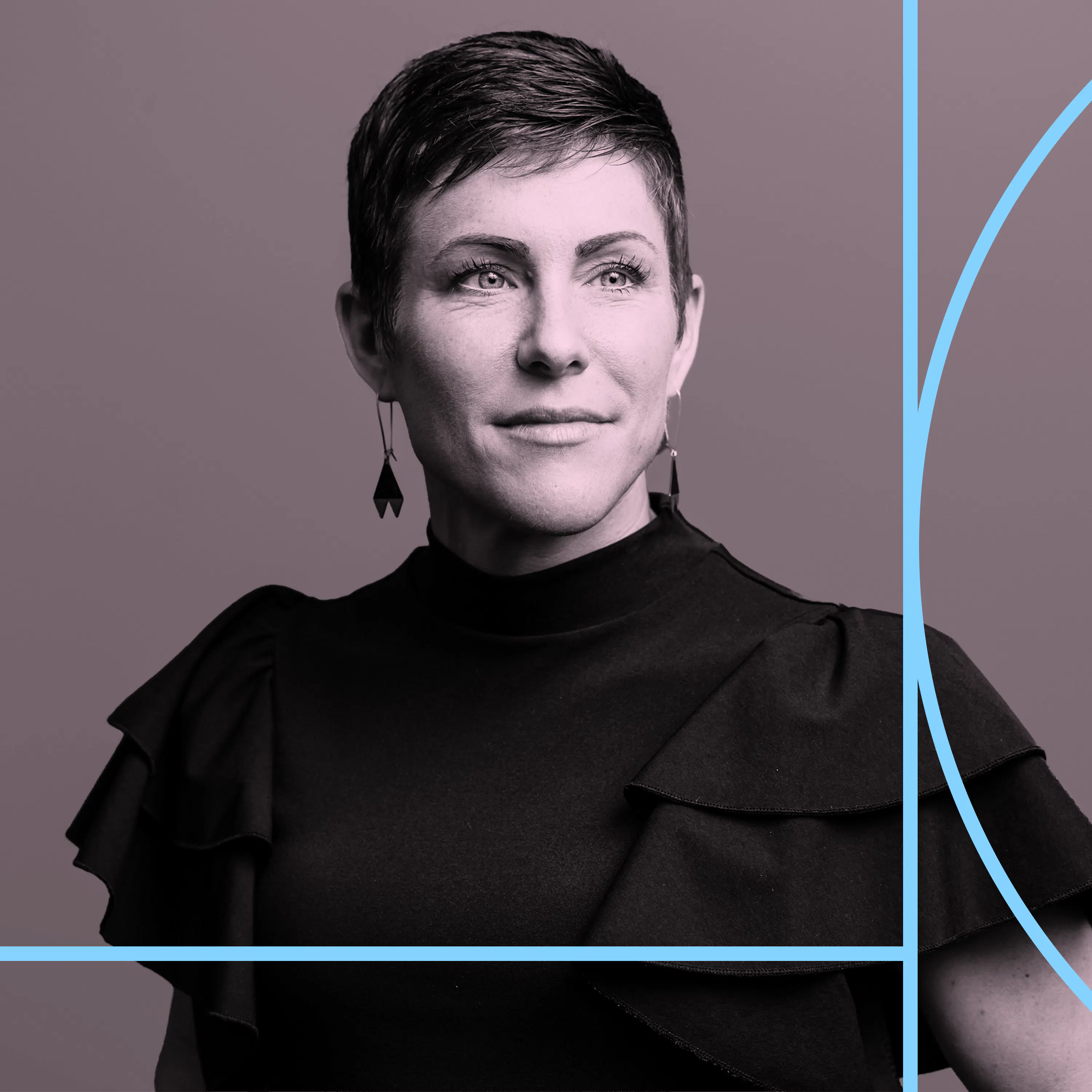
Brooke Hopper: Adobe's machine intelligence design lead on what AI can't touch
47m 7s
The conversation highlights how AI is reshaping design by accelerating workflows, such as enabling rapid prototyping and reducing reliance on engineers for execution. While technology streamlines tasks, the essence of design remains rooted in human creativity—empathy, taste, and experiential insight—which AI cannot replace. Adobe is responding by enhancing its tools with AI capabilities while ensuring they retain the precision professionals require, acknowledging that designers often seek perfection beyond AI's initial output. The discussion also addresses educational shifts, stressing the need to teach conceptual thinking and aesthetic judgment rather than tool mechanics, as AI handles more technical aspects. Initiatives like Adobe's partnership with Parsons, dubbed "Not Creative," aim to engage critical dialogue on AI's impact, preparing designers to leverage technology while preserving the human touch that defines meaningful creative work.
Things are changing so quickly and you can't keep up, but if you stay curious and you're playing, and I used to be that designer, I'd go and corner my engineers and say, "I'm sitting right beside you and we're going to figure this thing out." And now he can just hand them the thing and they can maybe even sometimes take the code directly from it. And so people are able to focus on doing some of the stuff that they love. There's a lot more exploration happening and I think that's good thing. Brooke Hopper stays close to her craft. Before she hopped on a call with us to chat about her role at Adobe, she was deep and cursed her prototyping navigation design ideas. Though Brooke holds an individual contributor role after more than a decade at Adobe, she's managed to have influence and demonstrate leadership without being relegated to management. This is what many designers dream of, craft and career. As senior principal designer of machine intelligence and new technology, she helped design the very first Firefly experiments and now she's working on unreleased tools that raise fundamental questions about other things like non-destructive editing or even layers in Photoshop still mean what they once did. Do we still need layers? If you listen carefully, you might get some clues about the products that Adobe is cooking up right now. And Brooke is more than a product thinker. She's also a design educator in leading partnership between Adobe and Parsons called "Not Creative," named she chose to liberally start a conversation. In this episode, we get into what it actually means to use AI as a creative collaborator rather than a shortcut. Why design education needs to stop teaching tools and start teaching taste. And why Brooke believes this moment might be the most exciting time in her career. This is Design Better, where we explore creativity at the intersection of design and technology on Miele Willary. And I'm Erin Walter. At Design Better, our primary mission is to produce work that helps people like you refine your craft, improve your collaboration skills, and get inspired by the creative process of others. If you enjoy what we do here, the best way to support us is to become a premium subscriber at designbetterpodcast.com/subscribe. We'll return to the conversation after this quick break. Design Better is brought to you by Wick Studio, the platform built for all web creators to design, develop, and manage exceptional web projects at scale. Learn more at wics.com/studio. And now, back to the show. Brooke Hopper, welcome to Design Better. Thank you so much for having me. I'm really excited for our conversation. So we've been chatting a lot with your colleagues at Adobe. There's a lot that's happening right now, as we were saying before we hit the record button. The role of design is changing quite a bit. Partly it's the times and the tools. And we want to talk about AI and Adobe's position and how it sees things in that respect. But you're also thinking about design education, thinking about design and its role more broadly. When you talk to customers and you sort of get a view of what's happening in various creative disciplines, how do you see the role of design changing right now? I heard someone say and I should go back and find out who it is. It was an article in Medium and they said, "Jobs and design aren't being lost. It's just being repositioned and refocused." And I think that's exactly what we're seeing right now. There are always going to be a certain set of people who, if you can find something cheaper and faster, they'll go for it. But the people who really honestly care about design, they really care about what it is that designers bring to the table. And the thing is, when we talk about creativity and we talk about the design process, what you're bringing isn't just the final thing. You're bringing the education, you're bringing all of your knowledge of design fundamentals, your taste, your aesthetic, your point of view, your emotions, your experiences. And those are the things that make design really amazing is this empathy and all these other things that are such core human experiences. And that's really the value of design. We have a friend of the show who's a cartoonist named Jason Chatfield and he recently wrote a little article kind of around what he calls the slow burn of mastery where in the end, it's not really about the final product. So much of it is about the process and what you bring from your own human perspective and your experiences to that process that make the end result more relatable to your audience or your customer or whoever you're sharing your design or your art with. I thought that was interesting and how does that kind of resonate with your perspective with the work you do at Adobe? That's exactly what I see and I think we're in this period where we have this new technology and it's enabling all these things that we quite physically and literally could have not done before. You can design things that may have been almost impossible. I mean, even just this morning rather than try to prototype some micro interactions in Figma, I just went into cursor and in less than 30 minutes, I had an exact version of my design and I custom built these sort of like sliders so I could play around with different micro animations to make sure that I was getting this panel opening and closing exactly the way I wanted it down to the microsecond. That's where design really shines and I think that's what a lot of people don't fully understand is design is bringing all of this to the table and then being able to put it into visuals and interactions and like how something snaps when you open a panel or even a sound that you hear. There's decades of experience that's put into that tiny little sound, Apple Pay when you do the t-ting and it has the little haptics that goes with it. That's human design right there. It's amazing. It's those little details that matter so much. It's interesting that you describe that process of being able to design those things. About 15 or 16 years ago, designers were able to do that with flash and then flash sort of famously got crushed when Steve Jobs wrote that letter to Adobe, Adobe acquired mac remedi, etc. Go look it up kids. It happened and now we have these skills that are back and there's a blurring of lines once again where design and engineering blur. I'm curious like when you work on something like that and you can be so detailed, normally you'd have to go to an engineer and there'd be this back and forth. Maybe best case scenario you sit down together and someone has the time and good will to sit down and go through all of that stuff with you and dial it in. Most of the time you don't and now you can go to a developer and say like this, it should be like this. How's that changed the conversation and the relationship with your colleagues? It has been amazing. I actually have a teammate, he's designing a brand new app and has not opened Figma once. It's an app that requires a lot of 3D, a lot of motion. You could do it in Figma. We used to do it in Figma. We used to do it in all the different apps that we've been designing in forever but he's been vibe coding the experience of this app without ever opening Figma. It allows us as designers to focus on getting the result that we want from it rather than struggling with the tools and if you are struggling with the tools, just build your own. The custom sliders that I built this morning that helped me figure out what the animation need to be. I think that's the thing that has changed so much is PMs are coming to design and they say, "Hey, I couldn't stop thinking about that design that you showed me and I was kind of curious about what if we did this, this and this." So it's almost opening up more conversations. It feels exciting and it feels more alive than ever before and not that design was boring or has ever been boring. I'm a career designer. I've started out as a graphic designer and I've done the whole thing but there's a playfulness that I'm seeing now that I haven't seen in a while and there's an excitement and people say, "Hey, check out this thing I made. It's so cool." Maybe it is just a little design is not to spec whatever but we're making things again. It almost feels like in the days of web, when I first learned HTML and CSS and I was just like, "Oh my gosh, I can make this thing real. It's not just pixels and Photoshop because that's where I was at the time designing." So I think there's just spirit of play and excitement and yes, there's a lot of stress behind the technology moving so quickly and things are changing all the time. Someone from OpenAI had mentioned that even they were struggling to keep up with the rate of technology which kind of gives you a little sigh of relief. That's not just breeze. Things are changing so quickly and you can't keep up but if you stay curious and you're playing, we're having more meaningful conversations and I used to be that designer. I'd go and corner my engineers and say, "I'm sitting right beside you and we're going to figure this thing out." Now he can just hand them the thing and they can maybe even sometimes take the code directly from it. People are able to focus on doing some of the stuff that they love. There's a lot more exploration happening and I think that's a good thing. It is a good thing. I think anytime we can decrease the gap between an idea and execution, there's just higher fidelity, less flailing, less confusion, less conflict. We can just work very quickly together.
and have like a shared vision, which is awesome. But I can't help but think as you described this stuff, we've lived through multiple OR toolboxes changing moments and like, oh, it's going to be very different. This feels very different to me, having seen multiple cycles. So for example, we had a conversation with Rianne and Bell who is VP of UX at Google, leading search. And she was talking about how they are designing for AI in search. And that's not a small thing. That's like, hey, the notion of the Google search page explodes and becomes something different. The destination is the AI conversation. And at Adobe, who makes professional tools, and I think always like there's going to be a place for professional tools because there's kind of different tiers of design and interaction with the creative process. But I can't help but think as you're spending time in cursor, like I could get there very fast by just talking, I'm writing some stuff, I'm just talking like a human being instead of, I'm trying to bend my humanity to the computer's understanding. It's very different. And Eli and I were just talking earlier today. His brother is a developer and he hasn't written a line of code in a while. It's a very different scenario. Where does this put Adobe strategically in building tools? The creative process, there's a lot of talk about, oh, it's changing. Yeah, it's very different. Like it's very different. It is very, very different, but I'll tell you something that stays the same is designers and artists are control freaks. Yes, we are. I need everything down to like, we're not even talking pixels anymore. It's mathematics at this point because everything is SVG. I have to have it perfect. And guess what? Genevieve is in a technology that gets you anything close to perfect. It might get you 80% of the way there. But then at some point you have to jump into a place that allows you to start taking that thing from 80% to 90%, to 95, 96, 99.9. You know, like there's always a more perfect thing to get to. And for people like us who really care about the quality of their work, Adobe has those tools. And so a lot of it is, yes, we need to rethink how our tools interact with this. And I think that you're even going to start to see new tools from Adobe because these tools have been around for a very long time. And they're great tools, but technology is fundamentally changing. And so thinking about how new technology integrates with our current tools. But then also thinking about how we can build new tools that enable new things. So there's some really exciting technology that our team has been exploring around being able to on the fly, show you controls for semantic level things. So I'm editing an image of myself on the fly, maybe Photoshop is showing you sliders on my hair, giving me a new haircut, change the color of it slightly, make some adjustments, things that would historically require me to go into levels, maybe even channels, if that's the way I still want to work. We're exploring these tools that can allow you to still work semantically in an object-oriented style way. But underneath we still have that stuff where you can get the exact thing that you want. That is something that I can guarantee you is not going away as a designer's and creatives care about something being perfect. And they're not going to be okay if it's not. Yeah, I think my point here is the way that we've often thought of our relationship to our tools is zero to one. There was nothing, there was a blank canvas, and then I made a thing, and it was perfect. And now there's nothing, and I say some words, write some words, and there's something that's pretty dang good. And then how do I tweak that? Because you're right that last little bit is really hard. That's really hard still. And what does that look like? That feels like a fundamentally different way to interact with the tools and to think creatively. You're sculpting technology in a way. It's allowing you to sort of start with something and start forming a general shape, and that used to be wire frames. There's something different about the way of working. It feels a little more tactile, and I personally have really enjoyed that. I think the other thing that we have to be aware of, particularly as it relates to AI and just the nature of machines, is it is very easy to just follow the machine. That's also something as designers. We have to push back against, because you start to get something you're like, "Oh, that looks good, that looks pretty good, that looks pretty good." And then suddenly you have a bunch of pretty good things. And so I think that's another area where I hear a lot of people who are concerned about this technology really raised that, is that our taste and our aesthetic is going to become more of a mean, the things tend towards homogeneity. But I do think that if we're aware of that, and we push back against those types of things, and still really push for that level of perfection and detail that we really care about, I think it's ultimately a good thing. And as humans, we adapt. We learn to work with tools. Honestly, it's one of the most exciting times in my career, for sure. I love playing around with many of these tools as well, especially in areas that are outside my domain of expertise. And the thing I'm curious about and where I feel like there's a little bit of tension is, so let's use audio as an example, and we use Adobe's podcast "Enhanced," which is very accessible to people. And it's amazing. It's amazing. If you haven't tried it, people. Yeah, amazing. Just for an example, Brooke, we had David Sederis on his iPhone in the back of a car driving across the state of Pennsylvania. We had terrible audio. We plugged it into Adobe's podcast audio AI tool. It sounded like he was in the studio with us. Yeah. So these things are amazing. And at the same time, our editor and engineer, his job is not at risk. Hey, Brian, how's it going? Because, you know, he's making a lot of editorial judgments and artistic and creative judgments that are very valuable to us. The thing that I wonder about and maybe struggle with a bit, and then maybe this is a transition to our conversation about education is, I'll take a step back and talk about my students in the design program at Stanford. And I kind of relate their experience to mine as an undergrad, where it wasn't a craft-based program. It wasn't an industrial design program. We do a lot of craft. But there was some craft, and there was some amount of struggling with the tools and learning about typography and line height and color choices and things like that. Now, all these same students are using things like Canva or maybe some of Adobe's more accessible tools. They're not really struggling. They're not experiencing that friction. I worry a little bit. They're maybe not learning as much in some regards about certain types of aesthetic judgment. So, yeah, I'm just curious on your perspective around that. I mean, what are these tools are so good for those of us who either have that experience and kind of leverage it or we're working outside or domain? What do you think about the educational side of things and where that's headed? What you're getting at is exactly what schools are going to need to really lean into, because it's not about the tooling more. There's a million tools out there to make the thing. It's about your taste, your judgment, the choices that you make, the angles that you see, the ability to be bored for a little bit. That's one of my goals is like, I just want to be bored for a little bit because that's when you come up with the best ideas. That's when the light bulb moment kind of comes on. And I love that you talk about the struggle and some of the friction that comes along with it because that's actually something I think a lot about in my job at Adobe is what happens when these tools are too easy. You need moments of maybe intentional friction, built into the tools, and I don't know exactly how that looks right now, but that's what makes you stop. And that's what makes you sort of think about it and pause for a little bit. I love to share the story of when I was in grad school, my entire thesis for grad school centered around me holding down on control Z and a bug and illustrator. But left like a bunch of artifacts on the screen. That was an impetus for my entire second year of grad school. And so there's these moments of bugs and friction and things that are actually so important to the process of creativity that sort of make you stop and take a different look or decide to break a certain design rule intentionally because that's what you decided. That's the point of view that you want to put across. And so these are the types of things that are going to be so important to creative education going forward. And then honestly, there's going to be a set of skills that are taught now that are not going to be relevant at all in the future. And I think that's okay. The first two years of my undergrad is going to date me, but we were not allowed to use a computer at all. We had to do everything by hand because that was still a very important part of the process. I highly doubt there's schools that do that anymore. But there's certain skills that go as technology as vances, but there's other new ones that you learn. I'm so excited about this because this really is a moment for us to embrace our humanity and embrace what makes us special and weird and unique and really capitalize on that. Tell us about the work that you and Adobe are doing, partnering with Parsons to try to rethink design education. Yes, so we're partnering with them. We decided to call it the partnership not generated. And I get a lot of odd looks from people when I say that. You know, it's a not generated partnership. And they say, well, isn't it about exploring generative education?
AI and the impact on creativity. And I say, absolutely yes, it's intentional. We chose the name to start some discourse and to maybe interest students and faculty who were not so sure about it or maybe they don't want to touch it. We think that that discourse and that conversation around this is really, really important and who better to be partners in leading this, but Parsons, the new school, very well-known creative career school and Adobe, the one who builds the tools. And so a lot of this is less around, here's how to use these new tools, because like I said, there's new tools every other day. We can make a new tool in 30 minutes if we want. But it's really around what we've been talking about, which is thinking about how does this need to change? What skills are important for a future, where you can do anything with anything, having deep conversations about what does copyright mean? What does sustainability mean? What does responsibility mean within this sphere, thinking about product equity in this world where so much is generated by machines, they have no moral compass. That's a design challenge that we can solve. The sustainability piece, these are all design challenges. And so making sure that the students are aware of all of the elements that go into this and having conversations around it, that's really what's going to inform the future is these students who are in school today or the future who can solve some of these challenges that we face. And so it's really exciting. We've got a couple more events coming. I'm really excited about what's going to come out of it, because we've already had a lot of really great conversations around what does it mean to live in this world, where you can make anything with anything. [MUSIC PLAYING] We'll return to the conversation after this quick break. [MUSIC PLAYING] Design Better is brought to you by our pals at Wix Studio. If you want to grow your agency or your independent work that you're doing for clients, you need more than just a website builder. You need Wix Studio. It's the all-in-one platform that's built to help you scale. You can design smarter and a hyper flexible, responsive editor, cherry picking, whatever your clients need from pre-built UI elements and templates. You can deliver robust back-ends with built-in e-commerce solutions for every industry, letting self-maintaining infrastructure just run itself. And stop reinventing the wheel for every project. You can create shareable design systems with reusable assets, apps, and components. And if your clients are growing really fast, no sweat. Wix Studio's AI-powered CMS lets you turn a single layout into hundreds of dynamic pages. It's true, more clients no longer has to mean more chaos. Wix Studio gives you one centralized view of every project. And it makes real-time collaboration just seamless. Do your agency's best work at scale. Build your next project on Wix Studio. It's an incredible platform. That's wixstudio.com. Learn more at wixstu.com. WixStudio.com. [MUSIC PLAYING] And now back to the show. I wonder if there's some interesting opportunities for our students and these programs to model ways to use these tools. And one example I'm thinking of is Aaron and I produce our illustrations for a lot of the posts that we do. And if we had the budget, we'd definitely hire an illustrator, but we're a little team. And so we often have to take that on ourselves. And at least for me, I find the most effective way is to maybe start with a prompt and get something terrible. And then I'll sketch something, hand draw something, more like this, or provide it some human feedback. And over time, it starts to get better. I'll throw it in Photoshop and use the generative field and a few areas to make things less AI looking, essentially, and then hand draw something. So there's a back and forth. There's an iteration. And it's leaning on my own skills. Some degree, I used to do a lot of illustrations, especially in my kind of younger adulthood. But also the power of the AI to generate something really detailed drawing very quickly that I can adjust. So yeah, one of there's opportunities there in that kind of education field. Yeah, I think there totally is. Going back to the Parsons partnership, I did a workshop in one of the classes. And Adobe has a product called Firefly Boards. And it's sort of this freeform brainstorming generative tool. And it was just a workshop around how you could use generative AI to really quickly come up with a bunch of different ideas to then hone in and work from maybe more manually. And at the end of the workshop, one of the students says, you know, I've been so worried about using Genie in my work because I thought it would make me feel like I could do everything on my own. She's like, but after playing around in this, she's like, it actually makes me want to collaborate more. Because what she saw is this ability to take someone else's style and remix it in with something you've done. And then exactly like you said, having this sort of back and forth conversation, put a little bit of your style into it and then see what comes out. Alejandro Chavetta, he's one of the executive creative directors on our studio team at Adobe that does all the max branding. That's exactly how they did the max branding a couple of years ago. As they started out with drawings from everyone on their team, they put it into Firefly. They got something out. They made some more adjustments. Did some more drawing. Maybe did some collage and Photoshop put it back in. And so it was this really fun sort of back and forth with the machine that can give you all of these unexpected results. It's one of the ways that we're looking at how do we work? And one of my favorite things to do with both teams who are interested in thinking about how they can bring gender to AI into their process and students is give them an assignment where maybe it's one that they've already done and say, you have to do this entire thing using only a generative technology. You cannot go into Photoshop and retouch something manually. You have to do the entire thing generatively. And really quickly, you find out where it makes sense to use Gen AI and where it absolutely does not. And I'll give you an example. I was working with one of our customers, a cosmetics company, and they wanted to try to do a 30-second paid spot end-to-end generative with the exception of they had some guidelines within their company. They don't generate people and they don't generate their product, which are very common. We gave ourselves a three-week deadline, start to finish, and we generated, I'm not even joking, thousands of assets. Their entire creative team ran out of generative credits. Their entire creative team. And because I work at Adobe, I'm one of the lucky people who don't have that problem. I had to end up finishing this thing for them. And at the end of the day, they were really happy with it, but they decided not to put this out into the world because there's a ribbon that goes through the entire sequence. And the ribbon at almost every point in time, no matter how much we tried, it was defying physics. There are certain things that just do it the old fashioned way. And I think that that exercise is so good for people who are worried about not being needed in their career. Your career is changing. And you get to focus on the stuff that's actually a lot of fun. I love telling that story because I think it's a really good example of no matter how hard you try, you're not going to be happy if you try to generate something end to end. Even the people I know who do AI short films or something like that, they're still using so many people to put this together, to do the voices, to do all these other things. Creativity is a human experience, and that I can guarantee you's not going away. I like this idea of the ping ponging back and forth where you've got something that maybe you start with yourself or you get some starting point prompt that comes back from generative AI. So last year, the key theme that we heard a lot of people talking about was agentic AI, having multiple tools, multiple AI's doing different pieces of a complex puzzle. How do you see that playing out in larger design teams? It seems like that would be potentially very helpful. We recently talked to the lead designer on the Winter Olympics campaign, just the vastness of that. I couldn't even really fathom. All the assets you would have to create, but I don't know, how is agentic AI fitting into the creative process these days? I think the most common place that people are using it for is that early brainstorming. And hey, take a look at this, the brief and the data, and whatever it is that needs to go into this, and maybe give me a few different directions that I could go. So it's at the beginning, some of the directionality pieces of it, I think make a lot of sense, because that's what you look at it. What are machines really great at? They're great at synthesizing data. They're so good at it. And then making human decisions, I think that middle part of the creative process is the more human aspect of it, where you're making the decisions, you're making the choices. And then more towards the end of it, especially when you think about the Olympics, you think about all the production aspects of it. I need these five assets and these 20 different sizes and these 50 different languages. And very quickly, you get to the point where you're literally making hundreds of thousands of things that really are pretty mindless work for most people. And that's the nature of production. And for so many years, we've just said, you know, well, this is probably the job. And we're finally at this point where some of that can be taken care of by our machine.
because those are the types of things that they do really, really well. You set it on a task and it does the task. Obviously you have to have a human check everything for right now. I could see a future when maybe there's a few things that you're totally okay with it, just putting it out into the world. It's such an interesting way to look at how some of that is changing already. And has been changing. Production is one of the biggest opportunities I see. And most obvious opportunities I see for all of this. We're actually one day past a moment in design history where it was February 19th 1990. Adobe released the first version of Photoshop on a Mac. It had a whopping 100,000 lines of code. And you have a unique position in being at Adobe for a pretty lengthy period of time over 10 years, I believe. And I imagine things have evolved massively at that time. Maybe you could just give us a quick run through of your time starting there up through now. Some of the big changes if you have observed. Yeah, so I started at Adobe a little over 10 years ago. And it was about three weeks after I started my boss, Eric Snowden, who I believe you've had on the podcast a couple of times, was on stage at Apple demoing the brand new Apple pencil, the very first one. And I was hired to work on mobile apps with Eric mobile drawing and painting apps. And so three weeks into Adobe, my job completely changed. And that really is what changed the whole direction of the iPad. And that's what opened up the whole new world of people who are actually doing creative work on their iPad, which is something that three weeks before when I started Adobe, only the people who are working on that could even conceive that that would be a thing. I've been able to work directly with Apple on certain features too, which has been really fun because we have a close relationship with them. Starting from basically finger painting apps on the iPad when I started to building a full-fledged, essentially pro version of Photoshop specifically for drawing and painting called Adobe Fresco. People do full-on illustration work and they build their careers by using this. And so that's been a really fun change. The story that I always like to share is I submitted a talk to South by Southwest 2021. And it was all about the metaverse, NFTs and the metaverse. And they were changing the way everything was doing. So many of the talk had it accepted. Two months later, I had to go back and say, "Can I change that to be about generative AI instead?" You know, because in just a couple of months, I was like, "This talk that I had planned is not going to be relevant because I could see how quickly Gen AI was just taking over the internet." And I remember the memes of Prince eating spaghetti out of a washing machine. I remember it was one of the first generated images I saw. And it was amazing. Being able to see the progression and how much things have changed even in the past few years, being one of the first designers on the Firefly site, whereas really just kind of put it out as an experiment quite honestly. We're like, "Yeah, let's put this out and see a few things that we can do." And up until now, where I'm working on future tools that have not been released yet and thinking about, "What does it mean to be non-destructive?" Adobe's known for being non-destructive and doing things in non-destructive ways. But when you can do anything at any point in time, does non-destructive matter quite as much anymore? You know, asking hard questions. I asked a question to a designer one time. I was like, "Do we even need layers anymore?" Like the sheer look of terror on their face. And, you know, I say these things to be provocative because I think we do need to be asking these questions. I think a lot of these things are up in the air. Can we build a femoral tools? Yes, I think we absolutely can. I was just mentioning, you know, we're looking at tooling that sort of constructs itself based on the content that you have on your canvas. So, you know, I think there's all of these things where we went from taking specs from, at the time they were designing it an illustrator, some of the mobile apps because it needed to be vector. And then all the way to being able to generate and code my own thing and just 15 minutes, it's insane. The rate that technology has changed. But it's so cool. I'm a forever optimist. I see a lot of the positive sides of it. And I see so much opportunity for design and for people to come in and really make a mark and honestly have a voice in the way that this technology manifests. And we've already seen it. A lot of it. One thing that it fascinates me is, you know, anytime I go to a school function at my kids' schools or I hop on YouTube and I see people who are creating videos and you know that they're an expert in a topic but they're not designers and yet their thumbnails are really good. And so, we've got some of those people who are thirds animation that pops up like they got skills for their medium design. We've talked about everyone's a designer or design has a place and everyone's life I think now it really is true. Everyone needs design in some capacity and they need good starting points and that's a really tough design challenge. If anyone who's ever tried to design templates or pre-structured elements that you can customize. There's the Adobe Express which has become a pretty major product in creative cloud. How does Adobe think about bringing more people into design, even those who are not designers. I kind of look at them, these people in sort of separate frames. There's the people like teachers or maybe people who work in an office that just need to make a flyer or candidly even sometimes students or I hear that all the time they say, you know, I just need this thing really quickly. I know it's not the best design but it works for right now because over the past however many years, a couple of decades, taste has elevated across the population. I would argue across the general public. Yeah, we're just exposed to so many things. Exactly. We just expect things to look better. I believe that that's a place where Express works really well. For marketers, for example, Express has a feature where as a designer, I can make a template and lock down things and my biggest fear was always, you know, I'm going to make this thing and it looks perfect and then someone else is going to get a hold of it. Two days later, it's going to be total trash, you know, because they've changed the font or color of the brand. They made the logo bigger. But Express is great for that because it allows you to keep control over the things that you want to have control over. We think of it as like a precision continuum, essentially like I need more precision and firefly kind of lives somewhere in the middle of that right now just because of the nature of the technology, like I said, you could probably get 80% of the way there, but in order to get 100% of the way you definitely need the more precise tools and anyone can sort of start at any point in time along that continuum. But I think it's just different groups of people. I may start and express as a student, but then I start moving maybe into firefly or into tools that give me a little bit more control. And then one day I'm like, oh man, I just need to go to that next level. We've got tools for that. And so I look at Adobe strategy in terms of the tools we provide is sort of enabling more people to make things look better at whatever level it is that they are. So we're kind of meeting people where they are in terms of their skill level. That's kind of how I personally look at that. Maybe there's just a bit of a build on errands question, but calling back to our conversation about coding and my brother and him not touching essentially said he hadn't written a line of code in six months and he was for a pretty major technology company that's invested in AI. So it's interesting to hear coming from him. And then one of the anthropic founders said that coding is largely solved. I don't see Adobe saying design is solved or illustration is solved. But is there a pithy counterpoint to that maybe from your perspective or the kind of organizational perspective at Adobe. The thing that I'll say is we kind of use design and creativity interchangeably to some extent at Adobe. And the thing is is that coding is a math problem for the most part creativity. You can turn it into a math problem. I know there's a lot of companies that try to turn it into a math problem. We have formulaic movies. We have formulaic. You know, like there are definitely formulas that work. There's a place for that. Marvel movies not just throw it on Marvel, but it's pretty formulaic. It's pretty formulaic, but you know what it works. It works for them. They've got a thing going. But when you get into true creativity, that is impacted by not only what I'm experiencing and thinking and feeling. It's impacted by social, cultural, political moments. Some of the best design has come out of like huge political unrest. Creativity is reactive. It has to move and change and gain relevance and coding is not that. Yes, there are advances in technology for sure. There is definitely innovation in technology. But I think that that's where I view it. And again, that's sort of my take on it is that that is such a human experience. And if you take any of that stuff out of it, it's no longer creativity. It's a formula shifting gears here a little bit broke. I'm fascinated that you've been at one company for so long because that is a. Me too. So I'm really embarrassed for a lot of people in the tech industry but also that you're a principal designer and I know so many people who have been in a role for a while and they found themselves sort of pushed into some managerial role and what they really wanted was to be a better designer and to excel at that. And we started the conversation today where you were experimenting with various specific interactions.
and so forth for a product, and you're at a senior level at Adobe. Can you talk to us about being a principal designer and the pathway of career growth while still maintaining that connection to the craft? - I learned very early on in my career through a very short-standing managing that I can manage, but I'm just not happy. I need to have my hands dirty. I've got to be in the trenches, working on this stuff to really feel fulfilled. I need something that I can look at at the end of the day and say, "That's the thing I worked on." And that makes me really, really happy. To your point, it's surprising to a lot of people when I say, "Oh, I was coding. I was trying to look at these micro interactions," or, "Oh, I was doing these things," and figure out, "Why are you doing that?" You're a senior principal designer at Adobe. Why would you be doing that? I think it's so important to stay connected. The moment that you step out of understanding what it is that maybe like the customer needs or the day-to-day of design, you're sort of stepping away from that connection. And I'm not saying it's for everyone, but for me, I need to be in the weeds doing this stuff, talking with people, talking with other creatives, talking with students, being a part of all these conversations. But then also, as a principal, my role is to also have a good understanding of the business strategy and make sure that I'm connecting the business goals and the business strategy to the design perspective. And so that's why I've been working most recently on a lot of future tools work, which is thinking, "How can we make those connections? Where are we going as a company? And where do we know that we need to get to?" And then, "How can we build things that are important and actually help people make a career but also achieve the business goals?" And so I sort of sit in between that business and design level. Well, still being an IC. And that's not to say, you know, I've talked my manager into letting me manage a couple of people a few years ago. And I love doing it, but I found that I'm a much better mentor and leader than I am a manager. And I made peace with that, and I'm okay with that. That doesn't mean it's not going to change in the future. I always tell people, you know, say, "Why did you decide to stay as an IC?" My career advice, and this is probably terrible career advice, is always, "Can you go back to what you were doing before?" If you can, what's the harm? It's not that you're going to be required to be a manager for the rest of your life. If you decide you want to be a manager, you know, you can always go back to IC. And so I think that just sort of like flexibility. And maybe that's sort of the mentality I bring to a lot of things. Is the flexibility, the curiosity, the sort of playing, not taking things too seriously. If you're not having fun at work, what are you doing? I believe it's really important to have fun at work and do what you love. And honestly, that's why I'm where I am, is I get to sit around and make tools for the most creative people in the world. And what work can I ask for, you know? That's pretty cool. Just a quick follow-up on that. So I think one of the reasons why people want to move into that managerial role is because they want to have greater influence at their organization. But I think few people are as mature and wide-eyed of the possibilities as you just described your approach to your work. How do you think about influence as an individual contributor? The way that I think of influence is I have become essentially an expert in this area. And what I'm able to do and what my position allows. It allows me to talk to our executives in a way that they listen. I guess a subject matter expert, SME, I guess what the shorthand is for it. You know, when I go and I present designs, yes, sometimes I'm presenting, you know, a combination of my work and other people's work, that's the nature of design. If anyone says they design something on their own, don't believe them, we design in teams. But when I'm presenting work, I try to be really honest about what is happening. Because one of the things that I've found is that, I guess there's two ways to look at this. One of the things I found that is the higher level title you are, the more people like to hide the truth from you or like to, you know, tell you something that looks really special. I sort of pride myself of being honest and yes, I'm going to tell you the truth. I'm not going to dog on something, but I'll be honest. If something isn't working, it's not working. If I don't think it's a good experience, I'm going to let you know. Respectfully, I don't think that's a good experience. How about let's brainstorm something else? And I think for me, that's the way that I've built influence with our executives. And I think there's also influence amongst your peers. And the best way that I can influence our peers is through mentoring, through leadership. I try to take an intern every summer. The way that I look at it is I am where I'm at because other people took a chance on me. And I've already had several interns. I'm like, you're going to be in my boss someday. They're amazing. Back to your point about the manager, I think most people only think about the upwards influence. And sometimes that's actually the least important. Yeah, that's an important message. What's inspiring you right now doesn't have to be work related. Give me something you're looking forward to doing on the weekend, movies, books, podcasts. I'm really looking forward to being outside. I'm in the Bay Area. It's been kind of rainy. I'm a very active person. I like being outside. I love being in nature. I'm really looking forward to that this weekend. I need that sort of divide in my life between sitting in front of a computer all day and doing very techy things and then being in nature and enjoying it. Fantastic. Brooke, thank you so much for being on design better. Thank you so much. It was so fun chatting. This episode was produced by Eli Wollery and me, Aaron Walter, with engineering and production support from Brian Pake of Pacific Audio. If you found this episode useful, we hope that you'll leave us a review on Apple podcasts, Spotify, or wherever you listen to finer shows. Or simply drop a link to the show in your team's Slack channel. DesignBetterPodcast.com. It'll really help others discover the show. Until next time.
Podcast Summary
Key Points:
AI tools are transforming design by enabling faster prototyping and reducing technical barriers, allowing designers to focus more on creativity and less on tool constraints.
The core value of design lies in human elements like empathy, taste, and experience, which AI cannot replicate, shifting the designer's role toward higher-level creative judgment.
Adobe is adapting by integrating AI into existing tools while exploring new ones that maintain precision and control, catering to professionals who demand perfection.
Design education must evolve to emphasize critical thinking, aesthetic judgment, and intentional creativity over tool proficiency, as AI automates technical tasks.
The partnership between Adobe and Parsons, named "Not Creative," aims to foster discourse on AI's role in creativity and prepare future designers for a changing landscape.
Summary:
The conversation highlights how AI is reshaping design by accelerating workflows, such as enabling rapid prototyping and reducing reliance on engineers for execution. While technology streamlines tasks, the essence of design remains rooted in human creativity—empathy, taste, and experiential insight—which AI cannot replace. Adobe is responding by enhancing its tools with AI capabilities while ensuring they retain the precision professionals require, acknowledging that designers often seek perfection beyond AI's initial output.
The discussion also addresses educational shifts, stressing the need to teach conceptual thinking and aesthetic judgment rather than tool mechanics, as AI handles more technical aspects. Initiatives like Adobe's partnership with Parsons, dubbed "Not Creative," aim to engage critical dialogue on AI's impact, preparing designers to leverage technology while preserving the human touch that defines meaningful creative work.
FAQs
AI is repositioning and refocusing design roles, enabling designers to focus more on creativity, empathy, and human experience rather than just tool proficiency. It allows for faster prototyping and more meaningful collaboration with engineers.
Designers bring education, knowledge of design fundamentals, taste, aesthetic, point of view, emotions, and experiences. These human elements add empathy and relatability, making design truly impactful.
AI reduces the gap between idea and execution, allowing designers to create detailed prototypes or even code directly. This leads to higher-fidelity collaboration, less confusion, and more shared vision.
Adobe is rethinking how current tools integrate with AI while also developing new tools that enable semantic, object-oriented editing. The focus remains on providing control and precision for perfectionist designers.
Design education should shift from teaching tools to emphasizing taste, judgment, and creative decision-making. Intentional friction and embracing humanity are key to fostering unique, non-homogeneous creativity.
It's a design education initiative exploring AI's impact on creativity, intentionally named to spark discourse. The partnership aims to engage students and faculty in rethinking creative processes in the AI era.
Chat with AI
Loading...
Pro features
Go deeper with this episode
Unlock creator-grade tools that turn any transcript into show notes and subtitle files.
 PodcastTranscript AI