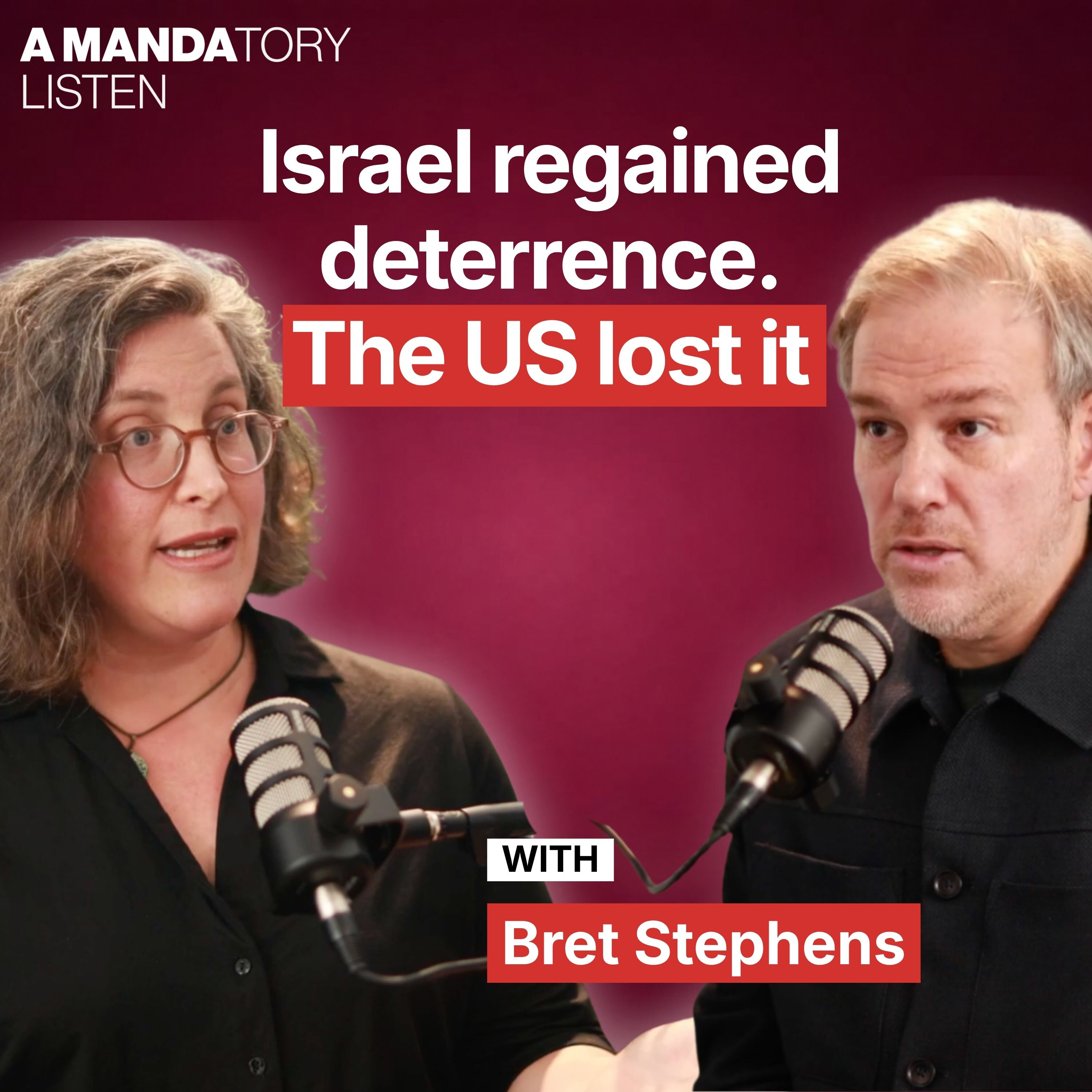
Bret Stephens: Israel regained deterrence. The US lost it
from A Mandatory Listen
46m 23s
The conversation centers on the moral and historical legitimacy of Israel’s war against Hamas following the October 7, 2023, attacks, which Brett Stevens describes as a just and existential defense against annihilation. He contrasts Israel’s reality with the U.S. experience, arguing that Americans lack empathy for the personal, widespread trauma of the Israeli people, unlike their reaction to 9/11. Stevens critiques Western media and political discourse for failing to recognize the scale and urgency of Israel’s threat, emphasizing that the world now faces a growing axis of authoritarian powers that could target democracies like Estonia or Taiwan. He notes that while Iran’s nuclear ambitions have been slowed, the U.S. has weakened its military resolve and deterrent, leading to a dangerous lack of strategic consistency. The discussion also highlights the importance of Jewish self-organization and resilience, with Brett’s *Superior Journal* serving as a platform for thoughtful, action-oriented ideas about a thriving Jewish future. Ultimately, the conversation calls for higher standards of judgment in warfare—aligning Israel’s actions with the historical precedent of protecting nations in existential danger—and urges a shift from victimhood to agency in shaping a more secure and resilient future for Israel and the global Jewish community.
This is a just war. It is absolutely a just war against enemies that were intent on your annihilation
and the murder of your parents and your siblings and your children. And I have no doubt about that.
What's so ever? And this is where I differ from a lot of other commentators in the United. This
was not a war of choice. This was not a war that Israel started. It was not a war that Israel picked.
It was a war that was inflicted on the people of Israel in the cruelest war imaginable.
Welcome to a mandatory visit. I'm your host Amanda Borschelle Dan, deputy editor at the Times of
Israel. Today I'm joined in our Jerusalem studio by Brett Stevens, opinion columnist at the New York
Times. And the editor of the superior magazine, Brett, thank you so much for joining me today.
It's a pleasure to be with you. It is such a pleasure always. I don't know if regular listeners
know, but Brett is my mentor. He took a chance on me and basically brought me to where I am today.
So Brett always a pleasure to see you. That is overstating things, but it's great to see you again.
It's a good headline at least, right? Yeah, yeah, for sure. We are here unfortunately on a very
10th day as we have so many here in Israel. Events are still unfolding, but we're recording a little
early and today on a fly Dubai plane from Dubai to Tel Aviv, the plane was rerouted suddenly to Saudi
Arabia. Again, events are still unfolding, but there are many indications that there was an attempt
to crash the plane on September 11. And you recently wrote a column about September 11 in the New
York Times. I want to add in loop in October 7, 2023, which we are marking this week. And Brett,
I mean, all of Israel is just in mourning this week. Of course, for those that we've lost,
and those who are injured are with us and just trying to live their lives, but it's just appalling
to me that again and again and again, we're seeing this utter clash of civilizations play out
in front of our eyes. Well, that's true. First of all, thank God, thank God, thank God, 160 odd people
were saved through what appears to be the heroism of passengers on the plane. We're just talking
in the immediate aftermath of that. So the details are going to unfold. I've been thinking about
both anniversaries. I was in Jerusalem on September 11, 2001. I just flown in to interview ex-prime
minister Benjamin Netanyahu, who was then in kind of out of sorts. Eric Sharon was the prime
of the prime minister. He wouldn't come back into power for another eight years. That interview
was cancelled for obvious events. I had been in New York just a few days before flying into
into Israel. And it actually wanted to take an out of town guest to the to the windows on the
world restaurant on the hundred seventh floor of the South Tower, just narrowly missed the last
elevator. And I remember telling my friend next time, they're one there wouldn't be one. But I've
been reflecting a great deal on on both anniversaries. In fact, a few weeks ago, it was just down in
in lower Manhattan and taking in the transformation of lower Manhattan from the pit and the disaster
zone, the ground zero that had been in the aftermath of the attacks to what it is today, which is a
really glorious thriving living neighborhood where immensely complex construction projects
have come together or are coming together in a remarkable way that makes it makes the place
actually much nicer than it was before 9/11. I used to work in that neighborhood before then.
And what I realized when I was down there is that actually we succeeded. The world succeeded.
There has not been another 9/11. Touch what it could that can always change from one day to the next.
But we've never seen anything in the United States on that on on such a scale. Whatever it was,
all the measures that we took internationally as well as domestically have prevented something
that was widely expected to recur many times over in in the wake of that attack. Now coming to
October 7, I am well aware of the heartbreak that the anniversary inevitably evokes among Israelis,
I share it. And I'm also well aware that this feels like a story without end. Here here we are
three years, unresolved conflicts north, south, east, further south, and of course with with
the situation in the air just earlier today. On the other hand, maybe Amanda a little bit of
outside perspective is useful to the Israeli listener on an anniversary like this.
Ten years ago, it would have been unimaginable that there would be a commercial flight,
a regularly scheduled commercial flight between the Emirates and Israel. Ten years ago,
it would have been unimaginable that 160 odd Israelis would end up landing in Saudi Arabia and then
being safely put put on their way. Ten years ago, the end of the Bashar Assad regime was unimaginable.
Ten years ago, the decimation of his Bola and Hamas were unimaginable. And the destruction
of much of course not all of Iran's nuclear programs. And I do think that that perspective
is worth keeping in mind even while we are realistic and mindful of the scale of the challenges
that the country continues to face. It is evident to you perhaps because you have a very zoomed
out view of what's happening with Hamas and Khazbullah that they've been basically what did you
say defeated? Decimated. Decimated. They're not the defeated. And I'm not sure they're ever going
to be defeated because that is work that only can happen in Lebanon, in Gaza, perhaps in the
Muslim world itself to say that this brand of Islam, this kind of nihilistic annihilationist
brand, should have no place in the religion or the civilization. And I think that's not something
that is in Israel's hands or America's hands to accomplish. That's work that has to be done
from within. But I would say as an Israeli, I'm less optimistic that they've been decimated
because of one front that you didn't mention in all the other existential threats that we have.
And that's the front of the public opinion in me sitting here in Israel. Well, I were building to that.
But sitting here in Israel, I just look out and especially, I mean, most recently,
there's the outcry over the, we'll call it documentary film, "Naza," collateral damage.
And all the allegations against Israel completely unchecked, unverified, perhaps unfounded,
I hope unfounded, but that Hamas in so many ways has won the war in Gaza just because it appears
to me sitting here in Israel that the whole world has turned its back against us even a large swath
of the United States. So, yes, but I just wrote the forward to the reissue of Saul Bellow's 1976
book to Jerusalem and back. That was the year Bellow won the Nobel Prize in literature,
greatest Jewish American novelist of the 20th century, maybe of all time. And he came in that year
to visit Israel spend some time in Jerusalem traveling around the country, talking to people,
everyone from then Prime Minister Rabin and Minister Paris to, you know, people on,
keep it seem, you know, all over society and he wrote this kind of short and book about his
experience, impressionistic, journalistic. But one of the things he's writing about is, well,
you know, the left has turned very hard against Israel and the Israeli government is doing nothing
to persuade public opinion that they face existential crises and Israel's neighbors are bent on its
utter annihilation with, in the most, using the most extraordinary invective. You kind of read
in, you're like, huh, and these were supposed to be the good old days. I mean, we look at the past
with rose tinted glasses and I would remind you, you know, when you and I first met, when I became
editor of the Jerusalem post in 2002, I remember very well the Janine, not massacre, the genocide in
Janine. That was a serious allegation. An endless series of European intellectuals, Nobel prize winners,
Jose Saramago, people like that visiting Ramallah, talking about, you know, the Israeli war crimes.
And again, even then the word genocide was being freely bandied about, it's actually less different
then I think we
we might suppose from the perspective of the present.
I mean, it is true that the Democratic Party seems to be taking a very hard turn against
Israel.
And even normally pro-Israel Democrats are on the defensive or they're trying to, you
know, couch their language or at least be vehemently anti Netanyahu, which is their right,
of course. And that's something that's different. On the other hand, in 2015, I wrote a column
for the Wall Street Journal. I think the title of it was "The Democrats are becoming
an anti-Israel party." So the country has been here before, and ultimately the goal for
Israel is not to win. I mean, let me put it this way. Would you rather have won the
battle for public opinion and lost the war or vice versa? If that's the choice, I would
say that Israel was better off losing the battle for public opinion. Now, you might
say, "Well, you could have done both." I think that's a very hard proposition given
all of the headwinds that the country has faced, not just for the last few years, for
the last 70 odd years. And it's particularly difficult in an age of social media, which
always favors mass over quality, right? Social media is a numbers game. If someone puts
out an anti-Israel tweet, right? And it gets a million likes because the person is mackle
more or someone like that. You know, Israel is a small country. The Jewish people are
a small people. We're not going to win that particular battle. What the country can do
is not bid for the world's love, but it can demand the world's respect. And I think that's
very important. You know, love without respect isn't going to last. But sometimes respect
actually builds into something approaching love. You mentioned the word genocide. And of
course, we all remember the film "Genean-Genean." I don't think it got a 25-minute ovation,
standing ovation at any festival that I played at. And so it seems to me that the volume
has just increased. It's hard, but who cares? I'm sorry. The Venice Biennale, all right?
So you've got, like, left-wing art people who want to ban Israel, but don't want to
ban China, you know, or any number of other countries that are that infinitely worse human
rights abusers. You know, look, I would say I haven't seen the film "Naza." At the times
of Israel had an excellent kind of look at its, the holes in its journalism. I'll see
the film for myself. But at a minimum, say, listen, this film was made by Israeli filmmakers.
And of course, they've done something very unpopular, and they're getting metaphorical
brick bats, but they're not getting their heads bashed in. And they're back in the country.
And the film is being discussed. Imagine if there had been an equivalent to "Naza" on
the Palestinian side. What would happen to those filmmakers? Imagine if something had
been done on the equivalent side with our great NATO ally Turkey. What would be the fate
of those filmmakers? It is the best argument about "Naza" is to say, you know, yes, we're
a free society. There are people who hold these views. They're wrong and hear the reasons
for it. It would help if someone were to explain, no, this is someone beyond just the efforts
of the times of Israel. Why, in fact, it's an error. Again, I'm withholding judgment until
I see the film, although I would enter with a skeptical mind. Right. We are, in a way,
very much a minority in the world. I feel like we at the time of Israel, Jews in general
as Israelis, etc., but we at the times of Israel, when we're trying to conduct fair-minded
journalism, and you're that is not helping us very much in trying to do that. And I would
say so many Jews that I'm in touch with have stopped reading The New York Times because
of its so-called slanted journalism. Your column is an outlier. Everyone knows that you
are kind of a unicorn at The New York Times. The gray lady is not offering much gray. It
often feels very black or white and more on the side of the black than the white in many
ways. Do you have any thoughts about how it is to be this critical, but pro-Israel voice
there?
You know, I've never gotten that question before. I'm sure you have not, Brad.
Look, let me, let me, let me answer it in a way that the people listening to this podcast
I think will appreciate. The New York Times without a doubt is the most important newspaper
in the world. It is a great journalistic institution. And it has always had a clarion pro-Israel
voice on its editorial pages, whether it was Abrose and Thal or Bill Sapphire going back
to at least 50 years or so. So my question to the people listening to this and in your
novel comments I get is would you like me to be at the Times or not? Would you like my
voice in that newspaper or not? And what does it say of the newspaper that it showcases
my views? I think it says something about the newspaper. So I'm not going to get into
an argument about this column, that piece. I'm not going to, there's no universe in which
I'm going to badmouth my employer in public. But I think it's a huge plot to the paper
that they have stood by my writing. I've been there now for nearly 10 years. They have
provided me with an opportunity to share a view which is not consonant with a view of
most of the readers or maybe most of the readers of the Times.
Is it though, I don't know, how do you judge that? It's hard to say. Is it the staff or
is it the readers? I have no idea. I really don't know. I sometimes read the comments
on my columns and I'm like, gosh, it seems like every reader of the Times is really hostile.
Then I have to remember that people who bother to comment on the comment section are usually
people have a lot of time on their hands, shall we say, and are maybe not representative
of the typical intelligent educated reader of the Times who I suspect hold nuanced views
on many subjects.
One question that I think many people have is also what's happening in the Republican Party.
We just talked about how the Democratic Party, for at least 10 years, is inching more towards
anti-Israel. In this Trump era, the Jews of the world have had a ambivalent relationship
with the US president, Donald Trump. Of course, as an Israeli, I say, of course, the
Golan Heights should be recognized. As an Israeli, I say, of course, the embassy of the
United States should be in the capital of Israel, Jerusalem, things of that nature. I suspect
that the Jews of the United States are really caught in this dilemma right now when we have
people such as New York mayors or on Mamdani who is overtly anti-Islianist on the one side.
Then we have the US president, Donald Trump, never know what you're going to get there,
who knows who his friends are and who those who his enemies are. It could change. Then
we have the next generation after him because there will be one. Where do you see the face
of the GOP in terms of Israel? As the physicist Niels Bohr repeatedly said,
"Prediction is very difficult, especially about the future."
Look, my view on Trump is that when he does things I agree with, I say so. When he does
things I don't agree with, I say so as well. That's been my steady conviction to call
them as I see them. I think on the subject of Israel, in many respects, he's done absolutely
the right thing. I commend him. There are many other things that don't commend him
to me. I never voted for him in any election. I think it's normal for Jews, American Jews,
as citizens of the Republic, to vote on a whole range of issues. If Israel were their
only subject, they would move as you did as a younger person to Israel. That would be
the only subject. I don't castigate Jews who don't support him in spite of his support
for Israel. I don't castigate Jews who support him precisely because of his support for Israel.
Those are their things. Now, to the question of the Republican Party, I think actually the
pro-Israel strain in the party is much deeper and stronger than I had feared it might be
six months ago. What you're seeing now with someone like Tucker Carlson, Tucker isn't
bringing the Republicans along with him. He's actually leaving the Republican Party. The
guy is practically campaigning for Abdul Al-Sahed, the Senate candidate in Michigan. The Democratic
candidate in Michigan.
You know, he's, and speaking up sort of openly against the Trump administration,
interestingly, Tucker's one issue seems to be Israel.
You know, when you get obsessive about a subject like that, it raises, raises eyebrows.
But Tucker is on his way out of the party and Tom Massey, you know, of Kentucky,
openly anti-Semitic in my view, his comments when he lost his primary.
So they're going to leave the party and there's, there's always been that straight.
Look, there's always been more anti-Semitism under the surface.
Then it's typically visible through comments, you know, I could feel it years ago.
When I was starting out in journalism, there was this habit of always holding Jews and the Jewish state
to a completely different standard than any other people or any other state.
And that that's the, the double standard is the essence of, of, of the anti-Semitic thought pattern.
That's been there for a long time.
I think a lot of us just didn't notice it.
I was, if I may say, I was yelling from the rooftop on this subject long before anti-Semitism became
sort of a governing concern of the Jewish community.
That being said, and I talked about this when I gave a speech earlier this year at the 92nd Street,
why? If the Jewish people make anti-Semitism, the core of who we are and what we care about
and what we talk about, we're really lost, right?
Anti-Semitism is a problem for anti-Semites to solve, and it's ultimately going to be a problem
that hurts them more than it hurts Jews.
It has always been the case, always been the case that when societies turn on their Jews,
the Jews, however much they may suffer, eventually escape, emerge and thrive, and the societies
that persecute them decline and, and sometimes even collapse, okay?
That's just, that's, I'm not, that's not an opinion.
That is a summary of historical facts, right?
Where is Spain today as a great empire?
Where is Germany today as a, as a global colossus?
Where is the Arab world?
How is Iraq doing without its Jews?
What about Egypt without its Jews?
You know, go down the list and the pattern repeats itself.
So the anti-Semites can solve their problems.
The question for the Jewish people is how do you go about both in the diaspora and in Israel,
organizing and preparing and creating the possibility of Jewish thriving?
Not just thriving at the level of the individual Jews, you know,
who are doing well in one business or another, right?
But as a community, how does Judaism become a centering fact in the lives of Jews,
not only Orthodox ones, but relatively secular ones?
How do Jews, especially in the United States, say to themselves, and I'm borrowing this thought
from the great Dara Horn?
How do they say to themselves that what makes them Jews isn't whether their grandparents were Jewish,
but whether their grandchildren are going to be Jewish?
Those are the important questions.
And so I've been trying to dissuade other American Jews from trying to pour and vast resources
into the so-called fight against anti-Semitism, because I think it's probably a lost battle, right?
And it's a waste of ultimately limited resources.
Let's go to the show, Greg.
A magazine says who counts as "South West Asian."
Somehow, Israelis don't make the list, but a mayoral candidate born in Uganda does.
On unpacking Israeli history, host Norm Weisman digs into the New York magazine cover story
that splits Jewish media into and finds something eerily familiar that underlies it.
He traces the same rhetorical move across 60 years, 1968 Poland, where the government insisted
it wasn't targeting Jews, just designers.
Right before half the country's remaining Jewish population fled, same claim, same playbook, different century.
Listen to unpacking Israeli history, wherever you get your podcasts.
Three years after October 7th, Israelis and Jews around the world are still grappling with a difficult question.
What happens when a national trauma becomes part of a people's identity?
On the latest episode of "Identity Crisis," host Yehuda Kertzer is joined by author and journalist Yossi Klein-Holevi
for a candid and deeply personal conversation about the forces shaping Israel today and for the future.
Together, they explore how October 7th has reshaped the Israeli psyche, the tension between victimhood and agency,
the dangers of rage and self-pity, and whether Israel can find a path toward healing and renewal,
while the wounds of the past three years remain open.
Listen to Yossi Klein-Holevi on "Identity Crisis," a podcast from the Schaum-Harmann Institute, wherever you get your podcasts.
And we're back. I'm Amanda Bursch, I was done, and we're listening to "Amandatory Listen."
Today's guest is Brett Stevens of "The New York Times."
And "Sapir Journal." Brett, I would like to quote, kind of quote, a little bit of Bible to you.
And this is something that is read during Sukkot, we are recording at the very end of the Sukkot holiday.
And it's from the book of Kohelet, as we say in Hebrew or Ecclesiastes, for every season, turn, turn, turn, right.
And so, of course, this was--
I wasn't around like you in the 1960s.
Oh, excuse me, I believe you are a tad bit older than I am.
In that case, so a time to be born, a time to die, a time to dance, a time to mourn.
But there's also a line that I think modern Western culture has the hardest time accepting.
And it's a time for war and a time for peace.
Yeah.
And coincidentally, during the Sukkot holiday, we had, under Arsuka, a couple priests who brought with them--
you're at my wedding, you remember how priest thing is?
Yeah, so one of these priests came with seven of his seminarians and we decided to talk about the book of Ecclesiastes.
And I said, I asked the group, is there ever a time for war?
Can you imagine that there's a time for war?
And the main priest, Francesco, a lovely person said, there's never a moment for a just war.
Never can be.
Only in the case in which you're defending a child or an elderly person.
That is the only case for picking up arms against somebody or hitting somebody.
And I think the Western civilization, or the greater Western mentality, kind of has adopted this in many ways.
And we here in Israel understand the book of Kohelet with every fiber of our being.
And so following October 7, 2023, when Israel went to war, until today, most Israelis understand that this was a just war.
But in--
This is a just war.
OK, you say.
This is a just war.
And I have no doubt about that whatsoever, and this is where I differ from a lot of other commentators in the United States.
It was a war that was inflicted on the people of Israel in the cruelest way imaginable.
You know, I wrote a column about this.
America hasn't fought a truly existential war for a very long time.
I mean, you might say since the Second World War, though, Bracket the Cold War in a different space.
And so, you know, we fought in Korea.
We fought in Vietnam.
We fought in Iraq and Afghanistan, and each time, at least in the case of Vietnam, Korea, of Vietnam, Afghanistan and Iraq, we said,
"Oh, we don't care. We're bored. We're out of here."
In fact, the news from today, the other news of today's United States is finally withdrawn all its forces from Iraq.
Which was planned several years ago.
But the United States sort of shrugged its shoulders, said, "Uh, whatever," and that was that.
So Americans don't really remember what it means to fight for your existence, in the way that Israel is being forced to fight for its existence on a daily basis.
But if you know your history, you know how the United States acted in existential wars.
You know, Ulysses Grant, whose we honor on the $50 bill, there's a beautiful memorial to him up near Columbia University.
You know how he won the Battle of Vicksburg?
Great Union victory, helped put the Confederacy on the road to defeat.
He starved the garrison of Vicksburg.
He starved the town of Vicksburg.
I'm not endorsing that, but I'm not seeing retrospectives on Grant calling him a war criminal, right?
Or much less on Abraham Lincoln for ultimately being the commander-in-chief that endorsed that policy.
When American bombers took to the skies to bomb German cities, the damage to civilian life, not just in Germany, by the way, in Holland, in France, among
innocent civilians was appalling.
Look at pictures of Berlin in 1945.
Somehow, I must have missed the op-ed
that said Franklin Roosevelt was the greatest war criminal
in American history,
or that Harry Truman is guilty of genocide.
Well, maybe in the case of the atom bomb,
that case is sometimes made, right?
But it's sort of on the fringes.
But when America was losing,
taking 7,000 casualties a week in the Pacific
in 1945 after the defeat of Nazi Germany,
there was no doubt in the minds of the overwhelming majority
of Americans that the best course was to fight
and conclusively win the war.
So when Americans now find themselves judging Israel
and asking whether you should be dropping a 1,000-pound bomb,
a 500-pound bomb, 2,000-pound munition,
what I would simply retort is say,
well, how did the United States act in the Second World War?
And if you're willing to acquit American
and other allied leaders, British leaders,
for their behavior in World War II,
because they were intent on the destruction of the Nazi regime,
judge Israel according to the same standard.
By all means, if there are intentional killings
of civilians without military justification,
those are war crimes, and they need to be judged accordingly.
And they happen, by the way, in every single war.
The Allies committed war crimes against the Japanese
and the Germans and other members of the Axis group.
But at least judge Israel by the same standard
because Israel's also fighting an existential war.
If Israel loses this war, right?
There is no more Israel.
That's the simple reality.
Israel's enemies aren't fighting for its defeat.
They're fighting for its annihilation.
And that point seems not to have been sufficiently driven home,
I think, in the minds of most Americans.
After October 7th, I would tell my American friends,
you have to understand that on 9/11,
I used to work across the street from the World Trade Center.
Across the street, I worked in the World Financial Center.
I don't know a single person who's killed on 9/11, not one.
I would say the percentage of Americans who know someone,
who died that day, is very small.
I think the number of Israelis who know, at first,
and someone who was killed, or raped, or injured,
or kidnapped, on October 7th,
is probably close to every person in the country.
So the order of magnitude of October 7th,
given Israel's small size, is several orders of magnitude
greater than what happened on 9/11.
If you as an American remember being shocked to your core
by the attacks of 9/11,
imagine how it must feel for Israelis,
where it's not just an abstraction,
something you're watching on television
in a city you might or might not have ever visited.
But it's a cousin who's living right on the Gaza envelope.
Or it's another cousin who's been forced out of their home
in Kirchman or somewhere in the north.
I think there's such a complete failure
of empathetic imagination on the part of so much
of the Western intellectual or media establishment
to understand the trauma of October 7th.
And it's a real failing in the West.
It's a particular failing, I might add,
because we are now sliding, slouching, if you will,
to use Yates's term to a world in which something very similar
could happen in Estonia or in Taiwan.
Other countries threatened by the axis
of authoritarians comprising Tehran, Moscow, Beijing,
and Pyongyang.
And what Israel is serving as, ought to be serving as,
is as a role model of a small democracy
that is able to organize for the security of its people
and the honor of the country and the Jewish people it represents.
It should be German leaders, Czech leaders, Polish leaders,
should not be looking down their noses at Israel
and judging of what happened in this engagement
and that engagement, they should be thinking every single moment
of every single day, we may be find ourselves
in precisely the same existential situation
that Israel's been in and the only other analog
that Ukraine's been in for the past several years.
How are we going to organize ourselves
so that we don't have to face the same existential challenges
that those two countries do?
A couple of comments and questions based on what you just said.
So you were talking about how Americans don't make comments
about World War II and all the so-called crimes
against humanity that the U.S. would now be judged on.
But let's talk about the Iran war.
And when we last spoke, it was just at the beginning
of the Iran dual war where Israel was a firm partner
in the war with the United States.
And at that point, we were talking about it
in kind of terms as preventative medicine,
meaning if there's stage two cancer, you treat it right then
before it gets to be stage four, we use these terms.
And it didn't go very well.
And the American people did not support it, do not support it.
And it does appear to me that in many ways,
the American people are judging this war, for example,
the Iran war in the same terminology
that they're judging Israel's actions in Gaza.
Maybe not genocide, but of course, the issue of the failed bombing
on a school that started out the war.
All of these themes keep coming up over and over again.
And it is a big cloud over this quote unquote preventative
medicine.
Yeah, well, the main problem with the war in Iran
is that Trump more or less ended it after six or so weeks.
People say we've been in a seven-month war.
That's not true.
We had six weeks of really an active war
and then a kind of series of skirmishes since then,
at most, and sometimes long stretches
in which there was no conflict at all.
So we gave the Iranian--
the new Iranian leadership, the confidence
that they could outlast us because their view
is you can always outlast the Americans.
They get bored after a while.
And they also have those democratic elections.
But let me ask you, where would we be?
So right now, I think energy is now
being shipped out of the straight of hormones
in significant quantities.
I think it's at 72%.
It's a pre-war level.
And I think some of that is due to our blockade of--
America's blockade of Iranian ports.
Imagine where we would be in another scenario
in which Iran continued to build up its vast array
of ballistic missiles.
And then race towards a nuclear bomb.
Remember, we thought there were two weeks away
from having at least enough enriched material
for a nuclear bomb, maybe some more time
to actually creating a nuclear bomb.
So imagine if, in an alternative universe,
Operation-- what was it called?
Rising Lion in 2025, it never happened,
and hadn't been followed up by the war epic fury,
or epic whatever it's called, in 2026.
And Iran had an arsenal of tens of thousands of missiles,
a nuclear device, and then had decided
to close the straight of hormones.
The world would have been powerless against it, powerless.
And this is not some far-flung make-believe scenario.
I know it's a counterfactual, but that's
where things would have stood if those two wars hadn't happened.
Now I'm sorry that the United States and Israel
didn't continue striking Iran and break the regime again
and again, right? It just-- they got cold feet.
Oil rose 15% above its rolling 25-year average.
And Trump kind of freaked out and thought, well,
they're going to collapse at some point.
But we are nonetheless in a better place today
than we were a year and a half ago.
At least because we have substantially diminished
what Iran is capable of doing.
Again, go back to October 6, 2023.
When everything seemed fine, right,
that was the happy world of before.
But it was a happy world, not because it was actually happy,
but because of things-- because you were not aware
of where things actually stood.
You were not really aware of just what a menace Hamas was,
how much staying power it was going to have
in a long-drawn out war.
You were not aware of just how threatening his Bola was
or the kind of capability that Iran possessed.
Now you're aware of it, OK?
You haven't eliminated it, but awareness
is a form of power and knowledge.
And I'd say better know about it than kind of continue--
if you would continue to sleepwalk in this process of feeling
like, you know, Hamas is negotiable,
and they just want a better life for their people.
And his Bola has its internal frictions
with the Lebanese government.
And Bashar Assad seems like he's coming around
and doing whatever he wants.
whatever he's doing, I think it's actually a better place, I would argue, that compared
to what might have happened, if things had just kind of moved on unchecked, maybe knowledge,
if knowledge is power, at least Israelis have a great deal more knowledge.
My one concern about everything you just said, and yes, it's fantastic if indeed Iran--
That's saying it's fantastic.
I don't want to diminish for one second just how serious and somber and difficult it has
been and continues to be, okay?
I'm not here to provide a polyanish gloss on things, but I think that sometimes it is worth
it, and I know this from having lived in Israel, this small country, like a pressure cooker,
to take a step back and ask yourself sort of what is going on in a broader perspective,
and I do think that that offers some light into this gloomy tunnel.
Okay, so I want to take two steps back, and it's fantastic.
If indeed Iran has been delayed, shall we say, in terms of its nuclear program, that I would
call fantastic.
However, I do wonder what it has done for the more zoom out axis, the axis that you just
mentioned, what we've, you know, glibely called the axis of evil, to know that the United
States does not have the guts to last, to actually start a war and end it properly.
Yes.
That's a problem.
A Trump has done a great deal to diminish America's deterrent power.
I mean, one of the interesting facts of the last six months, at least, is that even as
Iran continues to strike Kuwait, other Arab states, Saudi Arabia, uses the two T proxies.
One country, it's not lobbying missiles at, is Israel.
Israel has absolutely reestablished its deterrence vis-a-vis Iran, maybe not with respect to
acts of terrorism like today, but it's just, it's a striking fact that the Iranians know
very well that striking Israel is a line they dare not cross.
Or it's a strategic ploy, meaning let's touch all the neighbors, turn them all against
Israel and the United States, and then finish it up.
Well, look, I'm sure that's their intention, and I don't want to rule out the possibility
that I might try something between now and at least these really elections in late October.
But from where we sit now, and you can only speak about what you know, not what might
happen, Israel has substantially reestablished deterrence, and that's a very good thing for
the country.
The United States, on the other hand, has shown that it's sort of feckless, easily bored,
sex, instantaneous military gratification, if you will.
And when it doesn't get it, walks away, and that's really, that's really worrying.
The way Trump has ultimately managed the war with Iran, right, may be remembered as the
invitation that China needed to invade Taiwan, or maybe Russia vis-a-vis one of the Baltic
states or the vulnerable European states.
The only silver lining, I see only two silver linings here, one of them quite substantial.
One is that the naval blockade that the United States has imposed on Iran, I think, is taking
a very, very punishing toll on Iran's economy, and its ability to function as a state.
Whether that actually cracks the back of the regime or not, it's very difficult to say,
and it really is wounding them seriously.
The second thing is Americans have been alerted to something that we should have known and
kind of did know, I actually wrote about this in December, that we have a massive munitions
shortage, and that in a war, never mind with Iran, in a war with China, we would run out
of critical munitions very, very quickly.
So at least now, you're looking at the administration demanding of Raytheon, whatever it's called
now, and Lockheed Martin, other weapons-makers, vastly greater numbers of patriot missile interceptors,
vastly greater numbers of Tomahawk missiles, everything that we didn't stockpile in sufficient
numbers, because we're finally understanding that the war of the future we may face isn't
going to be a quick 30-day type of clash with an inferior opponent, but could be a year's
long fight with what, you know, strategies called near-peer competitors like China, like
Russia.
Just to close out, Brad, because I've kept you away too long.
I want to turn to your other project, the Superior Journal, and I'd like to hear, what
is your main goal out of this very, it's like a salon in pages, right?
And how are you seeing it affecting the conversation in the United States among the Jewish elite
or intellectuals, or those who like to read at least?
You know, when I started the thing, I joked with the publisher.
I said, you know, if we end up getting more than 5,000 readers, we're failing totally.
He laughed.
We now have about 45,000 readers, which is not a bad thing for a quarterly journal that
publishes fairly lengthy, pretty serious articles.
The subtitle for Superior is ideas for a thriving Jewish future.
And that's what we're trying to offer, not just simply a diagnosis of where things stand
and how terrible it all is, but prescriptions for making things better.
And we tried with each article to have a powerfully prescripted element, what should be done?
From the very beginning, I said, I want to publish people, I want to publish essays with
whom I do not agree, right, because I don't think that all wisdom happens to come from
my neo-conservative perspective or whatever parochial perspective there is.
If you're broadly speaking in the Zionist tent, if you're broadly speaking believe that
Jewish thriving also requires a thriving state of Israel.
If you're in that broad consensus, you are welcome in our pages.
We organize every issue thematically, so it's education, the universities, social justice.
We have a forthcoming issue that's going to be about courage.
And every essay talks about the subject from both, you know, sometimes a theological
perspective, a social perspective, let's say courage in terms of social philanthropy,
or courage in politics, these sorts of issues, martial courage.
And we seem to have just touched a nerve in the Jewish community.
I mean, Jews are thoughtful people who want ideas.
And if every so often, one essay in superior gets read by a person who wants to make a difference.
And that person says, you know what, that's a great idea.
That's a big idea.
That's a $10 million idea, or $100 million idea.
And it sparks a philanthropic effort, large or small, then we're succeeding.
And I think we're succeeding.
I think I'm more on the $18.
Is that okay?
You know, $18 is cool, too.
All right.
$18 is cool.
Brett, such a pleasure.
Thank you so much for joining me here today.
It's an honor to be with you.
Great to see you again, Amanda.
Likewise.
Thanks for listening to Amanda Toy.
Listen.
Please check out another installment next week.
This episode was produced by You Track the Day.
If you have any questions or comments about this or any other episode, please drop us
an email to podcast at timesofisrael.com.
Until next week.
Salon.
Podcast Summary
Key Points:
The war against Hamas on October 7, 2023, is framed as a just and existential conflict, not a choice by Israel, but a response to an intent to annihilate the Israeli people.
Brett Stevens argues that the U.S. lacks historical understanding of what an existential war entails, contrasting Israel’s daily survival with America’s retreat from past conflicts like Vietnam and Iraq.
He emphasizes that Israel’s trauma is far more personal and widespread than 9/11, as nearly every Israeli knows someone directly affected.
Stevens criticizes the Western media and political establishment for failing to grasp the depth of Israeli trauma, and warns of a future where similar threats could strike Estonia, Taiwan, or other democracies.
He highlights that while Iran’s nuclear program has been delayed, the U.S. has weakened its deterrent power, showing a pattern of military hesitation and short-termism.
The *Superior Journal* aims to provide thoughtful, prescriptive ideas for Jewish thriving, encouraging debate beyond despair and promoting action through actionable, diverse perspectives.
A key insight is that anti-Semitism is a problem for anti-Semites, not Jews, and that historical persecution often leads to societal decline, not Jewish failure.
The U.S. and Israel must be judged by the same standard in warfare—especially when facing existential threats—since both are fighting for survival.
Summary:
The conversation centers on the moral and historical legitimacy of Israel’s war against Hamas following the October 7, 2023, attacks, which Brett Stevens describes as a just and existential defense against annihilation. S. experience, arguing that Americans lack empathy for the personal, widespread trauma of the Israeli people, unlike their reaction to 9/11.
Stevens critiques Western media and political discourse for failing to recognize the scale and urgency of Israel’s threat, emphasizing that the world now faces a growing axis of authoritarian powers that could target democracies like Estonia or Taiwan. S. has weakened its military resolve and deterrent, leading to a dangerous lack of strategic consistency.
The discussion also highlights the importance of Jewish self-organization and resilience, with Brett’s *Superior Journal* serving as a platform for thoughtful, action-oriented ideas about a thriving Jewish future. Ultimately, the conversation calls for higher standards of judgment in warfare—aligning Israel’s actions with the historical precedent of protecting nations in existential danger—and urges a shift from victimhood to agency in shaping a more secure and resilient future for Israel and the global Jewish community.
FAQs
Yes, the speaker believes it was a just war because Israel was under an existential threat of annihilation by Hamas, which targeted civilians, including parents, siblings, and children.
The speaker argues that both Israel and the U.S. faced existential threats, and when a nation's survival is at stake, its actions—such as military responses—should be judged by the same standard of necessity and defense, not by modern moral scrutiny.
The speaker notes that while 9/11 affected a small number of Americans personally, nearly every Israeli knows someone who was killed, kidnapped, or injured on October 7, making the trauma far more personal and widespread.
The speaker states that Israel's enemies were not merely seeking victory but were intent on the annihilation of the nation, which makes the war a defensive, just response to an existential threat.
The speaker is concerned that the U.S. has shown a lack of sustained military commitment—such as in the Iran conflict—leading to weakened deterrence and leaving countries like Iran with room to build weapons and threaten global stability.
The speaker warns that global media and political movements often turn against Israel with little regard for its defensive needs, especially when it comes to issues like the film 'Naza,' which lacks balance and could be seen as one-sided.
Chat with AI
Loading...
Pro features
Go deeper with this episode
Unlock creator-grade tools that turn any transcript into show notes and subtitle files.
 PodcastTranscript AI