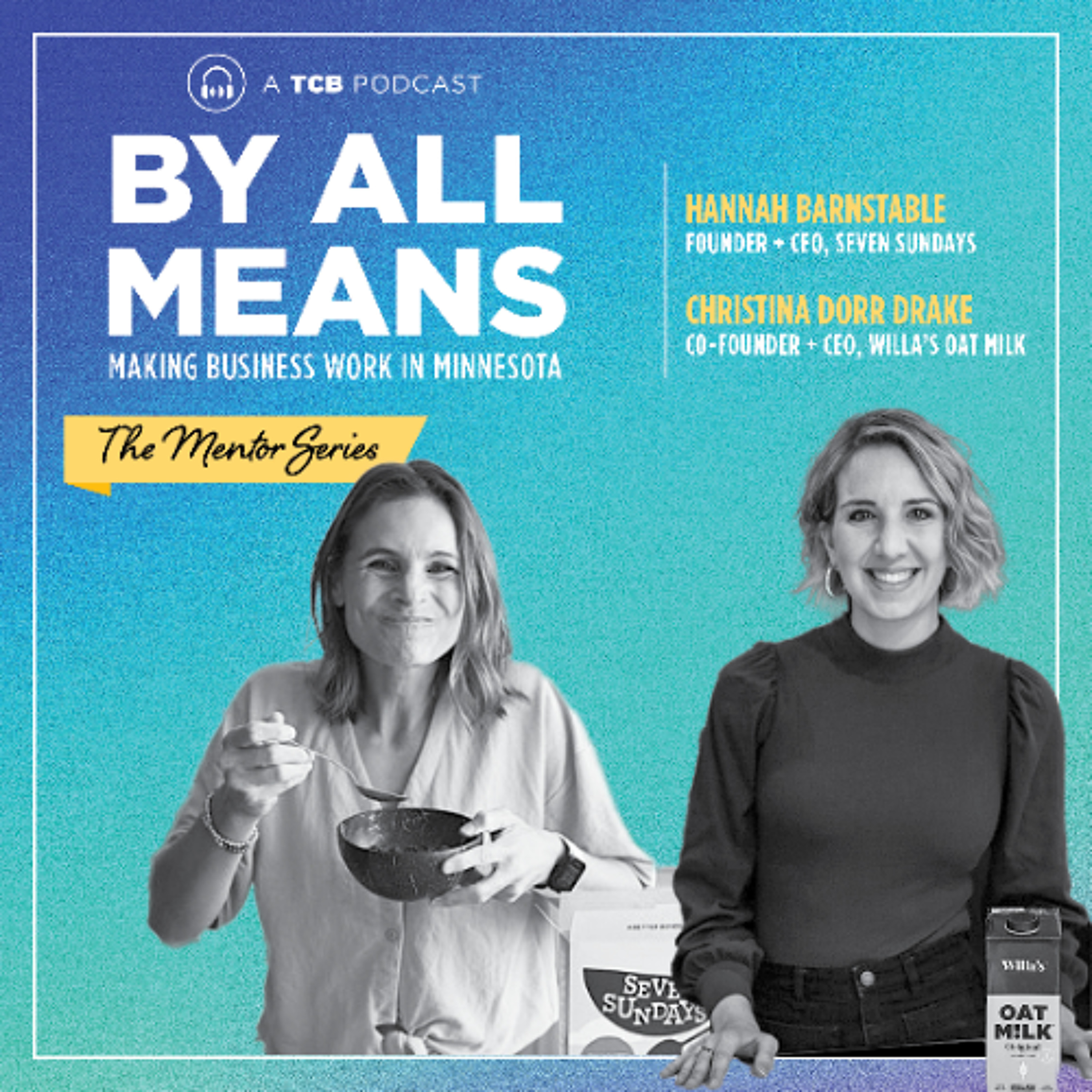
This episode of the Mentor Series pairs Christina Doerr Drake, founder of Willas oat milk, and Hannah Barnstable, founder of Seven Sundays cereal. Both Minnesota-based entrepreneurs share their experiences building purpose-driven brands in competitive food categories. They discuss starting locally in co-ops like Lakewinds and The Wedge, where direct consumer feedback through demos was crucial for refining products. Scaling to national retailers like Target required grit, strategic planning, and leaning on networks of fellow founders for advice on pitfalls and logistics.
The founders highlight the strong Minnesota entrepreneurial community, characterized by humility, pragmatism, and a focus on sustainable margins. They note the importance of storytelling in connecting with consumers, especially as demand grows for transparent, health-focused options. Christina’s brand draws on her grandmother’s oat milk recipe, while Hannah’s cereal blends nostalgia with real ingredients. Both emphasize that success in food and beverage hinges on mission-driven values, adaptability, and the supportive ecosystem unique to Minnesota’s food culture.
Today's episode is made possible with support from the law firm of Best Inflanagan, a team dedicated to building uniquely close relationships with all clients including individuals, businesses, nonprofits, and generations of family members seeking legal advice. Online at bestlaw.com. Best Inflanagan, celebrating 100 years as lawyers you know. Biol Means is sponsored by the College of St. Benedict and St. John's University. Two colleges creating exceptional experiences in the classroom and around the globe. At St. Ben's and St. John's graduates discover pathways to lives of purpose. They leave prepared for their next opportunity and inspired to build a better world. Learn more at cspsju.edu and stick around for office hours with St. Ben's and St. John's later in the show. Yeah, I'm often in sales meetings with Costco or you know whomever and I find myself like pitching other brands by accident. I love this space and I think that there's so many wonderful stories behind brands like Willas and to me it just you know when I'm sitting around the table and we have three kids. I like feeling I feel really good you know when I'm serving products that I feel good about I trust the founder and their story and how they've built the brand. From Twin Cities Business this is Biol Means a show about innovation, drive and the leaders who make business work in Minnesota. I'm Allison Caponeer host and editor in chief of Twin Cities Business and this is the Mentor Series where we pair an accomplished business leader with a founder in growth mode for advice, connection and ideas. Here it is. Biol Means the Mentor Series. Plant-based milk is a category that's exploded in recent years and already has some clear leaders but that isn't stopping Willas oat milk from carving out space of its own. Now add a thousand stores across the country and with a fast growing lunch size product for kids. Christina Doerr Drake grew up drinking oat milk made by her grandma Willa. Christina was a marketer who saw the opportunity for a better tasting product made with zero food waste. She's a graduate of St. Thomas who grew up in the Twin Cities so I've been eager to talk to Christina and when I asked if there's another entrepreneur she might want to join us on Biol Means the Mentor Series she was quick to name another Minnesota founder Hannah Barnstable of seven Sundays. The cereal brand now sold in more than 20,000 stores including Costco, Walmart and Target. The parallels are uncanny. Two women founders who had worked in business before feeling the call to start a purpose driven brand in categories dominated by larger corporate players. Both work with their husbands and siblings both triumphed over a cancer scare and both speak to the importance of having a network to lean on. The mentorship goes both ways. And besides what goes better together than cereal and milk for starters. How did the two of you meet? Well, thank you for for having us. This is so much fun. I can't remember exactly how we met. I couldn't find like an introduction email but all of the founders and the food and beverage world really help each other. Hannah has been so generous with her insight and advice. Same with her husband Brady. And yeah, I just feel really fortunate to be a part of a community like this and especially when a Minnesota where everybody is so supportive and got friends like Hannah now, you know that I never would have met otherwise. Right. I wish I yeah, I wish I could help but I agree. I think we were originally connected. My hunch is somebody from Minnesota a co-op or somebody within the tight Minnesota food network said you to need to meet your both from Minnesota. You're both at the same place in your business journey. And that's, you know, such a classic Minnesota thing we stick together. Totally. And I think I think for us it was like very early in our journey pre-launch and Brady was so helpful. I think I had all kinds of questions about getting the D to C side of things set up post pandemic because we had to. And I don't think I'll ever forget those early conversations. Yeah. Is it a food thing or is it a Minnesota thing? I mean, both of you have had experiences in and out of the state. How would you describe that Minnesota entrepreneurial connection? I think it was I would say that it's both I think there is something special about Minnesota entrepreneurs. I tend to find that we are humble mission driven, you know, kind of not out there for like I'm going to build this for three years and turn around and sell it like we tend to have more grit as far as how we start companies like that Midwest Minnesota grit. And do you think there's a fair amount of Minnesota just a Nate connection that is a true part of it. And then I think obviously within our category of food and beverage then that bond is even stronger because it is an interesting category and I'm sure we'll talk a lot about the challenges. You know, around building a food and beverage business indeed. I think to build on that I think sometimes we forget what an amazing food culture we have in the Twin Cities, you know, Michelin star chef Dan Barbour is one of our earliest advisors. He was an advisor to President Obama. He visited the food building in Northeast when it first opened and saw how they were doing grain milling the way it was done over a hundred years ago. He was like, this is what I've been working on building at Blue Hill, which is, you know, internationally recognized as leading the charge on so many aspects of the food system. And I think sometimes our humility almost makes us not even notice how ahead of the curve a lot of the businesses and brands and regenerative organic farmers and all of that are in the Twin Cities. And then I think also building on what Hannah said, there's a real pragmatism. I even say to investors sometimes like in our early days, we, you know, we went and flew out to the Bay area and we raised money, you know, we've raised money with investors all across the US. Oh, wonderful people. But I think maybe growing up just middle class in the Midwest gave us an appreciation for margins and making sure we make money. And in the times of the grow at all cost times, you know, which wasn't so long ago, a few years ago, I think it never quite made sense to us to sell products that were completely in the red where we would just be losing more and more and more business. More and more and more money, I should say. And I do sort of feel like that's there's an element to where we came from that that isn't transit to that. And I think Christine, I know you're, you're a graduate of of Opus at St. Thomas and you grew up in Minnesota, right? So, but you're in, you're in New York now. Do you still identify as a Minnesota entrepreneur? Both. And honestly, if you look at Willis cartons, we have the St. Paul, Minnesota and the Brooklyn, New York addresses, because we really have two headquarters. Most of our team is in Minnesota, my sister and co-founder lives in Excelsior. My husband and I have been living in Brooklyn for, you know, over a decade, but we're back and forth, back and forth all of the time. And our first stores that took a chance on a very new brand were, you know, Lake Winds, the wedge. And so, yeah, I just have so much gratitude for the community in the Twin Cities. And Hannah, what about you? I mean, you spent some time, you were in New York as well at one point, weren't you? Yeah, my life pre seven Sundays was in the finance space. So kind of an odd entrepreneurial track. So I did spend some time in both Chicago and New York. And I think that was important for my entrepreneurial endeavors for a variety of reasons. But yeah, when I decided to leave that career to shake up the cereal aisle, it was pretty clear that I wanted to do it in Minnesota. I grew up in Minnesota. I am. I often use the phrase like, you know, I'm just so minisoten. Like I love the winter. I love to cross country ski. I can handle about one month of summer and then I'm, I'm ready for the heat and humidity to go away. So yeah, the roots here are strong. And just like Christina, our food community with our co-ops is so unique in the Twin Cities. And we started exactly the same way as you in the wedge co-op. And Lake Winds, it's much easier to work with those partners than going straight to Target or Costco, right? So we're really lucky in the Twin Cities. And it is a wonderful place to start a food and beverage company. We do have such an incredible grocery culture and co-op culture here. I'm curious though, Hannah, it's such a big leap to go from the co-ops where maybe you're talking to the people in charge directly to the targets and and bigger grocery stores. What was that transition like for you? And how did that co-op chapter help you prepare? Sure. You know, the reality is food is relatively straightforward food and beverage. I mean, probably like you guys, you're, you're buying your food and beverage from a variety of different places. So on the one hand, they do sort of all operate the same. Like you're going to show up on a shelf at Target, you're going to show up on a shelf at Lake Winds co-op. It's from the consumer standpoint, you know, it's access. So there's not, you know, from that standpoint, it's not like a entirely different business model or product structure or anything. But the leap is really about making sure the consumer is ready. I would say more than anything. And so you have to learn a lot. And we spent eight, I always say eight years. We've been around for 14 years and eight of those years, I would say we were just learning and like trying to understand our consumer and a lot of that work was done at the co-op level. It's much easier to learn there. You can go in and actually do demos where you're like, you know, I don't even know how many hundreds of demos I've done over the years where I'm just listening and letting people know.
try the product and taking that feedback back to the kitchen, more back to our packaging designer to make updates. So the leap is really more about like getting your product, you know, taking your product on that journey and your brand on that journey to get it into a place where you feel like, wow, I can confidently go into 1800 target stores across the country and there'll be some recognition. I know that the product has staying power, that it's resonating with an incremental consumer there. So it was not a, you know, it's not a short, quick hop. It's definitely a journey is how I would describe that. Right. Christine, it's been a little faster for you. I mean, you started Willas in 2021. We launched in 2021. I don't know if it's been faster. To be honest, I feel like I'm never going fast enough, although I think all of us founders probably feel that we had a lot of time where we were learning too. We just expanded and launched with target in the last year. And so perhaps my memories are just so fresh because it's like what I'm, what, you know, I'm scaling up into 650 target doors with our new kids products. We've been expanding with the leaders. And as Hannah said, it's, it's not like a totally different game. It's like either way, this is real estate and you have to prove your worth on the shelf, whether you're in liquids or the wedge or on a target shelf. But the way you do it is different. The resources available to you on a marketing side are different. And then I think the, some of the best marketing research you can do is doing demos as Hannah said in those are that's what you can do in a co-op. And you can really, if you're a natural brand, a purpose driven brand like the co-ops, you know that the people shopping there are, are your people. So you're getting that kind of like super targeted insight, which is invaluable. But it's such a larger scale. And I would, I mean, the manufacturing, the logistics, the marketing to stand out on a much bigger set of shelves. Hannah, what advice do you give other startup food brands trying to make sure that a target launch is a success? Well, from strictly executing, like, you know, obviously a lot of things have to happen before you get that acceptance on the shelf. You have to show your sales data is really strong and other retailers. You have to convince them that, you know, your real, the real estate's worth it that you're bringing a new incremental consumer, right? You can't just be a me too that cannibalizes the cereal right next to us. So there's a lot that leads up to that. But as far as the execution of it, I often tell people like, this is not rocket science. It is grit. Like you, you definitely need grit coming back to those Minnesota roots we were talking about because you'll face some hurdles from like an operation and execution standpoint, whether it's convincing a manufacturing partner to take that volume on and help you test and get your product, you know, to scale the way that it needs to scale or a packaging supplier. But, you know, even going and finding the UPC that gets scanned in, right? Like all of those things are a little mini project tasks and part of the broader execution of launching a product nationally. And, you know, going back to just the intro, it's grit. And then we really rely heavily on people who have been there and done that and leaning on those, those other companies and founders in a lot of them local and where we can say, hey, you know, you just launched in Target. Can you just spend 45 minutes on the phone walking me through like, what were the things that were difficult? How did you market it once it was on shelf? But really grit and having that network of people who have been there and done it, it's not a new way to market and there's a lot of companies that have been through those trenches. So it's powering through, right? Christina, I mean, it's it's grit. Yeah. You know, hitting challenges and being not overcommon. And I think the biggest value for me in those conversations with other founders is not so much what should I do because it's like you you can make a case for whole foods, you can make a case for only co-ops, you could make a case for food service. There are very few decisions that are black and white. This is the right answer. This is the wrong answer. But they can tell you the pitfalls to avoid. And I think that is the most important thing in CPG because you can easily say yes to big pieces of business that seem like they are going to mean, you know, your ship is coming and that's going to be success. But really what that means is it's a new project. And are you ready for that project? Is your brand ready for that project? Is your team ready for that project? Is your production ready? Do you have, you know, inventory of financing? There's so many things and each retailer presents a different list of pros and cons and a different list of opportunities. And so I think talking to other founders helps you make sure your your strategy that you know what you don't know, that you know, you don't make a decision just because it sounds cool or fun or it's going to be a great headline for your business making sure that you understand all of those trade-offs before you say yes and you know as you plot out your course. When we get back the importance of telling your story from investor pitch to grocery store shelf, understand, protect and realize the value of your intellectual property and other business assets, expect a customized approach from Best and Flanagan with legal counsel carefully tailored to protect your interests within the context of your overall business strategy, goals and vision. Best and Flanagan, celebrating 100 years as the legal team dedicated to understanding where you want to go and helping you get there. Local advocacy and advice from lawyers you know online at bestlaw.com. Where stories important I believe is so that you stay your course and every entrepreneur and every brand especially needs to have their own story and reason for existence. If it's the same as something else then it's not innovative and there might not be a stickiness to what you're doing. So like I know Christina has an amazing unique you know story behind her product and it behind her brand and that then becomes the product and the reason for buying it. So I think story is important because that's how you that's what drives your mission. Yes consumers more and more like to connect with that even retail buyers like to connect you know on that human level. Absolutely. I've noticed that more and more and that's helpful for brands like mine and Christina's because we're up against some pretty big companies that have like in our case been around for not decades but centuries you know nearing centuries right. Right. So I think that coming to when I first started as a little serial brand like knocking on target store and all of that. And there were a lot more hurdles because so much infrastructure was already in place like some of those big companies were actually helping make category decisions at the retail level and I thought well that's so conflicting. Now the tables are definitely have turned and I think it's consumer driven you know people really and especially since covid they they want to understand their food and the beverages that they're consuming and what's in them and have some element of trust. So I would say that the tables have definitely turned and giving brands like ours, Willas and Seven Sundays a lot more opportunity and more of a voice in a seat at the table than we've ever had. Hannah who is the Seven Sundays customer what do you know about your fans. So serial is the interesting category. It's very much based on nostalgia and so I think that we come into the category starting with nostalgia. We often say like our cereals are coated in nostalgia, rooted in real. So we're we know that our consumer and really most consumers in the aisle want to taste and they want to sit down to a bowl whether it's at night or in the morning or whatever in front of cartoons and they want to feel nostalgic. So that's a part of our brand and then the real part of our brand touches our mission and our ingredients our mission is you know long term people and planet health and we are real people behind our brand. That's really important to us. And so I think that where we found our core demographic to be is on whole family or you know young families or the whole household we often say. So we're kind of meeting the consumer. We don't lean into keto for example. We don't lean into zero calorie high intensity sweeteners. We're really looking for families who are label readers who are interested in holistic health who are passionate about planet health. So that tends to be for us families and households. Okay. Christina it seems like there isn't a nostalgia play for you too just in your story with your grandma. However I sure don't remember I mean cereal aisle has always been there the number of different varieties of milks that you can buy today. I don't remember that from years ago. So so talk a little bit about your personal story and how this oat milk and just all of the different kind of milks the plant-based category is exploding. Yeah I mean it's it's been a long time coming you know 70% of Americans shopped the plant-based milk aisle and now there are even more families starting their kids on plant-based milks than dairy milk alone which sounds wild but at the same time when you realize that over 65% of the world is lactose intolerant. A lot of kids have dairy allergies these days. A lot of people are looking to incorporate more plants in their diets, more fiber. It's not too surprising. I think what the why behind why we started this
is we just didn't find that these so-called plant-based milks lived up to their promise, you know, that the ingredients were mostly artificial, lots of sugar, and my grandmother, what really did used to make oat milk. She was somebody who definitely showed her love through food. That's very much, you know, constant in our family, and she started out making her recipe, with just vanilla extract, oats, sea salt, for kids and grandkids, not because she knew that it was pre-botic fiber and all these things, but she knew it was good for digestion, and she wanted to make it taste really good. And so our whole brand is really born out of her recipe and belief in using whole plant-based ingredients. So with everything we do, we are about nourishing the spark inside of everyone, just like our grandmother did, and our oat milk is unique in that we use the whole oat growth, kind of like steel cutouts, so you get this really rich texture, it's never watery, never chalky, it's got the most protein, more than any other oat milk or nut milk, the most fiber and the least sugar, and now we're launching these kids products that feel like really full circle moment because my grandmother started out making oat milk for kids and us grandkids, so in many ways this feels like our most meaningful launch yet. Willa is, that was your grandma's name. That's right, yeah, yeah, and she still round. She's not, but she definitely gives us a lot of signs that she is rooting for us. So if you're at all spiritual, I feel like she reminds me to be spiritual just by her presence, we feel her love and support still. I'm sure, I'm sure she'd be so proud of you. Hannah, what do you like about Willa's? What speaks to you about this brand that Christina's building? Both the two things she really touched on, so I'll start with just like the actual consumer side of it. Like how does it, I always often say like, does it deliver in the fridge? Like that side of the product? First of all, we're a family that's really conscious about planet health, and so there is a fair amount of waste in the food streams that exist in production and actually reducing food waste as the number one thing that you can do to reduce the impact of climate change and slow climate change. So we're very aware of food waste in our house. So number one, like just from an alignment standpoint, the fact that they use the whole oat is incredible. There is a lot of plant-based milks that have a lot of waste. And then the second thing she touched on is taste in the rich and creamy kind of, I mean, I love oats first of all, but all of that really, again, that's like how does it perform once it's in my fridge? Well, it performs pretty well, right? Like we're constantly replacing. Everybody loves it. So I think you can't build a food or beverage company without leading with taste. It just will never work. It doesn't matter how great the idea is or the concept. If you're not leading with taste, it won't deliver once it's at home. So definitely those two things. And then I have to say, like I do make a lot of purchasing decisions based on the values behind a brand, and it certainly helps when you know the founder. So I have a handful of founders like Christina, where I just, they're in it for the absolute right reason. I trust them for to serve my family. I trust what ingredients they're using. And that does, I vote with my dollars. And so it's a brand that I can just so easily get behind. I'm just picturing your refrigerator, Hannah, and wondering like is it just a who's who of who's in food and beverage right now? Oh, there's that friend and that friend. Yeah, I'm often in sales meetings with Costco or, you know, whomever. And I find myself like pitching other brands by accident. I love this space. And I think that there's so many wonderful stories behind brands like Willas. And to me, it just, you know, when I'm sitting around the table and we have three kids, I like feeling I feel really good, you know, when I'm serving products that I feel good about, I trust the founder and their story and how they've built the brand. Like those are things that are really enjoyable to me. So sure. Christina, that said, it's a great story, great packaging, great taste. But it's getting crowded in the plant-based milk aisle. I can't believe how I feel like it just keeps taking up more cases. And you've also got the retailers themselves putting their spin on it. So how is the competition and how do you, how do you move ahead as a smaller brand? We're really focused on what we do in our own purpose, you know. We're, I guess, maybe not so different from Hannah's description of the serial category. If you look at the milk aisle, yes, there are a lot of brands, a lot of options, which I think is wonderful. I think we should have more options, especially since, you know, for a long time, it was like you were lucky if there was a soy milk available, let alone whether it was organic or, you know, you felt good about the ingredients for the taste. And now you have choices, which is amazing. What's kind of unusual about our category is because there's been this huge growth in it, there's been sort of a land grab with a lot of brands just throwing products on the market to try to capture some of that potential. And when you look at the the ingredients, the nutritional profiles, they're largely the same. And what we've discovered is most of them kind of copy-catted the same recipe from the market leader, Oatley, and tried to do something very similar. We've always led with our values, our commitment to using the whole load, you know, not just using the oat sugar and dumping out the protein in fiber as food waste, but using all of it to give you that richness and that deliciousness and all the nutritional value. And of course, with a focus on helping to fight climate change. But when we started, a lot of my friends, I have a very vivid memory of a conversation with a friend of mine who is vegan, who is like, "I don't really care what's in there, as long as I'm not having an animal product." And I thought, "Oh my goodness, are we really on to something?" Because if that's the case, there's no point to launching this brand. But we move forward just knowing that like we wanted to use organic ingredients. We wanted to use simpler ingredients. We wanted it to be whole-out. That was not the easy path. It was over two years of innovation and we're still constantly iterating on our team. You know, and so we just didn't choose the easy route. We chose the route that was aligned with our values and purpose and our beliefs. And what we've seen since then is the consumer has gravitated in that direction. People are taking a much closer look at the nutrition labels, a much closer look at the ingredients. They're no longer just assuming, "Oh, a dairy free option is going to be healthier. They want to know what's in it." And that has really been supporting Willis growth. And then on top of that, we had all these fans who were giving it to their kids and begging us to make a kid's oatmeal that had as much protein as dairy, had DHA for their brain development, had calcium, all from organic plant-based ingredients, not calcium carbonate, plant-based calcium. It was quite a brief. It was not an easy assignment, but I think I'm actually most proud of our kids' products because parents so desperately wanted them, pediatricians wanted them, and they are solving huge problems in the category that no other brand has and kind of living in a juice box aisle where there's really just sugary products and nothing like Willis. So, yeah, so I guess you could say we're kind of we're living our brands living in a part of the aisle where there's a lot of options, but what we're doing is super unique. And then it's living in a different aisle where there aren't a lot of options and we're solving some of the biggest problems in the category. How many stores is Willis in now? We're in over a thousand now, which is super exciting. Okay. And seven Sundays, Hannah? I think we are close to 20,000. Wow. Wow. Are there certain kind of like threshold numbers like milestones you have to hit like as it was a thousand, a big number? Is it or does it all just kind of start to blur after a certain point? Hannah, what are you start? I don't I'm not one who tracks stores. The only reason I know that stat is someone on our sales team mentioned it just yesterday. Otherwise, I would have been lost in space. So, don't really track the sales girl or the distribution growth as much as I do just our our kind of revenue growth overall because for example, for us, we have we do a lot of different products at Costco and one Costco store might be literally the equivalent of and I'm not exaggerating by much 50 others, you know, smaller stores. Wow. So there's a power of Costco. Yeah, I mean, they're, you know, bigger bags and bigger volume of people going through there. So and then we're one of 20 cereals instead of one of 250 in a normal grocery aisle. So there's just differences between the stores for sure. But yeah, milestones for us, probably really similar to Christina and Willas are often more like when I think of our year-end recaps, they're much more aligned with our mission. How many pounds of food waste did we remove from the food stream last year? How many acres of regenerative farm land did we direct contract on and pay a premium for? Like those types of things are more of the things that I think mission driven brands like us kind of track. That's great. Yeah, I'm not good at tracking the number of doors either. Sometimes I'll try to track the number of states. I believe we have two or three to go. But yeah, it's one of those things where it's like, yeah, what gets you up in the morning? I think in the early days, you're like, oh my gosh, I just got into the wedge. Oh my gosh, I got into lake winds. A little wind. You know, and then you're like, oh my gosh, Thank you.
to Target or Costco, I feel like those feel like really big milestones in of themselves. But I've actually been really trying not to align how I feel it, you know, a day was a good day or a bad day or a successful moment with like the results alone. Because in the early days, I would be like, oh, this was a good day. We had a big sales one. Oh, this was a bad day. We had a lower sales day. And then you start to sort of feel like you're just kind of at the whim of what's going on day to day with the business. Now I look at success as like, oh, we had this really complicated problem to solve. And as a team, we came up with a really creative solution. And oh my gosh, that made us discover this whole other innovation opportunity or something else that unlocked new potential with our brand. And so I've started kind of defining success in my mind around those like creative problem-solving moments that then kind of get you to a new phase that you might not have gotten to without whatever challenge that came along. That sounds wonderful and fulfilling and like a better place to be mentally. And yet, both of you have raised money to grow these businesses. So talk a little bit about that. The process of raising those dollars, especially as women founders and in CPG, which I know can be tougher than, you know, Medtech or software. To talk about that process and then what kind of pressures that adds to the scaling process, Hannah, can you start? Sure. Yeah, I mean, it's definitely not why we, either of us probably set out to start companies was so that we could spend time raising capital. However, trying to look at it from cup half full instead of empty, you do learn a lot through that process. And I actually really enjoy having other partners in the business. I get photos texted to me all the time, you know, because people have actual skin in the game, friends and family of ours. So that part, it can be fun to have those investors involved. But the actual raising of capital is a whole nother project when you really want to put your head down and run your company, right? Right. I would share that because I'm fairly passionate about this. And I did kind of luckily come from the finance space. So I think that I could put the deck together and position valuation and all those things maybe a little bit more easily than founders who maybe didn't have that background. But it is something I'm passionate about because the reality is 97% of venture dollars or startup dollars are men investing in men. Yeah. 97%. Crazy. So no question, I would never sugarcoat. Even with extensive seven years of finance background, I would never try to sugarcoat that raising capital as a woman is fine or easier the same because it's not some of the commentary and conversations that I've been involved in in the past have very much felt like, you know, somebody trying to teach me a lesson or give me that dad advice that I must so desperately need in those instances. And then debating in my head whether I get angry and give it to him or I politely just get out of that conversation and know that that's not going to move forward in a way that's beneficial to our fast growing successful brand. Right. And so, yeah. So what's worked for you? I mean, is it just sort of proving, hey, look at the number of speak for themselves. Is it talking about your story? Is it going to women VCs? What's worked? We do have a lot of women investors, which, you know, again, those were the easiest. They get it. They know what mission we're on. They believe in what we're doing and all the things. It's just like check, check, check. They're just felt like fewer hurdles. So we do actually have a very high proportion of our investors, our women investors. I think confidence is the biggest thing in sticking to your guns, you know, for whatever reason, women have a harder time with that. And I truly believe it's because we go into these as partnerships. We go into everything thinking like, I want to be just as helpful to you as you are to me. And I think we can trust each other that way. And so what ends up happening is if you're in a conversation where you're kind of traditional male dominated spaces like finance and investing, there tends to be more of a me against you sort of strategy to those partnerships that is not natural to me personally. I can speak for myself. And so what can happen in those instances is there's a trust and then that trust can be broken. And then those conversations aren't as beneficial. So I think going in with confidence is what I usually when I have these conversations with other women founders and when Christina and I have chated about capital raising, I'm certain we've had these conversations about, you know your value. You know where this is headed. Like stick to it. If somebody hesitates, they are not the right partner, just politely move on to the next. And don't take it personally. Every successful brand has had a many, many knows. So we remind each other of that and kind of lift each other up and just kind of just keep that moving forward. If you are a founder of a business and you've made it this far, like you're going places and people might join you on that right or they might not and that's okay either way. But yeah, I got some golden insight from Hannah over the years and then over, I think I was maybe about a year ago, I met with a woman who's an attorney and a lot of these acquisitions in CPG and she pointed me toward this Harvard Business Review case study that's very short to be honest. It's like a two-pager. But it talks about the difference between the questions women get versus the questions men get and the questions men get to be about big vision and the questions women get are about mitigating risk. And I think it actually explains a lot of the things that you're saying have worked better for you, Hannah, or that you recommend women do because it's all about the case study basically says you're going to get all these questions that are like, what if this happens and what if that happens and what if people don't like your product? What if your production goes sideways and what it suggests is reframing the question around, here's my vision. And bringing it back to the bigness, and I don't know, I found that so valuable because it's really easy to be in one of those conversations. We're just responding to all of the worst-case scenarios that someone throws at you and you think you're doing a good job because you've got all the answers. But what you also need to show is your vision for what's possible. If you're looking at a coin of all the bad things and all the good things that can happen, your vision for the good things that can happen and how you're getting there. In those meetings, in those pressure-filled rooms with investors, how much does your personal story matter? How much do you get into that, Christina? I always share the story of the brand and I always share how important it is for us to not only create products that are delicious but are improving the health of people and the planet. They're dogged about using organic glyphosate-free oats because they are a carbon sequester. They're improving soil health. We're dogged about using whole plant-based ingredients. And I think that's important because if an investor is not aligned on those things or doesn't think those things are particularly important or particularly attractive consumers, there's not really a point in us moving forward. Our values aren't aligned. And I think so. Sometimes I think it's really important to share your story because it gives people a starting point of what you're about, who you are. And if they feel that resonates, you're going to find that out pretty quickly. And if they don't, that's fine. You can go your separate ways. In the early days of our business, I was raising money in the midst of going through breast cancer treatment, which was as wild as you can imagine. I was blindsided at 36 years old and I didn't see it coming. I was a health nut. And I was pitching investors in a wig on Zoom calls. And I had a lot of internal conversations and conversations with other founders who'd gone through cancer co-founder of Headspace. And I was like, how do I talk about this? And I think you feel it out. And I've always been very forthright. And thankfully, I had the best response to treatment. I was in the top 5%. I was able to eat plant-based and work out and work full time all the way through chemo. I was very unlikely to come back. So I was just super fortunate all around. But I think it's important to share your story. I do. I mean, they're not just investing in the brand. They're investing in you. And yeah, you want to make sure there's an alignment. So Christina, I mean, that is so much. And here you were just starting this company and then to have those personal challenges and in the midst of a pandemic. Did you tend to share? Would you tell the people you're talking to that you're in the midst of cancer treatment? It wouldn't probably be the first 20 minutes of the conversation because I also think as a founder, you need to kind of interview them as well, especially if it's not someone you know. But I did share. I was very forthright, especially, you know, I wanted people to know also that I was going through this, but I also was fortunate to catch it early and I had the most curable kind and was having a really positive response to treatment. But yeah, it was complicated. I'm not going to lie. You know, I think my early investor updates were like always ending with like, I'm doing great. It's all going to be okay. Even though, you know, internally, I was going through a whole other emotional ride. But yeah, I think the other thing is if I look at our history, raising money, there were sort of eras. The first era was family and friends who were just really
excited about what we were doing. We were doing so many rounds of taste testing with our family friends. So they were already kind of feeling like they were part of it. And then I was asking for introductions to every founder I could possibly meet to get advice and a lot of those founders ended up investing. And so I guess, you know, if you think about those times, I was getting introduced to people I didn't know, but I was also getting, I was having a lot of meetings with people who had either been friends or former bosses or family members or owners of companies. We'd worked for or on the flip side were founders, many of which who had been cancer survivors themselves. Wow. And I know that cancer is a part of your story and your brand story as well. Your husband is a cancer survivor. He is. He had was diagnosed with cancer, treat, treatable cancer, luckily when we had, I think when our first born was maybe two year and a half or two years old. And at the time it was just me, I had founded seven Sundays alone. And I had started mixing cereals and a friends kitchen space and going to farmers markets and like delivering cereal to the co-op and my station wagon. But we were starting to at that point, you know, get some bigger distribution and then Brady had a cancer scare and had to go through treatment. And he was an environmental consultant at the time and kind of held down like the actual paying job, whereas I was an unpaid entrepreneur. So it was it was it's a lot, right? And I think what's interesting about our situation was that actually moved him. You know, some people might say, oh, how frightening you have someone who doesn't have a salary and then you know, and then the cancer scare and you have a newborn like a new, that's probably pregnant with our second two who knows. And actually what ended up what ended up happening is he, you know, he went through all the similar, I can imagine ups and downs that you went through Christina through that time and ultimately decided he wanted to leave that career track that he was on as an environmental consultant and do something he was more passionate about. And that's when he left and joined seven Sundays as a fellow unpaid. I think there's an acronym for like, you know, two incomes, no kids, but no one comes up with the income of like, or the acronym of three kids, no income. But so, so, you know, he is he's in such an important part of our story now. And I think Christina, you mentioned early on you and Brady were connected even maybe before you and I did. Brady's our visionary. He is the backbone behind our mission. And, you know, he's been such an important part of this story and this thing that I started. And I don't know that he would have made that move in those early years if he hadn't gone through that sort of personal situation and scare. Wow. Changes you. I mean, I often talk about how it's just this stark reminder that there are no dress rehearsals in life. And I, I have a different feeling every day of like really truly wanting to have an impact during my time on this planet, which I guess you have to have when you're going on this road. And yes, there are many, many months of no paycheck and working more hours than ever. Right. And Christina, you work with family as well. Mm-hmm. Yeah. But what is it? What's the key to making that work in life and work, both of you? Christina, you want to start? Yeah. I mean, for one thing, we all have so much trust in each other and we all have very different backgrounds. All in this background is in, you know, manufacturing food and beverages and research and development and even acquisition and Rusty's background is super entrepreneurial and corporate training and film industry and then my background is in marketing. So I think it does help that we each have our areas of expertise and we really respect each other's, you know, knowledge on those points. But trust is something that we all have in spades in each other and then equally, I think the other reason that it works really well is we are very direct and communicative and we we share how we're feeling, you know, if somebody is not in a good head space, they don't just kind of project it on everyone else. We try to ground ourselves and like, I'm having a rough time today or I didn't sleep last night or whatever. And I think what also has really helped with that is we all really believe in mental health. I think, you know, my cancer scare also especially for Rusty and I to kind of double down on just investing in our mental health and so all three of us see therapists sometimes we'll see a therapist together. You know, we I meditate, Ellen is a runner. Ellen is your sister, we should say. My sister, yes, yes. And and we all have our things that we do that even if we have to work a really long day or say, Ellen has to do a production run and she's working overnight. We all have our things that we do that we know we need to do and we need to prioritize to stay sane. And so yeah, you know, they never give me grief if I do a midday workout. I never give Rusty grief if he needs to go play guitar for a bit. I think that's really important. How do you balance things, Hannah? Family, life, husband. Oh, I just so resonate with everything. You just said, Christina. So yeah, I do work every day with Brady, my husband. Our third employee was my brother Andy, the three of us. So so many parallels. Really. But yeah, I think people often say like, how do you do that and like kind of give me a funny face, a funny look? The reality is it's actually quite natural. I think especially with Brady and I and having three kids together, I do remember the first couple of years when we had different jobs and priorities and that was really challenging in a lot of ways as an entrepreneur, struggling through all those things and then also trying to raise this family day because really you have a business, we feel like we have two businesses. We have seven Sundays and then we have our family. And it's funny because we actually operate both really similarly. Like he's the visionary of our family too. Like he's creates these the special cabin environment that I'm sitting in today. I owe that to Brady, these special things and he's the same way in seven Sundays and I'm the integrator and the CEO and the planner. And so there's such natural, you know, overlap with those roles. And I think too, it takes the way the stress of raising a family and growing a business because your priorities are always aligned. Like who makes more sense to go travel to that production run versus covering the soccer tournament? Like which one makes more sense? Doesn't matter. Like we're both on the same page here. So I would say it's relieved a lot of that normal stress and anxiety that a lot of families and couples go through. But then also Christina, to your point, all of us are different and that is also really key. If we were stepping on each other's feet all the time, that'd be one thing. But we trust, you know, in particular me, Andy and Brady, we have such a good familial relationship, of course. So the trust is so there, which is so, so important. And then we're so different. So we know like you got that and you got that and I got that. And we kind of have our separate things that we and our functions that we run with. I want to ask the two of you just about grocery in general right now. Um, prices are going up. Families are feeling pinched. There is so much competition, which we've already talked about at the, you know, national level. So does it feel like it's getting harder, scarier, more complicated? What, what, what's the feeling right now, Hannah? It is an interesting time. You didn't mention, but we'd draw out there things like tariffs. Right. You know, we've had supply chain issues through COVID lots and lots of things going on inflation now. I would say that a brand brands like Willas and Seven Sundays, my hunches, while I'll speak for seven Sundays, that we're able to navigate those a lot more easily than like a really large food company. Really? How so? You know, for example, our supply chain is different. We, we didn't set it up. We, you know, one of our overriding missions is to change the food system for the better. So we do a fair amount of direct contracting with farmers and buying local ingredients. So whether it's tariffs or, you know, external supply chain issues, we have those direct relationships. So we're better able to execute in more difficult global environments and keep our costs controlled. So we're leaner, you know, than, than bigger companies. We can actually absorb increases in costs and survive and not have to worry about the public stock market, you know, our stock price crashing because our margins took a hit for what we know is a temporary period of time. So I think that we can be more flexible and navigate through some of the challenges you mentioned more easily. And we're just doing things differently. You know, one of the things we haven't touched on yet, but we should is the fact that, you know, Christina's business is in the world of, you know, creating plant-based milks without the waste. We have an entire product line that actually uses oat by product from the oat milk producers that do have waste that are blending their oats with water and basically land dropping all that protein and fiber. And so when we think about cost increasing, you know, the creative way that we've approached creating upcycled, we call them certified upcycled lines of cereal, where we're using nutrition that would otherwise end in the waste stream and putting that back into food grade products. We're able to control costs better because those are things that would otherwise have been wasted. There aren't cost fluctuations to those types of ingredients.
Wow, that's so interesting. We are able to navigate some of that much more easily than what you kind of hear in the headlines of the news. Does seven Sundays do its own manufacturing? Or do you use co-manufacturing? Both. We do have some of our owned manufacturing today. We didn't always. And then we do also rely on manufacturing partners. Okay. It's a little bit of both. What about Willas? We work with a co-manufacturer, but all of our IP, our whole load process, all of our formulations are designed in-house by our amazing team, which is led by Eleanor and Laura for both in Minnesota. And I can't tell you how brilliant they are because they have achieved things that our competitors have not been able to figure out. And I do think, as Hannah is saying, there's an advantage to having a small agile team. You don't have all this bureaucracy that you might have in a large company. And if you've got brilliant people on board, we are fortunate to have. You can really come up with ideas that others might just think are too hard, but because of your values, we will figure it out. Just like I'm so inspired by Hannah and Brady, you know, they're like, we want to be regenerative, organic, certified. That's something we're working on as well, but they've figured that supply chain out, you know, and the way that they're using upcycled ingredients is absolutely incredible. I think if you can lean into your strengths as a small team that can get more creative, that can be more agile and continue iterating. Like every year we have goals of things you want to improve, even if there are tariffs, we know that we've got other projects that are going to improve our margins and even improve the taste and not and not detract at all from what makes Willis quality so special. So yeah, I think I think it's, it's, it's just a constant. It's never over. You just have to keep keep iterating, even if you have a co-manufacturer, our team flies out for every run and leads that whole process and often works, you know, 24 hour shifts. It's not for the faint of heart, but we just believe in doing things the right way is opposed to the easy way, I guess. It's never over. And yet I wonder, I mean, do either of you see a life beyond these brands? Are you going to do this forever? Hannah, do you want to pass this under your kids? Are you, you've taken on money? So I imagine there is a clock ticking a little bit. What, what's the, do you know, do you know what the plan is? I, I don't, I happily don't know what the plan is. I lead with, I mean, I just, I love what I do. I always say like not once has it. It's so hard. Don't get me wrong. But I've never once felt like it's never felt like work. But I'm starting to see with seven Sundays. We're in our fourth year of more than doubling in a row, like consecutive. So the business itself is, is transforming before my eyes. And so I think for the first time really ever on this journey, I'm seeing that like, wow, the brand might be more than just me and Brady, you know, like there's people who aren't our friends who are just buying it and gravitating toward our message and resonating. And so I don't have a clear answer for you other than I'm very pleased and proud that we're building something that can like be bigger than just me and Brady, because for so long, it was like all the weight was on our shoulders. If it, if we didn't figure it out, nobody would kind of a thing. And that is a tremendous amount of pressure. I mean, I can 100% resonate with Christy. We could have a whole another session on mental health and the tools that you have to learn as an entrepreneur for mental health. So I think that while I don't have a clear answer, I think, you know, where I see successes that this does live on as a beautiful independent brand and doesn't require me and Brady in the day to day forever. At the same time, I just so love what we're doing and building that I don't have a timeline for what that would look like. And my kids are too young to say like, this is going to be yours someday and you're going to be the, you know, so nor would I want to put that on them. They're already way too involved in the brand. The ultimate taste testers. The taste testers, we were backers on weekend, whatever it right. So so yeah, it's it's kind of fun that I that we're kind of hitting that point where, you know, there could be a graduation at some point. Yeah, I mean, that's crazy. Yeah, yeah, you put something out there and it's bigger than you. Yeah, Christina, what what about you? Willas is growing quickly. I think everything Hannah just said resonates with me and I feel I feel the same way. I want to see Willas continue to change the food system for the better. And we we do not exist just to have a net neutral impact or just be another dairy alternative. We exist to have a net positive impact in everything that we do for the health of people in the planet. And so growing, growing the right way, but growing is really the path to to doing that and creating more access to our products and, you know, even finding ways to get them at more accessible price points. We're going to be doing a Costco road show next month, which is an element and all that. And so yeah, I, you know, what gets me up in the morning is that I want to help change our food system for the better. Yeah, yeah. I want to bring it full circle and end with with this idea of mentorship where we where we started and having that network and those relationships. It's so important, right? I mean, you both touched on just this is a challenging road that you both chose for yourselves. What advice do you have to others who might just be starting out as far as building that network and making sure that you are tied in with other people who are doing similar things. I've often had a challenge with networking as an entrepreneur and mom and all the things in life and keeping my physical and mental health strong. So I think that it's important to recognize that you're not, you know, you aren't going to be able to do it alone and maybe you don't need to go to every networking event, but you might need to have those 15, 20 minute phone calls here and there and like really carve out that time to build those relationships with some key people who are. At the same kind of stage and category as your business, so you don't need 50 phone numbers on speed dial, but right and Christina, I mean, you need like, you know, your handful of founders that and the reason Christina and I work so well together is we're both mission driven female founders and a story like we know that when we pick up the phone and maybe she wants to understand Costco because we have experience there. We can have that conversation really easily our businesses and our missions are very aligned. So I think that it is really important to have that network and then I also, you know, big piece of advice for people starting out is to just know your values and your core values and make sure you're connecting with the right people. It should feel very natural. It should never feel forced none of the it's just like you and I can't remember how we actually met because it's probably so natural from the moment we began sharing stories with one another. So I think, you know, use your gut as a good bar for, you know, which of these relationships are worth fostering and investing in in order to kind of go through the journey with with these people. Yeah, we would not have gotten as far as we have. There's absolutely no way we would have gotten to this point without the help and support and guidance of people who'd been on this journey before us. And so one of the first things I did when I got started on Willis is I just reached out to everyone I knew who is an entrepreneur, even if it was tech. And then I ended every call with who else do you think I should meet with. And before you know it, I am asked a pretty amazing network of founders and the community of founders is so supportive. Most of them are the most time star, but the most generous with their time. Just go into those calls with really specific questions. A lot of curiosity. Ask the questions that you don't want to ask. You might not want to know what the pitfalls to avoid are, but you should definitely ask that anyway. And I would also say the mistake I made is I did not reach out to the more famous founders who were my heroes. And years later I got introduced to Walter Rob the former CEO of Whole Foods and Gary Hershberg, the founder of Stony Field Yogurt, Andrew Abraham, the founder of Organe and their investors in Willis and they are amazing people that I can call and reach out to for advice. But what really struck me when I met Gary is he said I wish I would have known you a few years ago when you were even earlier and that conversation hunts me because I could have reached out. I just didn't have the guts to do it at the time. So don't hold back reach out. And if they don't respond, they're busy. Follow up. You're actually doing them a favor. That's great advice. Great advice. Well, Hannah, Christina, can't thank you enough. This has just been such a delight. And it's just so fun to see your products on the shelf and then actually know the humans behind them and the mission. Appreciate what you're doing and appreciate you sharing. Thank you. Thanks for having us. What a great conversation and the idea of purpose and the purpose that drives Hannah and Christina is really so profound. It's now time for office hours with the College of St. Benedict and St. John's University. I'm excited to continue the conversation with none other than the chief operating officer of these schools. Kara Colomets, thank you so much for joining us Kara.
Allie, I'm so pleased to be with you this morning. - So I know it's a bit of a stretch to connect cereal and oat milk to a college. And yet, I think this idea of purpose and branding, these are things that you're thinking about every day on campus. - Every single day. And have been for 1500 years within the Benedictine tradition. But we have found in working around the integration between the College of State Benedict and St. John's University that really focusing, kind of quieting the noise and focusing on purpose, resonates, students, parents, certainly internally with faculty staff. And that when you really, I think, focus on purpose and the meaningfulness and the fullness of purpose centered organizations or products or cereal or an education or even in life. It is fulfilling and it really resonates with students and parents. - Well, you do have that sort of built in when you're talking about education. And but you also have this challenge of these two universities, these two colleges that are distinct and yet joined. And I know that that's been a big focus lately. So talk a little bit about some of your updated branding and how you're bringing the two schools together. - Well, thank you for asking because I'm happy to talk about that. It's been just a professional thrill for me to be a part of this truly groundbreaking experience. Like nothing else in American higher education to separate distinct institutions with some integrated portions and a shared lived mission value centered liberal arts institution. It was like a huge puzzle to figure out the new brand and how it was going to be kind of future forward but also resonate with our deep and rich past. And it's been a big joy, a lot of fun. And I think that it shows and certainly our enrollment numbers, certainly our visitors on campus. But our internal community, it's just walking across campus and seeing all of the new branding. It's either worn, it's up on banners, it's in the bookstores and classrooms. It's on our really very good athletic teams. So it's been, I think, a momentum building for sure. The other thing I would say about a new brand of any kind is that it does give an institution, an organization, a business, a chance to just recenter themselves and really go back to basics and figure out impetus for their being and the message that they want to send. It's noisy out there in any market. It's very competitive in higher education right now. But when you embark on a significant sophisticated new brand campaign as we have done, you really get to refocus. You have a very tight vision and the reward is great. I will say that. In that whole process, I think there are probably lessons for all of us, no matter what you're branding. So what was key to you when did the light bulb go off? How do you really kind of get down to the core of the mission? That's a great question. And I think we saw with Christina and Hannah that there was serious focus. They didn't ever give up and they didn't stop. It's very similar with the new brand or a campaign or leading large constituencies because everybody has an opinion and everybody has a voice and you don't want to discount anybody but you want to do what's best for the greater good. And in business, you also have a fiduciary responsibility. You don't want to make an error. So it's really high risk. People underestimate brand and brand campaign and particularly if it's going to be reformulated or reimagined in any way. What I would say about a brand, a new way to express yourself or a way that you want to reintroduce yourself to the market is really consider the run way that you need. It isn't a switch that you flip overnight. It has a lot of data, a lot of research behind it. You want to be solid when you go to market. And I think that maybe the outside world might underestimate a new campaign of any kind but it is serious business. - Right. It's not extra. It's essential to getting your message across. - That's exactly right. And the piece that is so significant about new branding, messaging, however you want to show up in the market is it's so important for your internal constituents too. It's a point of pride and it's a point of kind of re-sundering and reimagining and vision. And so it can be very optimistic and very uplifting and that shouldn't be discounted either. - I can only imagine it's competitive out there these days especially in higher ed. - Oh, particularly in higher ed. And I think that's why as the Chief Operating Officer it was so essential to be able to be reshared around our brand and our brand work because it's not just in higher ed about making sure that your messages resonate. It's also about scaling the culture behind those messages and that it shows up everywhere, that it's showing up and resonates with faculty, that it's with your athletic teams, that your board endorses it and understands it and that parents and prospective students can recognize it. So it's both and it's creating and it's really making sure that you resonate in the market. But it's also scaling it as a culture and understanding the ethos of who you want to be as an institution or institutions. - Wow, yeah, you have a lot of audiences to serve. Well, great work and great insights, no matter what your chosen field is. Thank you, Cara Colomets, for joining us today. And thank you to the College of St. Benedict and St. John's University for being our partner in the making of Biol Means. (upbeat music) And that's our show. If you want to know more, go to tcbmag.com/biolmeans. Biol Means is a podcast from Twin Cities Business. Our audio engineer is Tom Frelitti. Digital support is Dan Nipo. Our theme music is from Songfinch. Thanks for listening to Biol Means. (upbeat music) (upbeat music) [BLANK_AUDIO]
Podcast Summary
Key Points:
The episode features two Minnesota-based founders, Christina Doerr Drake of Willas oat milk and Hannah Barnstable of Seven Sundays cereal, discussing their entrepreneurial journeys and the supportive local food community.
Both founders emphasize the importance of starting in local co-ops for direct consumer feedback, leveraging grit and networks to scale into major retailers like Target and Costco.
They highlight the role of mission-driven branding, storytelling, and adapting to consumer demand for transparent, health-conscious products in competitive markets.
Summary:
This episode of the Mentor Series pairs Christina Doerr Drake, founder of Willas oat milk, and Hannah Barnstable, founder of Seven Sundays cereal. Both Minnesota-based entrepreneurs share their experiences building purpose-driven brands in competitive food categories. They discuss starting locally in co-ops like Lakewinds and The Wedge, where direct consumer feedback through demos was crucial for refining products. Scaling to national retailers like Target required grit, strategic planning, and leaning on networks of fellow founders for advice on pitfalls and logistics.
The founders highlight the strong Minnesota entrepreneurial community, characterized by humility, pragmatism, and a focus on sustainable margins. They note the importance of storytelling in connecting with consumers, especially as demand grows for transparent, health-focused options. Christina’s brand draws on her grandmother’s oat milk recipe, while Hannah’s cereal blends nostalgia with real ingredients. Both emphasize that success in food and beverage hinges on mission-driven values, adaptability, and the supportive ecosystem unique to Minnesota’s food culture.
FAQs
The Biol Means Mentor Series pairs an accomplished business leader with a founder in growth mode for advice, connection, and ideas, focusing on innovation and leadership in Minnesota business.
Christina Doerr Drake, founder of Willas oat milk, and Hannah Barnstable, founder of Seven Sundays cereal, are featured. Both are Minnesota-based entrepreneurs in the food and beverage industry.
The Minnesota entrepreneurial community is described as supportive, humble, mission-driven, and gritty. It provides a network for advice and collaboration, especially in the food and beverage sector.
They started in local co-ops to learn from consumers through demos and feedback, then gradually scaled up by proving product viability and building brand recognition before expanding to larger retailers.
They emphasize grit, leveraging networks of experienced founders for insights, and carefully evaluating readiness in terms of production, financing, and strategy to avoid pitfalls.
Storytelling helps differentiate brands, connect with consumers and retailers on a human level, and drive mission-driven purchases, especially against larger corporate competitors.
Chat with AI
Loading...
Pro features
Go deeper with this episode
Unlock creator-grade tools that turn any transcript into show notes and subtitle files.
 PodcastTranscript AI