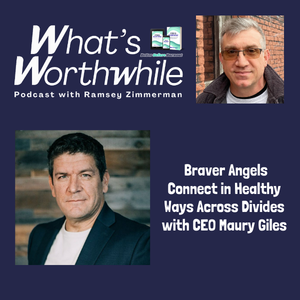
Braver Angels Connect in Healthy Ways Across Divides with CEO Maury Giles
from What's Worthwhile - Healthy Living Motivation and Discussion
52m 47s
The discussion highlights the severe toxic polarization in America, where people now view those with opposing ideologies as evil rather than simply wrong. However, data shows that 70–85% of people actually agree on most issues, but a large perception gap makes them think otherwise. This division is fueled by political systems that create 51/49 dynamics, media algorithms that trap people in echo chambers, and a culture that rewards tribal loyalty over genuine dialogue. A key insight is that opinions are often shaped by life experiences rather than chosen freely. The most effective way to bridge divides is to ask, "Tell me more about your life experience that shapes your view," which replaces defensiveness with curiosity. An example from a workshop with Utah politicians shows how sharing personal backgrounds—like growing up with a single mom—revealed shared values and allowed for collaborative problem-solving. This approach humanizes conversations and helps people find common ground, even on contentious issues like DEI. Ultimately, the solution lies in fostering empathy and understanding, not in winning arguments.
[Music] What's worthwhile? Considering what we consume, believe, say and do towards peace of mind by the mentality of body and joy of spirit, I'm Ramsey Zimmerman. Here's some more healthy living motivation and discussion. And so they were on two different sides of a particular policy question, but when it came down to the core value, they had the same thing, but one had prioritized one over the other of those values because of that life experience. And they were like, "Wow, I never knew that about you." And so the conversation all of a sudden was much more healing. It didn't stop there. It then led, that lends itself to then start talking about, "Okay, so what you're trying to solve for is this." Okay, well you're solving for that. Well, what if we looked at it this way? You can't have that kind of conversation if it starts with, "Well, why do you think that?" I mean, that's crazy. Let me tell you what I think. Hey there, it's Ramsey here. That was Mari Giles. Mari is the CEO of Brave or Angels. A nonprofit membership organization focused on reducing polarization and reducing the negative impacts of people not being able to speak with, let alone get along with people who have different ideological beliefs. This hits home for me. I often feel like my ideas about how the world works, or else everyone else's ideas have changed a lot over the years. And I want to speak up more, but I'm often afraid that I'll just cause trouble that way. I'm pretty focused on maha, but I know that's only one divisive issue we have today. In this discussion, Mari helped me understand that we should start by being curious and asking other people about their life experience in order to understand why they believe what they believe. I hope that you will gain some critical insights from this conversation as well. Let's begin. Hey Mari, how are you doing today? I'm doing great, Ramsey. How are you? I am doing well. Thanks for sitting down, taking a time to speak with me today. You are the CEO of Brave or Angels. It's a role that you took on relatively recently. I understand Brave or Angels was founded about 10 years or so ago to address the polarization that we experience in America regarding politics, religion, other social issues. Let's start with what brought you to Brave or Angels. When did you learn about the organization and what appealed to you about it? Yeah, so I think it was 2019. I read an article written by David Brooks, and he was talking about the organization and some of the work that was happening by it. I remember just being fascinated that this was a group that was focused on getting people to be able to talk together to sell problems together, especially at a time right now, and that's not really the thing that's rewarded in our society and practiced on that. So about 2020, I moved up to Utah in the summer of 2020, and I actually had was looking, it was a weird time to move up to a state, right, because it was COVID, and we weren't having church, we weren't having school in the same way where you couldn't connect with people. And I had started connecting with Brave or Angels, and I found the local people in Utah online and ended up because of my career, I did a lot of moderating, a lot of facilitating, and my work. And so I very quickly started finding out, well, wait a minute, I can help moderate some of these things. And so I jumped on and was part of a, whoa, it's called a red blue workshop within Brave or Angels. It was a fascinating experience to watch it happen. And so I immediately was like, I got to do that, I got to create, I got to get myself trained and ready to be able to do that. And so I then helped facilitate online with a group of people in my religious community out here in Utah, in where I live in Utah, online with a Jewish congregation in Salt Lake City, and facilitated a red blue workshop. And I was hooked because it was just the connections that people made, the haws that went up and realized that they started out with these impressions of each other, and then through the conversation landed in very different places. So I decided to volunteer. So Brave or Angels became, from that time moving forward in 2020, it became one of the places I volunteered whenever I had spare time. Yeah. And what are reds and blues in the context of Brave or Angels? So if you're going to help people see each other differently and have dialogue and build together, you've got to, and you're going to do it across political difference, you've got to make sure that you've got people coming to the table who have different points of view. And so what we do with the Brave or Angels is we have, we ask people to own their own ideology. Now it gets misunderstood a lot of times as being party. And because red blue gets associated with red being Republican, blue being Democrat. We try to push against that to say we're talking about ideological home. Where do you start? When you come looking at solving issues in society, do you tend to come from a home that's more conservative ideology or more progressive or liberal ideology? Or you know, we know there's everything in between the libertarian and others, but that's generally speaking red means more conservative ideology, blue means more progressive or liberal ideology. Okay, terrific. So it seems, it seems like there is as much or more polarization today in our country than there has ever been. Maybe that's not true, maybe there always has been polarization, maybe not. What do you think? What does Brave or Angels think and observe? You know, why is it difficult for people who have different ideological homes like you described? Why is it so especially difficult? It seems to, you know, even interact with or talk to or relate to people from a different place. Yeah, it's, you know, disagreement and polarization to some sense has been around since the founding days of this country when the framers of the Constitution and the debates they had after the Constitution was passed. The early elections after after Washington, all of a sudden you started getting into factions that emerged, right? And interestingly enough, the framers of the Constitution and the early principles of foundation of this country, they warned against factions quite a bit because every other time democracy had been attempted or something close to it, the role of factions ends up destroying and because people go to their tribes. But they had created a system that understood that and so they had a system that said, well, we've got checks and balances, multiple checks and balances, in different parts of the way that the Constitution organizes the structure that it's given us in our society. But, and certainly we've been divided as a country at many different times and the most intense when it went to violence, intense violence, obviously being the Civil War. Now, what's different today, however, is as a citizenry, as a members of the society here in the United States of America, we have reached levels of toxic polarization that is not about, I'm right and you're wrong, it's, I'm good and you're evil. And labels have emerged to be able to be litmus tests, if you will, for if you use these words or you associate with these particular elected officials, that tells me right out of the gate, not just what you believe, but what value you are as a human being to me, because it's been framed as an existential crisis, that if your tribe wins and my tribe loses, that everything that's important to me is going to be shoved down. That's new, that hasn't been in the same way at this level because of a few different incentives in our systems that's a play, you know, they've looked at what is on the governing side with elected officials, they've looked at, they've done analysis of all the votes or cast since they've been recorded in our country on the US Senate and perhaps. And what they're looking for is the degree to which there's polarization, just like clear factions voting on opposite sides, we're the highest we've ever been on that. That the overlap between representatives in Congress and then senators in terms of voting in the middle, you can count that on two fingers, you know, in terms of, I'm sorry, two hands, in terms of the total numbers that actually vote across. So we pushed ourselves to this 51 49 dynamic with the two parties in what's oftentimes written and talked about as a duopoly right that the two parties have created through electoral process and changes in incentives of the way they govern in Washington DC to where now. Converse has essentially. it's rolled to the executive branch, whether it's the Republican or the Democrat that's in the White House. And they function as if their role is to just raise money for their party and then support the platform that their leader in the White House brings forward. That's not what the framers had imagined in terms of the way the Constitution was supposed to operate. The reason they had the Congress and the Senate was to be able to have those that ability to have rigorous debate representing the masses in the House and represent the states in the Senate. And that the executive branch wouldn't control that, that those would fight it out and debate would happen. Well, now because of the incentive structure that shifted, you've got now parties to where they truly are operating in 51, 49 margins in terms of both in percentage in the House and then the actual numbers in the Senate. And that makes everything messaged in elections as being existential crisis. Like we have to get, we've got to get the other two over, got to get to the other two. You take all of that with we have an ad revenue based model for the way we information and media and social media particular is disseminated. And so the way our social media feeds work, we, you know, we all use these devices and we were, we're supposedly more connected that we've ever been digital. And we're most disconnected that we've ever been in reality because these devices and social media streams that we get our information from their intent is to be able to get us addicted to something so that we we stay focused on it. They gather data on us and then they can sell us as advertising targets to two different companies. And that creates a reality that we're not seeing any ideas different than our own. And you take all those together and we are, we are basically the most toxic polarized that we've ever been as a society. But the reality is, and this is the part that I think is really important, Ramsey, what you focus on is that we actually don't, we aren't as divided on the issues nor on our core values as we all think we are now. And all that we're told we are when you go through the biggest challenge that exists in this polarization is not that we believe different things. I can show you this in the data so many different issues. We believe about 70 to 85% depending on the issue the same across across the country. However, when you ask the same question of what do I think the other side believes on this issue there's a perception gap that is off the charts. We think that the other side was this way we would talk to the other side they actually feel as much as you on 70 to 85% of the stuff. But we don't believe that. That's a pretty incredible concept and statistic. So what I what I understand from that is that we have a perception that people think very differently from us but that your data says that that's really not true that that is. We know immigration even on abortion tariffs are a little bit different but even the tariffs we believe a lot more on the values level especially. But the concerns in the solutions we believe a lot more the same but because we're fed this information that we see in our echo chamber the anxiety that's being created in people is. It's crazy and it's it scares you it isolates us but the problem is when you're when you're anxious and you're isolated you're much easier to be manipulated at that point. And that's not healthy that's not healthy for the soul it's not healthy for the mind it's not healthy for families it's not healthy for organizations companies now we're seeing we're seeing data from the society for human resource management telling us that they're estimating 2.7 billion dollars. And that's not the only thing that's going to happen is that we're seeing data from the society and that's not the only thing that's going to happen. And that's not the only thing that's going to happen is that we're seeing data from the society and that's not healthy. And and which foundations may need attention it takes just a few minutes and gives you a personalized breakdown with clear recommendations go to burnout.what'sworthwhile.net and learn which zone your burnout resilience is in. Well, for me personally, okay, full disclosure, I would consider myself a red, although I think I considered myself a blue for almost all of my life up until maybe five or 10 years ago and then had sort of a change in sort of I felt like I changed my views, it felt like the views and the world around me changed. Have you heard that story before? You know, you see a lot of stories that stage of life shifts your perspective in a lot of ways. The most common one in American history is manifest in the Ramara Reagan story of being a blue for most of his life and then as he aged and looked at things differently, he became more of a red. Right. And then obviously very conservative in that. And I think there's a lot of stories that that you see in our society of that happening with stage of life. Some of it goes to, well, even in the state I live, right, it's interesting because most people I live in Utah now and I'm a red. I consider myself a red. In Utah, there's a lot of people think I'm more blue. It's kind of interesting because I'm not red enough, let's say. But a lot of people don't know in this state 60, 70 years ago was a very blue state, very blue state. And not a lot of wrecking and realization that there's societal changes that, you know, that happened. There's life experience through as you age that's going to have you look at things differently. And I think what you're describing Ramzi is an important thing that we need to help help realize about each other is that your own journey of blue to some version of red is about your own life experience. And the way you view things is shaped by that. And we approach conversations today with people assuming that everyone is choosing their opinions between the good and the bad through like, okay, you pick the bad side. How could you pick the bad side? Well, most of the science tells us that we experience our opinions far more than we choose them. And think about what changes in your mindset. If you approach someone and you realize, oh, Edmund, this person experienced something in their life that led them to this filter or this schema that they have, that that's how they see what's happening right now. As opposed to this person has chosen has chosen to be on the dark side. What is it? What's wrong with them? And if you think about it, the former instead of the latter that you've experienced something in your life, then it can lead you to one of the questions we train a lot in brave angels is saying when you feel that intensity coming up, that anger or that anxiety or that, oh my gosh, the person is saying something that I just totally disagree with. If you can get yourself to stop for a second, and instead of coming with your retort, ask this one question, tell me more about your life experience that shapes the way you view this. That has curiosity built into it. It has empathy built into it. And if you're doing it genuine, it will reframe the entire conversation. And it's no longer winning or scoring points. It's about curiosity and understanding someone's life experience. That's different. That feels different. If you're the one I'm talking to and I ask you that question, it feels to you, the you matter. Yes, me, even though we don't know each other well, but why else would I ask that of you if I didn't, if you didn't matter. But we don't do that. We don't ask those questions often. We feel like we have to go defend our tribe. And so we got to get that shot in. We got to get that shot across the bow. Do you like make sure to any and it's hard. It's hard stuff. No, that's such a great point. And it's something that I try to do. I try to understand as many perspectives and I try to understand, you know, what is it that where are people coming from? and why are they seeing this situation?
There's a question that you can ask, which is, you know, why is it that you believe that? But I like your frame of the question even better because, you know, why do you believe that could come across as, you know, something that would lead people to be defensive? But that's the spirit of what I wanna know. It's like, how did you come across that understanding? Like, where and how did you form that understanding? And I really like, I really like the way you framed it, asking about, you know, what in your life experience has shaped your understanding and belief around this issue. That's really fantastic. - You know, I experienced something on this when I was working with, I was doing, this is before I became CEO, I was moderating some groups with elected officials in Utah. We had recruited six state representatives, that was some of them, a couple senators and then, and then four of them who were members of the house, who were Republican and six were Democrat. And we brought them in to do a common ground workshop over two sessions, a total of eight hours. And they, they committed to it, they came. And one of the, and we were dealing with the issue of DEI in higher education, because that was an issue that was gonna be coming up in the legislative session back in 23. And, and I think it was going into the 24 session actually. It was, yeah, it was going into the January 2024 legislative session here in Utah. We have a 45 day session that happens at the beginning of the year, every year. And then they go back to living their regular lives and do it again. But we were talking about DEI. And we were going through this exercise where we had them hair up and we had them ask that question. In the context of certain policy perspectives on DEI. And I had this one Democrat sitting next to this Republican, both of them in, you know, in leadership roles within their parties, taking a position on this issue. And one of them asked that question. And I'm trying, I don't remember exactly what the, what the issue, or what the policy position was at the time, but they asked questions. Well, tell me more about your life experience with the shape that. And this particular person, this state representative started describing how they had grown up with a single mom. And they talked about the poverty they were in and the difficulty that that represented. And then the way they got out of that and the way they moved forward. And then all of a sudden, at the end of the time of that discussion, the other person sitting right next to that was asking the question when they flipped roles said, I had no idea. I've known you for 12 years. I didn't know you, I grew up that way. But let me tell you how it went differently for me. And they were able to find this juncture in their life where the same experience of single parenthood had resulted in a slightly different twist that gave a different perspective on accountability and ownership of your own future, right? Which was a fundamental value and principle that was being discussed in DEI in that policy position. And they were like, wow, I never knew that about you. And so the conversation all of a sudden was much more human. It then led that lens itself to then start talking about, okay, oh, so what you're trying to solve for is this. Okay, well you're solving for that. You can't have that kind of conversation if it starts with, well, why do you think that? I mean, that's crazy. And can I tell you the number of times I think we do that? Like I think earlier this afternoon, I was talking to my wife about some family things with parenting with our kids. And we were discussing some things and she was sharing something. And I think I went right in with my, no, I think this, we got to do that. And I'm sitting here thinking right now, like I didn't use it right then and that was like an hour or two ago, right? (laughing) And so it's not easy to be able to practice these but that's why I think it's like go into the gym and working out or it's like anything that, the wellness that you focus on with your whole body. It's like I have to do a routine in the mornings to deal with this work because leaving my job and coming into this work was been a big change for me and it's a big issue. And it's practicing, you know, doing things to help us so we can get it. It's like, just like going to the gym. - And yet the message that we get consistently in life is, you know, if you're at a party or you're in a social setting or you're sitting around the table at Thanksgiving, you know, don't talk about politics and religion. (laughing) And that's like, so the answer is to just not talk about it. But no, you don't think that's the answer? - No, to me that is the default cop out. Now in some cases, let's say in some cases, if there's already intensity that's there in the relationship and you know it because you've had different conversations than yeah, boundaries, healthy boundaries are important. But I fear that the more generic statement of no, we just never talk about that in our family. I don't know, to me that pushes me to say, well then, are there healthier ways you can have conversations in your family? Because if you never talk about those things, we live in them, we experience them. And that means that conversations are going parallel to but not with each other because you're experiencing it in life and you're either checking out altogether or you're talking to other people about it but not to the people that you're close to. And I think we have to learn how to be able to connect and talk about those things. But to be clear, there are some boundaries that from mental health and understand relationships standpoint that yeah, you probably have to put them up. But I don't think that should be the default. - No, that's a great point. So I'm in the health and wellness industry. I was previously in the sustainable energy space but now I'm in the natural health space and the main thing is the sustainable energy. - Yes, yes it is. Yes it is. And so now the Make America Healthy Again movement or Maha, you know that has been shining more national federal government light on natural and holistic health practices and priorities than maybe ever before. But you know, it also has made it political. And you know, I'm in a, you know, a number of networks and Facebook groups and things like that. And some of them are actively having this question about, you know, we don't really like to discuss political issues. But now we've found that our entire industry has become political in ways that it never was before. And what do we do about that? So I'm wondering what advice you have, you know, for me and for my colleagues, other natural health advocates, you know, regarding how to interact with our peers, clients and loved ones, you know, with respect to, you know, the fact that it has become kind of political through and because of Maha. Yeah, it really has. It was just yesterday or day before the Surgeon General candidate who has more of a wholeness and holistic view was being grilled on things and it, they're, they were going straight to vaccines and to, because that's the litmus test. So for 50 plus years abortion was the litmus test that was used in election, electoral politics. And I worked in campaigns for the early parts of my career. And the thing about those issues, those wedge issues is I firmly believe that the true partisans on both sides of the political aisle, if they really wanted to solve the issue around abortion for all those years, they would have actually dealt with it and moved forward. But it was easier as a political weapon to be able to use as a litmus test so that when you go, because what it is, it's a short, it's a shortcut to, if I talk to somebody, all I got to do is ask the question, okay, so what do you feel rovy weight? And then as soon as they answer that question, then it's like, ooh, now I've just signaled to my whole team, they're either with us or against us. Well, now vaccines, right? Post COVID vaccines and anything related vaccines or autism and vaccines and that's a litmus test now, right? And what gets lost in the mix, at least from my perspective, Um.
What gets lost in the mix is the really healthy conversation around our bodies and making them healthy and what are we putting into them. And it's such an ironic thing. Now we're getting more issues from sharing some of my personal opinions, but it's a fascinating dynamic to have Robert Kennedy in his role and the discussion in the Trump administration, where there's a lot of things that are being said that are challenging the companies that make our food and put it out there, right? And of what's healthy and what's not coming in our body, which would a lot of times that would been put up there as the litmus test of like your aunt, I like, wait a minute, you're off here there. But that discussion of what's healthy and what's good for our bodies is getting rapidly overtaken by well, the litmus test of what you feel about this or that type of holistic treatment or vaccines, no vaccines to where you can't have the conversation about healthy living and the kinds of food that you eat and maybe we shouldn't have someone's sugar in all of our stuff and so forth. So what I'm wondering is or what I'm thinking is it's a tricky part for those that are working in that space that you're describing because there are pre-established zones that new labels are being brought to that takes you to right away to say, okay, you're not on the team anymore because oh, you're one of the crazy people who doesn't believe in medicine and you don't look at data. And it's like, well, we'll wait a minute. That's actually not what I'm saying, right? But because it's politicized, it's get there now. How do you get past that? There's different ways I think you answer that in terms of how do you play the politics on that with Capitol Hill and Washington DC. The part I think is more important to people that are listening and you're in your piece and I believe is how do you play with that interpersonal and in your own life and having conversations because it is rapidly, it's like the way Israel in terms of Gaza, Israel is I mean, pick your issue. I snow ice, right? In terms of deportation, what have you? You have to take the conversation away from the issue solution level down to the values level because we live in the performative politics is what a lot of times he gets talked about. And they say performative politics because it's acting. It's the stuff that gets the rage banning. It's what's going to get people to pay attention to me because everything becomes a sound bite that immediately hits on social media. And then it fuels itself because it only hits the algorithm for the people that want to see that sort of stuff and feel that way. That's all by design, by the way, by the conflict on entrepreneurs. There's a whole industrial outrage complex that makes money out of us doing that. That we're talking earlier. If you want to get away from that on the space of talking about wholeness and wealth and healthy and wellness, then the conversation needs to shift down to tell me about your life of what's worth. Like what do you care about when it comes to your feeling, your health and your and the way you approach your life and the way you feel in your body and your mind and having those conversations instead of talking about particular instead of starting the conversations on particular solutions or methods that are currently being leveraged as a label of being crazy or not crazy or a good medicine or ignoring medicine. Because if you can get it down to that and say, "Yeah, I mean, you would know better than I. I'm trying to put in my own mind the kinds of things that would be talked about this, but I'll use one that I can think of as meditation, right?" I do meditation every morning. Why do I do that? Well, if I were just to go out and talk about meditating in certain spaces, I would get quite quickly put into a space of, "Oh, you're a progressive blue. You must believe in this or that," right? It goes down that way. Now, I don't know if meditation is as nearly as intense as some other wellness areas that you focus on. But if you go with it for a second, instead of me talking to somebody about the value of meditation, what I have had conversations with colleagues about is, "Tell me what you're struggling with and getting your work done or in your relationships and accomplishing this or that." And when you have that conversation in terms of what matters, you get down to what your value. Well, I value. I want to feel more peaceful. I want to feel more productive. I want to feel more able to get things done. I say, "Okay. Can I share with you some of the things that you've helped me with that?" As opposed to, "Hey, I've got a really good new, I don't know your world as well, to use the right phrases, but in right terminology." I've got this new practice that I've heard about this. Maybe it's chiropractice. I use a chiropractor in a very specific way. If I wanted to convince you of chiropractic health in one way, instead of jumping right in and talking about that, I would have a conversation with you about your life and your experience and the things that you're dealing with and then sharing the things that have helped me. I don't know if that's the answer. But on that. Well, part of what I'm hearing you say, I think, is instead of immediately trying to jump to convincing people of anything, instead, first of all, ask questions and more specifically ask questions about their own life experience, their own perspectives, their own beliefs and core values, and then look for commonalities and look for things in which you might be able to relate as people. As you were describing and as we're talking, we get with these litmus tests. I hear litmus tests and I think of vast oversimplifications. And the litmus tests usually are incredibly complex, nuanced kinds of issues where in many cases, reasonable people can disagree because the issue is so complicated or impossible. And yet, those are the ones that people grab onto saying you have to either be on one side or the other, but those are also the same issues where I just find them incredibly complex and difficult to even answer because of the nuances. Is that on purpose in your opinion? Yeah, I think the people that are using them, it's absolutely on purpose. And it fits the modality for our communication channels on a digital social media world. It's a simple way to simplify it to black and white. Simplifying and labeling has always been a political technique, but we now have the tools that can maximize the effectiveness of that in a very unhealthy way, but can lead for a productive outcome if you're trying to win an election or you're trying to make money through advertising, you the best way to do both of those things in today's world. The quickest way to do it is to fear, drive fear and anger and separate and divide people. And one of the easiest way to do that is simplify, simplify a very complex issue. Even Israel Gaza, you would think by the way it was talked about over the last period of time after the October 7th and during that period of time by the people that we're passionately talking about it is that it's very simple. You see on one side it's either genocide or it's not or go to the other side it's either you know take the issue and then and man that's been going on for centuries and and for millennia and the complexity and the nuance there off the charts, but yet simplify down to you're either for me or against. Yeah. Those ultimatum have relationships with those kinds of ultimatums on topics that are very nuanced. Absolutely. And being forced or feeling pressure to conform to one group or another that really stresses me out. I don't know like if it stresses other people out I think it does. In fact, so stress and stress resilience and resilience to burnout is something that I'm very interested in something I work on directly. And I really feel that a big part of what is making life these days so stressful is that many times we don't feel like we can say out loud what we're actually thinking or that we can be our true selves or represent that because we're going to make someone upset or we're going to say the wrong thing or we're going to get canceled or you know we're going to get thrown out of our in group which we've tried so hard to you know be popular in. What do you think about that in terms of stress? Have you sort of heard about that or seen any sort of examples or experiences of people you know experiencing a lot of stress based on this polarization we've been talking about? I really do and I think there's two major categories where you see it pronounced in society right now.
One is being caught in the outrage cycle and becoming addicted to it. And that's kind of what we've talked about a few times that I know people who were so upset about, let's say, one side of the Gaza-Israel issue. And then once there was a ceasefire, they almost felt like they didn't know what to do because they didn't have the thing that was feeding that dopamine rush, that adrenaline rush every day of all the horrific images of death of children and starvation when heavy and bombings. And so as soon as there was something happening with deportation and ice strategy and ice practices, then all of a sudden jumped right back in to not be able to think that, now, I want to be very careful and say this, I'm not talking about the merits of your point of view on either of those issues. I'm talking about the unhealthy nature of the stress that it creates of feeding your brain, that volume of information in small little sound bites for hours every day, creating an addiction that's stronger than drugs in many cases. And creating, and so think about the outcomes of what that produces in your relationships if you're a parent, if you're married, if you have a partner or something, that becomes the only thing you can think and talk about. I've seen it now on the Epstein files, same way with people I know that are so focused in on that. And once again, not suggesting there's not evil things that are involved in it, yes. But help me understand how you're adding to your own health and productivity in society. If you're caught in that outrage cycles, addicted to it to the point that you've got to get this message out to somebody, really? What do you? That's one of them. The other bucket to me where this manifests is what you were saying about being in social settings where you're just walking on egg shells as to whether you say the right word about it. And that's something that we've had for a while now. I think it's interesting because some people have just said, "Now days that I've just gone far enough that I don't even care anymore, I'm just going to go all in and just say it." But that's just making it more stressful for those that are holding back. Look, we all deal with stress. Stress is not the problem. The problem is that our body's innate stress response is built for physical challenges instead of the mostly mental, emotional, and virtual stresses that we face today. In my book Stress Response, you'll learn to manage your response to stress. In order to reduce anxiety, avoid burnout, and find calm and steady focus. The ebook is available on Amazon and only 99 cents for unlimited time. After you download, please don't forget to leave an honest review and rating so that others will find it too. But that's where I think we have to be the change that we want to see in our own lives. We have to be the ones that courageously maybe we look at, we're talking about as courageous citizenship but brave angels is that recognizing that I have the choice 100% control over that I can choose to act or not or react. In the react mode, typically is not the healthy one. Now, if fighter flight when there's a wild lioness about to attack you in the jungle, then okay, like react quick, it saves your life. Reaction is good. But in the context of social dynamics and relationships and toxic polarized environment, reaction is very rarely the right thing to do, acting proactively to be able to then be the one that instead of coming out and saying the thing that you want to save first of your point of view, be curious about the other person or the people you're around and discover that they will actually change their favorite reference. So you can then actually say what you think, but you started with understanding them. And when you do that, I've been studying a lot about this recently and I find it fascinating. I don't know if you study much about the AWG, the power of awe and what it does for us in terms of our minds and our bodies and are down to a fit and logical level. It's a very interesting thing. The study of awe, the science of awe has found that when we feel and experience awe, things happen in our body that in terms of at a chemical level that shift the way we view and the way we feel and what we view in terms of going, we feel a part of something bigger than ourselves. So if you think about anything that you've experienced in life that's awesome, you know, the Grand Canyon or a baby being born or you know, it is a quasi spiritual or sentiment of like, wow, and you feel about something bigger than yourself. When they did research around the country to see the most frequently mentioned sources of awe, unexpected public acts of courage are the most frequently mentioned sources of awe because it's not what you're expecting of its countercultural and you know in your heart that what that person just did was really good, but it was courageous because nobody else wanted to do it. That's what we need to do more of. That's the way to change this because that's when the power of awe outweighs the intensity of the selling power of outrage. So for those who are listening and who you know are just getting to know braver angels, what kinds of opportunities do you have, how do you help people to learn how to do this, internalize this, and then take action and bring it to their lives? Well, first off, go to braverangels.org and you'll see a lot of information that we have there. We have a lot of different resources. You can see the kinds of things that we do. There's a few ways to dip your toes into it. You're doing nationally that's all the time online. You can sign up for one of those so it'll be a debate or it'll be a forum or these different techniques where we practice the things we've been talking about here today Rams. Sign up for one of those, check it out. You also, if you want to dip your toe a little bit further, you very well may have an alliance of braverangels. That's what we call our local chapters in your area in your community. These alliances are these chapters. They have a red chair and a blue chair by design. They have to have that to be able to have an alliance. What they consist of is what they're comprised of is a group of people in your area who've chosen to try to practice these things. They have discussion groups, they have events, they'll practice these at the local level. Now there's two other ways that are kind of interesting. We know that one thing that we get the most frequent requests about is family and relationships and especially around the holidays. You mentioned earlier things giving your Christmas dinner. We launch the tool to help you practice on your own. It's called the depolarization dojo. It's an AI-driven tool that you, if you're a member of braverangels, you go bravering so that our join is a $12 annual membership fee to join. By becoming a member, you can get access to the depolarization dojo. You go in there, you log in, and you can choose from nine different personas, typologies. You say, "Who's that person?" Who's that, let's say, crazy Uncle Ted, who I'm going to be having Thanksgiving dinner with, or are we going to be going to a party with the family, birthday party? I know that they're a conservative discer that. You can look at the nine and you say, "Well, that one's closest and you pick the gender in the age." But then what's fascinating in the use of AI, it will create a synthetic persona representation of your Uncle Ted. Then you start to have a conversation. The really cool part about it, it'll pick an issue or you can pick an issue. It's really cool because it'll feed the issues of the day. If you're not sure what to talk about, it'll throw in whatever is the current issue of the day and then you start talking with this synthetic representation, essentially like a little robot version of whoever you're relative is or your friend. As you have that conversation, there's a little meter that goes up or down telling you how polarized the conversation is, how intense it's getting. On the right-hand side, there's a coach. The coach will tell you, "Oh, here's something you could do at this point." You can click on it if you want to, but you're getting north of the coach and just do that. We're trying to have fun, but in a rigorous way where it's really pretty cool. We've been beta testing this and running it beyond for the last five months and men, it's taking off. We have that kind of tool. The last thing I'd say is you go online, you can do one really cool thing of one-on-one conversation. What that is, you come in, you register, and you say, "I want to talk to somebody, a live person, not a synthetic AI person, but a real person." If you choose if you want them to be different from you in age, ideology, urban versus rural, race and ethnicity.
ethnicity, you pick what you want. And our team of volunteers will find somebody who also has signed up and they'll will connect you and will give you a script for three conversations to have. If you follow that script, you'll have a productive exercise. And it's a random person you'll probably never see or talk to. But you're able to practice it that way. So check out braveranger.org. Join get involved. We need help. We need financial help. We need people help. This is, this is, we've got 80,000 people across the country, part of our community 15,000 who are part of our alliances. We need to grow that to get more unexpected public acts of courage. So people get inspired to realize, no, there is a better way. That's important because we need a more resilient democracy. And that's, that's what we need with our today. Yes. Yes, we do. Well, Mari, Jiles, thank you so much for coming in and taking the time, you know, here on What's Worth While podcast. I talk a lot about mind, body, and spirit, wellness and about how we can build the foundations of health in all of those areas, you know, so that we can accomplish the things that we want to accomplish. And I really just believe that it's just as important for us to consider, you know, the themes and narratives that we consume as much as it is to consider and the foods and, you know, drinks that we consume because they all work together in the same way. And, you know, it's all interconnected. So I just, I really appreciate brave angels and I really appreciate you for coming in and, and talking to me about all of this. Thank you, Ramsey, for the interest taking the time and all of your listeners that learn the things that you share. I appreciate it. I've enjoyed it. Hope you gave me some things of value. Absolutely. Ready for more? Visit What's Worth While.net to listen to podcast episodes, master your response distress by reading my book Stress Response, available through Amazon, or to get better before burnout sets in by requesting the free guide. Regardless of where you are in your journey, I'd love to hear from you and talk about how we might move forward together. Please contact me, Ramsey Zimmerman, through the website, or on social media like Instagram, Facebook, LinkedIn, or X. Thanks. (upbeat music)
Podcast Summary
Key Points:
Toxic polarization in the U.S. has reached unprecedented levels, where opposing sides are seen as "good vs. evil" rather than simply having different views.
Despite perceptions, people actually agree on 70–85% of issues; the real problem is a massive perception gap about what the "other side" believes.
Key drivers of polarization include political incentives (e.g., 51/49 party dynamics), media algorithms that create echo chambers, and a lack of curiosity about others' life experiences.
A transformative approach is to ask, "Tell me more about your life experience that shapes the way you view this," which fosters empathy and understanding instead of defensiveness.
Personal stories, such as sharing backgrounds on single parenthood, can reveal shared values and lead to more productive, human conversations across ideological divides.
Summary:
The discussion highlights the severe toxic polarization in America, where people now view those with opposing ideologies as evil rather than simply wrong. However, data shows that 70–85% of people actually agree on most issues, but a large perception gap makes them think otherwise. This division is fueled by political systems that create 51/49 dynamics, media algorithms that trap people in echo chambers, and a culture that rewards tribal loyalty over genuine dialogue.
A key insight is that opinions are often shaped by life experiences rather than chosen freely. The most effective way to bridge divides is to ask, "Tell me more about your life experience that shapes your view," which replaces defensiveness with curiosity. An example from a workshop with Utah politicians shows how sharing personal backgrounds—like growing up with a single mom—revealed shared values and allowed for collaborative problem-solving.
This approach humanizes conversations and helps people find common ground, even on contentious issues like DEI. Ultimately, the solution lies in fostering empathy and understanding, not in winning arguments.
FAQs
Brave or Angels is a nonprofit membership organization focused on reducing polarization and the negative impacts of people not being able to speak with or get along with those who have different ideological beliefs.
In Brave or Angels, 'red' refers to a more conservative ideological home, while 'blue' refers to a more progressive or liberal ideological home, not strictly tied to political parties.
Toxic polarization has reached levels where people see each other as good versus evil, not just right versus wrong, driven by incentives in politics and media that create an existential crisis mindset.
Data shows that people believe about 70 to 85% the same on most issues, but there is a large perception gap where they think the other side believes very differently.
They recommend asking, 'Tell me more about your life experience that shapes the way you view this,' as it builds curiosity and empathy instead of defensiveness.
In a workshop with Utah state representatives, one Republican and one Democrat discovered they both had experiences with single parenthood, which led to a more human conversation and deeper understanding of each other's policy perspectives.
Chat with AI
Loading...
Pro features
Go deeper with this episode
Unlock creator-grade tools that turn any transcript into show notes and subtitle files.
 PodcastTranscript AI