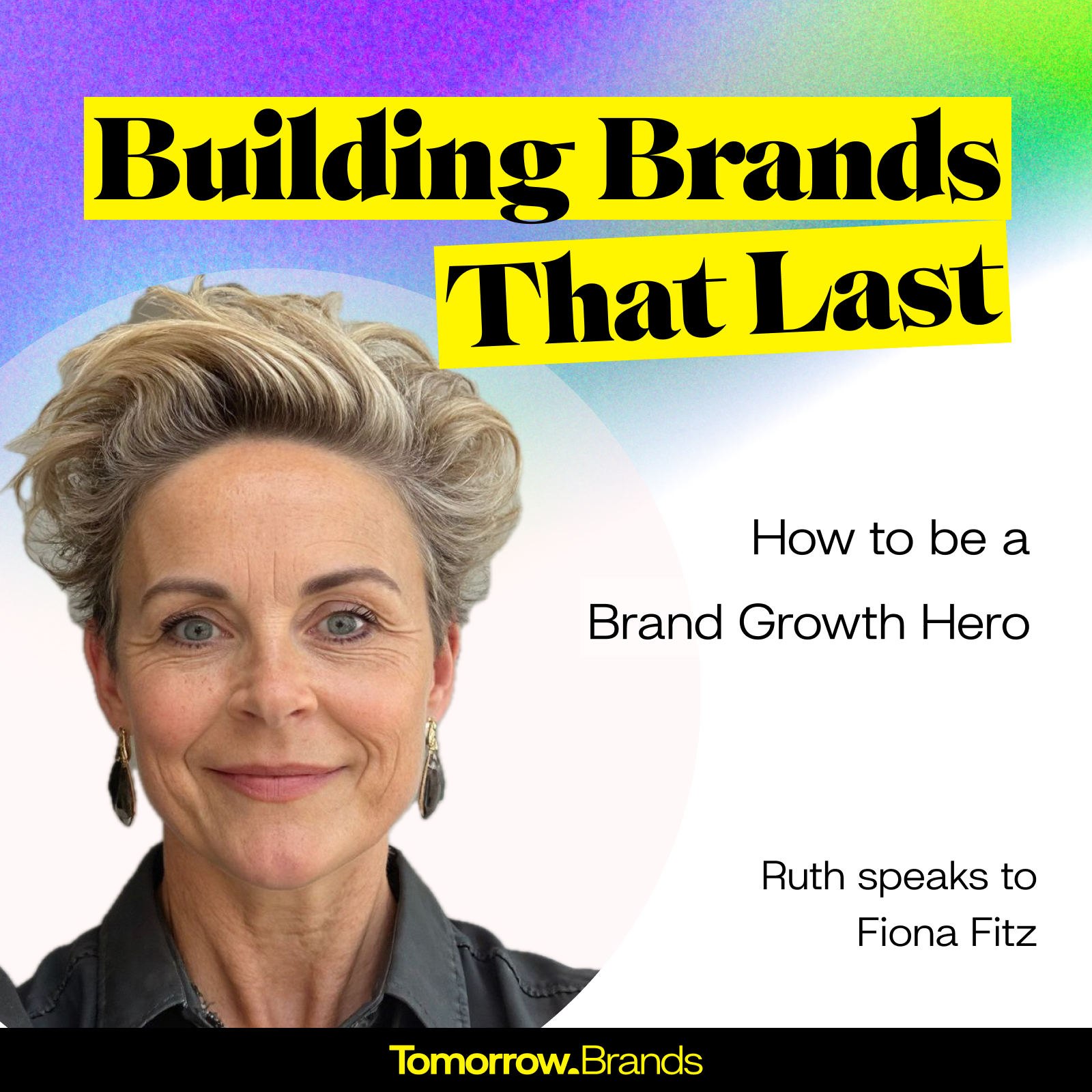
Brand Growth Heroes- Lessons on building brands that last with Fiona Fitz
from Building the Brands of Tomorrow
31m 36s
In this podcast episode, host Ruth Vitok interviews Fiona Fitzpatrick, founder of Brandgrove Heroes, about her journey from corporate to startup and what makes a brand scale-ready. Fiona began her career at Nestlé on the graduate scheme, working across brand management, category management, and new ventures. She proposed Nestlé invest in cross-category platforms like super-premium chocolate and positive health, but when headquarters rejected buying Gu and Innocent, she left to launch Gu France as its founding CEO. This experience fueled her passion for helping founders avoid common pitfalls. Brandgrove Heroes started as a podcast and evolved into a mini-MBA program for FMCG founders, focusing on building business plans around brand insight. Fiona identifies three key traits of successful founders: the ability to execute and transform every interaction into outcomes, the skill to chunk up to strategy and down to execution, and strong leadership and people management. She emphasizes that founders must be open to learning, even if experienced, and that her role is temporary—she works with founders until they outgrow her support. Fiona herself is risk-averse and prefers being entrepreneurial within structures, seeing her current venture as a proper business. Ultimately, she believes the best founders are those who know what they don’t know and actively seek advice.
[Music] Hello and welcome to the Tomorrow Brands podcast, where we explore what it takes to build a brand of tomorrow. I'm your host Ruth Vitok and today's guest is Fiona Fitzpatrick, founder of Brandgrove Heroes and one of the sharpest minds in the world of scaling FMC G brands. We talk about the leap from corporate to start up life, what truly makes a brand scale ready, the difference between strategy and execution and why being great at asking the right questions might be the most underrated super parable. Let's get into it. It would be great to hear a bit more about your background and how you got to where you are today. Sure. I was born in Ireland and I lived there until I finished my first degree in 1997 and then I went to London and I joined Nestle on the graduate scheme at Nestle UK and I was there for very many years doing a bit of everything. Brand management, category management, very beginning of category management actually, sales, retail side, food service side, big brands, small brands and I ended up working for the chairman of Nestle UK along with John Welsh actually who runs by on me. We were looking at how do you step change growth for Nestle UK because a lot of the categories that they were in, their traditional categories were back of covered categories that were in decline and I'd been working for the much smaller cousin of Nestle UK which was like the food service, the poor cousin department or yeah team really at the time food service wasn't as cool as it is now and we'd been looking at how to step change growth through acquisition and doing also to kind of equity self-swaps and investing in small companies that had like chilled vending solutions for hospitals and it was really the most amazing job. It was called new ventures and when the rest of Nestle UK heard that food service the poor cousin was doing this I think there was like a what if they're doing that then we should be doing that at a group level so myself and John got the gig which was amazing because I was still like 27 at that time so we did that for two years and our the culmination of that project was a presentation to Verve and Switzerland was basically said Nestle needs to invest in two cross-category platforms for growth so if you imagine traditionally a big beast like Nestle they'd been in pickle and chocolate powder and sweet cereals and there was all sorts of things that weren't really doing very well and the products that they'd bought are the businesses that they'd bought over the years that were doing well were things like water and pet food and stuff. Our job was basically to say to Switzerland invest in two cross-category platforms for growth one of which should be super premium indulgent chocolate brand which you would then leverage all of your assets across all of those different factories and all of those different teams across confectionery biscuits cereal hot drinks and the way in which you should execute that play as we called a strategic play should be by buying goo chocolate buds and the other cross-category platform for growth that you should invest in Nestle Verve worldwide is positive health based on fresh and you can imagine how you would then execute that across water and cereal and healthy iced goods etc etc and the play the execution of that should be to buy innocent so myself and John were sent off to start talking to these businesses and in the meantime Verve said we're Nestle we do not need to buy goo and we do not need to buy innocent here's a brand in Australia that we already own the chocolate brand that you can use to execute your cross-category play in super premium indulgence because the idea of this obviously was not just to get into chocolate that's not our get into indulgence the idea was to capture a group of consumers globally that were starting to buy into this new cross-category occasion super premium indulgence everyday premium indulgence or everyday positive health they were emerging categories at that point in the mass market so they said we buy into the plays the strategic plays but we don't that's not the way to execute it we're Nestle you can have this secondary rate brand from Australia and use that for your cross-category chocolate play and use this other one that we have for your fruit play so I put my head in my hands at this point and I thought if I can get to this point look lucky to get to this point in my career at 2627 driving these projects with these people in the room and they're still not realizing that you stick Nestle on the pack it's never going to go anywhere so I just thought that's it I'm done I'd been there for I think eight years at that point with a break in between when we got sold premier foods where I was working on Cabri's drinking chocolate which was a licensed thing that premier foods had for Cadbury's on behalf of Cadbury's and that was an amazing experience actually but yeah I just thought I can't do this they're never going to get it it's just like a in a moment so I rang Gouchakopud's and I got to speak to James Aberdeek and I said look I'm looking to move and he said do you speak any languages and I said yeah I speak French and I speak Italian and I speak German to find a degree and he's brilliant I need someone to launch Goufrance so I had three months notice and I left to set up Goufrance and that was how I made the jump from big FMCG into small startup and I was number five into Gou and literally I would say I was the founding CEO of Goufrance because I had to sit with the lawyers and set up the S.R.R.L which is a limited company employ the people find the office and James was very good he would say what should we do and come with each of some of those meetings and then I'd make a recommendation and we'd both decide but at the end of the day I was running that business from day one so I've been on the ground even if it was 20 something years ago when did I finish with Gouf 2010 so I've been on the ground doing all of that so I think it was a nice juxtaposition to have that incredibly strategic starting off with kind of being a really bad assistant brand manager I was a desperate brand manager right really bad assistant brand manager all the way up making my way up all the way up and learning having to learn how to do it what it meant to be a good brand manager what it meant to be a good marketing manager what it meant to be a good salesperson against all odds because I wasn't good but what I was very good at was trying to make sense of something when I didn't understand it and I think that's why I am where I am where why I have ended up building what I've built today which is a way of making sense of how to build and scale a brand in consumer package goods and that's why I'm so passionate about helping founders I think because I think when we're passionate about something it's often because we're trying to heal a wound and I am trying to help people not go through what I went through is it's like just not sure I'm getting this there must be a better way there must be a way that makes more sense than just doing it at Huckle over the Gough as we'd say in Ireland. Absolutely incredible background so explain for anybody who doesn't know what brand growth here is is what it does who it's for sure so it started just as a podcast but basically I think just very quickly when I come back I had to leave France when I was living in France for three years after being having been in Dublin or sorry in London for seven or eight goose ultranobile foods and I left and I came home with a baby under my arm little half-friend chef Irish baby who's nice 16 and I had to set up by myself as a consultant so I was consulting for years and years with CPG brands in Ireland and in the UK and at the same time I was wearing another hash which was with a company called brand learning who is in capability development and I realized I much prefer lifting other people's capabilities they're actually doing the stuff myself so that happened naturally and as we got towards lockdown I'd already built a lot of programs with brand learning for people like Michelin tires, O'Brien fine foods that is Ireland's 200 million quid, ham and chicken company for all of their senior execs and traveling to China and France like learning how to deliver programs learning how to build programs that help people go from not really understanding how to build say for example a brand plan or a sales and marketing joint up sales and marketing plan or annual business planning how to bring them from not understanding to understanding to really feeling comfortable with to being able to do it to be able to actually critique it to be able to actually build their own process that's like a learning journey and people think that writing a program or bringing people on a making people better at something is just basically sitting them down and helping them out there's actually a whole load of design behind it capability development design and that's what I love doing and Brandgrey Theros started as a podcast but then I realized that actually what I was doing with the podcast when I was speaking to founders who are scaling brands was that I was fueling my curiosity and my learning and others as I did it I was like why am I listening to all these people amazing people and learning from them everybody should be learning from them and it always drove me nuts that everyone was making the same mistakes over and over like we all go out and we launch a business and then we realized I saw a lovely post this week where someone said I think it was a lovely guy who was launching a Col Rabby business and you see that post and it wasn't until you were tacted but that's how I was remembering and it wasn't until like once and once down the line you realized that from a kind of a food tech manufacturing point of view it wasn't going to be possible or even supply point of view why do so many people make these mistakes when we've all so many other people have made them and we could all just have this co-created understanding of what works and what doesn't work and shared hive mind so that's what I started doing with the podcast and then all of of the programs that I started building during the summer.
lockdown, which we're just needs most lockdown. Let's get some founders in a group for six weeks and bring them through how do you build your business plan based around a brand and brand insight. And then I just realized that actually the podcast and the programs that I was building were one in the same thing. So, Brandgrethier has became the umbrella. And by the time it became what we call a mini MBA in invertecomas, that's a, I'll tell you, that's another story from the day. But by the time we leveled up to becoming a mini MBA in whatever that means, we'd already had 100 founders through the program, including build a fraibone broth, build Binko, perfect head, stocked. We've had some really lovely successes and some fabulous groups of founders who adore each other and talk every day or every few days on the WhatsApp groups and feel like a real, I don't know, like a real that they're each other's back. They've got each other's back and that's lovely. I love being able to facilitate that. - Yeah. - Have you, has there ever been a moment where you've wanted to set up your own thing? - Have. - Why? - It's just not who I am. I think you're either an entrepreneur or an entrepreneur. I suppose well, set up your thing I have done. The pivot I'm making now is realizing that Brandgrethier is no longer just a podcast and some courses. It is a business. I have some really big partners in terms of Alantra, Investment Bank, Isory, at Jollson, most fabulous corporate lawyer with incredible experience in CPG and Nielsen IQ. You couldn't want better partners. So it is a real business and I have set up something. - I should have said sorry, set up your own food or drink. - Yeah, I know, but I'm always making that turn, that pivot in my head right now because for a long time I didn't see myself as a founder. Where is now? Do you know what, this is a proper thing. No, I'll tell you why because I'm quite risk-averse. You're the same? - Yeah, I would say. - I would not, the thought of having stock and that much cash flow and it's just not me. It's just not me. And that's why I've always worked for other people. And I'm very entrepreneurial inside that structure. So that's why I ended up when they took me out of my innovation role in Nestle. I was working on a food service innovation and they were like new ventures. They created this role for me because I do think in quite a different way. Yeah, so no, absolutely not. And if anyone asked me, should I go into food, I don't know what I would say. And certainly if anyone said, should I go into chilled food, I'd probably say no unless you have experience. So I do think about those things all the time. And I think because I know it's so difficult and it's so difficult, that's why I want to help. You know? - Do you think from, I'm going to get into some of the common traits that you see coming through the program? But do you think that it helps to be fresh to the industry? What do you think is the bigger strength? Like naivety and being fresh to the industry or experience? - I think it depends. I think it depends on the type of person you are. So I think if you have experience and you are also very broad-minded and flexible and quick, then that is probably the number one profile to have, because there are so many founders who've got tons of experience. So if you're new and you come into food, beverage or CPG and you don't have an experience you are of against people who do have shed loads of experience and are entrepreneurial. So that's the first thing. And I'm thinking of, say for example, the boys from Dash or Freddie from Wild, typical examples of that. Or Emma Hill running, co-running Lucky Saint, tons of experience and it shows. If you are, if you've tons of experience and you're not flexible and broad-minded and an ideas person and able to chunk up into the big picture and then chunk down into the detail and you're just quite no, this is the way it happens is the way it did, then that's a bad place to be. And actually I'd put that in third place of who's likely to win. Second place for me would be someone who has just got an incredible brain, also able to, is able to be an incredible executor or able to get the right people around them to execute and is able to learn very quickly. And those people, the ones that succeed are the people who are always looking to learn and not thinking that they know how it works. So you're saying, yes to me, there's a lot of people that I find that people will send people to me. Yeah, I'm sure they send them to you. And those people, when I know they're not the right people for me and I'm not the right people for them in terms of working together. And this could be like a one-to-one, a two-speed one-to-ones, which some people will say, you've got to talk to me, do a one-to-one with her or get her on your board or whatever it is. And those people will spend weeks and weeks and months and months and it'll go back and forth, it'll never happen. And what I've learned over the time is I don't push that anymore because they are not in the mind space that they want someone like me in their life or they don't want to listen. They're not right for them, they're not very ash, that's fine. And they're either going to do it in the room, they're not. The people I work best with and you're nodding as well are the people who are like, yes, I don't know at all. I really need to learn, even if they're absolutely amazing. And this is one of the things I say, I'm working with Emily Tite from Mysy Slice, I'm staying with Ellen in Better Nature. They are way better than I ever was. Can I say this to them all the time? And I'm really happy to say that to them because it's true. But what, pretend I'm where they're and they're going to catch up very quickly and then they move on and that is the right thing for them to do. Those are the kind of people who I work best for. I have a shelf life and that's the way it should be because I work with people who are so strong that Jesus within years, they are two or three years, boom, they're gone. And Amelia from Bullbeen, for example, Shani and Marissa from Perfect Dead, boom, gone. Grace, I'm happy. I'll always be a part of that at the right moment but I do not need to be the person for the next phase as well. Yeah, I always think that a good founder knows what they don't know and is happy to ask for advice. And that's when you can tell and to your point, I was nodding very vehemently through everything you were just saying because if someone won't listen and there's just, it's not going to work, is it? That's their prerogative. I'm sure there's loads of people who actually don't need to listen to actually know that. I think there are a few people in the world in any profession who don't need to listen and they just ace it. I'd love to be one of them, maybe not. But it would be amazing to be so good that literally you always had it sorted. There's a few of them far between. And then, it's good at everything though. There's always going to be gaps if it comes to running a business. Exactly, exactly. And I think I've become very comfortable as to where I can help and where I sit in a certain group of founders' lives for a certain period of time. And I'm also very comfortable with how invaluable and transformational that can be. Yeah, whereas before I used to feel upset if time was to move on, I'm happy. I feel good. What are some of the biggest common threads you've seen across the most successful brands you've got with? I would say the ability to execute from day one really make things happen. So always be focused on transformation. But even if that's just a task, is this task going to transform something? I always use the analogy of a sausage machine. It's less appropriate nowadays, but could be a plant-based sausage, right? But I always say to founders, especially if they're young and they haven't had a lot of work experience or experience in the workplace, every meeting, every conversation should be you should be designing it to have inputs, transformation and outputs. So you go into a meeting with some colleagues or some people who are working with you or a supplier or anything, a buyer. You've got inputs into that meeting. You know what you want the output to be as in terms of the outcome. And there has to be something in terms of how you design that this is going to be a transformation happens. Because you want some people, you want certain people to do something or feel something new. Otherwise, nothing changes. I think people who automatically get that, who naturally get that, that they have to transform all day every day, rather than just be, rather than just read, rather than just think. I think that's a biggie because then you're a machine, right? So I'm always asking myself on my transforming. I think that's the first thing. I think the second thing is they also need to be able to chunk up and chunk down very quickly. So chunking up into the big picture and the strategy, what are we trying to achieve, where we're going to play, how are we going to win, realizing that strategies all about decisions, and there's a set of decisions that you make, you're placing your bets, nobody has all the answers, but that's what you're doing as a leader. But then you're chunking back down into making sure that transformation happens at the execution level in the right place, the right time, and trying to leverage those chips in a really cost-effective and energy-effective way. So I would say that's the second thing. And the third thing I was going to say is it's about people and mindset and leadership. And I think you asked at the beginning, when we were going over the discussion guide that you very kindly sent through, you're saying what's the thing that surprised you the most? I think what surprised me the most is the founders of today, the very successful founders that I've worked with throughout the years of the program since 2021. Say, for example, Emilie and Ed from Bull Bean were the perfect TED team, or so many of them, even much smaller brands, it is their approach to leadership, which has surprised me. At such a young age, I'm going to be 50 in 20 something days. Believe it, that's just a can't believe it. Less than a month, when I was 26, 27, 28, I didn't have a bloody clue. I'm a region, didn't. OK, we didn't have an Instagram that I was able to watch shorts on leadership and stuff. And I had, I had that, I think I would have eaten it up. But I was just blind to all of that, made shed loads of mistakes. People today are trying to
to be so self-actualized. And I love that. I feel I'm so in awe of them that they are on this journey of self-actualization and self-actualization in terms of how they lead and how they lead people and how they motivate people internally, intrinsically. And I think that's beautiful. That is the third thing that I would say differentiates these people. I think it's that desire to do things better, isn't it, that you get now, whereas business being seen as a force for good in a way that it wasn't 20 years ago and these younger founders, like Ed and Amelia, who are doing things their own way and showing that you can have success through that, I think is really quite something. And to your point at that age, I was not able to do that. Where were you? Where were you at that age? I was at pop chips and to be fair, we were trying to do things differently because my boss then, guy called Will Boller, who you may have come across, he was ex-innocent and so the culture that he did create at pop chips was the same. So I think I wasn't leading the team, he was, but that's where I learned, you know, how you can work really hard, but also have a good work boundaries and you have to be kind to people and nice to work with was like at the utmost priority. That was one of our guiding principles as we wanted to be around people like doing business with from suppliers to retailers across the board. I think that, you know, that is very different running your own business to our earlier point of how hard you can see that it is and being risk of earth. So embedding a culture within a company where young start up is one thing when you've got no, you've got no kind of skin in the game, but doing it when actually you're making these bets and that could affect the bottom line of your own business. I think is a much bigger and braver call, isn't it first? Can have a nice time here while we're selling all these crisps. Yeah, no, it's massively different, it really is. And I found that very stressful, I think, when I was running Goufrance, I was in the situation where I was signing off the bank every night, logging on to the French bank and approving each of the costs. We didn't have a finance director who was doing that and that was a lot of responsibility to have on such a young person in a foreign country, hiring and firing senior people, making those first big higher mistakes in a foreign country where the labor laws are very different, huge learning curve. And I think another thing I did, which was really, I think what's the word fundamental to my understanding of how you actually build is Chabani, the US Greek yogurt company. I joined them in 2010, I worked them in 2013 and at the beginning we were flying over the yogurt on airplanes. Now, can you imagine that? I can. Like flying it over an airplane. Can you imagine? That's how different the world was, but you learn so much about setting up a company when you're setting it up for somebody else in a big way in a foreign country in terms of co-materfactures, agreements, employment law, finance suppliers, ops, the internal joined up processes such as joined up sales and marketing. You learn so much and you don't have that risk that the founders themselves are holding. So I suppose maybe coming out of all of this, maybe what every founder needs is to get to place where they can afford to have a really strong number two chief of staff person. Like we might have played that role where you know that person is able to do all of that and give you the space to lead and to think about all those bigger strategic questions. Because certainly that's the role I've always played, I think. Why do you think Chabani didn't work here? It's not from the air fray team, you're good. It's not why I think it's I know because I was in it. That is the untold story in the food industry. I'm not sure I could tell the story without being sued. But it was an incredible import taxes from the states and the cost of phrase when you're talking about airplanes versus shipping. I've done all of that. I've got all the Excel spreadsheets. So like when you get into that level of detail for other people's businesses, then you're really able to ask the right questions of founders in sessions. Okay, I don't know all the answers, but I would say the thing I'm best at is asking the right questions, making helping founders to make the right connections. That's the only thing I would say I'd be I would back myself on 100%. I'm not like the best marketing director or the best anything, but I'd say I'm I would back myself there. That's a super strength there, and I think it's a really underrated. You mentioned the sort of speed hours that you get with people, and I get approached. People just ask for a quick chat, which I try and do when I can. And I find it frustrating when you set that up. I don't charge for it. And then people don't ask you very good questions, or they start the call and they're just like, hi, and you're like, I can't I can't just impart knowledge. You have to ask the difference between people who can ask you know and also prepare. And I would say for anybody who's asking for anybody's time. Good advice. So let's talk about building for the long game. What in your view from your experience makes a brand genuinely ready for scale? You've got to have your product, your brand, your organization, your finances to a certain stage before you can scale. And that might sound basic is your product being bought over and over again by a certain group of people, even that's if that's a small group of people. And everything I do with clients and is down comes down to that consumer insight. It's down to that friction. Who are you doing a job for or who is your product and brand doing a job for that any other alternative can't do as well. And if those people are buying it time and time again, then you know that you're onto something. And yeah, you can tweak the product. You can tweak the brand after that. But if you've got that bit right then good. Then you've got to look at your team. And you've got to look at your finances. If you've got the right people in place to help you manage that day to day so that you can lift your head up your nose out of the water. And you can think about things like fundraising, you can think of things about team planning six, eight, six, nine, 12 months, 18 months out. Then you know that you're in the right place, I think. But before that, no. And the thing you've learned from the stories you've heard from founders that's changed how you define success. Not really because I would always see success as does the person personally feel successful. And are they helping other people to feel successful? So for me, I'm not really motivated by big exits or money or growing something huge. So I think I would have quite a different point of view as to what success is in the first place really. It's whatever success is to them. I think also being clear on that, doesn't it? You know what you're trying to do because I say we're all, I've definitely been guilty of that. And then you're like, what is the outcome? What's the ideal outcome here? Is it scalable or is it sustainable? Is it an exit? Is it a nice life yeah? Yeah, I'd say the nice life bit if it's going to be scalable and an exit or the nice life of it has to go. One of the first things we do in the first challenge in the Brown Greeth here as many MBA is we look at reimagining your vision where you want your business to be in three years, your mission, what you're going to do every day in order to bring that alive, your purpose why you're doing what you're doing. Yeah. And then we look at the three year top down P&L. So what do your sales need to be? Your revenue need to be across three years. What does your growth margin need to be in order for you to say get to break even in year three? And we start looking and saying is that possible? And then we say you've done that. Now let's look at your personal goals, your team's goals, right? And that you're maybe your wife or your husband or your family, your partner's goals. And we actually make them do a wrecky like a, an analysis is what I've just written for the business actually aligned with what I want for my life or what my family needs for me for my life. We do that exercise on paper. And often people go actually do you know what? No, I thought I wanted to get this for the rest of the program. I thought I was going to go maybe they're in D to C or they're in food service. I thought it was going to go to retail. I've realized after doing that, I don't want to go into retail because my understanding of it is x, y, z and that's not for me. And what I'm going to do is I'm going to double down on what we're already good at thinking of, for example, a baking company who was on the baking kid company that was on the mini NBA a couple of years ago. That bit was the bit for them they went actually, no, we're doing really well where we are. We just need to get that to 20 million. So it's that kind of thinking, I think, that's really key. You do a few quick fire ones now. Sure. What's one thing you wish found as we're honest about or more honest about one thing God, when they're scared, it's a piece of advice you've ever been given yourself. People don't change. And you're watching right now and why? Mighty slice because Emily and Jamie and their team are incredible. The product's incredible. It has got such great cross category of potential. The people who buy it absolutely adorate. I love working with them. It is just the most amazing brand and product people absolutely. But also, I have to also say better nature who I was working with as any day for two years. I mean, that product is just a fabulous product. They are really focused on what they do and they're doing it really well and they work so hard. Ellen and Ando are such amazing leaders. And yeah, you might not want to answer this one. Favorite brand that's been through the program? God.
I don't think I could answer that one. No. I couldn't. So they're all my- So I'm picking your favorite child. Yeah, no, they're all my friends. I couldn't say that. Fair enough. Favorite business book. I don't get time to read business books because of my life. So I'm not one of those people who can spay short of business books. And I think to be fair, even if I did read business books, I wouldn't remember any of it. That is genuinely the actual reality of my life at 50 is brain fog, menopause, whatever it is. Like, I'd be lucky if I remembered any of it. Having said all that, category pirates, any of the category pirates books are incredible. Writing The Ramp by Dr. James Richardson, incredible. Blink by Malcolm Gladwell. But none of the other newer ones, like I wouldn't even know. Great. Thanks so much for coming on here. I hope you enjoyed this episode of The Tomorrow Brands Podcast. If you did, I'd love it if you could rate or leave a quick review. It really helps other people find the show. And if you're curious for more, check out the other episodes. We've had some brilliant founders and operators share their stories. Thanks for listening and see you next time. [Music]
Podcast Summary
Key Points:
Fiona Fitzpatrick transitioned from Nestlé to become founding CEO of Gu France, highlighting the shift from corporate to startup life.
She founded Brandgrove Heroes to help founders scale FMCG brands through a podcast, courses, and a mini-MBA program.
Key traits of successful founders include the ability to execute, chunk up and down between strategy and detail, and a strong people and leadership mindset.
Fiona emphasizes being comfortable with not knowing and learning quickly, as well as designing every interaction to transform inputs into outputs.
She sees her role as having a shelf life, helping strong founders until they outgrow her support.
Summary:
In this podcast episode, host Ruth Vitok interviews Fiona Fitzpatrick, founder of Brandgrove Heroes, about her journey from corporate to startup and what makes a brand scale-ready. Fiona began her career at Nestlé on the graduate scheme, working across brand management, category management, and new ventures. She proposed Nestlé invest in cross-category platforms like super-premium chocolate and positive health, but when headquarters rejected buying Gu and Innocent, she left to launch Gu France as its founding CEO.
This experience fueled her passion for helping founders avoid common pitfalls. Brandgrove Heroes started as a podcast and evolved into a mini-MBA program for FMCG founders, focusing on building business plans around brand insight. Fiona identifies three key traits of successful founders: the ability to execute and transform every interaction into outcomes, the skill to chunk up to strategy and down to execution, and strong leadership and people management.
She emphasizes that founders must be open to learning, even if experienced, and that her role is temporary—she works with founders until they outgrow her support. Fiona herself is risk-averse and prefers being entrepreneurial within structures, seeing her current venture as a proper business. Ultimately, she believes the best founders are those who know what they don’t know and actively seek advice.
FAQs
Brandgrove Heroes started as a podcast and evolved into a mini MBA program for founders scaling FMCG brands. It helps founders build business plans based on brand insight and avoid common mistakes through a co-created understanding of what works.
Fiona left Nestle after her proposal to invest in cross-category platforms was rejected in favor of using secondary brands. She felt Nestle wasn't grasping the need for innovation, so she joined Goo Chocolate as the founding CEO of Goo France.
Successful founders can execute from day one, transforming tasks into outcomes. They also chunk up and down between strategy and execution, and excel at people, mindset, and leadership.
Fiona uses her podcast and programs to share insights from experienced founders, creating a shared hive mind. She helps founders learn from others' mistakes and build better business plans through co-created understanding.
Chunking up means focusing on the big picture and strategy, making decisions on where to play and how to win. Chunking down means executing those decisions effectively, leveraging resources efficiently to achieve transformation.
Fiona works best with founders who are open to learning and recognize their gaps, even if they're talented. These founders quickly absorb knowledge and move on, making her role valuable but temporary.
Chat with AI
Loading...
Pro features
Go deeper with this episode
Unlock creator-grade tools that turn any transcript into show notes and subtitle files.
 PodcastTranscript AI