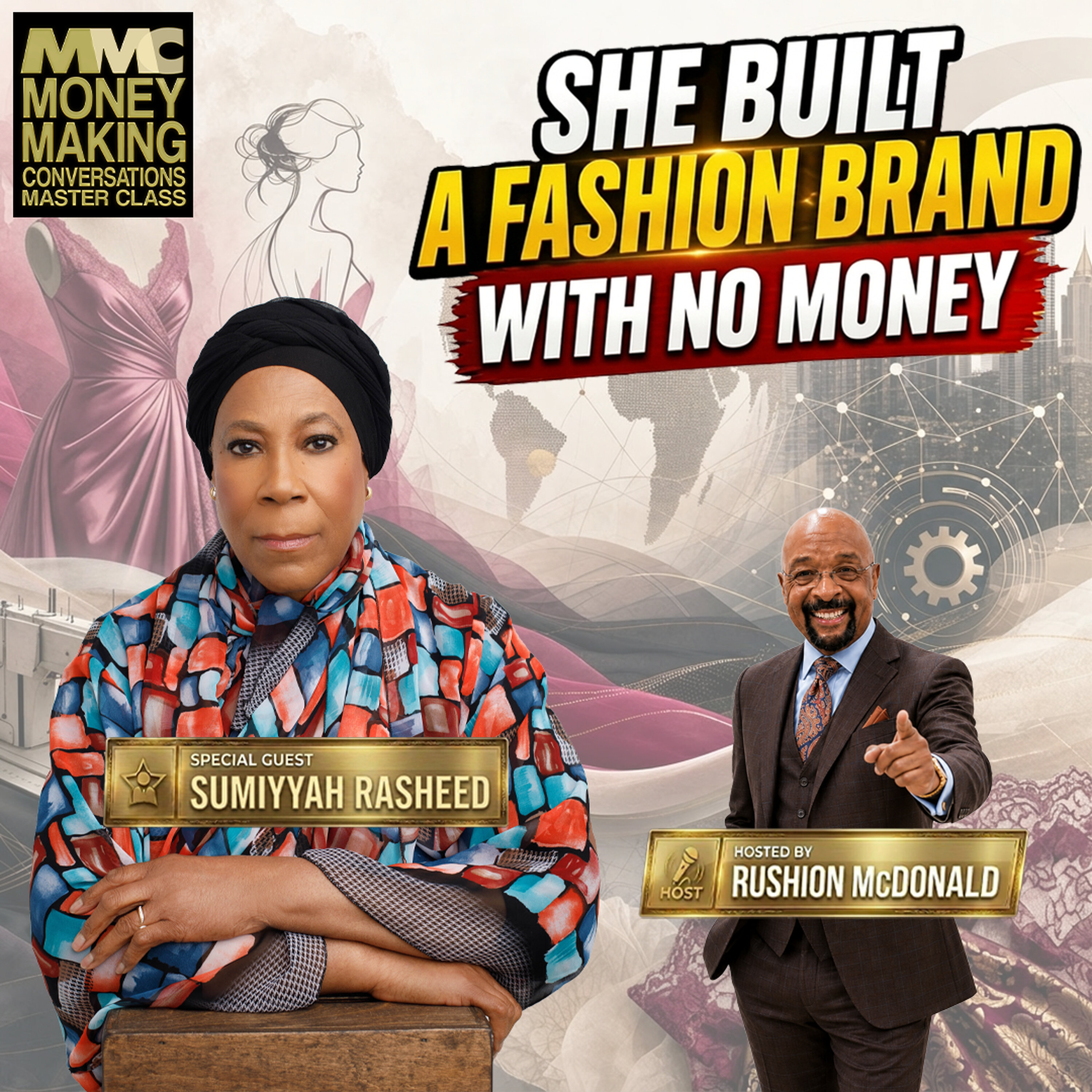
Brand Building: She demonstrates how entrepreneurs can launch and grow businesses without significant startup capital.
33m 40s
The transcription is a podcast episode from "Money Making Conversations Masterclass," hosted by Rishan McDonald, featuring Shia Mia Simea Rashid, a veteran in apparel manufacturing and author of "No Money Startup." Rashid discusses her journey in a male-dominated industry, focusing on full-figure women's clothing as a niche market. She emphasizes that success comes from observation and asking customers about their pain points, rather than relying solely on formal research. Rashid explains how she identified opportunities by noticing gaps in retail, such as limited sizes for plus-size women, and used data to forecast production and improve efficiency. She argues that "cheap is expensive" due to hidden costs like labor and fabric waste, and she competes on quality and speed, not price. The interview covers monetizing skills (e.g., pattern making), the role of data in business decisions, and the importance of resilience—Rashid shares how she pivoted from retail to manufacturing after facing supply shortages. The host underscores common-sense strategies like asking questions and adapting to market feedback. Overall, the episode provides practical advice for entrepreneurs, stressing that expertise can be turned into income through careful observation, data analysis, and continuous improvement, while acknowledging challenges like economic downturns that require business model adjustments.
This is an I Heart podcast. Guaranteed Human. Run a business and not thinking about podcasting? Think again, more Americans listen to podcasts than add supported streaming music from Spotify and Pandora. And as the number one podcaster, I Heart's twice as large as the next two combined, learn how podcasting can help your business. Call 844-844-I Heart. A homeworld cup only happens once in a lifetime. And we are not missing a second. I'm Castle 1021. On the 1021 podcast, me and the crew break down every match like it's personal. The drama, the upsets, the debates you'll be having all day. Soccer, culture, and chaos in one place. Pick a side we already did. Listen to the 1021 podcast on the I Heart Radio app. Apple Podcasts or wherever you get your podcasts. - This is Chelsea Hamler from Dear Chelsea. Every week the news gets worse. The world gets crazier. And Yamanika is here to tell whoever's responsible, you're the problem. If you know I just found out who Sidney Swini was, if he got a bunch of women, then I should have a bunch of men. Do better or do less, so I don't have to do so much. I'm Yamanika and I'm out. Listen to your problem with Yamanika on the I Heart Radio app Apple Podcasts or wherever you get your podcasts. - My first guest is Paris Totten. Shakira, Luke and Yerin. - How surprised. - I have so many surprises. Welcome to the Sweet 305 podcast where the group check comes to life. - What the (beep) - You're the only person I know that loves the Yellow Starburst. - What am I made? - This is Sweet 305. Here, oversharing is encouraged. Listen to Sweet 305 with Lille Ponds on the I Heart Radio app Apple Podcasts or wherever you get your podcasts. - Welcome to my show. I'm Richa McDonald, the host of money making conversations masterclass. When we encourage people to stop reading other people's success stories and start planning your own. Now you don't want to miss an episode. So please take a moment right now to follow or subscribe to a money making conversations masterclass. It's free. You can follow me on I Heart Radio app, Spotify, Apple Podcasts or wherever you listen to your podcasts. New money making conversations masterclass episodes drop daily. I want to keep you on alert because my guests provide tips on how you can uplift your community, improve your financial planning, motivation, or advice on how to be a successful entrepreneur. Now let's get this podcast started. - My guest is a manufacturing executive and technology consultant with more than 30 years of experience in the apparel industry. She's the author of No Money Startup, How to Build an Apparel Manufacturing Company, and she is the founder and CEO of Crescent Consulting Group, Inc. and SWH Apparel and Atlanta-based woman on Apparel Manufacturing Company. Please welcome the money making conversation masterclass, Shia Mia, Simea, Rashid. How you doing Simea? - I'm doing well, how are you? - First of all, you say woman on. Was that important to say that in your intro? - Yes, it is important because in our industry, it's male dominated. In the intimate apparel and in the outer rear apparel, it's male dominated. So there are very few women on this side of the table that own the complete process. So I felt it was important to make that distinction. Because it's really almost kind of like, 'cause when you say that, you say on this side of the table, which means it's the leadership side from the actual application of the putting the material together, the closing together, I'm assuming that's dominated by female. - No, dominated by males. - So on both sides, the actual leadership side and the distribution side, and the actual manufacturing is dominated by males. Why is that? - I don't know. I don't know why men dominated that area because you would think as women, we would say. - Like so. - Basically on the manufacturing side. The distribution I got it because men dominate and the boy is clueless. - Yes, it's a good old boy's clueless. - And it also becomes so realistic. I wanna do business with a guy. Okay, but when the manufacturer application put the material together, where there's shirts, shoes, t-shirts, whatever, I would think that would have been when we would have a major play in that. - No, and that's across the world too. I mean, it's not just here in the United States because when I first got started, I mean, I know how to sew from home economics, but that's a different type of sewing. That's home sewing. So now that you're talking about process, it's production planning, putting pieces together, that's dominated by men. Now the women, now you may have sewing operators that are the women, but when it comes to the production planning, forecasting and the leadership, that's male dominated. And I've met a couple of women in China that actually run large factories, some mid-factories. - So, you know, I'm not bragging. I wear custom-made clothes, shirts, suits, all my suits, you my shoes, a custom-made, because I've learned long time ago, and especially for my shoes, when cheap shoes can hurt your feet. - Right. - And I've also learned that buying a certain shoe at a certain price can last longer. So you're not replacing it that much. - That's correct. - So is that the metaphor with people in clothes, they go cheap and they really want to pay a price for them? - Yeah, because cheap cost, cheap is very expensive. - Okay, yes. - Talk to us about that. - Well, cheap is expensive because, you know, there's downtime, there's loss fabric, there's displaced fabric, you know, labor problems. And so when a factory says, oh, I can do it for you cheap, he's really telling me, "Nickaland, Dine, you and I'm gonna get all your money." Because see, there's a, there are hidden costs behind that. So for me, now people come to me and they say, well, you know, I get my things made in China, I get my things made in India, and I want you to meet this price. But I politely tell them I live in Atlanta, Georgia, my workers are here in Atlanta, Georgia, and I pay US prices. So I am not paying Chinese you on, and I'm not paying Indian rupees. So my price is going to be a little bit higher. I compete with the Chinese, but I don't compete with them on dollars. I compete with them on speed to market and quality. I can run circles around it. And they know, I mean, my customers have never sent anything back to me because they say, wow, you're custom, your work is good. - The business is similar. What clothes do you do? What type of style? - So I started out in, well, chunky girls dresses. And I used to do two suits, well, I used to call them church, my church lady dresses, and I sold them all over the southeast. But then I knew. - You found a niche. - Yes, okay. - That's my niche. - That's, in this business, Chick-fil-A found a niche, okay, chicken sandwiches. Everybody wanted to buy their chicken sandwiches, okay? So reason to say that, 'cause you said, tuck your gear dressing kinda like dip down, like that was a bad thing. It was not a bad thing. There are people selling shoes for people with 20, besides 20 shoes, that's a niche. So you found that, how were you able to find that from a marketing standpoint? - Well, you know, I found it because I set back and looked at the market. - Okay. - I just talked about it. - Yeah, I stepped back and I looked at the retail market and I thought, where are the gaps? What's missing? Where can we plug into? So I began to look at the ladies, you know, I see them, they lived on my street, you know, I see them going to church and, you know, they looked okay, but they didn't look to me. I said, you don't look, I went to them a good. I didn't see that. I saw fluffy, you know, mooo-type things. I said, okay, there's a market right here. And I talked my mother and my father into this. I said, there's a market right there and we could do this. - I would say so when I was managing Steve Harvey, when he dropped a female clothing line, we did for full figure women. So that's why I was just letting you know, is that strategically what you were doing was absolutely correct. You go work a market allows you to have an opportunity. - Yes. - And we saw that, you know, it didn't turn out, 'cause we were a man trying to sell a female brand. We brought his daughters in, but it still didn't work. But we saw that niche market out there because you flender women, petite women, they got all the fashion. - That's exactly right. - I got a size 12 foot, okay. A size nine is always on that shelf. (laughing) - Can I tell you about it, right? - You know what I'm saying, it's always on that shelf, okay? - It looks good to the side. - But not for you. - The size 12, but she was looking a little bit different and they're all gone because they know there's a popular size that they can sell consistently versus the odd size of 12 and up. So from a marketing standpoint, what helps you more observation or research? - Both. But it was more observation because what I did was, when I did a fight the niche, I actually talked, I got a part time job and I talked a guy into paying me full time money and I worked four hours. And by 11 o'clock in the-- - You're a dog right there. (laughing) - Well, I shouldn't talk to him. If he wants to, wait, wait, backtrack. - No less than me. - Get your kitchen. - She's gonna get all your food. (laughing) - So by 11 o'clock, I was out on the street Take a note.
measurements, I would go up to these women, I say, you look like a perfect specimen for my project. May I measure you? Okay. And I did. And I started collecting it back then. It was just spreadsheet. But I began to see it plateaued and I began to see the numbers and see how body shapes were working. So then I went to buyers like, oh, I was trying to, I think the avenue or whoever they were. So I showed up with these spreadsheets and these numbers. And they were like, lady, go away. But see, I would go in their stores. I knew when they had their deliveries. When their deliveries came in, they had sizes 20, 22, 24, 26 and they had about 632s. I noticed that 32s were always gone by the next day that I would, next two days I would go back in and check the inventory. They were gone. I checked the 24s. They were the next ones to go. I said, okay, so a shortage. So I began to take those notes. So then we weren't sewing at that time. We weren't manufacturing. We were buying out of LA and shipping them back here and selling them. But what really pushed us into the manufacturing area was the shortage and the fact that we couldn't get the dresses that we wanted and in a timely manner. So actually, we backed into manufacture. I have a sewing background, a home sewing background. But then a friend of mine, she said, look, you're going to need contractors. You got any pattern makers. Then I hired a designer who kept hanging up on me. I finally told her, I said, can you teach me how to do this? She said, no. Okay, I called her back. I said, okay, she said, I'll take you on. And we came friends. I would fly up to New York and hang out with her. She started really showing me about stitching. And I said, well, why does her money is close? Why do they buy, she said it's a stitching dollar. She said, look at the stitching. Stay with us. More money making conversation masterclass, comment up next. Welcome back to money making conversation masterclass with me, Rishan Megdahl. You know, that's why I always tell, let me just set the stage. I'm turning to Sibia. Rishy, she's the author of the book, no money startup, how to build and a parallel manufacturing company. And she's also the founder and CEO of Cresting Consulting Group. You know, I've been fortunate. I've lived in New York. I love going to the fashion district, Chicago. Right. Los Angeles, I have B black and Sons, which is one of the famous material outlets in the country. I've got my material from that. People tailor my clothes. I'm a big guy. I love going in, looking at that. I love seeing the different styles because you learn about what type of materials are from London and from France. They all make, it's a big difference. It makes a difference on what you buy. Yes. How long it lasts. Yes, sir. What is your favorite material to work with? My favorite material to work with is actually silk. Silk. I like working with silk because of the feel. I'm a tactical person. So when I'm in the wholesale markets or in the mills, an Italian guy noticed what I was doing because I take the fabric and I rub it over my face. I have to feel good. It has to feel silky to me. Once that happens, the guy was like, "Oh, do you want to do it?" He backed up off of me. It was at the show. I go twice a year to Paris to the lingerie show. He backed up because he understood what I was doing. He said, "Okay." He said, "Now I know what you want." I said, "All right." I said, "Now you can bring me the pieces." So I typically work with my Vee Luise line. I work with silk linen. Oh, stop right there. Lend girl. Long juice, stainless straight up. Yeah, right. The best material in the world. Girl, soon you sit down. You just try to. It's all good. It's all good. Now, but if you do a silk and linen blaine, that's fantastic. You don't have to talk about it. I may have to take you along on my field trip. Okay. I'm actually going to Italy in a couple of months to go to a product. I just got back from Italy. Did you go to Prado? Oh. Going to the mills. Because I fell in love with sea Italian blends. Okay. What do I do for my suits? Okay. The Italian blends I love. I love those. They're rich. Yes. In plus they're year round suits. I don't want to get too much into it because I want people to stay with us on this interview. Right. And this interview, a reason I brought you on the show is that your advice I thought was very tied to common sense. But I learned that people don't have common sense. Okay. You know, and one of the questions you had, and I'm going to go through a series of questions that you presented to me that I want the audience to hear your reaction to, you say, how can entrepreneurs identify hidden opportunities in their industries? Oh, you have to do. What you have to do is be observant. That's it. And I find a lot of people make it hard. And just like, you know, you understand the niche very well. You understand fabric. You understand what you want. You know what you want. But a lot of entrepreneurs starting out, you know, they do the pie in the sky thing. I'm down at the sidewalk. I'm watching what the customer wears. I ask the customer questions. What are your pain points? What frustrates you? What don't you like? What aren't you getting? What do you want to see? And the customer tells you what to do. So I don't care what industry it's in. All you have to do is step back and be observant and ask questions. That's it. And most people don't do that. If I had that answer, I would be. We just ask that question because I think that sometimes it's out of embarrassment. Because nobody wants to say what they don't know. But they want to act like they do know. Oh, no. No, because you make a bigger fool of yourself if you act like you know what you don't know. Because see, they're going to shoot all of them. I mean, you're going to expose yourself. I always ask questions. There is no dumb question. If I don't understand, I say, "Please, I said, can you explain it to me?" Now my point is, if you can't explain a technical issue in layman's turn, then you don't know. Yeah. That's fair to me. That's fair to me. Please don't go anywhere. We'll be right back with more money making conversations, Masterclass. Now I need for you to do me a favor. Right now, you'll follow or subscribe to money making conversation. It's free. You can find it on the iHartRadio app, Spotify, Apple Podcasts or wherever you get your podcast. Please do me that favor. Follow or subscribe, money making conversations. Welcome back to money making conversation, Masterclass hosted by me, Rishan McDonald. Let's get back into it. How do you turn expertise into income? Ah, I like this one. So you can monetize any skill. Anything you have can be monetized. Now for us, we turned our skill of cutting, sewing, pattern making, technical design. We turned those skills into money. So those people can come to us all a cart if they can don't want complete manufacturing. They said, "Well, I just need help with pattern making. I have a dollar amount for that." Because everything has a dollar amount. Time to. And a lot of people don't think they have worth. That's what it really kind of frustrates me. There's so many talented people. And then process of putting your book together. I understood the two things. What you're doing can be applied to so many different other professions. Because a lot of people don't understand that. And I always tell people, I always love using Chick-fil-A as an example. Because Chick-fil-A is not really about the chicken. That's not their priority. Service to me is their priority. And they've got it down. They've got it down to the science. You go to it. You say that. And so they understood, "I can't sell a chicken if people can't buy it." And that is a mistake that most people in entrepreneurs, like you say, they want that pines, it's got opportunity. They don't consider the work as tied to it or did your research as tied to it. Because I'm constantly with my company always making changes. I try to make sure they understand that just because we did it this way for three months, don't mean it's the right way. Or it doesn't come with adjustments. And because of that, you know, what role does data play in making money for the long time? And the short term of two long term role. How do you perceive data? Well, I. received data as the crux of my business. I work with major apparel companies across the country working with their bottom line, working with them and forecasting. So it was always important for me to watch the numbers because the numbers will tell you where you have leafages, where there are opportunities, and where you can improve. My position is always how can we be better? How can we have this? How can the data help us be better? Well, for example, like major big box stores, they send over data every week to apparel manufacturers, shoe manufacturers telling them every style, every color, every size, every store, every department across the country. Now, I have to take that data for my client and aggregate and say, "Okay, this is where you need to bulk up on your production." Because see, a lot of times, you see people just throwing things out on the market, internet is just cluttered. They're not reading their data, not at all. Because see, I pull things off my website. You know, I started running the numbers and say, "How many did we sell? What color did we sell? What size did we sell?" That helps me forecast how much fabric do I need to order? When do we need to run production? How much do we need to cut? Now, if those numbers are low, one person bought a size 12, I'm pulling it. To me, that's common sense. The data is going to talk to you all day long, and it's up to you to respond to it. Now, you respond with your production, with your forecasting forecasting is the main thing. Right. And, you know, the interesting thing about forecasting is two things that can happen. It can make you nervous that you may have gotten in the business that's not going to generate your revenue. Right. Not forecasting. You can close doors and not know why. I know in 2023, that's where I always go public about, I was about to close the doors of my business. Because that's what I did for care. I didn't have a business point that makes, either I had a business plan that worked for me, but didn't work for the economic numbers of keeping the doors open. And I had to make changes. Right. So when you're in a business, the fashion business, the apparel business, they're ups and downs. How do you determine the right level of consistency that may take a profit more? Well, say one thing I don't do is follow trends. Okay. Because see, when they zig, I zag. Okay. So I like to look at, again, the pain points. What do women want? Because women, I still, to this day, I still have that whole focus groups. I still get on the phone and talk to them. I have church groups, you know, Muslim women. I talk to the customer. What's happening in your life? What do you all need? They tell you specifically what they want, how they want. Right. Okay. It's good. So what's your definition of success? My definition of success is generating value. And I'm talking about long-term value. And opening the door for other people to come through behind me, just because I'm kicking. I don't want to be the only one. No, you come through behind me. And something that is going to outlast me. I don't, when I die, I don't want my business to die. Okay. I don't want my community to suffer. I wanted to still maintain whether I'm here or not. That business needs to go on. And to me, that's the success. So see, I'm writing now, I started with my son. Now I have my grandson's coming up through the business. And we're teaching. I just started taking him on the road with me. This is how you test fabric. This is what you look for. When you put your hand on it, I also make them pick up needles. I make them pick up for it. I make them sweet. I say, this is where you start. Samir. I was speaking to Samir Rashid. She used to author the book, No Money Startup, How to Build an Apparel Manufacturing Company. She's also founded a CEO of Crescent Consulting Group and SWH Apparel. Are you based in Atlanta? Why Atlanta? Uh-huh. Well, I came to Atlanta because I was really tired of Los Angeles. After 15 years in Los Angeles, what part of Los Angeles were you tired of? Well, we're in a deal range. Okay. I don't think we're in that. Yeah. We're in a deal range. Okay. Santa Monica. So, you know, I was just tired of the husband, Russell of LA. Is it is a different grind? It's a grind. It was really taken up told. And we were, you know, we didn't see ourselves really, we were hustling and grinding, but we didn't see us making progress. So a friend of mine, she said, her name is Samir. She's the same. You've got to check out Atlanta. So, for God's sake. She said, I need to go. She said, don't come back to LA. I said, okay. So, we came and we had a bit of a culture shock. But we settled in. Well, we want a culture shock about Atlanta now. Hold on. Hold on. You know, I'm the sushi kind of girl here. So it's like you were eating a black guy pees at a restaurant. So my mother told me she said she read the South here. Absolutely. Absolutely. Polky dokey. So we got through all of that and we set up shop. We were still manually cutting the scissors in the floor and you know, paper patterns. We were still there. That's when you start in your business, right? Yeah. So how did you start your business with limited capital? You know, it's really just a lot of determination. Really. And asking questions and a willingness to learn and just grit because we didn't have, I think my mother and I used $500 each to kind of jumpstart ourselves. But it was just a lot of asking questions, knocking on doors. I did a lot of traveling because I didn't understand manufacturing. I knew he had to grow, but I didn't know what manufacturing was. I said, well, who's still doing it in this country? You know, it's me. I really, you know, because I, you know, I hear traveling in China. Sometimes when you travel, you really, if you don't travel, you really are kind of stupid because you don't understand how the world works, you know, stereotypes and really dominate your thought process. So talk to us about the experience of how you go about doing business in China. Well, I actually, when I found this guy on the internet, and I said, where do you live? And he said, I live in Hangzhou. I said, how do you get there? I said, how far is it from Shanghai? He says, with three hours, and he explained to me, wrote it in Chinese, mailed it to me. I went over. And I met him. Seriously? Yeah. He says, he says, and I mean, we, we know, how long I've known during 12, 13 years? He says, I am Chinese son. I said, I'm a teacher just like family too. That's fantastic. That's how I got started. I mean, that's the honest truth. There were no research. I didn't know Chinese. So Jerry started teaching me the market and he was connected. He's connected in the apparel industry. So he started taking me behind the scenes. See, most people go to the little malls and he took me behind the scenes. He started showing me how it worked. I've worked, which is really key. So I, one of the reasons I brought you on the show is that, you know, they're like I said, when I was with Steve Harvey, you know, we went and we designed the line and got this sold in major, you know, department stores around the country. But they're also some brands out there where it's already, especially in the leisurewear line, casual wear, it's just a casual wear. That's t-shirts, shorts, jumpsuits that are really popular. If you want to know what casual wear is, it may be pretty rich. It may a JZ rich, you know, and Dame Dash, when he was a partner, was rich at the time too. So that is a great outlet to, because people buy multiple gem pads, gem socks or t-shirts. We found Steve Harvey and I found that black people, these black men, they buy a suit. That's who might stay with them three, four years, 45, another one, even though they wear to death, okay? And proclaim is a Steve Harvey suit, but it was only one in their closet, where they may have had four or five or six outfits that were tied to a P-Deadie brand. Exactly. That nature. And to my understanding, there are brands out there that you can just put a label on. Yeah, because it's what we call blanket, because we do it. I mean, we just make blanket things and we don't put our label in it. So we let the suit, you know, they come to us and we say, okay, if you buy $200 worth, or $300 worth, we'll sew your label in. Okay. Yeah, it's just blanket. Awesome, awesome, awesome. I wouldn't think it was that easy, but you could do that in Atlanta. Yeah, because we don't put the label in. I mean, as long as it's through our styles. So just like the gym.
short-send like we do a line we have an active wear line and we're we're resurrecting it again too. So when we're running production we may do like 500 pieces we say okay 250 is for us 250 will be blank. So they're out there so he will order them. You come you say well here's my label no problem because for years you know we were the people behind the scenes so in these labels and I mean these people are bringing thousands of pieces of from China and they were dumping them on us and all we did with label so label label label label so labels there. Wow you know watch this watch this someone read your book. They should want to read my book because it's going to give you insight into a world that has many people think it's a black hole a magic bullet you know the Wizard of Oz it's not it's processes people the P.P. system but I opened it up so people could see the real world of manufacturing and then understand that it's not as hard as you think it is I mean it's hard but you got to have the grit say I'm not giving up right I'm not gonna back up I'm gonna do this thing. So I think it's important you know because of the fact that I'll tell people man it's some days I don't want to get up oh well yeah you know I'm saying and I get up and 4/3 in the morning and over but I think that it's first time to what is your dream you know what are you trying to accomplish if you're not happy because I always believe that would eventually get to me out of it is what I want to do for that day okay that gets me out of that motivates me and then after a while all I need is one thing to trigger to get me out I've never been a person to hit the snooze button I never understood that and I say okay stay stay staying to be for Timmy or staying to be able to 20 additional means no that's just not me but when you look at the ability that you have you in the business to make money yeah what eventually satisfies you besides money as an actual you know it's the accomplishment and it's the journey and a lot of people just want to skip over the journey and get to the end I do too but for me the rush for me is the journey it's a sweat it's getting to that goal and then too it's the accomplishment that okay you know I actually fulfilled my goal I said I this is what I said I was gonna do the money will come a lot of people chase the money I just don't chase the money anyway I don't know okay we kept his sense of me what is your biggest financial lesson as an entrepreneur if we're not chasing money oh my you know it was understanding the difference between cash understanding cash flow operation management at my cost and revenue you know and profitability because I saw revenue was my profit like no you're broke I've been dead you're just broke because see you spit all your money trying to produce it you haven't made a die but so that was it was real ugly you know and I it's kind of like I had to sit down because I mean we at that point we were we're really financially hurry we look great on paper we look really good on paper but the reality is the cash flow it was just going and at one point my dad came in from California and you know he walked around my my plan and he said this is a good operation so he said but are you making money well that part right yeah I want to talk to you I love it I love it I love it you know I want to thank you for coming to my show some here I know you knew it a little bit but your book I recommended she's the author of the book no money start up no money start up how to build on a parallel manufacturing company she's the founder CEO of Crescent Crescent Consulting Group how can we get in touch with you can get in touch with me by going to our website Crescent Consulting Group but it's grp.com or you could call us 6 7 8 200 5 8 0 9 we give consultation on startup I have a checklist before you run off to India or China and take them $10,000 but we will help people walk through the process and understand what manufacturing is it's not just sewing soon no we're not saying that so it's it's a process. We here thank you for covering on money making conversations. Oh thank you for having me I appreciate it. Thank you for listening to this episode now I need for you to do me a favor right now to follow or subscribe to money making conversation it's free and you can find it on the iHart Radio app Spotify Apple podcast or wherever you get your podcast please do me that favor follow or subscribe money making conversations keep winning a homeworld cup only happens once in a lifetime and we are not missing a second I'm Castle 10 21 on the 10 21 podcast me and the crew break down every match like it's personal the drama the upsets the debates you'll be having all day soccer culture and chaos in one place pick aside we already did listen to the 10 21 podcast on the iHart Radio app Apple podcast or wherever you get your podcasts this is Chelsea Hamler from Dear Chelsea every week the news gets worse the world gets crazier and Yamanika is here to tell whoever's responsible you're the problem do you know I just found out who Sydney Swini was if he got a bunch of women then I should have a bunch of men do better or do less so I don't have to do so much I'm Yamanika and I'm out listen to your the problem with Yamanika on the iHart Radio app Apple podcast or wherever you get your podcasts my first guest is Harris Hilton Shakira look and getting have surprises many surprises welcome to the sweet 305 podcast where the new tech comes to life you're the only person I know that loves a yellow starbursts this is sweet 305 here oversharing is encouraged listen to sweet 305 with little ponds on the iHart Radio app Apple podcast or wherever you get your podcasts hey Portlandia fans Carrie Brownstein and Fred Armas in here the dream of the 90s is alive in podcast form we're launching podlandia a o re watch our brand new podcast where we revisit every episode of portlandia together breaking down sketches going deep on our iconic characters and pulling back the curtain on how it all got made and we'll also be joined by the people who helped bring it all to life guest stars collaborators and friends including director Jonathan Chrysler the mayor himself Kyle McLaughlin legendary musician Amy Mann and many more Kyle is going for it here you fully improvised not just words but a song about I thought you were going to write a song I remember you thinking that listen to podlandia a o rewatch on the iHart Radio app Apple podcast or wherever you get your podcasts
Podcast Summary
Key Points:
Podcasting is a powerful tool for businesses, with I Heart leading the market; the transcription includes multiple podcast promotions (e.g., 1021 Podcast, Dear Chelsea, Sweet 305, Money Making Conversations Masterclass).
The interview features Shia Mia Simea Rashid, a woman entrepreneur in the male-dominated apparel manufacturing industry, emphasizing her niche in full-figure women's clothing.
Key entrepreneurial strategies include observation over research, identifying market gaps (e.g., plus-size fashion), and using data for forecasting and decision-making.
Rashid stresses that "cheap is expensive" due to hidden costs, and she competes on speed to market and quality rather than price.
Monetizing skills, asking questions, and adapting based on customer feedback and data are critical for success.
The conversation highlights the importance of resilience, such as pivoting from retail to manufacturing and using data to adjust production.
Summary:
" Rashid discusses her journey in a male-dominated industry, focusing on full-figure women's clothing as a niche market. She emphasizes that success comes from observation and asking customers about their pain points, rather than relying solely on formal research. Rashid explains how she identified opportunities by noticing gaps in retail, such as limited sizes for plus-size women, and used data to forecast production and improve efficiency.
She argues that "cheap is expensive" due to hidden costs like labor and fabric waste, and she competes on quality and speed, not price. , pattern making), the role of data in business decisions, and the importance of resilience—Rashid shares how she pivoted from retail to manufacturing after facing supply shortages. The host underscores common-sense strategies like asking questions and adapting to market feedback.
Overall, the episode provides practical advice for entrepreneurs, stressing that expertise can be turned into income through careful observation, data analysis, and continuous improvement, while acknowledging challenges like economic downturns that require business model adjustments.
FAQs
More Americans listen to podcasts than ad-supported streaming music from Spotify and Pandora. As the number one podcaster, I Heart is twice as large as the next two combined, so podcasting can effectively reach a large audience.
The 1021 podcast covers the HomeWorld Cup, breaking down every match with drama, upsets, and debates, blending soccer, culture, and chaos in one place.
It's a show where Yamanika addresses who's responsible for the world's craziness, telling them 'you're the problem' and encouraging them to do better or do less.
Sweet 305 brings the group chat to life with oversharing encouraged, featuring surprises and candid conversations.
Hosted by Richa McDonald, it encourages people to stop reading others' success stories and start planning their own, offering tips on community uplift, financial planning, motivation, and entrepreneurship.
Be observant and ask customers about their pain points, frustrations, and what they want. The customer tells you what to do, so step back and ask questions.
Chat with AI
Loading...
Pro features
Go deeper with this episode
Unlock creator-grade tools that turn any transcript into show notes and subtitle files.
 PodcastTranscript AI