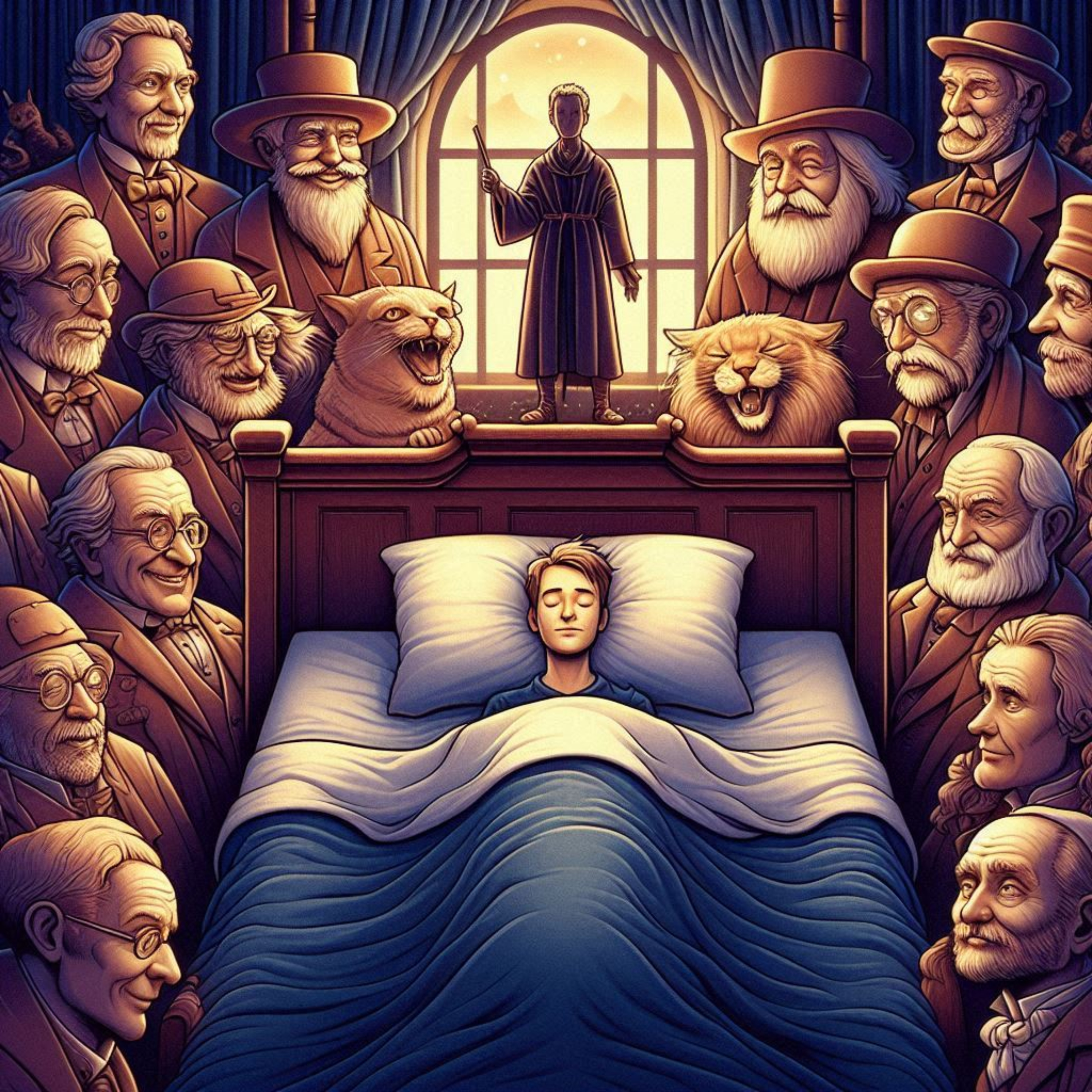
Boring History For Sleep | If You Time Traveled to Medieval Times & More
2h 12m 31s
Margaret Holloway, a meticulous librarian, inadvertently time-travels to a chaotic medieval village after activating an antique astrolabe. Instead of being stranded in a broken past, she finds herself in Kronos Commons—a thriving, cross-temporal community where people from different eras live together, share knowledge, and build a functional society. Initially overwhelmed by the absurdity and disorientation of her situation, Margaret soon realizes that the community operates with remarkable efficiency and empathy, blending historical styles with practical solutions. Through collaborative governance, shared learning, and mutual support, the residents redefine what it means to belong, creating a model of democratic, adaptive community life. The arrival of the Temporal Authority, initially skeptical, is ultimately transformed into a moment of recognition when they see the community’s success firsthand. They grant Kronos Commons experimental status, validating its existence and potential as a blueprint for future time-displaced populations. Margaret’s journey becomes a powerful symbol of personal liberation—her midlife crisis is resolved not by returning to the past, but by embracing a new, authentic life through connection and shared purpose. The story ultimately reflects on the value of human resilience, creativity, and community, suggesting that revolution doesn’t always require intention—it can emerge from simple acts of kindness and shared hope across time. The medieval world, far from romantic, is revealed as a stark contrast to the vibrant, dynamic reality Margaret now inhabits.
Tonight, we're imagining what it would be like if you time travel to medieval times, a world of knights and castles, plagues and feasts, superstition and survival. One moment you're scrolling on your phone the next, you're dodging chamber pots in the narrow streets, wearing scratchy wool and trying to figure out if the bread you just ate is safe, or if it's laced with yogurt. From strange customs to harsh laws, from bustling markets to the looming shadow of the church, this is a world where every day is a test of wits and luck. So take a deep breath, you're about to find out why time travelling to medieval times might not be the romantic adventure you expect. Now, before you get comfortable as always, take a moment to like the video and subscribe to the channel if you haven't already. Also, please let us know where you're watching from and what time it is for you. Whoever is speeding up the time of day and making it fly by, please stop so I don't get old and grey, I'm joking. Now, turn on your night light, grab a warm blanket and let's begin. Margaret Holloway had always prided herself on being the sort of person who read instruction manuals. Particularly for toasters, her insurance company continued to mention the incident from 19 years ago in hushed, traumatized tones. So when she inherited her great art militants peculiar collection of antiques, including what appeared to be a medieval astrolabe made of suspiciously modern materials, she naturally assumed there would be documentation. There wasn't. What there was, tucked behind the device like a guilty afterthought, was a post-it note reading, "Don't touch the blue bits when Mercury is in retrograde." Margaret, who possessed both a master's degree in library science and a healthy skepticism toward astrological nonsense promptly touched the blue bits. It was Tuesday morning, she had already dealt with three passive aggressive emails from her supervisor, a Mercury could frankly retrograde itself into the sun for all she cared. The astrolabe hummed. This was Margaret's first indication that perhaps great art militant had been more eccentric than previously documented. The second indication was the way her kitchen began folding itself inside out like origami designed by a mathematician, having an existential crisis. Oh, Bollocks and Margaret have said, which were destined to be the last word spoken in her ranch-style home in suburban Ohio for approximately 700 years. The world transformed into a pretzel, infused with cosmic salt and offered itself to the universe, accompanied by temporal displacement. Margaret found herself lying face down in what smelled suspiciously like a combination of horses, unwashed humans, and regret. When she lifted her head, she discovered she was wearing a brown woolen dress that itched in places she didn't know could itch, and her sensible flats had been replaced by leather things that appeared to have been crafted by someone who had only heard footwear described secondhand. Around her, a medieval village conducted its morning business with the sort of casual chaos that suggested this was perfectly normal Tuesday behaviour. A man chased a pig while shouting what Margaret assumed were medieval profanities. A woman emptied a chamber pot from a second-story window with the practice name of someone who had clearly done this before. Children played in the dirt with sticks, apparently finding the activity the height of entertainment. Margaret sat up slowly, her librarian instincts immediately cataloging the historical inconsistencies. The architecture was wrong for any specific period she could identify. The clothing was a mixture of styles spanning roughly three centuries. Was the man over there wearing what appeared to be a digital watch? Is this your first time? Asked a voice behind her. Margaret turned to find a woman in her 50s, wearing robes that managed to look both authentically medieval and suspiciously well-tailored. Her smile was knowing and her teeth were far too straight for someone living in the pre-dental era. May I ask for your pardon, Margaret asked? Margaret asked, then immediately regretted it. In her experience begging anyone's pardon in an unfamiliar situation typically led to complications. Time travel, the woman clarified, as if the solution were obvious. You've got that look. You've recently realised that physics is more of a suggestion than a law. I'm Sista Agatha, formerly dot Agnes Whitmore of the Cambridge Medieval History Department, and you're clearly not from around here, temporarily speaking. Margaret stared, "This is impossible." "Oh, honey," Sista Agatha laughed, "a sound that carried distinct notes of hysteria carefully controlled through years of practice. Impossible was last Tuesday. This is just inconvenient. Come on, let's get you oriented before the anachronism please show up." The what now? But Sista Agatha was already walking away, her robe swishing with the authority of someone who had learned to navigate both medieval politics and university bureaucracy. Margaret scrambled to follow her new shoes making sounds like frustrated cats on the cobblestones. As they walk through the village, Margaret noticed more inconsistencies, a blacksmith hammered what looks suspiciously like a smartphone case. A merchant sold authentic medieval remedies from bottles that clearly bore modern safety seals, and everywhere people moved with a particular sort of resigned efficiency that Margaret recognised from her office environment. Right, Sista Agatha said, stopping outside what appeared to be a tavern with a sign reading the Temporal Refugee. Here's the situation. Welcome to Kronos Commons, the accidental dumping ground for temporal tourists, displaced individuals, and the generally temporarily confused. We've got Romans, Victorians, a perplex gentleman from 1623 who keeps asking about the location of the nearest Starbucks, and last week we acquired a flapper from the 20s who has already revolutionised our cocktail menu. Margaret felt a familiar sensation that she usually associated with faculty meetings. The gradual realisation that she was trapped in something that made no sense, but would somehow become her responsibility. "How do I get home?" she asked. Sista Agatha's smile took on the sort of kindness typically reserved for delivering catastrophic news. Well, that's the question, isn't it? Some people figure it out, others don't. But the good news is, we've developed quite a nice little community here. We've got running water, thanks to a Roman engineer, decent food, courtesy of a Victorian chef, and surprisingly progressive social policies implemented by a group of suffragettes who arrived last spring. Margaret looked around at the village with new eyes. It wasn't medieval at all, she realised. It was something entirely new, a place where time had hiccuped, collected its mistakes, and decided to make the best of things. "How long have you been here?" she asked. Five years is a subjective time. It could be five minutes or five decades in the real world. Time is a bit wobbly here. Sista Agatha shrugged, but I've got to say, the research opportunities are unparalleled. Where else can you get primary source material from actual primary sources? Margaret felt herself beginning to panic, which was unfortunate because panic had never been particularly useful in her experience. But I have a job, I have a mortgage, I have a cat, had Sista Agatha corrected gently. Plus, tense is crucial when you're dealing with temporal displacement, but look on the bright side. No more mortgage payments. The temporal refugee turned out to be precisely what it sounded like. A tavern for people who had accidentally fallen through the cracks in time, and were making the best of it varying degrees of success. The proprietor was a cheerful woman named Gladys, who claimed to be from 1943, and had arrived during the blitz expecting to find an air raid shelter. Instead, she'd found herself the accidental mayor of history's most confused municipality. New arrival, Gladys announced as Sista Agatha led Margaret through the door. Welcome to the club that no one desired to join, yet everyone inextricably finds themselves a part of. The first drink is free, the second is on credit, and the third is your responsibility because you should know our economy by then. The tavern's interior was a fascinating collision of architectural periods, due to beams supported what appeared to be art deco-light fixtures, while Roman mosaics decorated floors laid with Victorian tiles. The overall effect was like walking into time and having an identity crisis. At a corner table, a man in what looked like 18th century clothing was engaged in animated conversation with a woman wearing a 1960s mod dress, and a Roman centurion who had apparently decided to keep his armour, but update his attitude. Their discussion appeared to centre around the best methods for organising a democratic government, when your citizenry spanned roughly 2000 years of political evolution. That's our steering committee, Sista Agatha Thierry explained. We found that representative democracy works surprisingly well when everyone's equally confused about the present situation. Thomas, who hails from the year 1776, arrived shortly after signing a document he describes as terribly important, which is why he has strong opinions about governance. Veronica, who is from 1967, holds strong opinions on a wide range of topics. Marcus has strong opinions about military organisation, primarily suggesting that all disputes should be settled through combat. Margaret accepted a drink from Gladys that tasted like it had been invented by someone who remembered alcohol fondly, but had to work with medieval ingredients. Although it wasn't entirely unpleasant, the drink felt like a metaphor for her entire situation. So how does this work, Margaret asked? The day to day I mean, you can't all just sit around drinking and forming committees. Oh heavens no, Gladys laughed. We've got quite the economy going. It turns out when you put together people from different times, you get a lot of useful knowledge exchange. Marcus taught us Roman construction techniques, which the Victorian engineer improved with modern material science, which
Thomas enhanced with democratic labour practices, which Veronica revolutionised with modern efficiency methods. She gestured toward the window where Margaret could see people working on what appeared to be a construction project involving both medieval stonework and suspiciously modern looking plumbing. "We're building a proper town hall," Sister Agatha explained, "complete with meeting rooms, a library, and what Veronica insists on calling a social services department. Apparently temporal displacement comes with its own unique set of bureaucratic needs. But surely someone's trying to get home," Margaret asked. The tavern went quiet in a way that suggested she'd touched on a sensitive subject. Gladys polished a glass with unnecessary intensity, while Sister Agatha developed a sudden interest in the pattern of the tablecloth. "Well," Thomas said from the corner table, "is colonial American accent carrying clearly across the room? That's rather the central question, isn't it? Some folks spend all their time trying to figure out the way back. Others come to the conclusion that staying in the present isn't necessarily a bad thing. And some, he trailed off. Some, Margaret prompted. Some discover that home isn't quite what they remembered," Veronica finished, "a London accent crisp despite the anachronistic setting." Turns out when you've been gone for subjective years, certain assumptions about what you want to return to start looking rather questionable. Marcus, the Roman centurion nodded gravely. "I was fleeing Gaul when I arrived here. The situation which involved a superior officer's wife and a misunderstanding about Roman marriage customs was rather embarrassing. Point is, going back would involve considerably more crucifixion than I'm comfortable with." Margaret felt the weight of her life settling around her like an ill-fitting coat. Her job at the library, while stable, had become increasingly automated and decreasingly fulfilling. Her marriage had ended two years ago when her husband discovered that his midlife crisis required a motorcycle and a 25-year-old named Crystal. Her mortgage was for a house that had always felt too large for one person and too small for the life she'd imagined she'd have. "How do you know if you want to go back?" she asked quietly. "That," said Sista Agatha, "is the question everyone asks, and nobody can answer for anyone else. But I will say this. In five years here, I've published more original research than I did in 20 years at Cambridge. It turns out that primary source material is much easier to obtain when your sources are sitting at the next table. Glad is set down her glass and leaned against the bar. I've been thinking about that night in London when I ended up here. The sirens were going off, bombs were falling and I was more terrified than I'd ever been in my life. But I was also more alive than I'd felt in years. Three years had passed since my husband's death. My children had grown and left and I was merely existing. You need me here. I'm building something. But don't you miss it," Margaret asked. "You're real life?" "This is my real life," Gladys said simply. The other one was just what happened before I started living. The tavern door abruptly opened, suggesting either extreme urgency or poor door maintenance. A young man stumbled in wearing clothes that looked like a confused merger between medieval peasant wear and what Margaret was beginning to recognise as the standard issue temporal refugee uniform. Emergency committee meeting, he announced breathlessly. We've got anachronism, policing coming, and they're asking about unauthorised timeline modifications that tavern erupted into organised a chaos. Thomas immediately began drafting what he called "emergency protocols for democratic crisis management." Veronica started organising people into what she termed "efficiency groups." Marcus began discussing defensive strategies that involved words like "falanx" and "tactical retreat." Anachronism police, Margaret asked Sister Agathas about the commotion. Time travels governing body, Sister Agathas explained grimly. Consider them to be the universe's hall monitors, but with the authority to erase entire timelines if they think things have gotten too messy. They don't like places like this. Too many variables, too much potential for paradox. What do they do? Best case scenario? They relocate us to approved temporal zones. Worst case scenario? They decide we're too much of a risk and Sister Agathas made a gesture that could be interpreted as either poof or obliteration. Margaret felt that familiar librarian instinct kicking in. The one that appeared whenever someone threatened to reorganise her carefully maintained systems without consulting her first. It was the same feeling she got when patrons tried to return books to the wrong shelves, or when her supervisor suggested "improving efficiency" through methods that would clearly make everything worse. Right, she said, surprising herself with her decisiveness, what actions are necessary? The emergency committee meeting took place in what Gladys optimistically called the community centre, which was actually the tavern with the tables pushed together and everyone trying to look official, although half of them were drinking ale at 10 in the morning. Margaret found herself appointed as Secretary of Records primarily because she was the only one present who knew what carbon paper was, and could also operate the hand cranked printing press that a Victorian gentleman named Nigel had constructed from memory and spare parts. Right then, Thomas said, calling the meeting to order, with the sort of gravitas that suggested he'd had practice at this sort of thing. Jeremiah, report. Jeremiah, the young man who'd brought the news, stood up and consulted what appeared to be notes written on bark. Three inachronism police officers arrived this morning via what looked like a temporal vortex disguised as a travelling merchant's wagon. They were staying at the inn and asking questions about unauthorised timeline modifications and dangerous temporal accumulations. Dangerous temporal accumulations, sister Agatha repeated thoughtfully. That's what they call places like us. We have an excessive number of individuals from various areas residing in one place. We're apparently creating what they term chronological instability. Bollocks, said Veronica firmly. We're creating a chronological community, there's a difference. Marcus nodded approvingly. In Rome, we had a saying, "When the bureaucrats arrive, hide the wine and sharpen the swords." We're not hiding wine or sharpening swords, Thomas said quickly. We're civilised people having a civilised discussion about how to handle a bureaucratic situation through proper democratic channels. Have you met "bureaucrats", Gladys asked dryly? In my experience, proper democratic channels work about as well for people in London during the blitz as they do now. That is not at all and you mostly have to muddle through and hope for the best. Margaret found herself taking detailed notes, partly out of professional habit and partly because writing things down helped her think. As she wrote, patterns began to emerge. The anachronism police seemed concerned about their community's effect on the timeline, but from what she could gather. They hadn't actually done anything to affect it. They were just living their lives in a place that technically shouldn't exist. What exactly is the timeline we're supposedly affecting, she asked? The room went quiet. Margaret was beginning to recognise this particular type of silence. It was the same one that occurred in library staff meetings when someone asked obvious questions that revealed fundamental problems with the entire system. "Well," sister Agatha said slowly, "that's rather complicated. See, technically none of us should be here. We should all be in our original times, living our original lives, making our original contributions to history. But we're not affecting our original times," Margaret pointed out. "We're not there. If anything, our absence should have more impact than our presence here." "Ah," said Nigel, the Victorian engineer. "Speaking up for the first time, that's where it gets intriguing. My research, which I've dedicated a significant amount of time to, indicates that our disappearances have received compensation. Compensated how," Thomas asked. "Replacements," Nigel said simply. "The timeline has generated substitute versions of us to fill the gaps we left behind. My wife believes I died in a factory accident. Sister Agatha's university believes she took early retirement. Margaret's library believes she moved to Florida to care for an elderly relative. Margaret felt a chill that had nothing to do with the medieval heating system. So there's another version of me living my life. A timeline generated approximation, Sister Agatha confirmed, close enough to maintain continuity, but not actually you, think of it as "temporal auto-correct." That's deeply unsettling," Margaret said. "Welcome to time travel," Gladys said cheerfully. "Nothing about it makes sense, and the more you think about it, the more you realise that sense was always overrated anyway." The meeting continued for another hour, with various committee members proposing solutions that ranged from diplomatic negotiation, Thomas, to strategic misdirection, Veronica, to trial by combat, Marcus predictably. Margaret found herself thinking about the other version of herself living in her house doing her job and presumably feeding her cat. Was that version of her fulfilled? Was she living the life Margaret had been too afraid to lead? "I propose," she said, interrupting a discussion about the proper protocol for addressing temporal law enforcement, that we find out what the Anachronism Police actually want before we decide how to respond to them. Revolutionary thinking, Veronica said approvingly, "Gather intelligence before forming strategy. I like her." "It's called reconnaissance," Marcus added. "Basic military procedure." "It's called common sense," Gladys said, "but I suppose that's revolutionary enough in most situations," Thomas nodded thoughtfully. Margaret raises an excellent point. "We've been assuming they want to shut us down or relocate us, but perhaps their concerns are more specific," Jeremiah, what a good day.
exactly where they are asking about. Jeremiah consulted his bark notes again. They wanted to know about unauthorized historical documentation, anachronistic technological development, and unsanctioned temporal education programs. Margaret felt her librarian instincts tingling. Those are very specific concerns, not general timeline protection, specific activities. Sister Agatha has been writing papers about medieval life based on direct observation, Nigel said slowly. "I've been developing hybrid technologies using knowledge from multiple times, and we've all been sharing knowledge across historical boundaries. We've been learning from each other," Margaret said, and apparently that's what they're worried about. The room fell silent again, but this time it was the thoughtful silence of people realizing they were in more trouble than they'd initially understood, but also possibly more right than they dared to hope. So, Thomas said finally, "We're not just temporal refugees, we're temporal revolutionaries. Accidental temporal revolutionaries or sister Agatha corrected." The best kind, for Anca said, with satisfaction. Nobody expects the accidental revolutionaries. Margaret looked around the room at her fellow temporal misfits and felt something she hadn't experienced in years, the sense that she was precisely where she was supposed to be doing exactly what she was supposed to do. She appeared to be tasked with challenging the fundamental principles of temporal law enforcement by radically establishing a functional community. "Right then," she said, surprising herself again with her decisiveness. "Let's go talk to these anachronism police and find out exactly what kind of revolution we're accidentally leading, based on her experience with various forms of bureaucratic authority." Margaret expected the anachronism police to be polite, efficient, and firmly convinced that their approach was the only logical one. They had taken up residence in the villages only in, which was run by a cheerful woman from the 14th century who had adapted to her unusual clientele by developing what she called a flexible approach to customer service. The three officers were sitting in the in's common room when Margaret's diplomatic delegation arrived. Thomas had insisted on formal protocols. Veronica had insisted on strategic positioning and Marcus had insisted on bringing weapons. Ceremonial purpose is only, he assured them, while checking the edge on his Gladius. Margaret had insisted on bringing tea service because, in her experience, any difficult conversation went better with proper refreshments. The lead officer was a woman who introduced herself as Inspector Cronos, which Margaret suspected was either an assumed name or evidence that the anachronism police had a department devoted entirely to ironic nomenclature. She was wearing what appeared to be a uniform designed by someone who had been told to create timeless professional attire and had interpreted the term as a boring grace suit that could plausibly exist in any century. Thank you for meeting with us. Inspector Cronos said, as Margaret arranged the tea service on the in's largest table, we appreciate your cooperation in this matter. Our pleasure, Thomas replied smoothly. Though I confess, we're uncertain about the nature of the matter that requires our cooperation. Inspector Cronos consulted a tablet that definitely hadn't existed in any time period Margaret could identify. You're aware that this settlement exists in violation of several temporal chords. We weren't aware there were temporal chords, sister Agatha said mildly. Perhaps you could enlighten us. Margaret poured tea while listening to Inspector Cronos explain the complex legal framework that apparently governed time travel. According to the temporal chords, an authorised time travel was prohibited, temporal settlements were forbidden, and cross temporal knowledge sharing was considered a class three chronological offence punishable by timeline rehabilitation. Timeline rehabilitation sounds ominous, Veronica observed. It's a humane process, Inspector Cronos assured her. We simply relocate individuals to appropriate temporal zones where they can live productive lives without disrupting historical continuity. Separate us you mean, Margaret said, offering the sugar cubes, send us back to our original times whether we want to go or not. The personal preferences of temporarily displaced persons are secondary to the stability of the timeline Inspector Cronos replied, accepting her tea with the sort of politeness that suggested she'd been trained in diplomatic protocols but found them tedious. Margaret felt that familiar librarian anger rising. The specific fury that came from dealing with people who prioritised systems over people and called it necessary efficiency, and who decided that timeline stability was more important than personal autonomy? Inspector Cronos looked genuinely puzzled by the question. The temporal authority, of course, timeline stability maintains the proper order of historical events. Whose proper order, Thomas asked? His colonial revolutionary instincts clearly activated who gave this temporal authority the right to determine how people should live their lives. The authority derives from temporal law, which exists to prevent paradoxes and maintain historical accuracy Inspector Cronos explained patiently as if speaking to children who couldn't understand basic concepts. Historical accuracy according to whom, sister Agatha asked. I've spent five years here conducting primary research that's revealed significant errors in accepted historical narratives. Are you more interested in preserving factual accuracy or in upholding your own interpretation of accuracy? Margaret watched Inspector Cronos' face carefully. Years of dealing with library patrons had taught her to recognise the exact moment when someone realised their position might not be as unassailable as they'd assumed. Inspector Cronos was having that moment right now. Your research is part of the problem, one of the other officers said, speaking for the first time. You're creating unauthorised historical documentation that could alter scholarly understanding of past events. You mean it could improve scholarly understanding, Margaret said sweetly, refilling his teacup? Isn't that what research is supposed to do? Not when it disrupts established historical consensus, the officer applied. Established historical consensus has been wrong before Veronica pointed out. I should know I lived through the 60s and the established historical consensus about that decade is almost entirely bollocks. Margaret could see that this conversation was heading toward the sort of philosophical impasse that typically resulted in either violence or very long meetings. In her experience, violence was messier, but often more efficient than meetings. However, both typically ended with someone feeling aggrieved and nothing actually resolved. Inspector Cronos, she said, interrupting would appear to be the beginning of a lecture about the importance of historical stability. May I ask you a personal question? Inspector Cronos looked wary. I suppose. When did you last have a vacation? The question clearly wasn't what Inspector Cronos had expected. I-- that's not relevant to this investigation. Humor me, Margaret said, employing the same tone she used with particularly stubborn library patrons. When did you last take time off from work? Temporary authority agents don't take vacations. Inspector Cronos said stiffly, we have important work to do. "Everyone needs time off," Margaret said gently. "Otherwise work becomes the only thing that gives life meaning, and that's not healthy for anyone. Trust me, I speak from experience." She gestured around the end's common room, where the afternoon light was streaming through windows that had been designed by someone from the 18th century, built by someone from ancient Rome, and decorated by someone from the 1960s. The result was chaotic but somehow harmonious, like a visual representation of their entire community. "This place works," she said. "We have people from a dozen different times living together, sharing knowledge, building something new. We're not disrupting the timeline. We're creating something the timeline never had before, something beautiful." "Unauthorized beauty is still unauthorized," Inspector Cronos said, "but her voice lacked conviction." According to the Temporal Accords, yes, Margaret agreed. Have you considered that the Temporal Accords might be wrong? The silence that followed was different from the previous uncomfortable silences. This silence was the result of someone who had blindly followed the rules for years, suddenly forced to question their logic. "The Accords exist for good reason," Inspector Cronos said finally. "I'm sure they do," Thomas said diplomatically. "The good reasons can become bad reasons if circumstances change. In my experience, the best laws are the ones that can adapt in new situations. What if, sister Agatha suggested carefully? Instead of shutting us down, you studied us. We could be a pilot program for controlled cross-temporal community development, think of the research opportunities." Margaret could see Inspector Cronos wavering. Years of bureaucratic training were warring with what appeared to be genuine curiosity and possibly the first intriguing conversation she'd had in decades. That would require authorization from the Temporal Authority. Inspector Cronos said slowly. "Then let's get authorization," Margaret said briskly. "I assume there's some sort of application process." Inspector Cronos stared at her. "You want to apply for legal recognition as an experimental temporal community? Why not?" Margaret shrugged. "We're already here. We're already functioning. And apparently we're already breaking the rules." Might as well break them officially. Applying for legal recognition as an experimental temporal community turned out to involve approximately 17 different forms, each of which had to be filled out in triplicate using writing implements appropriate to the time period of the person.
person filling them out. Margaret found herself wielding a quill pen for the first time in her life, while cursing whoever had decided that bureaucracy should be deliberately difficult. This is ridiculous, Veronica muttered, struggling with what appeared to be a form designed to assess cross-temporal cultural integration protocols. They want to know our policy for resolving conflicts between Roman law and Renaissance banking practices. We don't have conflicts between Roman law and Renaissance banking practices, Thomas pointed out. Working his way through a form about democratic governance in multi-de period communities, with a sort of methodical precision that suggested he'd had experience with colonial paperwork. Exactly, sister Agatha said. Marcus Handel's military justice, Nigel Handel's infrastructure disputes, you handle governance issues, and Gladys Handel's everything else because she's the only one who's actually good at managing people. Margaret looked up from form 47b, justification for temporal cohabitation, and realised something important. They hadn't just accidentally created a community, they'd accidentally created a functioning government, and not just any government, but one that actually worked because everyone involved was too confused and too practical to waste time on politics, we need to document this, she said suddenly. Document what? Inspector Cronos asked. She had remained at the end to oversee the application process, but Margaret suspected that her primary reason for staying was her interest in their community, which she found far more engaging than her usual assignments. This is how we govern ourselves. Margaret explained reaching for a fresh sheet of paper. If we're applying to be an experimental community, we need to show that our experiment actually produces results. Over the next several hours, Margaret found herself doing what she did best, organising information. With input from the others, she documented their decision making processes, their conflict resolution methods, their resource allocation systems, and their integration protocols. What emerged was a picture of a community that had organically developed solutions to problems that political scientists spent decades debating. This is extraordinary, Inspector Cronos said, reading over Margaret's documentation. You've created a functional multi-temporal democracy with built-in cultural sensitivity protocols and adaptive governance structures. We've muddled through Gladys corrected, bringing them all another round of tea. We've made the best of it, just like anyone else who finds themselves in an unexpected situation. But that's precisely the point Inspector Cronos said, excitement creeping into her voice for the first time since Margaret had met her. Most temporal displacement results in psychological trauma, cultural isolation, and eventual breakdown. You've created something that not only works, but actually enhances the lives of everyone involved. Margaret looked around the Inns' common room, where their impromptu government session had attracted an audience of curious community members. Marcus was explaining Roman military organisation to a group that included a Viking warrior, two medieval merchants, what appeared to be a flapper who had arrived just that morning. Nigel was sketching engineering diagrams on a napkin, while a renaissance artist offered suggestions about aesthetic improvements. Thomas and Veronica were deep in discussion about the practical applications of democratic theory, with a gentleman who claimed to be from the court of Louis XIV. It works because we need it to work, and Margaret said, "We can't go home, so we have to make this place home, and that means figuring out how to live together even when we come from entirely different worlds." "The temporal authority should see this," Inspector Cronos said. "They've been trying to solve the problem of a temporal displacement for centuries, and you've accidentally discovered the solution." "What's the problem with temporal displacement?" Sister Aga then veered asked. "Displace persons typically suffer from severe temporal culture shock," Inspector Cronos explained. "They can't adapt to their new time, but they can't return to their original time, either. Most end up in specialized care facilities or isolated temporal reservations." Margaret felt a chill. "Temporal reservations?" Quarantine zones where displaced persons can live out their lives without affecting the timeline, Inspector Cronos said, apparently not noticing the horror on everyone's faces. It's considered the most humane solution. Humane, Thomas repeated flatly. "You isolate people from society and call it humane. It's better than the alternative," Inspector Cronos said defensively. "Uncontrolled temporal displacement can cause paradoxes, timeline disruptions, and even reality cascades." "Has that actually happened?" Margaret asked. "Or is it theoretical?" Inspector Cronos paused. "Well, theoretical. But the risk is theoretical," Margaret finished. Meanwhile, the reality is that you're condemning people to isolation based on theoretical risks. She stood up feeling the same sense of righteous indignation that had sustained her through years of fighting budget cuts and bureaucratic interference at the library. Inspector Cronos "I think it's time the temporal authority met with some people who have actually made temporal displacement work." "You want to petition the temporal authority directly?" Inspector Cronos asked, looking alarmed. "I want to invite them to visit," Margaret corrected. "Let them see what we've built here. Let them meet our community. Let them understand that temporal displacement doesn't have to be a problem to be managed. It can be an opportunity to be embraced." The room went quiet again. But this time it was the excited silence of people who had just realised they were about to do something either very brave or very stupid and weren't entirely sure which. "That," said Veronica slowly, "is either brilliant or completely insane. In my experience," Gladys said cheerfully, "the best ideas are usually both." Inspector Cronos looked around the room at the faces of people who had accidentally revolutionised temporal community planning and were now proposing to take their revolution directly to the highest levels of temporal authority. Margaret could see her trying to calculate the potential consequences, weigh the risks against the benefits and figure out whether supporting this plan would advance or destroy her career. "I'll need to send a preliminary report first," she said finally. "Prepare them for the possibility of an unconventional solution to the displacement problem." "Unconventional solutions are the best kind," Marcus said approvingly. "In Rome, we had a saying, when conventional tactics fail, try something so unexpected that your enemies defeat themselves through confusion." Did Romans actually say that, Thomas asked? "No," Marcus admitted cheerfully, "but they should have. It's excellent advice." Margaret looked at Inspector Cronos, who was staring at their community with the expression of someone who had come to enforce the rules and instead discovered that they might need changing. "Inspector," she said gently, "when did you last do something that made you excited about your work?" Inspector Cronos was quiet for a long moment. "I can't remember," she said finally. Then maybe it's time to try something new, Margaret suggested. Maybe it's time to help us show the temporal authority that some problems are actually opportunities in disguise. The temporal authority's response to Inspector Cronos' preliminary report arrived three days later in the form of what appeared to be a medieval messenger, who rode a horse that moved slightly too smoothly and cast no shadow. The message itself was written on parchment that looked authentic but felt like high-quality printer paper, and the ink had the peculiar property of remaining wet until someone read it, at which point it dried instantly. Margaret had become fascinated by these temporal inconsistencies. Everything about the temporal authority seemed designed to look period-appropriate while functioning with modern efficiency, as if they couldn't decide whether they wanted a blend in with history or transcended entirely. They're sending a delegation, Inspector Cronos announced, reading the message allowed to the assembled community. Senior Inspector Paradox, Inspector Corsality, and Director Temporal will arrive tomorrow to assess the viability of Cronos' commons as an experimental temporal community. Director Temporal, sister Agatha asked, "That's either a critical person or someone with a deeply unfortunate name." "Both," probably, Veronica said, "in my experience the most important bureaucrats always have the most ridiculous titles." Margaret felt the familiar flutter of anxiety that preceded any important inspection, whether it was library auditors, health department officials, or apparently temporal law enforcement, but underneath the anxiety was something else, excitement. For the first time in years she was part of something that mattered, something worth further fighting for. Right then, she said, standing up with the sort of decisiveness that surprised everyone, including herself. We have one day to prepare for the most important visitors this community has ever received. I suggest we show them exactly what we've accomplished here. The next 24 hours passed in a blur of organised chaos that would have made any event plan a week with either admiration or despair. Gladys organised a feast that showcased culinary techniques from 12 different times. Nigel provided the entire village with a comprehensive overview of infrastructure improvements, highlighting the innovations that emerged from the fusion of Roman engineering, Victorian precision, and modern material science. Thomas prepared a presentation on their governance structure that managed to be both academically rigorous and practically applicable. Margaret found herself coordinating the entire effort, which felt remarkably similar to organising the library's annual fundraising gala, except with more times involved and significantly higher stakes. She discovered that her years of managing library events had prepared her surprisingly well for managing temporal diplomacy. The delegation arrived precisely at noon.
stepping out of what appeared to be a traveling merchant's wagon that definitely hadn't been there moments before. Director Temporal turned out to be a woman who looked like she could have been anywhere between 30 and 300 years old, wearing robes that managed to suggest both medieval authority and modern professionalism. Senior Inspector Paradox was a tall man with a sort of precisely groomed appearance that suggested he took temporal regulations very seriously indeed. Inspector causality was younger, with the eager expression of someone who had recently been promoted and was determined to prove worthy of the position. Welcome to Kronos Commons, Margaret said, stepping forward with the sort of confidence she usually reserved for dealing with particularly difficult library board members, we're honored by your visit. Director Temporal looked around the village square where the community had assembled to greet their visitors. Her expression was carefully neutral, but Margaret caught her pausing to study the architectural innovations, the way people from different times were naturally interacting and the general atmosphere of purposeful activity. Inspector Kronos has submitted a preliminary report suggesting that this community represents a viable alternative to traditional temporal displacement protocols, Director Temporal said. We're here to assess the accuracy of that assessment. We'd be delighted to show you around, Thomas said, stepping forward with colonial diplomatic charm. Perhaps we could begin with our governance centre. What followed was the most unusual tour Margaret ever participated in. They showed the delegation their democratic decision-making processes, their conflict resolution methods, their resource allocation system and their integration protocols. At each stop, community members demonstrated not just how their systems worked, but why they worked. The key insight, sister Agatha explained as they stood in what had become their informal receipt urge centre, is that temporal displacement doesn't have to mean cultural isolation. When you put people from different times together, they don't just adapt to each other, they enhance each other. She gestured to a wall covered with research notes, engineering diagrams, artistic collaborations, and what appeared to be a detailed analysis of democratic theory written in four different languages by authors from four different centuries. We're not just preserving historical knowledge, she continued. We're creating new knowledge by combining historical perspectives in ways that have never been possible before. Inspector Corsality was taking in in mild notes, while senior Inspector Paradox maintained an expression of professional skepticism. Director Temporal, however, was studying the research wall with the sort of intense focus that suggested she was seeing something she hadn't expected. "This is unprecedented," she said finally. "Cross-temporal knowledge synthesis on this scale. The implications are extraordinary. The implications are what we live with every day," Gladys said cheerfully, appearing with a tray of refreshments that somehow managed to appeal to taste preferences from across the centuries. Turns out when you stop worrying about the implications and start focusing on the practicalities, most problems solve themselves. The tour continued through the afternoon, with the delegation observing everything from Marcus' conflict resolution sessions, which involved more shouting than Margaret was comfortable with but seemed to work. To Nigel's engineering workshops, which had produced innovations that probably shouldn't have been possible with available materials, however Margaret was aware that the evening feast would determine the success or failure of their argument. As the community gathered around tables that have been built by combining Roman construction techniques with Victorian craftsmanship into modern ergonomic principles, she watched the delegation observe something that couldn't be documented or measured. The simple fact that their community was genuinely happy. "I have a question," director temporal said as the meal wound down, "what happens when someone wants to leave?" The question lingered in the air, a kin to an uncomfortable truth that everyone had been evading. Margaret felt her stomach clenched because this was the one aspect of their community they hadn't fully addressed. "Well," Thomas said slowly, "that's rather complicated. We haven't actually figured out how to leave, even if someone wanted to. But would you, inspector, cause a letter to ask? "Want to leave, I mean? If you could," Margaret looked around the table at faces that had become more familiar to her than her family. These people had become her colleagues, her friends, her chosen community in a way that her old life had never provided. "I think," she said carefully, "that's the wrong question. The right question is, would we want to go back to the lives we were living before we came here?" And the answer to that question, director temporal asked, Margaret smiled. Asked me tomorrow, "the temporal authorities decision came in the form of an official proclamation that somehow managed to be both bureaucratically precise and genuinely revolutionary." Crenos Commons was granted experimental status as the first authorised cross-temporal community development project with funding, legal recognition, and most importantly, official permission to continue existing. "Congratulations," director temporal said, "presenting Margaret with a document that looked like a medieval charter but contained clauses about innovative temporal integration methodologies and sustainable and agronistic community planning. "You've accidentally solved a problem we've been working on for centuries. You've accidentally solved several problems," Veronica corrected. "Temporal displacement, cross-cultural integration, sustainable community development, and Margaret's midlife crisis. Margaret laughed because it was true. Somewhere between organising emergency committee meetings and negotiating with temporal bureaucrats, she had discovered that her midlife crisis hadn't been about her age or her circumstances. It had been about the fact that she hadn't been living a life that felt like her own." "So what happens now?" she asked. "Now," director temporal said, "you become a model for other temporal displacement situations. We'll be sending observers, researchers, and probably a few more accidental time travelers your way. You're going to be busy." "We're already busy," Gladys pointed out, "but we're good at busy. Busy is what happens when you're doing something that matters." As the temporal authority delegation prepared to leave, Inspector Cronos approached Margaret privately. "I've submitted a request for reassignment," she said. "I'd like to stay here as a permanently liaison between the community and the authority." "Why do you want to be reassigned?" Margaret asked, though she suspected she knew the answer, because for the first time in decades I'm engaged in work that feel significant. Inspector Cronos stated plainly, and because someone needs to document what you're accomplishing here. Future temporal communities are going to need guidance and you've already figured out most of the answers." Margaret nodded. "We'll need help with the paperwork anyway. Temporal bureaucracy is even more complicated than regular bureaucracy." That evening, as the community gathered, for what had become their traditional end-of-day meeting, Margaret reflected on the strange journey that had brought her here. Six months ago, she had been living a life that felt too small, too predictable, and too much like settling for less than she deserved. Now she was helping to pioneer a new form of human community that existed outside normal time and space. "Any regrets," sister Agatha asked. Settling into the chair beside her. Margaret considered the question seriously. "Did she miss her old life? Did she miss her house? Her job, her routine? Or did she miss the person she had been when those things had felt like enough? "I miss my cat," she said finally. "The cats are adaptable. If he could see me now, he'd probably approve. He always thought I was capable of more than I believed." Cats are excellent judges of character, Thomson Greed. They see potential that humans often miss. Speaking of potential, Veronica said, "What do we want to be when we grow up? Now that we're officially experimental, we get to decide what we're experimenting with." The question sparked the sort of enthusiastic discussion that Margaret had learned to associate with her new community. Ideas flew around the room like butterflies, establishing a university for cross-temporal studies, developing sustainable technologies that combine knowledge from multiple time periods, creating artistic collaborations that had never been possible before, and writing the definitive guides to temporal community planning. We could change how people think about time itself, Nigel suggested. Demonstrate that past, present, and future aren't separate things. They're different perspectives on the same human experience. We could revolutionize historical research, sister Agatha added. Imagine what we could learn if historians could actually talk to the people they study. We could perfect democracy, or Thomas said, with the enthusiasm of someone who had spent centuries thinking about political theory. Test different approaches with people who have lived under different systems. We could just keep being ourselves and see what happens, Gladys said pragmatically. In my experience, the best revolutions are the ones that happen naturally, because people are living the lives they want to live. Margaret listened to the conversation swirl around her, and felt something she had never experienced before. Complete certainty that she was precisely where she belonged, doing exactly what she was meant to do, with exactly the people she was meant to do it with. I have a proposal, she said, and the room quieted to listen. What if we stop defining ourselves and just become who we want to be? We're not just a temporal community or an experimental project or an accidental revolution, where people who found each other across time and space and decided to build something beautiful together. That, said Marcus, approvingly, is the sort of proposal that wins wars. Are we at war? Inspector causality asked, looking alarmed? We're at war with the idea that people have to accept the lives they're given instead of creating the lives they want, Margaret said. We're at war with the notion
that different is dangerous instead of wonderful. The belief that the future must mirror the past, simply because it's the norm, is what we're fighting against. Revolutionary wars are the best kind, Veronica said, with satisfaction, especially when you win them by accident. As the meeting wound down and people began drifting back to their homes, homes that had been built by combining architectural knowledge from across the centuries, decorated with art created through cross-temporal collaboration and filled with the sort of contentment that came from living in a community where everyone belonged. Margaret stepped outside to look up at stars that had witnessed all of human history. Tomorrow would bring new challenges, new visitors, and new opportunities to prove that the accidental experiment in temporal community building could work on a larger scale. There would be more paperwork, more bureaucracy, and more negotiations with authorities who still weren't entirely convinced that rules were meant to be broken. But tonight, Margaret was simply a woman who had accidentally time-traveled into the best life she'd never imagined living, surrounded by friends she'd never expected to make, working on projects that mattered in ways she was still discovering. She thought about the other version of herself, living in her old house, working at her old job, probably wondering why life felt so unsatisfying. Margaret had been awaiting approval to pursue her desired life. This Margaret had learned that sometimes the best thing you can do is stop waiting for permission and start creating the life you deserve. The stars looked exactly the same as they had in her time, which somehow made everything else feel possible. Time was more flexible than anyone had imagined. Community was more important than anyone had realised and revolution could happen accidentally when people simply decided to treat each other with kindness and respect across the barriers that were supposed to divide them. Margaret smiled and went inside to help Gladys Planta Moro's menu, because even accidental revolutionaries had to eat, and someone needed to coordinate the logistics of changing the world when shared mirrors time. After all, she was still a librarian at heart, and librarians understood that the most important revolutions were the ones that happened quietly, one person has to time through the simple act of helping people find exactly what they were looking for, even when they hadn't known they were looking for it. If you were to travel back in time to Medieval times, it would be wise to bring more than just a sandwich. The air was thick with smoke and the scent of questionable hygiene. You'd likely start your day with stale bread, spend your afternoon dodging chamber pots dumped from windows, and end your evening praying you don't catch something with pox in the name. And if you thought plumbing was awful in your first apartment, try a bucket in the corner of a drafty hut. The medieval life was aggrined quite literally, your teeth on coarse bread, your hands on calluses, your mind on survival. Tonight's story reminded us that while the past is fascinating, it's also a pretty good reason to say thank you for the world we live in now, so if you're still awake, just take a deep breath. There are no leeches present here, no blacks, myth hammers ringing in your ears, just the gentle sound of my voice, cozy rain in the background, and the gift of a bed with an actual mattress. Sleep well my friend, may your dreams be free of mud, plagues and medieval taxes, sweet dreams, and as always, sleep tight and good night. September 7th, 1533, Elizabeth Tudor was born at Grennich Palace, amidst a flurry of anticipation and unease. Her father, King Henry VIII, had broken from the Catholic church to marry her mother, Ann Bolin, so Elizabeth's birth was charged with political tensions. The king, desperate for a male heir, found himself disappointed when the infant turned out to be a girl. Still, baby at Elizabeth bore the weight of diagnostic hopes. Her every cool cry, analysed for signs that the Tudor line might endure. The infant's earliest days unfolded in a court grappling with religious upheaval. Henry's new church of England stood at odds with Rome, courtiers whispered about the king's next move, the queen, Ann, attempted to shield her daughter from the swirling environment, ensuring she received the best available wetnesses and comfort. However, the precariousness quickly became apparent. A few years later, Ann faced execution due to dubious charges of treason and adultery, motherless at two, Elizabeth was declared illegitimate by her father's decree, losing her title of princess, raised in separate royal households. Elizabeth seldom saw Henry VIII. Various stepmothers came and went, with some offering brief maternal warmth. She formed a particularly close bond with Catherine Parr, Henry's sixth wife, through who oversaw her education. Elizabeth's tutors recognised her remarkably bright mind. She excelled in languages by Adolescence. She spoke fluent Latin, French and Italian, eventually picking up Spanish as well. She poured over classical texts, gleaning rhetorical finesse from Cicera and moral lessons from Greek philosophers. Even in childhood, she learned to keep her emotions cloaked, forging a calm exterior that masked in attentions, an attribute that would prove crucial in her future reign. A fateful shift occurred when Henry died in the 1547, leaving Elizabeth's half-brother Edward VI as king. Under the regency of Protestant reformers, the religious climate skewed more radical. Elizabeth, though outwardly cooperative, carefully navigated factional disputes. She relocated the household of Catherine Parr, who had remarried to Thomas Seymour. That arrangement sparked scandal. Seymour was rumoured to show Elizabeth overly familiar attention, fueling gossip that tarnished her reputation. The teenage princess soon departed, mindful that any whiff of impropriety could end her precarious position in the succession line. This brush with danger reinforced her instincts for self-preservation. Edward's short reign was followed by that of Elizabeth's half-sister. Mary I, a devout Catholic determined to restore papal authority. Mary viewed Elizabeth with suspicion, seeing in her a rallying figure for Protestant interests. As rebellions cropped up, Elizabeth found herself accused of complicity. She was taken to the Tower of London, where her mother had met her end, and then placed under house arrest at Woodstock. The gloom of potential execution hung over her. But lacking firm evidence, Mary couldn't condemn her. Over two years, Elizabeth trod a careful path, denying any involvement in plots while discreetly maintaining her network of protest and allies. Eventually, Mary's failing health lifted Elizabeth from her shadow. In November 1558, Mary died, childless, Elizabeth, at 25, ascended the throne. The people welcomed her with cautious optimism, hoping for an end to religious strife. However, no one could foresee the firmness with which Elizabeth would fear the ship. She inherited a kingdom exhausted by years of persecution and entangled in European alliances. Furthermore, lingering doubts about her legitimacy and ability to produce an air plagued the realm. Cortia's pressed for her to marry promptly, believing a queen-regnant threatened stability, unless her husband took the reins. Elizabeth, though aware of the political logic, also recognised that marriage might curb her autonomy. In her first weeks as queen, Elizabeth took bold symbolic steps. She chose moderate Protestant advisors like William Cecil, striving to unify the country. She declared her intent for a religious settlement that neither persecuted Catholics harshly nor caved to papal demands. She navigated a delicate balance, cognizant that either extreme could undermine her rule. She moved her court to White Hall, reestablishing routine ceremonial events that signalled the monarchy's continuity. Observers described her as poised, with sharp eyes that hinted at an agile, strategic mind. The once-exile princess stood now at the centre of power, forging a monarchy that would come to define an era. Thus, the stage was set for a pivotal chapter in English history. Elizabeth's early experiences, maternal execution, paternal neglect, complex family ties, had shaped a cautious perceptive approach. She had learned to conceal personal feelings behind a stately demeanor, armed with intellectual acumen gleaned from classical texts. The realm now looked to her for stability, religious compromise and a reassertion of national identity. For Elizabeth, it was time to prove that a female sovereign, even one with a contested legitimacy could guide England through its labyrinth of political storms. From the outset of her reign, Elizabeth first confronted a land torn by religious factionalism, under Mary I, staunch Catholic policies reigned, with Protestant heretics burned at the stake. Though those violent measures ended, many Catholics remained loyal to Rome. Meanwhile, radical Protestants clamoured for more extreme reforms. Elizabeth recognised that a middle path was essential for national peace. The Elizabethan religious settlement of 1559 aimed for a broad church approach. The act of supremacy declared her supreme governor of the Church of England, and the act of uniformity prescribed a moderate Protestant liturgy. While it alienated hardliners on both sides, established a stable framework that endured. This religious compromise had consequences. Catholics abroad questioned her legitimacy, urging Mary "Queen of Scots" Elizabeth's Catholic cousin to claim England's throne. Mary exiled from Scotland in 1568, ended up in England, effectively under house arrest. Elizabeth, wary of dethroning a fellow ennoynted queen, faced a quandary. Mary's
presence fueled conspiracies, yet executing her set a dangerous precedent. This predicament lingered for decades, turning Mary into an epicenter of Catholic plots that threatened Elizabeth's life and reign. Beyond religion, Elizabeth's foreign policy shaped her early years on the throne. England was militarily weak, overshadowed by Spanish might. The Queen needed alliances that hated entangling treaties that might compromise her independence. She courted suitors from across Europe, France's Duke of Anjou, Austria's Archduke Charles, using marriage negotiations as diplomatic chess moves. Each negotiation offered short-term benefits, but she consistently evaded an actual wedding. By keeping her hand in marriage available, Elizabeth dissuaded certain powers from aggression, hoping for eventual union. The saga of the Virgin Queen was as much political strategy as personal inclination. Economically, Elizabeth inherited a treasury battered by wars. Her ministers, notably William Cecil, Lord Burgley, instituted reforms, curbing inflation and streamlining revenue collection. They supported maritime ventures, encouraging sea captains like Francis Drake to harrow Spanish shipping and seize treasure, such semi-official privateering enriched royal coffers and stoked Spanish hostility, culminating in deep arrivals. Meanwhile, domestic industry, woolen cloth, for instance, expanded, aided by the stable environment Elizabeth's government fostered. As for the Queen herself, the court recognised her keen intellect and formidable will. She cherished her addition, employing multiple secretaries to handle a constant influx of diplomatic dispatches. Fluent in French and adept in Latin, she occasionally scribbled notes in Italian or Spanish. She reveled in masks and pageants, endorsing the arts to glorify her monarchy. She made a point of "progresses" travelling with her retinue through the countryside, letting her subjects glimpse the royal presence. This practice built loyalty for seeing their queen in person, resplendent with pearls and embroidered gowns, stirred patriotic pride. A lesser known aspect was her reliance on intelligence networks. Elizabeth, aware that conspiracies loomed, authorised spymasters like Sir Francis Walsingham to intercept letters, employ informants and uncover plots. This clandestine apparatus uncovered multiple assassins or traitors financed by Spain or Papal Agents. By revealing such threats, Queen justified harsher policies against recalcitrant Catholics. Some criticised these tactics as oppressive, but to Elizabeth, survival-mandated vigilance. Another challenge, cultural expectations for queens. She faced jabs about her gender, with some male courtiers urging her kingly partner. She responded by forging a regal persona, insisting subjects see her as both king and queen, a line reflecting her dual role. She skillfully navigated male-dominated councils, awarding title carefully, to ensure no single noble overshadowed her. She also used fashion as a political tool, her elaborate gowns, iconic ruffs, and dual-laden wardrobes signalled the monotheist's majesty. This cultivated image buttressed her authority in an era still grappling with a female sovereign. In parallel, Elizabeth's personal circle remained small. She could be witty and charming, dancing or joking with favourites like Robert Dudley, but letting affection over Sheetabode prudence risks scandal. Rumors flew about her closeness to Dudley, fueling suspicion that she might marry him. The potential controversy was immense given Dudley's questionable reputation. In the end, Elizabeth never wed. She cherished her autonomy, well aware that a consort could overshadow or manipulate her, the choice drew bafflement from the foreign courts, but domestically, it enhanced her mystique. The virgin queen identity solidified, spurring propaganda that cast her as wedded to the realm itself. Elizabeth's early reign involved balancing various tasks such as forging a delicate religious settlement, spurring economic growth, outmaneuvering suitor entanglements, and stamping out plots. She skilfully used image and ceremony to unify the realm, though critics lurked. Her government's stability rested on an ongoing dance with foreign powers and internal factions. Despite the swirling tensions, Elizabeth projected calm confidence, forging a national identity that recognised the queen's central role. Her mid-rain would bring graver trials, culminating in decisive conflicts that tested the metal of both monarch and kingdom. By the mid-1580s, Elizabeth's realm faced a new wave of external threats. The ascendant Spanish Empire under King Philip II brimmed with zeal to reassert Catholic supremacy and avenge the raids on Spanish commerce by an English privateers. Religious tensions spiked further after the Pope X communicated Elizabeth, effectively urging Catholic monarchs to pose her. In response, the queen's advisers realised that War with Spain was no longer a distant possibility but a near inevitability. They bolstered the navy, encouraging shipbuilders to refine vessels for seed and maneuverability. Commanders like Drake refined hit and run tactics designed to hamper Spain's massive, slower galleons. Additionally, the merry queen of Scots dilemma reached a climactic stage. She had been implicated in multiple plots, culminating in the infamous Babington plot of 1586, which aimed to assassinate Elizabeth and seat Mary on the throne. Court with intraminating letters, Mary was tried for treason. Elizabeth agonised over signing Mary's death warrant, the thought of executing an anointed queen offended her sense of divine order. But Council pressed her that Mary's continued survival in danger of national security. Reluctantly, Elizabeth signed, Mary was beheaded in 1587, an act that scandalised Catholic Europe. Elizabeth famed dismay at the news of Mary's actual execution, chastising ministers for carrying out the sentence too hastily. The sincerity of her regret remains debated. This event further incensed Spain, and soon word came that Philip II was assembling an invincible armada. In 1588, that formidable fleet sailed for the English channel, intending to rendezvous with forces in the low countries and deliver an invasion. England braced for catastrophe. Elizabeth visited her troops at Tilbury, Claudin armour, delivering a rousing speech about having the heart and stomach of a king, that rallying cry. Perhaps embroidered in subsequent retellings captured the national mood. English navy engaged the armada in a series of skirmishes, employing fireships to sow chaos. Stormy weather and miscalculation forced the Spanish to scatter around the northern coasts, suffering devastating losses. The triumph at sea became a cornerstone of Elizabeth's legend. Though historians note the fortune of unseasonable gales played as larger role as strategic brilliance void by victory, Elizabeth's popularity soared. Poets extolled her as a goddess, presiding over a fortuitous age. London's population boomed, commerce thrived in relative security, courtiers staged elaborate masks, celebrating Gloriana, a moniker borrowed from Edmund Spencer's allegorical poem, The Fairy Queen. This cult of Elizabeth, with pageantry and stylised iconography, shaped of golden aura around her monarchy. She bestowed knighthoods on naval heroes like Drake, though she never turned them into unstoppable political rivals. Indeed, part of her genius lay in praising men just enough to secure their loyalty, but not so extravagantly as to overshadow her own regal glow, yet crack surfaced. The war with Spain dragged on sporadically. English expeditions to support Protestant rebels in the Netherlands, water raids banish ports often ended in fiascos, draining resources. The Queen's earlier frugality turned to reluctance about fully funding new campaigns, prompting friction with bold but cash-strap commanders. Some younger courtiers like the Earl of Essex were impatient with Elizabeth's measured approach. Essex attempted to replicate despite Drake's glories, he led half-baked military forays and returned with meagre spoils. Tensions between the old Queen and these ambitious youths escalated, culminating in the Essex rebellion of 1601, where he tried a coup. She crushed it swiftly and Essex was executed. As Elizabeth aged, her once intimate circle diminished, longtime advisors such as William Cecil passed away, and favoured courtiers either died or fell out of favour. The Queen, famous for her fine dresses and elaborate wigs, now faced a more solitary existence. Gossip about her vanity circulated, she insisted on controlling her image, fusing to appear as a frail matron. She demanded loyalty from ladies in waiting, scolding them if they dared overshadow her attire or conversation. Although the realm viewed her as Gloriana, she struggled to maintain a mythic aura behind closed doors, diplomatically. The final years of her reign saw a cooling of tension with Spain, not via a formal peace but through mutual exhaustion. The impetus for large armadas had waned, with Spain focusing on European entanglements. England, for its part, lacked the finances to continue heavy engagements. Meanwhile, the seeds of colonial expansion were sown. English seafarers eyed North America, establishing fledgling outposts. The concept of an overseas empire was embryonic but emerging. Thus, approaching the turn of the century, Elizabeth presided over a stable yet evolving monarchy. She had defied invasion, face down.
conspiracies and reigned as an iconic figure admired across Europe. But the question of succession remained unmarried and childless. She had never named an heir. The matter loomed, spurring subtle negotiations as different claimant circled. This final stretch of her reign tested whether the tutelines magic could endure beyond her mortal presence, or if it would seamlessly transition to a new dynasty. By the twilight of her reign, Elizabeth I found herself contending with the question that had dogt her for decades, who would follow her upon the throne. No official heir had been named. Though many whispered that James VI of Scotland, a Protestant and son of the executed Mary, Queen of Scots, was the likely candidate. Elizabeth, ever cautious about naming a successor, understood that the moment she sanctioned an heir, her authority might wane. Yet the gentry and the powerful were anxious, fearing a resurgence of civil strife if the crown's transition lacked clarity. As the 1590s waned, the Queen's courts saw fewer robust festivities. Elizabeth's health was not the best, and her mood darkened by the loss of cherished confidence. Once a favoured explorer, so Walter Rally fell from Elizabeth's favour, the Earl of Essex, her erstwhile golden boy, died a traitor. Meanwhile, the luminous circle that had celebrated her youth, best of Hardwick, Countess of Lester, and others, had scattered. England's population soared beyond four million, many living precariously in squalid conditions. Bread riots flickered in adverse harvest years, and the cost of warfare remained burdensome. Some critics murmured that the Queen's refusal to adapt to a new generation's demands indicated the monarchy was adrift. Yet Elizabeth never lost her political savvy. She carefully managed sessions of Parliament, deftly deflecting demands for certain policy changes. She employed subtle flattery, reminding them that as a mother to her people, she prized their well-being above all this rhetorical style, combining maternal sentiments with a regal authority, continued to woo the common folk. Indeed, from the countryside to London's teeming streets, loyalty to the Queen remained high, an outgrowth of national pride partly forged by that earlier victory over the Spanish Armada. In the realm of arts, the Elizabethan theatre blossomed, spearheaded by William Shakespeare, Christopher Marlow, and others. Though Elizabeth seldom attended public performances at the globe, she invited theatrical troops to court. She found enjoyment in comedic interludes even if she publicly maintained a formal veneer. This cultural renaissance, ignited under her watch, was a point of national distinction, with travelling players bringing both dramatic flair and moral allegories to distant corners. The synergy of crowns and creativity underscored an epoch known as the Elizabethan golden age. Throughout, the religious settlement endured, though Puritan elements pressed for stricter reforms, criticising the hierarchical structure of bishops. The Queen tolerated moderate Puritan pleas but cracked down on radical preachers who undermined her supreme governorship. Catholic recusence faced fines or pressure to conform, though large-scale persecution was less aggressive than during cut Mary's reign. Despite friction, Elizabeth's stance staved off religious civil war, this equilibrium, though not perfect, enabled commerce and exploration to flourish. Merchants ventured to the Levant, the Baltic, and the Americas, sowing early seeds of a global maritime trade, and the final few months of her life. Elizabeth retreated to Richmond Palace. She was increasingly frail, refusing medical interventions that seemed invasive. Court rumours multiplied. The Queen's mind was drifting. She was losing appetite, or she stood for hours too proud to rest. Modern historians debate the exact cause of her decline, some speculate pneumonia or depression. She dreaded naming James publicly, but subtle negotiations with his envoys paved the way for a smooth succession. Advisors like Robert Cecil quietly prepared the details. According to tradition, Elizabeth, two weeks to speak in her last hours, made a vague gesture endorsing James' successor. She died on March 24, 1603, aged 69, after 44 years on the throne, a record at the time for an English monarch. Her coffin was carried from Whitehall to Westminster Abbey. The silent crowds reflecting on a nearer shaped by her image. That day closed the Tudor line, with James the 6th of Scotland becoming James the 1st of England, inaugurating the Stuart dynasty. Yet the Tudor brand had not ended in chaos. Elizabeth's measured approach for all her reluctances ensured a relatively peaceful handover. In the wake of her passing, tribute soared. Pampflitz hailed her as the wisest princess. The mother of her people and a near-legendary physical ear who steered the nation from the shadows of religious tyranny. The wave of national mourning overshadowed her shortcomings, which included excessive favoritism, suspicion of rivals, and stifling certain freedoms, over the next centuries. Historians would reinterpret her story, dissecting the illusions of the Virgin Queen narrative, acknowledging her harsh treatment of dissenters, yet marvelling at her capacity to wield authority in a fiercely patriarchal world. The stage was set for the transition from Tudor to Stuart, and though overshadowed by the next monarchy's own tensions, Elizabeth's reign retained a special glow in England's collective memory, an epoch where a single woman's will shaped destiny. Immediately after Elizabeth's death, the swirl of legacies confronted the English. James the first, newly ascendant, inherited a stable realm, but also the burden of living up to the fabled Gloriana. Over the ensuing decades, the myth of Elizabeth would be embellished by dramatists, historians, and genealogists, forging a romantic image of a queen unblemished by error. Yet parallel undercurrents recognised her complexities. Among the common folk, stories abounded of her witty repartee, her skill in navigating suitors, and the spectacle of her court. In the Catholic diaspora, she was demonised as a heretic who had executed Mary, Queen of Scots. This ideological tug of war shaped how Europe at large recalled her reign. During the 17th century, English authors occasionally stage plays referencing Elizabethan glories to critique or praise current rulers. The Elizabethan age label to cold, conjuring a golden past full of maritime exploits and cultural refinement. Meanwhile, Puritan writers viewed the queen more critically, noting that her religious compromise left them yearning for a more thorough reformation. Some pamphletiers portrayed her as a cunning politician, adept at double-dealing among Europe's Catholic powers. Over time, these multiple vantage points consolidated into a layered portrait. In the 18th and 19th centuries, national pride soared, fueling revivalist interest in the tutors. Elizabeth's image was moulded by Victorian taste, emphasising her unmarried status as a demonstration of moral fortitude. Painters depicted her in elaborate ruffs, overshadowing any mention of the day-to-day hardships endured by her subjects. She became an icon of English independence, especially when the British Empire sought parallels between the forging of a national identity under Elizabeth and contemporary empire building. The armada triumph narrative overshadowed the fact that storms aided English success. Her issues with Mary, Queen of Scots, became fodder for tragic romanticism, focusing on courtly betrayals and heartbreak. This romanticisation sometimes neglected the Queen's shrewd, often ruthless governance. Scholars of the 20th century took a more critical lens. They delved into archival documents to unearth how Elizabeth's intelligence network operated, how her finances were managed, and how propaganda shaped public perception. They passed the famed Golden Speech of 1601, analysing the rhetorical strategies she used to quell a restless parliament. The more historians explored, the clearer it became that her success hinged on forging an image that balanced motherly affection with regal severity, ensuring subjects revered rather than resented her. Scholars recognised the notion of the cult of Elizabeth, with its orchestrated pageantry as an early form of state PR. From the perspective of women's history, Elizabeth's significance soared. She defied the misogynistic assumptions of her era, refusing to seed authority to a husband or to male advisers. That independence, though hard one, showcased the potency a female ruler could wield in a male dominated society. Yet the same narrative acknowledges she was no radical feminist. She often leveraged stereotypes of female frailty or used her "womanly nature" strategically in negotiations. Thus, her complex relationship with gender roles remains a topic of ongoing debate. Archaeological digs at palaces and older states uncovered physical traces of her travels, like ephemeral scaffolds for pageants or remains of feasting halls. These glimpses illustrate the vast logistical machine behind each royal progress. The Queen might arrive with hundreds of courtiers and servants, imposing a heavy burden on local nobility hosting a long-terrage. Yet, from a political standpoint, these visits effectively reaffirm the monarchy's presence across the realm. Over and over, Elizabeth used personal displays to connect with communities. In cultural memory, items such as the Tudor Rose, elaborate state portraits by painters like Nicholas Hilliard, or references
to the Virgin Queen, remain in the public imagination. Filmmakers in the 20th and 21st centuries capitalized on this allure, producing adaptations that frame Elizabeth story with romance and triumph. Some films portray her as near saintly, others highlight her paranoia or the brutality of her crackdown on perceived threats. The continuing fascination underscores how she embodies a transitional moment in Europe, where medieval structures gave way to early modern states. With new forms of diplomacy, espionage and ideology all converging, thus, centuries removed from her actual reign. Elizabeth I stands as both a symbol of national identity and a figure whose complexities resonate with present debates. The interplay of female leadership, religious diversity, personal freedom, and the power of conjured, structured image. Re-evaluating her life reveals how skillful governance can stabilize a fractious kingdom, even if it requires navigating a delicate balance between tolerance and coercion. The conversation around Elizabeth remains dynamic, shaped by each generation's vantage on monarchy, gender, and the cost of maintaining a carefully wrought facade of unity. Elizabeth's story resonates with the notion that midlife can be a time of both reflection and strategic boldness. She ascended the throne at 25, but arguably her most defining decisions, the forging of a moderate religious settlement, the careful dance of marriage negotiations unfolded as she matured. In the face of personal regrets, lack of a direct air, an external crisis, Spanish hostility, internal plots, she repeatedly displayed resilience under the lens of older wisdom. Yet that sagacity was not innate. It sprang from a youth marked by precariousness, shaping a thorough calculation in adult life. One lesser discussed aspect is her intellectual curiosity. She was no passive figurehead. She read widely from classical philosophers to contemporary political treatises and engaged in theological debates with ambassadors. She wrote translations of texts, including Plutarch, honing linguistic precision. In an era when many noble women possessed only basic literacy, Elizabeth's depth of scholarship commanded respect. She used this knowledge to steer councils, referencing classical examples of leadership or mercy, grounding her decisions in a broader worldview than simple real politic. Another dimension concerns her approach to management and delegation. Faced with a swirl of court factions, some aligned with Cecil, others with Dudley, and various earls vying for influence, she balanced them by a rotating favor, ensuring no single man overshadowed the rest. This delicate maneuver allowed her to maintain her position as the ultimate arbiter, thereby preventing entrenched monopolies of power. While modern management gurus highlight transparency or direct leadership, Elizabeth's method was subtler. She nurtured multiple power centers, pitting them gently against each other to sustain a stable equilibrium. This method reveals a strategic cunning that, while occasionally breeding resentment, retained her supremacy in a fractious environment. The swirl of secrecy surrounding Mary, Queen of Scots, also underscores Elizabeth's careful manipulation of intelligence. She personally reviewed coded letters, Wade Evidence, and authorised infiltration of Catholic circles. These actions might unnerve contemporary moral standards, yet in the cutthroat reality of 16th century politics, such espionage was standard. The difference is Elizabeth's relative subtlety. She rarely boasted of her spymaster's successes. She recognised the value of illusions, letting conspirators believe they had infiltrated her circle while. In fact, her watchers tracked every step. Age imbued her with a distinct sense of gravity and speeches to Parliament, she framed herself as a guardian of the realm's welfare, addressing them as my lords and my good people, tapping into paternal or maternal imagery. She rarely showed overt temper in public, though courtiers recalled her sharp tongue in private, laced with scathing wit. She might banish a courtier from her presence for a trifling offence, then recall him soon after, sending the message that loyalty was paramount while partial forgiveness might be extended. This capacity to pivot from severity to magnanimity cemented her as unpredictable yet revered, a trait modern leaders might emulate in more tempered forms. Beyond the realm of politics, her personal attire and courtly fashion set trends across Europe, she championed fresh tailors to experiment with embroidered silks, extensive ruffs, and striking colour palettes. But behind the magnificence was a strategic layering of fabric. It signified her rank while concealing normal aging, or times of ill health. The resulting mystique helped define the monarchy's brand. Similarly, she championed structured ceremonies, like elaborate coronation anniversaries or public feast days. These events reaffirmed the bond between sovereign and subject, forging an emotional tie that buttressed the monarchy's intangible authority. Her approach to the arts had lasting effects. She never personally funded epic building projects from European royals, given her limited treasury, but her patronage of music, portraiture, and drama triggered a cultural efflorescence. Key composers thrived, producing refined polyphonic works performed at chapel. Her endorsement of secular drama laid the groundwork for Shakespeare's rise. She recognized that cultural prestige elevated national pride, thus investing in intangible capital that would outlast her. This fosters an analogy to modern soft power, a concept in global relations. In sum, Elizabeth's mid to late reign exemplifies how a leader can orchestrate multi-layered strategies, leaning on intellectual depth, balancing internal factions, leveraging espionage and forging cultural identity. Her longevity on the throne was no accident. It was an evolving mastery of monarchy in an era thick with risk. For those in mid life, her model suggests that the lessons gleamed from earlier turmoil, exile, precarious legitimacy, can blossom into confident leadership when harnessed with discipline. Even so, her story underscores that, behind the regal façade lay real heart-breaking regrets, particularly on questions of family and moral contradictions. But humanness only deepens the fascination with this queen who navigated a world not designed for women in power, forging a golden age from the crucible of adversity. When Elizabeth I died on March 24, 1603, at Richmond Palace, she left a kingdom dramatically changed from the one she inherited. Elizabeth averted religious civil wars, asserted an English navy against Spanish dominance, and planted the seeds of a maritime empire. Yet the queen's final moments offered a poignant contrast to the ceremonial grandeur that had marked her public life. Accounts say she refused to rest, standing or sitting in pensive silence for hours, as if grappling with the knowledge that her story was nearly done. The question of her successor, James VI of Scotland, was all but settled. Elizabeth's last gesture, whether a whispered name or silent acceptance, cleared the way for the stewards, bridging the chooders to a new era. The immediate aftermath saw an outpouring of tributes. Noble houses and commoners alike mourned a virgin queen, the stalwart figurehead who had reigned 44 years. Her body was transported by barge along the Thames, a spectacle of black drapes and heraldic flags. Observe as lining the shores recalled how decades earlier, the young queen had ascended to quell the chaos left by her half-siblings. Now, the realm faced another transition. But Elizabeth's half-century of leadership gave many confidence in the monarchy's stability. James's succession was mostly peaceful, a testament to the processes Elizabeth had overseen. Over the centuries, historians dissected her image with fresh angles. Some championed her as a golden archetype, praising her unwavering sense of duty. Others uncovered her manipulative use of virginity as political currency, or pointed out the authoritarian edge in how she stamped out dissent. 20th century scholarship introduced psychoanalytic readings, linking her mother's beheading to her reluctance to marry. Meanwhile, feminist analyses recognized her capacity to subvert patriarchal norms by forging distinctly female monarchy that demanded masculine respect. Archaeological research, too, contributed excavations at palatial sites and covered court yards used for lavish tilts or dancing events, fragments of decorative tile-bearing tuda roses. Art restorations revealed how state portraits were retouched to remove wrinkles or human imperfections, reinforcing her iconic aura. Evolution of her visual propaganda parallels modern brand management, illustrating how monarchy leveraged delusions to maintain public fascination. Elizabeth's era, characterized by Drake's circumnavigation, Shakespeare's stage, and an assertive national identity, evoked a deep sense of nostalgia among everyday English folk. Actual living conditions for peasants remained harsh, but the sense of belonging to an up and coming realm was soared. Elizabeth harnessed that pride to unify a land threatened by continental powers. She left behind no direct air, but her intangible request was a monarchy reinvigorated by a sense of national destiny, though future conflicts like the English Civil War would test that unity severely. In the present, Elizabeth's story continues to enthrall. Tourists flocked to the Tower of London or Hampton Court, longing for glimpses of her era's grandeur. historians piece together details from
and diaries, ambassadors, dispatchers, and state papers. The creative arts produce films reimagining her as everything from an iron-willed warrior to a lonely figure overshadowed by politics. Such portrayals reflect changing cultural values. We admire her resilience, critique her harshness, empathise with her personal constraints. Each generation reads new lessons into her life, with a celebrating female power or lamenting the cost of absolute monarchy. Her tomb rests in Westminster Abbey, overshadowed by the more elaborate memorial of her half-system Mary I. Herected during James I's time, it depicts Elizabeth recumbent, ironically sharing a memorial with Mary in a symbolic burying of old rivalries. While the effigy is fairly simple, visitors often linger, mindful that the occupant reshaped Europe's power balance. The inscriptions hail her as a "paragon of wisdom", praising her as "off her sex the pride of all time the wonder". The rhetoric might be thick, but it echoes how she was revered by her contemporaries. In the end, Elizabeth I stands as the testament to the synergy of personal cunning, cultural stewardship, and circumstance. The child overshadowed by a father's quest for a male heir, grew into a queen who refused to be overshadowed by any spouse or continental monarch. An improbable arc from uncertain princess to undisputed sovereign still captivates. Her life underscores that leadership is rarely straightforward, forging alliances, stifling conspiracies, and projecting authority-demand constant recalibration. Indeed, her success lay not in an unyielding set of principles, but in agile responses to crises. Through this fluid style, she carved a stable realm from a swirl of dangers. Years later, that story endures. When we think of the Great Depression, we see dust storms and bread lines in seepia. Before we can appreciate the psychological impact of the economic collapse, we must remember the world that was lost. A world of extraordinary optimism and excessive consumerism that few today can imagine. By 1988, Americans believed in endless prosperity almost religiously. The typical manufacturing pay has increased by approximately 40% since the early 1920s. Most new urban homes have indoor plumbing, long a luxury. In less than a decade, car ownership rose from 8 million to 23 million. Perhaps most telling 40% of American families, not just the wealthy, but teachers, clerks, and factory workers, invested in the stock market. We thought we'd discovered economic immortality, said Philadelphia, radio salesperson Martin Steinberg. My customers bought Philco's in RCA's, on instalment plans with 10% down. I set up their new consoles as they discussed their investments. Milton gave stock advice, stock tips were given to the shoe shine boy. Those should have been warning signs that we were drunk with affluence. Often forgotten is how boom times generated a strange isolation. Emerald families that lived together for economic reasons split into nuclear units. Many young couples bought homes in new projects far from parents and grandparents. Americans' individualism and materialism damaged community institutions. Sunday became a day for new car drives, reducing church attendance. Local social clubs became commercial entertainment establishments. When the crash came, we discovered how much we'd sacrifice for material goods, remarked late 1920s Boston girl, Eleanor Winthrop. At an insurance company, my father was well-positioned. We owned a packard, frigid air, and foam. We scarcely knew our neighbors, everyone competed for new gadgets and things. We had little, when my father lost his job in 1930. We had limited resources. They didn't know us well enough to help, and we were ashamed to ask for assistance. American society's atomization would be deadly during the economic crisis. Many families suffered a loan without community safety nets. American banks were unexpectedly vulnerable to financial instability's first tremors. In the 1920s, bank accounts were uninsured, unlike today's FDIC-insured deposits. Most Americans didn't know their deposits finance speculative investments. People viewed the collapse of rural banks in the late 19th and early 20th centuries as a local issue affecting backward rural communities. Continental Illinois bank teller Harold Jenkins recalls the denial. Management assured us these rural bank failures in 28 were isolated cases attributable to deteriorating agricultural prices. The crucial connections were missed. Our loan officers approved mortgages with low down payments and margin loans for stock buyers. After the crash, our leaders claimed a correction. This institutional blindness included government. In early 1930, Treasury Secretary Andrew Mellon famously said, "Gentlemen liquidate labour, stocks, farms and real estate. We will eradicate the rot." A virtually medieval understanding of economic economics held that economic hardship was necessary to purify and rebuild the economy. This approach would delay significant involvement until millions were bankrupt. The psychological modifications forced on everyday Americans were most acute. The 1920s influence consumer behaviour significantly. Advertisements pitched products as conveniences and identity markers. A car or cigarette brand defined one's social status. Many suffered financial and existential crises when these material indicators disappeared. "We lost more than our money," said Mildred Hayes, "a store clerk. We forgot who we were." The life and future stories we told ourselves crashed. My husband was promoted to floor manager. We saved for a suburban house down payment. After his job loss, we moved in with his parents and slept on a fold-out couch in their parlour. How do you explain this reversal? For millions of Americans, this cognitive dissonance between expectations and reality to find the early depression. The world they were promised had vanished overnight, leaving them in strange territory without maps or gold guides. The financial collapse of 1929-1933 wasn't just about stock market losses affecting wealthy investors. What truly devastated ordinary Americans was the destruction of the banking system and with it their life savings. Between 1930 and 1933, over 9,000 banks failed, nearly 40% of all banks in the United States. Each closure triggered cascading losses in communities where those banks operated. Unlike today's news cycle, which might report bank failures as abstract statistics, those closures were visceral community altering events. I was walking to school when I saw the crowd outside first national, remembered Eunice Templeton, who was 12 years old in Gelsberg, Illinois, when her town's largest bank closed. People were pounding on the doors, some women were crying, "Mr. Hall, Hobart, who owned the hardware store, sat on the curb with his head in his hands. My father lost $800, his entire savings. That night mother cut up an old dress to make me a new one for school. "We have to be creative now," she said, "the voice all typed like she was holding something back." What's rarely discussed in depression histories is how the crisis transformed attitudes toward money itself. Before 1929, cash had been migrating from the mattress to the bank account as Americans embraced financial institutions. After the banking collapse, many developed a profound distrust of banks that would last generations. Communities responded by developing extraordinary alternatives to traditional currency. In Minneapolis, the organised unemployed created script certificates tied to hours of work. In California's Imperial Valley, farmers traded promissory notes backed by future crops. In Seattle, professionals formed exchange networks where doctors and lawyers traded services directly with plumbers and electricians. Wayne Thornton, a plumbing contractor in Des Moines, described his experience, "Money just disappeared. I had customers who needed leaks fixed but couldn't pay cash. I started taking chickens, home-canned vegetables, and even furniture in exchange for work. My secretary kept a ledger of who owed what? By 1922, I was only getting about 30% of my payments and actual currency. The rest was barter or promises." This collapse of conventional currency revealed something profound about money itself, but it exists primarily as a social agreement rather than an inherent value. When that agreement faltered, communities improvised alternatives based on trust and shared necessity. For children, the depression's monetary lessons were particularly complex. Catherine Wagner, who grew up in San Francisco, recalled, "My father had been a successful attorney before the crash. Suddenly, he was accepting payment in firewood or fish. I remember asking for a nickel for candy and my mother cried, not because we didn't have a nickel we did, but because she understood that money now had to be horded, save for absolute necessities." The depression's monetary transformation was also visible in how physical currency was treated. Bills were pressed flat. Coins were counted repeatedly, and cash was hidden in increasingly creative locations. Laura Hillman, whose father was a bank manager in Cincinnati, described finding money throughout their home after his death in 1940. There were silver dollars sewn into the hems of curtains, bills tucked between book pages. Coins and sealed mason jars buried in the garden. The new better than anyone how fragile banks were, and it marked impermanently. Beyond the practical aspects of money's transformation was a deeper philosophical shift. Americans who had embraced consumer culture and defined themselves through purchases
now found themselves questioning the basis of value itself. The arbitrary nature of monetary value became unavoidably apparent when homes with $5,000 mortgages sold at auction for $1,000 and when a skilled labourers daily wage fell from $4 to $1 if work could be found at all. We realised money was fictional, explained former banker Thomas Whitfield, not just paper money, but the whole concept. A house didn't change physically when it's price dropped 80 percent, but suddenly the bank said it was worth a fifth of what they'd claimed last year. A man's labour didn't change when his wage was cut, but now an hour of sweat was worth half what it had been. This change made people question everything, this questioning extended to authority itself. When presidents Hoover Roosevelt made pronouncements about the economy, many Americans had become skeptical of official narratives. Having watched sound banks collapse and blue chip stocks become worthless, they developed a weariness toward institutional pronouncements that would influence American politics for decades. The Depression's monetary chaos also produced unexpected social effects. As cash became scarce, those who still had it gained outsized influence. Small-town bankers who had maintained liquidity, landlords who owned properties outright, and business owners who had avoided debt found themselves with disproportionate community power. This shift created new social hierarchies based less on traditional status markers, and more on financial prudence, a virtue that had been largely dismissed during the exuberant 1920s. The social order flipped, observed Harriet Crawley, a schoolteacher from Virginia. The flashy spenders of the 20s were now destitute, while cautious savers became community leaders. Someone thought our principal was a frugal miser, but he was the only one who could provide small loans to prevent faculty members from losing their homes. His influence grew tremendously. The psychological impact of the Depression created wounds that statistics can't capture, invisible scars that shaped behaviors, relationships, and world views for generations. While historians often focus on economic metrics, the true legacy lived in changed minds and hearts. For adults who had established identities and expectations before the crash, the psychological toll was particularly severe. I edwin Matthews, who practiced medicine in Cleveland throughout the 1930s observed. I treated physical ailments, malnutrition, tuberculosis exacerbated by poor housing, industrial injuries, but the most common problems were psychological. Insomnia plagued former businessmen. Digestive disorders affected women trying to feed families on inadequate budgets. I observed tremors in hands that had previously been steady. These stress-related ailments rarely appear in depression statistics, yet they affected millions. More startling were the invisible behavioral changes. People who had been outgoing became withdrawn. Decision-making became paralysed by fear. Marriages strained under financial pressure developed communication patterns centered on avoidance rather than confrontation. "My mother changed completely," said Richard Neville, who was 10 years old when his father lost his accounting position in 1931. Before she'd been the neighborhood social organizer, card parties, community theatre, church events. After we lost our home and moved to a rental across town, she stopped seeing friends entirely. She'd say she was too busy, but I'd find her sitting motionless by the window for hours. The woman, once the heart of our community, became nearly mute. This social withdrawal emerged as a common coping mechanism. Shame about downward mobility led many to isolate themselves rather than maintain relationships that reminded them of their losses. This isolation often compounded depression, creating cycles of emotional decline that remained unaddressed in an era when mental health care was primitive and stigmatised. For children, the psychological impacts manifested differently. Many developed extreme risk of version and preoccupation with security that would influence that dulled decisions decades later. School teachers reported students hoarding lunch leftovers and school supplies. Children as young as six began asking anxious questions about family finances. Clara Mortensen, who taught third grade in Omaha noted, "A further depression children would trade sandwich halves or share treats. By 1932, I observed students carefully wrapping uneaten portions to take home. They'd count crayons repeatedly to ensure none were lost. These weren't behaviours their parents had directly taught them. The children were absorbing the anxiety from the atmosphere around them." What's particularly striking about depression neuropsychology was the disproportionate impact on men. In a culture that primarily defined masculine success through provideorship, unemployment profoundly impacted the core of male identity. Women, though certainly not immune to depression trauma, often had secondary identities as caregivers and home managers that remained intact despite financial collapse. Henry Gladwell, who spent two years riding the rails after losing his factory job in Akron, described this gender differential. A man without work in those days wasn't a man at all. Women could still be mothers and wives without paychecks. Women faced severe hardships, but their experiences were different from men's. For us men, unemployment wasn't just economic hardship. It was a "masculation." Some fellows I knew would leave home each morning pretending to seek employment, but would actually spend the day in the public library just to maintain the fiction that they were still trying. This gendered experience created lasting imprints on family dynamics. Children who watched fathers struggle with identity loss often developed complex relationships with authority and achievement. Many depression era children grew up to become worker-holics, driving themselves relentlessly to avoid the vulnerability they had witnessed in their hurt parents. The psychological impact extended to how people viewed institutions, trusting banks, corporations and government, suffered damage that would never fully heal. For many who had believed in American capitalism as an essentially "fair-set system" that rewarded hard work, the depression destroyed this foundational assumption. My father was a true believer in the American dream, explained Catherine Oaks, whose family lost their Michigan farm to full closure. He'd immigrated from Poland, worked 18 hours a day and saved every penny. When the bank took our farm, something broken in her, not just sadness. His entire world view collapsed. He'd believed there was a moral order where virtue was rewarded. After that he viewed all institutions with suspicion. He wouldn't even trust the post office with packages. This institutional distrust manifested in behaviors that outsiders often found incomprehensible. People who had survived bank failures might divide their modest savings between multiple hiding places. Important documents were kept at home rather than in safe deposit boxes. Government assistance programmes were viewed with suspicion, even by those who desperately needed help. Perhaps most profoundly, the depression altered America's relationship with possibility itself. The assumption that tomorrow would likely be better than today, a quintessentially American outlook was replaced for many by a persistent expectation of calamity. This anticipatory anxiety became so ingrained that many depression survivors maintained emergency preparations throughout their lives, long after economic recovery. Grandmother kept a suitcase packed until the day she died in 1992, recalled Tom Whitaker about his grandmother, who had lived through bank runs in 1931. She insisted every family member memorise a meeting location if things fell apart again. She maintained a pantry that could feed 20 people for months. When we cleaned out her apartment, we found gold coins sewn into the lining of her winter coat. The depression never ended in her mind. When we examine the depression beyond economic statistics, we discover how profoundly it transformed everyday routines and practices. Necessity forced innovation in ways that fundamentally reshaped American domestic life. Perhaps the most remarkable transformation happened in kitchens across America, cooking practices that had been trending toward convenience foods in the 1920s reversed dramatically. Women who had never baked bread found themselves studying their grandmother's recipes. Complex systems for food preservation emerged in urban apartments never designed for such activities. Evelyn Carruthers, who managed to household in Baltimore, described this culinary revolution. Before 29, I bought bakers bread and canned vegetables without thinking. After my husband's pay was cut by two thirds, I had to relearn everything. I converted our fire escape into a cooling rack for bread. I learned to make five different meals from a single chicken. Nothing was wasted. Pnectopheels became soup stock and meat bones were boiled repeatedly. We strained the bacon grease and used it for cooking throughout the week. This culinary transformation wasn't merely about frugality. It represented a fundamental change in how Americans related to their food. The direct involvement in food production created new relationships with ingredients and nutrition. Despite financial hardship, many depression survivors reported that their diets improved in quality as they replaced processed foods with scratch cooking. Home maintenance underwent similar reinvention. The service economy that had begun emerging in the 1920s collapsed as families could no longer afford repairmen, cleaners, or delivery services. This scenario necessitated a massive reskilling of the American population, particularly among middle-class men who had specialized professionally, but now needed to become generalists. Robert Thornhill, who had worked as an accountant in Chicago exemplified this transition. Before the crash, I called professionals for everything – electricians, plumbers, carpenters, after losing my position.
I couldn't afford $0.15 for a street car fare, let alone dollars for repairs. I traded accounting help to a hardware store owner for tools and manuals. I rewired our lighting, fixed the toilet, and rebuilt our kitchen table. My father had been a farmer who could fix anything. Skills I'd dismissed as unnecessary in modern times. The depression brought me back to his world with humility. This re-skilling extended beyond maintenance to a complete reimagining of household objects. Americans developed ingenious systems for repurposing items that would otherwise be discarded. Flour sacks became dresses, car tires became shoe soles, newspapers became insulation, and cardboard was transformed into furniture reinforcement. Martha Simmons, who grew up in Tulsa, recalled her mother's ingenuity. Mom turned old wool coats into children's clothing. She unraveled worn-out sweaters to re-knit the yarn into socks. But her most extraordinary creation was our new living room set. She couldn't afford upholstery. She needed fabric so she gathered burlap coffee sacks from local shops, dyed them with walnut husks to achieve a consistent colour and refinished our worn-out furniture. She stuffed the cushions with unravelled cotton from worn-out mattresses. Guests complemented our rustic decor, never realising it was born of desperation. Transportation underwent perhaps the most visible transformation. The automobile, which had become central to American identity in the 1920s, was now often unaffordable to operate. Families who kept their cars developed elaborate systems to extend their utility, adding cargo platforms to carry goods, converting sedans into pickup trucks by removing rear sections, and modifying engines to burn lower quality fuels. Many families returned to pre-automotive transportation, urban bicycle usage surged. Alan Parker, who delivered groceries in Philadelphia noted, "A 1932 the streets had changed completely. For weeks at a time people parked their cars up on blocks to reduce tyre wear. Meanwhile bicycles were everywhere, often carrying entire families. I saw a father peddling with his wife on the handlebars and two children on the back fender. People rigged incredible trailers to bikes for moving larger items. Lesure activities were similarly reinvented. Commercial entertainment movies, nightclub, or labs and sports events became unaffordable luxuries for many. In response, Americans rediscovered participatory entertainment, community singing, amateur theatricals, and storytelling, circles experienced unexpected revivals. Ward Games enjoyed unprecedented popularity, with families often making their own versions of commercial games. The depression also forced reconsideration of living arrangements. Extended families consolidated into shared housing, creating new intergenerational dynamics. In urban areas, apartment sharing became common among unrelated adults, creating ad hoc family structures that pulled resources and distributed household labor. Margaret Wilson, who shared a Chicago apartment with five other women, described these arrangements. We each contributed what we could. Helen worked part-time as a secretary and provided most of our cash income. With my sewing machine still in working order, I made clothes for everyone. Dorothy had trained as a nurse and handled medical needs. We developed a system as precise as any factory, schedules for cooking, cleaning, and job hunting. We weren't relatives, but necessity made us closer than many families. Perhaps most significant was the transformation of time itself. The standardized workday, which had been increasingly normalised in the 1920s, disintegrated for many Americans. Work, when available, might come at any hour. The unemployed developed elaborate routines to provide structure today is no longer defined by workplace schedules. William Harrington, laid off from Pittsburgh's steel mills, described this temporal shift. After three months without work, I realised time was becoming my enemy. Empty hours bred to spare. So I created a schedule as rigid as the mills. Up at 5.30, breakfast, job hunting, until noon. Afternoons for a pair of work or gardening. I dedicate my evenings to reading in order to enhance my skills. On some days, I dedicate myself to church and spending time with my family. It wasn't about efficiency, it was about maintaining sanity when the clock no longer ruled my life. This reinvention of daily routines wasn't merely adaptation, it represented a profound cultural shift in how Americans related to material goods, services, and time itself. The depression forced a nationwide reassessment of needs versus wants. Durability versus disposability, and self-reliance versus specialisation. These values would influence consumption patterns and domestic practices for decades after economic recovery. The depression is famous for individual hardships, but its most impressive story may be how communities devise survival strategies that changed American social organisation. Together, these responses provided resilience where individual efforts failed. Highly sophisticated neighbourhood support systems arose. Informal communication networks convey information about jobs, assistance programmes, and local credit providers in metropolitan areas. These networks spanned ethnic and religious divides by using tenement hallways, laundry lines, and front stoops to spread information. Before the crash, the Jewish families in our building barely spoke to the Italian families two floors down, said Williamsburg resident Sarah Goldstein. Mrs Esposito and my mother ran a suit pot for both families in 1931. After learning about the warehouse job, Missed Esposito informed my father. Old boundaries fell because survival demanded cooperation. Mrs Esposito lit candles with us on Friday nights because we were family, not because she was Jewish. Community cohesion led to practical assistance systems. Organic childcare cooperatives let parents switch job hunting days. Tool libraries let neighbours share expensive gear. Urban vacant sites become fertile land with communal gardens. The depression also saw for more mutual help organisations grow. Many histories focus on government relief programmes, although community-based structures delivered faster and more culturally relevant aid. Religious, fraternal, and ethnic benefit societies extended their roles to meet economic requirements. The Black fraternal group prints hall masons exhibited this expansion. Detroit Lodge officer Thomas Washington said, "Our organisation traditionally provides burial benefits and social connections. We became a job office, food distribution centre, and housing referral agency overnight during the depression. Every working brother supported the unemployed. When the economy failed, our community retained dignity." Labour unions expanded beyond workplace activism to provide overall support. The international ladies garment workers union in New York sponsored health clinics, cooperative housing, and adult education. Michigan united auto workers and employment councils organised direct action to avoid evictions. Later, UAB leader Walter Ruther remembered early depressioner activities. Hundreds of workers blocked the sheriff when a family received an eviction notice. Then we'd negotiate lower rent or payment schedules with the landlord. We'd return the family's possessions after authorities left if eviction was inevitable. Now we fought for community survival, not pay. Rural communities established unique mutual help systems. Besides advocacy, the Grange-coordinated seed exchanges, equipment sharing, and labour pooling. Farmers formed communal lending circles based on European and African customs when bank failures devastated the conventional credit system. Transformations were especially profound in churches. Religion became a distribution, employment, and housing coordinators in addition to spiritual assistance. When public education funds fell, church basements became schools. Religious communities that had focused on spirituality now addressed material concerns directly. Before the depression, charity was a minor part of our ministry, said Dayton. First, a Methodist church passed a Michael Thompson. We turned our refuge into a nighttime dormitory by 1932. Our Sunday school classes became health care clinics with volunteer nurses. We broadened Christian responsibility from spirits to bodies. Theological consequences were huge. We couldn't preach about paradise while neglecting earthly misery. The cross-cutting aspect of these community systems was significant. Organisations that serviced ethnic, religious, or occupational groups expanded their reach. The result opened up social relationships across boundaries. Intentional communities planned cooperative living arrangements that pulled resources to foster security, grew during the depression. These included official ventures like West Virginia's Arthur Dale community, and spontaneous settlements like unemployed workers' cooperative camps outside major towns. According to Joseph Collins, who founded a cooperative camp outside Seattle, 60 families erected shelters from salvaged materials on vacant ground. We had sanitation, education, and food production committees like a little town. Everyone contributed skills, a fired teacher taught kids, restaurant veterans ran our shared kitchen. We printed labour-backed script. It was more than survival. We were developing an alternative to the failed economy. These villages were social and economic innovation labs. Many tried cooperative ownership, labour exchange, and non-monitory economies to replace capitalism. Most of these attempts were absorbed into mainstream economic institutions, but they shaped American community organisation. Community structures generated psychological resilience that individuals couldn't, most notably. Mutual aid participants had lower depression and suicide rates than those who struggled alone. Community responses brought meaning to suffering that may have seemed useless. Chicago Settlement House
worker Margaret Wilson said, "Community connections kept spirits alive. A huge psychological difference existed between unemployed men who joined our workers' council and those who stayed alienated. Meaning and perseverance came from shared hardship. The council members endured hunger and pain with friends, not shamefully alone. These collective survival structures challenged American individualism greatly. They showed that interdependence, not self-reliance, determined economic disaster survivability. Long after the Depression, this lesson shaped social policy and community organizing. The Great Depression affected almost all Americans, although some events have forgotten. Black Americans suffered greatly during the Depression, but conventional narratives rarely mention it. Already discriminated against in work, housing and education, Black communities saw the Depression as a worsening of their poverty. Atlanta domestic worker Lillian Thompson characterized this continuity. Whites discussed the Depression like it ended the world. Historically colored people were economically insecure. Last hired first dismissed was our norm. We lost even our minimal security. My spouse and I saved $400 for a house. When citizens' trust bank failed, that money vanished. No government officials worried about black banks like they did white ones. Black agricultural workers suffered most in rural areas. In addition to chronic debt from sharecropping, they faced falling cotton prices and agricultural mechanization. Mechanical cotton pickers eliminated thousands of jobs in the 1930s when alternatives were scarce. This agricultural displacement spurred the great migration of black Americans to northern cities. The housing discrimination forced them into overcrowded poor dwellings. Many new deal-core initiatives helped Americans find housing, but redlining excluded black neighborhoods. Indigenous populations experienced the Depression through a complicated mix of economic breakdown and colonial policy. The failure of the cash economy had less of an impact on traditional subsistence tribes than on non-natives. Those forced into wage labour by previous government legislation were especially vulnerable. Joseph Blackhawk, an Omaha tribal member who worked in Nebraska meatpacking facilities, said government schools and reservation regulations destroyed our grandparents land-based abilities. Any of us relied on wage work that disappeared during the Depression. The transformation of our hunting grounds into farms and our plant gathering sites into paved areas prevented us from reverting to our ancient customs. The simultaneous failure of both systems put us between worlds. The 1934 Indian Reorganization Act, despite its promotion as a progressive reform, resulted in increased economic dependency during the Depression. Constitutions that prioritized resource exploitation have reformed tribes, promoting outside interests over Indigenous communities. Mexican Americans in the South West had particular depression problems. Large producers slashed wages drastically, but still demanded hard work when crop prices plummeted. Mexican and Mexican American workers faced violent suppression and deportation due to their organizing efforts. The federal government's repatriation plans demonstrate economic distress and racial targeting. About 60% of the 1 to 2 million Mexican Americans deported or pushed to leave the U.S. between 1929 and 1936 were U.S. citizens. The result was one of the largest forced migrations in American history, frequently without legal procedure. Elena Ramirez, whose family was deported to Mexico in 1932, said, "immigration agents encircled our Los Angeles neighborhood and loaded everyone onto trucks. The fact that my brother and I were born in California and held American citizenship did not matter. We only had a few hours to pack. My father worked at the same factory for nine years. Our church, school, and friends vanished overnight. We landed in Mexico's strangers. 20 years after my parents departed, we were considered pochos, neither Mexican nor American. Urban Americans rarely saw the hardship of rural white populations in Appalachia and the Ozarks. Economic deterioration in these areas began before 1929, owing to resource extraction and changing agricultural markets. The depression sank economically marginalised groups into deep poverty. These regions emphasised the difference between deserving and undeserving poor. New Deal initiatives favoured recent middle-class dropouts over multi-generational poor. Such multi-tiered assistance schemes occasionally excluded the most desperate. Disability during depression is another underestimated pain factor. Family support systems and philanthropic institutions crumbled, putting Americans with disabilities in unparalleled hardship. When demand for disabled American services expanded, financial cuts deteriorated their facilities. A Massachusetts State Psychiatric Hospital's Dr. Margaret Chen observed this decline. We were understaffed and underfunded before the crash. After state budgets fell, circumstances were terrible. Our patient base increased while staff shrank by a third. Food quality plummeted. Treatment became confinement. We ran out of resources during acute illness. So many individuals who could have recovered were institutionalised for life. Depression devastated carefully developed support systems for physically challenged Americans living freely. When informal helpers focused on their own survival, disabled people who had retained autonomy through community networks were forced into institutionalisation. The depression produced new disability categories. Childhood malnutrition caused lifelong developmental problems. Safety requirements were abandoned to minimise costs, increasing workplace accidents, depression-related psychological trauma caused untreated mental health issues. How economic disaster affected youth is often forgotten in depression accounts. Schools in various locations cut academic years or shuttered due to budget limitations, child labour, which had been falling for decades rose as families required cash from everyone. Malnutrition at key development had lifelong physical and cognitive damage. Helen Morrison, a rural Kentucky teacher saw these changes. Planting and harvest attendance was intermittent before the catastrophe. Many children vanished by 1932. I found them working full time at anything they could find when I visited their homes. Some families had broken up with children living with relatives or neighbours, while parents looked for jobs. Many of my students lost the idea of infancy as a protected period of development. These forgotten depression scenes show how economic disaster deepened social divisions. While popular narratives highlight shared pain that linked Americans, these forgotten tales show how crises reinforced race, region, aptitude and age hierarchies. The Great Depression created enduring legacies that shaped American society for generations in ways few could have predicted. These influences transformed behaviors and attitudes that would persist long after economic recovery. The most visible legacy was Americans' relationship with financial risk. Depression survivors developed what marketers later called depression syndrome, financial behaviors that prioritize security over opportunity, even when economically irrational. Millionaires who had survived bank failures maintained multiple modest accounts rather than consolidated ones. Successful professionals refused mortgages despite having ample income. Families stockpiled necessities due to concerns about future shortages. Dorothy Klein, a consumer researcher in the 1950s, noted that conventional advertising could not persuade depression survivors. They evaluated purchases through a trauma lens. I interviewed a doctor who kept 25 pounds of coffee in his pantry. When coffee was rattened during the war, he'd developed anxiety about shortages. 20 years later, despite abundant supplies, he maintained this buffer against a threat that no longer existed. This security-oriented mindset was passed down to children raised by depression survivors. The silent generation and early baby boomers inherited their parents' risk a version, despite growing up in unprecedented prosperity. This generational transmission of financial trauma influenced banking, housing and retail sectors for decades, as these sectors are knowingly catered to customers whose decision-making was influenced by psychological patterns formed during the 1930s. The depression fundamentally altered American's relationship with government. Before 1929, most citizens had minimal interaction with federal agencies. By 1940, government had become an everyday presence through relief programs, employment projects, and regulatory frameworks. This created expectations that transcended traditional political divisions. Frank Holloway, who administered WPA projects in Tennessee, noted, "Before the depression, mentioning I worked for the federal government drew suspicion. By 1936, people welcomed me because I represented jobs and assistance. People who philosophically opposed government interference now expect government solutions. This evolution wasn't about liberal or conservative, it was about a fundamental recalibration of what government was for." Cultural expressions underwent profound transformation. The arts developed dual impulses that seemed contradictory, but often existed within the same works, unflinching documentation of suffering alongside escapist entertainment. The documentary tradition emerged in photography, Walker Evans, Dorothy Alang, and literature, Steinbeck Wright, while escapism flourished in Hollywood musicals and superhero comics. Playwright Arthur Miller explained this duality, "The theatre swung between agit-prop realism and pure fantasy. What endured were works that somehow managed both, acknowledging suffering while suggesting transcendence. Audiences needed both truth and hope, reality, and possibility." The depression created a generation that approached community building with deliberate intention.
Having experienced how economic disaster could isolate individuals, many survivors became what sociologists later called intentional neighbours, deliberately cultivating community connections as insurance against future hardship, the explosion of civic organisations in post-depression America, from PTAs to neighbourhood associations, reflected this impulse. While often viewed as expressions of 1950s conformity, these organisations actually represented lessons learned from 1930s isolation. Perhaps most profound was the depression's impact on American's relationship with work itself. Employment became more than an economic necessity. It became psychological validation. The experience of involuntary joblessness created lasting associations between work and identity that influenced retirement patterns for decades. To Samuel Weinstein, who studied aging in the 1970s found, depression survivors approached retirement differently than subsequent generations. They often couldn't articulate why continued work felt essential. One successful businessman told me, "I know I don't need the money, but I need to be needed." Their concern wasn't about income, but about avoiding the psychological state of uselessness they had experienced during unemployment decades earlier. Looking back, many aspects of American life we take for granted, from Social Security to Bank Deposit Insurance, emerged directly from depression experiences. These institutional responses to catastrophe became so normalized that their origins and crises were forgotten. Their existence seemingly natural, rather than a response to specific historical trauma. What remains most remarkable about the depression's legacy is how it demonstrated both human vulnerability and resilience simultaneously. It revealed how quickly prosperity could vanish and how fragile social structures could prove. Yet it also showed how communities could adapt and societies could reimagine themselves in response to catastrophe. As depression survivor, Eleanor Winthrop reflected, "What stayed with me wasn't the hardship itself, but the discovery of what humans could withstand and create from ruins. We lost our innocence about economic security, but gained wisdom about human connection. The disappearance of the money did not diminish the value of the ingenious adaptations, extraordinary kindnesses, and communities forged in struggle that replaced it. The paradox of catastrophe is that it takes with one hand but gives with the other, and sometimes the gifts out last the losses."
Podcast Summary
Key Points:
Margaret, a librarian, accidentally time-travels to a medieval village after touching a mysterious astrolabe with a post-it note warning.
She discovers she is part of Kronos Commons, a community of time-displaced individuals who have formed a functioning, self-governing society despite temporal laws forbidding such existence.
The community challenges outdated temporal laws by demonstrating that cross-temporal collaboration leads to innovation, mutual support, and genuine human fulfillment, ultimately proving that displacement can be transformative rather than traumatic.
Summary:
Margaret Holloway, a meticulous librarian, inadvertently time-travels to a chaotic medieval village after activating an antique astrolabe. Instead of being stranded in a broken past, she finds herself in Kronos Commons—a thriving, cross-temporal community where people from different eras live together, share knowledge, and build a functional society. Initially overwhelmed by the absurdity and disorientation of her situation, Margaret soon realizes that the community operates with remarkable efficiency and empathy, blending historical styles with practical solutions.
Through collaborative governance, shared learning, and mutual support, the residents redefine what it means to belong, creating a model of democratic, adaptive community life. The arrival of the Temporal Authority, initially skeptical, is ultimately transformed into a moment of recognition when they see the community’s success firsthand. They grant Kronos Commons experimental status, validating its existence and potential as a blueprint for future time-displaced populations.
Margaret’s journey becomes a powerful symbol of personal liberation—her midlife crisis is resolved not by returning to the past, but by embracing a new, authentic life through connection and shared purpose. The story ultimately reflects on the value of human resilience, creativity, and community, suggesting that revolution doesn’t always require intention—it can emerge from simple acts of kindness and shared hope across time. The medieval world, far from romantic, is revealed as a stark contrast to the vibrant, dynamic reality Margaret now inhabits.
FAQs
The community hasn't figured out how to leave, and the question of departure is seen as unnecessary. Instead, the focus shifts to whether they want to return to their old lives, with the realization that staying is more meaningful and fulfilling.
There is no guaranteed way to return. The community has found that staying and building a new life together is more sustainable and fulfilling than trying to go back to original timelines.
They coexist through shared knowledge, practical problem-solving, and democratic governance, creating a functioning community where each person contributes based on their unique historical background.
They are temporal authorities tasked with enforcing timeline stability, but their strict rules are challenged by the community, which proves that coexistence and collaboration can create a more stable and humane outcome.
She realized her midlife crisis was about living a life that felt authentic, not just surviving routine. She embraced a new purpose in building a community that values freedom, creativity, and shared growth.
It means that when people disappear from their original timelines, the timeline creates substitute versions of them to maintain continuity, showing that time adapts to losses in unexpected ways.
Chat with AI
Loading...
Pro features
Go deeper with this episode
Unlock creator-grade tools that turn any transcript into show notes and subtitle files.
 PodcastTranscript AI