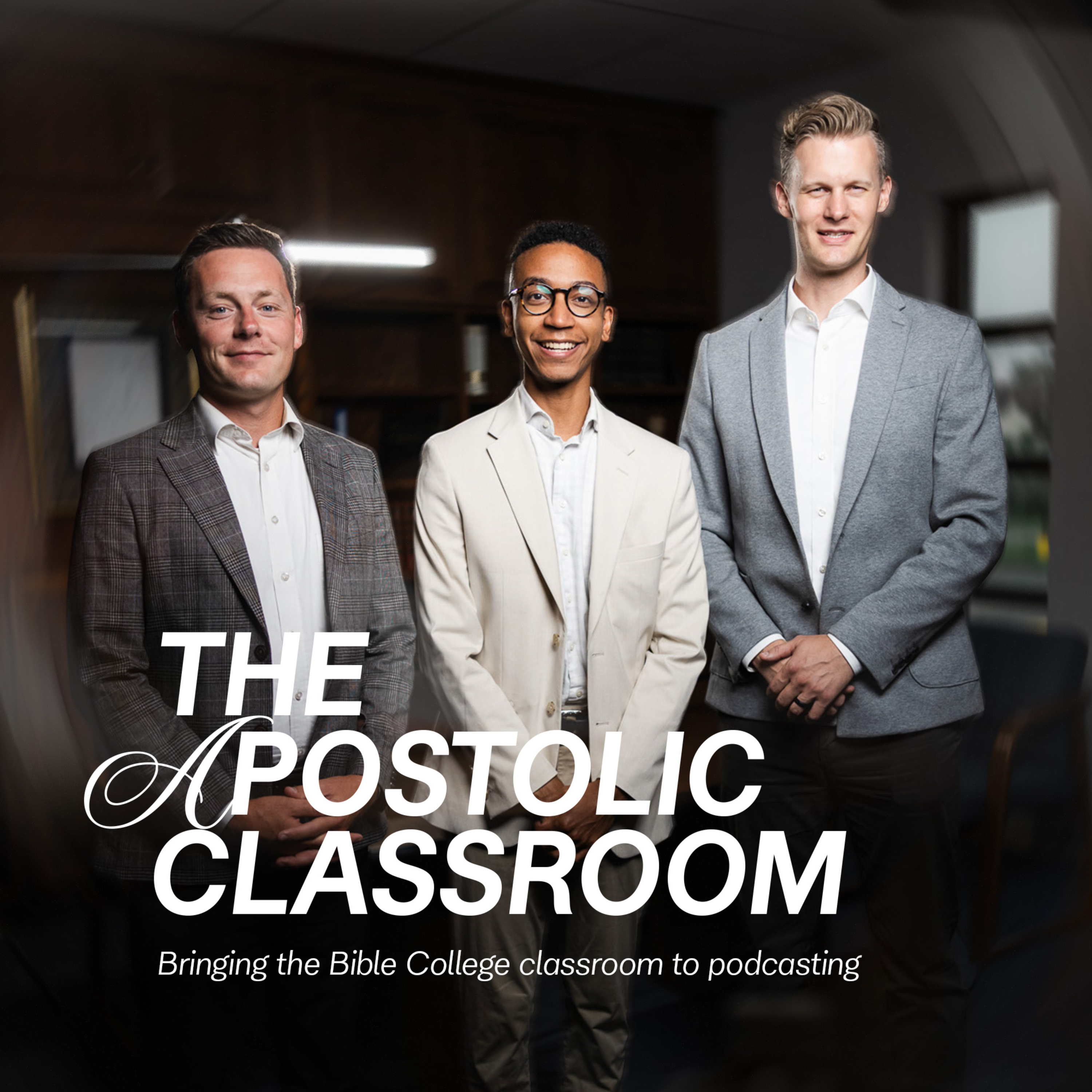
Speaker 1Well, welcome back to the Apostolic Classroom. Today, we're actually going to be dropping a bonus episode and respond to a couple of questions that we've seen some of our viewers throw in the comments. And we really wanted to start with a question that we've gotten a few different times is what Bibles do we carry that our viewers have seen on the show and what Bibles do we preach from? So I'll throw that to you guys first, and then I can jump in after.
Speaker 2Well, I was the one that didn't even bring my normal stuff, but this is a Bible I've actually had since I was like 10 years old. It has held up really well for just being bonded leather. But for Bibles that I use very regularly, I have a gift that was from my wife for my birthday and Christmas present is a Schuyler, similar to what you have here, the Tavares, the paragraph Bible. And so I've used that preaching from that. Uh, a bit lately as well as just daily reading as well. Um, also I have a, a heritage reformation study Bible, and I had originally gotten this one excited for the, the notes and the, um, the articles that were in it more from a historical theological perspective. There was a lot of creeds and different things that related more to church history. But as I started going through it, I just, man, there are so many good conservative, conservative comments and, and material in there. So I use that, um, often as well, almost every day. And then the last one that I use regularly, so that, so that was the heritage reformation study Bible. You can get that online. And then the, the next one that I use probably just as consistent is the Zondervan King James study Bible. I I've never actually seen that one in a store, like, like an actual Christian bookstore or even online. I had a hard time finding it. I found it at a thrift store, pretty much brand new pages were sticking together for $8. And so that was just a steal. And I think the reason why, uh, or maybe it's around more and I just, I, maybe I'm not looking at the right places, but I'm finding some random little typos in it just at random spots. So that might have something to say, but it is a great study Bible carefully. Yeah. But so those are the three. I, I use the, the paragraph, uh, Skyler. The heritage reformation and the Zondervan King James.
Speaker 1Maybe Steven can answer next, but which, do you preach from a specific one of those or?
Speaker 2So it just, it really depends on where I'm at, because if I'm, if I'm preaching in young adults at Calvary, I'll probably, I'll probably bring my Skyler. Um, but if I'm, if I'm out and about, if I'm traveling, I have taken that, but this is, this is such a, a, you know, it's a thin line Bible. So this one's easier as far as transportation. So this one just can, you know, just fits pretty easily anywhere. Uh, so I, I actually preach from this one quite a bit. Um, but I have found I'm, I'm pretty tall, uh, six, three, six, four. So I have found that there are some churches I go to that have lower pulpits and this Bible, the font is the font is small. There have been times where I'm like, dear Lord, my, I don't, I don't have bad eyesight, but sometimes, uh, using this one has been tricky sometimes. But, um, those are the three Bibles that I use very consistently. I have a couple other ones on the edges. Um, I know we're going to talk about study Bibles in a second, but those are the three that I use the most. Yeah. Um, study Bibles. I do not preach from because they're massive. Like you, you know, they're huge Bible thumper.
Speaker 3Yeah. Uh, I'm an Allen guy. Uh, I've got two, I've got the 54 C, which is just the, um, it's the, uh, semi yap. Yeah. It's just like the, the full it's, it's just like the full normal Oxford text, but with the, the bigger concordance and I actually do use it quite a bit. I tell people what I like about Allen's other than the quality is, uh, if you get the, if you get an Allen, get one with the concordance, um, there's a lot of valuable stuff in there. They have an extensive new Testament use of the old Testament section that it's not just that they haven't had one entire section devoted to new Testament quotes, uh, the old Testament. And then they have another one. That is new Testament allusions to the old Testament. And it goes book by book by book, which is great. A lot of, uh, cool, uh, like there, there's just a lot of cool, like, uh, plates in there. There's some cool, um, archeology stuff. Um, I would say, and then the dictionary of terms is great. I've never went back to look up a term and couldn't find it. So it's, it's, it's just a really valuable concordance. It's, it's quality.
Speaker 2Now for someone ignorant like me, before I went on this journey of premier study Bibles, the yap is this part right here that covers that.
Speaker 3That's called a full. Yeah. This is a full. Yeah. This is a semi. Yeah. This is, this is half. So, cause I'm half the scholar that you're, this is no, yeah, you are determined. Your intelligence is determined, I think, by how much you have yet. Um, no, I have a lot. So, yeah. So I've got, I have this one in the, the 54. I also have this in the 26, which is the smaller version. It's about the size of what, uh, uh, Andrew's got there. I like the 26 for travel. Cause it fits in my backpack. It's got the full concordance on it still, but it fits just real neatly in my backpack. Um, I preach, um, I carry this one at the pulpit quite a bit. I also have a old, uh, Kirk bride, Thompson chain that I love. That was actually a gift to me from, uh, my cousin. Uh, we, uh, we were roommates when we first moved out of high, we first graduated high school. We had our first apartment together. He got me that in like 2011 and the Kirk bride Thompson chain went out of business some years later, which Kirk bride Thompson chain is based in Indianapolis at that time. It's, um, now Zonder van owns. It's a, it's a, it's an old Thompson chain and the new Thompson chains are not like the old Thompson chains. They're not, they don't, the concordance isn't the same. I don't like the new ones that the old one I love. I tell people all the time, if I could put the archeology supplement that's in the Thompson chain in the Allen, it would be the perfect Bible for me because the archeology set, you and I've talked about that. The archeology supplement in those times, the old Kirk brides.
Speaker 2I remember as a kid, my, my dad's Thompson chain, I remember as a kid being under the pews. I was at church looking through and seeing two in common there and reading through those and, you know, never knew I'd be teaching that stuff years later, but yeah. And so I'm, those were good.
Speaker 3And I didn't know, did you guys know that word of flame, like PPH, like where they had, uh, they had rights to the Thompson chain for a while. Like there are word of flame Thompson chain. I was, I didn't know that until very recently. I think I should have known that growing up Pentecostal. Yeah. But there are word of flame Thompson chains. It's just, they will Kirk bride Thompson chain, but in word of flame. Yeah. I think I actually have one. I guess I, I didn't, I didn't think I had a, I had a new cover put on my Thompson chain last year. It was a little pricey, but it's super, super nice. And it's a, so I do, I, I carry both of those to the pulpit. This is a little less big than the Thompson chain. So I do, uh, I love this one a lot. Um, but the centerline concordance in this is also excellent. It gives you, um, if a, if a scripture has a phrase that's contested and other manuscripts, it'll give you in the centerline concordance, the minority majority text, it'll give you, um, sometimes if you're into that. That sort of thing will give you like the Septuagint translation stuff if you want it. Um, uh, I don't know, I guess we didn't say it yet. I'm a KJV only guy when it comes to like preaching and teaching. Um, we can maybe do a whole separate episode one day on that, but I, I only carry KJV to the pulpit. I only teach from KJV. Um, I'm not a, not a fan of, um, ESV and IV and ASB.
Speaker 2And I know we've talked about doing an episode just on translations, but to maybe say it briefly, cause you got to share. We're yours too, but with, with translations, just saying that it's, it's a readability issue, just dealing with the English is, is, you know, there's some deeper arguments that could be made there that what's underneath the English or, or other trends you say you're King James only, but there's other languages, right. That, that are based off of the right texts. And so with, with what is underneath the modern language, the Hebrew and the Greek, that really
Speaker 3does matter. Concerning English Bibles, I'm a KJV only the, the issue with the ESV is it depends significantly on Codex Sinaticus, a bunch of minority manuscripts, and it does the unredacted. It's the, it's the unedited Codex Sinaticus, which is a pretty insincere. I don't like Codex Sinaticus anyway, but even if you're using it, it's insincere to use the unedited version. And, uh, there's some other issues with it as well. We can get into later. Um, and then yes, Codex, uh, Vaticanus, uh, there's, um, a lot of arguments to be made. I'm sure somebody is going to comment and say, how dare you, but I'm, I'm KJV. So, uh, and then Jeremiah, what do you got? What's, what's over here?
Speaker 1So I, I brought these two, um, only because, uh, there's a reason why I I've got two different. Um, this one is, uh, Skylar, uh, this one I do write in and I usually preach from this one. And the reason why I like preaching from this one is because the text is big. Um, but also it just lays well on a pulpit and it's easier for me to kind of just have where it's not, uh, when I was a student, I had one of those. And, um, I wore it out so much, it was kind of falling apart. And, um, I, I, I was at a church and there was a lady who was very, very upset at, um, what was happening in the church or whatever. I don't recall everything, but she was, uh, kind of causing a scene in the parking lot. So, uh, somehow they, they thought it was a good idea to get me. And so, uh, I go out and I'm talking with her and it wasn't, it wasn't a massive ordeal. It was just, she, she. disagreed with us. And so I remember I remember showing her in my Bible where scripture had said what we what we were saying in there. And she looked at it and she said, no, you put that in there. It's a different color than everything else because I'd highlighted it. And she said, what? Yes. Wait, what? She said, my pastor gave me a list of verses and that is not one that I recognize.
Speaker 3She thought you added it to the Bible because it was a different color.
Speaker 1Like what she thought you typed it in there yourself. I guess. Yeah. And so it was one of those things where I had started to keep to two different Bibles. This one I do write in, but I preach from it pretty regularly. So it's got a lot of notes and just I scribble stuff in it. This one is an Allen. So that's a Schuyler. This one I don't write in. I don't keep any notes. And this one I actually carry more often than I carry my Schuyler. And the reason why is because of that, you know, I would hate to be in a conversation with someone, you know, immaturity. I probably should have had her grab her Bible so that way I could show her it's in her Bible.
Speaker 3It was probably the message, so I don't have to worry about it.
Speaker 1But my, you know, my hope with this is I don't write in this Bible and it's a little bit more kind of fancy, I guess. It's got the speckled pages, which I think are just cool. But I carry this one without marking and without any of my notes in it. Just that way I have something if someone is asking the question.
Speaker 3Does yours have the, so one thing I like about my Allen, so mine, this 54C, the, the content of this is identical to, this is a 53C. And what I do like about these is they have like a lot of 30 or 40 pages of blank notebook paper in the back. And I, and this is in my 26 as well. The small one, I fill these up, like, and this is what I preach and teach from too. Like I very rarely. Rarely anymore. If I go to do a Bible study with somebody, I don't bring an iPad. I don't bring a computer. I, I have it all in my Bible. So it's like, all I have to do is, and even from the pulpit, I have some topical sections broke up in my 26 that I can just pull out and go. So I do, if you're, if you're somebody who's like, I, I want to keep notes in my Bible, but I don't want to write on the pages. Allen's have that notebook paper in the back is really nice.
Speaker 1Yeah. And you could do, you could do that. You could also do what I do and you can leave a sticky notes.
Speaker 3Yeah. I'm always worried about, it's going to tear the page. Tear the paper though.
Speaker 1Like when you pull the issue with it.
Speaker 3I had a student that happened to last year. She brought me her Bible and she like, she like pulled the note and it like ripped her
Speaker 1Bible. I think if you move too quickly, it will rip it. Um, but I, I'm more of a, much more of an extemporaneous person. So I usually give myself just a bullet point or two. I don't know if you saw that. That's a, that's a whole sermon there for me. Um, it's just the way that I think, um, where I, I like bullet points to give me a structure, uh, not so much to, uh, kind of, uh, have everything on, on paper. Um, but that's just the way that I've developed as, as a preacher. And so when I preach, this is usually what I have with me. Um, whereas if I'm just kind of giving a Bible study, I have this one where it's, there's nothing in it. Um, and I, I, I work extemporaneously, uh, typically, uh, and I love exploring with people the text. And so that gives me that opportunity to do that. And they very like, Hey, we're, we're exploring this text and, and we're going somewhere with this, you know?
Speaker 3Yeah. Um, and, uh, so talking about just cause it's kind of related resources and stuff like, so obviously we have our Bibles, um, and each of them kind of have, you know, their own strengths of content within them. Um, as far as like ancillary stuff, but, um, we also had some questions about like outside resources, um, books, uh, reference materials, things like that. And so I've, I thought it'd be good. I good to have Andrew address, uh, just going and kicking off when, if somebody is asking, how do we evaluate the, like, if we're reading a book and we, we want to know about, you know, whatever Hebrews I'm, I'm dealing with this right now with my textbook, uh, at, at IBC, um, you know, if, if somebody is reading a book about Hebrews, how can they know what the theological bents of the author might be, or how can they identify potential either biases or even in good qualities as well? Like how, what, what are some things to look for?
Speaker 2Yeah. Evaluating a resource. I think it's a great question because. This is not just us saying, these are the sources I like, you know, for everything or whatever, but we're really trying to see if I pick up a book, what makes us a good book? I'm looking at these Bibles. Maybe they have different things that, that we really like about the notes or just the, how it's constructed. But when we're looking at books that are not the Bible, how do we look at those? So probably for me, and then you guys tell me what you think too, probably the number one thing is what do they even believe about? What do they believe about the Bible? We throw this word out a lot inerrancy and just inerrancy is a word that means that we believe that the Bible is without error. And I know that there are, if we get technical, there are different levels of inerrancy. I don't, you know, there's different levels of perfection or, you know, some people try to say they, they believe in very strong inerrancy. Some people would say the Bible is inerrant or it's infallible. Maybe there's some scientific errors, some historical errors, but for the most part, it's great. I just believe in absolute inerrancy that there's, there's, there's no error in scripture. So if I'm approaching a scholar, a professor written a textbook or a commentary, and I'm started reading through and they, they start making comments about, you know, a scribal error, or they start making comments about not knowing if Paul wrote this particular epistle or Genesis one, if Adam is not the first man, then, then I know something about that individual that he, and I are not viewing God's word in the same way. So as a foundational element, that, that to me is a very crucial thing to start with. What do they even say about God's word?
Speaker 3I was going to say just real quick, if you see the phrases, redacted criticism or Q source in the book, you're reading, you can be pretty confident you're dealing with a scholar that does not believe in inerrancy. So like, that's like a
Speaker 2good, that's a good, uh, or, uh, or they may not fully understand the implications of those. That's fair too. Because saying, so I know we don't want to get all over the place, but, you know, Q that, that is in reference to the gospels and how you have source material and it's Matthew had his writings and then he had Q and then he had Mark and that's how we have the book of Matthew. You know, there's some differences in how that is played out, but in short, it's a denial or at least a reduction of the spirit moving upon the individual that is writing that particular book. And so to, to say certain things that might sound scholarly, but it doesn't always line up with belief in the inerrancy and inspiration.
Speaker 3Yeah. That's a fair point to be made too. There are sometimes people, they just adopt terminology and they don't always know the full implications of the terminology. So you gotta be gracious sometimes I would say that, um, one thing that I definitely look for with, with regards to inerrancy, um, a quick one, um, that you can look for if you're reading a book that is about, um, the, like the composition of the Bible or if it's about books of the Bible, uh, usually a quick indicator is how they date the old Testament and how they view, um, if they, like, if they have an attitude, like we've talked about before with Isaiah, multiple authors, uh, if they have, if they have a view.
Speaker 2Well, let's just go through some of these, because I guess if you are looking at a specific book of the Bible, there are some very, I I've walked through this with students a few times. There are very key things in particular books. If you go to, uh, Genesis and they're, they're saying that day could mean something else. I know that there are conservative Christians that don't believe in a young earth creation, but I'm going to read them differently because to be consistent in the grammar of the Hebrew and even going into the new Testament to be consistent, you would have to say that it is a 24 hour period in Genesis one. I like that.
Speaker 1You said that you would read them. You said that you would read them differently. Not that you wouldn't read them at all. Right. Cause you might find some gyms, um, in, in unsuspecting places, but you to what I think you guys are saying is you have to be aware of who you're reading and what you can get from them because some things might put you on high alert, um, where it's a great point
Speaker 2because not, there's only one book where a hundred percent of it is going to be perfect. That's a hundred percent. And so oftentimes I think as we're talking or, you know, at IBC, you're going to hear, oh, that's a 70% book or that's a 30% right. Right. 30% is going to be great. The rest of it throw up, but that 30% can be worth the book for that 30%. That's worth it.
Speaker 1Yeah. Brother Mooney always kind of had that attitude toward reading. There are some books that I bought just because the title and I couldn't tell you what is in those books and I've, I've not opened the pages of those books is one of them mine, but no, I don't even own that. Those titles aren't even good. No, no. I mean, I, what I mean though, is, is that, uh, whether that book is good or not, I don't know, but the, the title was provoking enough thought provoking enough for me to say, I want that on my shelf. So it, I, it will remind me of something. Maybe it's something I'm going to preach, or maybe it's something I want to, uh, address in a lecture or, or in a, in a Bible study. I want that titled, uh, because it, it causes me to think certain things. Um, so there's that, but I would also even say, as we, as you evaluate, evaluate the Evaluate resources. I know that you guys have a lot more familiarity with study Bibles than I do. Uh, I know I mentioned that to you guys. I don't use study Bibles, not because I don't think that they're valuable. It's just something that I've not had, uh, the time to use just yet because of my research and the nature of it. Um, but I use, uh, what I usually do is I will, if I'm setting a text of scripture, I will either copy it into a word document and print it off and I will annotate it for days on end. I will just revisit over and over some texts I have read, um, thousands of times because I read it over and over every day for months on end. And I found that the first few reads, it's like, okay, I get it. And then the next hundred reads, I'm like, okay, I missed that. And then I realized that there were things that I was just overlooking. And what I have found is the best evaluation of a resource is time in the text of scripture
Speaker 3yourself. Yeah. And I would say too, even with books that you, with which you disagree, learning to audit the other side will help you. Number one, be a better, it'll, it'll help you in discussion and debate. It'll also teach you to be quick to hear slow to speak and slow to wrath. Cause I do know that there are a lot of people who it's like, they may have some crazy things to say, but if you can't respond positively to negative stuff, you're gonna have a very hard time being effective. And I went through that with John Barton's history of the Bible. It's super liberal. I mean, it just, it is, but I there, to say that I didn't learn anything from the book is a lie. Number one, I learned the way that this argument is often presented. So if somebody is taking an approach to the Bible where they, they don't necessarily uphold inerrancy and their view of inspiration is very low. I learned how they argue that. And so it trained me a little bit of how to work against it. Number two, not everything he said was wrong there that for some, I told, I shared with somebody, it took like 400 pages, like a 700 page book. It's like 400 pages to get there. But when he gets to the canonization of the scripture and he makes a strong case that like, don't, don't fall into the trap of believing that there was no canon in the first century. There absolutely was. And the argument was, uh, you know, he, he talks about the upper and lower limits of, of canonization. It was at least these books. And by this date, it was that most of these books and like, there's, there's some value there, but it was like, there was a lot of stuff I had to work through that I didn't like. So to your point about reading, reading slowly and reading it more than one time, you can apply that to books too, is that sometimes, you know, sometimes you're like, I'm not going to read this book. I'm going to read this book. I'm going to write this book. And sometimes you think an author said something that they didn't actually say. And that's kind of, that's happened to me. I mean, look, I I've written things I've been wrong before. Like you can't write four or five books and be right all the time. Like I I've said some things that, you know, it's like, oh, I could have phrased that different or, oh yeah, no, that that's probably not how I meant that to come across. But what you hope is that people will read you carefully and that they'll get the better sense of what he's really getting at, what he's trying to say.
Speaker 2And I think a good thought process to have, and really you have to know the word to be able to, to, to really put this into practice. But if you're reading scripture and what we would call just a plain reading of the text, just a plain reading of scripture is whatever resource you're reading. Do they somehow, even if it's small, go against that plain reading and what I, so you brought up Isaiah. So I just taught book of Isaiah last year at, at IBC. And there are, there are scholars, some of them very far left-leaning meaning they believe in a lot of scripture, but they believe in parts of it. They're going to say there's more than one Isaiah writing because they don't believe that God can give prophecy to a human and tell the future. So when the book over and over talks about Isaiah being the author, or this is what the prophet Isaiah said, saying there's more than one, Isaiah clearly goes against that. And I know there's nuancing to that argument. I know that there's arguments that they make to try to make it sound as though it's true. I know that there's arguments that they make to try to make it sound as though, uh, no, we're not going against the Bible, but from a plain reading of the text, if you have more than one Isaiah, you're going against the text. So just knowing it's that idea of knowing what is genuine first, you'll be able to pick out what is not genuine when it comes up. And there are so many things that Daniel's the same way. Did Daniel live when the Babylonians came in into Jerusalem or was it hundreds of years later because of those prophetic elements?
Speaker 3Yeah. You gotta, you have to learn to be comfortable with disagreeing with what you're reading to that. That's a challenge that it takes some people. That was probably the best benefit for me with college, actually. Like, I think what helped me the most was learning to be very comfortable disagreeing with what you're reading. And cause some people, they buck against that. Cause they're like, well, this person has to be smarter than me. This person has to know more than me because they've got a PhD or whatever. And I know brother Kilman used to say, I don't care if they have a PhD or an X, Y, Z, if it doesn't line up with the B I B L E. And it's like, you know, just, it is possible to be reading a book even as a lay reader and come across something that your gut is telling you there's something wrong with that. Um, there's nothing wrong with that and it's okay. There's been times where I have fundamentally disagreed with what I'm reading and then found out later I was wrong. There have been other times where I have been reading and I fundamentally disagreed with what I was reading and I still do. And that's okay. It's, uh, your, your, what you're reading is not gospel. You know, unless it's the gospel, it's not gospel.
Speaker 1Yeah. Yeah. Um, one of the first things I do, if I'm looking at, let's say a commentary or something, and it's on a book of the Bible that I'm, I'm hoping to dive deeper in. And let's say, I know that there's a passage that addresses a core doctrine. Uh, what I will do is I will turn straight to there and see how they engage that. And that's, for me, that's an immediate evaluation of where that person is. And, uh, I will do that with a number of passages in that, in that commentary. And for me, that helps me see, get a sense of where that, and that, and that, doesn't mean that I won't get something out of that commentary. Right. Um, but I might not get, and I'm not looking to read them differently. Yeah. And I'm not looking for affirmation so much, but I'm trying to gauge where, uh, that author is in their theology. And that helps me identify a
Speaker 2lot. And with a few things with, with commentaries, I have a running list on my phone of errors that I found in commentaries, just for the fun of it. You know, like I, I remember reading one where he, he talked about Jeremiah living 400 years before Jesus. It's a couple hundred years off. But okay. You know, so I just wrote that down, just, you know, so commentaries are not, they're not perfect, but I think another piece of advice is that if you're reading scripture, going back to what you were saying with slow down, read it for yourself, get it, go to a Bible dictionary first, which I guess is specific. You know, there's a couple of good ones. Like the new Ungers is, is a good, is a good dictionary. Go to a dictionary first and then go to the commentaries last. Don't just jump to a commentary and let him try to tell you what the text means. You know, let the Holy ghost help you.
Speaker 3Another, another brother Kilman quote, son, read the Bible. It might shed some light on those commentaries. It's like, yeah.
Speaker 1Here's, here's maybe, um, one thing that, that I did, uh, when I had first started seminary, uh, spiral Bibles. I don't know if you guys are familiar with spiral Bibles. I don't own one, but I've seen them. Um, they are essentially just spiral bound portions of scripture. And I would just use that as an annotation thing. Now, I don't know if you guys are familiar with spiral Bibles, but, and I, I, I, I, I, I, I, I, I, I, I, I, I, I, I, I, I, I, I, I, I, I, I, I, I, I, I, I, I, I, I, I, I, the more and more I use it, then I just realized I can just copy this into a piece of paper and then print it and then use it up, you know? Um, so what I found though, is that was very beneficial for me to, uh, take the time to slow down and read the scripture. And I would look for some key, some key things. I don't want to get too far into hermeneutics there, but I would look for some key things in those texts to see the progression of the text. What is the text really communicating? And then when I'd go to those commentaries, commentaries or specialized works, I would see where there was a deviation from what the text was saying. Um, or even I could see how they got to where they got, even if I disagree. And to your point about humility, I could say, okay, I get why they got there. I am disagreeing for this reason. And I think this reason is biblical. Um, as opposed to like, maybe even I misread something and I'm like, ah, they just shed light on, on what I was reading there. I was not getting that. So there is that humility that you get from slowing down and reading the text and recognizing that, especially man, when I would get to that hundredth or 200th or 300, uh, read through a text. And I realized in my first hundred or 200 reads, I missed a lot. And it was the same five verses of the Bible and say, realizing that I, I realized like, oh, I was reading too quick. And I was, I was, I was overlooking stuff.
Speaker 3Yeah. And so I would say like, just to summarize, uh, the resources thing about, um, you know, a evaluating sources and things of that nature, uh, number one, um, paying attention to the dating of certain events is a quick way. Like if you're trying to figure out how can I quickly determine if this person is, has a higher low view of inerrancy of the scripture or as a high, low view of inspiration, how they date events in the Bible. Um, and if, if you're somebody who says, well, I don't really know how to, what, like, what is, what is a biblical view? Well, read the Bible, but do you have any like apologetic sources that you could quickly recommend for, or if people are wanting like a quick hit, like I want like a foundation of, of some apologetics about the Bible before they dive too deep into those kinds of things. Cause like I said, dating of certain events, authorship of certain books, um, you know, we talked about redacted criticism, Q source stuff in the new Testament. Those are all like red flags I look for. But if you, if you have any resources that you want to mention of like, Hey, this is like a good place to start. If you're trying to make a personal defense of, um, inerrancy, et cetera,
Speaker 2with the dating, the, the really big event is the Exodus, right? And so there there's a a couple other ones too that come in that are significant as well. But the Exodus is the really big one when it comes to, is the Bible historically accurate? And that connects directly to the timeline. And so a scholar that I would point to right away, he's a younger archaeologist that has really been making a lot of headway and really come out with some amazing things. And he discovered just recently, well, his name is Titus Kennedy, first of all, Titus Kennedy. But he made just recently, right around COVID, I think, he went out into the desert for days, camped out, and he essentially rediscovered the oldest inscription of Yahweh in all of history. It was about, at the time, it was 700 years older than the next oldest inscription, which is crazy. I think there's been another one found since then, but his is still the oldest. He was reading an old journal, theological journal, and came across a drawing and was like, man, what is this? It had never been photographed before. So he went out. And anyways, it's an amazing story. But he is a fantastic archaeologist that lays out great arguments for when the Exodus took place. And some of his stuff with the Red Sea, I'm not a fan of. But as far as the Hebrews being in Egypt, who the pharaohs were, all that, it was not Ramses. Moses was dead by 200 years by the time Ramses came on the throne. So I love the Prince of Egypt movie. It's just not historically accurate, right? But in the Ten Commandments, the old movie too. But he'd be a great resource. And maybe in connection with some of these things, we're talking about what they believe and what they don't believe. They can be a trinity. But they're not trinitarian and still have really great research. And so a lot of these scholars, I'm thankful for our Pentecostal authors. And thankfully, more of them are coming out. But just because they're trinitarian, I don't think that should mean, well, we're just going to throw the book away. I have a pretty decent size library that's growing. And I have a lot of trinitarians on my shelves.
Speaker 1Well, yeah, because you've got two libraries.
Speaker 3Well, yeah, that's true. You've got an office in the house now. I was going to say, lest anybody be uncomfortable with that notion that, oh, well, I don't want to have trinitarian books on my shelves because they say things that are theologically inaccurate. Guys, there are a lot, and this is not disparaging, I'm not going to mention names, and I'll throw my hand up as the first among Pentecostal writers that has made mistakes. So don't anybody say that I'm disparaging. There are a lot of Pentecostal books out there. Oneness Pentecostal writers, they get things pretty wrong. And there are people who get things theologically wrong, historically wrong, well-meaning but misguided most of the time, to your point, like the Ramses thing. It's like, well, a lot of people just assume that one of the Ramses had to be the pharaoh because we saw it in the Prince of Egypt movie and something like that. Well, there are Christian, I'll call them Christian cultural traditions that come out sometimes in writing and in books and stuff that people don't even realize why they're wrong. They're just wrong. And Pentecostal writers are not perfect. They're not. They are not writing the Bible. They are not divinely inspired words on a pen that are without error. If you hold Oneness Pentecostal writers to a higher standard on this pedestal than you do all these other Christian writers because of their oneness, well, they might be oneness, but what if they get everything else wrong? You could be oneness and get salvation wrong. You can be oneness and get creation wrong. You could be oneness and believe in evolution. Like, it's. You know what I mean? It's like there's. There's. You got to be fair and say, like, these are men. If you read a book by a Trinitarian author and you know that they're Trinitarian going into it, keep that in mind while you're reading it, is that you don't have to take everything that they say about the nature of God and the person of Jesus Christ. Yeah, let me give.
Speaker 2I know you have something you want to say here. Just let me say this quickly. As an example, there's a scholar named Thomas Constable. You can type in Constable's notes on Google, get every single one of his PDFs, one for every book of the Bible. You can get those for free. I really like him. He's out of Dallas Theological Seminary. He's a Trinitarian. But you look at his comments about Scripture and his consistency within his beliefs, and most of what he writes is phenomenal. He's got great arguments in Genesis 1 combating gap theory, day-age theory, things like that. You get to some of the other issues in the Old Testament. He's very faithful to the text, and I really like that. Is he a Trinitarian? Yes. Does he believe in infilling of the Holy Ghost, speaking in tongues? I actually don't know if he believes in speaking in tongues, but he does not believe that it's essential. But he's so consistent in other areas that his comments, I have found to be very
Speaker 1enriching. Yeah, I was just going to bring up one of the questions that I've seen is like, show notes. Hey, can you guys provide some kind of show notes? That would be awesome. And I just wanted to. Show notes. Yeah. Like I said, I'm an extemporaneous person. And so one of the things that I would just ask for is to be on the lookout, because we do hope to produce at the end of this a book where we are, of course, partnered here with Truth Book Co., who has absolutely been awesome in helping us get this kind of launched and has given some. Some guidance on all of this tech stuff and YouTube and social media stuff. But one of the things that I would say is be on the lookout, because we do have a book that is coming out that recaps very specifically some of the things that we have covered individually in preparation for or as a result of our conversations. And so there will be an essay from each of us on each of the episodes. And so be on the lookout for that, because it is coming. The release date is. TBA. TBA. We will have some more. Hopefully this year. That's the goal. Hopefully this year. I would imagine it would be this year.
Speaker 2One within us really needs to get moving on is writing. Not mention it's me. There are two among us that really need to.
Speaker 3Well, we're each writing 16 papers. So if my math. If the math is math, then that's 48 essays. Yeah. That'll be in a book form. Yeah. And that will be a resource. Believe it or not, people ask about show notes. I get why they want them. We don't actually have show notes. Most of what's sitting on. You guys see my laptop sitting here most of the time. It is absolutely nothing that's sitting on the laptop. Occasionally I'll pull up quotes and things of that nature, but this is a very conversational-based podcast. So we don't have show notes necessarily, but we can give you guys those resources in the form of
Speaker 1essays. Yeah. We do just approach this podcast as. The discussions that we, in some sense, normally have. And this is kind of the overflow of those conversations. And in many sense. And another thing is just don't feel the pressure to have the same kind of conversation we're having. Because a lot of this is the result of 10, 15 years of direct study with some of these things. And so it's one of those things where if you ask for a resource on something like Genesis, to me, I would say, well, I don't know. I don't know. I don't say for what purpose. Because there are 50, 60, 70 books that I've read between commentary, specialized sources, academic. A hundred, right? And the same for each of you with different topics where when the conversation of, can you give me some good resources for that book? It's easier for us to say, well, hey, here are some things to use to evaluate whether something is usable. Or something. Or you can take something and feel confident with it. And how you're reading and using that resource, it's a lot easier for us to give you some criteria for evaluation as opposed to saying, here's something, use it, run with it. Yeah. I will say one thing that I've absolutely have enjoyed for quick reference is the NIV Old and New Testament historical background commentaries. I think that those have been super beneficial as well. Just kind of quick look, overview, the Old Testament one. Who did that? Is that the Walton and Keener books?
Speaker 3Yeah, Walton and Keener books. So, okay, the two volumes. It's the InterVarsity Press. Yeah. You said NIV. I think you meant IVP. Oh, IVP, sorry.
Speaker 1IVP. When you said NIV, I was like, that doesn't sound like him. I'm thinking of the commentary on Revelation that Keener did for that one. That was a.
Speaker 2Yeah, but dictionaries, right? Because I think it's just valuable to use the quote-unquote helps before you jump right to it. To a commentator. Yeah. And so the dictionaries and there's different. I know Unger has a handbook too. There's different ways that will walk you through the history, the context of those particular books of the Bible, that they're a great benefit.
Speaker 1Yeah, they can supplement your study in different ways. Yeah, and it's beneficial. So, well, I hope that we were able to answer a couple of those questions about some of the peripheral things that maybe we don't get to answer every week, as we do the podcast. So thank you for giving us the time to respond to those questions. We look forward to answering some more in the future. God bless.
 PodcastTranscript AI