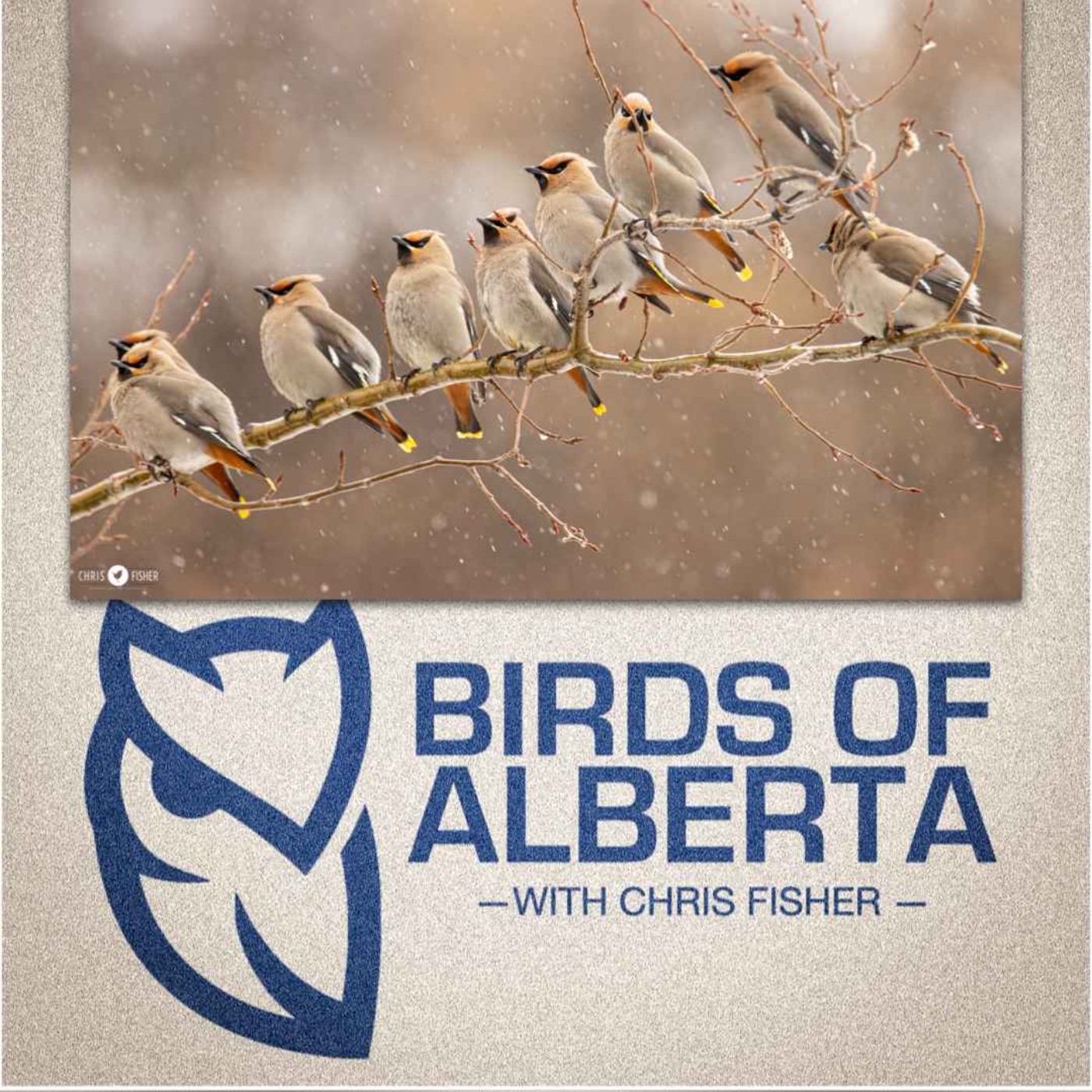
The great looks of Bohemian and Cedar Waxwings pair the French dynasty pompadour with the eye make-up of an Egyptian princess - but for Alberta birders, waxwings are so much more than just great looks. Cedar Waxwings are the iconic bird of our summer months while Bohemian Waxwings are the icon of winter. Both are THE calendar birds of of the province that provide a innate connection to our parks, gardens, yards and forested areas. Hosted on Acast. See acast.com/privacy for more information.
Transcription
2806 Words, 15401 Characters
Welcome to the Birds of Alberta podcast. I'm Chris Fisher, co-author of the best selling field guide birds of Alberta. Now they're resident birds and they're birds that come and go to and from Alberta. Some pass through quickly, silently, with only the most dedicated birders noting their brief stopovers at some distant woodland or wetland. Now other migrants pop into Alberta for a nesting season and their presence contribute to our distinctive summer season ambience. And then there are birds and there's really not that many that come and go but in doing so that they are not only harbingers of our seasons but icon characters for the province. So today I want to share a little bit about some of our most love birds that fall into this latter category. They're seeing in our yards and in our campgrounds. We see them ideally represented as local logos and pieces of folk are. These birds make up some of our most frequent posts on social media birding groups and on bird and nature calendars. Whether you pick one up at them all or support one of our many many local bird photographers out there who put these things out. These birds are the calendar birds of Alberta not only for their undeniable pin up looks but because their annual appearances and disappearances while they flip the pages of our seasons. But unlike blue birds and larks and robins that may mark the beginning of spring or the snowy owls that define the depths of winter. These birds do not necessarily kick off the beginning of a season but rather they define the soul of a season. And here's the kicker. These birds just don't do it for a single season. They define what it is like in our summers and what it is like in our winters. Now you are probably thinking that there is no one bird that can represent both sides of our seasonal coin and you'd be right. But we do have a twin pair a young bird and a young bird. These seasonal siblings are look-alikes that complement one another and round out our calendar as one perfectly reflects our summer season and another. Well it reflects our winter season. They are a birders bird and even non-birders bird too. Making them some of the best-liked birds of Alberta. They are of course the cedar and Bohemian wax wings. Now both Bohemian wax wings and cedar wax wings they share a look with each other but really not with any other bird that's found in the province of Alberta. They both are fine-looking birds. Each sporting a French dynasty pop-a-door and they each have a black eye makeup fitting of an Egyptian princess. When you get down looking at the nice and close they seem to have exceptionally fine soft and silky feathers that seem to blend in together creating almost a perfect continuous coat around their entire body. Save for the tip of their tails which is a nice vibrant yellow. Otherwise cedar and Bohemian wax wings are exceptionally similar with the only really major differences that cedar wax wings have a nice yellow belly whereas the Bohemian wax wings have a rusty red bottom. Bohemians are also a little bit bigger almost twice the weight at 45 to 69 grams whereas the cedar wax wing comes in at about 32 grams. The cedar wax wing being a little bit smaller top you know about 17 centimeters from bill to tail whereas Bohemian about two centimeters larger than the cedar Bohemians coming in at about 19 centimeters at their most likely. Now what these birds have that really no other bird in Alberta possesses are their name sake wax wings and they're really interesting indeed. The Bohemian wax wings will have red and a little bit of yellow on the wingteps where as the cedar wax wing really only has a little bit of red and those red waxy like markings are actually status symbols a little bit like the epilots on a red wing blackbird and these waxy substances that are deposited on the wingteps well they come from their food it's diet derived and it comes from primarily the pigment in berries a pigment called astazanthin and the more that is consumed by the birds the the more that will be deposited on the wingteps in fact they will serve as a bit of status more dominant birds more healthy birds will have more of those waxy wingteps than subservient birds for instance in a cedar wax wing a younger individuals will typically have zero to five of these waxy tips where as more dominant older individuals will have as many as nine. This status singling is perhaps a little bit on the unusual side but it does make sense because it is consistent with one of the characteristics that unifies both of these species and that is their strong social grouping. One of the great things about Alberta and Alberta birders is that we can enjoy wax wings pretty much year round but it's a little bit more complicated than that. Bohemian wax wings are really the wax wing that is found year round in the province in the summertime however they are a tough bird to find for they they nest kind of along the mountains and in the northwestern areas of the boreal forest close to the British Columbia border and in those areas it also coincides with the distribution of the western mountain ash berry tree and of course we're all very familiar with mountain ash trees as it is one of the most common ornamental trees in cities and towns throughout the province but it's wild relative does occur sparingly in the province and it is found where Bohemian wax wings commonly nest. Now Bohemian wax wings will retreat out of those remote areas where they nest and flood into other parts of the province when winter conditions do come in and they will of course hang out and feed on some of these ornamental bushes particularly in our cities and towns the aforementioned mountain ash but also crab apples as well. Now cedar wax wings tend to be only typically found in the summer and not in early summer either they're one of the latest migrants typically showing up in the first weeks of June and getting busy with nesting season a little bit later than even some of our more common warblers and sparrows they will feed primarily in the summertime on insects often aquatic invertebrates that have hatched out of our lakes and rivers and these high protein meals will help raise the next generation of cedar wax wings and we'll keep the cedars wax wings around well into July and into August and at this time of year you will start seeing their diets shifts somewhat to some of the fruits and berries even particularly some of the native choke cherries and Saskatoon cherries that become ripe in the early weeks of August and that will be some of their last meals before most of the cedar wax wings migrate to the south into the United States and Mexico where they will spend the winter. So wax wings are really one of the great fruit eaters in Alberta birds there's very few other birds that can match them and some of the interesting aspects happen when the cedar wax wings dine on the same trees that the bohemian wax wings do but they do it at the opposite end of the calendar they are a species that can survive for weeks and months at a time on fruit alone in fact brown headed cow birds which are a common summer summer species that will lay their eggs in the nests of other birds and have those other birds raise their chicks well when they do so in the nests of cedar wax wings the young cow birds don't tend to fare very well particularly if they're fed by their parents a constant crop of fruit cow birds aren't really designed to be fruit eaters like the wax wing youngs so that may be one of the advantages that
that wax wings have in nesting in relatively conspicuous places in Alberta, oftentimes at the edge of forests and in pretty open bushes and branches where their nests are relatively easily found by young prospective naturalists like when I was a child or perhaps more commonly and more ecologically and evolutionarily important by parasitizing brown-headed Calvin females. Now whether we're looking at Bohemian or Cedar wax wings, it is unusual to find an isolated individual. These are one of the most social songbirds that we have, whether it is in late summer with entire flocks of Cedar wax wings, taking berries or insects in our parks and gardens or certainly in the depths of the winter with large flocks of Bohemian wax wings descending on our fruiting trees. There is of course safety in numbers, both these species are commonly preyed upon by bird hunting and bird eating raptors such as Merlin or Sharpshin or Cooper's hocks. The loose colonies in which the nests can serve as a little bit of a protection against those and other potential predators as well. But there is also something very redeeming about their social cohesion and that is when you spot a whole line of wax wings perhaps perched along a common branch with one having access to the berries at one end of the branch and that individual will pick a berry and every now and then pass that berry to its neighboring bird which sometimes passes it to its neighboring bird and that's a shared scene that is very unusual experience among all the birds we find here in Alberta. In the last number of years has been quite a bit of discussion about the common names of birds, the common English names of birds and both the cedar and Bohemian wax wing have interesting common English names. The cedar wax wing is named for its preference of eating cedar berries, maybe not so much in Alberta as we don't have a lot of native cedar plants. So in Alberta it would probably have been called the Saskatoon wax wing which would have been really cool indeed. Now the Bohemian wax wing is just a wonderful name, the word Bohemian is perhaps best known as a result of the Queen song Bohemian rap city, Bohemian is a word which tends to describe a person who is sort of unconventional and who lives a lifestyle that's a bit abnormal maybe almost even artistic so in that way it's kind of a cool notion to be referring to the Bohemian wax wing as Bohemian because it is a little bit unconventional. They do migrate particularly in the winter time to areas that we encounter them but not always following the same roots or the same patterns are certainly never in the same quantities or numbers. In the years we're fortunate to have Bohemian wax wings within all the major cities in Alberta in the tens of thousands and other winters, well these Bohemians go on their ways to other places and don't visit us in the winter and only spare us with a few sightings of individuals here and there. Now as beautiful and as social as wax wings are there is another characteristic that is very noteworthy and that is their very distinctive sound. And when talking about the sound of a Bohemian or a Cedar wax wing I can't help but remember a story involving a friend and that would be my friend Shannon Tyler, Edmonton Television and Radio Personality that's well known in that particular city. This goes back over 25 years and I saw Shannon at the side track cafe, a legendary live music venue and I approached her that night because I was about to embark on my very own television career when I was about to host a television show called Wild Files. I much admired her dynamic personality on camera and I was hoping to catch a little bit of the magic that she contained as well. When I told her what the show was about she clicked in that she had a copy of Birds of Alberta in fact had it on her breakfast nook and knew the birds quite well and one of the birds that fascinated her the most were the Bohemian wax wings as this meeting happened over winter and I can remember fondly how she was imitating the swishing back and forth sound of the Bohemian wax wings that she enjoyed visiting to her backyard tree and it's no wonder why she remains a friend to this very day. It's not that wax wings have a terribly complex or interesting voice it is in fact just the opposite it is done at one particular frequency that seems to be a frequency that unites these large flocks when they do come almost like a contact call. It's a high pitched whistle whose frequency can be lost particularly by older gentlemen when their hearing starts to fade unfortunately wax wings are some of the very first birds that are lost to the ear of older birders. So these birds don't really necessarily have a traditional song but they communicate with each other with these ever continuous trillian or buzzing sounds and they're very very distinct and once you recognize it when you go for a walk with your dog or even walk through downtowns of our busiest quarters if they're around your head will tilt up to the sounds of overhead wax wings. So wax wings are special because they are common and in fact so common that they have become a component of the cultural fabric of our cities and that reminds me of yet another story and it's a story of my university mentor Dr. Jim Butler at the University of Alberta and he would tell it from time to time recalling coming to Edmonton for a job interview with the provincial government of Alberta in the mid 70s and he was arriving from his time at the University of Washington in Seattle. On this date it was really one of those fracking cold February days in Edmonton that we know unfortunately all too well and Butler tells us that after his interview in downtown Edmonton he walked back to his hotel and he was taken back by one of those telltale flocks of both Himian wax wings circling over the river valley and descending and trilling as they go down to feed on mountain ash paris. After seeing this, well a sight he'd never really seen before either in his time at Washington State, Florida and the Appalachians were he grew up he thought to himself that if he would be offered a job this place despite the cold may not be such a bad place to call home which of course Jim has for over 50 years now. And for me well one of the very first things that ever had the fortune of writing for the public was a little natural history walking toward pamphlet for the Musee Heritage Museum in St. Albert. Now while that publication has been long lost for years and years and years the memory of Cedar wax wings flying over the Sturgeon River in St. Albert remains very very strong to this day the sight of those birds launching from the Riverside Purchase to snap up flying insects over the Sturgeon River was elegant, mesmerizing and ultimately inspirational. Those Cedar wax wings were the epitome of his in life so much so that ever since I felt that our summer is not truly over until the Cedar wax wings say it's over and in the same way I guess our winter starts up when Bohemian wax wings say it starts and it ends only when they decide to end it and Bohemian wax wings well they tend to end our winters with a banger. So while yes here in Alberta we have incredible sights of snow geese and shorebirds that gather in flocks of thousands and sometimes in the tens of thousands.
for the most part, these formations are found far from the eyes of most Albertans, but waxwains, ohemian, and cedar waxwains. Bring these spectacles of mass to the masses. In March, over small towns and our biggest cities, flocks coalesce into super organisms, and they cloud over our neighborhoods. It's a feathered fireworks display that ends the winter seasonal celebration. So, has a single bird or as a swarm, waxwains are no doubt among the very best of the birds of Albertan.
Podcast Summary
Key Points:
Summary:
Chat with AI
Loading...
Pro features
Go deeper with this episode
Unlock creator-grade tools that turn any transcript into show notes and subtitle files.
 PodcastTranscript AI