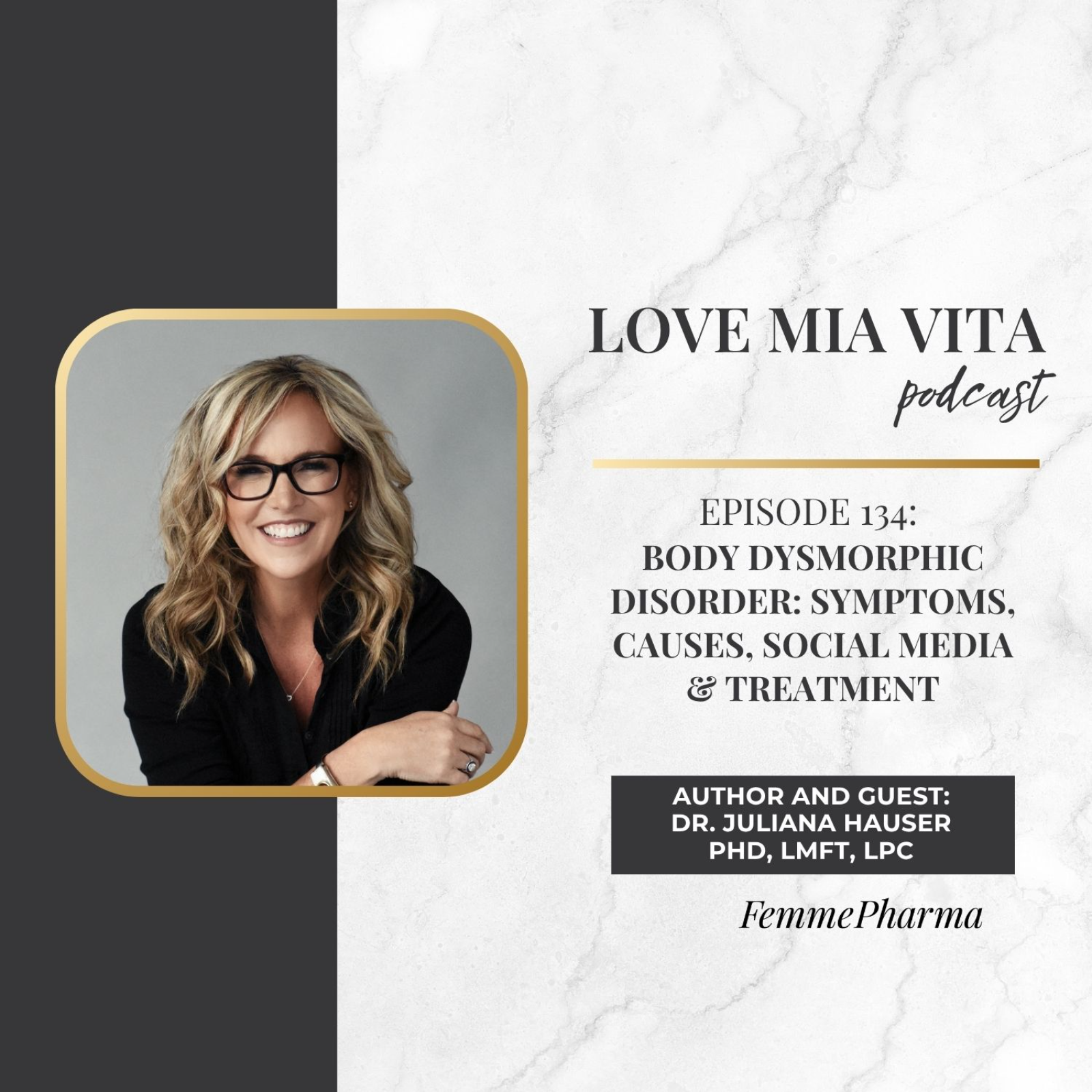
Body Dysmorphic Disorder: Symptoms, Causes, Social Media & Treatment with Dr. Juliana Hauser
from Love Mia Vita
38m 15s
Body dysmorphic disorder (BDD) is a serious mental health condition characterized by an obsessive, intrusive preoccupation with a perceived flaw in appearance—often invisible to others—that causes significant emotional distress and functional impairment. It is increasingly linked to social media exposure, where unrealistic beauty standards and constant comparison fuel unhealthy self-perception, especially among women. Unlike normal self-consciousness, BDD involves a fixation so intense it interferes with relationships, work, and daily life, sometimes leading to plastic surgery, depression, or suicidal thoughts. The condition often begins in adolescence and can worsen during life transitions such as pregnancy or menopause due to physical and hormonal changes. BDD frequently coexists with anxiety, depression, or obsessive-compulsive disorders. While self-esteem or cosmetic changes like surgery may be pursued, they do not resolve the core issue of distorted perception. The most effective treatment is cognitive behavioral therapy (CBT), which addresses the underlying thought patterns. Early recognition through signs like mirror obsession, avoidance of photos, and constant seeking of reassurance is vital. Supportive allies, especially family and friends, play a critical role in encouraging help-seeking without judgment. Stigma and internalized blame can make recovery difficult, but with proper mental health support, many individuals can find relief and improve their quality of life. This discussion emphasizes that BDD is not about vanity or superficial concerns, but about a deeply rooted perception issue that requires compassionate, evidence-based treatment. The message is clear: recognizing the signs, seeking expert care, and shifting from shame to self-compassion are essential steps toward healing.
(upbeat music)
- Hello, welcome to the Love Me of Eat podcast,
sponsored by Tham Pharma.
I'm Jerry DPNO, founder and CEO.
Thank you for joining us,
as we discuss all aspects of women's healthcare.
Please note, this podcast is for educational purposes only,
always refer to your healthcare practitioner
for personal advice.
(upbeat music)
- Hi, this is Jerry DPNO again,
and I am with Dr. Juliana Hauser,
who is one of our medical advisory board members.
And Dr. Hauser is a psychologist, a board certified,
and also a sex therapist in Dr. Juliana.
Tell us more about yourself.
- Yes, I am a twice licensed
life professional counselor,
licensed physiognomy therapist.
I have a specialty in sexuality,
menopause and psychedelics,
and love talking all things with you, Jerry.
- Of course, we always have a great time chatting.
Some of our topics can get a little thorny at times,
but we always want to end with hope,
and we're gonna do that today,
as we talk with something that's pretty serious
and something that we have seen possibly an increase
in due to more spending time or time on social media,
where what the body ought to look like turns into something
that can produce quite a bit of anxiety and distress,
and that's body dysmorphic disorder.
So first of all,
let's have you define body dysmorphic disorder.
- So this is a phrase and a diagnosis
that we hear more and more used in everyday conversation,
and it's often used incorrectly.
So how I will hear it is someone saying,
oh gosh, I just look so big now compared I used to,
and then their friend says,
no, you're very thin, you're very in shape,
and like I don't have body dysmorphic disorder,
and that is not the correct definition of it.
So the difference of the diagnosable condition
is that you have a perceived perseveration on,
it can just be one part,
it can be a whole variety of parts
that to someone else's point of view,
they wouldn't have noticed the difference,
they wouldn't have thought it was anything other
than typical, and this person is pretty obsessed
with that feature checking it and asking about it,
doing things to change it or to hide it.
For some, it can be so interfering
that kind of a range of it is like internal thoughts
to like other people around them
having to constantly reassure them about that part
to going to multiple plastic surgeons
or having multiple plastic surgery interventions
to feeling a lot of depression and anxiety
all the way to suicidal thoughts
because of the way a body part or part of their body
is perceived by them.
And it is something that we are seeing prevalence of,
and something that we absolutely as therapists
think is related to the increase in social media
and our ability to see others to compare ourselves
and have people judging us.
In particular, it's for all genders,
it's certainly female dominant,
but it's all genders have experienced this.
- You know, it's interesting that you bring up genders,
there is a slight difference between
and the incidence in women versus men,
but it is ever so slight.
So it's not disproportionate as in something
like an autoimmune disease
or even major depressive disorder.
And that was kind of striking to me,
but for what you just mentioned,
which is that men and women are seeing themselves
in others could be celebrities,
could be someone that just shows up on an Instagram feed
but they have an image that they want to try to replicate
and may not be possible given your genetics,
given the way in which you lead your life.
You know, if you're working 20 hours a day
and let's face it today,
people are working two jobs just to make ends meet.
So trying to find that time for a good diet
or exercise or what have you might be challenging,
and then trying to achieve perfection.
And I guess that's really,
so when I think about the difference between
being concerned about an imperfection
versus being obsessed about what you perceive
is an imperfection or two different things.
And at least the way I have understood
body dysmorphic disorder, it's the latter,
it's more of the extreme of const focus,
hyper focus on whatever you perceive
is a quote unquote defect.
- It's very different from an insecurity.
It is an all-consuming thought that is a perception
that there is something wrong.
Like there are some times that you could see
the will just use a nose as an example,
that you could perhaps look at somebody's profile
and say, oh yeah, I do see there is a bump there.
And I can see like maybe why it bothers you
or it's causing you to snore, you know,
that kind of thing that if you were to put 10 people
in front of them, that 10 people would notice it.
And then there may be a variety of people,
how they react to it,
but with body dysmorphic disorder,
it's often something that most people wouldn't notice
that they don't see this difference in.
And it can be even something like asymmetry,
that they think that their eyes are very different
or their jawline is different.
It's not even necessarily a body part.
And so it's a perception issue, it is a consuming issue.
They often need lots of reassurance,
either internally or externally.
And it's something that is so obsessive for them
that they begin, it's for some,
they won't leave the house, they won't let themselves
be photographed.
They are devastated by the way they look,
they are certain everyone is seeing it and looking at it.
It is a level of preoccupation
that most people can't identify with.
That is a diagnosable component of this.
There are certainly things on the continuum leaning up to that,
which is where we hear people talking more often.
But for those who are truly suffering
from this diagnosis, it's debilitating.
- Yeah, basically what I've read in the scientific literature,
is something that develops over the course of time.
And so it can show up, even in children,
but mostly in starting in the teenage years,
what are some of the factors that can lead
to body dysmorphic disorder?
- And there's certainly a social aspect to this.
If we were to look at the nature versus nurture,
we see in this environment, especially in the last 20 years,
and really in the last 10 years,
the increase of phones, the increase of social media,
our ability to be exposed to people
that we would have never seen,
except for maybe movies and some TV shows,
and seeing everyday people and social media platforms,
especially like TikTok,
where we're seeing the everyday person,
who is getting a very big following off a video
to or in general on their platform.
We're being exposed to different beauty standards.
And with that, there's comparison.
My daughter is a middle school, and it's brutal.
It is brutal, the way that your body
becomes a target of differentness.
But I think that is something that's been around
for a very long time,
but you put that on social media,
or people are able to do group chats and talk about it.
It really grows.
And when we have a society that does place a lot of worth,
self-worth, and also external worth,
on some of these looks,
and there's a social currency based on your beauty,
where your beauty lands on the continuum,
and who you're around.
Now, there's a culture aspect of that.
There's different beauty standards
and different races and different regions,
and some of that is really healthy.
The differences are, and some of them,
the differences are not healthy.
And so we have all this inundation of like,
what is okay?
What is normal?
And of course, we've had movements along the way,
of body positivity and better body images.
And, but we don't have a movement.
This is where I learned a lot of my work is,
how do we grow a different relationship with our body?
When that is not really the vernacular,
and we don't have classes that we're teaching kids about this,
then by the time you are hitting high school college
and in your adulthood,
you already have such a vast history
of how you look matter so much to how you get a job,
to who wants to be with you,
to your sexual currency,
that if you already had a tendency to be fixated on something,
in general, if you already had like the brain chemistry
of the genetics to have a perseveration issue,
for some it comes out in eating disorder,
for some it comes out in obsessive-compulsive disorder,
it can manifest itself and by dysmorphia,
by being linked into some point, something happening,
that the pain of your own perception
or someone bringing out something about your body
that they perceive is different, that's the hook-in,
and then it's a very difficult journey.
And then we add to the aging process,
or you change if you have a body that can get pregnant,
it gets pregnant, those changes,
we see a rise in it in pregnancy, too,
that it can all of a sudden turn on
when they start getting weight through pregnancy
or their body changes significantly.
after pregnancy and then paramanopause and menopause.
It's just, you know, a huge shift.
- So it is, it can be co-occurring
with other types of mood disorders,
like obsessive-compulsive disorders, anxiety, depression.
And I think as you illustrated, if they are,
it can show up as part of that diagnosis.
- Yes, it can.
- Mm-hmm.
- And it's, and not everyone has that comorbidity,
which means a co-diagnosis, but a lot of people do,
or at least there's a presence of it, we notice it.
And it's interesting because a lot of this
have very similar treatments,
which is cognitive behavioral therapy,
because you're getting at the thought process,
if manifesting itself in the way
that you're thinking about your body.
And we know this in a lot of ways,
because we will see people who will actually do something
that changes that body part with plastic surgery,
and yet when the plastic surgery is complete,
and again, other people would say you're successful,
and it looks good, that person does not perceive it that way,
and they have a perseveration on how it has been changed
and what it's been changed into.
And so we know, again, it's a thought process.
- So we talk about eating disorders.
This could be body dysmorphic disorder as well.
If you are obsessive or obsessing about your weight,
you're never thin enough,
but that's just one aspect of what is body dysmorphic disorder,
but this could be fixation on anything.
It could be fixation on your nose, your eyes,
your teeth, your mouth, your breasts, your genitals.
- And again, it's okay if you don't like it,
and I don't have a judgment on if what it is,
if you don't like it and you want to change it,
that is different than somebody who has
body dysmorphic disorder,
and no matter really what you're doing with it,
whatever surgery you're having,
it's highly likely that they are going to not change
their perseveration based on any cosmetic change.
And that the origin of that change is different,
as well as the intensity of need for that change.
It's really a continuum.
So, I know we don't want to position people
who have plastic surgery or especially labia plastic,
which is the change of your labia shape and size,
that it automatically means that you have that,
it doesn't, but how you talk about it,
why you're having it done,
what your connection is with the outcome,
and then how you react to the outcome is different.
And plastic surgeons are learning more and more
to screen for this,
but I've talked to several plastic surgeons,
and if they see that somebody,
most likely has body dysmorphic,
and they ask them to go see a therapist,
they could just go to somebody else who isn't screening,
and I have that done.
It's a really hard problem for plastic surgeons
to overcome, but they are often a first line
of bringing this to their attention,
because the other part of the disorder is,
a lot of times they're not aware.
It's very hard to convince somebody
when they have this disorder,
that what their perception is isn't accurate.
They are convinced that it is,
and other people just aren't telling them that,
whether it's your genitals or another body part,
and again, it's not always body parts.
It isn't, and it's hard for other people to understand,
and it's truly a debilitating disorder to experience.
- When someone looks in the mirror,
and they see something different
than what everybody else in the world sees.
So, for example, let's say that you look in the mirror,
and every time you look in that mirror,
you see a terrible set of lips.
Everybody else thinks your lips look just fine.
You have cosmetic surgery.
Maybe you do lip fillers or something more profound,
but you still see those lips
that don't look quite the way they should in your view.
So it's really that misperception
that you see in the mirror that no one else sees,
and then the repetitiveness with which you approach
the surgery or other forms of enhancement
to try to get to that level of perfection,
which is not able to be achieved through any means.
- And for some, the interventions,
like, for instance, with lip filler,
there's a difference of lip filler
at that to people like, wow, I mean, you didn't need it,
or gosh, like we can tell you've had it,
there's that conversation too, like, whoa,
what is going on with your lips,
and they don't even notice that the intervention
is, and other people's perceptions kind of outlandish,
and quite obvious, and in fact, a problem.
It even could happen to that degree as well.
But again, I'd go back to, I was talking to a parent once,
he was having a really difficult time
with somebody, their daughter, who was going through this,
and she's like, I just, I mean, it doesn't matter.
How much I tell her to love her body,
how amazing her body is, she's not listening to me at all.
And I was like, it's not going to be something
that you understand, and it's about the body part,
and it's not about the body part.
Like, we have to look at this holistically,
and not just so singled in.
But I said to her, the only way that I can get,
you to understand is if you were to go back,
look at a picture, she was in her 50s,
if you go back to look at a picture of yourself at 20,
how many, and I'll just speak to women right now,
how many women would go back and say,
oh, I have no idea how great my body was back then,
and like, had I known, like, if that was like a thinnest
I was ever going to be, or that was going to be the most
fit I ever was, I sure would have appreciated it more.
I mean, that is such a commonly heard phrase
of, I wish I'd appreciated my body back then.
The, but at the time, if you remember,
a lot of people would say, like, oh, I was upset about this,
we're upset about that.
That again, that's not by this morphing,
but it is the closest that somebody who doesn't have that
or propensity can understand, I'm like,
what, how could you not see when you were at that age
that you had this wonderful body
because you couldn't see it?
And, and in the perception is off again,
that's not, it's not a perfect example,
but it's one way to try to understand something
it doesn't make sense to a lot of people.
And when we have mental health disorders
that are related to our looks related to,
like, our, our body, like, an eating disorder,
or even for some obsessive compulsive disorder,
there's a different stigma attached to it.
I mean, there's less stigma attached to mental health
in general, but there seems to be like,
if you were to look at like a diagnosis,
like schizophrenia, people understand
that someone hasn't made that happen.
They haven't wanted it, they haven't thought themselves
into this, and someone with body dysmorphic disorder,
or sometimes even with eating disorder,
there is a blame put on somebody that they have this.
And so, thusly, if you just buckle down
and did something different about it,
you wouldn't have gotten this.
And that blame adds to the shame
that that person is experiencing,
and I haven't worked with a lot of people
with this disorder, but those who I have,
they are miserable, and they do not want this experience
at all.
And when, if you can get them to the point
that they kind of have a wake up up their perception,
their grief stricken over, you know,
what they've done already to their bodies,
or how much they've lost because of this,
because there's a lot of loss associated
with this disorder.
It is, it's really tragic, and it's misunderstood,
and it's not supported.
And we're in an environment that's really hard
to get away from.
Same with when I work with eating disorders,
we have to eat, and we have a coat of the soul lunch
that's wrapped around eating, and same with our bodies.
It's, it's very hard to break away
from all of the inundating messages that are unhealthy
for, especially for somebody who already has a tendency
towards listening out for that.
It's really hard to quote, get clean from it.
And it's harder than say, you didn't cause this.
This isn't your, this isn't a blame for you,
but the solution is helping getting
your thought process different.
It's, it sounds contradictory, but it, it isn't,
and it becomes a neuropathomy issue.
Yeah, yeah, we, we talked a little bit about teenage years
and how they, you know, something is like a mole
on the face, can all of a sudden take,
take on these proportions where it dominates the entire face
and it's hideous, and you need to change that
and remove that, or, you know, a nose
that's not quite symmetrical or eyes, or what have you.
And then you, you had mentioned during pregnancy
and postpartum where we know that, you know,
because of hormonal shifts and so forth,
the weight gain, et cetera, the issues may actually start
to pile up, so as we think about, you start out as a teen
who may be self-conscious.
And the self-consciousness may not be BMDD at that point,
but by the time you reach the point where you're having a child,
let's say it is something where, you know,
your features become slightly distorted, right?
Face becomes puffy or maybe the nose doesn't look quite as thin,
the jowls start to drop a little bit,
and now that adds on to your insecurity,
to the point where now it becomes an obsession.
Now it's trying to get rid of that pregnancy weight plus,
you're looking at this new body and this face
that seems to have changed,
where things may have shifted due to that weight gain.
You can almost imagine,
the exacerbation of symptoms as women transition from that and then to perimenopause.
Perimenopause, you know, obviously, there are a constellation of issues.
Yes. And sometimes with final health disorders, we will see like the, like, the light switch
gets flipped on. And for some, it just seems mysterious. For others, there seems to be a quick,
you know, an obvious, biologic link. And we, as we've said, a lot of times there's not a
research for us to understand a lot of these things should in perimenopause and menopause and mental
health. But I think anecdotally, a lot of us see that in perimenopause and then menopause, we see
a rise of this. And there's a legitimate change that is happening. And so when there's even something
even close to being legitimate, your body, most people's bodies are changing in perimenopause and
menopause, if that is going to be the thing that triggers it also, like something real in that you
can observe, then they can take it on a life of its own. If you already have the, you know, genetic
predisposition or environmental predisposition towards this. And again, it's, it's fixation is the
word that I would use for a diagnosable aspect of this. But there's a lot of suffering that happens
before you would actually hit the diagnosable level. And the suffering, you mentioned some
signs that there is extreme suffering taking place withdrawal, maybe a hyperfocus,
spending a lot of time in front of a mirror, self-loathing. So there are any other signs
that person's suffering, but also for the people that love that individual. Yeah. There's a lot of,
well, and again, everyone's a little bit different, but you'll see things like they start talking
differently about themselves, either seeking out reassurance or if you compliment them, they take
it in and take it to a level that feels different than either before or other people. You know,
women in general aren't great about taking compliments to their appearance, but it's more than that,
and you'll just, you know, you would feel a difference of it. And then it's the withdrawing, like,
from photographs is a very typical thing, or socially, there's not wanting anyone to see them.
So staying inward more and not letting themselves be photographed, always being the one taking
the photographs. But again, but a lot of women are like that anyway. There's always a one that
are the ones taking the photos because no one else is doing it, but it's you can't, even if you try,
they're not going to do it. And again, it's a level up to stress, either that's hidden or they're
verbalizing or you can see it, not wanting to socialize it to go out and the reasons and excuses
don't really add up, or they try to go and they're getting ready and they just can't leave the
mirror. They just can't imagine anyone seeing them in this state. It's looking at those
immediate, differently. It is doing lots of research about it. It depends on what it is. They're
perseverating on, but you'll often see lots of searches about it, talking about other people
who have the right, whatever. Probably what I see most is lots of searches on cures, things,
and then for some, especially if they have the money to do it, or even if they don't have the
money, they budget for interventions that can be anything that's just more topical to plastic
surgery. And we've seen a rise in the promotion of products that can address everything from
the neck to the eyes. We are fixated on youth and if aging in this kind of youth-focused culture
is really challenging for individuals as they hit their fifties and beyond. And yes, things
are going to change. You know, there are some eye circles that develop, especially if you don't
sleep or you eat improperly. So we do see that things will change and you're not going to look
the same as you did when you were 18 or 19. But because we are so focused on youth and youthfulness,
there's abundance of products that can treat everything under the sun. So it's easy to see
where someone who has body dysmorphic disorder would lean in and start to acquire and accumulate
any number of potential cures for these types of problems. And when they don't work because
most will help, but they're not going to undo. So the undoing is really where the plastic surgery,
cosmetic surgery comes into play. Not everyone can afford plastic surgery. And nor should they.
Because let's face it, there is some beauty in the wrinkles that we form these nasolabial folds
from smiling all the times. My non-n use to say that. Said, you know, I earned everyone of these
folds because I always smiled. And that is actually a beautiful way to think about the aging process.
But to somebody who has body dysmorphia, those nasolabial folds look like craters in the face.
And again, there's a lot of people who would say, yeah, I don't like it. Like that's great,
but I wasn't given that message. And I don't like it. That that not liking it is not
bite dysmorphic. It is the perseveration, the fixation. It's getting it fixed and not being
satiated in it. Either it didn't fix right or now they're moving on to a different part.
But the example you gave of a grandmother, I mean, what a precious gift that she gave you.
And what if that is what we were inundated with? What if that was it? And I do think that if we had
truthful examples and we were heralded, like if we could see that there was our heightened social
currency in aging and the way that our body ages, I do think that would be different. I think we
wouldn't see nearly as many people suffering from body dysmorphia. But I also think it's more than
that too. It's not just the perseverational effect. I think there's a genetic component to this
also. But I gosh, I sure wish that we were given that. And again, and I know that we have the
same way. It's not that plastic surgery in them itself is a negative thing. But I had an example
of my own life that I have, I'm hearing a whole lot more of people my age and my friends having
the surgery of the eyelash. I forget what it's called. Bluff, bluff something. Bluff, bluff, bluff, bluff.
Bluff for a plastic surgery. Yes, the upper and the lower. That's what my other word says. And I've
heard enough that it's something that I was like, "Hi, I wonder." I was like, "What makes you get it?"
And was it like, and I've seen people who say, "Oh, wow, you really can see a difference." And you
can, you look more useful in it. It was something I would have never thought of. I'm hearing it,
I'm seeing it. Somehow, my social media is now picking up and giving me more social stuff.
About it. And again, I hear more of my friends. So it's like, it's no one's saying it about me.
No one is criticizing myself. And it's nothing I really thought of. I've always had like, kind of like,
they could just call them like slitty eyes. And again, I haven't perseverated over that. But I've
thought about it. And I admire like the people who have those big eyes that you can really see their
eyes. So again, it's in my mindset. And then I just had an eye exam, a very thorough eye exam.
And when he downloaded my eyes, he had to pick up my eyelids. And if I had bought this morphia,
it would have felt like he was just like really trying to get it up. I would have felt devastated
about the fact that he knew how bad my eyelids were. I had like a little bit like, "Oh yeah,
I guess they are second more." Like he clearly couldn't see in my pupils because my eyelids were
down. And you know, I just got like what I obviously didn't think of thing. But if I had bought it
this morphia, it would have been devastating. I probably would have ever gone back, maybe ever
gone back to an eye exam because it was so humiliating. It could have taken me out for days.
And that is the difference of it. But the exposure I've had to it is what gave me a thought
that it was something to think about and to fix. And that's pretty profound to me too.
That if I hadn't been exposed to it, it would have never occurred to me. I don't even know if I
would have been noticed it. That's a really great example. And it probably goes to something that
how do you self-correct? So there's something that we can do. So thinking about how to address
the prism signals and warning signs that we recognize in ourselves. So you recognized it quickly.
But for those of us that aren't trained professionals as you are, what are some of the signs
that we see in ourselves and we're people that we love? What should we do about it?
Do you mention cognitive behavioral therapies? How do we approach recovery?
All right, at least are we somebody else? Because oftentimes we see it in others before we
can see it in ourselves. And that is, you know, if you just notice those changes that I mentioned
earlier in somebody and you ask them about it, like I feel really sad to that. I don't
any photos of you in it. I would really love a sicker photo. And their reaction is no, I don't
look good or I can't do this. And you can tell it's always an excuse. Then you can say to them,
this is something I concerned about. Does this sound familiar? Is this some of the way that you think?
And then in our, the way that our mental health system is set up right now, it is so difficult
to get help. It's so difficult to make the phone calls, you know, all of it. When the kind of
things you can do after recognizing it in somebody is helping them get from recognizing it.
to finding somebody that they can see.
And it used to be in our profession
that a lot of therapists wouldn't take somebody
who wasn't making the phone call themselves
or reaching out themselves.
In general, I think we are realizing now
the scaffolding of the system of mental health
is set up that shouldn't be the barrier.
And the thought process was that someone
isn't going to actually really participate in therapy
if they haven't been able to make a step
to ask for help themselves.
And there's validity to that to a degree.
But I think if you can help them get in the door
because the system's just so hard.
So make the phone calls.
Find out who is an expert in this area.
And you do want someone who's an expert.
If I had someone come to me this,
I would be able to go to a certain degree.
But I would say this is not my area of expertise.
I can diagnose or I can tell you this is an issue.
But if you want to go to a person like this
to really treat you, if you're come to,
if you have an issue that is recognizable to somebody else,
you need to find an expert in this.
It's not easy to find.
If you are somebody who is struggling with already
doing a Google search for this,
it's going to be such a huge hurdle.
You most likely are not going to follow through with it.
So do that for the person.
And then ask them about it.
And be an ally.
Be somebody who can hear it and listen.
Because oftentimes, when I have talk to people
who are dealing with this, what they'll say
is everyone told them not to worry about.
Everyone dismissed it.
Everyone said, oh, you're beautiful.
Oh, you're whatever did it.
What are you talking about?
And then they thought they were bad for superficial.
And so they really shut down in it.
So be a friend or a family member
that doesn't shut the person down.
And here's that is something that is legitimate to them.
They won't get help if the people who are talking to them
are saying this is something they shouldn't be feeling.
You have to meet them where they are
and the perception level of where they are
and say, hey, I'm concerned about this.
I hear you and I'm concerned, let's go do this together.
But it's a highly resistant population.
Perception is a really difficult thing to treat.
And it's usually long-term therapy with a skilled therapist
that's going to make a difference in this.
But there are people who do recover from it.
And there are some people who take medicine
that can really help cognitive behavioral therapy
is highly effective.
And if there's ever like a trauma point that can--
and there isn't always a place that's related to trauma
or a specific incident.
But if there is, there's work that can be done
to help with that.
Even like EMDR can make a difference
in going much of this moment and reliving it
and changing the neuroplasticity of that moment.
So that is not held on.
And then if it's yourself, do you have the insight
to realize that this is different than other people?
Do you have the self-analysis that this is hampering your life?
Do you have enough loss that you no longer are going out?
You've lost your friends.
Your family is sad that you aren't going to do things.
You feel terrible about yourself.
You perhaps feel suicidal.
Those are the signs that you also need to go get help.
You need to tell somebody.
Sometimes the first person they tell is a therapist.
Some people can go on their own and get the help themselves.
And others, it's asking someone to help them do it.
So ask because there are things that can be done
to help you feel better.
And it is such a debilitating and disorder to experience.
And there's so much loss associated with it
that it always breaks my heart when I hear about it
because I know that somebody who has suffered a long time.
So body dysmorphic disorder is not about vanity.
You can be helped.
If you know someone, if you love someone,
if you care about someone who you suspect,
be their advocate and their allies, you pointed out.
Encourage them to seek professional counseling
without judging.
And I know that this information will be helpful
to individuals who do see that imperfection
is much larger than it is and have unrealistic expectations.
For those that want to make a correction,
we want to reinforce that this is not about somebody
who wants to have cosmetic surgery
because they broke their nose playing lacrosse
or maybe they don't like the fact that they were born
with lips that are very small and receded.
So they go and they have plastic surgery
or even if they want to correct an issue
with their genitals, with their labia
because it's uncomfortable or just somehow got distorted
during a surgical procedure.
That's not what we're talking about.
This is really the extreme of looking in the mirror
and seeing someone that really doesn't exist.
It's seeing the monster when there's really just somebody
that's probably attractive, but yes,
has some imperfections here and there.
So that's great advice, Dr. Juliana.
We appreciate you and we appreciate the takeaway
and for any of you that are feeling
like you have, may have this type of issue.
We strongly encourage you to get the kind
of cognitive behavioral therapy and support
that you need to make you feel better about yourself
and living a good life, a healthy life
where you can love Mia Vietta.
- Yes, and I'll double down on the last part too,
which is I love it when I hear mental health terms
being something that people are using
and educating themselves and others about.
But when it gets to the point that we're using it
so that it is desensitizing,
I'm using it correctly, but it prevents some people
from really getting the help they need.
So it's both shame reduction and also causing a hurdle
for those to come in and we're not saying
that wanting to change your appearance is a definition of it,
but it's the level of intensity.
It is the way that we talk about a lot in medicine
is the quality of life is being impacted
by the way that you perceive and are fixated on something.
That's what we're talking about
with being diagnosable.
And again, there's lots of suffering
that happens up until that,
but the diagnosable part is something that is serious
and needs intervention in order to have relief from
and understanding the difference in that terminology
is really what we're hoping to educate today.
And as always, Jerry, just love what you and Ph.M. are doing
and educating and you will hit any topic.
And especially those that might be others avoid.
So I always appreciate you.
- Likewise, likewise, we appreciate you as well,
Juliana, and we also appreciate all of those
who listen and so remember to tune in again
and do love Miha Vita.
The love Miha Vita podcast is proud to be sponsored
by Ph.M. Pharma founded by healthcare experts.
Ph.M. Pharma is dedicated to providing research driven
pharmaceutical grade solutions
for the complex physical changes
women experience throughout their lives,
whether you are navigating hormonal shifts,
seeking better intimate wellness,
or simply looking for science-backed self-care.
Ph.M. Pharma's Miha Vita product line is rigorously tested
to ensure safety and efficacy without the use of hormones.
Don't settle for good enough when it comes to your body.
Visit Ph.M. Pharma.com to explore
our full range of solutions designed
to help you live vibrantly at every stage.
- Thank you for joining us on the love Miha Vita podcast.
Love Miha Vita means love my life.
And that is a mantra we should all live by.
Please like and subscribe wherever you get your podcasts
and remember to follow us on social media
and on Ph.M. Pharma.com.
Thank you and be well.
Podcast Summary
Key Points:
Body dysmorphic disorder (BDD) is a diagnosable condition involving a persistent, obsessive preoccupation with a perceived flaw in appearance, often invisible to others, leading to significant distress and impairment.
It is increasingly linked to social media exposure, where unrealistic beauty standards and constant comparison foster fixation on perceived imperfections, particularly in women but affecting all genders.
BDD differs from normal insecurity or self-consciousness—it involves a hyper-focused, all-consuming thought pattern that disrupts daily life, relationships, and mental health.
The disorder often emerges in adolescence, worsens during life transitions like pregnancy, perimenopause, and menopause due to hormonal and physical changes, and can co-occur with depression, anxiety, or obsessive-compulsive disorders.
Cognitive behavioral therapy (CBT) is the most effective treatment, targeting distorted thought patterns, while plastic surgery rarely resolves the core issue due to the persistent misperception.
Key signs include mirror obsession, avoidance of photos, seeking constant reassurance, extreme research into "solutions," and withdrawal from social interactions.
Stigma and blame often accompany BDD, making it harder for individuals to seek help, as they feel they "shouldn’t" have this issue or that it’s their fault.
Early recognition, supportive allyship, and access to specialized mental health care are crucial for recovery, with long-term therapy and sometimes trauma-informed interventions offering hope for improvement.
Summary:
Body dysmorphic disorder (BDD) is a serious mental health condition characterized by an obsessive, intrusive preoccupation with a perceived flaw in appearance—often invisible to others—that causes significant emotional distress and functional impairment. It is increasingly linked to social media exposure, where unrealistic beauty standards and constant comparison fuel unhealthy self-perception, especially among women. Unlike normal self-consciousness, BDD involves a fixation so intense it interferes with relationships, work, and daily life, sometimes leading to plastic surgery, depression, or suicidal thoughts.
The condition often begins in adolescence and can worsen during life transitions such as pregnancy or menopause due to physical and hormonal changes. BDD frequently coexists with anxiety, depression, or obsessive-compulsive disorders. While self-esteem or cosmetic changes like surgery may be pursued, they do not resolve the core issue of distorted perception.
The most effective treatment is cognitive behavioral therapy (CBT), which addresses the underlying thought patterns. Early recognition through signs like mirror obsession, avoidance of photos, and constant seeking of reassurance is vital. Supportive allies, especially family and friends, play a critical role in encouraging help-seeking without judgment.
Stigma and internalized blame can make recovery difficult, but with proper mental health support, many individuals can find relief and improve their quality of life. This discussion emphasizes that BDD is not about vanity or superficial concerns, but about a deeply rooted perception issue that requires compassionate, evidence-based treatment. The message is clear: recognizing the signs, seeking expert care, and shifting from shame to self-compassion are essential steps toward healing.
FAQs
Body dysmorphic disorder (BDD) is a mental health condition characterized by a persistent and obsessive preoccupation with a perceived flaw in appearance, which is not noticeable to others. It can involve any part of the body and often leads to compulsive behaviors like mirror checking, seeking reassurance, or undergoing cosmetic surgery.
No, body dysmorphic disorder is more severe than simple insecurity. While people may feel self-conscious, BDD involves an all-consuming, irrational fixation on a perceived flaw, leading to significant distress, anxiety, and dysfunction in daily life.
Social media exposure to idealized images and constant comparison can contribute to BDD by promoting unrealistic beauty standards. This environment fosters over-identification with others' appearances, leading to distortions in self-perception and increased anxiety about one's own look.
Yes, BDD affects all genders, though it is more commonly reported in women. However, it is not gender-specific, and men can experience it in similar ways, often with the same level of emotional and psychological impact.
Signs include excessive mirror checking, compulsive research on the perceived flaw, seeking reassurance from others, avoiding photographs or social situations, and spending excessive time on appearance-related searches or treatments.
The most effective treatment is cognitive behavioral therapy (CBT), which helps individuals challenge distorted thought patterns. In some cases, medication or trauma-focused therapies like EMDR may also be used to address underlying issues.
Chat with AI
Loading...
Pro features
Go deeper with this episode
Unlock creator-grade tools that turn any transcript into show notes and subtitle files.
 PodcastTranscript AI