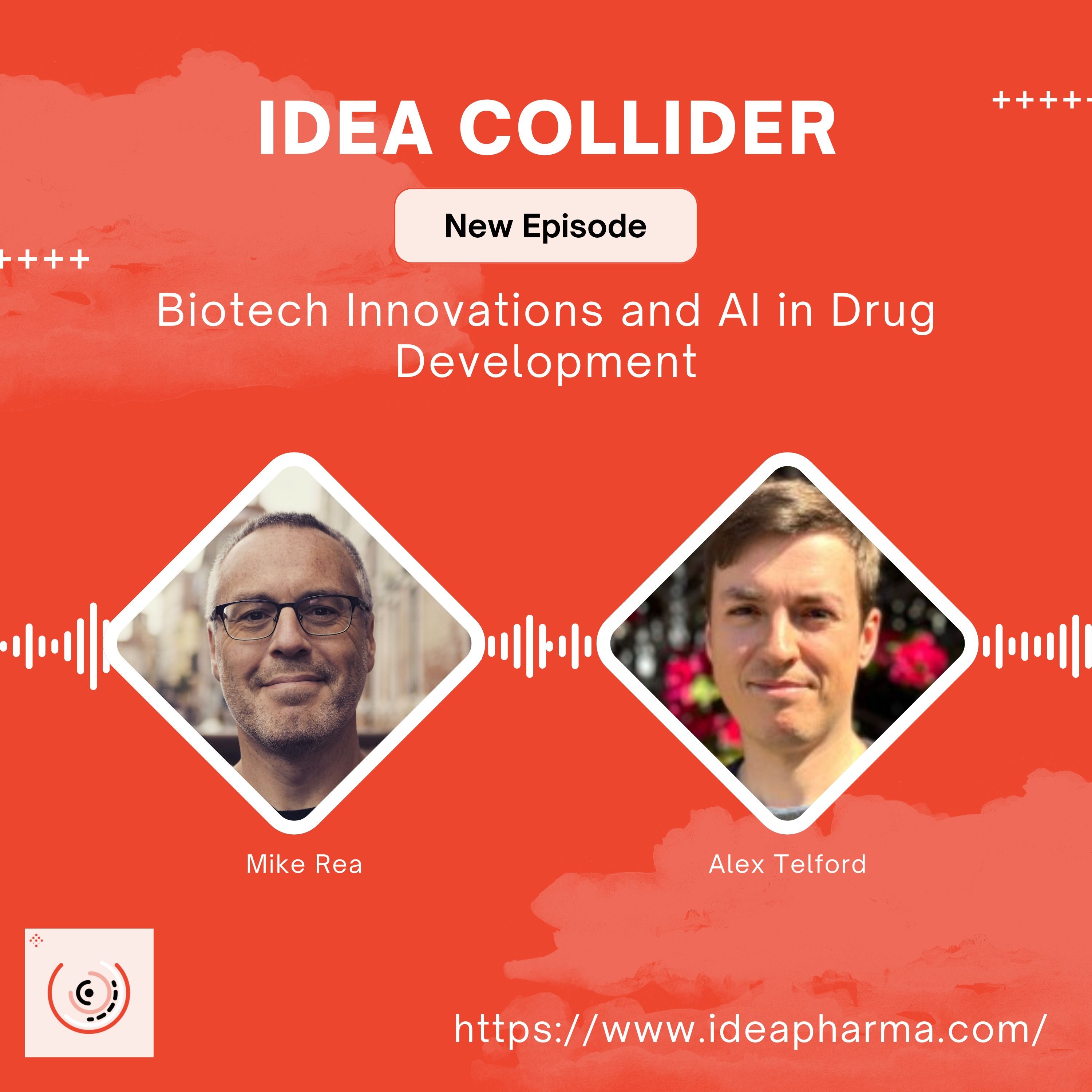
Biotech Innovations and AI in Drug Development with Alex Telford:
54m 19s
The conversation centers on Alex Tulford's background and his company, Convoque Bio, which aims to accelerate drug development by applying AI, specifically language models, to biotech. The discussion highlights how these models can automate knowledge work, process large datasets (like clinical trial records), and generate documents, thereby increasing efficiency. A significant problem identified is the pharmaceutical industry's fragmented and slow decision-making process, where costly information analysis and long development cycles (10-30 years) limit the exploration of multiple paths for a drug early on. AI presents an opportunity to cheaply and quickly analyze possibilities, integrate commercial and development considerations sooner, and potentially redesign decision-making structures. The dialogue also questions why pharmaceutical companies exhibit similar drug launch rates despite different strategies, contrasting this with the high-performance variance in software, and attributes it to slower learning cycles and diluted market signals in pharma. Ultimately, AI is seen as a tool to build practical knowledge management systems, flatten organizational hierarchies, and fundamentally improve how the industry learns and makes decisions.
You're listening to Idea Collider, a show that explores the world of asymmetric learning. In this show, I will sit down with pharmaceutical experts and business leaders to discuss how to embrace uncertainty and the different learning style that follows. I'm your host, Mike Rear. Let's get into the show. So, welcome to another exciting episode of Idea Collider. I was delighted to be joined by Alex Tulford. He's a biotech founder, writer and thinker, a great thinker based in the San Francisco Bay area. Co-founder of Convoque Bio, a company which builds software tools to streamline bio-farmer workflows so things like lab management, data and integration, collaboration. He has a background from the UK and from UCL and writes extensively on his sub-stack, just live where. He's going to go find him there and his personal blog about industry, about drug discovery, molecular biology, neuroscience, consciousness, AI, bio-risk decision-making, philosophy and forecasting. And actually, today I subscribed to a new magazine called Works in Progress. And I was delighted to see Alex turn up there and with his remarkable article on the boat, about how we think about monoclonal antibodies and how we could do things like increased body fashion and capacity to hundreds of thousands of tons, for example, and what that would look like if we were able to get there. So, his work is usually the reason I like his work is because it addresses the big questions, the role of serendipity and breakthroughs, regulatory impacts on the economics of drug development. So, you can imagine why I follow him so closely. But yeah, follow him on X, we'll give you the details of his links at the end of this podcast, but enjoy a really insightful interview. Alex. Hey, Mike, how you doing? Do you very well, how's things? They're good. So, Alex, you know, you're writing, which has been a final for a long while now, you know, often feels that there's kind of collision between your kind of deep knowledge of kind of the hard science and the kind of big philosophy questions. So, you know, biotech is a kind of industry in its own right as a business and a quest for understanding life itself. Can you tell me a bit more about your journey from UCL to kind of funding convoc? Yeah, so when I was young, I always thought I would be a scientist. So, I studied reading all the new scientists and old and kind of science books and from a young age. And then I went to, I couldn't pick between biology and chemistry. So, I did biochemistry at university. That was my selection criteria. And then at UCL, I'm really interested in the methodology and some of these sci-fi ideas of, okay, what can you do with biology if you project forward 50 years or 100 years? How can you develop entirely new organisms that we've never seen before? And how can you turn biology into engineering science? Those ideas are really interesting to me. And then I did my, my master UCL and I realized that synthetic biology is really far from anything that's practical, at least back a decade or so. So, and all the work we were doing was really just making these toy synthetic circuits in the lab or just these little toy systems that didn't have any practical purpose. And I think that's, that experience turned me off a bit on going down an academic route because I felt like I could be spending many years just playing around with ideas that were fun and cool but actually weren't helping anyone in the real world. So, I wanted to, yeah, that's when I took, I decided not to do a PhD even though I had long thought that I was going to do a PhD and go into science. And I wanted to explore something a bit more applied. So, I looked for roles in the pharmaceutical industry, one of our family friends worked in life sciences consulting. I had no idea that consulting was a career or life sciences consulting was a specialty of, of, of something. And it sounded interesting enough. So, I applied for some jobs, got one in Switzerland joining a small boutique firm in a city called Citical Dutzerne. And we just, we got acquired by a larger biotech consulting firm a few weeks into my job. But still I stayed around and it was fun, had advising biotech and pharma companies on all sorts of things from business development deals to market access strategy to, you know, just like primary market research, medical fairs, regulatory, so the whole gamut of work you can do is you take a drug from an idea to market. And that experience was, yeah, I just really, both interesting and also gave me a pretty good perspective of, you know, everything you need to do to develop a drug. And so if I complicated, I just saw so many inefficiencies doing that knowledge work. And when language model started getting started getting more and more capable, I got pretty excited about language models of technology to automate knowledge work broadly. And to reimagine knowledge work. So, a lot of process in the biotech industry, very artisanal. Everything is done on a one off basis. A lot of service vendors, a lot of information that gets, you put a lot of effort into creating that information and then that information just gets stored on a share point. And I'm going to share points somewhere and not looked at again, you know, and it just felt like if you can build software products to automate those processes of knowledge synthesis aggregation and then even knowledge generation eventually. You actually, that is one way you could have a pretty big impact on the way work at the industry and efficiencies. So that's what motivated me to start the convo eventually. So tell me a bit more about convo, and you know, what it's free mid-air is what it's mission is. So the mission broadly is to try and accelerate the capacity to develop new drugs. So that's a pretty broad mission. But actually, most of the day to day stuff we do now is focused on applications of language models, though finding ways to use this new technology to improve make the industry more efficient. And we've narrowed down to start with on a few use cases that center around getting language models to process large amounts of information documents data coming out in the external world and in and generated by internal systems or teams. And then processing information structuring it and creating data sets. So that's like one angle is using language monster create data sets at scale. So one example is we've gone out and processed every clinical trial record. We can find on the web and we've structured it into a database of clinical trial results that is a tabular format and then you can run analysis over it. So you can very easily do a ask a question like what's the overall response rate for every drug has ever been tested in second line non small solid cancer, something like that. And then we're trying to create data sets like this across many different types of data sets like patent data sets of company deals data sets of who's working on what target. And I think the because language models can you know, process of volume of information we can create a lot of new data sets that would otherwise be too expensive to create. And hopefully we can do something like in gender something like the money boldification of farmer decision making where you can be a lot more analytical and data driven about decisions because you can you now have the capacity to create these data sets of very large scale very granular data sets that can add can let you reason quantitatively and analytically about decisions. So that's one aspect of what we do. And then the other aspect is generation so language models are good at both reading documents and the information and then generating information. So we worked with companies on just generating things like medical affairs documentation, language summaries abstracts, manuscripts, bits of investigators brochures and other regulatory documents and also internal reporting as well. So and that uses the capabilities and models already have and some of these proprietary data sets were putting together. So I'm always fascinated because that two questions. You know one is these kind of efficiencies. You know one of the problems we have with decision making, especially in the early phase around the effectiveness of decisions as well as sort of efficiency of decisions. So you address both what you're looking at. I think we hope to I mean I think we're a long way from reimagining the way the decisions are done in the industry. I think eventually we want to get there and I would be like, he was sick to say that we're going to be the reason why everything changes. But the way I think about it is the way the industry makes decisions is very fragmented and siloed right now. It's almost like a factory line right you have the people in discovery making a molecule and then deciding whether or not to advance it to the people in early clinical and the people in clinical. Shunted into late clinical and then it goes to the commercial team. And I think you have this you know because there's no like integrated decision making process. You have these like errors get passed on the chain or they never get like a big problem doesn't get discovered until later. Right. Like if a drug is there's some consideration of maybe the commercials of a drug when you're in discovery phase, but not so many. But then you get to late phase like clinical events like, oh, now we've realized that actually there's some fundamental problem with this drug and we're not going to get reimbursement in Germany or something like that. So I feel like finding a way to integrate those decisions so the people in early discovery are considering the entire potential like every way you could develop this molecule and what that means for. Developability, manufacturer ability, commercial potential. I think you can bring a lot of those decisions earlier in the process because.
because you can do an analysis so cheaply now. What would require a few hundred thousand dollar consulting study? Now you can do a language modelated decision making. You can do a lot of this pretty rigorous analysis of future paths, potential TPPs, commercial landscaping. You can do that very early on, but the few clicks of button. Yeah, and then that's really where we set as well. Because idea that one of the fundamental problems is that the pursuit of a single TPP is already killing decision making later on because you've already cut off a lot of the different paths that were available, but one of the things that limits people's ability to do that is just the ability to easily and quickly assess multiple paths to market. Because everyone knows there's not just one path for a month, for a molecule, but everyone behaves as if that's true. And so then she loses things just by never looking at them. Yeah, and I think part of the problem is because the decisions get made a bit too late. As you get further in development, you lock down what you can do. The most optionality you have is when you've just found the molecule or when you're even just looking for the cathedron. Then you can change everything about. You can change the molecular structure or you can change the manufacturing process. You can change the indications. And then as you get closer and closer to market, then you can change less and less. So you want to try and explore as much as possible as early as possible. But we don't really do that because it's so actually processing information is pretty expensive because you have to use expensive humans to do it and go and do all this research. It takes a long time so you can't actually interrogate all the possibilities before you had systems like language models that can do some level of reasoning, whatever that means. That's pretty exciting about it. Yeah, I think that's really where we need to go next. Five, ten years is to address the kind of decision-making processes in companies and just how they go about that stuff. The biggest problem that we find is the kind of McKinseyization of this is the process we have. Let's improve it by 5%. Without getting 5 or 10% less efficient on the way through without ever getting back to the real problems in the mix. That is something I worry about with just language model technologies and AI, as it gets adopted in the industry. You don't want to, I think it's an opportunity to rethink how work gets done and to rethink some of the decision-making processes because you're not constrained in the same way as you were before. If you think about a company structure, a lot of the hierarchy of a company is just a means to filter information. You have people lower in the company who do a very grunt analytical work of I'm reading every paper and I'm pulling out figures or something. The next level up is synthesizing that and then synthesizing it again. The executives maybe get a very high level polished deck that tells them this is the decision or this is the proposed decision and here's all a nice forecast model and everything. I don't think you need to structure work that way anymore because you're not so limited by time. You can just ask a system like chat to everyone who's used chat to everyone who's used chat to be at this point but you can ask live with model-based system and it can go and engage directly with the data for you and it can perform this analysis on the fly that was very expensive to do before. I think you'll have a lot more flattening of organizations where the decision makers are directly interacting with the data and what I don't want to happen with AI is I say language models is that we have all these pro these suboptimal process and then we just automate the suboptimal process and then we just lock them in. So we just have, you know, we just like train the language models to make the same kind of bad decisions that we're making. And just think about things in the same way. That's probably not what we should do. We should take a step back and think how would we redesign decision making. Now we have this partial technology that can read a million papers and it can look at my organization's entire knowledge and synthesize it for me. Yeah. You're going to rethink the process. Yeah. No, it's interesting. I wanted to get into, I know you were on Beyond Biotech recently and you talked about things like clinical 12 failure rates for sure, but also the idea of serendipity and discovery which are huge fans of this kind of plan serendipity in the approach. But I know there was a lot of debate after that after that post. Have you got any sort of big questions that keep you up and night after that kind of conversation? I mean, I think one thing, one of the questions in that post that we talked about in that podcast that we didn't really get to, but I find really interesting and it's a bit on the South of the Serendipity is if you plot the number of drugs launched by every farmer company you put on a line like over over time, pretty much every launch of drugs the same rate. But actually if you work with these companies, you know they're very different organizations. They have different therapy areas, different platform technologies, different cultures. So why is it that everyone launches drugs at roughly the same rate? I think the thing that is maybe concerning is, okay, maybe there's some like fundamental rate of biological discovery and these ideas are just in the air and then some companies going to get to them. But no one company is particularly good at developing drugs and maybe developing drugs is so hard that it's just not something that anyone can be good at and it's just almost pure luck. I don't think that's true, but I think it is interesting that we haven't seen, we have like, you know, you have an opinion like maybe Lily is doing very well right now or maybe Vertex is good at developing drugs, but I don't think we've really seen a company that has been two or three times or ten times better at developing drugs whereas in software you have, it's very obvious that you have this, these like orders of magnitude differences in company outcomes and some companies are extremely good at developing technology and some are much less good and the variance is much higher. But like all the former companies sort of cluster around the same revenue, they cluster around the same kind of performance, same market cap and maybe they escape for a bit of time like Lily is doing right now, but then they often come back to, you know, the peer they revert to the mean because of generic separation among other reasons. So like, yeah, so why is that? Can we find the way to develop drugs much better is that possible or are we limited by some constraint, more fundamental? Do you think that's something to do with the kind of cycle times or kind of, you know, the decision making process to finding out whether you're right or not? Because, you know, this is an industry, so 10, 20, 30 year cycles where you find out whether you know, that thing that you decided to do 20 years ago is going to be commercially viable. So far, I think, and even hardware and IT is a little bit faster cycling right to get to a disaster or that was a kind of great idea. I think that is a huge part of it is, you know, having worked across both industries now, the cycle time and the learning rate and software is so much higher because you can just, you can build a prototype in less than a day and then you can show it to a customer and they can say, yes, I like this, yes, I don't like this, so it can be money, I won't give you money. And then you can iterate on that feedback. So you could very quickly learn with your market, but it's actually very hard to learn from, you don't really get any signals from the market in a pharma company. Even when you're commercializing, actually, the signals you get from the market are very diluted because you have, you know, payers and doctors like so many stakeholders involved in making a drug purchase decision that it's actually very, it's actually pretty unclear for a long time, how you're going or. Absolutely. Absolutely. And knowing what's contributing to your success or failure as always, you look at Nover, you look at Lily and you go, look, this was a perfect combination of opportunity and molecule, you know, whether they were great commercially, it's hard to say they were just there at the right time. And then you're turned around sometimes from, you know, as they pass hands within companies. So those kind of metrics that you would traditionally look at to see whether the decision that you made was a good one is, you know, those are diluted already by the process. And then the timelines are so long that the context gets lost. I mean, this is one area that I'm excited about. AI, I mean, I think like pharma for many years has been talking about knowledge management systems and it's like, okay, let's invest in making this great knowledge management system. So we can use all the data we're generating and make it effective in accessible to whole organization, but none of those have ever really panned out or been actually useful. But I actually do think with live with models, you can build system, you can build these are creating knowledge management systems that are actually useful. You can dump everything into a knowledge base and you don't need humans to curate everything all the time and spend all this time like, you know, making it perfect and keeping up today, you can have language models doing that. And then like directly interfacing with the end consumers of that data to serve it up in the form and it's relevant. So I think we can finally build good knowledge management systems and that could be actually pretty powerful because you can think of you can transition from, you know, an organization where everything, every piece of information is in people's heads and maybe it's in some PowerPoints, but people lose those to an organization where everything is centralized. And you can, you know, crew that knowledge over time and then your own AI system internally becomes steadily more and more intelligent and learns more from your data. Whereas something I've seen a
a lot working and consulting. And I'm sure you've seen it too, is if you work on a program for a long time, the people working on that program will leave, although it goes somewhere else than the company. And then the context gets lost. And then the amount of time, we've been working, our firm had worked with a company on a particular asset longer than anyone on the team had individually. So we've become almost a store of organizational knowledge for certain pieces of information. - No, no. - Is it like, "Can you send us that? Did we do some market research three years ago and did you guys do that? And can you send me the deck and could you represent it?" - I think those kind of things will move more to software systems and maybe then we can actually have this accruing knowledge so companies can learn more effectively from experience. - Definitely. - On that kind of subject, I know Convo looks at software pain points in farmer integrating a lot of data workflow and so forth. What was forward to, says the biggest inefficiency you've seen, maybe the inspired Convo, how do you see AI kind of overlapping with that? - Well, the original inspiration was just working in consulting and seeing the work that my teams were doing to just pull information from many different sources. I think so much information is fragmented and siloed and I think it's almost like a trite point to say that. But it's been a problem for a long time and no one's, there's been no solution. I don't feel that tried to solve it but there's no solution. But I think that's the main problem is everything is so fragmented, everything is so siloed. Every one decision you need to pull from so many different databases. I think part of the problem is just like the construction of the industry, every decision is very multi-modal, multi-factorial. You have to consider if you're making a drug, can you manufacture it? Can people pay for it? Will the regularizer prove it? Can we show efficacy in a clinical trial? - Reformulated. So it's very necessarily complex multi-optimization problem. So I think just like informing decisions requires you to look at many different sources of information sources of data and pull together. I just felt like a lot of the actual interface between the data and the decision was very inefficient. Like you're logging into these antiquated systems, you're downloading an Excel and then you're spending a bunch of time cleaning up things like, okay, is this drug name in this Excel, the same as the strong name in that Excel? And is this target the same as that target? And then like putting it together into an actual like data set. And then finally you can go and make decisions and reason about that data set. I think that first one is as if going from the data is all out in the world or the organization to now we have a clean compiled data set that pulls together all these different pieces of information in a way that's like ready to help us inform this particular decision. That felt like it was taking way too long. So I wanted to build better tools to help with that process of just searching for information and consolidating it together and then cleaning and packaging it up. But I think like now that I've been working with farmer companies, we've also, I've also got a lot more interested in the document generation side as well. So you know, for like medical affairs, like how do we write, how do we scale things like medical legal review, how do we scale things like writing compliant messages at scale? Yeah. I think these things are just, I know like how do we scale things like writing regulatory documents? These things take up a mass amount of time. And frankly, I think a lot of these tasks are, I mean, they're obviously not trivial. They require highly skilled people to do them. But they're not really, they are like programmatic in a sense. Like you put the data from the format, from one format into another format that fits the regulator suit a bit for preferences and fits their template they provide. And I think that task of taking data from one format, whether it's tabular or like other unstructured format and putting it into a template is a, like a very common activity in the farmer industry broadly and something that I think language models are like very well adapted to do. I think we're going to see, I mean, all of companies have already deployed internal tools to do document generation. And others are working with companies like ours to bring those people to the house. And I think we're going to see, that's going to be the first place, or that has already been the first place where we've seen a lot of inefficiency gains is generating a lot of these templates as regulatory documents or templates internal reporting documents. Yeah. Which has been, oh, and I've been fascinated watching someone like Anjen. I know they were early adopters of that idea of, you know, mentations are really easy, it's just a whole problem that would point AI towards. And they've gained three, six months, which is a big deal for a big drug. But I think some of the more imaginative stuff is still the common thing. But as you say, it's easy to look high. You can save a few hundred million on some of those internal processes, but the kind of big gains, I think are probably still to be seen. Yeah. And I think a lot of them will be discovered. Rather than, you know, reason about from first principles. Like, we are, you know, we work with language models every day to figure out how to best use them to solve our customer's problems. But just, but we like constantly discover new ways, new techniques to use the models, new applications. It's a very interesting technology because I think typically in software, you can reason about something you're trying to build. And then you can tell if you're going to build it before you try and build it. But the language model, you don't really know what they can do and what they can't do. There's this massive, it's like a complex system that you can, you know, send language to and get some language back. It's like a, you know, this is like the Chinese room. You don't know exactly how it's operating in there, how much it knows, is it really understanding you are not how complex of a task can it do. But I think what we've seen is that, if you're very creative in how you feel at information, you can access these like emergent, very powerful capabilities. And we're still exploring the frontier of the knowledge that exists within these models. And I think so that's like one part, it's like the workflows that, the complexity of the task the models can take on is like emergent and discoverable. And then the other part is just like how you work with these tools. You know, I think we're going to need new interfaces. Like one example is we started working, in our product we have a simple, we started with a very simple like window where you can describe a report you want to generate. Let's say like, oh, I want a landscape. Give me a landscape of all the companies, of the target safety for some given target. Let's say, like give me a landscape, give me a EGFR target safety report. And go through very diligently and search for my papers, search our internal data. And it will come out with a template of target safety report where it can go through. You know, okay, who else has tried this target? What's in the, what have we seen in literature? Based on the pathway, where do we think the toxicity liabilities are going to be most the clinical data from other EGFR inhibitors? And then you show that to the customers and they think, okay, that's just cool. Can I find a way to run this across 1,000 targets or 10,000 targets? Yeah. Then you have to, then we create a new system where we give customers the ability to run many of these reports in parallel. So you have one template and you just swap out the entity or getting the model to write about. Like now it's EGFR and now it's TNF, now it's TL1A. And then you just run that at large scale. And then you set it back and say, okay, here's your 1,000 reports about every, like the safety of every different target that you're interested in. And then they think, oh, wow, that's great, but I can't read all this. So then you get like a new system to help them digest the information and flag. Okay, what is the key information within those 1,000 reports? So I think, you know, when we move to a world where we have all these, these tools like doing a lot of work in the background, we're going to need new systems to help humans actually digest that information. - Yeah, it's kind of, I find it fascinating because I'm not an AI expert, but you try and stay across what's possible and you look at companies like causally, exploristics, there's a bunch of fascinating companies doing unbelievable stuff. You think, well, is there anyone sitting across all of this looking at what's possible today that wasn't even possible last week? - Yeah, how do you stay across what's out there, what's coming, what's possible? What's your process for keeping abreast of things? - I will say it's pretty hard to keep track 'cause AI is a fast moving now. What I do find very helpful is Twitter, actually. A lot of discussion about AI is on Twitter. I think also being in the Bay Area is helpful. Open AI is here, Anthropic is here. A lot of discussion is just happening in restaurants among people working at these companies. So there's a lot of local knowledge diffusion with it ecosystem here. And certainly, it takes a lot of time to keep up today with what's happening 'cause it's both complex and fast moving. So I would say that we can follow everything, but we try to keep abreast of the main trends and we try to share with other companies who are working in, maybe they're working in insurance, they're working in AI applications for Vintech or something else. Like what can we learn from them and how are they adopting tools in their industry and what ideas can we bring from legal AI to farm AI? So I think there's a main one. Obviously we try a lot of stuff out internally as well. It's like really Twitter and just local information diffusion. - Yeah.
I've written a lot about the idea of asymmetric learning. So how are you learning in a way that other folks aren't? And what kind of advantage do you get from the way that you learn? Are you written in post about how most launched drugs don't even recruit their own development costs? One of the problems industry has is its economic model. And I think it made the point about different companies having different strengths. But there's a huge range of different costs per company, per molecule that gets approved. Do you see AI making a difference to the economic model? In its current form, or is there a different way of applying it? I don't. I think it's hard to see how AI fundamentally changes the economics of the industry. I think that we are a hit-stripping industry. I think that's going to stay the same. I don't think-- I mean, the thing that would really change the economics of the industry would be I have some system where I can put in a molecule into a computer. And then it tells me what patient or disease is with treat with like perfect accuracy. And then I don't need to run the clinical trials. I can just go directly from a molecule to a patient. I mean, that's what would fundamentally change the economics. But now I don't see how you can escape things like the running the regulatory process, running RCTs, having to commercialize through a network of doctors and payers, because you have to appraise the evidence that you generate, because we don't have this certainty about whether or not something works or not. And I think we learned that it's probably not the right model for our industry to have just like any company could list their drug on Amazon or something. And patients could just buy it. That probably a good idea. So I think the actual business model and economics stay roughly the same. I think what AI will help a lot with is reducing cost and timelines. So reducing just how much work you need to do to write all these documents, analyze those data to make the decision. So you can make decisions faster. That can reduce some of the white space that's maybe like 50% of trial development timeline. And then I think you know, you're always constrained by biology. You're just waiting for biology, clinical trials and site operations. I don't feel like site operations are that amenable to automation. It's just like a people problem. But if you design your trials effectively, you have a very good end point selection. Maybe AI can help you figure out opportunities where you can run an eight week trial instead of a 12 week trial to get a initial readout. Yeah. Then we can get some savings there. I don't want to really put a number on it. But I think you can shave off 10% of the role development. 10% of the percent of that magnitude. You know, very rough of the development timeline. I think in discovery, that'll be a big impact there. We have all these design tools, general binder tools. Those will help us make better molecules. I think it's not going to be a step change. It's going to be a pretty meaningful improvement. In the same way, we've had other discovery technologies in aggregate making a large improvement. But any one technology has not completely transformed the economics of the industry. I think both AI is going to be like that. We'll just have a combination of better molecules coming into the clinic, better clinical trial design, better decision making. I think in aggregate, that will improve timelines, reduce costs. That will help improve some of the economics of the industry. I don't think we're going to see. I think unfortunately, I don't see a way for AI to get us to, okay, now it's tech or something in a 10-year time frame. No, I think that's one of the more interesting. You watch Twitter and you watch the polarization of folks. I think AI discoveries the new thing. These drugs have to behave like any other drug on the hitter pipeline. They're not going to behave differently when they get there. You look at companies that are able to tell you where to put your clinical study because it's more likely to have a positive outcome. Then you see the effects of different clinical trial sites on different modalities, just the way they recruit patients or whatever. Anything, a lot of this is a knowledge issue, right? You should be able to address that going forward. That fundamental thing, as you said, you also have this analogy of, if you're taking an advisory board of eight people and this seven of them agree on something and one guy doesn't, you still don't know whether he's right or wrong, even though you have that kind of an opinion and then come to the individual position and what they think about when they're having an individual patient in front of you. What's the perfect decision process? How do you influence that kind of decision going forward? That's going to be a human problem for a long time yet. What I do think is true is, I think the first thing I do is, I think the first thing I think the farva industry as a whole has been so good at making money for a long time and having high margins. They haven't really had to take a very hard look at every step of the process and to my is the costs and the time of that process. I think now, the way that maybe a manufacturer has, right, if you look at the Japanese auto manufacturers as an obvious example, they've been very rigorous in how they've driven down, how they've atomized every step of their manufacturing process and how they've driven down costs for each step. I don't think farma has had to do that kind of level of optimization, but now maybe with some of the pricing pressures coming on and the lowering and the rate of return, some people are saying that the rate of return is now negative in the industry. I think we probably are coming up on a point where the industry is going to have to look more seriously at its cost structure and just invest in more efficiencies. I think AI is one way that I think will be quite impactful in the aggregate, but there's also many other, like they're probably so large that there's many other ways that beyond AI to lower costs. Like maybe it's maybe all early discovery goes to China. I think China is probably more of a rise of China as a discovery engine. It's going to be more impactful or has been more impactful as well. I can't figure a time frame, then AI will be, I think, even though AI is very useful. It's just literally going to raise the idea of China because within our innovation index, we've kind of tracked China for a while. It was that they were discovery engine for a while, but now they're looking to launch, commercialize their own drugs from China in the way that China was great for a while, not so much anymore. What else do you see coming from China? There's clearly innovations in AI there that we don't know so much about, as well as the kind of their ability to increase speed and development on a bunch more. How do you see in China impacting our industry in the next five to ten years? I think the obvious one is discovery. They continue to move out of the value chain, right? They take a large share of discovery. It's hard to see a world where discovery and preclinical funding for your clinical biotech in the US and Europe is sustainable now as it used to be. I think the funding model of the industry is going to have to change a lot. I don't think we're going to have these, oh, I'm going to make, I'm going to fund this biotech, $200 million and they're going to have some kind of discovery platform. Then take a few drugs. I think anything that's technology that's not super novel and almost fringe will just try and will just do because they can take ten shots on goal for your one shot. They don't even have to have any AI to help them make better decisions or anything like that. They can just throw a bunch of cheap made chemists at the problem and array a bunch of similar structures and just copy your, like as soon as you publish, you're working on a target, then they can just throw a bunch of people at it and beat you to the clinic and run one of these investigators, initiate a trial locally, get some clinical data, sell to a far burn and suddenly you've lost the race. I think the biotechs that get funded and founded in the West need to look quite different. I think they'll look like either very novel fringe biological insights, drugging things that we didn't think were, like I don't fit into like easily conceptualized models of a drug or they'll be really new technology, like new technologies, combination drug devices, complex self therapies, things that require really significant expertise to manufacture and develop. I think China will become the discovery. Like the same way like Wushi is now where everyone sends, you know, sends a lot of their pre-canicle work. I think it'll just become a source for a lot of like raw assets and then the Western, then Western farm economies will develop those drugs. Yeah, and that's going to be interesting because I think that kind of Darwinian environment, you need some water in the pond, you know, basically and I thought water is the kind of biotech funding which is struggling at the moment in the US. It's not out in China for, you know, of these reasons. It may well be that some of the sources of innovation are going to be coming from there. I wanted to dig into, I know you've written a lot about consciousness and intelligence, natural, artificial. How do you see kind of neuroscience, AI kind of blurring the line between biological and artificial or synthetic minds? I think.
So having dug into it, I think we're still pretty far away from understanding just what consciousness is. And one of my theories for why that is is we don't have good sensors, we don't have good sensors, not invasive sensors to measure brain activity. So we have our eyes or functional MRIs, but those are pretty coarse. They just measure blood flow in the brain. They don't measure actual neural activity. I think it's also quite hard to access what is actually happening in below the cortex. If you do an EEG, you just get the top level readings from the top level of the cortex. You don't actually get what's happening in the midbrain or the brainstem. And I think if you look at a lot of literature on the consciousness, it's pretty clear that there is a lot of important functionality that's happening in the phalamus in the midbrain for a conscious activity. So I think one way to get closer to solving this problem, what is consciousness is developing better, better sensors to measure brain activity in living conscious organisms. And I think until we have that, it's not very clear to me exactly how we'll really figure out what consciousness is. I think if you look at the history of biology as a science, it's very empirical. It's not really been driven by these. It's not like physics or math where you have this mathematical representation that you can just test everything in the math. And if the theory holds and you know, that's great. It's been very like driven by empiricism and very driven by new tools. And typically what happens in biology is you have a new tool and someone applies that new tool to an old problem and then they make a breakthrough. Like as far back as a microscope, we wouldn't have reasoned out bacteria from first principles. Maybe not. I mean, we actually like the reasoning was bad air or people thinking that it was like a little microbial particles of the beings. So I think it's similar like we probably, there's probably something that if we had the right sensor technology, we would be able to understand the mechanisms of consciousness. But now we don't have good sensor data. So we get to speculate and there's so many different, you know, speculative theories about what consciousness is. Oh, it's, you know, maybe it's the, it's stored in the microtubules or it's stored in the electrical activity of the neurons and electromagnetic field or it's stored in the, or it's fake or something. I don't know. I just think we don't know. It's like so uncertain. We have so little information to go off. So these brain faces maybe a good. No, it's kind of fascinating. I mean, I studied genetics back in the 80s and you look at what we're still discovering about DNA and the way it works and the way it doesn't work. So I thought we had it mapped back in the 80s and then you go, no, it's still relevant in 2025. And I guess and then you look at some neural link, which everyone was skeptical of for a long time and they go, well, it's, you know, maybe you need an engineering mind to look at the nidif different way. I think the thing that's really interesting about biology is it's almost infinitely deep. It's like so hierarchical. Like, you know, take genetics, right? Like, okay, you have epigenetic regulation, then you have. You know, all sorts of mechanisms to repair the DNA, all these control mechanisms were just discovering now we're discovering the ways to edit a genome. So I think, you know, every time you look closer or you get the tools to look closer, you find more and more like detail, it's like a fractal. Same with, yeah, it's like with the neuroscience, right? You can measure very closely what's happening in the blood flow in the brain and then you can look into the levels of the individual neurons and then you have in the neurons. Actually, what's important is, okay, the level of like what proteins or receptors are expressing the synapse, what channels are expressing the synapse, what's the level of like intracellular calcium in the neuron. So it's just like it gets so deep and all these little like the biology has found a way to use every level of hierarchy to do some kind of computational adjacent activity. So I think it's just as we get better tools to look deeper into what's happening at a like a level, then we'll have them will eventually like slowly I mean all the mysteries, you don't think like we have a good sense of what is consciousness or like. And it is interesting, we might even redefine what it is and what it isn't that Steven, Steven Johnson, the author of you know a lot of books about innovation on this podcast a couple of years ago and that's a revelation of the inner tools and I draw the way that we see things. And we have a situation where you know we think that the latest tool gives us all of the answers instead of in novel insights and we tend to behave that way and I think some of the AI discovery companies are still in that mindset right is that we can map things perfectly now so it's going to be easy. So well, you know what we might have found is a new bunch of problems yeah one thing I also like along this fan is just the like we use technologies and mental model to understand ourselves well so there's a pretty funny like me that goes through like different technologies and is like a picture book and a guy's like oh man the human mind is just like a book you know it's told us knowledge you can like retrieve it. And then there's like a picture of gears like all the human mind is just like a lot of gears and then there's a picture of computers like the human mind is just like a computer and then there's a picture of like you know like an AI like some weights when I was a man's like the human mind is just like AI. So I think we just find like we just use new technology we map on new technologies to like what the mind is we use as now you don't understand it but it's just like something we've always done and it's not really clear that it's not really clear to the brain is like a book or like a computer in a way this meaningful. Yeah definitely and you know we find and I was folks looking for self-driving cars and a bunch of other things you go look there's some things that you know humans will be good at and those addressable issues are you know that's going to be where we start but it probably won't be where we finish. I wanted you know remember the last few minutes to get into I know you look at forecasting probability a lot so I just want to take an apply it to you know what you think is going to happen in the next five, 10 years. Give us a kind of wild prediction of something that's going to be your pick for some of the kind of change things you know crisper post lies medicine synthetic biology where are you putting your money. So I wrote a whole post with a bunch of predictions and 10, 20 years and then blockbuster posts I feel pretty good at those predictions still I think one that maybe I want to highlight is I think if you look at the economics of rare disease treatments. It has been a number of gene therapies that have like something like bluebirds sickle cell or tell us any therapy that functionally they work but you know maybe they have some unpleasant conditioning or side effects but actually they do work they have high efficacy but they haven't been successful in the market. And part of that is because you have to hard you have to charge a very high price to recoup your investment to build single business so they can't charge you know two million dollars or whatever is going to charge. So but these are like relatively high prevalence monogenic disorders and it's actually not that many high prevalence monogenic disorders if you look down the list of. Of you know all the monogenic disorders with high on my need you very quickly run into conditions where you just have a few thousand patients a few hundred patients even tens of patients in the world. So how are we ever going to create treatments for those patients it's pretty obvious that we can't do it with the current regime for you make a single gene therapy and then you have to you know run all the preclinical and nhp talks and then like. Manufacturing do gmp manufacturing and for the last and you can't change anything about the manufacturing process and what you've done it and then you have to run all the trials and there's only 10 patients in the world so how do you run a trial for 10 patients in the world. I just think it doesn't work so the only way that I see for getting treatments for those conditions is you start improving platforms rather than products so maybe you approve like a Christopher platform that's a combination of the delivery system plus the like the Christopher protein and then you swap out the guide RNA and then you recognize that there's some variability in that in that system and that means you can like with this one system you can then treat many different types of patients. Like if you look at eye diseases like inherited blindness some of these mutations are so rare but maybe you can approve a gene therapy or Christopher editing therapy to like across many different genotypes at once and so then you can actually get economic rather than like having a single just like new molecular entity or construct that guess has to get approved simply every time. So I think we'll move I think we'll move to that kind of world where you're not approving like that it's not what's not getting approved is the specific like molecular construct you're approving the process for constructing a drug and that will include some element of software that will include some element of a delivery system and then some element of like a programmable or interchangeable editing systems. Yeah, which is I've argued for a while that some of some like the UK could you know well pioneer some of this because we do have a closed loop system here right. Discover utilization longitude and more patient records.
and very experimental regulatory system as well. So this could be a way that soon as you remove the commercial side from the equations, suddenly you could have a different system where you can approve things and also take the risks in the same system, but I think we're away off that still. Yeah, it's sad for me as someone who is from the UK. It's sad for me to see how the country has fallen off in life sciences in many ways. I think the UK has or had all the ingredients to be, well, I mean, it was well-dating at one point. And I think it had all the ingredients to maintain a well-dating position. And I think having a hospital system integrated with a research system is integrated with some of the best universities in the world is, in principle, very valuable. But just haven't really been innovative in regulation. And I think now the UK does have to do something to recover its position. It would have to do something pretty innovative, like that new like platform approval or finding a way where you can run some aspects of clinical trials in a commercial type setting. Like I know France has an early access program where you can start selling your drug in some cases before it's going to full approval or full reimbursement. And maybe the UK has something similar where you can just like very quickly start getting into patients and collecting data in areas of higher met need. Yeah. I hope so. I would say it should be perfectly said for this. But I think it's going to take a bigger leap of imagination than our current government is likely to get anywhere near. Probably the last thing I just wanted to come back to is, maybe the-- do you think we'd look enough at things like cognitive bias? Because I know you've written about this as well in the past. The way that cognitive bias ease affect the decision-making in far more. Do you think we're aware of them? Do you think we're doing anything to address them? I think people are aware of them. I think we should do more to address them. I think of it. Yeah. I think it looks like money bowl and what we've seen happening in other industries where you've really tried to quantify decision-making and making more rigorous. I think that's a proven to be pretty helpful. But we know we have a good toolkit for making better decisions. And we've seen that apply to finance. We've seen that apply to other industries. And I think there's no reason why we couldn't apply some of those same principles in the farm industry. Like I'm a big fan of the super forecasting at some of these other books about techniques for making better decisions. I think people know bias is a problem. I think everyone in the farm industry recognizes that decisions get made for reasons that aren't necessarily good reasons. It can sunk cost or people getting to emotionally attach their drug program. And I think it's just a hard thing to change because the way organizations are set out that's very siloed. There's a bedded culture. The culture of the farm industry has been built up over 200 years. How do you rewind parts of that? It's not going to be old in one day or one year or even 10 years. But I think things like some of the work we're doing to make better quantitative data sets and some of the work other organizations are doing internally to try and embed more regress as it's making quantitudes, as it's making it their process. I feel like it's going in the right direction, but these are big oil tankers, too. Definitely. Every road. Definitely. Alex, I wish we had more time for what we don't. Where are the easiest places for people to find you? But where would you point people? Twitter is maybe the best. Just a telfo. Or I do write my blog is at telfo.getup.io. I'll include those links in the show notes. Alex, thank you so much. This has been a remarkable dive into a bunch of stuff that we don't usually cover. So thank you. This was fun. Thanks for having me on. That's it for this week's episode of Idea Collider. To continue the conversation, visit our website at ideafarma.com. Follow us in your favorite podcast app, so you never miss an episode. Don't forget to rate and review us on Apple Podcast. Until next time, I'm Mike Rhea, wishing you great success.
Podcast Summary
Key Points:
Alex Tulford, a biotech founder and writer, discusses his journey from biochemistry to founding Convoque Bio, a company using AI to streamline biotech workflows.
Convoque Bio leverages language models to process vast amounts of data, create structured datasets (e.g., from clinical trials), and generate documents, aiming to make drug development more efficient and data-driven.
A core challenge in pharma is slow, siloed decision-making due to long cycle times and high information-processing costs; AI offers a chance to integrate decisions earlier and explore more development paths.
The industry shows little variance in drug launch success rates between companies, possibly due to fundamental biological constraints or slow learning cycles, unlike the high variance seen in software.
AI could enable effective knowledge management systems, allowing organizations to learn from past data and flatten hierarchies by letting decision-makers interact directly with synthesized information.
Summary:
The conversation centers on Alex Tulford's background and his company, Convoque Bio, which aims to accelerate drug development by applying AI, specifically language models, to biotech. The discussion highlights how these models can automate knowledge work, process large datasets (like clinical trial records), and generate documents, thereby increasing efficiency. A significant problem identified is the pharmaceutical industry's fragmented and slow decision-making process, where costly information analysis and long development cycles (10-30 years) limit the exploration of multiple paths for a drug early on.
AI presents an opportunity to cheaply and quickly analyze possibilities, integrate commercial and development considerations sooner, and potentially redesign decision-making structures. The dialogue also questions why pharmaceutical companies exhibit similar drug launch rates despite different strategies, contrasting this with the high-performance variance in software, and attributes it to slower learning cycles and diluted market signals in pharma. Ultimately, AI is seen as a tool to build practical knowledge management systems, flatten organizational hierarchies, and fundamentally improve how the industry learns and makes decisions.
FAQs
Convoque Bio's mission is to accelerate the development of new drugs by using language models to improve efficiency in the biotech industry, focusing on processing information and generating data sets.
Convoque Bio uses language models to process large volumes of documents and data, creating structured data sets and generating content like medical affairs documentation and regulatory summaries.
He found synthetic biology too impractical and focused on toy systems that lacked real-world impact, leading him to seek more applied roles in the pharmaceutical industry.
It targets inefficiencies like artisanal processes, siloed information, and high costs of knowledge work by automating data synthesis and decision-making with language models.
They enable cheap, rapid analysis of multiple development paths, allowing early consideration of factors like manufacturability and commercial potential, which were previously too costly.
Decisions are often fragmented and siloed, with errors passed along the chain, and limited early exploration of options due to high costs and slow cycle times.
Chat with AI
Loading...
Pro features
Go deeper with this episode
Unlock creator-grade tools that turn any transcript into show notes and subtitle files.
 PodcastTranscript AI