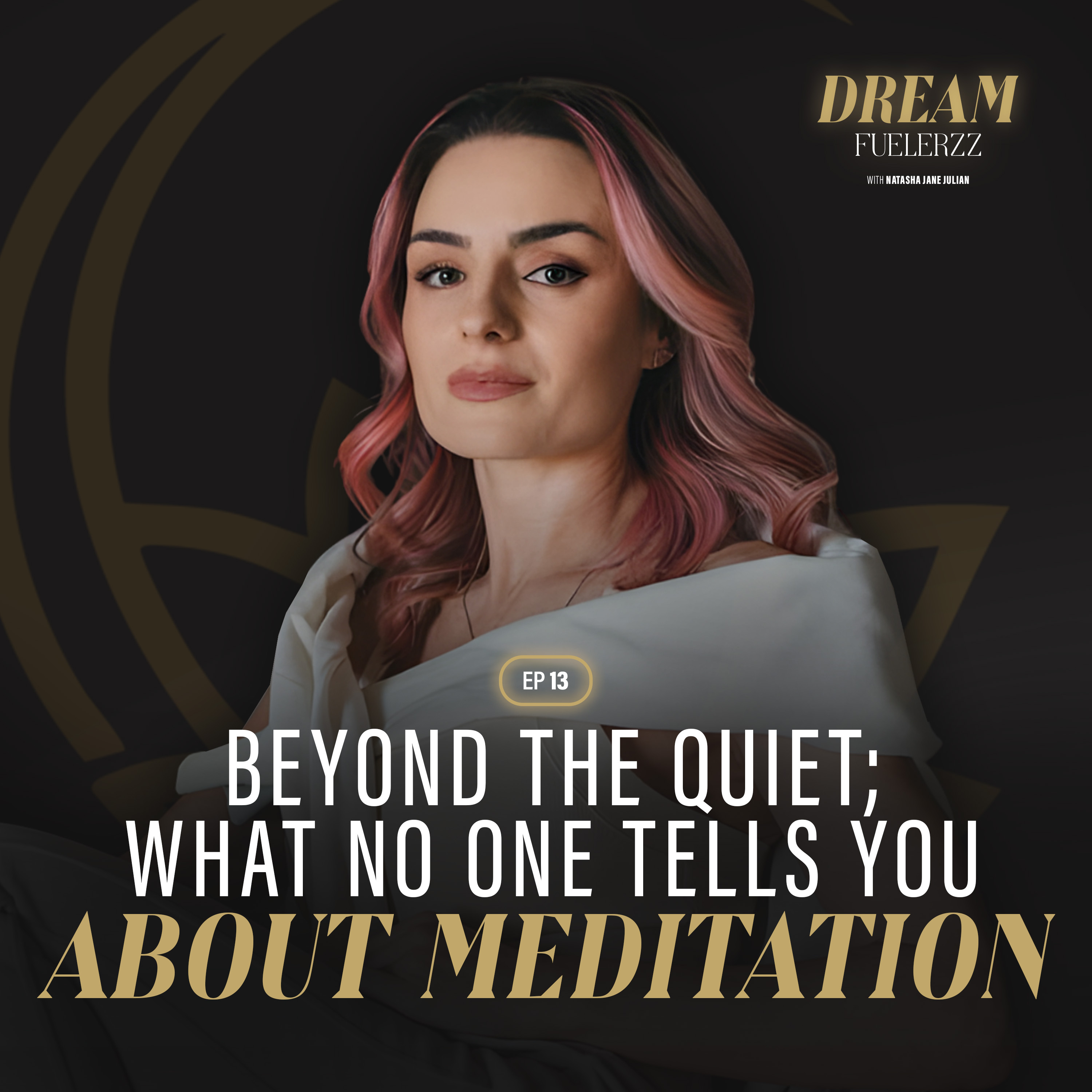
Beyond the Quiet: What No One Tells You About Meditation
from Dream Fuelerzz - Tools and stories to rewire your mind and reclaim your power
15m 54s
In this episode of the Dreamfuelers Podcast, host Natasha Jane Julian reflects on her personal journey with meditation, which she credits as the initial catalyst for transforming her life. Growing up, she dismissed meditation as boring—just sitting still and suppressing thoughts—but later realized how wrong she was. After years of living in anxiety, panic, and survival mode, she turned to transcendental meditation, inspired by figures like Oprah and Jerry Seinfeld. Her early sessions were emotional, often involving crying, but she soon noticed profound changes: better sleep, reduced brain fog, improved relationships, and even relief from chronic pain that had led her to frequent chiropractor visits. She describes meditation as a "washing machine" that cleans out fear and tension with each practice, sometimes producing intense sensations like body vibrations, heat, heaviness, and a trance-like state of deep connection. However, she notes that not everything shifted immediately; core issues like self-worth and feelings of inadequacy remained, requiring deeper work through breathwork and Kundalini activations. Ultimately, Natasha emphasizes that meditation didn't change who she was but gradually removed layers of fear and limitation, allowing her to move from urgency toward freedom. She hopes her story inspires others to explore meditation with curiosity rather than preconceived notions, reminding listeners that transformation is possible for everyone.
Welcome to Dreamfuelers. I'm Natasha Jane Julian and I've been through it all. Anxiety, panic attacks, you name it. I'm here to show you that healing is possible. I'll share my journey and chat with other guests who transformed their lives. If you're ready to reclaim your power and chase your dreams, you're in the right place. Let's dive in. Welcome to the Dreamfuelers podcast. My name is Natasha Jane Julian. And today our episode is about meditation. This has been a huge part of the reason why I started the podcast is because it was the very first ever catalyst that helped change my life. So I'm going to be talking about all the things that I wish someone told me before I ever meditated when I was a child. Because I thought it was just boring. I thought it was just something that some people do where they just sit still and try and not think about anything. But boy was I very, very wrong. And today we're going to dive into it. When I first learned of meditation, I was just a kid. I always thought of meditation as someone just sitting very still, trying not to think about anything and not have any thoughts go through their mind. And I thought, wow, that sounds really boring. I thought I would never be the type of person that ever meditated. But no one ever told me that you can feel things like an entire body vibration. Sometimes you cry. You could feel sometimes involuntary facial movements or facial jerking. You could feel a connectedness to the universe, to life itself, feeling that feels so good that you do not even know how to explain it. No one told me that. Life before meditation was very, very different. I was living life as a survivor. I was living life in brushing from one thing to the next, worrying about one thing, worrying about the future, worrying about the past. I was living in a state of urgency. And although I had a lot of fun times because I am really good at having a lot of fun, I was not living a life of freedom. And that for me was the only thing that I ever knew. I didn't know that you can live a different way. When I discovered transcendental meditation, I was at a point in my life that I was willing and ready to do anything and everything to take me out of this pain that I was in, to take me out of this state of anxiety that I have experienced all these years to take me out of whatever I was in at the moment because I knew that I was meant for more. I knew that there was a better life out there for me and I just felt stuck and I just felt like I was not coming out of this cloud and I didn't know how to get out. So I found a transcendental meditation course after hearing that Oprah had been doing it for years and Jerry Seinfeld and I was like, okay, I'll try it. At that point I was going to try anything. So I signed up for the course. It's like a four-day training, this particular method. And yeah, I was on my way. What meditation actually feels like is a lot different than I ever thought. So the first couple of weeks after I started the training, I pretty much cried in every session. I was crying and crying and then I asked the teacher, I'm like, is this normal? And he was like, yeah, that's normal. So you go through different stages. I'm not sure if everyone else did that at the beginning, but I started to sleep better. I started to slowly come out of this fog that I was in. My relationships around me started changing. I was working on the inner work. I can describe it as and I must have been putting out a different energy or different vibration to my family members and they were responding accordingly, but I didn't expect that. And it wasn't something very drastic. It was just very slow, like a very slow shift. But I felt different. I felt things around me different and I felt different. And I can remember asking the first couple of weeks when I was new to it, what does it actually feel like? How do you know that you're actually in it? And this is a very popular question to get. Like how do you know that you're actually meditating? Because meditation also means different things to different people. And that's fine. That may be their state of calm, like, oh, I'm meditating now. But for me, in my experience, when you're truly meditating and you're really in the zone, sometimes you forget you even have a body. Sometimes your body vibrates or buzzes from head to toe. Sometimes it's like you're on one of those little buzzing machines. Sometimes one of your hand is or different parts of your body. Sometimes you can feel heat. You can feel heat in your head or pressure in your head. Sometimes you get very heavy. This was a big one at the beginning. I started to know that I was slipping into a deep state of meditation when I felt heavy. It felt like I was sinking to the bottom of the ocean. Just like if you can just picture a girl sinking to the bottom of the ocean. And I felt just like, boom. And that's usually when I knew that I was going into meditation. And I also got a sense like I was in trance. So if somebody accidentally came into the room, or I got interrupted at any point, I literally couldn't answer or move because I was not there. I was in a different world. I was in a deep state of trance. I didn't expect that. I didn't expect to feel my whole body like having a rings world around me feeling this intense love, this intense passion, this intense like connectedness to the universe. Like I was making love to the universe. I did not expect that. I didn't know that. I wish I knew that. But not every day was like that. Some days are very uneventful. But they see that it's like a cycle. It's like cleaning house. It's like a wash machine. It's running its cycle. It's cleaning house. When you stop, it actually doesn't go back to the beginning as if you had never meditated before. When you stop, it starts off from where you left off every time. And that is really cool. So the more you sit down and you do this every time, it cleans out a little bit more. Every time it goes a little bit deeper, cleans a little bit more, pulls a little bit more fear out, pours a little bit more of whatever else you have in there. It's like I don't know exactly what is happening, but I know that my body knew what I needed. I knew exactly what it needed. Okay, so we talked about a little bit like what changed, what changed. My relationship started changing. My anxiety started to come down. My brain fog started to clear. And I became obsessed with reading. This is coming from somebody who actually never read books. I read in school, but something in me just was wanting to learn and to start reading abruptly a couple of weeks after I started. And that was mind blowing for me. It just means that I had more space and I had more focus and everything around me started to clear out so that I could think clearly and say, "Hey, I want to learn. I also have the capacity to do so now." I definitely could feel less pain and less tension in my body. I went from being a regular at the Chiropractors Office because I have upper cervical problems for years due to my schooliosis.
And I stopped going to the chiropractor. I pretty much stopped and I knew that my body was being able to handle the pain. So that tells you right then and there that something is happening, something very exciting. And I also started to have more creativity and more freedom within my poppies, activities and work as well. What didn't change? So the things that really didn't change right away and I didn't notice this at first because I can say this now after a few years of doing it and reflecting back that here, mindset stuff, the stories that you've been telling yourself forever and that that didn't change right away. My sense of self worth, my feeling of not enoughness, which I didn't actually discover until recently that it was something really deprooted, that didn't change right away. And I think the reason is because when you start meditating, it works on your nervous system first. It brings you into a state of calm. So if you're in fight or flight, living in that every day, it takes you out of that. And then over time as you do it more and more, you're able to think and see and do things in a different way and live in a different way that you can now start peeling off the layers and start really digging deeper because meditation calmed the waters. But I still needed to dive deep and figure out what was making the waves in the first place. Where am I now? Where am I now? About four or five years into a consistent daily practice of meditating, actually meditate twice a day. I wouldn't say I'm a completely new person. Still my same personality, but wow, life has changed a lot. Recently, I've been really wanting to dig deeper on the core root issues of not feeling enough and I've done some breath work sessions and some Kundalini. I did my first Kundalini activation session and I'm going in soon for a second in person one. And it really is fascinating because during those sessions, I was able to have really like physical body stuff happening such as body jerking, facial movements. I chest, I was like doing some energetic flows and in and out. And I can relate that to pain and tension from years held in my heart, my heart chakra. So having that come out in these physical ways really shows me that there's more in there and that was really stuck. It gets stuck in the body, really in the fascia. And it just gets stuck there and sometimes you don't even know it. So this really like deeper work that I'm doing is something that I would have never done if I didn't start meditating because I wouldn't be in it that much and I wouldn't have discovered and had the awareness that I needed to go deeper in the first place. It's just so fascinating to me. I don't know exactly what's happening, but I know that my body is responding very well to it. And I know it's exactly what I needed. And I also realized I had a lot of deep rooted trauma as I'm sure a lot of people do. And some people decide to go and dig deeper and some people don't get that far. So looking back, I would say that meditation didn't change me. It just slowly started removing a little bit of fear. It slowly helped me strip away things that didn't serve me anymore. It started to bring me towards a state of freedom. And every time I sat down, it was like running the wash machine cycle again. Every time I was clearing out a little bit more of fear, every time it was clearing out a little bit more of what I didn't need in my body. And I wish somebody told me these things before I started meditating because then I probably wouldn't have thought it was boring. Maybe I would have been intrigued to try it because the feeling that I have sometimes during my sessions is like nothing I've ever felt before. It feels amazing. And I wonder how I went all those years without doing it because I was living in urgency and survival. And now I'm on my way towards living more freely. And that's what I hope for you. Thank you for joining me today on this episode of the Dreamfuelers Podcast. I am Natasha Jane Julian. I am your host. And I'm here to share anything that you might be curious about. Thanks for tuning in to Dreamfuelers. We hope today's episode inspired you on your healing journey. Remember, transformation is possible for everyone. Follow and share with someone who really needs it and we'll see you next time. Keep dreaming big.
Podcast Summary
Key Points:
Natasha Jane Julian, host of Dreamfuelers, shares how meditation became the catalyst for transforming her life after years of anxiety and panic attacks.
She initially viewed meditation as boring—just sitting still with no thoughts—but discovered it involves profound physical and emotional sensations, such as body vibrations, crying, heat, heaviness, and a deep sense of connection to the universe.
After trying transcendental meditation, she experienced gradual shifts
Not everything changed immediately; deep-rooted issues like low self-worth and feelings of "not enoughness" persisted, requiring further inner work, such as breathwork and Kundalini sessions, to address.
Meditation is compared to a washing machine cycle—it cleans out fear and tension bit by bit, and each session builds on the last, even after breaks.
She emphasizes that meditation didn't change her identity but stripped away what no longer served her, moving her from survival mode toward freedom.
Summary:
In this episode of the Dreamfuelers Podcast, host Natasha Jane Julian reflects on her personal journey with meditation, which she credits as the initial catalyst for transforming her life. Growing up, she dismissed meditation as boring—just sitting still and suppressing thoughts—but later realized how wrong she was. After years of living in anxiety, panic, and survival mode, she turned to transcendental meditation, inspired by figures like Oprah and Jerry Seinfeld.
Her early sessions were emotional, often involving crying, but she soon noticed profound changes: better sleep, reduced brain fog, improved relationships, and even relief from chronic pain that had led her to frequent chiropractor visits. She describes meditation as a "washing machine" that cleans out fear and tension with each practice, sometimes producing intense sensations like body vibrations, heat, heaviness, and a trance-like state of deep connection. However, she notes that not everything shifted immediately; core issues like self-worth and feelings of inadequacy remained, requiring deeper work through breathwork and Kundalini activations.
Ultimately, Natasha emphasizes that meditation didn't change who she was but gradually removed layers of fear and limitation, allowing her to move from urgency toward freedom. She hopes her story inspires others to explore meditation with curiosity rather than preconceived notions, reminding listeners that transformation is possible for everyone.
FAQs
Meditation is a practice that can bring about deep relaxation, emotional release, and a sense of connectedness to the universe. It involves more than sitting still, as it can include physical sensations like vibrations, crying, or involuntary movements.
As a child, Natasha thought meditation was boring, involving sitting still and trying not to think about anything. She never imagined she would become someone who meditates regularly.
Natasha was experiencing severe anxiety and felt stuck, willing to try anything for relief. She discovered transcendental meditation after hearing about Oprah and Jerry Seinfeld practicing it, and signed up for a four-day course.
During meditation, you might feel your body vibrating or buzzing, heat or pressure in your head, a sense of heaviness, or forget you have a body. Some people also experience involuntary facial movements or crying.
Within the first couple of weeks, Natasha started sleeping better and slowly came out of a mental fog. Over four to five years of consistent practice, she experienced significant life changes, but some deep-rooted issues took longer to address.
Her anxiety reduced, brain fog cleared, relationships improved, and physical pain lessened. She also gained more focus, creativity, and a desire to learn, eventually stopping regular chiropractor visits.
Chat with AI
Loading...
Pro features
Go deeper with this episode
Unlock creator-grade tools that turn any transcript into show notes and subtitle files.
 PodcastTranscript AI