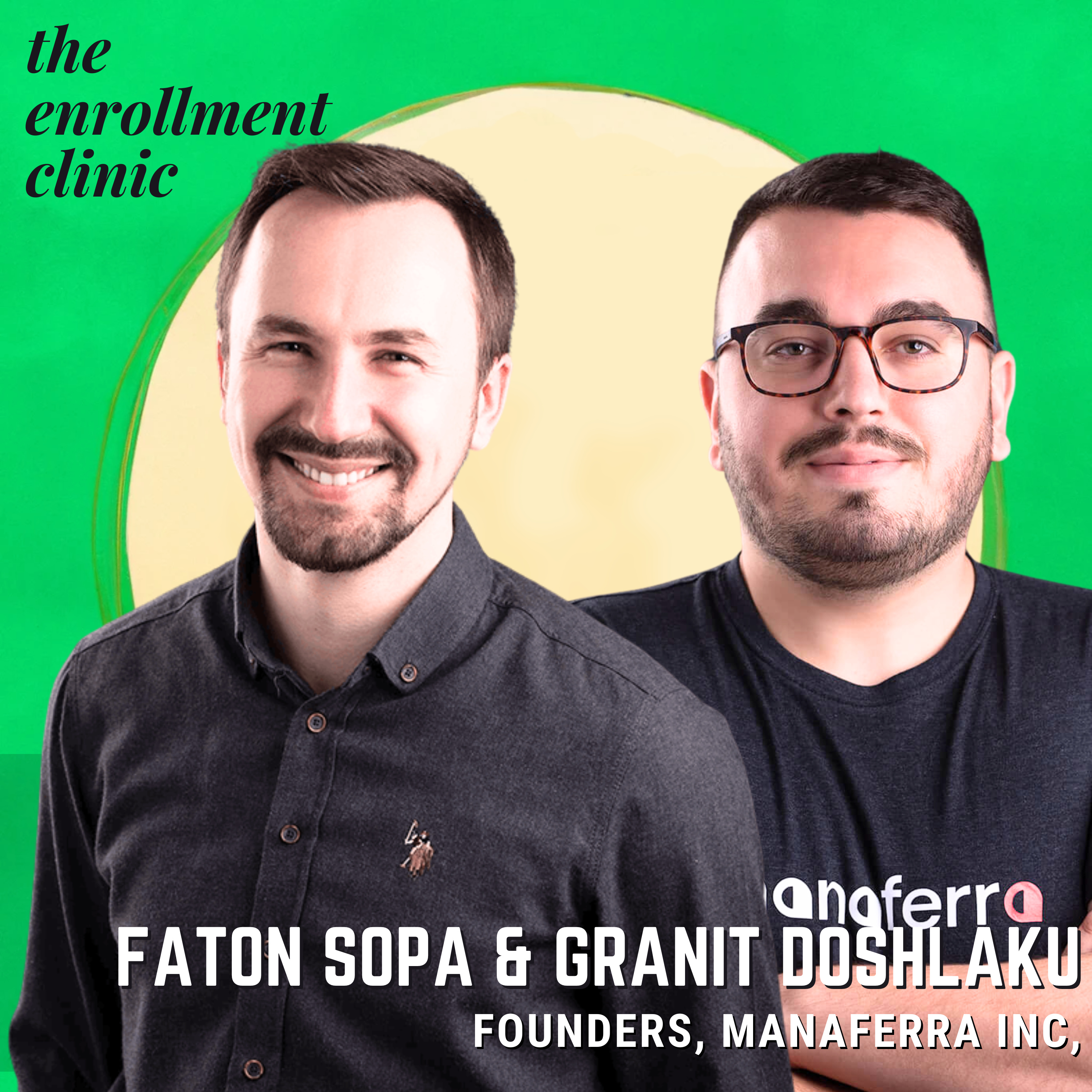
Beyond Rankings: How Manaferra Is Redefining Higher Ed SEO
from The Enrollment Clinic
46m 58s
In this episode, the hosts discuss the agency’s focus on higher education SEO, a field often overlooked by institutions that rely heavily on paid search. The founders, Ghanit and Faton, highlight their 11-year specialization in understanding how students search and make decisions, which has earned them multiple international awards. They argue that organic search is more sustainable and trusted by students than PPC, and they help institutions appear for relevant keywords at the right stages of the decision-making process. The agency goes beyond Google, analyzing student behavior on platforms like Reddit, where prospective students seek authentic experiences, such as life at the University of North Dakota during winter. This insight drives content creation that addresses real-world questions not found on official websites. Despite being based in Kosovo, the team of 50+ serves US clients effectively, benefiting from a young, talented workforce with low turnover and strong English proficiency. They stress that students are savvy researchers who cross-check information across channels, so institutions must maintain consistent messaging to build trust. Overall, the agency aims to raise awareness of SEO’s value in higher education, helping institutions achieve more with less while fostering long-term enrollment growth.
Okay, so welcome to the latest episode of the enrollment clinic. This is a very different, very special episode for me, but it's also an episode that's been, I want to say, months in the making. So Amir at Manaferas offices in Kosovo, in South and Europe with Ghanit and Faton, the two founders of the agency, and both our experts in SEO in higher education. We tried to record this episode, I want to say a month ago, and it turned into a one hour of fun and banter, which kind of shows that how serious I was that really focusing on this one. But here we are today with a huge production set, and this is amazing to be here. And I think it's also a testament to the work that you guys do. Again, I've followed it very closely for years now. So what I wanted to talk about specifically is not necessarily focusing on SEO because I feel like that's a topic that's everywhere, and there's no mystery now. It's not like something that's being discovered. Everybody, especially higher-ed institutions, are all spending a lot of time on really understanding what SEO means, especially now with the introduction of AI and how that's changed the industry. So we're going to touch a little bit on that. But what I wanted to talk about is two things. One, agency work as it relates to higher education, and two, the success that you guys have had in this industry. Because I feel like in the last four or five years, I just kind of see you ever have seen some of the awards. I mean, you'll walk in, right? There's search awards, European search awards, there's American search awards, there's international search awards from 2021, 2022, 23. So I'm really interested in really kind of finding out what is it that makes you guys successfully and what you do. First of all, thank you for being here and visiting us. It's really pleasure having you here. We actually, I think what makes us different is, or focus on what we do. We have been spending the last 11 years, actually, to understanding how students search, how the shoes university is, how they show the program that they choose, how the university is respond to that. We actually, that's all the things that we do. We search, marketing, in higher education is all the things that we do. We have been working with this industry for the last 11 years. And actually, we have been investing quite a lot into understanding the search behavior and being able to provide a really great service to higher education institutions, with the end goal of getting more and more enrolled. Yes, we have been working on bringing more traffic, more leads and more applications. But I think what really makes the difference, a difference for us, especially bringing those awards, is making an impact in the pipeline. I would say being obsessed. Like, a lot of times, it's said 100% sure, but also like, we are super niche, just SEO, just for higher ed. So, search marketing is on our DNA. And because we are super obsessed with it, we know what's happening in search, or those we know as well, as we don't mention how searches are evolving, especially lately. And we are also aware of the struggles in the higher ed industry. So, we know that cost is something that everyone talks about, not just from the student side, but also from the institution side. How can you achieve more with less? And, or industry, the higher ed industry, they've known, for decades, the search marketing is something that wars for them. They spend hundreds of millions of dollars every year in paid search campaigns, and they generate results with that. But they've been totaling the Glatton's Organic Search. And this is where we come in. So, we kind of like are on a mission to raise the awareness, to let people know that search marketing doesn't need just paid search ads. If you can build your organic presence or organic visibility, if you can appear for the right keywords at the right stage, when students are searching, you can generate more with less. It's more impactful, it converts better, students trust their organic results more. It compones, and it's more sustainable as a channel, because once you stop the campaign, once you're pausing the budget, your traffic leads, applications, all the conversion they pause as well. Organic, we are building a foundation that keeps them giving to the institutions. Because of this obsession, with the search results, and with using this channel to benefit the goals of the institutions, I think that has resulted on the type of clients that we work with on the awards that we won, and basically allowed us to be where we are today, which even though it's been over a decade now, I still feel like we're just getting farther. Yeah, but it's interesting to me, because both of you mentioned the fact that higher education institutions had neglected SEO, right? I'm just curious, is that, where does that come from? And is it lack of technical knowledge? Is it, you know, it just seems to me, just with the amount of higher ed agencies that are out there? What do you think is the cause of this neglect in SEO and focus in PPC? I think it's not as straightforward as PPC, meaning you put money in, you get your ass live, immediately you start quicks coming in, and they see on SEO, like, this is here, all these different conflicting messages over the years, and they look at SEO and all they see is a black box, that they don't understand, and they don't want to work with something that they don't understand. And it's not a black box. There are best practices, and if you, and one of the benefits of us, like focusing only on higher ed SEO, is that we are able to understand algorithm very well. We are able to, we've learned what students want, how they search, what Google wants, and this has allowed those two then, build, develop and implement the strategies that are very efficient, that can get your results very fast, can be targeted on specific programs that you want to push, and not necessarily do side-wide campaigns, and you can see ROI very quickly, and you can adjust the campaigns based on your institution. It's something that is a conflated approach for all the institutions, because not every institution is unique, and all different programs have unique needs. So, basically, for agencies, on the agency side, it's also easier for them to work on pace. I'm not saying that, I mean, you need to have strategies, and you need, if you're not spending time and thinking through what the best way to approach, even with page search, you're going to fail. So, I think lots of companies all there do a great job. But when it comes to SEO, the agencies, they just come to the conclusion that it's not working for them. They have to engage people with technical background. They have to engage content writers. They have to engage people with digital PR backgrounds, all these different teams, for one service, and then even then, if you are not doing it all the time, you are not being as efficient. So, they just either, like, say, we're only implementing some best practices. When you look at the impact of those best practices, it's like, you can't see that impact anywhere, or they're outsourcing it, or they're not offering it at all. On the institution side, they've been talking for, or about SEO for decades. So, both of you that talked about how higher ed institutions really focus on PPC, but they don't touch SEO. And it's interesting to me because there's so many SEO agencies out there that higher ed institutions are not educated in SEO. Why do you think that is? Is that a technical issue? Or is there a knowledge issue? A couple of reasons, but to sum it up, I would say a lot of the institutions look at SEO, and all they see is the black box that they don't understand. They understand that it's good to appear organically. Students trust those results, but like, how do you get there? And also what KPIs retract, and all that stuff. So, basically, there is a lack of education and awareness on how to approach SEO from a higher ed perspective. Then you have the agency side. For an agency, it's more straightforward to push paperclap because it's more manageable. And with SEO, you have to invest more. You have to have different teams are on technical, or on the content, or on the PR, and this just complicate the whole process. So, they either do the bare minimum or they don't offer SEO at all. And when you say SEO agencies, there are lots of SEO agencies, but SEO agencies with higher ed experience, and we know that higher ed is very different from other industries. There were a few of them. And again, because higher ed sometimes can move slower, sometimes you need to work with a lot of people to make small changes. Not everyone has the patience to see the, that can work, that go through. So, different reasons have kind of like brought us to where we are today, where they know that SEO is worth it, that you need to invest, you need to be present. But like, how do you get there? Faton, you mentioned something very interesting, that what may win
And when I asked, you know, what made you guys different, you mentioned that we understand how student recruitment and higher ed works. Can you extrapolate a little bit more on that? So, from a starting point, you know, when a student is kind of faced with that decision, I really am interested in higher ed. What's that process like? Yeah. This obsession of ours with such results has actually put us into this position where for every new client that we get in, like we actually spend a lot of time into strategy and understanding their segment. And as long as there are students, who they are, how they search, what this behavior is, what impacts their decision and what is the decision making looks like. And we actually put a lot of efforts into understanding this search patterns. And above that, how does the market looks like for that specific degree? Then we work backwards with the institution, with their marketing team, with their contenting to be able to tell what their program is all about and provide that those answers that their students, their future students are asking in all search engines. One thing that is different with us is that we go beyond Google because the student search behavior is changing. They are lying beyond Google. They are searching actually on social media, on forums, on AI. So the search pattern is different sometimes. It's different for different degrees. It's different on different search engines. Different countries, so it's all about understanding the student behavior and being able on translating that on market as well. It's been actually interesting for me to kind of learn the process. How big red it is when it comes to just decision making. I'm not a user myself. I mean, I sometimes go on reddit, but not the typical reddit user. I don't think I have an account. It's crazy to me how, you know, just kind of being on the university to decide myself, where I've had comments from students like, I'm not coming here because I just saw a message on reddit that said this is not the place to go. Reddit actually is much bigger than we thought. We are actually, um, our finalizing, um, research, um, that goes into more in depth about that. And we understood that reddit is much bigger than we thought. I mean, I don't want to support the results at this stage. Come on. This is the opportunity to spoil it. Now I just found out you have something going on. I want to know everything. I would say, I would say it's much bigger for different type of degrees like undergrad, grads and professional education. Okay. Interesting. There are different groups of the goal more integrated to understand what is a student live? What is the real experience into studying in that, uh, large university? And, um, they want to have discussions with students who actually gone through the decision making process. We are seeing that, yes, they are reading your website. They are going into social media, but they're also validating what you're saying, what others are saying in, in platforms like reddit. I'll give you one example. And it's, I think it's a good one. So when you think on STL, I work with agencies to think about promoting specific programs. When you think about how students search when they're done, how they are thinking about deciding on a school, it's not like, just let me find a school that offered this program for this degree. They're also asking like, what is like going to that school? And this is where places like reddit are shying because like, uh, we work with university of Norde Gota and apart from optimizing them and making them more visible for the, the programs that they have to offer one other thing that we're doing with them is also like identifying opportunities on, uh, content beyond that. So they're based in Grand Forrest, Norde Gota and Winters there can be, you know, the Cota Winters. Yeah. Norde Gota Winters. So one of the questions that was asked on on the reddit is like, what is life on campus during a winter? And then the student would answer like, yeah, you're going to use the tunnels and and and you're going because they have tunnels, we've been to their campus and they, they have tunnels and they have bridges, uh, cover bridges and they kind of like to navigate through the campus during the winter because they, you can walk all there in some days when there is like a strong wind and you have snow. It's, uh, it's not the best experience walking through the campus during that day. But they have kind of like great options. Yeah. And is that and how the shuttle works and why you don't want to use your car during those days? And that content didn't exist in a website. Yeah. But someone asked the question reddit and existing and pharmaceutical students answered that. So we were finding all these different opportunities and say, look, more and more people are asking and have asked for years this question that we haven't addressed them. Yeah. So this is like a great opportunity to, for content ideation. We want to talk about this in our website. It's not going to help us rank for, uh, best engineering degrees. But someone who has already made up their mind or they're considering university of North Dakota, they are going to search beyond these key was now. So if we have the content and we kind of like provide the best answers for that, they are no consuming our content. They're getting information from us and we are making sure that we are providing them with the best information out there. So this is just one example. Do you think because it's one question that, you know, it kind of pops all the time in my head. How much trust do students have, you know, to the, or prospective students have to the information that's on the website of the university, right? Because I mean, to me, and again, I'm going to be thrown out of the education industry at this point with the question I'm going to ask. But, you know, university website is a sales site, right? Like it's, it's sales information. And of course, you're going to, but your best face forward, right? Does that kind of diminish the trust? I think the students today are very good at due diligence. If you're doing that, they are going to know. So if what you're saying on your site doesn't match what they're seeing in non-places, like Reddit, TikTok, X, all their platforms, then they are going to, it's going to be a red flag. So and I also don't think I have a lot of trust on the teams that work on these institutions to be very kind of like honest with how they're describing. Obviously, it's, it's, it's marketing. So you are pushing specific messages, but you are also not going to be misleading. And you are not allowed to be misleading, of course. So I don't think that that's, it's, that's an issue. But I also think that the students are really good at due diligence. So it's not just one channel that's impacting how they think about your school and the programs, they're looking and validating these information that they're gathering at all these different places. Now, I would add on top of this that the way the student actually search, search, I said it goes beyond Google. And we'll find in all that the channels that are visiting is different on each different phase of decision making. So in the awareness stage, channels are the different channels than all the decision making stage. And sometimes it's different for for grad under red and all the types of degrees. So it is very important for institutions to have a consistent messaging across all platforms because students are not all searching on Google. They are searching everywhere. And you have to be there with the right answers on the right time in the right channel with the right messaging. And if there is inconsistency between all of these students will, will know that and actually will go on platforms like Reddit and others to validate that because they are, they are taking really important decision in their life. And I want to make sure that they are taking the right decision. Interesting. Now let's, let's shift gears a little bit and then just really talk about about my fat about you guys and you know, just the agency overall. How big is the agency right now? That wise. Yeah. We are 50 plus. Okay. Yeah. Global agency. Okay. And we have employees everywhere or production office is is based here in slow future in Europe, in costable, but or employees are are spread across US, Europe. We work with the US market, eventually all four clients are based in the US. They're all higher ed, right? They're all, yeah, all higher ed. And why, why higher ed? I mean, it just seems like there's so many industries out there. Why focus on higher ed? Yeah. And when we started out, we started work with many industries with a variety of of services. And through all the time, we understood different industries more and more. And we had a passion about education or salt because I think everything that we are done have come from.
from education, it'll be formal or informal. And we wanted to put that passion into working and serving other institutions as well into helping the students make the right decision, finding the right institution, because we know how important that decision is, the student's life. And then on the other side, we had the expertise to actually how the university is to be able to serve both students better. Now, from an institutional standpoint, it just seems like you'll want to work with agencies that are close to you, right? And here you are in South and Europe, and you're working with universities in the US. What are some of the, I guess some of the benefits, some of the drawbacks of this geographical distance? Yeah, so we are a really small country here, one point on sectional and something like that. And 70% of the people here are under 30. And we really have a great talent pool here. So we've been able to grow really fast to expand our operations and be able to hire and retain the talent for a very long time. And one, one feedback that we are received from a work client is that the people that were later on the first call are the ones are the same, even after three or four years working with them. So very very low turnover. Yeah, you know, furlough high over and full high school workforce, that has really helped us to put us in a position where we can compete with those big agencies, whether be it in US or other countries. And even though we are in a different time zone, we're worth real well with that for more than a decade now. Yeah. Yeah, it's kind of interesting because I don't think people realize we take countries like, you know, Kosovo, you take countries like Estonia, Latvia, you know, there's unicorns here. There's like startups that are over a billion dollars that are from here. What makes, you know, one thing that I've noticed is just everybody speaks English better than I do. And I've lived in the US for over 30 years now. Why is that? I think we as a nation, we have a drive really strong in a drive for growth because of the history, because of the things that we went through, especially during the war. So we really have a passion for growth and you can see it everywhere. Like you can just walk up in the street and you can see the people are trying to build something. You can see entrepreneurs. We have entrepreneurship in our spirit. And this has helped us to really build great companies and work with institutions and companies throughout the world and to provide different services. But the drive I think is a main reason for that. I would add that being in Kosovo, very small country, 1.6, 1.7 million people live here. From the very beginning, if you're starting a company here, you'll think about growing outside of Kosovo. Guys, there is not a huge market here that you've been growing to. The second thing I felt on mansion is I have a two-year-old daughter. She goes to the kindergarten and she basically everyone there speaks English. So she knows more words in English now than Albania words. It's just the way it is. We grew up watching series, movies, all from the all-English. And yeah, so this is one thing in terms of just the language and how well we understand the culture and then being able to serve that culture. And the second thing is, cotton mesh and the time zone difference. It's not that bad actually. It's like six hours difference between us and Eastern time. I joke with clients that it actually works well, benefit, because we get to do the deep work in the first part of the day and then do the calls in the second part of the day. And we're with you 24/7. And understand that you have different needs and we are there to kind of like palp and be your persistence. And when we talk to schools that we work now, like one thing they said that we were worried a bit about like the times on difference and you being based in Europe. Like we were sending you an email at 2pm, 3pm and maybe we thought like, and then after five minutes, we got an email back from my insipose, one of our assiomanagers. And I was like just thinking, "Isn't he asleep now?" Right. We are quite flexible. It has worked so well so far. I think I think it's also globalization now has just taken a bad wrap with everything that's happening. I'm going to spend time talking about that stuff. But the benefit of globalization is that you can hire the best talents anywhere in the world. So you don't have to go look outside your window to find talented people. There's talented people all over the world. And I think that's probably one of the reasons why a lot of schools want to work with you. Now tell me a little bit about how the agency is split up. This is an area I don't really know much about. But I'm really interested in learning. And so do you have like a production crew? Obviously you have the writers. So how is that separated? Yeah. So one thing that we are different from many agencies are there is that we own the production. We don't stop contracting them to other agencies. By production, I mean content. Content, VR, SEO, SEO, SEO. Okay. Everything in between. So our goal is to serve, search and to end. Right. To provide the service and to end. So we have a content team who actually, because they are fluent in English, and they started across UK, US, and here as well. They can provide really great content because we produce thousands of content pieces per month. And we need to make sure that they are actually great content that serves these students, but the university is as well. So we have a content team. We have a PR, a link building team, then we have an SEO team. We have a design team, and then we have the operation side of that. We have the finance administration, the management. This being having most of our production team here and some others in remote countries, enable us to have some kind of control of the core production and how those dots are connected with them. And then to use the expertise that we might have in other countries like full-time employees. And then be able to deliver a service that makes it different for clients. So given the way, search is evolving, higher ed is evolving as well. What do you see the trajectory of the agency and the industry going to be in the next 10 years? So I mean, very hard to predict in 10 years, but what we're seeing right now is agencies are making the most out of the new tools and platforms in our disposal. And that's true for us as well. So talking from the agency side, we're thinking about how we can use everything that's coming out of the market, especially being AI power to be more efficient, to generate better output, to just create better deliverables for the schools that we work with. But AI is not just impacting or efficiency and how we do the work. It's also impacting the channel that we service, the search channels. So more and more people are turning to platforms that chat, GPD, Proplexity, Gemini, and others, and are asking questions. And they're not just saying, like, they're using tools like deep research to research the school that they're thinking of. And like, what type of information appears there on what is trained, how we can influence that. So we are tacking this from both sides from efficiency side and just doing better work and better deliverables for our clients. But also like we are working on new product offering and service offering to make sure that we're addressing these new platforms that are becoming more popular day by day. And at the same time also, making sure that we are not forgetting about the Google, which is still like we like to say, a chat GPD, Proplexity, that's all the hype today. And everyone is talking about that. And we need to be thinking and addressing that. But then the majority over 90% plus of search is also happening in Google. Yeah. So you can't just stop working on Google and ignore it as a channel and focus on the new comments because then you are going to be led behind and you are going to be impacted negatively. So like years from now, to be honest, very hard to predict. I think everyone is now is finally led to be true. But I believe that we are going to do way better work. And we are going to make sure that our clients are more visible in all the channels that prospect the students are using to search and educate themselves about the options that they have.
So this is basically how we're approaching it. Do you think these new technologies will replace some of the work that the staff does here, for example? Do you think AI will replace copywriters? So here's the thing. You might replace certain parts of the copywriting kind of writing process, but let's talk about how that process looks like when you're working with Hyrant. It's not like you can just write something and publish it in that.edu website. It has to go through a fact checking process, which we do. It has to go through a editing process, which we do. But it also has to make sure that we are aligning with all the key stakeholders on the institution side. It's not just the marketing communication department. It's also the faculty. It's also like the deans of different schools. Like, they're all these different people. And at this point, AI is not capable of doing that. Oh, it's sinking with all of them, of understanding their needs and making sure that what we are creating here addresses what they want to achieve with their content and with their programs is like what the goals are of the campaign. This is why what I'm thinking about when I say more efficient because like something, like just creating an initial draft and like, and then working to make that better, it definitely helps. But the final output, we still want at this stage to make sure that it has that human element, not just editing high level editing, but like, it needs like, if every piece of content looks like the same, like, all these different schools and identity. Yeah. And like one thing that schools today need to work on is in identity and brand. Like, if I'm reading this content at searches university's website, like how's that, like, what's their position? What's their messaging and how that's we've been into every content piece that gets published there. But what I'm hearing you say is, human creativity is really irreplaceable in the sense, right? Like you'll need that person to generate new content and not just take pieces of different content and make every single school look like they're providing the same content, right? That's, you know, it's pretty interesting because now, and I can see that from an institution side, oh, I can write them, you know, I can tell GPD to write in an article, or I even can tell them to make it SEO ready, you know, whatever that means. So I feel like there's almost like a trap to just kind of go, well, here's a free way to do it, right? Like what's, obviously the disadvantage there is you're not really kind of generating the right content for your school and you're just taking bits and pieces of what's available out there and putting it up here. And I also feel like, because LinkedIn has already started doing this where they've started looking for AI content. And if they see that the content that you provide is AI driven, then they'll rake it lower so you'll get less views. And I feel like, you know, that's probably going to happen everywhere. I mean, Google is on a record saying that they don't analyze it for using AI, but if you're using AI to try and spam, the search is also just creating a massive amount of content and putting it all there on the web, that's going to cause an issue for you. And also, I want to say that we're talking about content, but content is just one component of SEO and making you more visible and for the right terms, the prospects of students are searching. But like what is the goal of content? You want someone who's going through a piece of content to take an X action. And if it's like just bland and boring reading, they're not going to even read that they're going to scan it and probably bounce back to the search result, which isn't even it packs you negatively. But if you have great content, then they will want to go, okay, I love this piece. I learned so much from it. Let me go and see what else they have to offer. And even if they're not ready to convert right now and fill out an RFI form or even apply, they are going to subscribe. They're going to basically remember your brand for the next time when they're ready to take an action. Kind of like we should see like with content, it's about understanding what type of content we need to create because we're not yet a traffic game. We're not just trying to get as many A-boss as possible to our brand. You're there not converting and becoming enrolled students and what are we doing here? Yeah. But it's about creating the right type of content that goes after the right audience, but also is aware and in front of those best practices that allow you in Google Tundis under this is a great content piece and it deserves visibility, deserves top rankings. Now you've also worked with some universities in Europe, right? Yes. Yes. Does there are a big difference between how that market works and how the US market works? Because I know now you're focused on your working at the American institutions, but the principles are the same. And it doesn't change a much when it comes to providing the service. We just have to deal with different types of service sometimes. The way that the communication is done, the way the project is managed is different. Yeah. How is the difference? It's more keen of the processes of rules of being precise, very precise, everything that you do. Why in the US we kind of have more freedom. I would say more room for flexibility, which actually is something that we need when it comes to providing voice service in SEO because SEO is very dynamic and it changes very fast. And we need to adopt other changes of algorithms, of changes of platforms. So whenever we have the left flexibility with our clients, it's helped us to provide more service. Now, you also work with, you know, just looking at your portfolio, right? You work with universities that are the top 10. You've also worked with universities that are very regional, very small, kind of almost like neighborhood, type universities, right? Is there what's the biggest difference you see from the way they manage SEO and how they work? I would say that with the Ivy League type of schools that we work, the process can be a bit slower and you have to involve more key stakeholders and get the provosts. And I'm not saying small changes, but I'm saying some initiatives that could take two, three weeks, could take two, three months with the big vehicles. And while the smaller schools think they can be more agile in terms of like, and we usually end up owning more of the process with smaller schools. So we can move faster and get to the results faster. And it's like pros and cons because when you're working with larger schools, they have more authority. So even though it takes a bit longer to make some changes, the moment you may go changes, they immediately are reflected by Google and and you see positive results almost instantly. The smaller schools we are studying that part in that process where you're earning the trust from Google with all the changes we're doing. So it's going to take a few weeks, maybe to see the same results that we would see in a few days with the larger schools. So yeah, basically that is kind of like the main difference. And it's also like the bigger schools, you're mostly working on the program level. The smaller schools, they want to push the whole school and all the problems that they have. So this is another, another difference. And yeah, I mean, these are the two things, but I would kind of touch back on what's unsaid to go back to the working with the schools in Europe and what the difference is. I think one of the key things that we see is like who they're targeting. I think the type of schools that we're working with and we work with some schools in Switzerland and they're going to target international students way more than that saying the US. Right. Schools that are going after international students are like attracted demographic. But in Europe, especially in Switzerland, some of the schools that we were there, were class in culinary hospitality. They are known for that. They're targeting students from different regions of the world and trying to get them back to get Swiss quality education. And basically that's how they're kind of like even promoting it. With US, we depend on all the schools. Sometimes we're doing local SEO to go after the students in like if they're in my radius or something. And sometimes you, for online programs, we're going nationwide. And for some of the schools, we are also doing campaigns to go after international students because as I mentioned, it's an interesting and attractive demographic. But as you mentioned, from time to time, there are changes that have an impact on how the visa delays and everything. And you know this even better, how this impacts which we haven't seen to be the case in Europe. So as we're approaching the end of this discussion, one of the questions that I had.
That, that I'll also be on the institution side of, I've also kind of wrestled with as well is when, when you're working with agencies, one of the thoughts that comes into your mind is, you know, the age to them working with, that's a US-based agency, always becoming too expensive for us. Let's go look outside the US for cheaper options, right? And I'm sure with you guys being based here in Europe, you, I'm sure there are instances where there's institutions that have approached you with that mindset, right? Like, how do you handle that? We tend to work with institutions that have the kind of mindset that are focused on, on results, not so on the financial side of it, because at the end of the day we are not in the financial decision business. We are in a student-centric business, so our goal is to serve the students that are surging for their live decision. So, as long as we have the right partner to work with, with helping those students take the right decision, and helping the institutions to bring more results, the financial part of that is, I mean, it's still important, but it's not the first and the main thing. Because I mean, at the end of the day, right? It becomes a financial decision, because if you're a group of more students, then the cost doesn't, you know, but. Yeah, yeah. We are very confident that our, our, our work with an agency that is obsessed with hired SEO is going to be much better than working with a full service market agency, or even with an industry agency who doesn't know high-read. So, in our initial discussions with the schools that we showed to us, they realized that we were different, and we have key studies, we have awards, and we have a history to prove that the impact of our work, and once we talk about what's possible, what we've done before, we don't talk about the financial, yeah, the financial is not. They're not looking to tell you money with us, they're going to get more students with us, right? We pray in the conversation, we focus on that, how can we get more students for your school? Yeah, make sense. Last question. What is one thing that we're not talking enough about, or we're not talking about at all when it comes to higher-ed and, and student recruitment? Yeah, I think I have two answers for that. The first one would be that it might not be related to SEO, actually, is that more and more students are kind of trying to gain education on what the market is looking for. And I'm not sure that the universities are doing the best job when it comes to adopting two-lose-market meets, and so they are looking for certifications for informal education, for programs that the companies are looking for, and there are a lot of companies that are not as for specific degree, but they are asking for a specific knowledge. So I would say to have universities that are more focused on providing that knowledge to those students and match those needs with what the market is looking for. And that's one thing. And the second thing is actually how much universities are investing on paper click, and just throwing money, and it just like throwing spaghetti in the wall and seeing what stitches there. Because a lot of those campaigns, I mean, yes, they are working for some and for others, my world less. But there are the amount of money and resources that you have to actually spend to process those leads. And when you see the conversion rate, like we have done the research, we have the data to prove that, the conversion rate of leads that come from paper click is way, way, way much lower than the leads that come from organic research engines. And I don't think people are talking about this a lot, and we are in a mission to actually tell the truth about that. Just because you're spending a hundred thousand dollars per month on paper click and generating those huge number of leads per month, it doesn't mean that you're having success and marketing. Leads, the number of leads is not equal to success. It's equal to success is actually the enrollment that you got from that marketing and us. And I'm not sure that the higher education more ideas, especially CMOs are being true to be data that are telling us. I would say me being more technical. It's not something that we're not talking about. It's something that we're not doing. Something about and we are calling this a matter of only channel SEO. We just told earlier about how people how perspective students are searching in different channels to find the answers and to make a decision. And we were still struggling with like should we invest in SEO where yes, you should invest in SEO, but not just for Google not just for AI platforms. You should be thinking about how can I be visible in all the places. The students are going to get answers and educate themselves when they're thinking about making a decision where they're thinking about like find the problem they want to go to find the school. And we're learning more about the financial options and all of that. How can we be present during that journey all these different platforms and let's say channels maybe as well. So I'm the channel SEO is kind of like a key thing that others and agency we're focusing going forward. I think the industry knows that this is important, but they're not doing anything about that. And it's kind of like our goal as an agency to get this thing up and running and work with schools to get results and increase enrollments through this approach. And it's now working for you find you LinkedIn or website. This would be like the two main places. Awesome. Well, thank you so much. This has been a really good discussion. And I'm sure we'll do this again. Thank you, Jerry. Thank you.
Podcast Summary
Key Points:
The agency focuses exclusively on SEO for higher education, a niche often neglected by institutions that prioritize paid search (PPC).
Their success stems from deep understanding of student search behavior, both on Google and beyond (e.g., Reddit, social media, AI).
They emphasize organic search as a cost-effective, sustainable alternative to PPC, building long-term visibility and trust.
The agency’s team of 50+ is based in Kosovo and globally, with low turnover and strong English skills, serving US clients.
They create content based on real student questions (e.g., campus life in winter) to address decision-making needs beyond generic keywords.
Students validate university marketing on platforms like Reddit, so consistent messaging across channels is crucial.
Summary:
In this episode, the hosts discuss the agency’s focus on higher education SEO, a field often overlooked by institutions that rely heavily on paid search. The founders, Ghanit and Faton, highlight their 11-year specialization in understanding how students search and make decisions, which has earned them multiple international awards. They argue that organic search is more sustainable and trusted by students than PPC, and they help institutions appear for relevant keywords at the right stages of the decision-making process.
The agency goes beyond Google, analyzing student behavior on platforms like Reddit, where prospective students seek authentic experiences, such as life at the University of North Dakota during winter. This insight drives content creation that addresses real-world questions not found on official websites. Despite being based in Kosovo, the team of 50+ serves US clients effectively, benefiting from a young, talented workforce with low turnover and strong English proficiency.
They stress that students are savvy researchers who cross-check information across channels, so institutions must maintain consistent messaging to build trust. Overall, the agency aims to raise awareness of SEO’s value in higher education, helping institutions achieve more with less while fostering long-term enrollment growth.
FAQs
The agency is hyper-niche, focusing solely on SEO for higher ed for over 11 years. They are obsessed with understanding student search behavior and building organic visibility to generate more enrollment with less cost.
PPC is straightforward with immediate results, while SEO is seen as a 'black box' that requires technical, content, and PR expertise. Institutions lack education on SEO, and agencies often find it easier to push paid campaigns.
They analyze search patterns on platforms like social media, forums, and AI, recognizing that students validate information across multiple channels. This helps tailor content to different stages of the decision-making process.
For the University of North Dakota, they found Reddit questions about winter campus life. The agency helped create content addressing those concerns, like tunnel navigation and shuttle use, which wasn't on the website, to better inform prospective students.
Students are skilled at due diligence and cross-check information. If a university's marketing doesn't match what they see on Reddit or TikTok, it becomes a red flag, so consistent messaging across all channels is crucial.
The agency has over 50 employees globally, with a production office in Kosovo. All clients are US-based higher education institutions.
Chat with AI
Loading...
Pro features
Go deeper with this episode
Unlock creator-grade tools that turn any transcript into show notes and subtitle files.
 PodcastTranscript AI