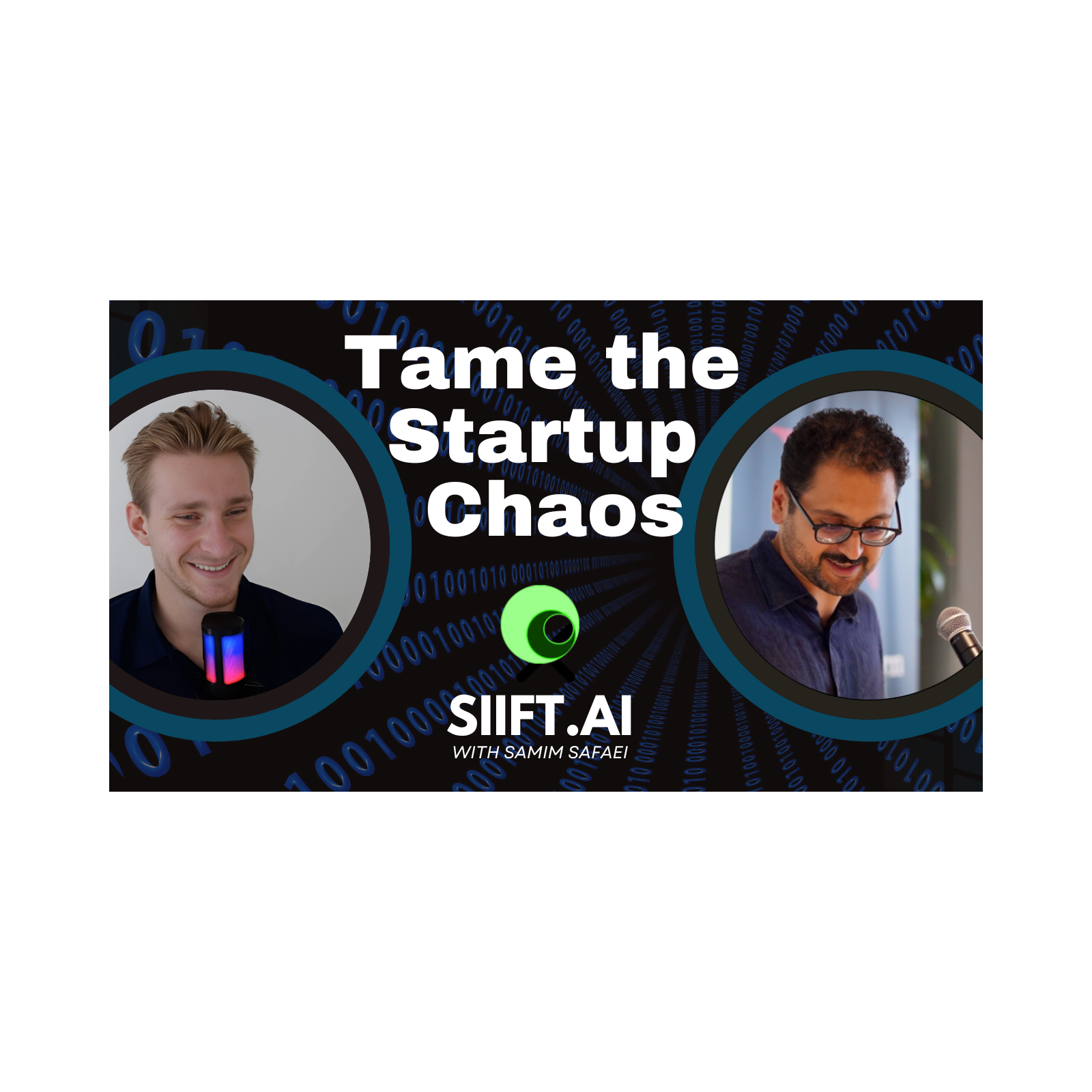
Beyond Chat AI: The AI Playbook That Keeps Founders Focused
36m 45s
SIFT AI is a platform created to assist early-stage founders and small teams in navigating the chaos of entrepreneurship. It provides an AI-driven, structured workspace that helps users validate, organize, and progress their ideas by addressing common pain points like scattered information across tools such as ChatGPT and Notion. The platform functions as a "founder's compass," offering guided, step-by-step processes through a chat interface combined with a canvas for organizing insights, emphasizing critical thinking over passive AI use. Currently in beta, SIFT AI plans to launch publicly soon and is pursuing a partnership model with accelerators and advisors, allowing them to white-label the tool to extend their reach and support more entrepreneurs efficiently. The company prioritizes accessibility and affordability, aiming to democratize startup resources while complementing, rather than replacing, existing mentorship and advisory ecosystems.
All right everybody welcome back to off the grid on the record. Today I'm joined by Samim co-founder of SIFT AI, a platform that's helping founders and small teams cut through the chaos of early stage entrepreneurship. So we all know that starting a business today means a flood of prompts, notes, half finished docs spread across a dozen tools. So SIFT is trying to change that by giving solar
preneurs and small teams that guided AI-driven workspace that helps the validate, organize and actually move their ideas forward. So Samim and his team have been building fast. They've been running private beta tests and giving up for a long later this year next month actually. So we're going to get into where the ideas came from, how it works and what it's like building in a public at the speed of AI. So Samim, welcome to the show, man. Awesome. Thank you very, very happy to be here. Great intro. Or as of course, amazing. We're excited. What are you calling from today? I'm calling from Vancouver BC, Canada. Amazing. Two Canadians now. It's been a while since I've had a Canadian on here. Happy to boost the ratio up. Amazing. Well, just before we get into everything, what's been keeping you busy outside of building SIFT? Is it just all hands on deck? Or do you guys have some kind of time to do some personal stuff as well? A little bit. Yeah, I mean, it's summer here in Vancouver, which is like obviously the best time I bought a paddle board. So I'm going to take it out. The summer here isn't very warm, but we got up with like a couple of weekends ago. And yeah, it's pretty fun. Hopefully, we'll go again before the season ends out. That's amazing. It's good to hear. I'm more of a kayak guy, but I heard the paddle boards good for the core. So maybe you're in a better spot than I am. But I'm going to jump into a lot of it. I mean, you've been through startups before. I mean, what led you to the pivot just a few months ago into building SIFT? Yeah, great question. So yeah, we were doing something else experimenting like everybody is. But a few months ago, I kind of connected a few dots along with my co-founder. And we realized that a lot of the challenges we were having with using ChatGPT for our own startup, we're really weighing us down. For example, I'd create a project folder in Chat, and I'd have 30, 40, 50 conversations a week sometimes on this. And then later, I'd find myself trying to recall information. Hey, what's our ICP again? What was that messaging thing again? And it was kind of clunky. And on top of that, it wasn't the most accurate because there might be a mix up between different conversations that I had. So it kind of got our wheels turning, and this is my fifth startup. Depends how you count it. But then doing them for a long time. And I think that really the validation phase is even more important than ever nowadays because of all the buy coding and all the flood of new ideas and founders into the market. So yeah, that kind of was the genesis of it. I guess you could say. We just had all these ideas kind of pull out from that and our own PTSD and kind of experience, building startups in the past. So yeah, it was just kind of like, hey, this is a great tool, but doesn't really fit the exact needs of a founder, especially an early stage founder. So yeah, it was good enough. I mean, are we talked about a bit more in depth a couple of weeks ago, but you realize that the problem was the tools like notion clip, click up, chat GPT. It wasn't that they couldn't do it. It was just the order of operations for founders, right? So can you give me a bit more of a background and for people listening on why that organization is so important and why actually structuring your prompts, structuring where your information is, why is that so important? Yeah. And so I'm guilty of this as anybody. But founders don't have the cleanest room mentally speaking. They have a lot of different ideas going on, half-picked ideas, expired ideas, kind of conflicting ideas. And what we kind of found in our own experience of using chat GPT for this stuff is, you know, chat is reactive. So it's really at the mercy of what you ask it to do. It doesn't have like a structured or kind of frame-controlled way of asking you to do things. That might be a priority or might make more sense for your startup. On top of that, it also thinks everything's a good idea, right? ChatGee is a general purpose tool, more of a consumer tool. It has different drivers or considerations than something that is meant to de-risk, you know, building a business. So that was a big one. And you know, we spent a lot of time trying to prompt or essentially remove the bias or remove the psycho-fancy or yes-manning that happens in chat GPT by default. But again, that comes from us being experienced founders and actively trying to like debunk or debase our biases. So there's that. And then chat GPT also thinks it's, everything's a good idea. You know, oh yeah, you should open that like ice cream shop in Antarctica, you know, like you can do it. That's not very off. You're ready buddy, right? So yeah, there's a few other things like that. But I think the other big thing was just that it's just not able to extract or really keep surfacedable or keep the discoverability of key information that you uncover or it tells you over time easily. So yeah, there was a lot of, I mean, I could keep ranting, but I think those are some very clear areas where, you know, chat GPT is a great tool for consumer use, but it doesn't really make sense at least not in our experience for founding. Fair enough. But I mean, I think a lot of those things came to light during, you know, the beta process. So I'm going to curious like how did the beta testing process start and what kind of feedback have you been hearing from those first? I think we said 30 users, right? Has it grown since that? Yeah, it's growing. Yeah, we're in the process of pushing our next update actually. So we haven't been able to get out to the new people that have signed up just yet, but yeah, we had 30 in the initial batch. And the feedback has been very interesting, right? Because we have our own bias, our own perspective of being, you know, certain experience founders, building our own kind of like ideal tool. And a lot of, I think, variability exists in how you talk to founders based on their skill set or based on their experience level, right? And again, that's something that, actually, Pete, he starts to develop with its memory or with its kind of personalization to a person over time. So we're trying to bridge that gap. And then the other thing was our understanding of, again, how to build a startup. So there are established best practices, right? Validation exercises, customer development, prioritizing actions over just like scheming and coming up with the best idea ever. And I thought of the framework and the UI UX that we build tries to get around that, but it's almost like there are gaps in terms of how. Let's educate people. So the more we kind of do this, we're really trying to keep it as a practical tool and something that's applied. But there seem to be certain educational elements or learning elements that we need to kind of tuck in or kind of pass in certain areas. So that was interesting. And I think, very valid. Fair enough. But I mean, I think it's about time that we explain very simply what SIFT AI does. I mean, for people hearing about SIFT for the first time, how do you describe what it actually does? It's pretend I'm a 12 year old first and then we'll get into the more technical side. Yeah, for sure. So we like to call SIFT a founders compass. And why we do that is because founding a startup is really about finding a lot of different things. We were joking with some people the other day. It's like you're Sherlock. You know, you're trying to find a clue here. You're trying to find a clue there and you're trying to connect all these dots and really found in the past tense something of value. So for us, that looks like something conversational, something AI first, but more step by step. And we'll guide it and more structure. And something that really walks users through the thinking process around maybe their problem set, their audience, you know, the actual unique value prop that they have in mind and then takes them from idea to action through a series of streamlined or more convenient validation exercises or actions. So that's kind of like the very basics of it. Anyone who's been through a startup accelerator or who's done like a lean canvas would understand that, you know, there are frameworks or there are kind of like exercises that you can do that really are not that hard, but they help you just get your thoughts out on paper and start to spot different things that maybe are missing or contradicting and focus your effort on where you want to like spend time de-risking the business that you're building. So we incorporate a lot of those elements. I do think we're building is a hybrid of all these things that we've talked about. It's not that simple and that's. That's why we have our own term of the Founders Compass. But yeah, it really is just an AI app that makes it so you can do a brain dump and properly organize and over time keep track of what's working in building your business and what's not. That's fair. So would this be considered something that someone would use as a replacement of the tools that they're currently using? I think eventually, yeah, we want to get it to that point. Obviously, Chatt GBT has a lot of utility, cloud, Gemini, you name it. But yeah, we are kind of going for this approach that you would have it all in that source. We probably, well, I shouldn't speak too soon, but I think other tools like Notion or Google Workspace wouldn't be things that we want to replace. At least, not completely, and it would probably talk and work well with those tools. The same goes for like my coding tools or cursor or whatever else it is that you're using to build. So it's certainly not like a catch-all replacement for everything, but it is probably a better way to kind of organize your AI chat conversations. That makes sense. I mean, we talked about how it's almost described as a guided chat. That stores and structures information. I mean, almost like a glennified canvas. I mean, can you walk us through what it looks like for a new founder logging in for the first time and just starting to use it? Yeah, sure. So it has a chat component to it. And then on the other side, there's essentially a canvas. So something like a structured table and you're able to kind of talk and have that information go into those different topics. The rest of it's a bit complicated, but when you think of this concept of sifting, and I'm a bit of a sucker for a good name or brand, not that I'm particularly good at it, but we spent a lot of time coming up with the right term. The term we came back to constantly was sift because we're really trying to help people filter down and cut the noise and get to the point where they have valuable nuggets or relevant information that they want to go through. So as you use the UI, you start to notice these kinds of themes of like the layered filtering or being able to have structured to something and then zoom in and focus on something else. I think we're hoping we can eventually achieve a level of quality or level of kind of product depth of something like a notion or something like a mirror, which is an extremely coherent UX UI brand, everything, right? So that's kind of the direction, but on the surface, it's going to look familiar in terms of the layout to other like EIA tools that are chat first. It's amazing. I mean, have you found that some users have said that they felt a little lost and needed more guidance just because of how technical it is? I mean, how are you approaching the UX? So it doesn't overwhelm people who aren't already AI savvy. We're hearing a little bit of that. I think that a lot of the people that we do talk to are more AI savvy or maybe a little bit more familiar with that layout, often they're Gen Z or they're a bit younger. So they grew up using chat GPT. For the ones that aren't, we do try to keep the UI quite simple. We're still working out pieces here and there and improving, but there's only a few pages to it. It's not like that complicated on the surface. Really the complexity comes just in terms of like the data management or how you actually keep track of all the information over time. But if you think about the customer journey as a as a slope, we like to keep it fairly shallow or we like to keep it as a pretty gradual grade that you don't have like to come in. And there's a huge cliff for a huge wall in front of you and there's a million things that you have. I mean, I think a big component of that itself is information like we talked about before. I mean, too many prompts, too many experiments. Everyone's talking about how there's so much information out there and becoming an expert in something is near impossible. So do you find that that's the single best headache sifter solving? But when we think about the AI age, we think about like the post truth or post reading age, essentially that we're in today because nobody wants to read anything, but they just want chat to give the answer. Funny people have talked about how that impacts thinking and neurological development. But I think that ultimately what we want to do is actually make people think more, but reserve their mental capacity of cognitive load and cognitive energy for that critical thinking or for that higher order stuff that is what's make or break for a good founder. I shouldn't be spending all I'm scouring through websites looking for a little bit of information or trying to like find that one chat that had that little nugget that I thought was really interesting last year's day. I should have that information surface something so I can focus on the next higher level thing, which may be comparing a few different ideas or maybe looking more deeply into some of the assumptions that are a part of my business. So I think it is largely about filtering, but with the cool of helping people think deeper about what they're about. That makes sense. Making deeper itself is, I think I'd say about people with what agree is kind of a skill like that critical thinking side of things. So there's one way to mindlessly use AI, but another to actually put your mind to it to be able to put together the right prompt and get it all together. But that being said, with all the moving parts, what's been the hardest thing for you so far? I mean, is it building the tech, shaping the product or actually getting people to understand it and use it? Question. So this may be an uncommon answer in the vibe coding each, but I think for us, the hardest part is the architecture and essentially like the data strategy around it because it needs to be scalable and it needs to fit different types of businesses. This isn't just for SaaS founders. This isn't just for AI startups. We're really trying to approach this in a more inclusive manner and what that means is that we have to think at another layer of abstraction in terms of the way we organize information. It's not just like on the canvas or it's not just something that a very specific type of business would want to use. It has to be something that is almost generalized and made versatile across the board. So we spend a lot of time rebuilding different aspects of the backend. We spend a lot of time thinking about how to properly set up the information architecture or properly lay out different aspects of the UI/UX so that the user even understands this level of organization. And I certainly think that we're nowhere near the end of trying to refine that experience or trying to get to a point where it is truly modularly scalable. That's amazing. I like the word scalable because that's kind of the next thing that I want to talk about. You're go-to market and launch strategy because this is coming very soon. I think by the time this gets released, it's already going to be out of beta, out to the public to use, which is a pretty exciting time. You've mentioned a partnership model, bringing in accelerators, advisors or influencers who can white label or co-brand the tool. Just give me a very simple breakdown of how does that work. Yeah, for sure. So I think that's actually a great point to kind of stop and say that we are not trying to replace accelerators. We're not trying to replace the mentors and advisors and all the really experienced people who make entrepreneurship possible and make entrepreneurship successful nowadays. But what we are trying to do and we can't take credit for this idea that something would hurt from the market is we're trying to help them scale their reach or scale their operations because there's so many people that are sitting on an idea or very early stage. And very few of them are at the point where they can justify or they can really attract that level from an ecosystem, a leader or an ecosystem, a naveler, like an accelerator or a mentor. So we're trying to bridge that early stage gap and we do that while full while knowing and admitting that we're not the world's experts in building a business. We certainly have some experience. But what we have more so is this technology or this product vision of how to help founders based on our own understanding of the problem. And so we invite and we're already partnering with a bunch of different ecosystem enablers like these accelerators and so to use our platform, customize it, make it their own and offer it to their communities and use it to make their own ecosystem more efficient. That's really the kind of core of it. So the way that works is that we entice and incentivize those partners by making it free for them. We make it very easy for them to come in and kind of customize their curriculum and do [BLANK_AUDIO]
they want to do with us. And for the earlier partners, we give them extra perks or incentives and how to do that so that then we can launch it to their communities and do it in a way where they focus on what they know best, which is maybe particular strategies or having you know that community aspect leadership there and let us focus on what we know best, which is the technology and the product. That's amazing. And I mean, I love the explanation there actually. You said a lot of very interesting things because there's always a niche and a need for anti-complexity. So I think the one thing I want to get into is people pay a lot for something that will just organize their calendars. And you have tools out there that are costing 30 bucks a month and all they do is play Tetris with your calendar. So when we're talking about making things affordable on one side, but what are we talking here in terms of price? What are the different tiers and how is that go to market strategy kind of reflect that? Yeah. So I'll be upfront. We haven't figured that out yet completely. But our goal is to offer the best value service in our market. And the reason we want to do that is it'd be two or threefold. Firstly, you know, our mission is to make entrepreneurship more accessible. I have done five startups and all of them have been in these startups. Didn't ever raise from VCs or go to a prestigious program. We would have wanted to in many cases, but it's very competitive and hard to get in, right? So for us, for entrepreneurship and sift is about making things more accessible. For us, it's about accessibility. I think that's a core core value for us. And that translates into inclusiveness. That translates into equity, quality, you name it. But with that value in mind, we also see that vibe coding AI has made it much easier to build things, right? So software has come out of fine. And we're seeing a huge collapse in the price or the pursuit value of software as a result. You know, I think the days where you can charge 30 bucks a month for calendar Tetris are numbered. And when we take the long view on this stuff, we want to be able to offer way more value for the dollar to our customers, because it's just good business, right? We want to retain customers. We want to go with them. We want them to understand that sift is not a quick money grab. It's really a movement where we're trying to change the game here. So with those two things in mind, yeah, I think we're talking about $700 a month, the type of price. That's incredible. You don't see that very, very often. But I think you answered the values question phenomenally. So I'll kind of go and spit off the dome here for a bit of a side, a side question. But what does this successful launch look like for you this fall, then? Is it signups, revenue, or is it just validation that people just get it? I think it's a bit more than just like idea validation. I think it is like value validation in terms of people actually wanting to pay for the service. So we're launching here locally in the community in Vancouver. We're lucky to have partnered with a lot of great ecosystem leaders and community builders that are kind of also coming up around this time cheer locally. And so our goal for the, I think, initial launch is just to get that validation and understand where we want to focus because everybody says this, right? What's your market on my market is everybody? Well, that's not how you go to market. Never true. Right? Exactly. So you have to niche down, you have to sift down, and you have to find where you want to go to market. So as we kind of dog food out of act, and as we start to kind of go through different strategies, and our go to market, I think that my goal for September is really just to get to a point where we have a small base of core users who are paying for the product, who are using it regularly, who are giving us feedback, and who are able to really say that this is helping me. This isn't just like an impulse buy. That's huge. I love it. And I mean, you're always using the best words for my segues, but on the other side of impulse, let's look at the future and actually thinking through a lot of decisions. But right now, sift guides founders through the basics. You have the problem market solution revenue period. Where do you see evolving in the next year? Are there any steps for any new cool features that are coming out or just in general? Where do you hope to see it? Yeah. We have a lot of ideas. And ideas are dangerous. I'm going to start up early stage like this, because we want to kind of go where the data tells us to go and what the market wants. But I think there is plenty of justification for different types of integrations we could do in the typical kind of founders stack. So things like notion, things like Google. I think those are obviously fair game. I think it would be very interesting to have cross platform or kind of like more accessible options. So maybe that one's voice, maybe that one's mobile. And I think that there is a lot of interesting things that we will do with data as well. So various early stages there. But one of the most interesting things is the early stage founding journey isn't just obscure or isn't just murky in terms of like a founders thinking or the kind of clues that they found during their Sherlock Holmes episode. But more so in how they're able to even document or then communicate or then show other people what did those be co-founders, what did those be investors, or whether they be mentors and advisors. So yeah, I think that again, there's tons of stuff here that we are just scratching the services and we don't really know where it will go. But it seems like there's value there and a lot of people are assuming to agree so far. That's amazing. Well, it is a bit of a weird place where you don't know exactly where it could go. But I'm in fact push that button a little more because I'm just curious, could this eventually become not just an admin for founders, but a full operating system for early stage startups? Question. It could be. Who knows? I think it's a question of priorities and time. Something like that probably would take a lot of effort and I think you look at a great tool like Notion. It has so many features and it is such a deep product. But I would say that a lot of people don't use it to its full potential or maybe not even half of its full potential. And I think there's this like old joke that whenever someone tries to make like a universal standard or a universal go to for something, it usually falls short and it just adds to the pile of options that people have to choose through. So it's not specific enough. Yeah. Well, it's not that it's also there's not specific enough, but it's also that the customer journey becomes too long because the journey becomes steep, the customer journey. It just isn't like really feasible for most people. I don't want to spend 10 hours learning how to use this tool or I don't know what the exact mechanism is in which I could turn it. A daily go to tool like Notion for my, I don't know, companies knowledge management into also a tool that I use for tracking our backlog or doing like spirit fine and things like that. You know, it's there and I'm sure smarter people have thought about how to do it. But I think that's the number one concern for us when it comes to like adding features is building the features in hard maybe even knowing what a valuable feature isn't hard, but it's more so like how do we create a simple and accessible customer journey and UX so that the users actually get the value out of that tool. Fair enough. I mean, one thing that I kind of want to twist on you just to see how this is what you're seeing in the industry, but with all the buzzwords of AI now, do you think founders are ready to trust AI was shaping their earliest business decisions or do you think that there's still a mental hurdle that you have to cross before that can happen? Yeah. Great questions. I love them. Keep them coming. You're totally right. No, I think it's a concern that we've heard and it's something we're definitely trying to to address. A lot of people have very valuable unique ideas that they want to build out and it is a challenge, I guess, when they try to pitch or when they try to share or when they try to use the tool like ours. But the alternative is that they're giving away their data for free to open AI, to go to Anthropic, you name it, right? And a core tenant or a core thing that we're doing is protecting your privacy and being essentially.
your IP or any perceived IP that you think you have in the platform. By using our service so it's kind of a core thing front and center in our product and. We have a lot of I guess you could say like infrastructure or kind of technical features there that to help protect that so yeah I think is very important and I think that. It's going to become more and more important over time because as we look at how we connect maybe advisors or accelerators to promising founders. This becomes kind of a battlefield right is who gets what data how's that data. Essentially monetized right and we again take a founders you have been getting founders for so long so I think that. That's a key reason why we need to charge for the service you know if we don't charge for the service then we're at the emergency. The emergency of the investors or the B2B companies who want to pay for that data and so it's a question of you know if you don't value that privacy that's totally fine. You can go use chat you can you but part of the structured value. That using something like sift offers is also on top of it the peace of mind that you know your data isn't going to be shared without a profession. That's amazing well I know one thing that we talked about as well was like the personal growth that comes through this and you know people to stay back step back and realize those things from ethical standpoint to I mean. For a founder I think personal growth is almost paramount to business focus I mean you grow with your business right I mean you hear that all the time so. I mean what's been your biggest personal lesson for you going through this pivot and this entire build. Yeah oh man I always think that's my favorite question of the interview and then you ask me another one it's like. So I guess that. The medium story is that I. I'm an introvert and I think I've always been more like a tinkerer or more of a builder than like a talker. Nothing wrong with talkers but I always gravity more towards doing and you know at this point I've done so many startups but I rarely talk about them or rarely put myself kind of in these situations to speak as an authority on these things. Because I feel like I don't know that much compared to some other people but along the way you kind of like look back and like oh I've gone pretty far you know I actually might have a bit of perspective now on certain things. And I think the biggest shift for me with that kind of backstory is just my ability to kind of contribute to the community be able to maybe like help young founders and maybe even accept that you know I'm not that young kid anymore just like playing around building cool things but like I maybe have a bit of experience to share and I probably should know better in a lot of cases. When I'm doing things and and yeah I think that was just really nice for me because it feels in a lot of ways like a full circle moment where I'm able to kind of give back or show a certain type of the term but thought leadership on certain issue because I've been you know living and breathing it for for so long pre GPT and now post GPT. Very not I like that I mean you say you're more of a builder than like a talker so I mean if you weren't building sift right now what problem would you be working on instead. Oh I have too many ideas so it's hard to name one but I music is big for me I'm a big music I I just start in the music space a while ago. So I might might me enter back over there I think mental health is also super interesting I think that's something that's needed as well yeah I don't know I would be torn between those things I find myself gravitating more towards like you to see type of cases just because that's where my heart is but. Yeah I mean that doesn't mean that you know sustainability or energy or anything like that isn't important or we actually we did it start up kind of in that space and the smart building space so why would go but. I'm pretty passionate about AI and software these days versus like the hardware that is required in those kind of. Ventures right so yeah that's kind of I think what I would probably be. I'm poking around it. Sure I love it well so this has been awesome I mean I think a lot of founders listen you're going to really resonate with the pain of messy notes like half done plans not knowing what to do next I know when I started. I couldn't believe how much I actually had pen and paper work done but just everything across like my entire dashboard was you know disgusting so. I mean not knowing what to do next is also the big thing that we talked about so having something that basically guides you and helps you figure that out as massive so I mean. Sift is giving a structure to the chaos I like and I mean it's clear that you're definitely on to something. For anyone curious. Keep it on sift.ai the public launches coming really soon if you're found or this is something you really want in your toolkit. Some of the working people go to find more information about you about sift and about the entire initiative. Yeah so you can just go to sift dot a i that's s i i f t two eyes dot a i um or you can find me on LinkedIn say m i m. S a f a i and yeah happy to chat any any founders or anybody who's interested to talk about. Fantastic well thank you again for joining us to meet me and to our listeners if you found this conversation useful share it with another founder who's grinding through their own early stage built don't forget to subscribe on Spotify Apple podcast YouTube wherever you get your podcast where everywhere and we're going to be getting into more deep dives into the people building the future so. Some even thanks so much again and we'll see you guys in the next one. Thanks a lot Eric really enjoyed it appreciate your time. Thank you.
Podcast Summary
Key Points:
SIFT AI is a platform designed to help early-stage founders and small teams organize, validate, and advance their ideas through a guided, AI-driven workspace.
It addresses challenges like information overload and disorganization across multiple tools (e.g., ChatGPT, Notion) by providing structured, step-by-step guidance for startup validation and decision-making.
The tool acts as a "founder's compass," combining conversational AI with a canvas-like interface to filter noise, surface key insights, and integrate with existing workflows.
SIFT AI is partnering with accelerators and ecosystem enablers, offering white-label solutions to scale accessibility and support for early-stage entrepreneurs.
The focus is on affordability and inclusivity, aiming to make entrepreneurship more accessible without replacing mentors or accelerators.
Summary:
SIFT AI is a platform created to assist early-stage founders and small teams in navigating the chaos of entrepreneurship. It provides an AI-driven, structured workspace that helps users validate, organize, and progress their ideas by addressing common pain points like scattered information across tools such as ChatGPT and Notion. The platform functions as a "founder's compass," offering guided, step-by-step processes through a chat interface combined with a canvas for organizing insights, emphasizing critical thinking over passive AI use.
Currently in beta, SIFT AI plans to launch publicly soon and is pursuing a partnership model with accelerators and advisors, allowing them to white-label the tool to extend their reach and support more entrepreneurs efficiently. The company prioritizes accessibility and affordability, aiming to democratize startup resources while complementing, rather than replacing, existing mentorship and advisory ecosystems.
FAQs
SIFT AI is a guided AI-driven workspace designed for founders and small teams to help validate, organize, and move their ideas forward. It acts as a 'founder's compass' by structuring prompts, notes, and documents to cut through the chaos of early-stage entrepreneurship.
Unlike ChatGPT, which is reactive and general-purpose, SIFT AI provides structured, step-by-step guidance tailored to startup needs. It helps de-risk business ideas by focusing on validation and prioritization, rather than just generating responses.
SIFT AI is aimed at early-stage founders and small teams, including those in various industries like SaaS and AI startups. It's designed to be inclusive and versatile, catering to both AI-savvy users and those new to AI tools.
Beta testers highlighted the need for educational elements to guide users through startup best practices, such as validation exercises and customer development. The feedback emphasized making the tool practical and applied for diverse experience levels.
SIFT AI partners with accelerators, advisors, and influencers, offering white-label or co-branded versions to help them scale their reach. This strategy focuses on making entrepreneurship more accessible while leveraging ecosystem enablers for community growth.
Pricing details are still being finalized, but the goal is to offer the best value in the market to align with SIFT AI's mission of making entrepreneurship more accessible and inclusive for early-stage founders.
Chat with AI
Loading...
Pro features
Go deeper with this episode
Unlock creator-grade tools that turn any transcript into show notes and subtitle files.
 PodcastTranscript AI