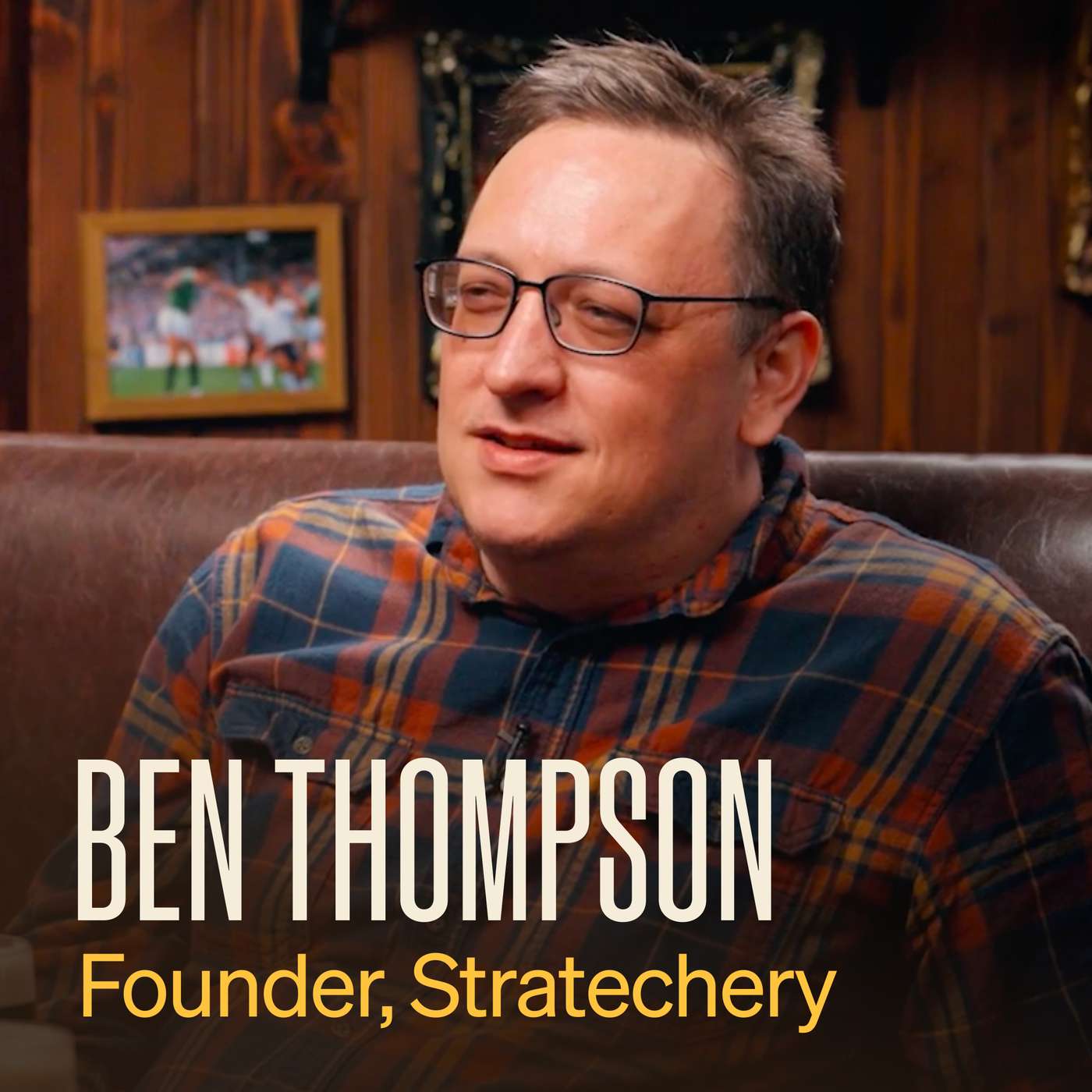
Ben Thompson from Stratechery on AI ads, the end of SaaS, and the future of media
90m 15s
The discussion covers two main themes: Taiwan as a destination and the application of aggregation theory to AI and advertising. Taiwan is described as incredibly convenient for living, with a mixed-use urban layout similar to Tokyo, but Taipei is considered aesthetically lacking despite its wealth. The growth of food delivery services like Uber Eats has transformed the dining landscape, reducing traditional restaurant foot traffic. Shifting to tech, aggregation theory highlights how platforms like Booking.com aggregate demand, overshadowing suppliers. For AI, there is internal debate on updating this framework, especially concerning monetization. Advertising is argued to be a valuable and efficient model, with criticism directed at OpenAI's implementation of contextual ads in ChatGPT, which may create user suspicion. Instead, a Meta-style approach—profiling users broadly to show relevant ads unrelated to immediate queries—is suggested as superior. The conversation concludes that leveraging AI data for ad targeting across other properties, rather than within the AI interface itself, could be an optimal strategy, balancing revenue with user experience.
[MUSIC] Ben Thompson is the founder and author of Stratekry, the news about that everyone in tech reads to make sense of what's happening. He's also early to the premium newsletter model. Let's become very popular in media nowadays. For many years, he runs Stratekry as a solo founder in Taiwan. [MUSIC] Cheers, good to see you. Cheers. [MUSIC] It feels like people in San Francisco have not properly discovered Taiwan as a tourist destination. Like, do you agree with that characterization? Unless your recommendation always asks me about Asia and the way the way I always characterize Taiwan. There's lots of great places to visit in Asia. And I would also put Japan on the list. But I like to think I would do Japan before it was cool. Yeah, nothing else Japan at first. Well, the whole thing with Japan is going to Japan pretty smartphone. Was a completely different experience. And going there post smartphone. Like, you think, oh, the subway system's amazing, the trains. Try navigating that with no smartphone and nothing's in English. Like, Japan used to be very low on English. It's still lower than places like Taiwan. It's surprisingly low. Yeah. And Japan has the way to visit Japan is you just walk. Like, don't go to set destinations. Where the way I would talk about this is places to visit. But the best place to live is on Dalai Taiwan. The one word everyone says for Taiwan sounds not that impressive, but the word is convenient. Like, it is the most convenient place to live. So part of that is actually 7-Eleven has really good food. Well, it's actually downstream from the Japanese. Because Taiwan was a Japanese colony for the first 50 years of the 20th century. And it's laid out a lot like, why is it great to walk on Tokyo? Because Tokyo is all mixed use, right? That's how Taipei is as well. You have these big blocks where the exterior will be commercial. And the interior of these big blocks is all residential. And the first four is all like small shops or restaurants, things like that. So wherever you live, you basically have access to everything all around you. But I think the downside as a tourist is it's kind of an ugly city. Like, Taiwan's kind of notorious for just these dumpy dilapidated buildings and you go inside. And they're like, polatial on the inside. Like, Taipei is very, very rich. It's like at the top 10, I think, as like number of billionaires in the world or something like that. All downstream from building out China, things like that. It's a very beautiful country from Taipei 30 minutes to the ocean, 30 minutes to the mountains. East coast is amazing. But if people listen to this or visiting, like, I feel like one thing they should do is it's a mistake to try and use the Elk or anything like that too much because like, you should maybe just try and go to a night market and follow your belly and see what looks good. And it's like a lot of excellent street food. And so that'd be one thing is to don't try to overplan. Well, here's a problem though. We're tech is made at worst. I would argue it's a tourist. Which is Taiwan is arguably the greatest Uber Eats market ever because there's amazing options. It's all delivered by scooter. So it's always like 10 minutes to get dinner and things along those lines. I think you're going to ask me about difficulties in the way of the States. Not having access to that is definitely one of them. But the problem is that it's such a huge market now that I think there are fewer and fewer restaurants in that a lot of these places actually just straight up closed their storefronts are just ghost kitchens basically. And all they do is just make Uber Eats orders all day. I see. So I mean, famously, the restaurant economy in places like Taipei would have been really good, but it's gotten worse because people are eating in more with Uber Eats and stuff. I think so. I think so. As far as walking around, there's still plenty of places. It's still great. But there are a number of restaurants that I used to always take people to. Like holes in the wall that I knew are super good beef noodles or something. And I remember a couple times like, oh, you can't actually go eat there anymore. But there's still no breeze. That's the bummer. There's like a separate problem, the San Francisco problem at restaurants is that nobody drinks anymore. And so the restaurants can't, you know, they've lost a major restaurant. It's so bad you're you had to get out. Exactly. We're trying your own office. Exactly. We're trying just first hand to fix this. Be the change you want to see in the world. Should people visit places beyond Taipei or first they've. Oh, for sure. Yeah. Taipei is great. It's great to walk around. Taipei 101, which is obviously very much in the news these days with the scaling. But you can go up the elevator and the other. Go up there because there is a massive ball at the top. The mass time period. Yes. Which is amazing. It's like if you're into like engineering, that's actually a very underrated thing. National Palace Museum is amazing. But the whole the East Coast in particular is incredible. Like you drive, there is a train, but the driving you drive like you're driving on the coast like the lost coast of Hawaii kind of. Exactly. The problem there is an incredible gorge called Turokogorj. That's close. That was really, yeah, messed up by an earthquake a couple of years ago. I don't know if it's even reopened yet. But I used to take people to that all the time because it's world class. Yeah. It is impressive that they said we're going to build the tallest skyscraper in the world in like a very frequent earthquake region. Yeah, but the last skyscraper was worked all well for the Netflix. Yes. So you've talked a lot about over the years about aggregation theory and really popularize this idea where pre-internet often power would live with the supply, whereas on the internet because of the different marginal cost dynamics and things like that, power will rest with the demand aggregators. And so booking.com is a much bigger company than any hotel chain of news. You don't like that. And booking.com is the particularly interesting one because they aerate all the hotels, but they are also aerated by Google. So they're like Google's biggest customer even as they're also on the other side. I feel like booking.com is a very underappreciated success story in tech. You know, they're a European company kind of much quieter in a lot of ways. But like if you invested a dollar in booking.com and a dollar in Google 20 years ago, you made much more money as a booking.com shareholder. And I think people don't appreciate that fact. It was a very well run business. But what I was going with this is how does aggregation theory apply to AI? How does one need to update the framework? TBD to a certain extent. I mean, this is part of the huge probably the one of the most angsty debates that I have internally, generally, which is open AI is sort of welfare going forward. I put forward a few years ago that actually open AI could stop making models and be one of those valuable companies in the world just because of chat GPT. That's their most valuable asset. And part of the problem issue that they have is that was definitely the case in 2023, 2024. But they never, you have to actually build the business model around that. And I, you know, I think fairly famously who is based on all the tweets that I got when they announced that they're going to launch ads. I've been losing my mind about this fact for a long time. And I think this is interesting. I'd actually be curious your view of this. Which is there's this mindset in the valley of this skepticism of advertising. And people have sort of like internalized that it's bad and evil. Do you do, do you sense that? Do you feel that? I agree. This kind of a knee jerk skepticism of ads. And like, look, you know, when I, I mean, you two premium subscriber, when I see someone, you know, watch a video without premium. That's worth a guess. Yeah. It's like, what do you do with your life? And so like I get the knee jerk reaction and that's right, but some level is kind of the anti advertising company and like we're the opposites, a form of monetization. But I don't know, I have no particular issue. I think it's like a very efficient form of monetization. It makes a lot of sense for certain products. And so I think it's just different strokes for, yeah, I think you're, I think you're with Stripe. You're on the, you're on the skepticism side. I think ads are amazing. And, you know, I'm talking my book a little bit. The tracker has gotten tremendous traction just by not hating ads. Even though I'm not an ad model. But you're a paid model. Well, it's actually, it's funny. I actually think I got a lot of traction over the years by talking about ads when no one else was, despite the fact that it's the most important business model. Yes. And I look back and all my early writing was terrible. I know I do what I mean, but I'm just by virtue of talking about it. It was, it was helpful. And the reality of advertising is number one, people, if you are making a product in the world, like, should a checkery is very fortunate. Like it is definitely a new model or a new internet native model in that I have subscribers in like 200 countries, right? Like, I'm literally the whole world as my market and Stripe obviously helps me. It helps me. Yeah. A few in the Vatican, you know, they're following on. I could go check. I would put the odds are very high that I do have at least once a couple of the Vatican. And but where I benefited from is I was a massive beneficiary of social media, particularly Twitter. And that back in the early days, good days of Twitter, if you want to say whatever it was, there was currency in sharing smart links. And so if I was a regular provider of links that people felt made them smart, so they would share them and talk about them and be sort of back and forth. And so that solved my customer acquisition issue. The reality though is most because the other thing about content, actually, is the point I should have come back to is it's something to talk about. It's something that's commonality sort of between us that we can both read the same thing. We can both have opinions on it sort of react to it. The sort of product that I buy on Instagram is not what I'm not going to like post about it or talk about it, but it can be tremendously beneficial. And they in theory have those small businesses or whatever they might be, or Chinese suppliers or whatever, they have the same opportunity which is sell to everyone in the world. They just need a way to tell people about it. Someone who buys way too many products off of Instagram.
And by the way, one of the great things that we've got to the US is the Instagram ads are unbelievable. - Oh, that's pretty good. - I don't know much better than that. - There's so much better in the US. So like, oh, this is the best part of living in the richest country. - In the end of the advertising. - It's amazing. Like, what's this native content? Give me more ads. Which by the way, Facebook is very happy to do over the last six months. - Okay. - Lots of ads these days. But I get stuff that I never would have thought of. I didn't even know about it. And it's great. It's amazing. And it's a real benefit to me as a consumer who, for sure, as a consumer, you should premium and invest down on people who don't. But finding things that I didn't know about that make my life better. So as a user, I'm benefiting, as a rich user, I'm benefiting. As the world is six billion people, most of whom do not have the disposable income that I have, much less you have, much less anyone else that's ever Cisco has, they get the same experience I do. And something for AI, like, when you think about, particularly when it's so costly to provide, and the free product is so much worse than the paid product, of course, it's a win for them to be able to get back. And like, so to have a mission of believe that AI makes the world better. And to not embrace ads. - No, no, I agree with that. It's being an efficient form of monetization. What do you think is the right way for consumer AI apps to do ads? Like, you know, Chachypty, just announced that they're doing ads. - Right. - And they're terrible. - Well, no, they're doing them as the very separate experience to the answer. - No, I even have to know. - This is why it's so bad. This is why I'm so frustrated with them. So what they're doing is the bare minimum easiest solution, like banner ads basically. - It's banner ads, but it's based on the context of the conversation. And the problem is that like, they release like their ad principles, right? Which is our ads do not influence your answer. If you're using the easiest possible way to target ads, which is based on the context of the conversation, we'll just show you a roughly relevant ad. Number one, your market's way smaller, because you have to hope someone starts a conversation that matches the inventory you have. Number two, you're getting into a, my t-shirt answers questions that my t-shirt is raising sort of situation where if the ad is clearly connected to the answer, you're going to raise suspicion to user's minds about what sort of the connection is. So I would prefer if the ads had nothing to do with the answer. The way you get there is you build a meta style understanding of the user and show them stuff that's relevant to them, like in Instagram. The best Instagram ads don't have anything to do with the stuff I'm surfing. It's from meta's understanding me broadly. - I'm sorry, are you saying that like the AI ads should be more like Facebook ads than Google ads? And right now the focus on doing targeted ads that are related to the prompt, whereas instead it should all be profiling the user and who this person is and what their interests are. - I think that would be better. It would present less conflict of interest less uncertainty amongst the user. And it's a model that I think, I'm not the world's biggest fan of search ads precisely for the reason why they work so well. I think there's a lot of search ads. - Because the confusion between organic ads. - Oh, their catabasation. Like why is it that I have to buy my own name in search ads, right? Because someone else will go in there and you're getting a harvesting a click on the ad that would have been there sort of organically. Which is fine, it works. The search is running a lot of value. But the challenge obviously is they only have one space for inventory, which isn't chatty.pt. - Well, sorry, it's an offensive Google ads that everyone complains about the branded search and yeah, you're paying for cannibalization. But Google pays so much attention to search quality that the sponsor listings themselves have a ranking of the like a relevance ranking of them. And so it's really just like the yellow pages where you need to page and be listed in the Amazon. - Oh, that's fine. I don't, I'm not, I don't, again, I'm the ad lover here. I just think that meta ads are more broadly valuable because they're showing me stuff I didn't know that I wanted. - But if the AI apps are to generate a profile of you, does that profile include the content of all your conversations? - Well, so this is the thing. So Demis is out there saying, "Well, I can't believe they're adding ads, "we are not gonna do that." Which is hilarious because the entire Gemini, DeepMine, Apparatus, what is it funded by? - Sure, yeah, it's the Google Admissions. - It's funded by ads and that actually is probably the ideal model. So it's actually very funny. I was actually in New York City last year. I was meeting, actually I was meeting with someone in the office in the shared office or across the hallway, it was like a hedge fund or someone. And they came over and he's like, "Oh, a long time reader, you're responsible "for our worst decision ever." And I'm like, what? He's like, putting money in Twitter. I'm like, I've never said to put money in Twitter. That's always been a terrible company. I stopped covering them because it was such a bad business. And I'm like, oh no, I remember what it was. It was when they bought MoPub. And my theory, my problem with Twitter advertising has always been that it, especially was very textual. I think text doesn't work as well. This is a problem for all the supplies and checkpoints. Text isn't the best interface for ads. Obviously visuals are generally better. And there's also a posture. If I'm on Twitter, I'm ready to do battle. I'm locked in. I'm searching for information. If I'm on Instagram, the whole point of seeing an ad is I don't really care what I'm seeing right now. I'm wasting time. You're actually in a much better posture, I think, to absorb, just like TV. Like you're sort of absorbing, can absorb the ad. And Twitter is like bad for that. But Twitter, because it's an interest-based network at least in theory, it should be able to understand a lot about you above and beyond theoretically, pixels and SDK sort of all over the web. And so my theory at the MoPub acquisition, I thought it was a great acquisition. Because they can harness signal from Twitter and manifest it in other apps through this sort of MoPub network. Now Twitter was incompetent, so they didn't have to do it in MoPub, gave it to Apple, and it was now written MoPub to the top of the world. But that was sort of my thesis. And I think that could apply to AI as well. I think the ideal outcome for Google is they never put ads in Gemini, but they understand so much about you because of what you do in Gemini that they can then manifest that through ads on YouTube, through ads on Google, through ads on their other properties. And the challenge for OpenEI is they only have one place with inventory, which is in Cheshire PT. - Okay, so you're saying that Google could use Gemini to just improve the targeting of the ads across the Google properties. And then maybe if you want to have ads in Gemini, you need to never put ads in Gemini. - But just if you did, you would also have the profile like Google has-- - For sure. - Of you from across the web, and you could do that. You don't need to have ads that are like making the user feel weird because why are you so happy about what I'm asking you about. - Okay, but in the scenario you're just describing for Google, wouldn't that have the same, just like the meta is listen to your microphone conspiracy theories or when the targeting is too good, people get concerned. Like wouldn't you get similar issues? - I didn't have to make up concerned. - No, it is, but sure, but like people have it. And wouldn't you have a similar issue where if you're using the Gemini data to make better ads, ultimately the targeting be too good and people find it weird? - I mean, I think that's a bridge that every tech company would be happy to cross if they came to it. - I see, if they're the people say when you have very good targeting. - I think there's a lot of, like I honestly think a lot of the, there's a real stated versus revealed preference about a lot of this stuff. The reality is is people like, even the you as a thing, oh, you could pay for Facebook or you could show up. People would rather see the ads. - I think most people don't care. In this, a lot of tech, in this sort of ties into the skepticism of ads. - Yeah. - It's sort of, and a wheat town, there's a wheat regulators, everyone's thinking about these very theoretical things. - In the bit of the challenge banner blindness where Instagram advertising works so well because it's a picture feed and it's showing new pictures. - So the amazing thing. - And then some of the pictures are like commercials. - So this is where Facebook is. - Because with an AI app, you're like looking for an answer. And you don't wanna look at the banner. - No, it's a huge concern. And this is one of the great ironies of Meta/Facebook. Is the extent to which, and of course, Mark and everyone hates Apple for lots of, I think, very justifiable reasons. But Apple saved Facebook from itself. Like back in the day, remember Facebook platform and there's a way Facebook payments and all this sort of thing. And Mark has always wanted to build a platform. And if you're just an app on a phone, you can't build a platform. And the problem is that I think being an advertising based model is generally incompatible with being a platform. The whole point of a platform is you're just letting something else shine, something else bring to the surface. You're just on your support structure for something to take over. So your operating system is not about the, ideally, it's the application on top of it that you're using. When Facebook was forced to not be a platform, it would just be an app. Suddenly, they could be fully into being an advertising thing. And think about a Facebook app. Even back in the day when it was a feed ad or a story ad. Literally, your entire device is all an ad. And somehow, it's not a banner. That's a little thing on the edge. They literally have achieved permission from users to take over your entire device to show you a full screen ad every five seconds. It's amazing. And they were forced into it by Apple. Do you-- OK, this reminds me of a non-convict day I dynamics, but this reminds me of you. I've had this-- I'm curious through your thoughts on-- which is often when tech companies become really big, they become really big just because the core idea works better than even the founders could have realized. And so Meta's a really big company because.
they have a feed and the feed got really big. And they were very smart along the way where they bought Instagram and they're like, incredibly tired. - No, it's the feed. - Good amount of station. - But just I turned out people spent a lot of time and many people, you know, the P times Q of that with the feed and they monetized it very well. And that's what got really big. And same within video, it just turns out that the GPU markers got really big and they sell a lot of GPUs. And so maybe founders, because they're often like high-powered individuals who want to have lots of new ideas, they're often thinking about the next thing or like what the second act or the third act is and every once in a minute, invent a AWS. But I'm curious what you would say to the idea that just generally it's making the core thing really big and there's more orders of magnitude at the top than you thought. - Yes, I think that's always the case. And I think that sometimes people end up making something that they didn't want to make and they continually push back. I think better is the perfect example. My impression is Mark's not very interested in ads. He's had very good people along the way that have helped him build these ad products. I think Meta has suffered from that because he has not been front and center fighting for, actually ads are good. They are societal good. They get, they are the driver of all the consumer surplus that tech throws off. Like the president uses the same search engine as the guy on the street or the same AI or whatever it might be. That's because of ads. And the. - Probably not. The president probably used like a Palantir of search engine or something. - Yeah, it's probably worse. Go last left a lot to prepare. There's always a junk online. But the. I don't know, the Donald Trump ever searched. I don't know, that's a good question. But he's not made that case. And I think Meta has suffered because of the failure to make that case. And then you get things that we're gonna do the Metaverse. We're gonna do XYZ. It's always coming back. You be a platform, be a platform. And Meta is an entertainment company. I wrote this years ago about the. Like, I think there's actually. It was simultaneously a good call and a bad call. Do you remember that Paul Kruehm in quote, the internet's gonna be very big or the facts machine because people are much interested in the same? I actually defend that quote. And because it's actually true. Most people actually don't have that much interesting to say. And I brought up that quote around 2015 by saying this is a fundamental limiter on Meta's long-term potential. As long as they think of themselves as a social media company, they're gonna run into a problem with their feeds becoming insufficiently interesting over time. Now, the move from kind of peer content to. Well, so that was. If I might say so myself, a very brilliant insight. The bad insight was my prescription, which was they needed to do more with professional content makers, like more funding of the BuzzFeeds of the World and share revenue, all that. 'Cause that was wrong. That was a good, generated content. The actual answer is what TikTok did, which is TikTok's not social network at all. It is a harvesting in YouTube, you know, the same sort of idea. It's like personal live TV. What actually matters? And this is a key thing. People get hung up on relative numbers. What matters is absolute numbers. So it is better to have 1% of your content be as good if your content is like in the billions or trillions. As opposed to, oh, 10% of our content is good, but you only have 100 pieces of content, that's actually worse. You think there's a better hit rate. And so spurring lots of creation, writing the algorithms to capture the good stuff, put it up there, that actually solves the Paul Krum and Facts Machine problem. And Facebook was blindsided by that. They were so stuck on their identity of being a social network that they let TikTok take this huge chunk. It was their blind spot. Speaking of TikTok, I feel like you don't write about Bytons that much. And I'm curious just what your thoughts are on. Bytons from here and the TikTok sale and everything. I mean, what a mess. I had to make a decision a long time ago. I wrote about Chinese companies more previously. And I think there's two-- number one, I've decided what I'm going to be able to cover and what I'm not. I'm not in China. I was in Taiwan. It is a different internet. And there was too much uncertainty and unknowns just in general about a lot of Chinese companies. I would write about them occasionally in the context of US tech companies. So I think I wrote about like WeChat and what it meant for the iPhone's relative competitor position in China, how it's different than other countries. I think that sort of held up pretty well. Wrote about TikTok in the context. I mean, more about TikTok, I think, in the context, particularly these kinds of meta. TikTok came up around the same time as the quibi, which quibi was the example of that. Quibi was like, it was actually right that there was room for a mobile entertainment product. Yeah. It was totally wrong about the content acquisition strategy. So even if the hit rate was higher, their total volume was way too small. I follow them, but not super closely. It's just a hard market to understand. And the-- But like TikTok's very relevant to the US market. So TikTok. TikTok. So I wrote the TikTok war, basically making the case that the problem with TikTok, and back then everyone's talking about user data. Who cares? The whole user data thing, people have this view of the East German, Stasi, and folders of going through people's data. These are vector databases with numbers that no human can parse. It's really quite anodine. You're just really the target ads. And I was very skeptical about that being a forcing function in terms of forcing that extra or whatever it might be. The issue I had was the algorithm. And I noticed-- I think it was when the Hong Kong protests happened. And Darryl Mori, the then GM of the Houston Rock, is tweeted like free Hong Kong or something like that. And there's a huge meltdown of the Emmy games that canceled. And I noticed that on TikTok-- this was from-- I tested it from Taiwan and VVPN from the US-- if you search for every single MBA team, you got MBA clips, except for rockets, you got nothing. Oh, that's funny. And I'm like-- I've got demonetized. There is the Houston Rock. There is a thumb on the scale here. I started talking about it then. And I did support the ban of TikTok or the forced sort of divesture from China because it seems fairly insane to have a primarily information source controlled by your chief of political adversary. Yeah, same like those rules over TV station ownership. And it's not really different. And so everything's a trade off. Of course, I'm pretty well known for being a pretty stark defender of free speech and against censorship. And my issue was in TikTok per se. It was-- the reality of China is the founder of TikTok of Byte Dance is long gone because he got called to the carpet for Byte Dance showing a little too much of what people liked, which is mostly like Hot Girls Dancing. And being insufficiently showing the right things that the party wanted, it's in China's-- the reality is China has the price of doing business. Is they get-- they're on somewhere on the control structure or they can tell you what to do. And this just seemed like a very foolish thing to tolerate. Unfortunately, the US political process, or fortunately, maybe the reality is the US process and system is such a mess. Can anyone really truly impact it over time? The way that it shows up messily is we somehow do pass the wall, betting TikTok, and it didn't get banned. And now it is sold, but China still controls the algorithm. So I think it's a big disaster. It's also like, what can I say about it? I said my piece. We ended up in the worst possible case, which is we violated property rights. And we did all this stuff that's ridiculous. And we probably bartered XYZ for ABC. And we didn't get the most important thing, which was control the algorithm. Has that not happened as part of the sale? No, by 10, so it controls the algorithm. I didn't know that. Yeah. Good job, my ass. That does seem like it was the point of the spin-out. Well, the data was always the most salient political point. And so what I wrote about it, that was my point. It was like, I don't care about the data. The issue is the algorithm. Yes, yes. And unfortunately, that did not care. Maybe I should read about more. But anything like all the politics stuff, there was a period-- I mean, think I'm for AI. There was a period when I wrote "I'm Addition Theory" a couple weeks later, wrote something about regulation. This is going to drive a bunch of regulatory issues and antitrust things and all these bits and pieces. When that actually happened the late end of the last decade, of course, I was writing about it. I was watching a congressional hearing, I was sort of thing. And that is the close-up came to quitting and burning out. I think burnout's not a function of how much work you're doing. It's doing work. You don't enjoy. And at one point, I like-- oh, either I quit or I stopped covering congressional hearings. So I stopped covering congressional hearings. I only wrote about antitrust stuff. It was super prominent. And I've been much happier ever since. And maybe that's part of the price of just not writing about that is maybe I should have pushed on the TikTok thing more. That's interesting. I said my piece. Yeah. Is this a trajectory very widely read in DC? It is. Yeah. It is. Sometimes it's gratifying. It's great when you get called and ask for your opinion or you get some responses or you see impact. It's less gratifying when you get yelled at and people are mad at you. But fortunately, the key thing to succeeding on the internet is something I have in spades, which is a very high level of disagreeableness. So you can be all of me all you want. I'm not going to change my mind. OK. But going back to--
The aggregators are the new aggregators, and so a huge amount of economic value will accrue to them. And that's it. You can also say that that's too simplistic in a bunch of ways, because one of like, you know, book.com, you expected to return you hotels that you should book, but you expect a little less of a commercial incentive from the AI apps. And this is like a little more of an abstractive thing. A little more of an abstract technology where it's actually not trivial to insert all of the, you know, commercial incentives in the right way. And you could come up with various objections. And so, do you think-- What do you think the ad model is probably the way to start, which is I just talked about before, sort of the lean-in versus lean-back, ads are very tight into human psychology. And like, what you're sort of tapping into, and people's response to that, and how do you make something creative in the short term, you know, technology often makes old business models, even more powerful before it kills them. Right? So you have something like, you know, some of your newspaper, I used to be living into my geographic area. Right. Now I can reach the whole world. Yes. Oh wait a few years later, everyone can reach the whole world. Yes. I mean, pure competition, I'm screwed. And that is certainly a concern about this model. If you get to a world of, say, agent of commerce, and the agents are just buying the right thing. Like, I think this is also something that has driven a lot of tech skepticism of ads. People in tech tend to be fairly nerdy, fairly obsessed. They're doing a ton of research to find sort of the exact right thing. Yes. Why would anyone tell me what to buy when I've, you know, researched it for two hours? That's right. But, and so, like, ads have no effect on me. Well, what if that sort of obsessive deep dive approach is now trivily available to everyone? Because AI is the one actually doing it. Now, where do ads sort of function? And I think this is definitely a bit of a, be careful what you wish for, scenario. Because what this entails is, of course, more transparency, more details, more understanding, sounds good. What it actually entails is sort of perfect competition, which is a very sort of brutal game that can just wipe out entire categories. That's, you know, that's basically what happened in newspapers in many respects. So that's that's number one. Number two, in a world of this sort of world, you're sort of by definition, anchoring on whatever specifications or whatever can be measured, can be put down. And you had the old sort of Steve Jobs adage about feeds and speeds versus like the feel of something. And the intersection of the raw origin, what the, what the fuck does that mean? And it's just like, well, what it actually means is there's things that can't be measured. And that don't go on an Excel spreadsheet. And everyone you talk to acknowledges this, say, yes, there's things that can't be measured. And the way it actually plays out in practice is only the things that measure sort of matter. I think this has happened to a, this is a huge problem with sports analytics. It's a great example of this, where I think basketball is my favorite sport. There's a lot that goes into basketball and winning. That is somewhat hard to wrap your hands on. It's not like baseball is very measurable. Faith baseball is very measurable. I do think there's aspects about clutchness and stuff that I don't know that are properly measured. But around basketball for sure, there's the interaction and weightings played together and how your effort on, or your involvement on offense can affect defense or sort of back and forth. And you see again and again, like to take my, you know, I like to armory. I think there's a reason his teams have one. They over optimized at the expense of some of these, these other issues. And if you can't measure them, they tend to get devalued. And in a world of AI mediated everything, how many things that can't get measured fall by the wayside. Because we end up with, it's very utilitarian sort of goods that are no soul to them. Sort of a silly sort of thing to worry about in some respects. It's like, or it sounds silly. But I'm a human. And I anticipate liking and preferring the humanity of things of all sorts in the long run. But you could say this, like e-commerce aggregators, like Amazon and lots of others, have led, you know, fairly anonymous manufacturers of lots of everyday goods, the kind of Amazon basics type stuff. And a much lower price point than they, you know, were at previously at still a perfectly good quality. No, this is not fine. No, this is where you throw my ad argument in my face. Yeah, it's like, actually, it brings up the base level for everyone. Like your basic consumer, the access of items they have to, like ever. Does your soul in an Amazon basics, and that's fine. Everyone thinks back to, like, oh, my wash machine was so much better than 1960s. And it's like, yes, that's true. And also far fewer people at wash machines. And so I'm now, like, making the opposite art even sort of. I would leave and you can have a one person say, yeah, it's back and forth. You can actually change sides of the booth. And you mentioned agent of commerce, where, you know, we obviously are big interest at how they're an announcement with OpenAI back in October. Where do you think that goes? Like, how do you see agent of commerce playing out? I mean, the contrast between your own OpenAI is an announcement and sort of Google's announcement. I think is pretty interesting and speaks to what the companies are driving for. I want to be the place you do everything. They want to be like the editor. I think a critic would say people compare that to that scape. I think the better analogy if you're an OpenAI skeptic would be AOL. Where they want to be those sort of like the interface for everything that you might do. And it goes through their channels. And Google, just as they were, relative to AOL, is like, actually, we want to, we want to make, equip everyone. Knowing that if everyone is capable, we are the greatest beneficiaries because we still marshal sort of the, the sort of front end demand sort of in that regard. Now, how does that actually manifest in terms of commerce? The funny thing about tech is I don't think it will manifest in terms of airplane tickets, which is everyone's example. Like everyone can never think of a better example than that. But what is the AI going to buy? What is it going to get? I don't know. I think I would like to think people will want to have agency in their buying decisions. But then again, we have like assistance, whether it be like, you know, for work or whatever it might be. And they make buying decisions that were necessarily not involved in. And that I think is a good predictor precursor of what people ideally like do. I really need to know actually very strong paper towel ideas. That's going to be my, that's going to be my, but once I once I had set, can that be sort of monitored and done? So I don't know. I think there's a very unsatisfying answer other than to say it has big implications on things like advertising and on things like, like, is that going to be available business model going forward? What margins are going to be available? Is there going to be perfect competition? Things like those lines. Okay. Let me try this on you for agent of commerce. And I'm curious to have you critique it, which is sort of how I see things playing out. I think some skepticism is triggered by people pitching a very far end state with a lot of agentical autonomy. And so it's like, please book me a honeymoon in Japan and all the activities. It was like, no one actually does things that way. Whereas actually you should go from the bottoms up in some very basic building blocks where step one is just replacing filling out web forms. That's an activity that sucks. No one likes this. And so imagine you find the winter jacket you like and you copy the URL into check to you. It just say, please buy this for me. And that's a much better experience than going and clicking around beside you've never been to before. And so there's just the agents doing kind of tool use on your behalf and everyone can create that. Maybe it clarifies this multiple colors, which one do you like, but it's just replacing filling out form fields. This is by the way one thing that I am very, a lot of people are skeptical of this, but I am very optimistic about, which is, I call it just in time UI. Exactly. It's a better UI. That's right. Okay. So that's like level one is a better UI for kind of doing it and actually wants to know, okay. Then level two is better discovery and search. It is crazy that we've gotten this far any commerce with keyword based search. Like keyword based search works really well when you're buying a book that you know the name of. It's like, I want to go by this particular title. And for winter jackets, it's like, I don't know, I want it's like a puffer like what's it called? And so instead you want to be able to say, I'm looking for a jacket. This kind of, I'm going to this place going to be this cold. I like these kinds of things, whatever. And so step two is just better search and the ability to search with parameters that like no existing search UI lets you specify the temperature of the place you're going to actually get a jacket of appropriate warmth. That's obviously with the jackets, one of the core things. And so better search UI is kind of level two from our point of view, which I think is already sort of manifesting. And like in the early usage of the kind of chat GPT buying experience, I think that's one of those like super cool features. And then level three, which we haven't really seen play out yet, is this idea again of a persistent profile of the user that anticipates their needs. Exactly.
be able to just pin things I like as I go along. Or maybe if I can share my browser history, or maybe if I can just share a Pinterest board of just like these some styles I like, give me a good winter jacket for the cold, based on that. Here are some photos of me based on this. And so start to get-- - I want to give you a better idea. - Okay, imagine if you were using Chatchy PT and it's circa October 1st. And there is an ad for a great winter jacket that is perfectly seated to me because they've been understanding my interests. They understand the context of where I am. I'm not searching for winter jackets because I don't plan well. It's going to get cold. And then I'm searching for winter jackets. But what if it could anticipate that and show me an ad at the right time when I need to see it? - Okay, maybe that's level four is like the-- - That's what I've been wanting them to build. This is my whole bit before. Like this is like this is why they're so late. - Yes, yes. - They should be shipping that this year. You're always shipping that this year if you start your ad product two or three years ago, this is doable today. This is what meta ads are. You need to be on more-- you need to watch more reels. - I-- - Like just the-- I've bought more ski equipment this year than I don't need. Just because it just shows up, I'm like, I'm moving back to Wisconsin. So I'm buying stuff for the house. - Yeah, yeah. - And I get all those ski hangers. I bet those would be great. That sounds very useful. They're still in the box. I would actually put them up. - Yeah, so there's a limit to kind of-- - With just kind of banner ad type experiences to what you can do. I think the search thing is very powerful. But yeah, I'm curious what you think of kind of step one, just the very act of checking out. And then or level one, the very act of checking out. Level two, better search. And then level three, defining your own embedding space of preferences. - Right. No, I completely agree with that approach. I just think you underrate the extent to which level three has already been built. Actually, one thing that Mark Zuckerberg said a couple of earnings calls ago that I thought was very astute is we get hung up on technological definitions for what is an agent. And he's like, actually the largest and most successful agent in the world today is Facebook advertising. Which is exactly right. Facebook advertising, people have it in their head that you go and you put in demographics and you're targeting and stuff. - No, it's a very auto-pilot. - Yeah, what you do is you go and you say, this acquiring a customer for this is worth $10 to me. I'll spend up to $10 and they will deliver you a customer for $10. - Yes. - They'll margin will actually increase because they will make sure they deliver it at exactly $10. They can do it for more. And they actually make more money. You get exactly what you asked for. I think the extent to how powerful this already works. They're stuck on the 50% of my ads work. - Yes, don't I don't know which ones. - Yes, yes. - No, on Facebook, they all work. - Yes. - I feel like a bunch of new very big successful companies will be created in AI powered e-commerce. It just feels like a different enough product space. - But what your job are retailers, merchants, or agents like you? - I always talk about discovery and kind of the demand side. - They're also probably retailers. - Yeah, well, I certainly think, I think the part that I think would be new, which is a bit, which you're maybe talking about, is this real anticipatory aspect, which is right now what is amazing about, to go back to meta ads, is it helps merchants who have a very specialized product find customers that they never would have found otherwise. But there is the inverse of, I need a very specialized product. How do I find what it is? Which I think you were referring to before. - What? - But to what extent can that not just be an in the moment I need this specific? I remember I needed a server, a piece for my rack to mount like this router, because I had like an extra, I didn't want to buy a whole new thing or whatever, I had this extra router. And of course there's some guy in Australia that does 3D prints that perfectly matches this on Etsy or something. And it was great. I found this random guy. I'm sure he made a bunch of money selling me a $40 piece that cost $2 to make. Good for him. - Yeah. - But what if an AI should be capable of anticipating that need? - So it's not I have a need, let me go find it. - Yes. - It's like I know you're going to need this and let me acquire it and that would be very powerful. In his excellent newsletter, Stratekry, Ben Affan argues that whoever controls the customer relationship shapes the entire ecosystem. And then mobile apps has always been this interesting tension here within our purchases, where historically app developers had an intermediary relationship with their customer through App Store policies. Over the past year, that layer has started to open up. Mobile developers can choose what they use for in-app payments. Developers, now have more freedom, but with that freedom comes new challenges. App Store payments were previously handling a whole bunch of different tasks like payments, tax, fraud, disputes, all bundled together. Strike management payments is built for this new world, handling all that operational complexity for you, with Stripe at the merchant of record. And with our new app to web flow, customers can check out in seconds in an experience that feels native. It converts like in our payments, but it runs on Stripe. The public markets indicate, as of January 2026, the Sases cancelled. Are they right? I think it's probably a mix. I think one of the brilliance of American business is, actually, this is one of my theories about why the Europeans are so gung-ho about data privacy and regulation is because they so often interact with European companies. So like I was in Paris a couple years ago, and of course going on a tourist trip, going to the Lou, going to the museum or wherever it is, like, or not wherever it was. Seeing a bunch of museums. They all have their own homegrown registration systems. And they're collecting so much data. And they're widely secure. It's like, yeah, what's your age, what's your pet, what color is it's like, why do you need to know all this information? They're all non-standard forms. This is where you need AI to fill all this sort of thing in. And it's like, there's this theoretical idea in their head if we capture this data, it could be useful. So they built these homegrown things in like the 2000s that are horribly insecure. And I use them. I'm like, where's the regulator? Because someone, this is ridiculous. So I get the mindset. US companies don't do that. Like, US companies are so good. And I think one of the big strengths of US business culture is understanding. And I think about this personally, is what I give life advice. What's the other one mistake people make when they're young in particular? They focus on their weaknesses. Like, I have to ameliorate my weakness. Like, no, what you do is you double down on your strength. You get rich reward for that. And then you hire someone to take care of your weaknesses. Right? Like, I have a big lever in the getting things done system. Like, great book, anything's up. Even if you don't use the system, the book is really good. Lots of great insights. There's this whole thing like tickler files and like all these sorts of things. It's an amazing system. I'm completely incapable of managing the system on my own. So there's a Mac app called OmniFocus that is complete built around the system that I don't have a license for my assistant doesn't like license for. And I text him stuff and his job is to maintain my getting things done file because I can't do it. What do I do? Actually, my wife is very, very optimized around. I write three pieces a week. I do an interview and I do three podcasts. And all my focus and energy needs to be on that. And if I do that, that will make a lot of money. And I can pay to fix all my problems sort of elsewhere. And I think American business does this very well. They don't waste time and energy on stuff they're not good at. They double down on what they're good at. And they're focused on the upside, not on their cost centers. I think so. And just the competition. It would be in a very large common market. So you like, you don't have your, like you go back to like newspapers. They had lots of homegrown stuff. Like with your publication, not like online, if you're like me on the internet, I get paid to comment on the big tech companies. It's probably the most competitive market on earth. Right? Like lots of people have takes on the big tech companies. And so you have to be super focused. Given that that speaks to the enduring value of just paying someone to manage these, these business functions from a software perspective. Now, there's a lot of set, like there's a lot of SaaS applications. Not sure they're all sort of strictly necessary and worth the price. I like to think, I'm sure I'll check out me a big five. I was just, there's a big six. This six was Silicon Valley Inc, which is basically this cookie cutter. VCE goes to this founder addressing this specific business case with the SaaS business model. Everyone likes to, they get to talk about changing the world. It's actually the most predictable thing yet. That's why VC returns compressed, but because they're also very predictable in terms of like this sort of dimension going. A big problem there is that all seat based. Like anyone's seat based that a sum of essential that just there's going to be probably fewer seats. And then if the replacement is more small scale, ideally, there's lots of, you know, the internet in general has writing or content is a good example. There used to be sort of, you want to be in the big pond. And everyone in the big pond sort of ate. If you if you had a job accounting to ask that one of their magazines, like you lived life well, if you were like for magazines, today if you want to be a writer, I give advice to people that want to be content producers all the time. Like, well, you don't want to be, you don't want to be an upon with me, right? Bill Simmons is like the like first internet sports writer. And you don't want to be doing a Bill Simmons impression on the internet because he got there first. And what you want to do is you want to make your own pond. The internet enables the creation of a million different pond. So you would get to define your own pond, be the only biggest fish in that pond.
That's how you succeed. To the extent AI makes that, I think this is the upside case, is AI makes that possible for more than just content. For all sorts of businesses to be lots of smaller scale individual entrepreneurs or small teams, all of whom don't really fit in the Salesforce-driven seat-based model for a lot of these companies. So there might be a big return to self-serve, or maybe let's roll their own because their needs aren't that large. So that's more a larger structural change. But the problem is it's fine to say businesses will be okay as they are. If you're eliminating the growth, that's the big problem. I think that's the biggest issue for all the compression. - By a hey, Concruth? - Just growth in general. Like, like what's, if these are just stable businesses with astronomical stock-based compensation that is predicated on where it's going to be very large. - Yes. I can see two things you might have of the software space and why everything is straight down. One is where everyone's just going to use Cloud Code to rebuild their own version in-house and so as software mode is less. And the second is actually just that many of these products price on a per-seed basis. And so if you're drawing headcountless. - On the first. - For shrinking. - Exactly, yeah. On the first, like, and prop life just installed workday. - I know. - Famously. - Exactly. So I don't think, I don't think, you know, we're cloud-coded. - Systems of record are, that's the category. - Yeah, it's definitely not seem to be, and you know, we see this with FriBug as well. Like I don't think I'm in cloud coding one of those systems of records anytime soon that we use RK. I don't know what to make of the second criticism, but again, it just feels like for a very broad and deep system of records, it's kind of hard to make the arguments that the business is somehow in per-adversive your take on. - Right, but I think that that's my point though, is people saying they're going to zero are wrong. But if the assumption is you're fine, but you're not gonna be growing indefinitely. Like that shift from thought of as being a growth company to being a stable. - I see. - That's a haircut. And again, it's combined with these whole compensation structures. - Yeah, you're now valid on EPS rather than revenue or something. - That's right. - So yeah. Can we talk about your business in secretary? - Sure. - So you were very early to the, I mean, the sovereign writer concept. I think you were one of the first premium newsletters. - I think so. - Yeah. - Well, so there's two broad assessors to talk about. One is just on Wall Street in general. There's a long history of facts out newsletter and things like like grassroots or everybody. - Yeah, that's pretty much all of the stuff here. The difference there is those were very expensive and a very small addressable market. So the difference for secretary is it's much cheaper in the market it's much larger. The other person that deserves a call out, which I think was the first person to do it before me. Otherwise, I think I was the first was Andrew Solven, who did-- - I haven't seen a paid news, either. - He did for like a year. The problem is he did it all wrong. You're doing it wrong. He would turn out like 50 posts a day. Just about a gazillion different things. He totally burned out and all this sort of stuff. But that was happening to be a great fit for the advertising model back in the day 'cause you would always go back there and just always be new stuff. And I'm sure he drove gazillion impressions for that. Especially when he was with them. He went independent. He was pretty successful. I think he did around a million dollars or something like that. But it was this very leaky paywall. It was like after like 35 posts, then you'll hit like a paywall. And there's a bit where you're like, you're punishing your users. It's very easy to get around. But he was actually very inspirational in how I thought about the model in that he was held as a failure because he burnt out in quit. But like, he made a million dollars. - Yeah. - Right. - That's pretty good. I wanted from the beginning, just thinking about the psychology of this. When I started Shritechery out of gazillion ideas of things to write about. And I limited myself to writing a max of two times a week. And the reason is I had this subscription model in mind. And when I added the model, I didn't want it to be, I'm taking stuff away and now you have to pay. I'm like, you like this so much if you pay, you can get more. And so I always want it to be your paying to get more sort of, sort of aspect. And I think that probably mattered more at the beginning, especially because the model was new. You know, I had, my metric I looked at was people visited Shritechery on days I didn't post. 'Cause they were people that were going there for things I had posted that day and they were leaving disappointed. And so in this case, usually previously a pay wall would disappoint people if they hit it. In this case, the pay wall would leave their disappointment. 'Cause they could now get what they wanted. And so I'm like, if I can capture our ex percentage of these visitors, it'll be very good. One day go, one week go, one month go, failed to reach all of them. But what happened was, I actually thought it was not gonna work. I was like, go back to like teaching English or something like that. But it sort of grew and grew and grew. And at six months actually hit my one year goal, which was a thousand subscribers, thousand true fans. You know, it was a hundred thousand dollar run rate. And I posted a little-- - So I took here how long to get to a thousand subs? - Six months. And I posted a little note saying, hey, you know, model works. You know, my goal is a thousand for a year, and I already reached it. And this is the only step change in subscribers it ever had. In the next 24 hours, I got 250 new subscribers, 25% increase. What they were was, I had identified those people who wanted to be subscribers. They just didn't trust that it was gonna work as they got a business to take their money. And so what's the reason? - They realized I wasn't going anywhere. Then they all signed up. And those people signed up. So I actually had my metrics were right. I didn't properly calculate the uncertainty in people's fear of losing their money. So I'm very grateful that now people decide for stuff all the time, right? Of course, I'll probably go to my gray being most one over Shisekri, but I am equally proud of the model and that lots of people make living doing this. - How far do you think this model can go? Like again, the defining characteristics to me seems like the unbundling, like maybe 30 years ago you'd been writing for a publication whereas now it's unbundling. It's the direct relationship with your subscribers. It's direct monetization and generally paid. I mean, there might be some ad support you can put it as well paid. Obviously kind of sub-stack has proven that this is a very broad applicability. But how far do you think this goes versus traditional media bundling? - There are, I think there's a couple interesting angles to this. Number one, I think people, including people in tech, are seriously underrate how large the internet is. And like the biggest pushback I got when I announced, like the Shisekri paid product was from VCs, I won't say who. It's like, "Love you, Ben. This doesn't, not gonna work on the internet." So, and by bit about Ponds before, I don't know that we've scratched the limit of how many Ponds can be sort of built in the world and you can sort of occupy. And the other part of this, the critical piece of this in AI is actually an important factor here. Is the key to the model is your costs. So you need, just as technology enables you to reach everyone, you need to leverage technology to keep your costs very, very low. And so for the first several years, for sure, it was just me. So as long as I could feed my family, I was fine. And this is the problem for the traditional like media companies. Their cost structures were not internet cost structures. They were predicated on much higher revenue. And this is interesting to think about and talk about this 'cause a lot of this is not really applicable. It's like before. I write about ads a lot and I'm not an ad business. In this case, I write about VC high-scalable companies, but my actual business is very sort of boutique and soft. - Yeah, yeah. - And art is in that regard. And this is a super important point is managing your costs. If you manage your costs appropriately, then the possibilities. But that also means there's some things that don't work with this model. Like your traditional classic investigative journalism, six months sort of piece. It's not well supported by this. What did support that was the bundle? Having lots of different writers in one publication altogether. And the thing I worry about, I wonder about is bundles are good for everyone involved and no one wants to be a part of it. So, TV is the classic example. Why did we have a TV bundle? Because you have like, so I think it started in Pennsylvania. So you have like a television station in Philadelphia and you have the Elgany Mountains and you have a bunch of towns there that want to get the signal from Philadelphia but they can't get a good signal. So they band together, they put up a big tower to get the signal, they run actual cable from that tower to other houses. And all of cable television started in small town, rural America to get TV from the big cities. And Ted Turner comes along and is like, I could just broadcast directly to these towers. This would be amazing. And you get the model and suddenly, but you had a Geographic forcing function. And you ended up with all these companies with the best business model in the world. They everyone paid them whether they watched you or not and they made a ton of money. And what happened the moment they could do something different? I could also go directly. I could stream directly and there's just something about business
It's almost like you have to be forced into the game, the optimal game, from like a game theory perspective. And the moment you can desert, everyone always deserts, even if it's the best thing. And I so I wonder, so I do wonder, can bundles have to be required to your world. Because in theory, there should be bundles. Substacks should be a bundle. Like you should be able to win a fee and get everything. But they, you know, they started, I think a mistake, Substack made, and I have a huge Substack fan just to be clear. I made the script before and made a bad about it. But is they care for themselves as being totally right or friendly? And I think that was a mistake, because it's impossible for them to be ultimately right or friendly, because the most right or friendly setup is running up open source software like on your own server. Like that no one can do anything to you. And by definition, I was actually going to say like the most right or friendly thing is to have like a humming consumer business. It would be, was the problem is so they, they, all their initial terms, let, didn't made the bundles impossible. And all the individual publishers owning their own subscribers, having their own strike account and all these sorts of bits and pieces. But I feel like there's a well-traumat patent tech here where open table started as like entirely as on-prem purely software for restaurants and then they added the customer discovery layer on top. So Shopify started as a solution just for merchants and then they added the shop pay kind of network-fac layer for consumers on top. Yeah, but what actually meant, even with those business though, like the shop pay bit is nice, it's not the driver of the business. It's a pretty cool part of the business these days because I like it, but at the end of the day, the vast majority of shop interactions are, I see it out on Instagram and I go there, I get shop, the shop button which is incredible. Sure, but it makes things, no, yeah, but then it makes the Shopify offering to merchants so much more compelling so you get the shop pay in Aspart. And there's where I'm going to, I'm skeptical that's the driver of the business. I think it's a nice to have. I think the, but can't sub stack just add a sub stack prime bundle on top of it? When merchants can, or I might as well choose to opt in. Yeah, the problem is the merchants who will drive make that bundle valuable, have no incentive to join the bundle because they could make more just monetizing users directly. So imagine I'm on sub stack. How much more revenue to sub stack have to give me for me to trade $15 a month from why subscribers for a smaller amount from whoever's part of this. And so the problem is they have to really pay me off to be a part of it. Meanwhile, everyone who doesn't have any subscribers, of course they love to be in the bundle. So this is why the geographic portion is like. It feels solvable to me. I think it's solvable at the beginning. No, sorry, feel solvable now. I think a counter example is something like Spotify. Spotify is arguably the best bundle on the internet. But the reason why they were able to assemble the bundle is because they only needed to negotiate with like four entities. And so it's interesting because on one hand that limits Spotify's upside because those entities are able to negotiate such a large share of Spotify's revenue. On the other hand, that's also why Spotify was possible because they only need to negotiate with four. Yeah, yeah. And if you're trying to get every artist on earth, of course I got to get Taylor Swift. Okay, good luck with that. Oh, all the small fry will sign up. Yeah. And the music's unique in particular because music, the moment a song comes out, it's not part of the back catalog. And actually people only are listening to back catalogs. So that's a pretty unique industry in that regard. But that is a bundle that formed. But I think it's because there's only four players. Okay. And how do you use AI and writing to decorate these days? I think it probably replaces what I used to do a lot of on. It's much more efficient guling. So I really, the most gratifying articles I write is what I write about a topic that I usually don't. And then someone from that industry is like, wow, that was good. Because you're always working on this. Yeah, this posture syndrome. No, I mean, fortunately I don't really have a posture syndrome. But like, if you, let's try it all works. What's the mechanism where you're reading something about your heirloom and amnesia? Yeah, that's right. It's like, this is totally wrong. And then you trust everything else. I don't want to trigger gulms and amnesia amongst anyone. So I would, and people ask me like, I hate the book question, like what books do you read? I read a lot of books, but they're very targeted. Like I will, I'm a very, very fast reader. So sometimes I'll write an article, I know there's a partner book and I will just read the whole book in the morning. And like, I'm not sure if that's really content in there. And but in general, I really want to make sure I fully understand a space. I'm sure it's new there, right? This is partly though why I have a big competitive edge. I've been thinking about Tex since I was in junior high school and I've been writing about tech for 13 years. So I've already done so much preparatory work that anyone's starting from scratch, it's like, it's hard. But something, so I want to dive into it. I'm one of the world's greatest Googlers. I'd like to think I know every sort of parameter and how to find it. And so I think I can say pretty authoritarianly, Google has gotten worse. And I don't think it's Google's fault. I just think it's harder. But I think Google's fault. They got so biased towards that recent seed. And so you have to be super like diligent. But I was incredible for this. Just sort of getting background, making sure you understand an issue, the ins and outs of it, how things work. You can query stuff, dive deeper. So that is by far my number one use case. I do not always, but I will sometimes ask it to, this is where I like chat to you, like I type in BD edit as an integration. There's also like, I'm very annoyed by and very sensitive to the calling nature. Oh, this is really great. I know. I just know what I'm asking for. I can watch you and I can't go in and find stuff. So I do not use it to actually generate any exact content. But I get a targeted research and then critique. Yes. Yeah. Those would be the two biggest use cases. You've written a lot about the TSMC break, this idea that the limiting factor on all AI expansion is basically the rate of TSMC capacity expansion because almost AI chips are fabed at TSMC. It seems like as you look at the AI space and everything interesting going on. So for mostly chip constraint right now, which would not have to be the case, you could be power constraint and stuff. But if you're chip constrained, there's a population of people who want to expand very quickly, the AI labs in video, people like that. And then, yeah, famously, which TSMC, which is more conservative in how it expands, why is that? Why does the market signal not cause them to build out fab capacity faster? Because the risks for fabs are basically larger than for anyone else. You're spending billions and billions of dollars on a fab that if it's not fully utilized, if you end up with too much capacity, number one, all your costs are locked in. Like, basically 99.9% of the costs for a fab is depreciation. Which you're paying the depreciation, you're paying it in cash flow obviously, but it's on your account, you're saving no matter what. So the fabs can be extremely profitable. TSMC's margins are higher than ever, but they can very quickly tip over into having a huge problem. And then what should it already build? These fabs can run for a long time. So that excess capacity is a depresses prices for years. I mean, we see this in memory all the time. Memory famously goes through these cycles. Like what's going to happen? We're going to believe it or not. We are going to have too much memory capacity in a few years because we have such a shortage right now. Like micron just announced, like a huge new fab in Singapore. Right? And everyone's going to do that. And so, but why is this happen memory? There's three competitors in memory. If micron doesn't do it, SK Heinrich's will. If SK Heinrich's does do it, Samsung will. And so you have a dynamic where a healthy dynamic, which is the fabs, no better, but they can't help themselves. And so they take on the risk and they build these fabs. The problem we have with logic is that TSMC doesn't have that pressure. And so they're actually behaving rationally. TSMC is giving up potential long-term revenue. But the downside for fab in particular is so large that they don't want to realize that downside. Can they not pass the risk on to the customer? It's like, you are going to pay for the entire fab. That's probably what they need to get to. And so Apple famously did a lot of this sort of prepaid and particularly when TSMC was sort of expanding usually in the 2010s. And they maybe need to get even more explicit about that. But I think the better solution and the cheaper solution for the hyperscalers in the long run would be to do what is necessary for TSMC to get better. Then you get it for free. You don't need to prepay it. So there's this risk that's out there. There's this risk of overbuilding. Right now TSMC is shifting all that risk to the hyperscalers, to Nvidia, to Apple. And the reason why they get away with it is because the risk is foregone revenue. It's money you don't make. And worse than that, it's money you don't make four or five years down the road. And everyone's like, what does every company say on their own is hard now? We could have made more, but we don't have enough supply. And if you think it's bad or the why is it bad right now, Chatchy PT comes out.
Every hyperscaler starts investing like crazy. What does TSMC do? They actually decreased their cap-ex year over year two years in a row They did they there was no market response from TSMC to the chat GPT moment Now they increased to 41 last year they're going up to like 60 this year But even that increase to 60 is a less percentage increase than then last year Yeah, I think we're looking at a massive short Nessenships in 2029 or so and particularly as the other thing the compute density of AI is so much larger Right, if you have an agent out doing stuff It's doing so many more computations in a limited amount of time Then me and my googling is even humanly possible to do yeah, and all these look up So we have a CPU shortage too and Intel Intel Down some their CPU plans, right? So it's the whole semiconductor the I just think it's a it's a big problem and we're shifting to for a long time It's like how can we get an alternative to TSMC for geopolitical reasons? Mm-hmm And the truth is it's kind of like the bundling thing It's really hard to get companies by insurance particularly when the insurance is Number one you have a like everyone else on someone else to do it right who's gonna be the one to go it go and make the sacrifice But also it might not happen trying to might not attack time for yeah, and also As long as it doesn't happen it's super sub optimal to go somewhere else because TSMC's better right and their customers It's not just their their fathom better their customer service is better They have all the IP blocks you need and they've done this before and you have existing relationship and they'll punish you because they have Women and they have control because they like they're they're not gonna fulfill other orders Right now because there's so much demand and so they can pick and choose sort of who and so people are scared They don't want to go nowhere else and and the So how are we gonna solve this problem and I think I actually wrote on the front page of checkery about this this week Even which is basically the same thing I wrote an update, but this was a like This so we're gonna say yeah someone needs to the hyperscalers particular need to appreciate I think a massive crunch is coming and it's now on them to get Intel up to speed to get Samsung up to speed to get a credible alternative Yes in theory you could pay to get a cheap political reasons or for shortage. No, we'll get the duplicate reasons for free Okay, I think there's massive economic reasons to do so. Yeah, yeah, which is all the revenue you're gonna be for going Yeah, I'm 2029 if you don't do it now and then we'll happily get geopolitical Insurance for free. But if TSMC are the best like isn't rather than like stand up Intel Which seems hard isn't the answer to just again pre-pay For an extra fab build out for this is like how do we feel in tech about ongoing operational costs as opposed to Putting in some money up front and fixing the problem permanently the market structure is a problem. You're dealing with a monopolist and Like not a like a mean monopoly Yeah, exactly that's yeah, they're not very nice, right? And they actually have not already we not raise prices nearly as much as they should have right But the reality is there's a market structure problem that is going to impact the hyperscalers and it be hooves them I think to fix the structure otherwise the cost of Ensuring they are overcoming that yeah, just gonna be be larger larger. They seem like the topic you have felt strongest about in the past you're too I feel pretty strong with Apple vision pro. Okay, fair. How's your take with Apple vision pro? They finally show an NBA game and they kept changing cameras. They're applying to the Television production techniques to an immersive technology. Let me say a short time I know that TSMC brakes seems like a bigger deal. And oh probably I have some rapid fire questions or I'm not gonna say Rapid fire necessarily, but More a collection of disconnected Questions for you. I'll connect them. That's what I'm great How should schools do homework another day I exist? I Think they should Incorporate it and they should probably do in person exams like or in person like the Yeah, I mean you you it's silly to try to crush it out I'm very opposed to these AI detectors saying don't work is more I mean probably I'm particularly sensitive to it because obviously a lot of my Pro's is in these models. Yes, yes, I'm no one like my thing is I wasn't an M-user But I'm a Matt world's biggest semicolon user. Yeah, which I was a big M-dash user all along Well, first of the models don't seem to have really incorporated the the semi-consumable. I haven't been that influential But oh, but yeah, no you want kids to use it Yeah, because whoever can use AI most effectively their jobs going forward is going to have a big advantage So there's probably some return to You know more in class being more important. I think the this might this is my view on content generally this I just I Think there's a world in which not all content, but some content is more valuable than ever Because AI is a perfectly individualized experience what you read is not necessarily what I read so stuff that we both read is actually compelling and I'm very interested in Figure out how to leverage that to be sort of beneficial to people in the long run and What can you get from school they can't get elsewhere right like I can read the notes I can read xyz, but there's being in class having a discussion about it like actually interacting being pushed on these sorts of things All this is a sort of a beautiful theoretical Depiction of what school might be that is probably very far removed from the reality, but identifying Things that are common experiences are going to be more and more valuable. Yeah common content Common classroom time live events like shared experiences Because anything that's individualized. Yes is just gonna be completely swalled. Yes do sports teams become More valuable and an AI abundance everything why because we're valuable. Yeah, that's the only I think a lot about as far as my business right like the There's some aspects of Tens of thousands of people read the same thing every day. Yes. That is actually really powerful. There's something interesting there the possibility of doing live events where people can come together I think a lot about community. I think no one's ever really solved community wrong content Like a message board or comments are not you have to get very bad dynamics as if you build that dominated totally yeah, but what is great is if we're in a group chat and you share an article and you have a discussion about that Yes, so there's a lot of stuff around that I think it's really interesting and that I'm thinking a lot about What do you think of what's going on in crypto these days? What's crypto? No, I've always been a crypto defender like just because Digital scarcity is fundamentally interesting. Mm-hmm. It's probably even more interesting to this point in a world of infinite content Which you thought we had infinite content before now we have infinite content on steroids Not just of six billion humans typing away, but agents generating stuff sort of constantly and in that world I think crypto as an identifier of Authenticity is going to be more and more important like the end of the day. I want the original I don't want a reproduction and I'm optimistic about humans ability to Create value where it seemed impossible to ever exist. I'm literally a professional like Integrator and get paid a lot of money to do it Imagine explaining that to someone on the farm worried about the Yes automation speaking of that you mentioned this a majority of Stratekery Consumption is now in the audio form rather than the written form as far as I can tell I don't do like but the more than well More than have I subscribe or subscribe to I can say but the audio form. Yeah, it's quite interesting I added the pot. This is actually where I started building my own software I was begging everyone to support paid podcasts There was dedicated paid podcasts and there was like right ones and no one would do it So of course I did higher engineers and build it myself At which point it obviously was the right thing to do not everyone does it. Um, whatever. That's my fate in life, I guess but the Yeah, people love it like the interesting thing is I'm not sure it's been good for my business Why? Oh, he's put on his chair. Good news is is I think it drives retention Yeah, because people would build up emails because it feels like a lot of work and they say I even read this in ages I guess I was described whereas you know They just consume seven minutes or eight minutes the problems they don't share. Yeah, audio content is not shared totally I listen to in the car and the way home from work and That's great and then I Never Well, it's great for me because I could write the same I say the same thing the next day like oh that was a great very insightful comment You even know I said it yesterday. Yeah, we if we reason about hot sectors are gonna be important down the road You know for the AI build out Energy is It's gonna be a big big deal in the ability to actually power the data centers that are coming online that may be a bigger constraint going forwards than even chips Robotics are clearly going to be a big thing It seems like China is doing better on energy and better on robotics and is catching up on chips Doing okay on near the AI models, but does that mean China's potentially very well positioned for the coming wave of tech friends? I mean, I think any country that is capable of actually building things is well positioned But then again the counter argument if I could support sort of put a silver lining on it is the challenge the trick going forward and To sort of defy the tumors as it were is actually creating new sorts of value new sources of value in a way that humans are uniquely capable of And that is by definition a sort of an innovation story It's a free.
up resources from things that can be done by machines to more productive. It's having a consumer market that pulls out that sort of innovation that makes it possible to write a newsletter or a podcast and actually pay for it. And so there is a scenario where China is well positioned to win the total commodification of everything, which doesn't have much margin. And the actual value creation and what makes humans, humans and generates the value that I think people in AI are skeptical can be created. Despite the fact 90% of us use working agriculture and like 1% do, for some reason that's not going to repeat. If you want to be optimistic, that's the sort of thing that America has always done well. What's your strive feedback for us? Where to start? Obviously it's hard for the right about Stripes because I was very early. I think you introduced the Billing API in 2011, which is a direct spur for why you do Strecke, thinking this is a bit small, that's possible. So very, very big thumbs up on that. You didn't warn me about this, I should have not done about this. Actually you have one huge issue that I was just dealing with. Oh yeah, ACH, your ACH implementation is, is someone can go in and if I try to add on to an ACH plan, so say I have a team, because that's where you use ACH like large companies, and they want to add someone on. If that add on fails, the entire plan gets canceled. So we have to build a bunch of lines to handle that. Yeah, that's very gently. Okay, so that's a very detailed specific problem that we're facing. Buggie ACH subscription interactions. Okay, that's a good one. This is definitely more, I'd have to go back and think about it. But I mean, I do think the, you know, we didn't talk about stable coins in this sort of area of, I've always been a big skeptical like micro transactions, because the problem, it goes to the investigative reporting thing. You can't build something sustainable if you're only monetizing the backend. And the only way to do that is to have a very large market, this is what YouTube is. YouTube is a bunch of speculative video makers, hoping that they'll get enough views that the ads will pay for it. And there's such a large scale and they monetize their ads so effectively that it works. There's no market like this for written content or podcast content. And you can't, people like go, "Well, we pay for one article." Like, no, what's your pain for when you, when you pay for me, is your pain for my ongoing production. I'm making a promise to you. I'm going to write something every day. And you're paying for that promise. You're not paying for the actual content. The content is a byproduct of that. The question for AI and micro transaction is, you have all these labs paying people over the world to generate data. And we feel like a radiologist, you can pay $350 an hour, I just know some article about it. And they're all these sliding scales. And they're all duplicating work because everyone feels the sense that I can get differentiation. What we clearly need is some sort of market mechanism for data generation that in the long run will replace what we're getting from journalistic enterprises which are even more doomed than ever before. So how do you generate, like, we're paying drug if we're content and then AI's can get it and can, you can build a large market like YouTube. That people will speculatively do it, trusting that they'll get paid because the market is large enough. That's what needs to happen. Like, a lot of things, there's this massive value of how we get from here to there. But we'll see, I know, cloudware is trying to push on that. So we'll see what happens. Yeah. Last question. How would you rate the execution of the major tech companies? Like the big five? Yeah, sure. Apple traditionally, very strong. Their manufacturing, I was remains amazing. Like the iPhone Air that just really weren't went off and makes sure I turned the snooze off. It was the greatest smartphone I ever made. Really? Oh, yeah. I've never been seen one. Oh. It's 10. Is it battery life good? Good enough. That's a great thing. It's bad. What's that? It sounds like it's bad, but then. No, it's fine. I mean, I actually forgot my extra battery and it's saying, okay, now, back to what it's got. It's got that word genes because it's cold and it slides right in. It's been, actually, I love it. Okay. I'm very devastated here. They might not make it right, literally. Obviously Apple's software has gotten pretty rough. Their relationship with the. I mean, Apple is so interesting because the reality is when it comes to platforms, you have to build the price of becoming a platform is making a great product. So Apple gets platforms so they make great products and they're terrible stewards of the platforms. Microsoft is a great platform steward, but they can't make good products so they never get the permission to have big platforms, which is sort of a tragedy there. But Apple, it's an old company, it's my managers and not founders. Maybe the AI is serious as bad as it was, it's obviously really bad. But at the end of the day, we still need devices. There's still better than anybody else. So they'll probably be okay. Google, I've had the hardest time understanding Google in part because I think Google does a lot of stuff suboptimally. Almost everything I feel like they do suboptimally. I think that lack of. there's Apple can be superoptimally. But I think it's their lack of optimization that actually makes them maybe the most resilient of all the tech companies. Because they never get so exactly what they should do and they have all this extra fluff and doing things and resilient science projects. But because their core business model is so good and there's so much cash, they can just be very flexible and I've come to appreciate that about them. Everything that frustrates me in analyzing them actually has this hidden benefit of resiliency and strength and adaptability. And they're like the amorphous, what's the slime that just slow like. And if they're coming in your direction, like you're actually in big. You might take them a really long time to get there. But when they get there, you're doomed. So Microsoft is always. I've got a lot of mileage available, Microsoft. Everyone is especially into the SAS era. All these companies are like, "Oh, the Microsoft sucks. We're going to make the best of breed products." And guess what? Start up to Silicon Valley, they want to buy all the best of breed products and they have the facilities to send together. Joe in managing the tire shop doesn't care about that. He just wants this crap to work and it worked together. And if it's all mediocre but it kind of works together, that's better than best of breed. And Microsoft is just squashing. He's got to grow and just hit that Microsoft wallet and again, "Is that going to persist in an AI world?" It's probably tied to the SAS question sort of before in some respects. Their distribution and power, they remain sort of substantial. And as probably in my experience been the best excuse. You just see stuff like interacting with PR or executives. Like they just run such a tight schedule. They're really honest, yeah. Yeah, that's always been very impressive to me. I think the. Again, I think their ad model is underrated. The trick with them is keeping engagement. That's what makes the whole thing go. They've done a decent job of that. Never spent in chat GPT hours not spent on Instagram or not spent. And I think that's an underrated area. And I think they're kind of betting that. Well, that's all fine and well today. But in the long run, this is an infrastructure game. We have cash flow to fund it and. Yeah. Opening AI does it. I think opening AI might be a bigger thought to Facebook than Google. Something worth considering. But Facebook is obviously clearly spending to meet it. So. Amazon. There's a lot of. There's a lot of fab capacity and power being spent on training. That one wonders could be better spent on other chips. But we'll see what happens. Aren't people happy with the training chips? The degree to which Amazon optimized cloud computing, I think, is underappreciated. When you're operating in a commodity market, so there's two ways to succeed, right? You can have a differentiated product where you can charge a high margin. Or you can have a lower cost structure in a commodity market. Where the price floor is the market price, but your cost structure is lower than your competitors. So that's where you make your margin. That was how Amazon dominated the cloud. Their cloud was way more optimized than anyone else's. The whole Nitro architecture, just the way they architect everything, doing a lot of their own chips, shifting to Graviton. I think the thing with Graviton, their sort of ARM CPU, is they could. Who's the number one customer for Graviton? Amazon itself. So they can move all their loads to that, optimize it, build all the software libraries, and then start offering it on a cost-quadrat basis to others. That's the playbook that they try to roll the training. Where the number one customer training them in the library is Amazon. But then they develop all the capabilities around it for other people, for it to be attracted to other people at lower prices. They have that structurally smaller cost structure. The problem is that works when you sort of level it off in performance. Amazon executed this model between 2005 and 2025. Of course, the process was got faster in that time. But it wasn't like the '80s or '90s when every leap was massive. Does that work in a relatively new market when there's massive leaps to be made generation on generation? they have in the world.
video servers do they have as many as they could because they're on the strategy. That's probably not. Ben, thank you. Thank you.
Podcast Summary
Key Points:
Taiwan is praised as an exceptionally convenient place to live due to its urban layout and amenities, but Taipei is noted as visually unappealing with dilapidated exteriors hiding wealthy interiors.
The rise of food delivery apps like Uber Eats has negatively impacted Taiwan's traditional restaurant scene, leading some establishments to operate solely as ghost kitchens.
Aggregation theory explains how internet platforms gain power by aggregating demand, with examples like Booking.com, and its application to AI is debated, particularly regarding business models.
Advertising is defended as an efficient monetization model, with criticism of OpenAI's contextual ad approach in ChatGPT and advocacy for broader, user-profiling ads like Meta's.
The ideal AI ad model may involve using AI interactions to improve ad targeting across other platforms without placing ads directly in the AI interface, similar to Google's potential strategy with Gemini.
Summary:
The discussion covers two main themes: Taiwan as a destination and the application of aggregation theory to AI and advertising. Taiwan is described as incredibly convenient for living, with a mixed-use urban layout similar to Tokyo, but Taipei is considered aesthetically lacking despite its wealth. The growth of food delivery services like Uber Eats has transformed the dining landscape, reducing traditional restaurant foot traffic.
com aggregate demand, overshadowing suppliers. For AI, there is internal debate on updating this framework, especially concerning monetization. Advertising is argued to be a valuable and efficient model, with criticism directed at OpenAI's implementation of contextual ads in ChatGPT, which may create user suspicion.
Instead, a Meta-style approach—profiling users broadly to show relevant ads unrelated to immediate queries—is suggested as superior. The conversation concludes that leveraging AI data for ad targeting across other properties, rather than within the AI interface itself, could be an optimal strategy, balancing revenue with user experience.
FAQs
Ben Thompson is the founder and author of Stratechery, a premium newsletter that provides analysis on technology and business trends, widely read in the tech industry.
Taiwan is described as incredibly convenient due to its mixed-use urban layout, similar to Tokyo, with easy access to shops, restaurants, and amenities like 7-Eleven, all within walking distance.
Tourists should avoid overplanning, explore night markets for street food, visit Taipei 101 and the National Palace Museum, and consider traveling to the scenic East Coast or Taroko Gorge.
Uber Eats has led to a shift where many restaurants now operate as ghost kitchens focused on delivery, reducing the number of traditional storefronts and altering the local dining scene.
Aggregation theory explains how internet platforms gain power by aggregating demand, with Booking.com being a prime example as it aggregates hotels but is also aggregated by Google, creating a layered competitive dynamic.
He sees advertising as an efficient monetization model, arguing that AI apps like ChatGPT should adopt Meta-style ads based on user profiling rather than context-specific ads to avoid conflicts of interest and improve relevance.
Chat with AI
Loading...
Pro features
Go deeper with this episode
Unlock creator-grade tools that turn any transcript into show notes and subtitle files.
 PodcastTranscript AI