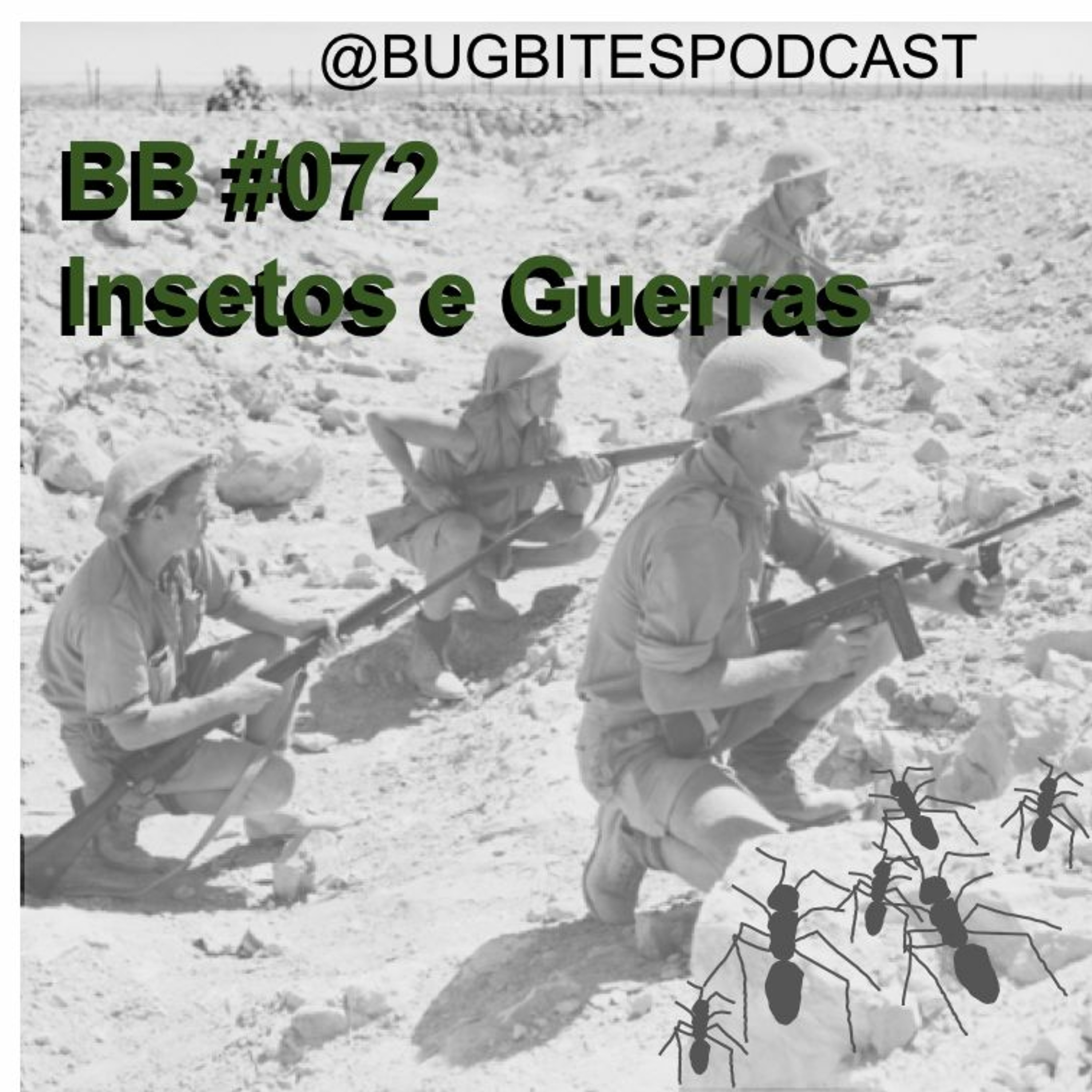
The Bugbytes podcast discusses the entomological aspects of wars, highlighting the fascinating strategies employed by insects. Ants, such as paramedic ants and kamikaze ants, showcase complex behaviors in battles. Throughout history, insects have been used as biological weapons, impacting human conflicts significantly. Examples include incidents like the Black Plague and the defeat of Napoleon, where insects played crucial roles. Entomological wars involve using insects as biological weapons in various ways, showing the intricate relationship between insects and human warfare.
Transcription
3941 Words, 23166 Characters
[Music]
Hi guys, and welcome to another Bugbytes.
I'm talking directly from Trincheira do Bisou Studios.
Here who speaks Philippe, the new member of the Bugbytes podcast team.
So, I'm here today with Gus, how are you Gus?
Hi guys, how are you? I'm Philippe.
I mean, I'm very happy to be here, talking to you about these amazing animals
and still have the opportunity to share science.
Well, one of the things that fascinates me the most about entomology
by being present in practically all places and directly affecting human life
ended up being inserted into several cultural aspects of humanity.
And so we, who are in entomology, end up being in contact with several types of knowledge
in several areas through the study of insects.
In today's episode, we will focus on one of these aspects
in which insects and humans share behaviors and places in history.
I would like to tell you a little bit about the wars of insects
and about insects in the wars.
The guerrillas' tactics used by insects
and also how insects influenced human wars.
So, let's go to today's episode, which has a lot of cool stuff.
Let's go!
What do you know about them?
I'm Caio.
And I'm Pedro.
You are listening to the noise of the mosquito,
the sound of the cigarette behind the ear.
You are listening.
Bug bites.
Your podcast about insects.
In the struggle for survival, insects can enter battles,
be it through resources or reproductive partners.
The ants, for example, are one of the most famous guerrillas,
with castles of armed soldiers, with powerful mandibles
and wagons loaded with pharmic acid.
Really, Philip, the ants are really incredible insects.
Believe that the sociability of these animals
is one of the biggest factors
and contributed to them dominating the planet
and performing such cool behaviors.
And the search for food resources
often makes them have to use battle strategies
and collective action from the ants
to find their prey.
And of course, in the process,
many ants end up dying or severely injured.
In a large colony, with thousands,
sometimes millions of individuals,
the death of several ants can be easily recovered.
But in a smaller colony, each ant counts.
And that's when the ants enter paramedics.
Paramedic ants?
How is that, Philip?
Well, in a 2018 article,
which we will leave the link in the description,
German researchers found that there are paramedic ants.
Specifically, the ant Megaponeira Analis,
which lives in sub-Saharan Africa.
These ants are specialized in cupid's food.
The problem is that the cupids also defend
their predators from the attack on predators.
And the soldiers of the cupids have big and strong mandibles.
And they stay at the entrance of the feeder
preventing the passage of an intruder ant.
But against these ants,
usually the cupids end up dying worse.
In this type of war,
many soldiers are gravely injured
and end up having their members amputated.
But these paramedic ants,
they take care of the injured ants, right?
That's right.
As the Megaponeira Analis colonies are small,
the amputated ants in war are not left behind.
Even though the ant,
with one or more legs amputated,
and the other leg amputated,
they are encoded by their members
and are carried to the companions.
But Philip, the ants don't have weak vision.
How do they know that one of the companions is injured?
Look how interesting this is.
The amputated ants release a pheromone
from the mandible gland.
As if it were a drop-down request,
which is perceived by the companions,
who then carry them back to the nest
and take care of them through a process
that we call "Gialogrooming",
in anti-microbial distances
present in the saliva on the pheromones.
Wow, that's cool.
But does this strategy work effectively?
Yes, it does.
If an ant is not taken care of by its sisters,
the chances are 80%
that it dies within 24 hours.
But if it is taken care of,
mortality drops by only 10%.
In addition,
the ants normally walk back,
even after having some injured legs.
But the coolest thing
is whether the ant will be treated or not.
It is not an ant that helps the companion be treated,
but the ant itself in the battlefield.
If they are very injured
and have little chance of survival,
they try to move more
and do not adopt a position
that allows the other ants
to carry them back to the ant.
And even if they are loaded,
within an hour, the ant realizes
that the ant has no chance of survival
and takes them out of the nest.
Wow, that's cool.
But following with our episode,
let's talk about
another curious form of war between the seven.
Did you know that ants exist in kamikaze?
Kamikaze ants?
How do they explode
like Japanese soldiers
of the Second World War?
Yes, that's right.
This behavior was what gave the nickname
of kamikaze ants
for the species "Exploded Camponots".
Just like Japanese pilots,
these ants sacrifice themselves
in the presence of the gaster.
Ah, gaster, for those who don't know,
is what we call the ant's abdomen.
That's right.
This behavior of self-sacrifice
is called autotasy.
It is also found in cupins.
The compression of the gaster
makes the bodies of the body break
and release a toxic pegasus substance
in the enemies.
The most interesting is that the pegasus substance
is produced in the maxilla gland,
which in this species is hypertrophied,
and runs through the whole body
until the end of the gaster.
And do the ants exist here in Brazil?
In fact, they are found in the Southeast Asia,
in Borneo, for example.
Even, they are very difficult to collect,
because when you pick them up with the tweezers,
they start to explode.
Very cool, these ants and cupins kamikaze.
In a way, we also remember the Jabelia operas
that attack the ants with the honey
and with its fur,
but end up losing their lives.
Literally, these insects give their lives for the colony.
Well, now that we have two curiosities
about the strategies that insects
use in the battlefield,
let's go to the next block,
where we will tell you how the insects
impacted the human battle.
We are back, guys.
Let's talk about the insects in the human war.
As well as insects,
humans also make war.
But many times, for much less noble reasons.
Now that we have already briefly talked
about how insects fight against natural enemies,
let's talk about the use of these animals
and how they affect our wars.
Well, yes.
We humans are proud to have built a life in society,
but when things end up not doing very well,
we often observe the birth
of conflicts and wars.
And we have already passed on to many of them.
But it is clear that the chaos
and horror of the war took global proportions
with the First and Second World War.
But you should be wondering
what insects have to do with the human war.
Well, yes, believe me,
they have already been used,
even with biological weapons,
in several occasions in the history of humanity.
That's right, and at least 12 order of insects
have already been used in conflicts.
Humans use insects
for this purpose for a long time.
An example of this ancient practice
can still be observed in the African continent,
where they inhabit a group of people
called sands,
which are considered by genetic studies
as the oldest populations of our species.
Some of these people
live in a life of collectors,
just like our ancestors.
Looking at the habits of these people
is like looking at our older habits.
So it is difficult to say when
the sands spent using insects as weapons.
But without a doubt, it was a long time ago.
They collect larvae
and beehives from the Crisomelid family.
And they mate together with plants,
creating a powerful poison
that is then passed on to the tip of the arrows.
A arrow in a large animal,
such as a giraffe, for example,
makes that in about three days,
the animal becomes much more vulnerable
and susceptible to a final blow by the sands.
Nowadays, this habit is not very common,
be it by the illegality of hunting
in some regions of Africa
but also by the loss of traditional customs.
Wow, that's cool.
In a way, it is like the Indians
that use poisonous substances
from the Crisomelid family
on the tip of their spears
and I think it also flashes.
You know, Philip? What is interesting, too,
is that the poison of these amphibians
comes mainly from the ants.
In other words, in a way,
there are insects in this story, too.
But both in this case and in the previous one,
these tribes seem to use the insects
only for hunting, right?
But do you know when the insects
began to be used in battles?
The use of insects as weapons
dates back a long time,
probably since the Paleolithic,
about a hundred and one years ago.
A very cool story about the use of insects
comes from ancient Rome, around 67,
before the common era.
escaping from Pompeu's army,
King Tridentius VI, a notorious enemy of Rome,
fled to the ancient city of Colquida,
where Georgia is currently located.
There he dreamed of the local population
and placed a jar full of honey
on the way of the Roman army to the enemy.
The soldiers drank that delicious honey
apparently abandoned on the road.
After a few minutes,
some began to feel strange
as if they were bewildered.
Some began to present storms,
storms, other heart attacks
and hallucinations.
Soon, everyone who took the honey
was affected.
It was then that the allies of Emitridates,
taking advantage of the plethora of torpor
that were Roman soldiers,
quickly killed a thousand soldiers
and Emitridates managed to escape.
The honey, or the crazy honey,
as it is called,
is usually produced by bees.
In the honey factory,
they look for pollen in rododendron plants.
Wow, that's cool!
Rododendron are the alias, aren't they?
That's right.
The leaves and pollen of these plants
have toxins called Graianotoxins.
The bees are immune to the effects
and these toxins are incorporated
into honey, probably as a
defense strategy against vertebrate predators.
Wow, that's crazy!
So it means that you can't
consume this honey, is that it?
Look, it even gives,
but it has to be a very small dose.
In fact, there is a curiosity
that even in today's days,
some people die because of the crazy honey cultivation.
In Nepal, the consumption of this type of honey
used in traditional ceremonies
but sometimes some people end up
dying in the dose.
The bees were also used
on other occasions,
like in catapultes, for example.
Even the next story has to do
with catapultes too,
but the catapult of pineapples.
So, I think you, the listener,
everyone has heard about the black plague,
or the bubonic plague, right?
Yes, of course, the black plague killed
almost a third of the European population
in the 14th century.
So, there are many people, right?
Yes, exactly.
And if you talk about insects,
maybe it helped to turn the black plague
into a pandemic.
Ah, it's not possible.
Even that, the insects are involved.
But the whole disease is not a rat.
Yes, in reality, the rat
causes the plague,
which is the entire bacteria and the plague
that causes the disease.
So, how did the bees help
to reduce this disease?
People did not know that the bees
were responsible for transmitting the black plague.
In fact, the conflict that we are going to focus on today
began in 1343
when the Mongols attacked
near the port of Kaffa,
the current Theodosia,
and the war in the area lasted for about three years.
The black plague was already surrounding the Asia
and the battlefield,
contributing to the casualties of the Mongols.
But then, at the end of the war,
the Mongols catapulted bodies
that carried the bees
into the bacteria, or the bacteria itself
inside the city,
which caused a surge of black plague in Kaffa.
Wow, but this must have helped
to spread the disease, right?
Yes, the powder present in the clothes
and the bodies catapulted
spread to rats, cats and dogs of the city.
Infecting the inhabitants.
There, between the Middle East Asia,
there was also the route of the silk,
and it could also have been responsible
for spreading the black plague to Europe.
But anyway, the Mongols' action
was effective, without a doubt,
which is still horrendous.
But history doesn't stop there.
The inhabitants of Kaffa, seeing the disease,
being vaccinated, ran away from the city
and ended up spreading the black plague
throughout Europe. In 1350,
the disease had become a pandemic.
Ah, a very cool thing is that
the insects also helped in the defeat
of Napoleon, the attempt to conquer Russia.
Ah, really, son?
The insect and Napoleon
tell us a story.
Well, in 1810, in France
there was a disagreement, let's say,
with the Kisar of Russia, Alexander I.
Due to the continental blockade
imposed by Napoleon Bonaparte.
For the Kisar, the continental blockade
caused the Kava-Russia plague
and ended up devaluing the coin.
That was a lot for the two nations
to enter the disagreement.
On June 24, 1812,
the great army of Napoleon
counting with more than 500,000 soldiers
entered the Russian territory.
Napoleon thought that
with such a large army
he would win the battle easily.
It turns out that the army
was extremely affected by the rigorous
winter in Russia, and the army
of Napoleon also could not
establish itself in the city of the Russians.
Because the country worked the tactic
of the burned land, where the
population kept fire throughout the city
and there was nothing left for the French army.
Ah, but where do these insects
fit in the story?
What interests us
is that the defeat of Napoleon
and its gigantic army
must, in addition to the cold,
the cold extreme, go to the insects.
When the cold passed
and the summer came, the army
of Napoleon, already the freaks
by the desertions, hungry and cold,
received another severe blow.
In a month, 80,000 soldiers
died, especially in the Tifu.
The disease caused by the rickets
was pro-Azek, which had human eyes
At the end of the campaign of Napoleon, without success
and with less than 100,000 soldiers
remaining, he ended up going back to France.
That's crazy.
It's a tragedy, we have to admit it.
But with insects they changed
battles and conflict results
and it's very interesting.
A sample of how the insects
really part of the history of humanity.
This reminds me of another occasion
in which the worst were responsible
for the worsening of the war conditions.
Well, the trenches, as everyone knows,
allowed the soldiers from the first
of the Second World War to protect themselves
from the attacks on the battlefield.
And the soldiers practically lived
inside them for years.
But who also lived in them?
They were the pyres
which are the vectors of the bartholomellar
bacteria responsible
for the fever of the trench.
Few people came to die, but the disease
reached about 800,000 men.
I believe that everyone
who studied insects
already heard about the canfra.
The canfra is a product
that has been synthesized
and replaced in Italy
in the preservation of insects.
In the First World War
French women produced
large quantities of canfra content
that were loaded by soldiers
close to the body as a profile
against pyres inside the trench.
Since one of the functions
of the canfra's strong smell
is to keep insects as, for example,
pyres inside the trench.
The terror of the entire entomologist.
Can I just add
that you don't have a taxonomic observation?
Many of you may have
learned from the gradation
that the pyres belong to the Fittiraptor Order.
But it is not considered valid,
because now the pyres are considered
by the molecules
as a group by the Piscicodidils.
And now they are grouped in the Piscocodian Order
which used to be called Piscocopter.
Cool.
It changes all the time, right?
It is true.
We are moving to the end of today's episode.
There is a lot of cool history
that we will not be able to tell today.
Like, for example, the DDT
which was very important for today's
exercises in the Second World War.
Stay for the next episode.
But before closing the episode
we will tell two more events
in which insects involved in the human wars.
But this time, as entomological weapons.
First, we will conceptualize
an entomological war.
An entomological war is a type of conflict
in which insects are used
as biological weapons.
They can be used in three ways.
The first is when the insect is infected
with bacteria or viruses
and is used as a dispersor
of the infectious agent.
The second type is the use of an insect
to destroy plant crops.
Also called agro-terrorism.
And the last type is when the insects
are used to attack enemies.
In countries already used insects in wars
and, as we know, Japan had a long
and rich tradition when it comes to entomology.
And of course, not even during the
First and Second World War,
the Japanese allowed to recognize the importance
of these insects as allies in combat.
The Japanese massively invested
in biological weapons production
containing insects.
There are many interesting details in this story
that you can check in the reference of this episode.
But one of the most crazy things
that came out in the Second World War
were the bombings of Agui,
a device launched by airplanes
in enemy cities.
When it collided with the ground,
it opened a compartment containing
thousands of domestic insects.
And another compartment contained
a mixed yellow-golden mixture
filled with bacteria that caused the cholera.
With the impact, the yellow and liquid insects
mixed and the flies were acting
in the vetors of the disease.
And Japan did not just develop these bombs
as it tested them in Baoshan, China.
Around 60,000 refugees in the city
died of cholera
and with the dissemination of the disease,
the final number of victims
would reach about 200,000 victims.
Seeing the effectiveness of this weapon,
the Japanese returned to use it in 1953.
This time they were in the area
where the attack would be carried out.
And the solution was simple.
They carried out the attack with the bombs and Agui,
but they vaccinated the Japanese troops
against cholera.
Well, to finish the episode,
I wanted to tell the listeners
a case, this controversial one,
of the use of insects with biological weapons
that occurred in 1952
and ended up involving
several countries, including Brazil.
Wow, really? How much is that?
So, Gus, during the post-war period,
the planet lived at the beginning of the Cold War
and the world was divided
by communist and capitalist ideologies,
the United States versus Russia.
In 1952, China accused the United States
of using infected insects with diseases
in Chinese territory and in Korea,
during the Korean War.
To verify the accusations,
China composed an international
scientific commission to analyze
the data and write a report.
Among the convocated researchers
was a Brazilian, Dr. Samuel L. Pessoa,
professor of parasitology
at the University of Sao Paulo.
In short, the report presented
through the World Peace Congress
pointed out that the United States was guilty
of using colemols, coleoptors,
various species of flies, ants,
beeswaxes, gorillas,
scorpions, eucalyptus,
and contaminants with more than 8 types of diseases,
such as cholera and anthrax, for example.
In addition, the evidence of the report
points to very strange situations,
clearly not natural,
such as a huge column of colemols
found inside a stadium,
as well as dust infected
with cholera or black plague bacteria,
a disease that had been exterminated
by China more than 500 years ago.
The United States, obviously, denied
and claimed that everything did not pass
through the communist propaganda.
As an argument, they pointed out
that the World Peace Congress
was largely led by Marxists,
which was true.
The United States pointed out
the fact that the choice of insects
was very bizarre to have been used.
For example, to use colemols
as biological weapons, a beast
that should walk a few meters in distance
throughout its life and inside the soil.
However, the reports of observations
by citizens were supposedly attacked.
The drawback of this story
is that no one was responsible.
And if the United States attacked China
and Korea with infected insects,
it will always be a mystery.
It seems that this kind of history
repeats itself.
Many times the U.S. does things
and then...
It's all in the political context.
That's it.
But it's really...
The citizens woke up
early in the morning
and saw a
plane passing over the village,
according to the report.
And they released a lot of snow flakes.
And they thought it was a snow flakes
and then they said it was actually a lot of dust.
And then these people
who were in contact with it fell into the water
so there was a cholera in the water.
So...
It's a very bizarre situation
and obviously
there was a plane passing over it.
Exactly that night,
people started watching the cholera.
If the report was true,
if the testimonies were real,
it would be very bizarre.
Another thing that is quite controversial in this story
is that the report that China
produced
was related to war prisoners.
It was related to American war prisoners.
Captured during the war.
And then, according to the report,
war prisoners made things
clearly not natural.
They say things like
the United States,
this kind of villain,
they must have attacked
Chinese cities.
Things that the soldiers clearly wouldn't say.
The American soldiers wouldn't say.
And there were some very,
very rotten things.
It was clearly staged.
So it seems that it was
kind of a lie from China.
Well guys, that's what
I wanted to talk about today.
Certainly Gus,
often we try to anthropomorphize
insects, but the relationship
of good and bad is a human concept.
Anyway, the episode is cool.
We learned a lot, guys.
And this subject is very extensive.
We just took a look at the content.
For sure, Felipe.
Although sometimes talking about wars
can make you very sad and sad,
it is interesting to see these parallels
between insect society and our society.
The law is clear about the influence
and you are interested in this topic and want to know more?
Don't forget to check
our list of references in the description of this episode.
That's it.
We will end here and you already know the 20.
We await your criticism or suggestion.
Just send us an email
or contact us on any of our social networks.
Facebook or Instagram.
The addresses are in the description of this episode.
And we want to take the opportunity
to thank our parents.
They help us to make the episodes with their support.
If you can, support us too.
You can do it through the platform Padrinho.
And you can find all the information
about how to do it in the description of the episode.
See you, guys.
Bye, bye.
[Music]
[Music]
[Music]
[Music]
[Music]
[Music]
[Music]
Podcast Summary
Key Points:
Insects have been used in wars throughout history, influencing both human and insect outcomes.
Ants exhibit intricate war strategies, including paramedic ants and kamikaze ants.
Insects have been used as biological weapons in conflicts, impacting human battles.
Historical examples include incidents involving insects in wars like the Black Plague and the defeat of Napoleon.
Entomological wars involve the use of insects as biological weapons in various ways.
Summary:
The Bugbytes podcast discusses the entomological aspects of wars, highlighting the fascinating strategies employed by insects. Ants, such as paramedic ants and kamikaze ants, showcase complex behaviors in battles. Throughout history, insects have been used as biological weapons, impacting human conflicts significantly.
Examples include incidents like the Black Plague and the defeat of Napoleon, where insects played crucial roles. Entomological wars involve using insects as biological weapons in various ways, showing the intricate relationship between insects and human warfare.
FAQs
Insects like ants use battle strategies to find food resources, with some species even having paramedic ants that care for injured members.
Paramedic ants identify injured ants through pheromones, carry them back to the nest, and engage in 'Gialogrooming' to treat them.
Autotasy is a behavior where ants sacrifice themselves by exploding to release toxic substances as a defense mechanism.
Insects like fleas carried by rats helped spread the black plague in the 14th century, causing significant casualties in Europe.
Insects were used as biological weapons in entomological wars, where they were infected with diseases or used to destroy crops or attack enemies.
During the Second World War, Japan developed insect-containing bombs that spread diseases like cholera, causing significant casualties in cities like Baoshan, China.
Chat with AI
Loading...
Pro features
Go deeper with this episode
Unlock creator-grade tools that turn any transcript into show notes and subtitle files.
 PodcastTranscript AI