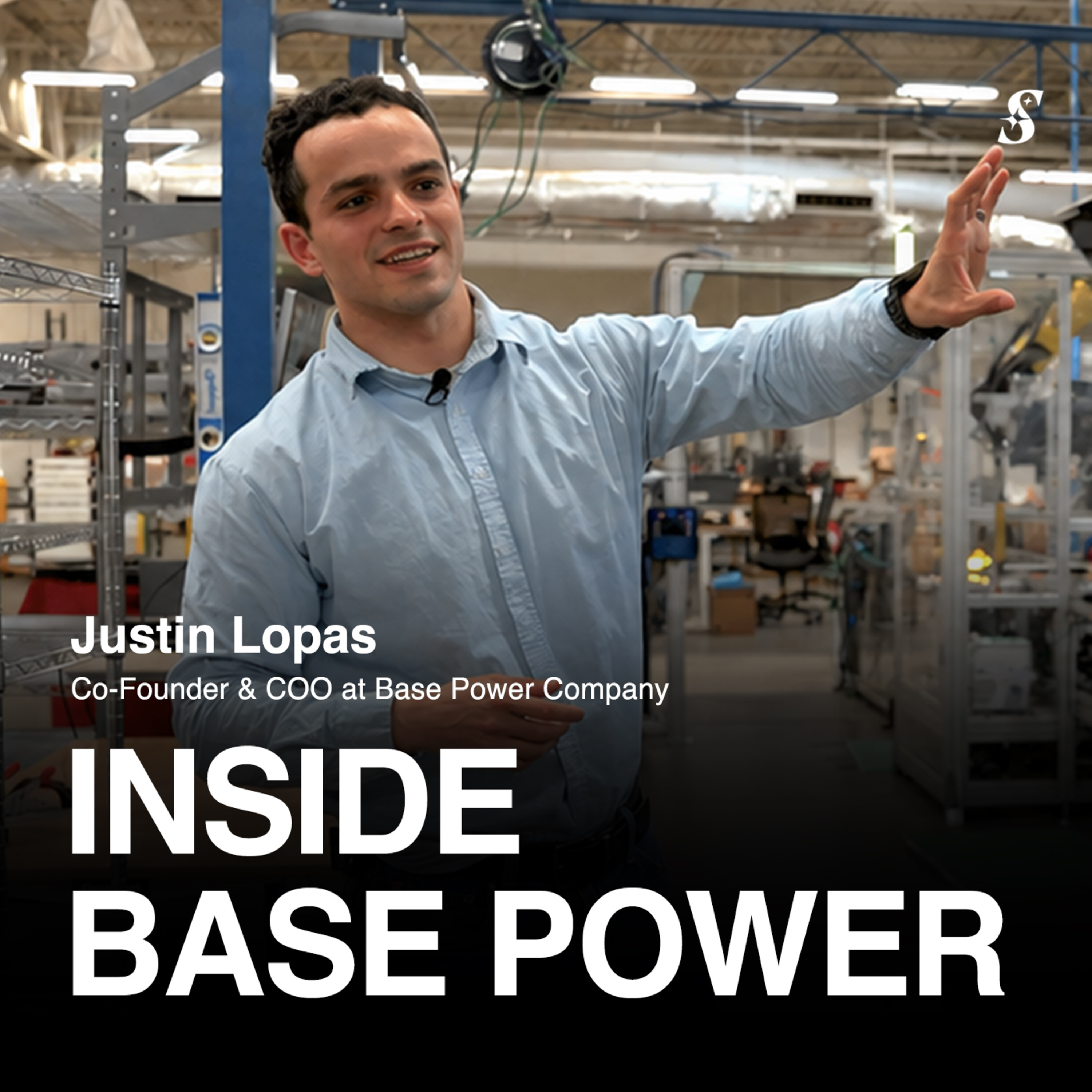
Basepower, a battery manufacturer based in Austin, Texas, recently raised $1 billion in a Series D round at a $13 billion valuation, led by Rivet, Edition, Valor, and JP Morgan Chase, just 10 months after its $1 billion Series C. The company announced the launch of Base Core, the largest standalone home battery on the market, offering 40 kilowatt-hours of energy storage and a 20 kilowatt inverter—about three times larger than typical home batteries. The battery is designed for whole-home backup, connecting directly to the electrical panel, and features a quick-connect system that simplifies installation: an electrician installs a disconnect box in 1-3 hours, while delivery drivers can set up the battery in under an hour. Basepower’s factory, built in under six months, employs about 100 people and uses a mix of manual and automated processes, including robotic assembly cells, to produce up to 4,000 units per week by year-end. The company’s business model varies by market: in retail choice areas like Texas and Chicago, it sells power directly, while in non-retail choice markets like El Paso, it partners with utilities that pay for battery access. Basepower’s vertical integration strategy aims to reduce costs, speed up hardware changes, and support US manufacturing. The batteries also provide grid support during peak demand and can be topped off with a generator during extended outages, making them a versatile solution for both homeowners and the grid.
Basepower just raised a $1 billion series D at a $13 billion valuation led by Rivet, Edition, Valor, and JP Morgan Chase bringing total funding over $2.5 billion dollars just 10 months after their $1 billion series C. Today they're launching base core, the largest standalone home battery on the market. So this is actually the base core, this is what we're announcing. It's almost like plugging in an EP and so they stack up the modules inside and the inverter and then they just plug everything in. So it's a 40 kilowatt hour system and 20 kilowatts on the inverter. This is like three times larger than what you would find in a traditional home battery. So these are battery cells. Inside of this is a bunch of chemistry that basically stores energy so you can charge and discharge it. We're not there yet but we'll be able to produce about 4,000 of these units per week towards the end of the year. That's like one every few minutes which is very very quick. Let's say that the grid goes off. You can see like grid goes off but no matter what. So last time I talked with you guys was your series C back in October where you raised a billion dollars. Congratulations on another billion dollars and a 13 billion dollar post valuation. Thank you. But this doesn't exist. So how long did this whole facility take? Yeah so we moved in here in September or October of last year but the production line really only got started getting built in February or March of this year. So like where we're standing right here all of this is you know less than six months old. We were doing some warehousing and distribution stuff for the six months prior to that but this all has come together super quickly and if you came here in the morning you see like most of the people that we've brought on also have started in the last six months that are working in the factory. So it's been a super rapid you know increase in our production capacity and all of our team that's producing. And how many people work in this facility? We've got about 100 now. Yeah we got about 100 and then we're going to be starting a second shift. How many floors is this? Is it just one floor? Just one floor. Really? Yeah I'll show you the building looks huge. There's a there's a multi-floor office that we don't use that's not part of our lease but yeah we've got three floors in our HQ one major production floor here and then we've got a big warehouse back there too. And you guys are hiring? We're hiring a ton yeah. All right across all rolls. All rolls. Cool. All right so we're here at base power in Austin Texas specifically in the neighborhood with Justin Lopez. How are you? Good how you doing? Thanks for coming. Pretty good. So you're going to lock us through base. Yeah. And something very special that just got released. Yes let's do it. So base designs and manufacturers batteries we're about to show you where they're made. And this display shows you how they're installed on a home. So the batteries provide backup power for homeowners so if the grid goes off the battery backs you up. And also when the grid's up and running provides the grid support. So when there's tightness on the grid from everybody plugging in their EVs and turning on their AC and it's hot in the summer of very cold in the winter here in Texas or anywhere else the batteries provide that support. But here's how they're here's how they're hooked up. So the way that it works is grid typically comes in into your meter. This we don't install this is the utility meter. We just put our logo on it for this display. And then normally it goes straight from here into your electrical panel and electrical panel then distributes it to your washing machine and your refrigerator and all that. But instead when we come we basically break that connection and we install our system right here and on the ground over there in the middle. So the way that this works is electricity comes in through the meter. It goes out of the meter into our disconnect box which I'll explain in a minute and then comes out of our box and into the electrical panel. This is important because this provides what's called hole home backup. So oftentimes many batteries in the market will only backup certain circuits on your home and you have to like pick those circuits when it's getting installed. And so maybe you won't backup your washing machine which you will your refrigerator. That's a bummer. And so we said why don't we backup everything in the home and build a system that can do that. And so that's how we've done it. This box is also designed by us. It looks gray and boring and that's on purpose for regulatory reasons. But this is actually there's a lot of smartness in here. And what this does is it does all the telemetry and all the data collection and also is controls the system. This is installed by an electrician. So highly skilled electrician takes an hour or two sometimes three depending where it is. And then that's it. That's all the electrician does. And then later on the next day typically the delivery drivers come and they install this. So this is actually the base core. This is what we're announcing. This is the new. This is the new product. And so this actually has a quick connect on that disco inside and a quick connect here. So you don't have to do any wiring. You don't have to like cut and strip wire or fish it through conduit. All these things that like require a lot of skill sets and take a lot of time and are very expensive. We don't do any of that. It's almost like plugging in an EV. And so they stack up the modules inside and the inverter and then they just plug everything in. That takes like you know however long it takes to walk from the truck to stack these heavy modules basically. So 15 minutes, 30 minutes, etc. They have a little phone app that allows them to turn it on and make sure it works. And then that's it. And then this also allows you to plug in a generator. So if there's a super long duration outage where like the battery doesn't back you up for the whole period of time. Say it's a few days or even a week you can top off the battery with one of those little like pull start generators. And that's it. That's the product. Wow. Do you want to do the? Oh yeah we can do the thing. Yeah so flip the flap. Okay so if you look at where the where the lights are this is like showing the flow of electricity. So the grid is powering the home and in this mode right now we're charging the battery so you can see the electricity going into the battery. But let's say that the grid goes off. If you want to like point the camera at the window you can see like grid goes off but then the battery goes off. And now the battery is backing up. We actually made it made that gap like a few seconds for dramatic effect but actually we don't even know. So like oftentimes our customers will be backed up on the battery they won't even know because like there's no outage in between because the battery flips over so quickly. And now you can also see like battery energy going into the panel and then into the home. Damn and so you're a bit of an electrician yourself. I'm a I'm a very amateur electrician but yeah I do some electrical work at my house and such. But yeah we have actual real electricians that actually install these things who are licensed and trained and much much more highly skilled in me. And you said it takes how many people and how many hours to get this installed. So this box is like an hour or two typically by an electrician and then that box is like less than an hour by two guys just because it's like it's heavy. And so I'm in California we only have one power service provider. Yeah. You're sharing how you're in Texas there's multiple options. So I'm going around to different offices and I'm going to be sure that they choose you next but like can you walk through that process like what how do you get to choose and what are the what's the main difference between the offerings. Yeah totally. So there's basically two types of electricity markets in the US. There's retail choice many you can choose who you buy your power from and then there's not retail choice. And so in California is mostly a non retail choice market and Texas for the most part but not all of Texas is a retail choice market. So what that means is that you can choose who you buy your power from. So outside of batteries and we offer this without a battery you can sign up for our service and we sell you power. So if you use you know a thousand kilowatt hours in the month we sell you a thousand kilowatt hours and that's what we bill you for. And on the back end we are maintaining your lower cost of energy because we have these batteries on your neighbor's homes. Now that's in the retail choice markets so like Houston and Dallas and parts north of Austin and in the Chicago area those are all retail choice markets. And so that's what we do in the non retail choice markets. So like California we don't operate in California yet but places like El Paso is an example where we operate. Those markets you can't choose you how you where you buy your power from. So like PG&E is the only game in town. If you want electricity that's it. And so in those markets we partner with the utility. We still put the battery on the home. We own the battery but the utility controls it and then they pay us for access to the battery. So that's how we recoup the cost of the battery so to speak and that's our business model in those markets. Cool. Should we see the factory? Let's do it. Okay. Okay so basically we're doing three things in this building. The first is R&D. So here each one of these silver boxes is what's called a thermal chamber. So these are basically like hot, cold, high humidity, low humidity and we're doing like reliability testing primarily. So like we want to be able to install the thing for you know it takes like an hour or two and then not touch it for 15 years. Right. And so that turns out it's like a harder technical problem than anything. And so like that one right there is at 85% humidity and 85 degrees C which is like hotter than it would ever get on earth to like simulate extreme temperatures. Yeah. And so. The hot box. Exactly. We did exactly. These are units that don't have their skins on so you can kind of see what this looks like. So there are four of these battery modules and then one inverter. So this obviously has this has some test equipment on it but essentially when you take all the covers off this is what it looks like inside. And these are all made here which is what I'm about to show you.
Oh wow. This episode is brought to you by Brex, my favorite. You become what you spend on. And I refuse to spend my time on work that shouldn't exist, expense reports, receipt chasing, and manual closes. The company is building what's next from Versel, OpenAI, Anthropic, Grinola, and Deepgram. All made the same call. They all run on Brex. Brex is the intelligent finance platform that combines cards, expenses, and banking into a single stack with a gentick finance built in. AI agents that handle expenses automatically enforce policy before spend happens and close your books in minutes. That's why sorcery runs on Brex. So I can spend time on building and not busy work. It's time to get Brex AF. Learn more at brex.com/sourcery. That's brx.com/sourc. Bye. Turing is training the next generation of AI with tasks that require real expertise and real world judgment. That's why companies like Nvidia, Anthropic, Salesforce, and Gemini partner with Turing. Turing builds realistic reinforcement learning environments and data systems based on real operational traces. The kind of infrastructure frontier labs need to train superintelligence. Visit turing.com/sourc.org. So how big is the battery in kilowatt hours? And that's purposeful. We want to put as much power and as much energy on a home as we can because our install costs are basically the same whether or not we install five or 40 kilowatt hours. Have you put anything on the newspaper line? No, no, we haven't. That's decommissioned, unfortunately. We've walked around on it, but not-- You walked around on it? We had some people walk around on it to do some maintenance up there, but no, we have not. OK. But anyways, this is the end of the module line. So the module line comes towards us. And what it produces essentially is-- let's see if there's one in here. Yeah, this one's empty. These are all empty, I guess, but we haven't, because we're just producing more. But essentially, we pack them out into these boxes at the end of the line, the inverters that look like what's on the shelf over there. And so if you walk this way-- again, this is all empty right now, but normally, you'd see parts running through here. So each station has a different purpose. We also designed all of the software, so the MES, as is called, manufacturing execution system. The software in all of the monitors is all what we've written that controls robots and controls traceability and all this other stuff. So you can see this line is semi-automated. Semi-manual. So we have an automated potting operation. We have a manual screwing operation. There's an automated test on the other side of the line at the end of the line. And so we've done a mix of basically manual versus automated. And the reason for that is some things are really hard to automate, and humans can do them a lot better. And so why would waste time on it? Do you foresee any humanoid robotics in here? Someday, yeah, for sure. I think the challenge that we have, and a lot of things that are hard to automate physically, have very high dexterity. And so when the hands on humanoid robots get very good, then I think there's an opportunity. There was one that just went viral. I saw that. Yeah, yeah. I saw it. I saw that. I saw that. That-- it's hard, though, because, like, for instance, one of the steps here is to install a little screw. And so you have to hold the screw and hold the torque on and place it very carefully inside of the printed circuit board. And you can't mess up, because there's a bunch of components around it. And so that's really hard to automate. And so we have a person that is here doing this, or installing connectors on the other side of the line. So it just depends on what the process is. So why are you guys building this? You could have kept on building and installing it while building it yourself. Yeah, I mean, I think the fundamental thing is that the use case for the battery, which is really focused on backing up a home for a long period of time and being supportive of the grid, is different than most home batteries, which are typically paired with solar. So if you look at other competitive battery products that are, like, sold mostly to wealthy people at very high cost, they're, like, small, typically wall-mounted, take a long time to install, and aren't really focused on supporting the grid. And the business model isn't oriented towards that, they're, like, just sold to typically wealthy people. This is a totally different play on grid batteries. Instead of big shipping container batteries, we chopped it up into a bunch of little pieces we put into the edge of the grid. That's what this is. This is a grid-focused battery. Then why do we make it ourselves versus, like, pay somebody else to make it? It's a vertical integration thesis, right? We can cut down costs. We can reduce lead time. We can change the hardware much more quickly, because we can change-- we can have the engineer drive the golf cart or run over here and go change something on the line from HQ. And so it's just like it's a control thing. And also, like, we want to bring manufacturing back to the US, there's something very passionate about, and we're able to do with a big factory like this. Cool? This is the unit. We've got-- this is the end of the line also for the battery modules. So you can see that these were built today here. So there's two lines here. They're the exact same thing. They just double the output. And so the beginning of the line starts over here. Damn, these are some robot arms. Serious automation. These are crazy. Yeah. So it starts life as a big aluminum box. And this comes from one of our suppliers. This is all to our design. Afterwards, it goes into this big robotic assembly cell. And so what this does is this basically creates, if you look through here, you can kind of see-- you see those racks that are facing down on the right side here? Those are groups of cells. You see that on those downward-facing racks? So those are groups of cells. And those are created over here by this robotic cell. So the first robot applies a layer of glue. And then the second two robots place those battery cells into the enclosure. And if you look on all these carts, they're not moving right now, but they're driven automatically. So they follow this tape on the floor, and they go into the cell here. That's crazy. How did you guys learn how to do this? So we've hired a lot of great people who have worked on automated assembly systems before at various different high-volume companies, some automotive, some not. And look, I mean, this is like cool engineering and awesome, but we didn't invent the robots, right? The robots we buy, the robots, the we program them, and we use them for our use case. One of those stacks over there is basically this. If you want to sit down here-- Yeah, I want to-- no, I can-- I can total agree with it. Is this like 40 pounds? Yeah, and there's 40-- There's 40 of them in there. Oh, so it is 40 pounds. No, no, there's four of these inside the module. And it's like 110 pounds. So it's like 25 pounds. Let me try that again. It was 25 pounds. Yeah, it's 25 pounds. Yeah. It's so heavy. So cells are dense. And what's right behind me creates this. So it stacks up the cells. It puts a little fire break in between. It puts these bands on. And then it puts the end caps on and compresses all of it. So it's all one big block. So for people who don't know how batteries work, can you explain the architecture of a battery? Yeah, sure. So a battery is made up of a bunch of cells. Each one of these blue boxes is one cell. And so our batteries have a few tens of cells in them. Inside of this is a bunch of chemistry that basically stores energy. So you can charge and discharge it. And then as you can see on the top, there's a plus and a minus. So it's just like a nine volt battery, and you're remote control for your TV. But much bigger. And you can't dispose of these in your normal garbage. You should not dispose of these-- well, don't dispose of any of these, because we own them. But in general, yes, you cannot dispose of these in your normal garbage. Yeah. Today's episode is sponsored by VCX by Fundrise, the public ticker for private tech, allowing investors of all sizes to invest in venture capital. Learn more at getvcx.com. Some of you may not have heard this yet, but our sponsor public just launched something called generated assets. And it brings AI into investing in a way I've honestly never seen before. Here's how it works. You type in an idea like AI-powered supply chain companies with positive free cash flow or defense tech companies growing revenue over 25% year over year. Publix AI then dispatches a swarm of agents that scan every single US stock, evaluates them, and instantly builds a custom index around your thesis. What really stands out is how clearly it explains why each stock is included. And before you invest, you can even backtest your idea against the S&P 500. So you're making decisions with real context, not just guessing. And beyond generated assets, public lets you invest in stocks, bonds, options, crypto, all in one place. They'll even give you an uncapped 1% match when you transfer your investments over from another platform. If you want to build a portfolio that actually reflects your thesis, visit public.com/sauce.
sorcery paid for by public investing full disclosures in the description. Founders scale faster on deal set up payroll for any country in minutes hire anyone anywhere get visas handled fast and get back to building visit deal.com/sourcery that's D-E-E-L dot com slash sorcery so once the batteries come through there they go into this big box we've designed inside of there won't show you the details but that's a welder and so what that does is it creates these little welds here on top you see those little c-shaped right there so those are where the battery battery tabs are joined to each other and that's what electrically connects all of it we just have these covers on here for safety when we're not working on it and then it comes to here there's a few more manual and test steps and then it goes in one of these two pieces of equipment here it's called the friction stir welder and so what that does this is one that just that came out of the friction stir welder what that does it creates this weld so we put this this lid on and it welds the whole thing shut so now it's all one sealed unit this can be submerged in water if we don't obviously don't desire it to be but if you're in Houston or somewhere on the coast in Florida if it floods you're totally fine and then there's a few more test steps and then it goes out the door and all of this is all managed by if you look on the screen here all of our own software so we manage units per hour equipment utilization and all of our other important production metrics so how many how how many hours does it take to make one of them so it's less than an hour to go from start to finish through the whole thing yeah it's like 10-15 minutes but more importantly is how many we produce every every minute and so we're not there yet but we'll be able to produce about 4,000 of these units per week towards the end of the year and so like that's like one every few minutes which is very very quick and so these little robots are driving around and if you were here during the day you'd see them cycling oh I understand why this is why you wanted me to come during the workout work and I was like I can't yeah yeah happy happy back whenever but there's this line and then that line over there and then there's the inverter line and then we're building a new factory out by the airport cool amazing and so you're installing 100 today right now we're installing over 100 today and we're gonna hopefully double that we're pretty soon so we've got more than 100 people now out in the field that are doing installs running around doing deliveries we do our own logistics so a lot of what you see here is cool inside of the four walls but where the where the rubber really hits the road is like literally on the road going to the homes and so we install like I said over 100 of these things a day right now so if you didn't have your job which one of these roles specifically in I guess like the factory side of things or in the install side of things yeah would you want oh I'd have I'd be an electrician for sure yeah I find wiring actually super interesting and fun it's like it's a technical puzzle basically of like what connects to what in what order and to do it safely and effectively you get to interface with our we call our customers members our members they're the they're the one interface that we have physically with the member because they knock on doors they hey we're gonna be on the side of your house turn off the power for a few minutes while things are being installed and you get to go all around the city and see various different neighborhoods I mean we're installing you know one electricians installing multiple of these things a day and so if you're in Dallas or Houston or Austin you're getting to see the whole city which is fun pretty cool did you make any bombs as a kid I did not make bombs I'm just kidding no bombs I worked on cars nothing that exploded though I worked on an oil rig as an intern yeah yeah you worked on an oil rig as an intern yeah it was a oilfield service intern is in land rig not a not like a rig on the water oh like a drilling rig but not really the same yeah yeah yeah yeah it's like the show land man exactly like there will be blood yeah yeah yeah okay cool that's it anything else I guess it covered it all base power by your power from the best power on earth and that's base power power hey it's Molly if you enjoy our interviews check out our newsletter sorcery dot bc where we deliver a once a week top deals and tech headlines email and also go deeper on our podcast interviews subscribe to sorcery today and don't forget to subscribe to the podcast on youtube Spotify Apple or wherever you listen link in description to sign up
Podcast Summary
Key Points:
Basepower raised a $1 billion Series D at a $13 billion valuation, led by Rivet, Edition, Valor, and JP Morgan Chase, bringing total funding to over $2.5 billion, just 10 months after a $1 billion Series C.
The company launched Base Core, the largest standalone home battery on the market, with a 40 kilowatt-hour capacity and a 20 kilowatt inverter, roughly three times larger than traditional home batteries.
The production facility in Austin, Texas, was built in under six months, with about 100 employees, and aims to produce 4,000 units per week by year-end.
Base Core is designed for whole-home backup, connecting directly to the electrical panel, with a quick-connect system that simplifies installation—an electrician handles the disconnect box in 1-3 hours, and delivery drivers install the battery in under an hour.
The business model varies by market
The factory uses a mix of manual and automated processes, including robotic cells for battery assembly, with a vertical integration strategy to cut costs, reduce lead times, and bring manufacturing to the US.
The batteries contain multiple cells with chemistry that stores energy, and the system supports grid stability during peak demand, with an option to connect a generator for long outages.
Summary:
Basepower, a battery manufacturer based in Austin, Texas, recently raised $1 billion in a Series D round at a $13 billion valuation, led by Rivet, Edition, Valor, and JP Morgan Chase, just 10 months after its $1 billion Series C. The company announced the launch of Base Core, the largest standalone home battery on the market, offering 40 kilowatt-hours of energy storage and a 20 kilowatt inverter—about three times larger than typical home batteries. The battery is designed for whole-home backup, connecting directly to the electrical panel, and features a quick-connect system that simplifies installation: an electrician installs a disconnect box in 1-3 hours, while delivery drivers can set up the battery in under an hour.
Basepower’s factory, built in under six months, employs about 100 people and uses a mix of manual and automated processes, including robotic assembly cells, to produce up to 4,000 units per week by year-end. The company’s business model varies by market: in retail choice areas like Texas and Chicago, it sells power directly, while in non-retail choice markets like El Paso, it partners with utilities that pay for battery access. Basepower’s vertical integration strategy aims to reduce costs, speed up hardware changes, and support US manufacturing.
The batteries also provide grid support during peak demand and can be topped off with a generator during extended outages, making them a versatile solution for both homeowners and the grid.
FAQs
The Base Core is the largest standalone home battery on the market, offering 40 kilowatt-hours of storage and a 20-kilowatt inverter, about three times larger than traditional home batteries.
Basepower raised a $1 billion Series D at a $13 billion valuation, bringing total funding to over $2.5 billion, just 10 months after their $1 billion Series C.
The Base Core uses quick connects, requiring no wiring, cutting, or conduit work. An electrician installs the disconnect box in 1-3 hours, then delivery drivers plug in the battery modules in under an hour.
In retail choice markets like Texas, customers can choose Basepower as their electricity provider, and the company sells power while using batteries for grid support. In non-retail choice markets, Basepower partners with utilities, which control the batteries and pay for access.
The Base Core provides whole-home backup by connecting between the utility meter and electrical panel, so if the grid goes out, the battery automatically powers all home circuits without interruption.
The factory aims to produce about 4,000 Base Core units per week by the end of the year, with a production line that started less than six months ago.
Chat with AI
Loading...
Pro features
Go deeper with this episode
Unlock creator-grade tools that turn any transcript into show notes and subtitle files.
 PodcastTranscript AI