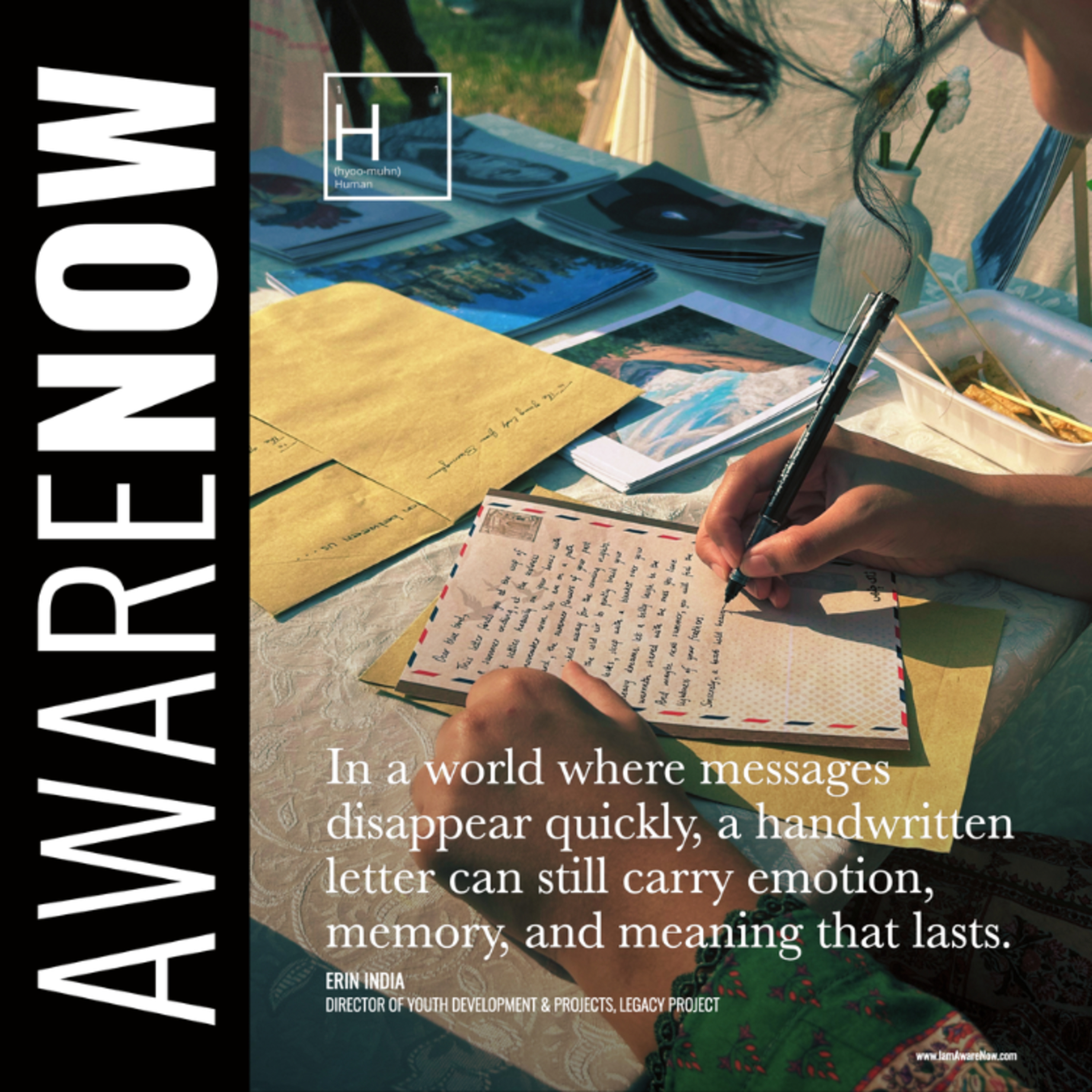
Dak Chiti is a global movement that revives handwritten letter writing to foster community, intimacy, and advocacy, operating in eight countries. Founders Murshid and Manuel explain that letters offer emotional depth and patience absent in digital communication, capturing raw feelings through physical traces like scribbles. Events include workshops with prompts like "how are you really?" and collaborations with midwives to explore grief, yielding cathartic, personal letters. Challenges include overcoming stigma against analog practices and proving sustainability, but participants often surprise themselves by writing lengthy, heartfelt letters without prior writing experience. The initiative values preservation and connection, with many letters archived as treasures. Future plans involve expanding workshops, partnering with NGOs, and launching projects like Dak Umeet for underprivileged youth and Dak Dastan for public readings, all aimed at giving voice to marginalized communities. A call to action invites readers to write a letter to a memory they choose to forget, embracing vulnerability and reflection.
And I am aware now. Aware now. The official platform for causes tune in and turn it up as we raise awareness, one story at a time for the causes that tie us all together. So I'm on today with the team behind Dak Chiti. Do you guys want to tell me a little bit about what that is? Fast and full, Maste? Sure. So the idea of Dak Chiti came about to Murshid when we realized that writing had become an archaic sport in regards to community, in regards to connectivity, and we wanted to sort of channel that and bring that back to the people we love, the people that make up our community, our community channels. And it became a means of not just communication, but also advocacy for a lot of claims that were close to our heart, a lot of motives that were close to our heart. And now we're operating in eight different countries. We have ambassadors here. I'm operating as the country director for Dak Chiti here in Pakistan. Murshid does similar work, but in Bangladesh, that's his corridor. And I was assigned to bring a team to the board. And I knew of Manuel and I knew of her work and I knew of her connection to poetry. And I brought her on board as a curator. And now we're all sort of in this like, we're very, we're very intermingled with this cause because we're all writers from very different genres, very different worlds. So yeah, that's Dak Chiti and Annette Shell for you. That's fantastic. And it's so nice that you guys are a bit spread out as well. I mean, obviously our whole thing is we've got this massive global network. The next question was sort of for Murshid also. I'm going to move on. So in a world of instant messages and social media, what do hand written letters offer? The digital communication just often can't. I feel like from the get go, the idea of intimacy, it can't be replicated through digital notions as it is through letters. For example, we did an event that Manuel can touch on as well. The event was sort of centered around the idea of capsulating grief. So we had midwives from sin work with us on this and we got to sit with them and understand and work through the idea of grief. And we got such beautiful responses, such different takes on loss, on love, on just the kinderness of building a newborn. And these little aspects of emotion that then blow up and become more concrete feelings. I feel like this is something that you cannot have in the digital scape and can only be replicated through. Something as tender and as intimate as writing letters. We did another event at the IIT library here. Manuel, you want to touch on that? I remember, yes. I still remember there was one of our participants and he wrote this beautiful letter to his lover and we asked a few of our people to recite them out loud and it was such an intimate connection that we got to have. We were looking through what he felt at that time and it was something so personal, so beautiful, somewhat somehow forbidden as well to get to know what he speaks out from his heart. So we were just like audience speaking through somebody's soul and it was such a delicate feeling. I think it was even shivering while he was reciting his letter and it was very much felt. And since I'm one of the creators, I still have a lot of letters and when you read them on your own, you feel the sadness, the grief, the emotion that they have, bend down. The way the words are scribbled, the way they are formed, you can even tell that they were probably stumbling while writing and it's such an intimacy that I think you don't find in digital life. When you're typing, you're almost always so infulsive. We're just texting and just waiting for a prompt response but with letters, you know that there is patience to it and it's something that stays for a longer period of time. It's going to stay. And so you're very careful about the thoughts that you are going to bend down. So it's almost like a beautifully crafted emotion and you just let people see through whatever that's in your soul, in your heart. And the way it comes out in a form of written word, it's also cathartic as well. So that's something that we feel. Every time I'm holding a letter and I'm reading it, it's such a beautiful. It's very personal. It's got character and it's got the feeling of emotions that you don't find on text messages. So yeah. Yeah. And going off of a man who said, there's like a very beautiful sense of humanness to writing letters and I don't think it can be replicated through anything else. Just sitting down and practicing patience and letting the most pauses come to you in all their awkwardness. It's so human and it should be allowed and people should know that it is allowed to feel it in all its essence. That is absolutely beautiful. I really, I really, really love what you guys are doing. Especially when you said about how much you have to think to write down on paper, compared to digital communication, there's no backspace, right? It's really, really fantastic what you guys do. I, last time I wrote, sat down to write somebody a letter, I felt uncomfortable. I felt really strange. So it's nice that you guys are bringing that back into modern life. So it's one that talks me about some of the challenges that you face since you launched. What's been the hardest to overcome? So one of the hardest things to overcome is understanding where to stop and where to begin. Our community branches out into so many different aspects of itself. There's so many different wounds that need catering to that. You don't know where exactly to branch out and like what part of you is required where. So many different parts of you show up for so many different people and so many different perspectives and you truly get to learn a lot from it as well. But from a technical perspective, people don't really realize the essence of letter writing until they truly step into it. Just getting this stigma sort of out of the way, out of the conversation that it is allowed to go back in time sometimes. It is allowed to go back to old practices. It is allowed to practice tradition in a way that feels real, that still feels true to you. There were certain events where our criticism was from our crowd. They didn't know how we were going to mobilize such a movement or they didn't know how it was going to be long term or if it was sustainable enough to be long term and just proving that to people one project at a time was definitely overbearing. What do you think, Manor? Oh yes, we always kept thinking that we won't really have a lot of crowd and there were so many of our events where a lot of people stood and they were like, they were waiting in line and we had to write people's name on the list that they are the ones who will be writing a letter to their lover or writing a poem. I think in one of the events we got our tie-priders out and instead of the handwritten one we thought that it's best if we tried with the tie-priders. A lot of people were still quite amazed that people still used tie-priders and we got a good response. I think the challenging part would probably be as a writer, I feel like a lot of people were like, "Oh, what's the spelling of this?" and like, you know, a little stuff, nothing so huge. But accepting the fact that all of that is gone but there are still places where they bring it back, everything that's analog. So yeah, I think it was mostly for me. I felt like people were something with words, not knowing what the right word is. I feel like it was challenging because when we're texting we always know that we're saying that the spelling is going to be correct. They're predictive words and you go, "Oh, instead of this we can go for that." But to really think and sit with something and know the right thing just like that.
being one group of like you talked about a while back it's like that's like I feel like was difficult with people. So yeah. Another thing that came to mind was a lot of people think they need to be a writer or a poet to come and write but I feel like this innate ability to be able to read and write is what makes you human enough and I feel like there's a lot of poetry that comes to just in a humanity and just allowing to see that through this project and witnessing people come into their poethood was definitely one that we all really enjoyed witnessing as well. It was like a metamorphosis happening in front of our eyes. Yeah yeah I hundred percent agree with that. A lot of people thought that oh we're not writers but I think all you have to do is give them a pen and a paper and a prompt and they just don't stop. There were so many people who wrote like three page letters and I still I still carry them and when I read them I go like whoa this person said that I can't write but they ended up writing in such a lengthy manner and it's just it's beautiful it's so delicate. Yeah I feel like a lot of our forums a lot of the framework for our workshops work similarly where we pick a cozy nook in our city we get people to come together and sit together and we hand out prompts and the idea is to start dialogue, start conversation and then flow into the script and sometimes to motivate that I feel like one of the best elements is pulling out old letters. We all have very different inspirations that brought us to Dr. T. it was Mershid's mother who inspired his poetry. For me it was my grandfather he was a poet and one of the only like outward poets I knew of in the family and he passed before I was able to recognize that aspect to him but he left behind this treasury of letters for all of us to skim through. A first time's in Greece of his travels of his lovers of his wife of his children. Just oldies little momentos of his livelihood and I feel like I would not have been able to recognize like my poethood if it weren't for his poetry but weren't for his attempts at letter writing if it wasn't for his words and I feel like it bought like a quamtime and really allowed me to see the essence of letter writing and allowed me to see its potential to bring other people to it as well. I think there was a lot about connection at our events as well a lot of people ended up being friends once they realized that oh you know this is something so relatable that I've gone through and I think it's all so preservation as well. It was it was my family would have just owned them away you know they wouldn't have preserved them but yeah I feel like it's it's doing like oh it's such a baggage to keep something like that so just throw them away but it's also about preservation as well I think it's something that needs to be preserved because I mean we never know we can lose our phones whatever is in our phone it can get lost anytime. I was like archiving them is something that is as important as well. Yeah absolutely and so you handle these prompts that you're letter writing events do people always follow them do you ever surprised by what emotions people choose to express when they write by hand. So my policy with this and this is something I learned from a facilitator who led a workshop for me the workshop was called casual magic and she would always start this the first prompt would always be how are you really so the idea of having a prompt as vague as that would be so that if people can't go through like follow through prompts you can always go back to how you're feeling and write about something that is that personal and that close to you so even when we're devising our prompts I make sure also it's like an homage to her I always start with how are you really and then gradually it's like the prompts get more intense more intense more intense and then people always have the option to not go by any of the prompts sometimes people bring a lot to the table that that doesn't go or follow through with any of the prompts so just the idea of being in community and sharing that personal aspect to you I think is enough so and even in our prompt cards we just go with how are you really prompt a bc and then the third option always being if many of these abide by what you're feeling or what you want to write through then write your heart out beautiful I also think a lot of people were able to write letters to themselves as well this is such a beautiful art that were able to be wonderful out there and just just write lyrics to ourselves mostly those things are like hidden away in our journals but a lot of people who wrote letters to themselves like it was something very it was the wonderful feeling to be bred to be something that they have written addressing themselves the things maybe they can't see or accept to themselves but when they're writing them out it's like they let it all out yeah it's awesome and looking ahead and then let's say the next year what role do you hope that Dijk Chatee is going to play in our society moving forward and helping people reconnect do you have any big plans there is a lot that we have been planning for a very long time it looks very different every month so I wouldn't say there's necessarily one set direction we want to take but we have a lot of workshops planned a lot of ideas around advocacy we do believe that feel like they can't advocate for themselves and just granting them a voice and that's I feel like the essence of dr. T in a nutshell that's what it is we're giving people a voice we're giving them a platform we're giving them a way out of the ordinary to say things that they can't say and to allow them just to feel in a way that feels authentic to them and so I feel like we're gonna definitely go towards that direction where we pay room for more collaborations we would love to work with other societies other NGOs operating within our vicinity we want to expand projects like Dijk Umeet which we started initially to target underprivileged schools and the essence of that project was to bring letter writing to the youth and more importantly underprivileged youth because they are as much the heart of the nation as any other individual and then Dijk Dastan where we bring back our cake writers and have them read out their letters so just focusing on connectivity and ensuring that we stay true to our initiative and we stay true to what Dijk Dijk was intentioned to be it's so fantastic you're giving that platform to these people did you have something to say Muno? Yeah I feel like so there are a lot of communities that need voices and I think we were able to you know give voices to those people like I feel like the event that we did with the midwives like that was I don't think anybody has done something like that and it was such a beautiful thing I missed out on it sadly but when I read the letters that they wrote like I feel like it's such a big step for community building and giving voices to and I think that's for something that Dijk Dijk was to do with give voices to people who you know think like they are not being hurt or I think that's the future for us giving voices to people. Absolutely absolutely is and what you're doing is so so important especially in this day we're getting to the end of the interview something I thought might be quite nice for us to do is for you to give a prompt that I can give to the readers of the magazine and get them writing so if you'd like to do that we can we can do a call to action and we can get everybody that reads or watches all listens to this writing themselves. Amazing. There's a tip from me to have a few of the accounts that we wrote in the past events I think we can give one of those. Okay. So let's go with um.
Hmm, okay, write a letter to a memory you choose to forget. And it could be as descriptive as you wanted to be. It could be as figurative. It could be as literal. But travel back to a memory and allow yourself to feel it in all its essence and write to why you want to forget it, what part of it is still haunting you. Tune into our podcast, subscribe to our magazine, find us and join us online. Visit IAmAwareNow.com. We will no longer wait for permission to change the world. Together, we are IAmAwareNow.
Podcast Summary
Key Points:
Dak Chiti is a global initiative that revives handwritten letter writing as a tool for community, connection, and advocacy, now operating in eight countries.
Handwritten letters offer intimacy, patience, and emotional depth that digital communication cannot replicate, as they capture personal feelings and physical traces of the writer.
The initiative hosts workshops with prompts like "how are you really?" and events (e.g., with midwives on grief) that help people express emotions, often leading to surprising, lengthy, and cathartic letters.
Challenges include overcoming stigma against old practices, proving sustainability, and helping people realize they don't need to be writers to participate—everyone has innate poetic ability.
Future plans focus on expanding workshops, collaborations with NGOs, and projects like Dak Umeet (for underprivileged youth) and Dak Dastan (public readings), aiming to give voices to the unheard.
A call to action
Summary:
Dak Chiti is a global movement that revives handwritten letter writing to foster community, intimacy, and advocacy, operating in eight countries. Founders Murshid and Manuel explain that letters offer emotional depth and patience absent in digital communication, capturing raw feelings through physical traces like scribbles. " and collaborations with midwives to explore grief, yielding cathartic, personal letters.
Challenges include overcoming stigma against analog practices and proving sustainability, but participants often surprise themselves by writing lengthy, heartfelt letters without prior writing experience. The initiative values preservation and connection, with many letters archived as treasures. Future plans involve expanding workshops, partnering with NGOs, and launching projects like Dak Umeet for underprivileged youth and Dak Dastan for public readings, all aimed at giving voice to marginalized communities.
A call to action invites readers to write a letter to a memory they choose to forget, embracing vulnerability and reflection.
FAQs
Dak Chiti is a platform that revives handwritten letter writing to foster community, connectivity, and advocacy for meaningful causes, operating in eight countries with ambassadors and curators.
Handwritten letters offer intimacy, patience, and a tangible sense of emotion that digital messages lack, as they capture the writer's personal touch, pauses, and care in crafting words.
Challenges include deciding where to focus efforts, overcoming the stigma that letter writing is outdated, proving the movement's long-term sustainability, and helping people feel confident in expressing themselves without being professional writers.
No, anyone can participate; the innate ability to read and write is enough, and many people discover their poetic voice through prompts and community support.
Prompts often start with 'How are you really?' and gradually become more intense, but participants are free to write about whatever they feel, including letters to themselves.
Dak Chiti plans to expand workshops, collaborate with NGOs, target underprivileged youth through projects like Dak Umeed, and host readings through Dak Dastan to give voices to marginalized communities.
Chat with AI
Loading...
Pro features
Go deeper with this episode
Unlock creator-grade tools that turn any transcript into show notes and subtitle files.
 PodcastTranscript AI