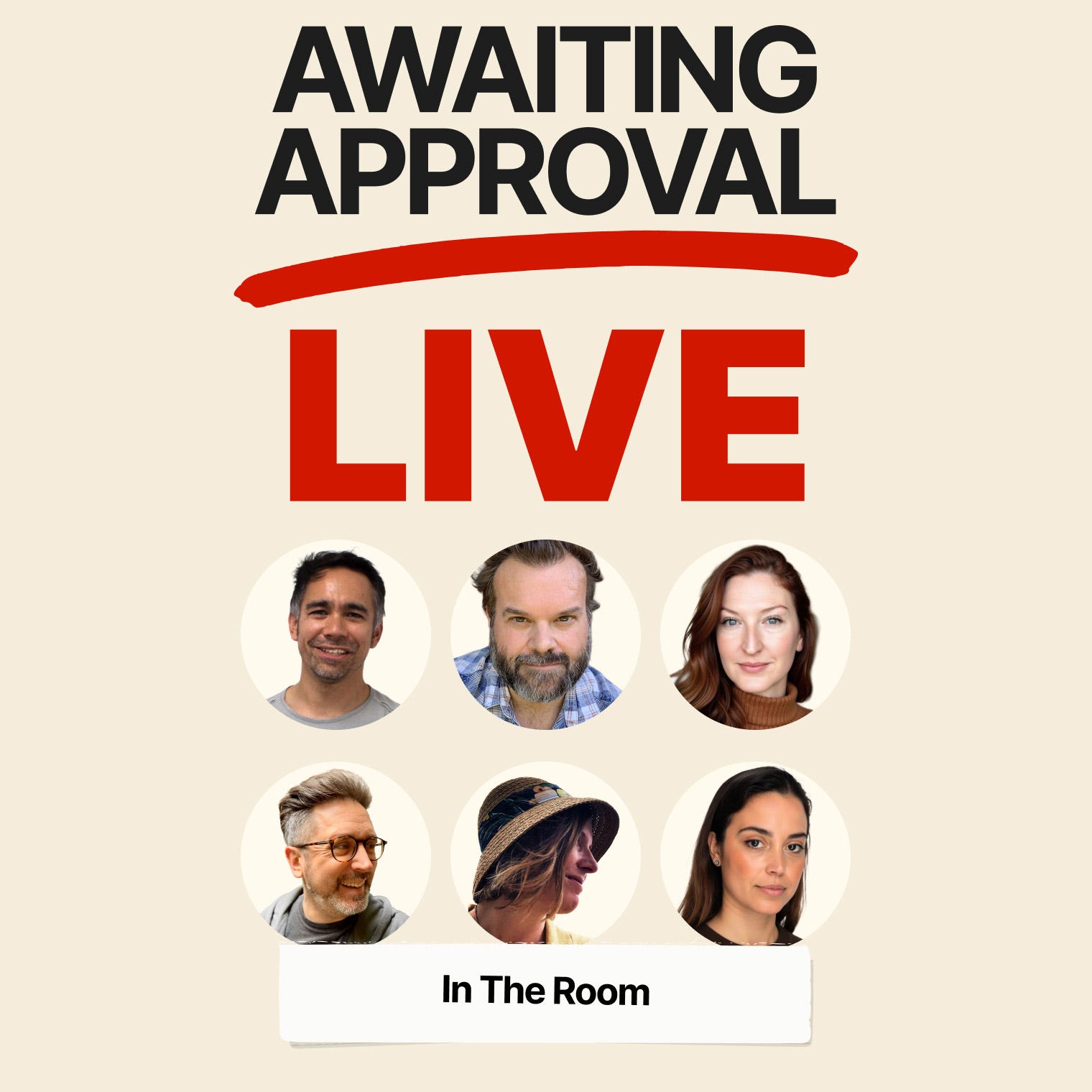
Speaker 1Hi. Quick reminder, the opinions and views expressed by my guests in this episode don't necessarily reflect mine or those of the show. Not every episode, but some episodes this season, we talk about very deep, serious subjects. So if at any point you need to take a pause from listening or watching, please do so. Your mental well-being is far more important to me than any listener metrics. And the show will always be here when you're ready to come back. All right? Let's go. Hello, everybody in London, everybody in San Francisco, and everybody in New York. Thank you so, so much for turning up tonight. It really means so, so much to me. To give you a little bit of insight into the Waiting Approval podcast, for those of you that don't know what it's about in any of the three cities tonight, or this morning, or this afternoon, depending on whatever time zone you're in. Waiting Approval is a podcast that was set up to help other people. It's a platform to share stories that others might get guidance or inspiration. Or be able to see how someone else has solved the challenge that they have right in front of them right now. That was my hope in setting it up over the last year. And I still get messages daily from people saying that it does that, but also far, far more. That it energizes them, that it gives them inspiration, it gives them hope, it really pushes them forward. So I'm incredibly grateful to everybody who has turned up to hear the live recording tonight in all of the three cities. And I'm incredibly grateful also. To our special guests, Chris Samui-Adams in London, Sonny Stafford in New York, and Gray Joyce in San Francisco. And I'm also eternally grateful to my very special guest hosts, Amy Carr in San Francisco and Marion Cristillo in New York. Thank you all so, so much. This tonight is only the second time for this podcast that we've done a live event. The first one was incredibly experimental. There's a couple of faces here who weren't there and they're laughing because they know exactly. What I mean by that, and this one is even more of an experiment. The reason that this is across three cities is because I had this really stupid idea at 3:00 AM and thought this would be great and put a post out about it without thinking about how to actually do it. And so the last three months have been spent trying to pull it all together. But we're here, which is brilliant. And I'm incredibly, incredibly happy that it's happening. If the normal episodes of Awaiting Approval are a slow, deep dive into the career of a producer. Of one person into the journey of that person, the depths that they've unfortunately reached or the highs that they have traveled, Awaiting Approval Live is like the speed dating, fast paced, higher level version of that. So what we're going to do tonight, we'll start off with Chris dating the dreaded clipboard of truth for about 20 minutes, then you'll all in each room get an opportunity to ask questions of Chris, then we'll hand over to Amy and Gray in San Francisco, do the same thing. He's has volunteered to do. He has put himself in front of the clipboard of truth. Finally, we'll then hand over to Mariam and Sonny in New York to do the same thing before coming back here, posing it off. So with that in mind, let's start us off. We'll start off kind of nice and light, and then we'll get a little bit deeper. So first of all, I can't read my handwriting. What is the most ridiculous piece of feedback you've ever been given?
Speaker 2Oh my God. Well, we hear quite frequently. We have one client that just says, can you just make it pop? Let's delve into that a little bit more pop. What do we mean by that? And it got to the point where she now knows, actually, can you just get Chris on the call? Cause whenever I say, can you make it pop? Then he knows exactly what I mean. And that's that. So in terms of the dickiness feedback, I'd say that's the most endearing bit of feedback as well.
Speaker 1Right. Okay. Kind of following on from that, if there's one word that you could. Ban from all creative briefs from this point going forward, what would it be?
Speaker 2Whoa. One word to ban from a creative brief. Uh, can you make it look like Apple? Right. It's not one word, but Apple then.
Speaker 1Right, right. How often, how many times a quarter do you get that?
Speaker 2Oh, we get it. Uh, we get it, um, almost on every brief. I'd say not so much recently, funnily enough, but yes, yeah, it was always a case. I think particularly when we're working. More, um, with tech companies, it was, uh, it was a case of, yeah. Can you make it look like Apple? So you guys, how long it takes Apple to load, right?
Speaker 1What's your creative guilty pleasure?
Speaker 2Creative, creative guilty. Thank you. Yes. Um, my creative, can you expand on that a little bit?
Speaker 1Is it a trend that you like? You know, is it a visual aesthetic that you always go?
Speaker 2Yeah, yeah, yeah. Okay. So I think my team reports out, tell me that the amount of times they have me say, oh, I remember David. Carson's. No, do you remember Neville Brody? Maybe. So I think I'm a little bit stuck in the nineties, maybe, you know, that sort of love affair with digital, just as it was coming out and it's never quite left me. So I'd say that is probably my, uh, credit you'll go to my go to creative guilty pleasure.
Speaker 1All right. This one, I'll leave it to you, whether you answer this or not, what's your most that'll do project you've ever delivered.
Speaker 2We'll keep clients out of it, right? Okay. Uh, my. That will be actually funny enough. I don't know if it was working with you. It was, uh, was world online back then. So I'll keep on it because they don't exist anymore. Yes, working on a project. And, uh, I've been brought in by you, funnily enough, um, to work on a, it was like this little kind of Pac-Man and, uh, subscribe. Well, I could do a national script at a time because we're trying to do a printer onto t-shirts and I couldn't figure out how to. Get what we were doing. We were creating like graphics in, in, uh, flash with action scripts and trying to get it from action script onto print. And it was the point where it was like, okay, that's quite a low fidelity image. I'm managing to capture out of flash onto a t-shirt, but I'm afraid. That'll do. Right.
Speaker 1Yeah. Okay. I remember that project. So your journey, you've gone through big network agencies like Saatchi and Saatchi, BWA, isobar, et cetera. And you now work for B Corp working mainly in the charity sector with sort of purpose driven clients of those two parts, which version would a younger you recognize the most?
Speaker 2As in which one would I aspire to be in? Yeah. I think a younger me would still be the agency. I think that's kind of what got me in love with design. That's kind of what got me in love with, um, we were having this conversation the other day, you know? It was like, I, I have this sort of, I get a kick out of people getting excited about their environment and the things they see around them and the art and design and everything they see around them. So to say now that it would have been the charity sector that got me excited to do what I do would be a lie. Um, I think as you go through big agencies, you have a hell of a kick, but I kind of got to a point where I wanted something a little bit more meaningful in terms of what was the work that I was producing. So to say now that it would have been the charity sector that got me in love with design, I think as you go through big agencies, you have a hell of a kick, but I kind of got to a point where I wanted something a little bit more meaningful in terms of what was the work that I was producing.
Speaker 1from one hand towards the other one agency towards you know from that kind of big agency world into
Speaker 2the charity sector um it was a i got slightly disenchanted by the amount of work we were actually doing versus the amount of work that was actually going out the door i mean the route that i actually took in the end was to go and set up my own agency because what i was seeing was a we were working a lot of projects burning a lot of client money and not much was actually seeing the light of day and i thought there must be a better way to do this i was also at the time and again i don't think this is necessarily the case now i was seeing a lot of a lot of um disingenuity is that the right words where you something would be sold in maybe it's like a senior team was sold in but that wasn't the team that's working the job or maybe an idea was sold in but that wasn't really the idea that came to life so there were just a number of small things um that kind of led me to think actually there's a a better way to work with a smaller team to work with the same kind of clients but working in a much more sort of uh engineering style world i guess and actually getting stuff out and getting stuff seeing the light of day and trialing it and maybe contrary to what i said earlier maybe actually getting something to a point where you say okay let's get this out into the light of day make sure it's good enough which is big learning by the way um and then perfect it afterwards so yeah i think that's kind of what's a little bit what led me out of out of big agency into into smaller smaller
Speaker 1environments you led um the work on british airways yes from like all customer touch points yes what working on a project of that scale did you learn that you can't learn on a smaller project i think it's it's the layers of
Speaker 2complexity of actually selling the idea in um there and the the amount of thought that has to go into selling an idea and i think when you work with slightly smaller clients when you work with um not big commercial clients it's easier for things to rely on trust a little bit more i think the uh yeah jobs like british airways where you'd literally be spending the whole day selling an idea in um is is something that you only learn from from from from working big agency big clients and i think also not just to uh not just the client itself so internally i think you know you've got many many people that need you need to get on board with your idea because at the end of the day you're selling that particularly when you're talking um more sort of conceptual there's nothing really rational that ties it back to what the brief is so you have to think very very carefully about how you're going to present the idea what is the lead up what is the story that culminates to your end creative because when you're when you're showing something you know which can be quite left field in terms of execution or in terms of idea you need to be able to trace that all the way back to what was said in the brief why who the audience is so you really really have to tell that story right from right from the start rather than i'm not saying you get lazy but you sort of build i think we're quite lucky in pixel days because we've had clients for 15 years now so we kind of know each other to agree we've got a lot of the relationship built there so sometimes you can just rely and say that trust me it worked last time we can go with it you don't get that with big agency and i think and and understand that you have to be a good communicator as well as a good designer and a good
Speaker 1creative last question from the clipboard of truth before we pass out questions to the audience what's the difference between an agency that says they're purpose-driven and an agency that
Speaker 2actually is oh okay i can only talk from what we do and i think it runs through um everything that we do down to the fact that our websites are hosted with kinsta which is green hosting the fact that we do a lot of the work that we do we do a lot of the work that we do changed our bank accounts um the fact that we you look around the room and we do have a very very broad set of uh you know broad um uh team and i think it's it comes down to talking to the owners really and if the owners actually live their life that way and turn up in 15 year old t-shirt and shoes they're probably wearing through at the back or they bought second hand i think there's a philosophy that goes through with it that you kind of have to see um you kind of have to see with the owners that of the owners of the agency and i think then you see that just built and actually through um every aspect of that business um yeah does that really answer the question thank you yeah
Speaker 1it does absolutely that chris is you facing the clipboard of truth thank you so much which means we hand over now to amy khan and gray joyce in san francisco
Speaker 3away you go thanks so much adam and thanks chris that was really insightful thanks for sharing all that great stuff with us um okay so great hi um you have done um you've gone from um agencies in-house to founding your own consultancy to now running thetas uh what version of that work really feels like the most
Speaker 4authentic um i i think uh i i think after 25 26 years i'm i'm finally finding my footing and um i've i've always been i've always been a fan of your work and i've always been a fan of your work and uh uh not to start quoting point-blank uh one-liners at you but um i've always been a searcher uh and the the thing that has resonated the most with me recently is uh even before founding uh thetas like the the team the group of people that uh i'm choosing to or getting to surround myself with and that's that's both like my team client teams um i've always been a fan of both sides of that uh the the the that collaborative kind of mesh of of of good people um feels the most authentic and and feels the most like rejuvenating and um you know i i a lot of this work can be kind of a grind um very rarely do things go according to plan so i i think it's really the uh sharing ideas and and and bouncing things off of of your your colleagues your teammates your clients um getting them to kind of kickstart your brain and get you over those blockers like that's what gets me up you know out of bed and logged on every day and um right now i feel very fortunate because like a lot of people in the room here um are long time colleagues partners teammates uh and uh yeah thetas is has been a wonderful um place for us to kind of pull all these people together in a in a new community so
Speaker 3so what do you look for when you're looking to hire a creative that a lot of people overlook
Speaker 4um i really like uh people that have at some point in their career uh by choice or by force uh been freelancers and and been contractors um because they have inevitably like been trained or trained themselves to get dropped into a fire drill or get dropped into a different way of working and they have to be really adaptive really quick and really responsive and in order to you know stay on that contract stay on that that project you have to be uh able to present your ideas quickly succinctly clearly so there's there's a communication aspect and and a little bit self-promotion um that naturally bleeds into your work the other thing that i really look for in anybody is their willingness to step outside of their chosen practice or discipline um i'm i'm a big proponent of like all voices in the room are important even if they can't carry the same weight in terms of a vote um uh we we we build experiences and communications for people and therefore like even if you're not the target audience you're the audience in in some shape form or fashion um i want my designers to be responding to the messaging the copy i want my copywriters to be responding to the ux the the overall design aesthetic i want my account people and my strategists um to to throw out ideas and play the what-if game and you know um i think that's how you know a small idea grows into something bigger i love that i love the idea that we all have a
Speaker 3voice regardless of discipline um and i think i've i've really enjoyed working with yet creatives who who give me a seat at the table so to speak you've um you've you know built teams of 30 plus creatives embedded at google and youtube and you know i've been working with a lot of people who do how do you keep people caring so much about a brand that isn't necessarily theirs that's a really
Speaker 4good question i i think it's really hard i think you have to instill in people um a great like agency you know from a from a creative director standpoint like i have to show how appreciative i am of of someone's efforts someone's ideas someone's craft um i very often try to vocalize um how excited i am when they take something simple and craft it into something really beautiful. And I think a really successful brand is both the big things and the small things altogether. The micro moments really make a brand or a campaign or a product or an app, whatever you're designing, it's the micro moments that string together to form the full experience. And I really try to celebrate like, oh my gosh, you made a simple icon that is such a really well-refined version of this complex idea that no one else will ever notice this. And that means it's a good, successful design execution, but I'm taking note of it. I really appreciate the amount of effort and craft and detail that you put into that. And I think that's. It always has to be balanced with the practical approach of we're all just kind of nannies. None of these are our children. When we work on client projects, it's their money, it's their project, it's their product. We're just sort of shepherding it along and hopefully landing in a better place. And I think that's really the hardest thing for especially young creatives coming out of school, they've spent all this time and effort building their portfolios. And then the hardest lesson is that everything they do in their career from that point on, you want to put your name on it, but it's not yours. And you have to be able to roll with a lot of changes, a lot of pivots, a lot of stakeholders that need to put their own stamp on things. So you have to be. You have to be willing to share.
Speaker 3Speaking of that, what's the most ridiculous piece of advice or piece of feedback rather that you've ever received?
Speaker 4How long is this show? I think the hardest thing to sit with a client or a stakeholder and help move them past and the most ridiculous feedback is the sort of nebulous, vague, well, I like blue, make it blue. And it's like, well, let's approach this with purpose. Let's make, if we're going to use a color, what does that color mean? If we're going to change the shape away from the UI system for that brand, why are we doing that? And I think everyone's probably experienced. I'm trying not to. give too many details that might get us in trouble.
Speaker 3Protect the guilty.
Speaker 4Yeah. Can you blur my face out and change my voice? The. Well, I just like it this way. Like, that's the worst feedback you can hear from anybody. Yeah. And I've heard that from clients and creative directors alike. And to me, that kind of goes back to the same previous point. Yeah. It's, collectively, it's ours. It's not yours. It belongs to the brand that you're supporting or the company that you're supporting. It's not even the stakeholders. It's not even the marketing managers that's leading the works. Yeah. And make it pop.
Speaker 3Make it pop. The one I've heard a lot, make it feel more preem.
Speaker 4Like Apple. Exactly.
Speaker 3Let's get that out of all of us. Maybe in a similar vein, what's the most corporate thing you've ever had? What's the most corporate thing you've ever had to do with a spray face?
Speaker 4Oh, deliver new corporate approaches or corporate policies from, like, the agency leads or, like, the C-suite when I was in-house at Visa. Like, there were changes handed down from on high. And even in, you know, a director position, you're very limited in how much influence you actually have. You're more just kind of executing the person next rung up the ladder, what they hand you to deal with. And most of the time, they're just dealing with what was handed down from them, like, to them as well. So, again, a lot of people in this room today are, we've had hard conversations that are, were just a policy that, like, I didn't agree with, but it's the job to, yeah, the company is shifting this way or the client is shifting this way and it's contrary to what we want to do, what we believe we should do. And I firmly believe in putting in the fight for the team and for good work and for good results. But sometimes, like, in that corporate environment, there's there is no fight to be had.
Speaker 3You just become the messenger. Yeah. Yeah. So, what's the difference between a brand system? Because we've actually worked on brand systems together. What's the difference between a brand system that works and one that just looks good in depth?
Speaker 4Oh, man. Another good question. I love this. Really want to get me on my soapbox today. Are we going to talk about M-Dashes next? Oh, yeah. A brand system that, that works well in, in my experience and I think is one that is able to be incredibly flexible. I think the, the interesting sort of dichotomy of what a lot of marketing and, and advertising like creative agencies have to, to do is live between what is, is the brand and what is the campaign and like the go-to-market, like the channels that you execute across. Campaigns are naturally meant to be disruptive, meant to push boundaries and very short half-lives typically. A brand needs unity, recognition. It needs to build affinity in an audience over time. It needs to build trust. So I, I think very effective brand systems are, are ones that are designed to live and evolve over time and across many different mediums, experiences. They're very modular so that you can, you know, pluck this piece out of a sales deck and drop it into a, you know, a, a banner ad or an event, a piece of creative for, for an event. And it still holds true to the overarching brand framework, the messaging, the design systems. I think that's where we get into kind of like the big ethereal, what is UX? -
Speaker 3So what's the, what's one creative opinion you hold that would get you in trouble? -
Speaker 4It very much has gotten me in trouble. And, and, and I can point to like my performance evaluation in a specific year at a specific agency that it did get me in trouble. I think it is important to speak up when, especially in the room within your own agency or within your own team. I think it's really important to speak up and push back and push hard when something is just okay or just adequate. And, and I'm not saying like, don't die on that hill, like understand that sometimes things can be a little bit different. I think it's important to speak up and push back and push hard when something is just okay or just adequate. I think it's important to speak up and push hard when something is just okay or just adequate. - Can I push that back to maybe an eight year span? - Sure, sure. - I got lucky enough to be hired on at a small agency here in San Francisco that was just exploding in growth and popularity. And I came in when it was still small enough that you knew everybody in the building, you were able to have an actual conversation with people. And, you know, within the first year or so that I was there, the agency kind of updated their brand and their tagline, and they adopted what was kind of their mantra of good people are good business at the time. time i thought that was just like a clever sort of nod to like okay this is a very personal boutique approach to um their model of like embedding creative teams within clients and embedding strategic and media teams within clients um so they were they were really focused on like the idea of partnership um what i have come to learn is that uh the idea of good people being good business i think i said this before like whether it's your teams or your your clients um the vendors that you work with like that amount of trust is so much more valuable than any tool that you have at your disposal or um you know i i would rather make sure that like my team and i feel good about the end results um than when it and or a one show or something like that like i'm i'm much more about the the dynamic and the relationship like in the room and if i think
Speaker 3about that question and the previous question about the opinions that got you in trouble yeah isn't that something that you can you can like at the end of the day you can feel good about those that i mean that's how you operate and that's how you show up for your teams and your
Speaker 4stakeholders and your clients but i i think it has to be a conscious choice like in your and and without judgment like anyone like if if awards is what drives you like go for it go after it if the notoriety and the celebrity is is what gets you out of bed to do this job every day like we need that too like we need the people that are sort of setting the bar as as high as they can at any cost i'm more on the other side like i'm i think i'm more kind of a pragmatic creative in that regard
Speaker 3i don't know um and i i am now gonna hand the baton over to mariam so hey san francisco london
Speaker 5so glad you can join us in new york um we're here with sunny stafford and uh yeah um so sunny is a creative and brand exec with 20 years and she's worked with brands like victoria's secret whole foods bare minerals um and she's worked and led in both commercial and creative teams so uh she also believes that there's a the divide between um between those two uh is actually a myth between commercial and creative in modern marketing and now she works as a fractional cmo and is a member of we are the board it's really cool so happy to have you here and just some background for everyone sunny and i used to work together i used to report to sunny at victoria's secret and i remember the day she interviewed me she didn't want to leave the room which was such a compliment and i'm not leaving the room until i interview you today as well so welcome all right so we're going to start with our first question what is the most ridiculous thing you've heard a marketer say with total
Speaker 6oh let's make this go viral let's go viral
Speaker 5nice nice nice okay on to the second so creative team or commercial team who throws the better
Speaker 7party oh i do the best parties you did do you remember i do remember uh yeah there was always
Speaker 6margaritas involved we won one time we played pin the wings on the angel yeah our christmas
Speaker 5party yes the tail of the dog yes i remember that that was a blast from the fashion show we did i actually wore do you remember i wore them down new york city yeah down the street and i was
Speaker 7blocking traffic to let our entire team cross the street so much fun so obviously it's creative team that was the answer guys um can i say i think actually the people who hear the best parties um it's very hard to get invited to them but it's hr oh sneaky yeah they know how to break the rules
Speaker 5yeah so what's one piece of industry advice you wish people would stop giving specialized
Speaker 6i think it's i think we're getting to a place now there's so many different things that uh we're all capable of like i'm obviously a big believer in portfolio careers and understanding lots of different sides of businesses i think the more you kind of niche down uh the the less big your world can be so i think that that's you know when people continually are like well you have to be like you have to be known as the you know whatever the graphic designer in beauty you know or whatever the thing is i think it's the wrong
Speaker 5way to go interesting very good advice um so if your career had a warning label what would it say
Speaker 6um probably i mean much like what gray was saying like i i think that i'm i'm maybe very vocal so i think that my warning label would be expect the truth oh nice that's actually that's that's very
Speaker 5yes oh yeah i learned that from you yeah yeah i'm very candid person yes it's just it just it makes more sense it does be candid yeah so what's uh a meeting you wish you could unsee oh no are you anything that's a i'm under nda okay all right we're gonna move on to the next one um this is actually a really good one i i was thinking about this one a lot because i worked with you and um the question is what's the most that'll do solution you've ever signed off on do you want me to answer that for you uh you you can yeah don't settle on any that'll do that's very good that's really that's so great to hear like i i do
Speaker 6think that there's um there really is something to be said about not letting in in this kind of maybe uh somebody in the other room had asked this question but don't let perfection be the enemy of progress right like not every single piece of creative is worth dying on your sword or every campaign like 90 of what we do especially now that there's such a content explosion um is about creating and being a part of the conversation as quickly as you can and i think that that's probably advice i'd give to my earlier self is is don't don't allow you know the progress of you know letting this ephemera all of the things that we do kind of hit the world and then iterate and keep moving and kind of going then then just you know honing
Speaker 5in on that one thing that's that's awesome that's so much different yeah but like you you did such a great job of like just miriam just a little bit just go a little bit further just a little bit further and like the craft was yeah so thank you for that um what's something you secretly admire about the commercial side of the business oh
Speaker 6um you know i think as creatives we're all very hard on ourselves um and we really we bring our home our work home with us in a way that you know the guy running your uh analytics does not uh you know like we live with us it's about our personality and it's about our identity and i i think that there's a lot to be said about um being able to just turn it off at the end of the day and you know go about your life without it you know waking up in the middle of the night and worrying if you picked the right typeface yeah yeah that's if that was the right shot for the
Speaker 5campaign if you know yeah and as you continue your career you start to realize how important that is in order to be better at your work right like you'll just shut it off to be able to shut
Speaker 6it off is very important and you know there's you always need people who are craftsmen and i think that that's what our you know that's what i think you know a lot of like creative and marketing is about is you know being a master craftsman and creating something worth seeing worth experiencing worth reading but i think that in a in a lot of ways there's just you have you just have to figure out how to how to divorce yourself from what that output is as being a part of your identity yeah
Speaker 5yeah that's really great advice um so we're gonna start getting really deep oh you ready okay hold on your hat um you've worked with brands like victoria's secret bare minimal bare minerals full foods and 100 flowers which one taught you the most about what a brand actually is oh wow i mean all
Speaker 6of them all of them in different ways right like i think victoria's secret taught me what it was about to be emotionally resonant um bare minerals i mean they own the world and in clean beauty there's tons of other brands that kind of do what they do but they've done it for so long they really know who they are and everybody inside that building knows exactly what they're talking about doing and then 1-800-Flowers ultimately there's 14 brands there from Harry and David to Sherry's Berries like there's 14 brands and so each one really needs to kind of know exactly where they stand with the customer and understand exactly who their customer is so I would say like all three of them I've kind of learned I don't know I mean I keep learning every single brand has a different kind of take on what it means to be them yeah that I think is a very different kind of experience than you know when I did agency work yeah yeah that sounds similar to to Lint
Speaker 5like they have boutique brands yeah right they have to know their consumer is and then very much very much target yeah yeah absolutely um so what's the most con mistake you see brands making right
Speaker 6now I mean I think most most of the companies that I work with um especially on a fractional basis a lot of what ends up happening is that they think that they know who their customer is and they've read the right data reports and they you know but when it really comes down to it I don't think that they actually you know when you start digging into it you find out that they don't and and then who their customer really is is maybe just a little more nuanced than what they had originally considered um and I think that that's a big mistake I think that's one of the bigger mistakes that I see yeah and so now that you're
Speaker 5fractional right yep um what does that model make possible that if full-time role doesn't and it might play into that question I just asked you yeah right uh perspective really I think that
Speaker 6there's a lot more uh I've spent a lot of time at these different brands and um I've personally been very enveloped and kind of you know I say a lot of times like I've drank the Kool-Aid like whatever the thing is that we're doing um and working fractionally uh jumping around working with different brands um it allows me to kind of just you know work towards what that particular problem is um and I do get to kind of turn it off at the end of the day in a bit of a different way than if you know like what that Victoria's Secret I had a team of 65. and that I mean it's a lot of people to kind of oversee and you know whatever and now I don't have to do as much of that right still mentor I still help people but at the end of the day they're not answering to me right different kind
Speaker 5of focus yeah yeah yeah and what's the hardest truth about creative work that nobody wants to
Speaker 6hear oh um sometimes the best solution is a beautiful that's I mean it still hurts it isn't sometimes it's not you know um that's a hard lesson I learned at 1-800 flowers yes you know yeah I went in there guns a-blazing like you got a bit you know this this could be so much better creative like what is this and uh you know we did all this testing and everything else but it turns out um their particular customer really likes to buy flowers that look a little digity that look a little you know those images are what's all that's what works and no amount of beauty was what was
Speaker 5going to solve the problem Tuesday yeah yeah yeah uh-huh I'm hearing a lot of huhs um and how do you know when a brand is lying to itself I feel like we kind of touched on that a little bit uh lying
Speaker 6to themselves or talking to themselves I remember us using that one a lot yeah I think I still use that one a lot talking to ourselves as you know maybe a nicer way of saying saying that like I yeah and I think a lot of it has to do with just um uh you know I mean when you don't have diverse perspectives in the room when people have been at a certain place for a really long time you're very comfortable with what everybody's rules are and exactly how they should be responding to something you don't get that diversity of thought yeah um I think that that's kind of the worst mistakes and I think that's what fractional really helps is to kind of come in and raise some new life nobody's losing their role you know right like it's about like working on a specific project or you know providing a different kind of point of
Speaker 5view that they didn't have before right I like this one what's the bravest decision you've seen
Speaker 6a brand make um you know I think the bravest decisions that brands make is when they don't sacrifice long-term growth for this quarter's numbers and I I can't tell you how many times you watch that happen and it hurts it hurts as a as a previous creative as someone who cares about you know connecting with the customer and what that customer needs from whatever your
Speaker 5brand is um that part hurts yeah yeah yeah I'm gonna do the last one if you could sit every creative leader and every commercial leader in one room and say one thing to both sides what would it
Speaker 6be because girl you speak your truth so this is your chance um I mean I think I think I kind of already said it like I think diversity of you know of opinion and life experience is is very important and I think that a lot of times uh you know one of the reasons that I kind of moved into the roles that I'm doing was because I couldn't take any more bad briefs and I couldn't I just couldn't stomach it anymore like I wanted to know why they were so bad who was making those decisions how could I affect those and how I could do a better job for all of us um and I you know I think that that's um probably my answer is just to to to open yourself and your business to to being able to hear
Speaker 5very diverse opinions if you're in a position where you can shift or steer the boat in a certain direction you have more power than you realize and that's the kind of the kernel of hope I want to give everyone um but if you're entering the creative space um a tool is a tool but how you use it will change everything yeah really well said yes and I think that's a fantastic note to
Speaker 1wrap it up on thanks for tuning in if you're feeling stuck or want to think out loud about where you're heading remember that you don't have to figure that all out on your own I offer a free 15-minute conversation to anyone who wants help figuring out what's in front of them whether that leads to us working together or not doesn't matter what matters is that you have someone in your corner even if it's just for those 15 minutes head to growwithadamjennings.com and book your call I'd love to hear from you and if you haven't already subscribe to the show so that you don't miss the rest of season three there is some absolute gold coming your way so until next time keep creating keep questioning and above all else keep going
 PodcastTranscript AI