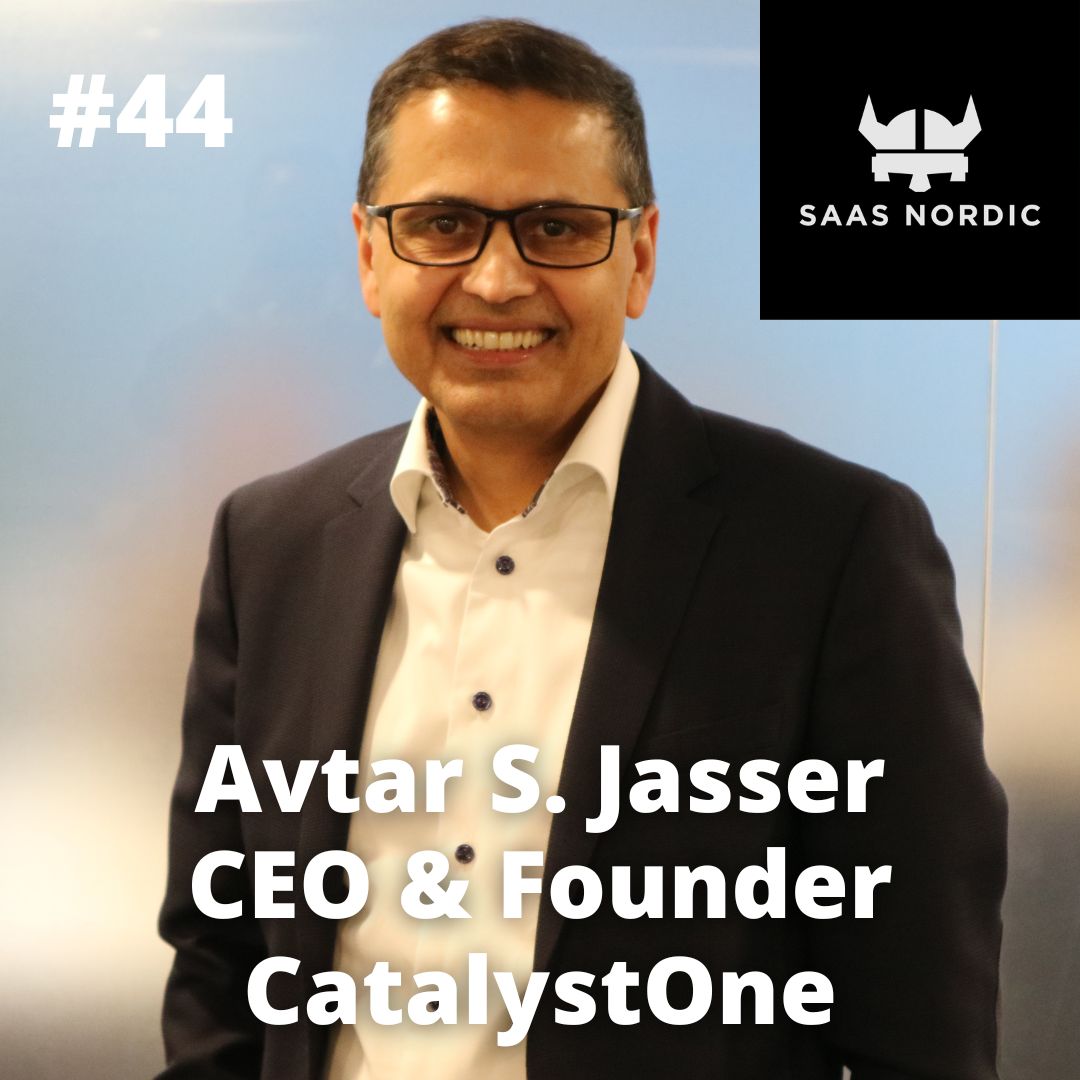
44. Avtar S. Jasser , CEO & Founder, CatalystOne Solutions AS - How to go from Startup to Scaleup!
37m 49s
In the SaaS Nordic podcast, Avatar Yasser, CEO of Catalyst One, emphasizes the significance of competence, emotions, and financing for founding teams. Catalyst One provides human capital management solutions tailored for mid-market companies. Avatar Yasser discusses the journey from startup to scale-up, highlighting the importance of identifying product-market fit, focusing on niche strategies, and developing strong go-to-market capabilities. The podcast delves into the challenges faced during the scaling process, such as building leadership capabilities and managing organizational growth. Avatar Yasser also shares valuable advice for companies transitioning to the scale-up phase, emphasizing the need to balance competence, emotions, and financing effectively.
Transcription
5920 Words, 32030 Characters
Hi, I'm Daniel. And I'm Thomas. And we are experienced SaaS professionals that are curious
about how other successful SaaS companies go to market, scale, build winning teams and
great products. Join us on our journey as we speak to Nordic
SaaS leaders trying to get hold of their secret sauce. And today's guest is Avatar Yasser,
the CEO and founder at Catalyst One. Especially for the founding team, you need to think of
three things. You need to think of competence. You need to think of emotional side and you
need to think of financing. So welcome back to another episode of the
SaaS Nordic podcast. And Daniel, how are you today?
I'm great. I'm great. I love this type of period. It feels like, you know, you're just
preparing for that big game. Lots of stuff happening, all the training you've done. And
so it feels really, really good. And hopefully people have seen all the stuff we've done
and the announcements we've done on LinkedIn. I don't know, Thomas, what do you think?
Yeah, and what you're talking about, of course, is SaaS is digital 2022 that is coming up
on September 27. And you know, we have all the preparation with the speakers. We are
working with the marketing. I hope you have seen all the activity at LinkedIn and other
places. So yeah, it feels great. Yeah. And I'm a little bit envious. You have the sassiest
cap on you. So we are starting to do some merchandise as well. And yeah, it will see
more of that coming forward. Can we drop that right here right now? I'm dropping it. Nobody
stopping me now. We're doing a merch shop. Yeah. If you want to have cool gear, you can
find it. We should probably announce that it's somewhere in an email or something. Yeah,
we should if we haven't already. So let's see. Yeah. So besides sassiest digital, is
there anything else that we should highlight at this moment?
Sassiest digital is coming up. You've seen the content contributors go and warm and publishing
articles and so on. And there's been a lot of push also for the networks. So the CEO
networks and the executive networks, we're opening up for new applicants. Yeah. So go
to sass Nordic.com under networks and you can register your interest to join one of the
groups next year. We're going to try to close those and form the groups by November, December
time. Yeah. And if you're working for a Nordic SaaS company and you're not in the Slack
community yet, join 600 plus companies in the discussions there. And yeah, join us.
This time, we are going to talk about how to transition from a startup to a scale up.
And we will talk to one of the CEOs in our network that we admire a lot and yeah, listen
to what he has to say.
Today we are very happy to have Avtar Yasser, the CEO at Catalyst One here as a guest in
the Sass Nordic podcast. So welcome Avtar. Thank you very much. It's great to have you
here and we have the pleasure, Thomas and I, to meet you regularly because you're in
one of our CEO groups. But for people that don't know Avtar from before, can you briefly
introduce yourself?
Yeah, I'm founder and CEO of Catalyst One. I am an Indian guy who came to Norway for
studying mechanical engineering, found love here and stayed on. And I've been working
for the public sector for and with global warming and environmental issues before global
warming was on the lips of everyone and also with business development and energy sector.
So my entry into IT was through sales. And then I ended up founding Catalyst One Solutions
by gathering bits and pieces of a company that was almost bankrupt for around 18 years
ago.
All right. And tell us a little bit more about Catalyst One. What do you guys do?
Catalyst One is founded on a desire to help customers build thriving workplaces. So to
be more concrete, we offer a platform for human capital management commonly called HR
System, which has a strong support for HR master data and broad talent management functionality.
Let me explain what it means. It can be functionality for performance management, competence, learning,
compensation, absence, employee feedback, recruitment, onboarding, offboarding and the
list goes on. So it's a pretty broad platform and the software is not specifically built
for HR but is built to benefit all employees and managers. And it is specifically built
for mid-market.
So it sounds broad and you mentioned mid-market now, but are there any particular verticals
or industries that you approach more actively?
This horizontal approach we have, this kind of solutions are needed by all organizations,
but for now we prioritize private sector as we are not that active in public sector yet.
But in private sector, we are active in all verticals.
Okay. I have to ask you, we always ask everybody, who's the ideal customer? Who's in this case
the ideal persona? When you do your first outreach, who do you reach out to?
Let's see HRO, who is the ideal persona, but we see that things have changed the last
few years. Now there are many more stakeholders involved like CIO, CFO and chief digitization
officer and so on, because it's not only HR tool anymore because HR master data sits
at the core of system landscape and it is so necessary foundation for driving digitization
and change. So the number of stakeholders have evolved and become broader. And the ideal
customer is a mid-size to large company and especially those with multinational operations.
All right. And to more understand your operation and the scale of it, what can you say about
your ARR, your growth, the number of customers, employees, markets and so on?
We are now at 15 million euros in ARR and we have the last five years have compound annual
growth rate of 35 percent, a pretty stable growth during these years. We are 230 employees
in Sweden, Norway, Denmark and India where we have a development center.
Yeah. And how was it? You guys are profitable also throughout this growth, right?
Yeah. We were burning cash for a few years, but now we are profitable have been last year
and this will be this year.
Right. That's a good spot to be in. It's like there's a lot of people that would listen
to this and maybe envy you now.
Yeah. It's good, especially in today's environment, but this was the whole plan. This was a plan
when we acquired funding for a few years ago that we will become profitable after a few
years and it was a very well-defined time perspective and we have been able to stick
to it.
So, tell us about the funding. How much have you raised and how does the ownership structure
look like right now?
We were bootstrapped until 2016. So, we were bootstrapped for many, many years and then
we raised funding in 2017, early 2017. We had raised five million euros until recently.
We have raised five more million now and ownership structure. We have only one investor. It is
a Swedish investment company called Next and they own approximately 50% now and the rest
is owned by employees and some board members.
How much do you own?
I own somewhere between 25 and 30% of the company.
Okay. Still a very solid stake. Congratulations.
Thank you.
The main topic for today is how to manage that transition from startup to scale up and
you have done this journey. So, it's going to be interesting to hear your insights from
sort of real life. So, when did you start the transition from startup to scale up?
Well, I would say that we started, it's a gradual process, but the turning point was
when we felt that we had a good enough product market fit for a big enough market and we
felt that we were succeeding in a certain niche where we were, had high win rates and
were really successful and also a very, very early version of the go-to-market model had
started to work. It was not fully built out, but we had started to show some good results.
All right. But more specifically, how did you know that you had a product market fit
for that market?
Yeah, that's a good question. Actually, I would say that it's very hard to know when
you have the product market fit. It is easy at hindsight to say, "Well, that's where we
had the product market fit." So, it was a gradual feeling that now the number of opportunities
have started to increase. The win rate is higher and higher. We felt that we were solving
a real problem and our competitive position was strong and the feedback from customers
was good and it was consistent. That's when we felt now it's time to start scaling. At
hindsight, I would say that's when we had product market fit. I didn't think like that
at that time.
Yeah. So, it sounds like, based on what you said, that you looked at the pace of how fast
qualified pipe was built, you looked at the hit rate when they were at a proper level,
whatever that level is, and then the retention, the customers you weigh and they actually
started using it and expanding and so on. Would you say those three metrics are something
that you should keep an extra eye on to identify this fit?
Yeah. Based on my experience, I would say so. Yes.
All right. But what was your strategy for nailing your niche?
Oh, that's the difficult part because everyone knows that for nailing a niche, you need to
focus. But in early stage, when you need the customers, you need the revenue, it's very
hard to say no to something. And so, it's very easy to go after all the opportunities you
see. But gradually, we started to understand that we were spreading our resources too thinly
and started to focus more and more and even started to say no. So, I would say the strategy
was focus, although the risk increased by doing that. And it's still tough. I mean,
it's just for a few months ago, I said no to a very large company, which where we were
in the final stage and it seemed like they were preferring us compared to some of the
large global vendors. They were so big and the requirements were so special that I felt
that they will jam the whole organization. It's hard when you are saying no to tens of
millions of ARR. But it is easier now than it was at that time, nailing the niche.
All right. I need to ask this now. So, the dynamics internally here, I mean, there must
been a sales guy who saw the opportunity of his life, right? I don't know how your compensation
structure looked like. Who actually did the decision that we shouldn't go this way?
It was a decision we took together, actually. We have built a culture where sales organization
is not that aggressive as you will find in many other organizations. So, they are very aligned
with our culture and values and they know that we shouldn't be selling to wrong customer.
But it was tougher for them than it was for me. But of course, saying no to so much revenue is
tough for everyone. Yeah. You were like tens of millions of ARR. No problem. No problem.
Very understanding salespeople. I'm curious a little bit. So, you enter the scale up phase.
What was your top priority? What did you need to get right?
Yeah, there were as many things we needed to do, but we decided that it's the go-to-market
capability that we need to build. So, I started by recruiting the first outside VP marketing
and VP sales. And we spent the first few months defining clear roles, building the organization
and just kicking off all of that. And it took like a year before we saw the results of it.
We have long sales cycles. It's actually a year to one and a half years. And in 2018,
we really started to see the results of it. Of course, the go-to-market capability became
oversized compared to the rest of the organization because we were not able to build rest.
And I think that's a common theme that you see. People feel like now we're spending heavily on
sales and marketing. It sounds like that was your world as well. But what happens and how
does this affect the rest of the organization? It's pain everywhere. That's to put it short.
Tell us more. What type of pain? Lack of capacity in all parts of the organization. Tired people
on the edge of burnout who are trying to do their best to keep the new customers happy.
But you are all the time behind the curve. And it is easy to say that we should have recruited
upfront and be proactive. But it's hard to say how long time it will take before your investment
in go-to-market will start working. Because you know that you're going to do some mistakes and
it may not start working at once. And you don't want people to be sitting on the bench.
But it was a hard time for everyone. But also a very fun time because we were getting so many
customers and more customers than we could handle. Right. Yeah. I don't know who says that pain is
good, right? But what were the other challenges in the beginning of the scale-up phase besides that?
For me, the main challenge was to build the leadership capability enough so that the leaders
could be leaders full-time and not be operational. Because most of the leaders were very operational
and they were at the same time given the responsibility to recruit a lot of people,
which takes time, and onboard them, which takes even more time, and then manage them.
So handling the whole management capacity and competence issue was a big challenge, I would
say. That's interesting. So you mentioned the department imbalance and now the management
challenge. Looking back at it, is there anything you feel that if I would do this again, I would do
ABC different? And what are those things? Yeah. Well, I thought quite a few times during that
phase that if only I had more money to invest, I would have recruited many more people,
which is kind of right. But at the same time, I would have ended up wasting a lot of that money
because when you have, you know how it is, when you have money available in the bank,
it's very easy to throw money at all problems. But I would say that we should have raised a
little bit more money, not too much, but a little bit more. You know, we have a very bootstrapped
culture, although we had raised money at that time, but we were still thinking it up as a
bootstrapped company. And another thing, it's easier now to do, but at that time, we didn't have
enough self-confidence. It is to say to customers, "You are welcome. We would very much like to work
with you, but please wait for some time before we can start the onboarding." We should have done
that earlier. So be more mature and grown up. We are now, but we're not at that time. Okay.
And you just made me remember, you spoke at our event in April here, Sassiast,
and you had a phrase that will forever stick me. "Too much money makes you lazy in kills creativity."
Yeah, it does. So that's why I'm saying that we should probably raise a little bit more money,
but not too much. And I'm still thinking the same way. We shouldn't have too much money available,
because otherwise it's so easy to throw money at all problems. That goes for the private life
also, isn't it? We wouldn't know anything about it. So that's what's keeping us creative then.
But looking at your role as a founder, how has that changed during this period when you scaled
up the business? Earlier, I used to be involved in everything. I used to spend a lot of time and
energy in products, strategy, sales, customer success. And I would say I was a decision-making
machine, making decisions all the times. I'm getting involved in all decisions, which is not good.
Very popular. But I felt that it was important that I was involved in everything. You know
how it is early on. But my role changed during that period from focusing a lot on building a
great product to building a great organization. So that was a big switch in my mind. And also,
from managing people to managing managers was a big change and a big learning for me. The learning
curve was very, very steep at that time, because I had never done it before. So was this something
that you realized yourself and from the beginning that you had to do this shift? Or did someone
encourage you to coach you to go in that direction? Yeah. I was very lucky that I had some very
mature and experienced people in my board who were coaching me and telling me that now you have to
change your mindset. One of the things that was a big problem for me was to delegate the
responsibility for my baby to others who had not proven themselves yet. So you recruit new managers
who you don't know whether they are going to succeed or not. And then you're delegating all
that responsibility to them. But the board was very, very helpful in that phase for me. All right.
A good SaaS company can grow to 10 million dollars in ARR and exit to M&A Consolidator. But a great
enduring SaaS company can grow to hundreds of millions of dollars of ARR and become really
iconic. The difference between a good company and a great one is often in perfecting their
go-to-market fit. But how do you do that? Access our new go-to-market fit toolkit at gtmf.ox.vc
to find out the common denominators for perfecting your go-to-market fit and much more.
How did your existing and core team react to this? Jokes aside, but they felt like I need
something. I will just go to after the decision-making machine. And suddenly the decision-making
machine is no longer there. They have to go somewhere else. How was that transition for them?
In the beginning, people kept on coming to me for decisions and I asked them to go to the right
person. So I had to actually put a lot of strength on me to not make the decision. It's so natural
for me to say what I think. And I had to just keep my mouth shut, which was difficult.
Right, because it's very easy to say yes, go left, go right, because you want to keep the momentum.
I had to be very, very conscious about this, that if I open my mouth and say something,
then I am actually blowing up the whole thing, which I had worked so hard to change.
That makes a lot of sense. And so you have yourself, you have your own people,
and then you have the investors playing a part in this transition. How did you
find them? Did you specifically look for investors that knew how to take you through
this journey? What role did they play? Yeah, there was a very interesting process, a very
different process than many most other companies do when it comes to selecting the investors.
What we did in 2016 is that the board and I just defined evaluation of the company. We said
this is the valuation which we feel is right, and we'll find someone who accepts this and then
who is right for us. So we went out to four investors and three of them wanted to invest,
two of them were willing to pay the price that we asked for. And then we did a valuation,
values alignment exercise. So valuation was set, but we set our, we put our values on a list,
and then we did the rating of each of those two investors related to our values. So the investor
with the highest score was invited in. So it is, I would say that I assume there are many companies
who do that kind of structured approach to find an investor who is aligned with your values as we
did. And this was also input from one of the board members who had experienced these problems or
challenges with investors before. So I'm very grateful for that input. Okay, great. So what would
be your advice for companies that are in this situation going from a startup to a scale-up
phase? Anything, I mean, if you would try to point out three things or something like that?
I would say that especially for the founding team, you need to think of three things. You need to
think of competence. You need to think of emotional side and you need to think of financing. Financing
is pretty straightforward. You have to find the right balance, not too much money, but also money
enough to, to get through maybe 18 to 24 months during the initial phase. When it comes to competence,
there is a different kind of competence needed. And you need to recruit the right kind of leaders
who have done it before and maybe recruit before you, you think you need them. And, and, but, but
again, then you shouldn't be recruiting leaders who come from large corporations and bring the
corporate style to your startups. You need them to, to, to have experience with something bigger,
but not too big. When it comes to emotional side, that is the hard part, I would say. You have to
accept that there are other people coming in, taking over the responsibility and driving your
baby or driving your startup. And you have to let that happen. Otherwise, you will not succeed.
And that was a hard part for me. And what are the tools to sort of succeed in that challenge
with the emotional party? Do you have any tools or any tips on that specifically that worked for
you or that you realized afterwards that this is how we should have done it? Have someone to talk
to? I talked a lot with some of the board members, our chairman was experienced leader and also our
investors, their CEOs of their portfolio companies, other CEOs. So I spent a lot of time talking to
people outside our organization. Yeah, but were you the only one that was affected in this sort of
emotional sense in the organization? Yeah, I would say so. The rest of the organization
was ready for all these things long before I was ready. You know, emotional investment is much
bigger as a founder than for others. So that's how it is. And another question here you mentioned,
the competence and recruitment. I mean, it can't be easy to find that person that has done a journey,
but they are not coming from these big organizations. I mean, how did you go about
finding these rare gems to join your company? Well, I have spent a lot of time recruiting
leaders, sometimes up to two years finding the right person. For example, we have recruited
CFO and CHRO now, we have spent a lot of time finding the right persons. I can give you one
example when I recruited my first VP of sales, I didn't have experience with how to go forward.
What I did was that I was looking at candidates who had worked for something which is five to eight
times bigger than we were, but at the same time not recruit Mr. Dashboard, who can sit in front of
the whatever CRM system you have and look at the dashboards and how things are popping up and down.
But a person who really has empathy for all the salespeople is there in the field to support them
all the time. And I'm very happy that I succeeded with it. So spending a lot of time finding the
right people with the right culture fit and who whom you felt that you had good chemistry with
has been important. And I'm very happy that I've been successful with all of those recruitments
since we started the scale up phase. Wow, that must be really rare. It takes a lot of time.
When I was a little bit uncertain, then the conclusion was no. So I needed to be 100%
certain. That's a special skill because it costs so much energy and money and time
to land the wrong talents at the wrong time, so to say. And yesterday we had a conversation with
another gentleman about what type of talent you need in different stages. And I'm curious a little
bit like when you go from startup when everybody is a generalist, like everybody has to roll up
their sleeves and do a little bit of everything. Are you hiring specialists when you're going to
scale up or is it still a T shaped person that it's a VP of sale that still can jump on a call,
still knows how to prospect, still knows how to forecast, but is maybe not a master at anything
but has a good idea. When we started the scale up phase, we started to narrow down roles and they
have been narrowed down more and more and more. So every year we narrowed them down. So it is a
gradual process I would say. But in 2016-17 I was very clear that we needed to recruit specialists.
So the time for generalists was over. But we still are struggling with that. It takes time to
get there. But that has been the strategy. So you have been at this for 18 years here. So
what keeps you motivated with what you're doing? I mean, as I said, I used to be in love with our
product, building a great product. And now I am in love with our culture and organization.
So see every day the power of our culture, how it creates value for customers, how it attracts the
right kind of talents, and how it attracts the right kind of partners. That gives me a lot of
energy. And in addition, see new people, new talents come in and shine after a short time.
There's a lot of motivation in it. As the saying is, when the snowball starts rolling,
it rolls faster and faster. And it becomes more and more fun. So it has never been as fun as
it is today, I would say. And why should I do something else? I mean, this is the best place
to be, I would say. That makes a lot of sense. And that gives us a lot of joy as well. We've
been fortunate, Thomas and I, to also sit in an organization and work for founders that spend
15, 16 years before they exited that organization, which was lots of fun,
which also makes me think about when you're this long in an organization,
and you're the founder, you're the CEO, is there ever any thought of maybe I should give the CEO
hat to somebody else? I mean, I have been thinking of that quite a few times, especially during the
pandemic, sitting at home with my wife and thinking about life and future and so on.
However, I feel that as a founder, I have a superpower, although I lack experience from
what's going to happen next, because I have never run a company which is two, three,
five times bigger than we are today. The thing is that since I have been involved in everything
from scratch, I can much more easily keep consistency in our strategy and our culture.
Right. Of course, we are just as when we need, but I remember why we made the various decisions
throughout the whole history of the company. So this helps us to stay focused and also create
really long lasting relationships with our customers, with colleagues and partners,
and that is very powerful when you're attracting talents, attracting customers,
attracting investors and so on. I think it will be a challenge for a new CEO to make that happen,
although that person would probably have a lot of experience, which is helpful.
Well, I compensate for it by recruiting people in my management team who know much more than me
from about the next phase. All right. About the next phase, what is in the future for Catalyst One?
Well, we are hoping to be able to continue growing organically in the current markets.
Market penetration is still low for cloud based HCM solutions. We are planning to enter new markets.
We are also working on MNAs to grow. Further on, we have also announced that our plan is,
if the market sentiment is right, to do an IPO at the main list in Oslo towards the end of 2023.
So these are the things that I'll be working on going forward.
So it seems that you can be busy for a while with all of that.
This is going to be fun and the nice thing is that I have a lot of experienced managers,
or many of them have done this before. So that's good. I feel comfortable.
So I have to ask, what is the driver to go public?
Both our investors and I, and of course, many of the employees, want to continue as owners
of this company for the long term. We want also to provide liquidity to those who may need as
we go, but mainly we want to be investors for the long term. We want to make the company more
visible in these markets. We want it to be even safer buy for our customers, and we think it will
be easier to attract talent, but also it will make it easier for us to drive MNA going forward.
So overall, this makes a lot of sense for us because our investors don't want to
seek any liquidity anytime soon. They have been with us for five years. They can continue for
five, 10, 15 more years. And I've been doing this for 18 years. I can continue for, hopefully,
for 10 more years. Yeah, what's another 10 or 18 years, right?
So is there anything particular that you're looking for right now?
Senior developers is what we need more of. It's hard, but we are doing a lot of work to
make sure that we can attract more. And should they be in Oslo or could they be wherever in the
world? We prefer them to be in Norway. We have several offices in Norway, in southern Norway,
so they can travel to some of these offices once a while. But they can, of course,
work, have a hybrid kind of setup. But we can also recruit them near our Swedish offices or
Danish offices. And of course, our Indian office. But we want them to be coming to the office once
a while, but they can work main part from home. That's great. Now, it's been truly a pleasure
to speak to you again. Thank you so much for generally sharing your story and your thoughts
on going from a startup to scale up. This has been great. I wanted to ask you also,
who would you like to see on the show? Yeah, I'm thinking that in HR Tech,
there is one person and one company that I really would like to hear more about. And I have a lot
of respect for what they have done. The company is, it's a Swedish company starting in Sweden,
winning TAMP with head office in Gothenburg. And their co-founder and the CEO, Pierre Lindmark.
We'd very much like to hear to his views and his story. Okay. Pierre, I hope you're listening to
this because we're going to start chasing you now. Yeah, expect us. Savtar, again, it's been great
having you. And we want to wish you the best luck with the IPO and everything else that are ahead
of you. And see you around. Thank you, Thomas. Thank you, Daniel. And thanks for having me here.
Our pleasure. Take care. Bye-bye.
So, Daniel, what are your main takeaways from the episode?
Lots of good points here. And but one thing I think that was good to hear as well, a good
refresher was after described himself as initially being a decision-making machine.
He knew everything. He pulled all the triggers. He made all decisions. Moving into a scale-up phase,
he had to hire specialists, people that knew. So, it was about delegating decision and the power
and authority to other people that's so important inside of the organization to make that switch
and that mindset and that everybody is aware of it. So, that's one of the big things I take
away from this. What about you, Thomas? I'm thinking about what he said about dealing with
your emotions. So, I mean, he came from a point where he loved the product and that was very
important for him. And he had to change in the situation and he found himself also loving the
organization. And that is something that, I mean, keeps him going. He's been at it for 18 years and
he loves the organization. He loves the culture. He loves how we can see his co-workers growing in
their roles and so on. So, yeah, that's how you do it for 18 years. That is how you do it. And
actually, it's probably a trend that we've seen without thinking about it, that all the CEOs that
have been there for a while that we've been talking to, like, they fell in love with the problem and
the product that was supposed to solve that problem. But then it evolved to loving the culture
and what it does for the people they have on the roster and their customers and so on. It's really
fascinating to see. It's sort of to have a mature, loving marriage. Yeah. All right. So, I mean,
again, I hope you have registered for SESD Little 2022. Head over to the website if you haven't.
Also, if you want to make us happy, which I hope you want to do, you can head over to iTunes or
Spotify and give us a good rating or maybe write a review. We appreciate that. And also,
if you have some feedback to us, maybe you have someone that you would like to see on the show,
maybe you want us to cover a specific topic, you can reach out to contact at sesnordic.com at
any time. And we appreciate you all. So thank you and see you next time. Take care.
Podcast Summary
Key Points:
The SaaS Nordic podcast features Avatar Yasser, CEO of Catalyst One, discussing the importance of competence, emotions, and financing for founding teams.
Catalyst One offers human capital management solutions for mid-market companies.
Avatar Yasser shares insights on transitioning from a startup to a scale-up, focusing on product-market fit, niche strategy, and go-to-market capabilities.
Summary:
In the SaaS Nordic podcast, Avatar Yasser, CEO of Catalyst One, emphasizes the significance of competence, emotions, and financing for founding teams. Catalyst One provides human capital management solutions tailored for mid-market companies. Avatar Yasser discusses the journey from startup to scale-up, highlighting the importance of identifying product-market fit, focusing on niche strategies, and developing strong go-to-market capabilities.
The podcast delves into the challenges faced during the scaling process, such as building leadership capabilities and managing organizational growth. Avatar Yasser also shares valuable advice for companies transitioning to the scale-up phase, emphasizing the need to balance competence, emotions, and financing effectively.
FAQs
Competence, emotional side, and financing.
A platform for human capital management with HR master data support and talent management functionality.
All verticals in the private sector.
Mid-size to large companies, especially those with multinational operations.
15 million euros in ARR with a 35% compound annual growth rate over the last five years.
10 million euros from Next, a Swedish investment company, with the CEO owning 25-30% of the company.
Chat with AI
Loading...
Pro features
Go deeper with this episode
Unlock creator-grade tools that turn any transcript into show notes and subtitle files.
 PodcastTranscript AI