Avoiding the PLG Trap: Strategies for Scaling to Enterprise
25m 28s
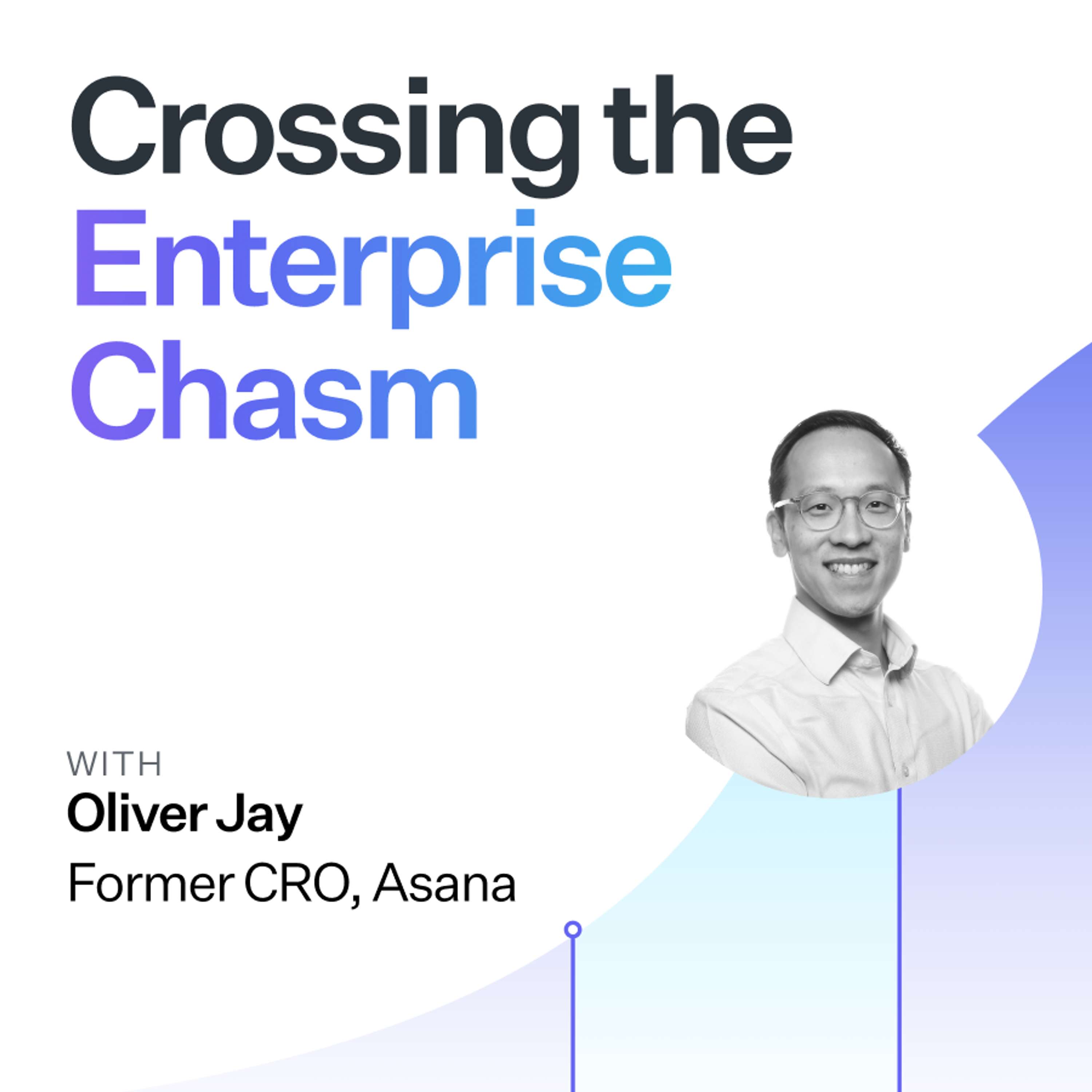
WorkOS CEO, Michael Grinich, and former Asana CRO Oliver Jay discuss insights on the benefits of targeting outbound to existing customers, international expansion, and the challenges and strategies of scaling from product-led growth (PLG) to enterprise sales while avoiding the PLG trap.
Transcription
4356 Words, 24093 Characters
[MUSIC] Welcome to Crossing the Enterprise Casm, a podcast about software startups and their journey moving up market to serving enterprise customers. I'm your host, Michael Grinich. I'm the founder of Work OS, which is a platform that helps developers quickly shift common enterprise features like single sign-off. On this podcast, you'll hear directly from founders, product leaders, and early stage operators who have navigated building great products for enterprise customers. In every episode, you'll find strategies, tactics, and real world advice for ways to make your app enterprise ready and take your business to the next level. Today, I'm joined by Oliver J, the former CRO of Asana. Oliver joined Asana back in 2016 as their CRO, where he first grew that go-to-market team from, I think, 20 to over 450 people in the span of just five years. Before Asana, Oliver was the head of PLG sales at a little company, might know, called Dropbox, where he built that Dropbox for business sales team. At both of these companies, he's led international expansion of each product, and in Dropbox's case, triple their international AR. Super, super excited to dig into this and more with Oliver on the podcast today. Welcome. Hey, Michael. Great to be here. All right, so let's go back in time a little bit. It can put on your time machine hat. Let's go back to that experience at Dropbox. So walk us through when you joined Dropbox. What was the state of the business? Maybe what was the state of the focus on enterprise or actually even before that that Dropbox for business product? So, you know, I go in 2012. It was a time when Dropbox had a lot of momentum in the consumer side, and had just dabbled into business. I would not even use the word enterprise. The big e-word did not come in until a bit later. It was really this opportunity when Dropbox saw that a lot of people brought the application to work, and started using it, and had just started to commercialize a product. It was actually called Dropbox for teams, right then, which is really just the idea that you can pay for multiple people at a time. That really was when it was at that start. And of course, over time, we built bigger businesses and they eventually went into the enterprise, but that's really where it started. You had this title, "Ahead of PLG Sales," which I haven't seen before this, and I haven't seen that much of actually after. What did that mean? What did "Ahead of PLG Sales" mean within the context of Dropbox? So, the caveat is like, this is a little retroactive title amending because no one actually knew what that was at that point, right? PLG as a term didn't even exist. I think it's, however, looking in retrospect, the best descriptor. So, there were a few sales motions. The first selling motion was the most PLG I would think is inbound. We built up a few inbound channels and the volume was pretty astonishing from the start. And so, there was the inbound sales channel. And then eventually we started building, why not go expansion sales, which is taking cues from different sort of product usage behaviors, and also the quantum product usage as signals to then identify the more, call it, "healthy accounts with potential to expand." So, those were the first two selling motions that we resourced and built teams around. What did it look like to do those sales? Maybe it walk us through one or two deals, the bigger side, right when you joined. Sounds like it was going out and fishing for those bigger fish that happened to be in the pond, but what did the actual sales process look like? Yeah, so the inbound is pretty straightforward. All right, people are coming to us. Back then we actually had a full number. Companies don't today anymore because they know what it means how to use a phone. All right, and so that's usually someone already fairly technically satisfied with the product. And they're just looking for last-minute guidance. But how to buy, really. The next one, you know, expansion sales was very much around, it's very data-driven. It's very much looking at, okay, which of all the accounts that we have, which one is demonstrate the highest likelihood and highest propensity to either expand seats or eventually go for a bigger stew. And this is one where we looked at lots of different signals. At first, it was the most simple, which is, are people actually using their storage, okay, that's one. But then over time we got a little bit better, which is like actually looking at how people are using it. Are people using drop-ons of multiple devices? Right, that's much, much stronger signal actually on monetization than just if someone using up all their storage for their birthday party photos. So I think that sales is very data-driven and very quantitative. What were you selling in those first few deals in terms of the product for Dropbox for business or teams or, you know, early enterprise? What were the customers getting as you were saying? Is it a contract? Is it discounted pricing? Were there some futures? I think there's a few things that I think about, like if I had to rank what did people value most in the early days for B2B product? I think centralized billing was a major one because now people didn't have the expense their individual drop-ons usage and that ended up being pre-nice bonus. Well, okay, I can take it back. First, it was like, if back then if you get a term by your data, that's virtually unlimited, especially if you use it for work, right? So I would say obviously just pretty much unlimited storage. That's one, then centralized billing. And the third thing is actually CS. I think we're saying that you get access to working with someone. And today it's like, I think it's a bit of a throwaway. But you have to remember back in 2012, the smartphone was pretty new. Still, right? Blackberry was still around. And so this idea of being able to get files across multiple devices and how you actually interact with your content on multiple devices, including at that point in the cloud. And just getting content in the cloud was a new thing for many companies. And so being able to have someone to talk to to help walk you through maybe moving some of your content and workflows into the cloud, maybe onto mobile, was like a pretty pretty big thing. And so I think those were the main things that people cared about. When did that step into the sales process? That portion of CS? Was it like pre-sales? Was it like enablement that the sales team was getting to talk about use cases? Was it post-sales for expansion or renewals? You hear about that a lot in terms of SaaS businesses. Kind of talk about where it sat within the buyer journey. Yeah, I can tell you what we did. I can tell you my 10 years of doing this, my latest thinking as well. Yeah, please give us updated all of our 3.0. We set it up the same way any SaaS company did. Because that was our only comp at that point. So we looked at Salesforce, LinkedIn, Workday, we were like, all right, how did they set it up? And they was like, all right, pre-sales and AE's, post sales, right, is CSMs. And then in between you have like solution engineers at like some time to pre-sales, you have to post them as they do both. So we set it up the same way. And we had CSMs work with compliance after they converted. They were fine, they were trying. I think in the world of PLG though, I think the very first interaction you have with a potential customer is already a CS conversation. Folks have done, especially now, they've done their research. They've like read through the threads. They might have even played around with your product if you have a freemium product or certainly if you've a trial. And so they're fairly educated already. And I think I really think today, if I had to like redesign the customer journey, I'd leave a CS. And that first conversation is already the CS conversation. I wouldn't have called it PLG sales. You know, I would define it as that's the start of your customer success journey. And it's probably the most important one, which is why I remember our conversion rates were much higher for accounts that went through at that point we called sales. And there's certainly some self-selection bias there. But when you actually look at and listen to the conversations you can tell, it's because people are off to the right start. Because they're set up for success based on that CS effective CS conversation. Yeah, exactly. Like you don't need to like play around with first. And then like swipe your credit card. And then like, I'll introduce you to CS. And like, I don't think you should probably need that anymore. I talked to a lot of founders talking about inbound dealing with that. Founders where they want to supercharge the inbound motion with outbound stuff. Did that happen at Dropbox? Did you start doing outbound when you guys were there? Was it just still such a strong inbound machine you didn't have to do it? No, yeah, we did. I say the outbound to answer your question specifically. Using outbound to drive inbound, I think it's really hard. I think it's really hard. It's very, very long cycle. Like, hypothetically, there is a virtuous cycle here. You go outbound, you eventually get some big deals, get some big logos, make them case studies, market those case studies that drives more, you know, more awareness. But that cycle takes a long time. And so where we had success with outbound was outbounding to our existing base. Existing base meaning people who signed up specifically. Let's say work OS had 20 people using Dropbox ready, but you had like 100 people in a company. Right. So
Those 80 people who don't use Dropbox may not have any clue One of those 20 people are using Dropbox for and the value of their cutting So you're basically using the existing install base as a case study And you're really you're marketing messages like hey, ex-mizing your companies are ready to get a great value from this product Don't you want to get it on it too? That kind of motion was very very successful You're very successful because you're already like you're already acknowledged right and in some cases IT may have already approved the use of your product No at Dropbox, right? We can talk about it later, but at Dropbox Going outbound for outbound sake like a cold account never like Don't really have much action bottoms up action in that account really hard and I would say really make success And I think for many PLG companies really makes success and the reason is because I Think for true outbound will work right outbound By definition, you're going to have lower conversion rates lower conversion rates means To make the economics work you need bigger deals To get bigger deals you need to appeal an outbound to Sea level VP level, right? I mean if it's a fortune 500, there may be the director level But you're going after leadership and Most PLG companies the value they provide is To the end users or to like small teams or to the line managers And so what happens is you have this like Your persona is not aligned to the value that your product at that point is actually providing And so that's my amount of work it's like yeah either either works in terms like getting small deals Blue and economics doesn't work or you can't even get any deals because you're going after the wrong people Given the where you are where you have product markets it But it sounds like you're saying this outbound. I guess it's outbound to your inbound Allows you to convert those folks and drive maybe expansion from that 20 seats to the 100 within the organization That's the magic bit. There's a lot of action there Yeah, I would say that that probably built God drop us to become a 10-billion-dollar company is that dynamic Let's talk about a sauna another company you joined early on which became a multi-billion-dollar company You joined and the go-to-market team was like 20 people? Is that right? Yeah, yeah Early on when you left us over 400 people bring us back to this early days as you were thinking about maybe It was which gears here building the team folks that you're looking to hire as you were now scaling out the organization for sales What did you look for what type of people did you hire? I looked for so based on my experience at Dropbox I had pretty strong opinions on how I was set up the team and so Early on it was really important what I learned at Dropbox is to harness that self-serve business I think that we learned like a lot of companies take it for granted They just spend so much time after YC they launch to get all those you know people coming in and then they move really really quickly in the sales And they forget just how much opportunity there is to just build a self-serve business so That was the first thing I looked for is someone around that business and I was really fortunate because there was someone ready at a sauna who was really plugged in and Understood both the products and the business side and so I asked for the group and that was really helpful What we call PLG sales really quickly that was an obvious one to hire someone to build out that practice And then at the same time I thought We knew that we had good product market fit and so It was a big bit to sort of like time the market readiness, but I did feel like a sauna will be ready to have enterprise conversations two years later But we need to start developing the muscle Hey at that point work OS didn't exist so we didn't have like I think we had SSO but maybe not I forgot but it was like at that phase right Yeah, yeah nothing else forget anything on Like none of that right but like I could tell from the customer conversations and where the product Feature when I was going that it would be and so I feel like it takes two years to really build your like enterprise Selling go to market muscles on the sales and marketing side So early on even though we went at 20 people Right 20 million revenue we invested in a higher-than-first enterprise leader And we carved out like a small enterprise sales team For the purpose of like basically building the organization muscles To sell on price Second thing was solutions like super important probably the most Undervalued role in the go-to-market side And then we started looking at international so one of the benefits of PLG is If you do your launch right you should have users from around the world because You know the open web and so we started investing in international really early So that international was always growing alongside the US and so it never felt that we need to expand internationally We just built an international apparatus early so that we could grow together What did that look like hiring international? Were you hiring? Yeah, translating the product were you trying to hire like people to run growth experiments in Germany or like more tactically What does that look like? The first step is So I think the three functions product sales You know revenue right and marketing I think at first is You get aligned with product and marketing on the actual localization strategy Right like which of the markets that we're doing full translations With localization Wishing so we're only doing translations which ones are we only doing translations on like the you know top 30% of assets and something like that So building that roadmap is important and getting that alignment is important Because that ends up being the backbone of like when you actually launch in region Does it make sense to your launch in Germany if you don't have German right so aligning on that roadmap And then adding in the customer facing pieces and so for us because Asana at that point was very much P.O.G. driven It made sense It's really much more of an inside sales Motion as opposed to field sales and so we were looking for hubs Where are we going to go hubs to give us that local Knowledge as well as language expertise That allows us to cover a broad market and so many companies follow what Google Facebook did by going to Dublin Right to cover Europe because it's like the one place where you can hire great talent From other tech companies they get this how this tech thing works And you can get everything on your being like which covered in one place And so that's how we thought about it I want to ask about this enterprise sales later you said it takes about two years to kind of build that muscle and start getting it going What were the initial signs that it was the right time to start investing in this was it intuition from what you had seen at Dropbox? Did you have some Proto-interprise customers or some bites at these features? Maybe thinking through the lens of a founder today listening to this What signs might they look for in their business that is the right time to start investing in enterprise? I think it comes down to your intuition on the scale of the problem you're solving and So you've used Asana as an example most teams use Asana for like fact ten people And they're getting a lot of value out of it for those ten people Not really an enterprise scale Then we started seeing Tens and tens of teams and teams starting working together And then you dive into like what are people using the product for and you're like oh wow This athletics company global athletics company is using Asana to plan their creative marketing campaigns Right this like luxury goods company in London is using Asana to launch new products and coordinate across all these different teams also around the world Once you start realizing that you're solving the enterprise scale problems Right, I think that's a good sign Now I also think later on we can talk about this like I think it can sometimes get companies in trouble when they over index on those food use cases But to me to answer your question like when is the trigger to start going? I think that would be my trigger is when you're solving problems And I'm talking about note that my answer is not Oh when you start selling five six figure deals All right, that to me is probably correlated but that might mean that you just have You've put in work OS and now you're secure and now people want to buy you Right, that's an amazing first step but you also need to drive actual enterprise level from selling I should say too for this podcast as you're selling work OS that Oliver is a small investor angel investor in work OS from years and years ago I think when you're still out of sauna I pitched the company idea to you and you're like oh my god everybody needs this because you had Don't with it there and seeing it in Dropbox as well. So we first got connected You have written about something you call the PLG trap Which I love you know, it's reminiscent of the name of this podcast crossing the enterprise chasm You fall into the chasm and you're trapped I guess what is your PLG trap maybe walk us through that Yeah, it started with an observation that PLG companies start
with this amazing engine that is highly, highly efficient in terms of unit economics, right? Because you're using a lot of, you're driving a lot of word of mouth, bottoms up usage, and so hypothetically, and I actually see this many companies, it's the unit economics is really good. A lot of PLG companies are profitable, right? Like when they get to like the 10 and 20 million mark, it's amazing. But then when you look at all the PLG companies at scale, they're actually even less efficient than the non-PLG sales driven, top down driven, software companies. And so I thought that, like, I'm really really interesting. And I mean, we think a lot about my experiences. And I'm like, oh, well, you know, what typically happens is PLG companies get great success in the beginning, then they have a few enterprise companies come to them and they look, if all I need is I need you to give me skin integration and managed access controls. And I will go from 100K to 500K in annual spend guarantee. Well, it makes a lot of sense if you're not going to turn that down because you know that's always part of her about anyways. And so here's the trap. The trap is a lot of PLG companies are lured in by these enterprise feature requests that is really purely only on the security and admin perspective. And they put a lot of effort because you, as you know, for sure, like, especially for companies who want to do it alone, it is like, it sucks up like a 30-year resources, if not more. - Yeah, we've heard this a lot. Tens of millions of dollars in R&D, literally. Yeah. - It's huge, right? And so a lot of companies then spend all their effort into building these things, right? And they think that that is what it takes. Because indeed what happens is you build all the stuff, now you have access controls, right? And access controls, by the way, is like the Santa Claus list. I mean, it just never ends, right? But like you start building these access controls, everything you land opens up one, two, three more big deals. And so you think, oh, this is my enterprise play. Well, it gets to a point in time where you actually don't even have enough accounts where this security and admin alone provides sufficient value to drive an enterprise deal. All right, and this is the trap. Because when you're in this trap, you're like, whoa, like I was doing really, really well. But suddenly I just don't have enough accounts, just where my security admin stuff satisfies and is sufficient to drive bigger deals. Because back to what we said earlier, at the end of the day, you need to be solving enterprise scale value. So on top of, yeah, you need the security piece. And what you want there is like, you want really the minimum. But what you really want is you want to take most of your resources and build enterprise scale features. So for Asana, for example, when we're selling enterprise deals in the beginning, it's not, in the beginning, of course, it's like project management stuff. But over time, we're selling like OKRs. How do you use Asana and use built goals, right? Company Y. Now that's enterprise scale value. But if you didn't have that, if you're only selling project management, like try selling that to CEO that doesn't already have half their company using Asana, that's not going to resonate. Last question for you before we wrap up. Thinking back to those early stages and early stage founders going through this transition, what advice would you give them? Maybe advice to help them think about navigating the beginnings of this transition, or maybe trying to start thinking in ways to avoid that PLG trap. If they get to that point later on, what would you say? I really think that it's important to understand their multiple, multiple personas in a company. So if you want to go after your enterprise, you have to be really clear about which level, right? Is it executive? Is it mid-level, which function? And I think a good test is, are you solving one of the top three pain points? If you're not, especially in this day when everyone's really really cost-conscious, you have to think about a different persona. And don't think of a target company as a monolith, but really think about the individual who will sponsor you and what problem are you solving for them. If you're solving a top three problem, then you've found product market fit. Oliver, thanks so much again for joining us. It's really good to see you. It's great. Great to see you. [MUSIC PLAYING] You just listened to Crossing the Enterprise Cousin, a podcast about software startups and their journey moving up market to serving enterprise customers. Want to learn more about becoming enterprise ready? The work-o-as-block is full of tons of articles and guides outlining best practices for adding features like single sign-on, skin provisioning, and more to your app. Also, make sure to subscribe to this podcast. So you're first to hear about new episodes with more founders and product leads of fast growing startups. I'm Michael Grinich, founder of Work OS. Thanks so much for listening and see you next time.
Podcast Summary
Key Points:
Summary:
Chat with AI
Loading...
Pro features
Go deeper with this episode
Unlock creator-grade tools that turn any transcript into show notes and subtitle files.
 PodcastTranscript AI