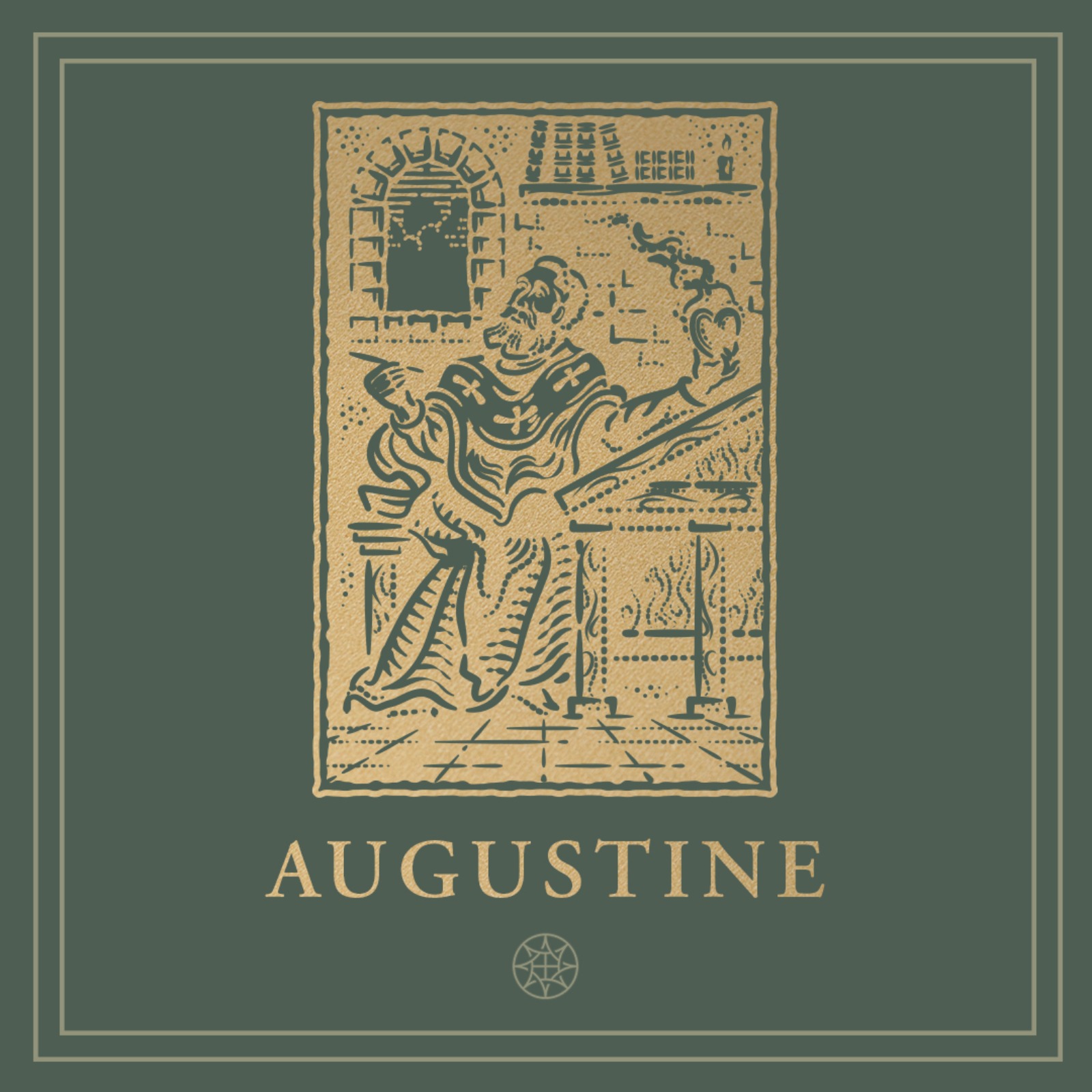
Augustine of Hippo stands as one of the most influential theologians in Christian history, shaping Western thought from the Middle Ages through the Reformation. Born in North Africa, he initially lived a life of indulgence, marked by lust, intellectual pursuits, and philosophical explorations, including Manichaeism and Neoplatonism. His profound spiritual conversion in 386, sparked by hearing children chant "pick up and read," led him to embrace Christianity through a deep encounter with Romans 13. He later became bishop of Hippo, where he spent decades in pastoral ministry, teaching, writing, and engaging in fierce theological debates. His defense of Christianity during the sack of Rome in 410 through *The City of God* addressed accusations that the Christian faith had caused the empire’s decline, arguing instead that the fall of Rome reflected the clash between earthly and heavenly cities. Augustine’s theology emphasized sovereign grace, asserting that human will is captive to sin and that salvation requires divine intervention. He also wrestled with issues like music in worship, ultimately affirming its value when aligned with truth and devotion. His life reveals a deep conviction that God alone is the source of true joy and fulfillment, surpassing all earthly goods. Though he navigated controversy and conflict throughout his life, his legacy endures as a testament to transformation through faith, intellectual rigor, and unwavering devotion to God.
Even those of us who are rule followers at some time or another have probably done something
or had that inclination to do the wrong thing just because you knew you could, and a group
around you thought it would be fun, and the people looking in if they knew they would
even be surprised to see you doing, that was young Augustine.
As Christians we have a 2000 year history filled with stories to tell and lessons to learn.
The Church History for Everyone Podcast offers snapshots of key figures and consequential
moments in time.
In this episode, Kevin DeYoung explores Augustine and the Twilight of Rome.
This lecture was originally delivered at Christ Covenant Church during Sunday School on
November 6th, 2022.
In the summer of AD 430, the Barbarian vandals crossed the Straits of Gibraltar into North
Africa, and they headed east toward the town of Hippo.
For over a year, the vandals laid siege to Hippo.
When they finally breached the walls, in August 431, most of the town, the people there were
dead, dying, starving, one of those who had already died, was the town's bishop, Aurelius
Augustine.
Augustine spent his final days in his room, in Hippo, reading from the penitential
Psalms, he had fixed the Psalms on the walls of his room, believing, and you can understand
why, that the end of the world was at hand.
In August 28, 430, the great Theologian, great lover of God, one of the without doubt most
important Christians, and indeed persons to have ever lived, died and went to be with
his Lord.
When you measure, if you can measure such things, the greatest Theologians in the history of
the church, you ask people today, they usually mention the same handful of people, Augustine,
Aquinas, Luther, Calvin, perhaps from the 20th century, Karl Barth.
But whoever you ask, they will undoubtedly put on that list Augustine.
Augustine's book says after Jesus and Paul Augustine of Hippo is the most influential person
in the history of Christianity.
B.B. Warfield said that Augustine not merely created an epoch in the history of the church,
but determined the course of its history in the West up to the present day.
Almost anything you want to say about Augustine's influence in the church, particularly the
church in the West, you can say without exaggeration, he was simply that important and his influence
is incalculable.
No Theologian was quoted more during the Middle Ages, no Theologian was more important
in the Reformation.
You look at the index to Calvin's Institutes of the Christian Religion.
There are over 800 references to Augustine, some of the leading Theologians in the Middle
Ages, especially those who the Reformers would draw from in like Gott's chalk, Bradwardine,
Gregory of Remini.
They were all vastly influenced by Augustine Wickliffe was a disciple of Augustine, not directly,
of course, as was Jan Huss.
Luther was indebted to him, he was, after all, a monk in the Augustine order.
Not only that, but Augustine was well known and read deeply by Anselm, by Aquinas, by
Pascal, by Kierkegaard, by Vidkenstein, even by Nietzsche, anyone with any semblance of
Western philosophy, let alone Western history, or the history of the Christian church,
has to be deeply aware of and indebted to Augustine.
He was a pastor, a poet, a mystic, a philosopher, a controversialist, a Theologian all rolled
into one, and he wrote, "My oh my, did he write, of course, long before the age of any
sort of word processing?"
He wrote and wrote and wrote paper to pen to paper, or quill and ink to paper.
He wrote, his influence on Christian history and Western civilization can hardly be overstated.
What can we say about Augustine and just a short time in our class here today?
There are mountains of things that he wrote and that could be said, easily you can take
an entire course.
Our friend Blair Smith has done a course on Augustine, an entire seminary course, and we're
just trying to barely sketch an outline in these minutes together of his life and of his
influence.
Augustine was born in 354 in the Gast, T-H-A-G-A-S-T-E, the Gast, or the Gast, town in North
Africa, present-day Algeria.
He had a pagan father who eventually became a Christian and he had a devoutly Christian
mother, Monica, and she looms large in his life.
Augustine was not a good kid.
He talks in a famous passage in the Confessions, which is a philosophical memoir and autobiography,
and something that has had vast influence in the Western world and hopefully everyone
at some point gets assigned that in high school or college.
He writes in a famous passage about stealing pairs and how he didn't even want the pairs.
He just had delight in doing the wrong thing.
I won't ask you if any of you have children or if you were the sort of children child
who did things just because you knew they were wrong.
Here's what Augustine writes, "But my pleasure was not in the pairs.
It was in the crime itself, done in association with a sinful group.
It was all done for giggles as if our hearts were tickled to think.
We were deceiving those who would not think us capable of such behavior and would have
profoundly disapproved."
Even in that sentiment, Augustine is capturing something deep about fallen human nature.
Even those of us who are rule followers at some time or another have probably done something
or had that inclination to do the wrong thing just because you knew you could and a group
around you thought it would be fun.
And people looking in, if they knew, they would even be surprised to see you doing.
Well, that was young Augustine.
He was highly intelligent and he was highly sexual.
He was sent to Carthage at age 17.
There he fulfilled a life of hedonistic pleasure.
Again, he writes in the confessions, "The single desire that dominated my search for
delight was simply to love and to be loved.
But no restraint was imposed by the exchange of mind with mind, which marks the brightly
lit pathway of friendship.
Clouds of muddy, carnal, concupacence filled the air.
The bubbling impulses of puberty be fogged and obscured my heart so that it could not
see the difference between love's serenity and lust's darkness.
Even of the two things boiled within me, it seized hold of my youthful weakness sweeping
me through the precipitous rocks of desire to submerge me in a whirlpool of vice."
What a remarkable paragraph there from Augustine.
Of course, he doesn't write that when he's 17, but he's reflecting older in life to see
what he was as a young man.
And just incidentally, when you think about what the LGBTQ revolution does and introduces
to people in the confusion of puberty, it's no surprise that so many people would take
these massive, wrong turns.
I mean, you think of Augustine says, "The bubbling impulses of puberty be fogged and obscured
my heart."
When you are a young man or woman in puberty is happening and all of this sexual energy
is coming to the fore, you're very confused about all sorts of things.
And it seizes you and leads you and it's why we need to be in community, why we need
good parents, good friends, good influences, why the social contagion spreads so quickly
with some of this deviant behavior.
Augustine certainly could understand that.
He saw that he was swept away in this whirlpool of vice, soon he had a concubine, not uncommon
at that time in the world, and by this concubine he had a son.
His spiritual journey continued.
At Carthage, he studied rhetoric, and his studies of rhetoric, he read Cicero, one of the
Classic Red Arissions, one of the most. important orators and moral philosophers be influential in the West and down
through the history of the Church, often looked to Cicero, turned him into the
pursuit of truth and the pursuit of style. That's what the study of rhetoric
did for Augustine at Carthage. And his pursuit for truth led him to embrace a
philosophy called manachism. And he was deep into manachism for nine years. What
was manachism? Well, Manny, M-A-N-I, was a third century prophet who taught that
there were two principles at work in the universe, light and darkness, spirit and
matter. This is not uncommon in the ancient world, this sort of stark dualism.
Every human, Manny said, was in a mixture of these two elements. And so the goal
was to separate the two, so the spirit could return to pure light. Because no
new mingling was allowed, followers had to avoid procreation. So you can see a
gust in swinging. You can understand perhaps overcome with what we might call
today a sexual addiction that any finds this teaching of Manny to be perhaps
giving in the freedom that he longs for. And in order to be a good manachias, you
have to avoid procreation because otherwise you're mixing these elements of
spirit and matter again. And light and darkness and the goal is to be set free
from all of that. And the spirit to return to the pure light, Manny saw himself in
the line of teachers from Buddha and Zoraster to Jesus himself. And Augustin
resonated with manachism. It solved, quote unquote, it solved two problems for
him. Not just on this perhaps visceral level, but two intellectual problems. One,
he viewed at this time the scriptures to be very crude. And this helped him see
how the scriptures could have been corrupted. They weren't all the way divine.
And it also helped him to understand the problem of evil. Ah, evil, it wasn't
from God. Evil was this other impure force in the world that's a rival to God.
So manachism helped scratch some intellectual itches for Augustin. But he was
during those years a somewhat hesitant follower. He had lingering doubts. When
one of the great teachers of manachism of the age, Faustus couldn't answer his
questions. He rejected that religion and wanted to move into a different direction.
He moves to Milan and he had been a teacher of grammar at his hometown of the
gast and of rhetoric and carthage and he moved away from manachism and he
secures a professor's that professor ship in Milan in 384. There he's quite a
successful order, a successful professor, but he's unhappy. He had separated from
his longtime mistress in favor of a wealthy young woman. He was still mastered
by his passions. He said he was in quote a world of vicious love making.
He later wrote quote, there's nothing so powerful in drawing the spirit of a
man downward as the caresses of a woman. So he was still not free from these
passions and desires. He was successful by some worldly standards, but he was
unhappy. He says in the confessions and here's one of the great lines that's
worth tucking away and how many of us at some point in our life could say this
although we might not be as honest as Augustin. He wrote, I had become a vast
problem to myself. Only our eyes could be open at various points in our lives. The
same could be said of us. I had become a vast problem to myself. While in Milan he
begins to listen to the teaching of Ambrose, the famous preacher, famous bishop
of Milan. Initially he went to hear his style. It was after all in search of
great brilliant rhetoric and Ambrose certainly delivered. But as he listened to
Ambrose at first for his style, he began to pay attention to his content. And as he
listened to Ambrose content, Augustin found himself trusting the Bible more and
more. And he saw how Ambrose handled the scriptures and he began to see the
scriptures were not this crude thing that he had thought that there were more
answers to his questions than he realized. So he listens to Ambrose, but he's
not yet a Christian. He becomes enchanted with neoplatanism. Neoplatanism
following the teacher platanus or platinus. Neoplatanism stress the
contemplation of the ineffable. There is just one being in neoplatonic
thought. And evil is not a thing. It's just a movement away from the one. The
one being is God and evil is that negation, a privation of that thing. Just like
ripples and a pond move away from the stone that's dropped into the pond. So
evil are like those ripples moving away from the one being. So again you can see
Augustin is interested in getting answers to this question about the problem of
evil. And to be fair, Augustin probably didn't shed all of his neoplatanic
thought. All of us appropriate Christianity with something of our own cultural
lens and intellectual framework. That doesn't mean that all theology is just a
matter of cultural preference. Now God really can speak to us and we really
can see trans-cultural truth, but it's just to be honest with ourselves and to
try to have our eyes open as much as we can, that we are likely to have
certain mental frameworks that we inhabit from our culture. And perhaps don't
ever fully get eradicated from the scriptures no matter how careful we are. And so
if there is a critique of Augustin and certainly with someone who wrote as
much as he did, there can be lots of critiques. But someone would say he
didn't shed all of that neoplatonic thought and that his solution to the
problem of evil could sometimes be unsatisfying for for that reason. But neoplatanism
was a step closer for Augustin in the right direction, less materialistic and
certainly more of a transcendent God. 386 is Augustin's famous conversion. He had
witnessed the lives of the monks. In fact, he explains to a well-to-do friend of
his that they were both looking at the lives of the monks around them with
their austerity, with their simplicity, with their rigor and their devotion to
Christ. And Augustin and his friends were pricked and their consciences wondering,
what are we doing? We're living these these posh lives, cushy elite, we might
say, filled with all manner of pleasure. And yet something was repulsive but
on a deeper level attractive about the life that he saw in these monks. In all of
their unlearned simplicity, unlearned simplicity. Augustin thought they were
doing what he could not. And again, it gets to the matter of his passions. He saw
in them, though they didn't have the rhetoric he had, they didn't have the
training he had. They had one thing that he didn't. They had victory over their
lusts, or at least their outward lusts. We still, I'm sure they would have said
they were wrestling internally, but they were not swept away in a vicious
whirlpool of lovemaking like Augustin was. He since the onset of puberty, he
had not been set free from this swirling vortex of passions. He prayed in the
confessions, looking back at this time and his desire. Again, one of these
brilliant, famous lines, he says, grant me chastity and consonants, but not yet.
I was afraid you might hear my prayer quickly, and that you might too rapidly
heal me of the disease of lust, which I preferred to satisfy rather than
suppress. Markable insight into the human condition. How many of us, perhaps not
so eloquently, but have prayed prayers like that, grant me chastity, but not
quite yet. He wanted to want the right thing. He knew what it was, and he wanted
to get there. And yet you can feel the wrestling in that very prayer. I was
afraid he said, you might hear my prayer too quickly. He want this is, this is a
man, again, to use our terminology, a man struggling with what we would
probably call addiction. Any addict will, will resonate with this. You want to be
set free. And yet at the same time, you prefer slavery and bondage to free
him. I want chastity. I want to be set free from this pattern of sexual lust and
vice that I'm in. Augustine said, but I'm afraid that you're going to set me
free too quickly because I hate it and I love it at the same time.
And this famous, one of the most famous conversion stories in all of Christian history, as he's walking, wrestling, struggling with this thoughts, with these thoughts walking through the garden in Milan,
thinking about Ambrose sermons, thinking about the lives of the monks, thinking about what he has heard, and he then hears children playing, or at least what he thought to be children playing.
And they're saying, "tole lege, tole lege, pick up and read, pick up and read."
And so hearing this voice as divine instruction, he picks up the word of God, and he turns to Romans 13, seemingly by happenstance, but we know by the Lord's providence, Romans 13, 13 through 14, and his eyes, a light upon this passage, which is just the passage that Augustine needs to hear.
Let us behave decently as in the daytime, not in orgies and drunkenness, not in sexual immorality and debauchery, not in dissension and jealousy, rather, clothe yourselves with the Lord Jesus Christ, and do not think about how to gratify the desires of this sinful nature.
That was just the verse that Augustine needed to hear.
That was in 386, he's not baptized until Easter Sunday 387, he's baptized by Ambrose from Milan, along with his son on Easter, and Augustine is now a Christian.
Augustine would eventually become a priest and then the bishop of Hippo.
He traveled to North Africa to settle in a monastery on the way his beloved mother, Monica, died.
He said of his mother, quote, "I cannot speak enough of the love she had for me. She suffered greater pains in my spiritual pregnancy than when she bore me in her flesh."
That's probably true. She longed for her son to be set free from these false religions and false philosophies in this lustful way of life.
She desperately wanted him to become a Christian.
How many mothers out there can relate to those prayers in that longing of Monica and Augustine was surely right that she was in greater pain for his spiritual rebirth and even giving birth to him physically.
His mother dies soon after the son that he had had with the concubine. He too dies.
In Augustine, filled with grief, a new Christian wants nothing more than to hide away and live a life of study and contemplation.
He wants to commit his life to profitable study.
He said, quote, "Let me, my God, say something also about the intelligence which was your gift to me in the ways in which I wasted in on follies."
He understood that God made him exceptionally smart.
You could see that about himself from a young age.
Anyone who reads Augustine knows that that's undoubtedly, undoubtedly true.
He was blessed with superior intelligence.
He knew that at different points in his life, he wasted it in follies.
It is possible for very smart people to just use their smarts as a kind of parlor game with others, a kind of competition to show.
Their smarts, their rhetoric, their argumentative prowess.
Well, now he's a Christian. He wants to put his intellect to good use.
But as so often happens in church history, when you find different men and this is certainly Calvin's story and it's been many others,
what they want is a life of quiet, contemplation and study.
Just give me my books, give me a room, let me think, let me write.
That's not that such a life is unfaithful and the Lord may give it to some people, but often he pulls those men into something different.
And so he did with Augustine.
He wanted this kind of life, but God wanted this man of learning, of brilliance, of reflection.
He wanted him also to be a man of action. He wanted him in the arena as it were.
He travels to hippo to recruit a friend to join the monastic community with him.
This makes sense. This is what you would often do in the ancient world.
Today, maybe if you're serious about Christ, people think I may be going to seminary.
I'm going to go into campus ministry, sort of a path.
I became a Christian. I'm on fire for the Lord. What might I do next?
Well, here, a next step was often to enter into some kind of monastic community.
While there in hippo, he attends church.
By this point, he has written some and he is building quite a reputation.
The Bishop Valerius sees him in church and he preaches a sermon about how God always sends shepherds to care for his flock.
And then he has the church pray for guidance in case there might be such a minister in their midst.
Valerius is really tightening the screws here and the congregation all think of Augustine.
Ah, he's the man who's here in our midst. And yes, we need good shepherds.
And the Lord might be providing us one. He's right here among us.
And Augustine is ordained as a priest, somewhat against his will.
It's not the path he had chartered for himself. He was going to be a monk.
Now, he's ordained as a priest. Four years later, he's ordained co-bishop.
Really quite an office of co-bishop, but he's ordained alongside Valerius, share the bishopric with him.
And you might think this was a great career move for Augustine, but he considers it rooting him in one place where that wasn't necessarily the place that he was looking to put down roots there in hippo.
But he's the bishop, and so now you're responsible, not just for one congregation, but for multiple congregations.
And given the political and ecclesiastical dimensions of the day, you're responsible for a lot more than that.
You are a leading figure in that entire city. The city depends upon the bishop.
And so may not have been the plan that Augustine had for himself. Scratch out. Here's what I'll do. This is my career arc in a land in hippo, but now he was, and he was going to be faithful in the role of God had given him.
Shortly after being co-ordained as a co-bishop, Valerius dies. And now 396, so we're 10 years after his conversion, 396 Augustine is the bishop of hippo.
From 396 to 430 Augustine serves as the bishop of hippo for the rest of his life. Those 34 years hippo incidentally is the Greek word not for hippo, but for horse.
A hippopotamus, our word, is a river horse. That's what the word "potomus" at the end of it means. You think of the Potomac River in Washington, D.C. is by Greek, the river river hippopotamus is a river horse.
So he's the bishop of hippo, the bishop of horse city. And his legacy will be in his preaching, his teaching, and certainly in his writing.
Too numerous to mention, his book on Christian doctrine, his book on the Trinity, his book with reference several times, confessions, his book City of God, sermons, letters. He found a monastery in Augustinian order of monks, he trains clergy, he was a man of contemplation, of learning, of action, of preaching, of pastoring.
And his entire Christian life was spent in unending controversy. If ever there was a man who did not try to live his life above the fray, it was Augustine.
Like many Christians before him and after him, the Lord did not give him his desire for a life strictly of contemplation, but instead put him in the midst of battle and gave him a life of conflict.
Or the end of his life, Augustine compiled a list of over 8080 heresies that he was involved in combating. Too many to number, we'll look at just a few in a moment, he even got into worship wars, we might say.
Here's what he said about music, it's worth quoting a couple of paragraphs here.
Sometimes Augustine says, however, by taking excessive safeguards against being led astray, I err on the side of too much severity.
He's talking about the question of should we have music in church? Seems strange, but they were debating it. And might that be worldly, might that be to entertainment driven?
So Augustine says, I have sometimes gone so far as to wish to banish all melodies and sweet chants commonly used for David's solter from my ears and from the church as well.
But I think a safer course, one which I remember being often told of the Bishop Athanasius of Alexandria. He used to make the reader of the psalm chant with so flexible a speech rhythm that he was nearer to reciting than to singing.
Nevertheless, when I remember the tears which I poured out at the time when I was first recovering my faith and that now I am moved, not by the chant, but by the words being sung when they are sung with a clear voice and entirely appropriate modulation, then again I recognize the great utility of music and worship.
Thus I fluctuate between the danger of the pleasure and the experience of the beneficence.
and to fact, and I'm more led to put forward the opinion, not as an ear-avocable view,
that the custom of singing in church is to be approved, so that through the delights of the ear,
the weaker mind may rise up towards the devotion of worship. Yeah, when it happens to me,
that the music moves me more than the subject of the song, and confess myself to commit a sin,
deserving of punishment, and then I would prefer not to have heard the singer. Fascinating
that the same sorts of things we wrestle with, they wrestled with millennia and a half ago,
and likely did so with more deliberate thoughtfulness. You can hear what Augustine's wrestling with,
ah, the music, it seems like it sometimes moves us in a way that is carnal or fleshly.
It would be good for churches and worship leaders and just listening to Christian music to consider
that. It's not something we consider as much as we should, that it's possible that we're really
a certain chord modulation makes you feel a certain thing, and you confuse yourself that you're
having a spiritual experience, you're having a musical experience, and you don't need this spirit
of God to have that musical experience. What happens when you listen to music swelling in a certain
way, and of course the music in Augustine's time was far more simpler. You hear him talking about
a reader and Psalms in chance, so he's of one opinion that says, "Ah, there's a danger here,
maybe we should just have the reader just barely do a little flexibility enchanting the Psalms,"
but then he comes around to say, "But I remember with tears, I remember how much God
ministered to me, the great utility of music in worship, and all of us who are Christians, I understand
that, to be true, that music is one of God's great gifts." So he says, "Let's not be drawn away by
the music, apart from the words." Augustine goes so far as I say, "That's a sin." But the music
supporting the content, supporting the truth can be a great gift and utility in worship.
There are too many controversies to mention, but let me just highlight three of them. One,
Augustine was intimately involved in the Donatist controversy. That was a different class
earlier in this course. Donatist was a bishop of Carthage who opposed certain practices of the
Catholic Church, that is the universal church, or at least the church that called itself Catholic,
the Donatist didn't agree that they were the universal church, but that's how they've
become to be seen by history. Under the the Diocletian persecution recalls some priests handed
over the scriptures to be burned, and Donatist was of the opinion that these priests were apostates,
and therefore the sacraments that they administered were null and void in any priests who had been
ordained by these bishops were also null and void. And this was a longstanding controversy in one
of the leading bishops on that side. On the the strict side was Donatist, and so they became known
as the Donatists, and it led to not only theological wrangling but conflict and physical violence,
the issues were not entirely theological. They certainly were theological, but they were also
geopolitical. They also had to do with Carthage and Rome, and they had to do with city and
countryside and socioeconomic factors. And I dare say that Augustin didn't get everything right
in the controversy, but in the main his theological point was right, namely that the efficacy of
the sacraments is not to be based upon the worthiness of the priest, but on the grace of God,
and that we can't measure the truth of the ministry or the truth of the church based on how good or
how bad the ministers of the church are. We certainly want godly ministers, but we can't say that
when a minister proves to be a sinner or has some scandal that therefore the ministry has done
is all null and void or let alone this strict sacramental theology, which was prevalent,
that all the sacraments administered by him did not count, and all the priests under him were not
real priests. It's in the context of the Donatist controversy that Augustin postulates his famous
just war theory. What are the reasons that would justify going to war, and then what are the
practices within war that are fair and just? He does this in response to the Donatist rebellion,
because it was not just theological, but it came to warring factions literally.
Then we should mention second of all the city of God, not a specific controversy in terms of
heresy and orthodoxy, but certainly Augustin's apologetic aim was on full view there.
In 410, the world changed. I mean, it really changed. We used that language lightly, but this
is one time it really did change when Aleric and the Goths sacked Rome. I mean, this is Rome,
the eternal city. This is Rome, the capital of the empire. Rome, one of the leading cities in
all of Christendom, Rome does not get overrun by the Goths, but it did. Let Augustin to write
his massive and brilliant tomb, the city of God, trying to understand how do we make sense of the
fall of Rome, this eternal city, especially when some non-Christians are saying, look, this is the
fault of the Christians. This wouldn't have happened if we hadn't neglected the gods of our
ancestors. If we hadn't turned from our pagans, gods and goddesses, if the empire under Constantine
a century earlier had not moved towards the Christians, this is the problem. We need to return
to paganism. It's the Christians. This is the judgment of the gods upon us, or Christianity has
rendered us weak and vulnerable. Those are the sorts of accusations. It's in this context that
Augustin writes this great work. He says there are two cities. There is the earthly city based on
self-love and the heavenly city based on love for God, and we live at times in the midst of these
two cities. The earthly city has its own aims and the heavenly city has its own aims.
And then finally, let's just say something about Polesius. Polesius was a British monk,
famous for his piety, for his austerity. He was respected as a man of genuine faith,
but he taught that humans had the ability to overcome their sin. By his reasoning,
he thought, well, how can God really blame us for our sins if we can't actually overcome them?
We can resist sin. And so he denied that there was original sin. He didn't deny that people sin,
but he thought that corruption is not inherited from parents. We don't have inherited depravity.
We don't have inherited pollution and guilt, but we sin by imitation. Sure, we're sinners,
but that's because we have bad examples and we look around us and we sin because people sin.
But it's not something intrinsic to the human nature.
Original sin is passed on by imitation, not by imputation.
Polesius opposed, in particular, a phrase from the Confessions. Augustine said famously,
grant what you command and command what you will.
Polesius thought Augustine's view of sovereign grace in this passage made man too passive,
because listen again to what Augustine's saying there. Grant what you command and command what you will.
So Augustine was saying God has the right to command us to do things that in our own nature,
we are unable to do. It is not unfair for God to tell us to do something that he himself must
grant us the ability to accomplish. And that is what stuck in the crowd of Polesius. He said,
no, God can only hold us responsible if we have it in our own power to do these things.
Against Polesius Augustine taught, the will is in bondage to sin. It is not free to choose the good.
It must be unilaterally made new by the power of God. And so he emphasized our need for grace.
Of course, every Christian who has a Bible knows that grace is important. You need grace.
But no, Augustine helped us see that it's this sovereign unilateral grace. It's not just a,
it's not the grace of a life preserver to thrown out to a man sinking at sea who has a
last grasp to hold on. It's not the life preserver. It's the grace that reaches down into the bottom
of the ocean to the man who's already dead and has no pulse and no, no brain waves. And God
must give him new life. It's, it's, it's resurrection grace, not just helping grace.
So Augustine emphasized that we can only accept God's grace by the power of grace itself. See,
everyone always talks about grace, but in Polesius scheme, you had the ability to, to get this grace
for yourself. Augustine said, no, it takes an act of God's grace to even receive God's
grace. Why did Augustine change? So much more we could say about Augustine, but
let's just end here by thinking about what made the difference. Many people most
Christians that don't have these dramatic conversions like Augustine did, but
his is certainly one of the most dramatic and important in history. And it's
worth asking because Augustine answers the question for us. What made this change in
Augustine's life? Well, at least one of the answers is that he found God to be the
most desirable object in the universe. He found God to be that thing that being alone,
which could satisfy, which could fill in him, all that he had been looking for in learning,
in rhetoric, in success, in women, in lust, found something better in God. Here's what he said,
where and when then have I experienced the happy life for myself so that I can remember and love
and long for it? The desire for happiness is not in myself alone or in a few friends,
but it is found in everybody. Even if one person pursues in one way and another in a different
way, yet there is one goal which all are striving to attain, namely to experience joy.
There is a delight, which is given not to the wicked, but to those who worship.
For no reward, save the joy that you yourself are to them. So this is Augustine writing,
as he often did in form of a prayer addressing God. He continues. That is the authentic happy life
to set one's joy on you, grounded in you, and caused by you. That is the real thing.
And there is no other. Those who think that the happy life has found elsewhere pursue
another joy and not the true one. A custom grasp like every real Christian should,
that the excellency of God surpasses all things. A custom saw, whatever we prize as humans,
there is something better, something truer in God. And this is how we must motivate our own
hearts and how we motivate other sinners. Yes, we need to say here is the right thing and do it,
and there is the wrong thing and stop doing it. But we must come at sin with joy,
with better promises, with the persuasion to convince ourselves and each other
of that very thing Augustine was persuaded. Namely that the joys he was experiencing
were fleeting and counterfeit. And there was something better.
And what Augustine does so well and commend it to each of you and try to embrace it myself
as a Christian and as a pastor is he paints a picture of God's beauty and depicts to mix
the metaphors such an aroma of God's holiness that Christ becomes attractive. It doesn't become,
he is attractive. What we need are the eyes and the ears and the nose to see and to apprehend
Christ as he is and believe that infinitely superior happiness is found in God. Listen again
to Augustine. How he speaks about finding in God something greater than all that we could chase
after. All that Augustine had sought after luxury or possessions or security or
sexual freedom as he understood it. A quiet life even. He says that God out shines all of these
things. Quotes, but there are no caresses, tenderer than your charity. And no object of love is more
healthy than your truth. Beautiful and luminous beyond all things. Curiosity appears to be a
zeal for knowledge yet you supremely know all. Ignorance and stupidity are given the names of
simplicity and innocence, but there is no greater simplicity than in you. And what greater
innocence than yours? Whereas to evil men, their own works are damaging. Italeness appears as
desire for a quiet life yet can rest be assured apart from the Lord. Luxury wants to be called
abundance and satiety, but you are fullness and inexhaustible treasure of incorruptible pleasure.
Productality presents itself under the shadow of generosity, but you are the rich bestower of all good things.
Averis wishes to have large possessions. You possess everything. Invy contends about excellence.
What is more excellent than you? Anger seeks revenge. Who avenges with greater justice than you?
Fear quails before sudden and unexpected events attacking things which are loved and takes precautions
for their safety to you. Is anything unexpected or sudden? Or who can take away from you? What you
love? There is no reliable security except with you. You hear what Augustine is doing there?
He's taking all of these desires that we have. Italeness, luxury, Averis, envy, fear, anger.
And he doesn't, in every case, say that the thing we are desiring is in itself wrong.
It's not a wrong desire to want rest. It's not a wrong desire to want abundance.
Or to want to be rich in possession. Or to want to see justice. All of these things are good,
but what Augustine does over and over is that you want that. Here's where you can truly find it.
You want the best version of all the joy, all the satisfaction you're looking for. It can be found
only in God. And that's what made the difference in Augustine's life, not only in his conversion,
but in his long ministry as the Bishop of Hippo. Give the last word to Augustine. Again,
another one of his famous lines which sums up so well Augustine's life, his theology,
and is worth pondering for its own sake. He says, again, speaking here vertically
with reference to God, he loves thee too little, who loves anything together with thee,
which he loves not for thysink. Dive deeper into this biography and others by reading
Kevin DeYoung's book, "Church History for Everyone", published by Crossway. On the next episode,
Kevin explores Cyril of Alexandria and the two natures of Christ. The "Church History for Everyone"
podcast is a ministry of clearly reformed. You can find more resources like this at clearlyreformed.org.
Podcast Summary
Key Points:
Augustine, a pivotal figure in Christian history, was profoundly influential in shaping Western theology and church doctrine, with his writings shaping the Middle Ages and the Reformation.
His personal journey from a hedonistic youth to spiritual conversion illustrates the universal struggle with sin, desire, and the human longing for true fulfillment.
Augustine’s theological development involved engagement with Manichaeism, Neoplatonism, and later a deep commitment to Christian doctrine, particularly the doctrine of grace and original sin.
As bishop of Hippo, he actively engaged in theological controversies, including the Donatist conflict, the debate over music in worship, and the apologetic defense of Christianity against accusations of Rome’s fall.
In his masterpiece *The City of God*, he argued that there are two cities—earthly and heavenly—reflecting the ongoing spiritual conflict between self-centeredness and devotion to God.
Augustine emphasized sovereign grace, asserting that human will is bound to sin and that true salvation requires divine, unilateral intervention, not human ability to resist sin.
He famously taught that God is the ultimate source of true joy and fulfillment, surpassing all earthly desires and offering a deeper, more enduring satisfaction.
His life exemplifies how Christian transformation occurs not through escape from the world, but through active engagement with spiritual and social realities.
Summary:
Augustine of Hippo stands as one of the most influential theologians in Christian history, shaping Western thought from the Middle Ages through the Reformation. Born in North Africa, he initially lived a life of indulgence, marked by lust, intellectual pursuits, and philosophical explorations, including Manichaeism and Neoplatonism. His profound spiritual conversion in 386, sparked by hearing children chant "pick up and read," led him to embrace Christianity through a deep encounter with Romans 13.
He later became bishop of Hippo, where he spent decades in pastoral ministry, teaching, writing, and engaging in fierce theological debates. His defense of Christianity during the sack of Rome in 410 through *The City of God* addressed accusations that the Christian faith had caused the empire’s decline, arguing instead that the fall of Rome reflected the clash between earthly and heavenly cities. Augustine’s theology emphasized sovereign grace, asserting that human will is captive to sin and that salvation requires divine intervention.
He also wrestled with issues like music in worship, ultimately affirming its value when aligned with truth and devotion. His life reveals a deep conviction that God alone is the source of true joy and fulfillment, surpassing all earthly goods. Though he navigated controversy and conflict throughout his life, his legacy endures as a testament to transformation through faith, intellectual rigor, and unwavering devotion to God.
FAQs
Augustine is considered one of the most influential theologians in Christian history, shaping Western Christianity for over a millennium. His writings on grace, original sin, and the nature of God deeply influenced the Church, especially during the Middle Ages and the Reformation.
As a young man, Augustine engaged in sinful behaviors, including stealing and lustful passions, driven by peer influence and a desire for excitement. He described how he enjoyed the crime itself, not just the outcome, reflecting the deep root of human sin and desire.
Augustine was deeply conflicted about music in worship, fearing it could lead to carnal indulgence. Yet he ultimately affirmed its value, recognizing that music could uplift worship when aligned with truth, though he cautioned against allowing it to replace the focus on God's word.
Augustine's conversion, triggered by hearing children chant 'pick up and read,' led him to read Romans 13:13–14, which deeply moved him. This moment marked his spiritual turning point, leading to his baptism in 387 and a lifelong vocation to Christian service and doctrine.
Augustine taught that humans are born in sin and that the will is enslaved to sin, requiring sovereign grace to be renewed. He rejected the idea that people can resist sin through willpower, emphasizing instead that true freedom comes only through God's grace.
Augustine defended the Catholic Church's sacraments, arguing that their validity depends on God's grace, not the moral worth of the minister. He rejected the Donatist belief that sacraments from sinful priests were invalid, affirming that grace, not human merit, is essential.
Chat with AI
Loading...
Pro features
Go deeper with this episode
Unlock creator-grade tools that turn any transcript into show notes and subtitle files.
 PodcastTranscript AI