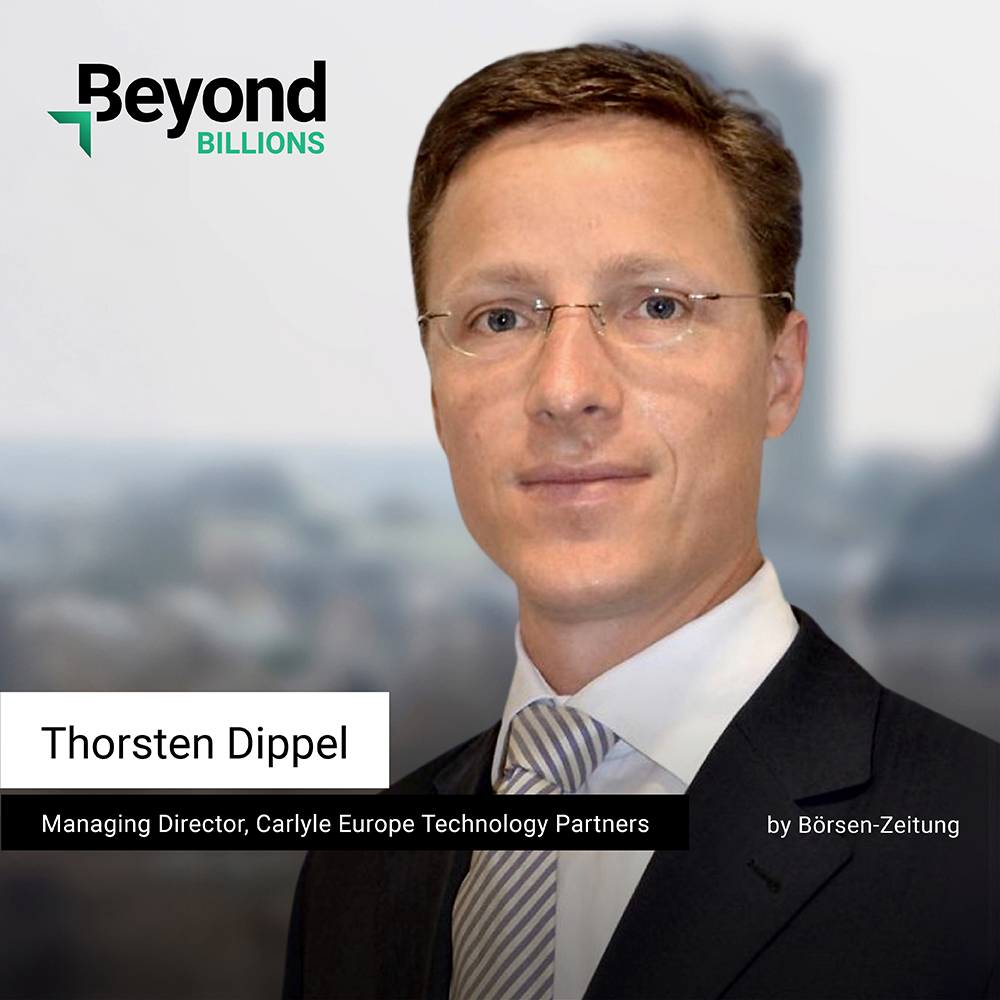
Auf Private-Equity-Zeitreise mit Thorsten Dippel (Carlyle)
43m 42s
The podcast episode, hosted by LBBW Asset Management, delves into the world of investments, tech deals, and industry trends. The hosts, Philipp Habtank and Nadine Klays, explore tech investments by Pride Equity and the journey of All Funds Group, highlighting value fluctuations and strategic moves. An interview with Thorsten Dippel from Carlyle Europe Technology Partners offers insights into the evolution of the tech sector over the past 20 years, discussing past investments, market dynamics, and the shift towards international growth strategies. The discussion touches on the significance of HR tech software, strategic investments in tech companies, and Carlyle's focus on B2B technology sectors. Thorsten Dippel also shares perspectives on successful software investments, the tech portfolio in Germany, and Carlyle's strategy in the midmarket tech space, emphasizing partnerships with founders for international expansion and expertise in cloud transformation and AI integration.
Transcription
6376 Words, 35339 Characters
This podcast episode will be presented by LBBW Asset Management.
To create values for the future.
As a 100% daughter of the National Bank of Baden-Württemberg
we spend 75.5 billion euros
and therefore belong to the leading capitalist companies of Germany.
Our focus is on public funds, special funds,
direct investment mandates
and a professional private market offer.
[Music]
Welcome to a new episode of Beyond Billions,
the private market podcast of the Börsen edition.
It's nice that you're back again today.
My name is Philipp Habtank, I'm a host here on the podcast
together with my colleague Nadine Klays.
Exactly, hello from me too.
At Beyond Billions, we take you with us to the world of investors,
founders, foremanagers and deal makers
and take a look at the current trends of the industry together with you.
And as the name already says, we are also looking for the stories behind the billions.
And what is going on today, Philipp?
Today it's getting technical.
Oh no, now I'm back with a crazy niche strategy
that's in the niche, the next niche and even more niches.
You know me very well.
Don't worry, no, today it's not about niches.
On the contrary, today it's about a real mainstream.
It's about tech investments from Pride Equity.
That's where the next exciting billion deal is taking place.
What's the name of All Funds Group?
Isn't that the British selling platform
that wants to take the German stock market for 5 billion?
Big deal, but isn't the German stock market
the opposite of the private market?
Yes, but if you look behind the billions,
then you can see that the store once belonged to the tech investor Hellman and Freedman.
He took over All Funds 2017 together with the Singer-Porean government GIC
at the time for 1.8 billion.
I would say a decent value increase since then.
Yes, 1.8 on 5 billion.
Yes, a strong value increase, right?
Yes, but you can also relate a bit.
Hellman and Freedman have already brought All Funds to the stock market in 2021.
They sold some of their shares, kept some of the remaining shares.
I think they still keep around 38%.
And the stock market was at a price of 11.50 Euro per share.
So back then, a stock market value of about 7.2 billion was mentioned.
So All Funds was more valuable than it is today.
The stock market history wasn't a growing story,
but the value went down like this, because instead of 11.50 Euro per share,
the German bank now offers only 8.80 Euro.
That's a really cool growth.
But I'm sure that Hellman and Freedman still can still eat well and happily twice a day.
Just like they do, maybe they have to suppress some or the other trains under circumstances.
They should have been interested in the German stock market as well,
in other terms.
But there are now exclusive talks with the German stock market.
Exclusive means you don't talk to someone else.
That's why CBC is probably the shorter one.
But I think it's already crazy how Pride Equity makes exciting tech companies work.
Today, it's totally unimaginable that it used to be different.
How exactly do you mean that?
Can you imagine, in this whole hype about software, chip companies,
KI and the whole boomstrap around it,
that as a Pride Equity Manager, you were looked at in a bad way when you said,
"Hey, I'd rather invest in software than in a German car manufacturer or supplier."
Yes, that's actually unimaginable today.
And in the meantime, automotive for Pride Equity is dead, isn't it?
Unless you're a brave turn-around investor, maybe.
Totally right.
So today, you still find Pride Equity that makes automotive or something.
But go back 20 or 25 years.
The world still looks completely different.
And how do you do that?
We'll beat them with our today's expert interview.
Yes, of course, 20 years is a very long time.
It sounds a bit like you've prepared a time trip for us.
That sounds super exciting.
Who did you talk to?
I talked to Carlis' Thorsten Dippel.
Carlis, you know, especially from the big Pride Equity large-cap business,
so a big Pride Equity investor.
But Carlis has been doing tech investments for over 20 years.
And Thorsten, he was there from the beginning.
It's really a cool interview about how the tech scene has changed over the years.
He brought a lot of exciting anecdotes with him.
It's crazy to say a lot of things about what I've done there.
And of course we're not just talking about the past.
Time travel is not just about the past, we're also looking into the future.
We're talking about the AI-hype and how you can handle this whole issue as a Pride Equity investor without burning your fingers.
Well then, let's get into the time capsule, turn the time back and forward.
Have fun with the interview.
For me and the podcast today, Thorsten Dippel, Thorsten is Managing Director and Partner
at Kali Europe Technology Partners, focusses on European buyout and growth investments.
That's all in the tech sector.
And he's in London, that's why he's here today.
Hello, Thorsten, nice to have you here.
Hello, greetings. I'm looking forward to your invitation.
Right away, a provocative question for the start.
You used to do restructuring at Roland Berger, now growth at Kali.
Do we have to worry about Kali?
Very good question.
So, in fact, Roland Berger, 25 years ago, is already a bit ahead when I started there.
And that's how it was, why am I actually at Kali?
I studied BWL and informatics.
And when I started restructuring, I noticed that the companies that are restructuring there
don't have much to do with tech and software and informatics,
but rather the traditional German and construction companies, I call them "MAL".
And then I thought, well, where do you actually want to bring your career to?
And what do you really enjoy?
And then I looked around a bit and then I changed to tech in the past 20 years.
And maybe as a little background anecdote, which I also noticed,
even though all the companies I've been participating in or restructuring at Roland Berger,
the majority of them went bankrupt at some point.
And then I thought, is it probably up to me?
Maybe that's why it's not the job I should be doing.
And in fact, I've been there for Kali for 20 years and of course it's a lot of fun.
Yes, growth is, I think, less fun than restructuring, I would say.
We also have to be a bit of a guy, right?
I think so too.
So, of course, every company that grows, of course, something dynamic happens.
Employees of development, potentials or employees also offer a perspective.
But for me personally, the interest in the tech sector is also there.
It's just fun to be permanently involved in new topics and to develop that with design.
And I think that's what it's all about, when you find something that's really fun.
A. It's, I think, more successful and, of course, it's easier to work with when you're having fun.
Absolutely.
You said, after 25 years of tech, I think, right?
Yes.
Technology has changed a bit over the years, I would say spontaneously.
How has this asset-class tech developed over the years?
What was hot-shit in the tech sector 20 years ago and who doesn't understand anything about tech today?
That's probably the book I'll be writing when I go to the rescue.
Because in fact, when I think about it, 20 years ago, my first deal with Carlisle was an IT service company, Microsoft Dynamics.
Is there still one today?
Or is it still interesting today?
But...
So it didn't go bankrupt?
No, of course not.
Now it's in growth.
But it's really one of the very interesting areas that Microsoft Dynamics has grown a lot.
Back then, no private equity wanted to invest in this company.
20 years ago, buyers on the tech side, especially software IT service, hardly found investors.
Because especially in the tech market, investors have been looking for all traditional industry companies.
Banks didn't want to finance such companies at all.
Because there was no security somewhere in the factory hall that could be secured.
And with that, the market was completely different than it was today.
Where you had to form your own opinion in a completely different way.
And to be an outlier, to say why are you actually doing this, Thorsten?
Why do you invest in this company?
Even at Carlisle, where Carlisle was at the beginning of technology.
And so you really had a niche or a completely different dynamic.
Of course, that has developed completely in the last 20 years.
Or changed.
And of course, a lot of people were right about it.
Then it started, or they developed into it, also raised the force.
And today, of course, the market is very different.
And today, you know exactly how we are, there are of course many specialized, many technology firms.
And it's almost the pendulum around it.
That a buyer today has too much choice, almost to find an investor.
The second thing that has changed a lot is the price.
If I take an example, back then you bought a company, for example, what I'm talking about right now, and paid 6-7 times EPDA.
If you sell it today, everyone starts to laugh and say, "Wow, what is that?"
You start at 15 times today and the people want more.
And it's the same company, that's what I want, the trend is different, you can also detail it.
But on the specific example, IT Service, Microsoft Dynamics, there is exactly today's company.
If you compare that, really already a big change.
And then of course, last point, are certainly also the content topics.
There was a lot more of such companies back then, to basically help each other, to modernize.
Basically, to help outside of doing something.
At the beginning, I call it choice, what then went to a lot of investments over the years, where you were a business model.
Then the theme of cloud came up, the theme of SaaS, where you helped companies in the technology sector, developed into that.
And of course, today the topic is AI everywhere, next to Munde, what does that actually mean for these companies?
I think the trends have changed, of course, but the market in sum is of course also very strong.
You also actually did something in Germany, and took over in Gentes, from Magua Capital.
I find it interesting from different reasons, among other things, because Magua Capital is one of the few German pride equity houses,
which are started as a newcomer.
In Gentes, because it was the first real big exit, because I don't think it was very cheap.
Can you tell us a little bit about what changed in Gentes, how it fits into the new tech world, or what your investment thesis is behind it?
And if you paid 20 or 25 times there, because I've already learned 18 years ago.
8, probably 8 and a half.
So in Gentes is a company, which they do, they offer software for org, chart, org design, org analytics,
so to speak, on HCM and payroll systems, and take the whole data together for large enterprise companies to really make decisions for HR, CFO, CEO.
And of course, it plays into the exact theme, which is very relevant today, I think, is permanent changes in companies, transformations,
which today are no longer a big project, what you do every five years, but where permanent changes take place.
And then, of course, topics are analyzed, like what does AI mean for my employees?
How should the company be set up when I have changes there?
And all of this has been done very strongly in the past with PowerPoint.
Somewhere there was an org chart in the drawer, which was no longer up-to-date, the employee was already in the race, and had to be updated again.
And today you use exactly the software like in Gentes, which is up-to-date and can be used worldwide for exactly this analysis.
So very exciting topic. If you are now 20 years in tech, of course, I have done a lot in HR, HR Tech, which means a lot as well as investment.
And in Gentes, a transaction that was introduced as Margoire, we also looked at it, and it was too small for us.
Because of course, if you have a size, it has an implication on the size of the beer.
Exactly, it is almost over 3 billion. We invested 50 to 250 million in equity, and in Gentes it was too small at the time.
But we found it very interesting. And of course, we also stayed in contact with the company.
Margoire, in fact, I know the colleagues well, and so you are actually exchanging the whole time.
And as Margoire, as you rightly said, thought about selling the company, of course, we were very interested.
But we also had a concrete opinion on the market, what you can do with it, whether it suits us or not.
And so, from a relatively smaller discussion with Margoire, at least for us, an interesting deal came out.
They do more in the area of HR. I think they also have HRWorks in the portfolio.
This whole tech-HR software topic, is it big?
Absolutely. It is a very big topic. Of course, it is also very broad.
It starts with payroll systems, HCM systems, and then specialized, which means best-of-breed companies that apply it.
And it is really a worldwide topic. That is always the question of how I can have a product that can also be used internationally.
And since it is in Gentes, also as an example, predestined, it is already active in the USA and is also interesting for us as Carlyle.
Because of course we are looking for companies, now I will take the comparison to Margoire, we are looking for companies where a management team is looking for a platform like Carlyle.
To really benefit from this, especially with internationalization, maybe even from our portfolio companies that we all have,
and say, okay, how can I use them as customers? How can I work with them?
And how can I generate more growth on this side, than if I either stay standalone, or drive the whole thing with the pure German font?
What do you have with Gentes? The standard playbook for the expensive software companies that are platform investments and have the 20 times EBITDA or even more than multiple on it.
It is that you make a large-body image with smaller add-ons that then bring down the multiple a little bit, and again a little bit of new regions.
What do you have with Gentes? What is your thesis?
So Gentes is also a relatively young small company, it is now also in great order, because it is about 30 million units, that is, it is not a big deal yet.
And what the company has not yet completely focused on so far is precisely this internationalization.
And I think that if we look at Carlyle as our form, if we look at companies, that is actually often our approach, where we say that if we can help a company like Gentes in the USA,
outside of the roof, really significantly to take the lead, then it should be able to generate much more value and growth than if a company tries to do it alone and then generate private equity value over other measures.
That means, for us it is really core, core thesis now with Gentes, international growth.
Yes, we will probably look at that too, whether we buy something on the M&A side, but then more strategically, technologically, there are special topics again with HRTech that can be very interesting,
but core investment thesis internationalization and really helping the management team with Carlyle.
And with the view of exit strategy, then we would then take the logical conclusion if it is then a larger company, the next larger private equity investor,
which is still too small for you to take part in, isn't it?
Well, that depends on it.
So if I always take our perspectives and our history, we have almost 60%, maybe even more than 60%, we sell strategies.
Because the mindset in our team has already said that I am also not a banker from the house.
We are all people who have a bit of IT background, technology background, and we are already trying to develop companies that have strategic interests or are relevant for strategic reasons.
But of course, we are not always a good company. If it develops well, then it finds itself a buyer, then it has both P/I and strategic interests.
But that is not for us yet, it is not on the radar today, or we don't think about it today.
About an exit, private equity must think about an exit from the beginning.
Yes, that is certainly a correct statement. But still, if I take our approach, then we already have three or four certain topics where we really want to transform and develop a company.
And we focus on that for the first time, the first three, four, five years. And we think that if that happens, then the exit will automatically take place.
Whether it has a strategic interest or, of course, private equity-sized ones that are permanently looking for it.
Interesting statistics here, when you look at software investments over the last 20 years.
Without analyzing them, I don't have a complete statistics, but there are hardly any successful investments.
Almost all have money earned with software. And that's why it's so interesting.
And therefore, of course, high interest in investing in larger private equities.
If I look at your portfolio in Germany now, and then ask, okay, what is the strategy of Karl Leil in the area of "Midmarket Tech"?
What is the playbook then?
Then I will first look at it from the outside and not completely clarify it, because I have classic buyouts in there, I have co-investments with strategies in there.
I have seen a series B financing round, so that's even closer to the venture world than to the classic private equity world.
Can you, maybe specifically, draw a little bit for me a red color on your current German portfolio, what the "Midmarket Tech" strategy of Karl Leil is?
Absolutely.
Or is that completely opportunistic?
No, of course not.
But the red line is that we are looking for founders or founders who are also significant as shareholders in assets-related technology companies in the area of software, IT service and also industrial hardware.
These are our three focus topics in the "B2B" area.
So what we don't do is always a strategy definition of "B2C" topics.
And if there are situations where one of these founders, a shareholder, is looking for a partner who can provide him with a support outside of the roof,
and we really think as Karl Leil that we either have in other countries or in our portfolio topics that can support there,
then that's exactly a deal for us.
And that's why it's rare for us, or if you take it like that from the portfolio, I have an investment in the IT service security area, an investment in enterprise content management with SEA,
Agilox is in Austria, in the robotics area, in the robotics area, an investment in CSS, an accounting software investment.
We have talked about this in GENT, but they are all the same topics.
There is a founder/shareholder everywhere who has looked for a partner to really internationalize the business model
and really has also looked for someone who has experience in this area to help him with topics that we just talked about,
a cloud transformation or today a lot of AI.
And these are topics that we also differentiate from local funds that of course also invest in software or in these topics,
but often technology companies cannot provide the platform in the USA or Asia.
And then when I take that to the lower-mid-market, where we are active,
then there are not so many global private equity firms that cover this market exactly,
but then there are more global private equity firms that invest in the large-cap.
And so we are actually active in the lower-mid-cap and look for these firms.
But what I am interested in, how far are you going down, let's say, in the biggest technical direction towards venture capital?
For example, HectorBox, a series B financing round, if you are still in the series world,
these are actually also late-stage venture capital forces that are a bit far off the road or the border to close capital.
It is then flowing at some point, but how often do you tap on the venture world?
So first of all, venture world in fact, that is a topic that we do not do.
That means we do not take any venture risk on the product side, where one has not yet shown anything.
HectorBox is a growth investment, but it is really very well positioned in its area,
where it is actually about a similar question as how you can make this company very strongly internationalize and support it on the product side.
That means the question, that is the red line, the question with these investments that we make is always the same and the task that we want to do.
We as a firm, that is also a strength, I would say, we actually say that the capital structure is always the same.
We do not want to invest because we get a financing, because we have a majority now or whatever.
We think about the content issue, we believe in it, we really think what I just said fits and we can of course generate value with it and how then the capital structure looks like.
Okay, we already solved that and are we flexible, because whether I have 49% or 52% doesn't matter to me.
Interesting. And how do you come up with strategies from time to time?
I have read that, for example, with Shopwear, PayPal, Rabu, a bank, are these strategic topics that are interesting for the company,
PayPal or Rabu and they are looking for a private equity as a partner or are these the topics that you are looking for or that you are initiating?
And then the target says, for what reason, there is still a strategy with it, because there is the logical exit partner in the investment case.
Yes, a good question.
First of all, it is still the exception that a strategy is invested with or that we do it together.
It is not like we go there and say, with which strategy we can look at the topic ABC, that is not the case.
It is more in the top of it, a certain flexibility on the capital structure side, I'll call it that now.
If we say to Shorpay and Hectobox that these are companies that interest us or Shopwear and we want to do that and a founder then says,
but I also have a PayPal or a Rabu Bank that also have interest and they could maybe help us go to market, could help us with certain content topics, we have nothing against it.
So that's a flexibility.
We really look at it much more contentedly than you might think from the outside, because of course, private equity thinks, okay, let's say zero to 15.
But we are very individual and look contentedly at it.
Where can we help this company, Shopwear? Where can we help this company, Shorpay?
And if there is a Rabu Bank with it, which already was a shareholder, in this case, we have nothing against it.
And we actually think it's good if the company also helps.
And who is my thesis, logically and practically the first contact partner, if you think about it at some point later on?
There is a good question also there to give the background, actually the private equity does not like that.
Because of course, if you have a shareholder and he is supposed to think about the Exit, then it's actually not what you want to like.
Because where is the interest or the possibility of action with it?
That means it's almost the other way around, as you just said.
We are rather sure that it does not prevent us from exiting, versus to say, oh, there is already an exit candidate.
He is always the subject of investments together with a strategy.
Absolutely. That's why I also say that it is rather an exception.
So it is with us, even if in this case it was twice, but it is a pure exception when I take the last 20 years.
Co-investment is more common in the large cap area, so with the really big deals where private equity needs to adjust such ratings,
that he does not get it out of one form alone, if he still wants to have a sufficient diversification portfolio.
That's why you can see a lot of cooperations in the large cap area, with the State Force, just out of the Middle East, you can see that.
You are in the mid-market, maybe a little bit too short to limit, what are the biggest differences between the market segment in the area of tech in which you are on the way to the large cap tech market?
I would say that there is already a big difference.
Of course, the content topics, software, what we just had, cloud or AI, are similar topics, similar trends.
But the large cap market in general, regardless of technology, is also a different market than the lower mid-market.
And what are the topics? The one is how to approach deals and how to find deals.
So there is a lot of discussion with the founders, with the core shareholders, who sell companies once in their life.
He founded it. This is not a pure financial transaction for him. Of course, he wants to get something financially, but it is also very emotional and involves a lot of other topics with it.
The second is the number of companies, deal flow, how many possibilities there are, also a completely different one.
That means the number of potential investments in tech or software areas is much more in the small mid-cap than in the large cap.
And then the business model, because I need to go there, is also a different one.
So when I am in the large cap, I actually know for the next almost 24 months which five companies are relevant and are likely to be sold.
And so I have two years to prepare myself to do that, like all my other colleagues, and then a bank comes and makes a standard process.
And then it will not be standardized, that is a wrong word, but I have to prepare myself very deeply, very long, and really do a lot of work in the large cap, if a deal comes to the market.
With us in the lower mid-market, there is much more fluidity and there are deals on the market that are permanent because of a decision to be made.
And it is much more about the topics that I just said, the seller, what exactly is he interested in besides the pure financial, what exactly is this company looking for.
We say a lot of topics that we do not do, where maybe a company in Germany says no, for me the topic of internationalization or for me the topic of strengthening the product is still not so relevant today.
I maybe go first with a local firm, then we do not do it.
So these are more of these content issues that are relevant to us and also the kind of work that is really fun for me personally, what exactly makes me fun is exactly in this market in which I am at the lower mid-market.
To discuss such deals and to discuss them with founders, as now to follow a pure large cap process.
Now you can see in the last time that more and more big, classic large cap-wide equities are starting to rise in the mid-market, with decedent mid-cap forces, with their own vehicle raisers.
I think there is an example right now that he is building up a mid-market strategy. How do you look at the fact that more competition is coming from above?
Because from the industry, I say from the pure-growing mid-market players, they cut a little bit and say, here they are making our beautiful mid-market structures a little bit broken with their locker large cap structures,
which they like to drive, stichwort covenant lights and so on, high ratings and so on and so forth.
Does that mean a little bit, or is software rather outdated, because there is also a lot of money in the mid-market?
First of all, I'm not worried about that at all, because because these two large cap-wide equities and the mid-market are really different from the large cap,
sometimes the large cap thinks, oh, I'm going to do that next to you, or I'm going to get that.
And what I observe is that the way you approach it has to really be different, and that sometimes takes a long time for large cap funds to develop until they have developed,
at the end of the day, and the second point, our model, especially in the small mid-cap market, in the roof or in any country, is really very dependent on people.
And with that, if I do this for 20 years, I think you need a certain, as always, experience, history, knowledge about the market.
That can rarely be one of those who go into the small cap and compensate or pick up a fund raise.
That means for me, it's one thing to collect the money, okay, that's one thing, but then really make good deals.
That makes me less worried, but that's often the exit potential for us, where, of course, one of these funds may buy something from us.
That's why I think it's positive again.
Your long tech experience, I would like to tap on again for a final part of our podcast and do a little tech talk with you.
We had already talked about what such exciting sub topics are, so everything around H.A. and so on, we had already worked out.
Then we have the whole thing about KI, which is just brutally hyped and what's on it, I mean, word data center and everything you can somehow pack under this label.
I would now be interested in your assessment. What are really sustainable, big mega topics in the field of tech?
How do you, maybe with a look at 20 years, 25 years of tech experience, at the moment, prefer to let your fingers go, because you say, hey, that's way too hot, that it's going up.
What are your two or three hot takes there?
Well, first of all, you have to differentiate between us as FON now, or as Carlisle Tech Fund.
We invest more in stable technology companies.
That means, if I take your question away, where the fingers are from, what we don't really do, where it's venture, the physics, the latest topics are quantum computing, for example.
We haven't looked at anything in the last few years, where he says, in quantum computing development, of course, there are very exciting companies and very good, but for us as FON, that's too risky on the venture side.
We're looking for companies that are established in tech and then can more profit from this trend.
That means, for example, ideally, for us, companies, let's say, are again an accounting software company, CSS.
How does the market today benefit from automation and AI?
I firmly believe that in five years, these software companies will really look different and the software used differently, namely much more automated, much more intelligent, even in topics like booking, etc.
And these are the topics we're looking for.
That means, how can I profit from the mega trend of AI, cloud computing, etc.
And how can I join in my established technology companies? That's actually what we're looking for.
But that means, you wouldn't enter 100% AI competitions and invest in a company right now, what's written primarily on AI.
You'd invest in a company, a tech company, and then think about this company.
How can you use AI? But AI itself is not the investment case for you.
You're more careful about that. I got it right.
If it's a purely AI company, where you can't yet see how it develops and has too much venture risk, that's nothing for us.
That means we're a tech fund, but we're looking for the established technology companies that benefit from this new trend and where we can connect to it.
That's what we're looking for. And that's also the core focus of our topic.
Do you make sure that in the area of AI, in the pride equity venture sector, there is a blast, which is discussed a lot, that it overhypes?
Yes. I think AI is definitely a long-term trend and a long-term legacy, not just legacy, but positive changes for companies. 100%.
As always, when new topics come up, in the 2000s, there's always a bubble, there are always investments that are not profitable.
But that's what happens a lot in the venture world. That's the job of 10 companies, where 1 or 2 work.
The other 8 investments don't work, but that's not negative, it's the business model of venture capital.
Yes, of course, today you're in a phase where the rating is very high in AI, but I don't see it as negative, but I see it as a necessary development for this topic.
But I'm not worried at all that AI is relevant and that it will be really relevant or important.
What do you think about the whole topic of defense tech? It was a classic old-school technology industry, but every start-up of equipment, or a lot of equipment companies, are building more and more tech companies.
There we have the whole German drone scene with quantum systems, dark defense, helsing and so on and so forth.
There are also issues in the venture field, especially large-scale issues, which then become potentially relevant for private equity as a next step.
Or they skip private equity directly and go directly to the stock market.
But how do you look at the whole topic of defense tech, which is currently in the venture field, but do you think that in the next few years there will be a big, exciting topic, which will be ready for private equity?
I think that defense tech will be relevant in private equity on the large-cap side and even more relevant.
Capital needs traditional defense companies that have to invest in these new technologies and also have to buy.
That is, I think there is a huge capital demand that can be served and supported by large-cap.
And as you said, the second level is rather venture, where new topics are invested.
In our market, I call this small mid-cap again, I think that companies skip it.
But if a good venture company has developed, it will be bought by a large defense company and not rare can happen, but will not often go the way over a financing in the mid-cap.
Okay, interesting.
But the market is of course interesting.
Yes, totally, so a lot is moving. Thank you very much for taking us with you and telling us some exciting stories from 25 years of tech here on the podcast.
It was very entertaining. I took a lot with me. Thank you for tuning in.
No, thank you. It was very entertaining, very nice and I was happy.
Maybe you will come out of London sometime again. Who knows, when you are in Frankfurt.
I am permanent, because I make the roof market in Germany every week.
But I have been trying to move from London to Germany for 20 years.
Until now, without success, but the day will come. I'll report.
We will then report it at the Börsen newspaper when it's time.
Thank you very much.
But for today, thank you, it was fun and see you next time, ciao ciao.
Thank you, ciao.
Yes, a evaluation of 6 or 7 times ebitda for a software company.
It just sounds so abnormal, surreal when you listen to this story.
Yes, I would say, with the evaluation market to the software sector, I think we have seen a decent inflation for the last 20 years.
However, that sounds crazy. But hey, at some point the Internet was once for all New Zealand.
In some cases it is still New Zealand, so to speak. I just imagine how today a pride equity investor would go to a reason of such a software bubble and say, hey, here you have 7 times ebitda for your company.
It would just be like when I say to you, hey, Nadine, your new iPhone, I think it's mega.
Hey, I'll give you an offer, you can't take it off. 100 euros, how does it look?
Okay, yes, I understand, but the fact that you think it's so funny says a lot about your private equity liquidity level.
I think we are now at the end and wish our listeners a nice weekend.
Nice weekend, nice second advent and so on. See you next week.
[Music]
Podcast Summary
Key Points:
LBBW Asset Management presented the podcast episode focusing on creating future values.
Discussion on tech investments from Pride Equity and All Funds Group's journey.
Interview with Thorsten Dippel from Carlyle Europe Technology Partners about tech investments and changes in the industry over the years.
Summary:
The podcast episode, hosted by LBBW Asset Management, delves into the world of investments, tech deals, and industry trends. The hosts, Philipp Habtank and Nadine Klays, explore tech investments by Pride Equity and the journey of All Funds Group, highlighting value fluctuations and strategic moves. An interview with Thorsten Dippel from Carlyle Europe Technology Partners offers insights into the evolution of the tech sector over the past 20 years, discussing past investments, market dynamics, and the shift towards international growth strategies.
The discussion touches on the significance of HR tech software, strategic investments in tech companies, and Carlyle's focus on B2B technology sectors. Thorsten Dippel also shares perspectives on successful software investments, the tech portfolio in Germany, and Carlyle's strategy in the midmarket tech space, emphasizing partnerships with founders for international expansion and expertise in cloud transformation and AI integration.
FAQs
LBBW Asset Management focuses on public funds, special funds, direct investment mandates, and a professional private market offer.
The hosts of the Beyond Billions podcast are Philipp Habtank and Nadine Klays.
The main topic of the podcast episode is tech investments from Pride Equity.
The tech sector has seen significant changes over the years, with a shift towards software, IT services, and industrial hardware investments.
The investment thesis behind Gentes focuses on international growth and leveraging Carlyle's platform for value creation.
Carlyle's strategy in the 'Midmarket Tech' sector in Germany focuses on investing in software, IT service, and industrial hardware companies with founders as significant shareholders.
Chat with AI
Loading...
Pro features
Go deeper with this episode
Unlock creator-grade tools that turn any transcript into show notes and subtitle files.
 PodcastTranscript AI