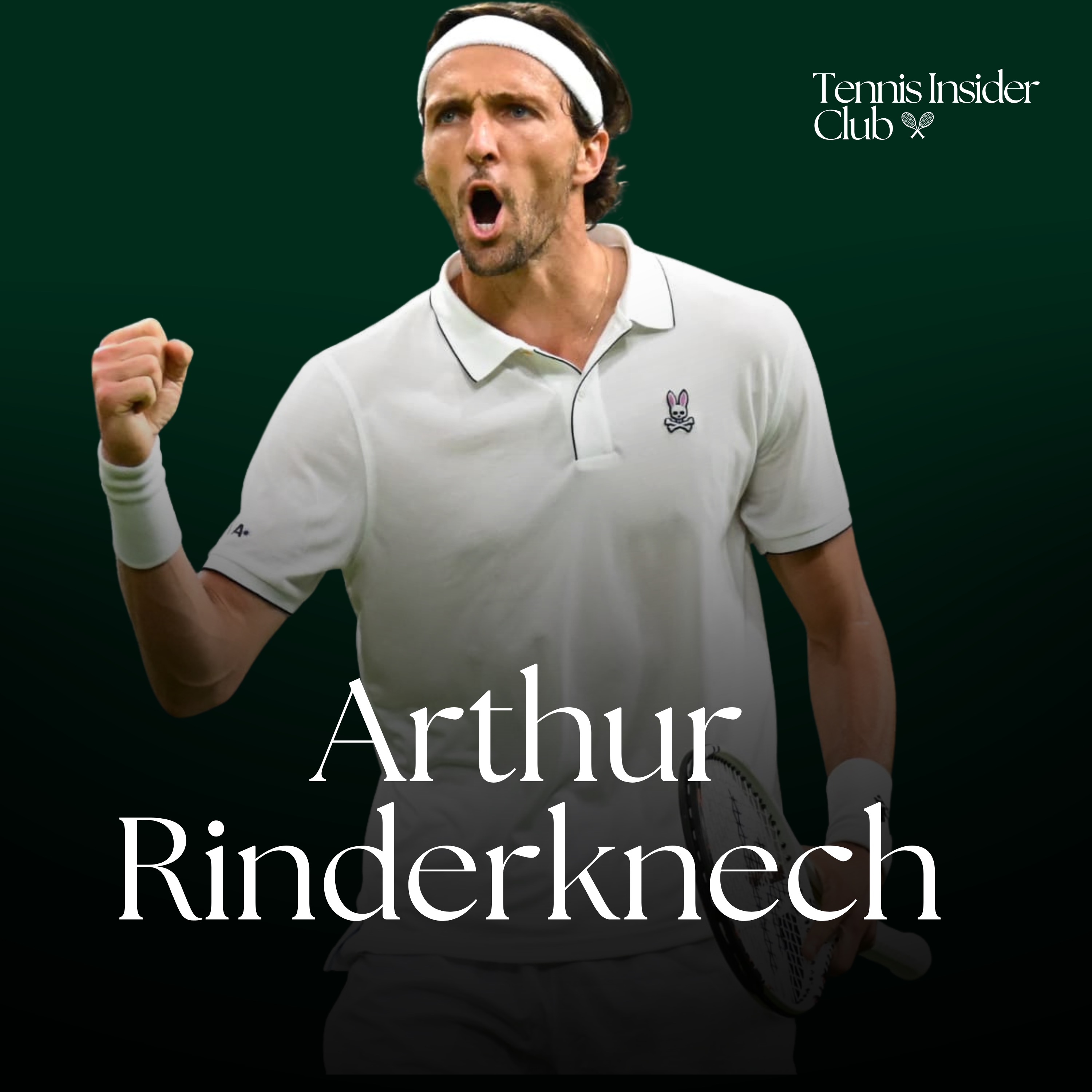
Arthur Rinderknech: He Went to College in America & Reached ATP Top 30 at 29
64m 46s
The speaker outlines a deliberate and educational path to professional tennis, contrasting with the conventional early-start model. He began playing due to his parents' involvement but chose tennis over soccer himself in his early teens. Committed to education, he completed high school in France and then played college tennis in the U.S., earning a degree while developing his game in a supportive, team-oriented environment without professional pressure. After college, having matured physically and mentally, he gave himself a strict 1.5-year deadline to break into the top 250, funding the attempt himself to avoid burdening his family. This plan, backed by his degree as security, allowed him to play freely. He succeeded, crediting his late start for his continued mental freshness and contrasting the fearless American competitive mindset he adopted with a more conservative French approach. His core philosophy is to invest fully in his career so he can eventually retire without regrets.
I signed something with myself and giving myself a year and a half. If I'm not in the top 250, I stop. I don't want to be 10 years on the circuit and be 400, 500. Like, too many players are doing it. I think it's a waste of time. You need to be smart on how you train. If the ranking was based on who is training the harder and the longer is the number one in the world, then it wouldn't be the same ranking. At one time, I told my wife, I said, "I'm not sure I'm going to keep on going." Blow-in titers, it's Karol Garcia. Before we start, one quick thing. If you enjoy this conversation, hit the subscribe button. It's the best way to help us grow and keep bringing in user players and coaches you love. Thank you so much. After you're thank you so much for being with us, how did you start with tennis? Thank you guys for the invitation. First of all, and how did I start with tennis? My mom was playing professionally for a few years until she got injured when she was 19 years old. She was already 200 WTA. She was playing pretty well. She went through the young process of the federation and everything. Then Gottinger had to stop. She played some tennis. She put me on the court early. My dad also played tennis. He was ranked minus 15 in France, which is good ranking. Even though he never played seriously, I would say more professionally. He started working pretty young. Naturally, I went on the court. I was probably four or five years old. At the beginning, I was playing more in the. It was a clay club. I was playing with my little carers on the clay, more than hitting balls. Then I started hitting really quickly and really enjoyed the sport. I loved it a lot. I played soccer at the same time. At some point, I switched to tennis 100%. Because of the background of your parents and them being involved in tennis, did you feel you had to play tennis or you could chew that? No, I've never really had pressure from my parents. They really never tried to push me to play tennis. In fact, my dad wanted me to play football or soccer more than tennis. But I was feeling the ball with my mom quite often and I really liked it. But I would say I was more passionate about soccer being young. And then at like 12 or 13 years old, I had to decide because I couldn't do both at the same time anymore. And I remember this choice, but at the same time it was really natural. I decided to go for tennis. If it was not a family choice because they never asked me to do tennis. But I went for tennis naturally. I thought that was the sport I had to continue. But of course, I'm still a big fan of soccer. A bit boring. And Ren, as we're discussing and so following a lot, I love to play sometimes when I can, but not anymore. I really brought me so much that I'm really happy with this choice. And did you stay in school? I went all the way to school. I went all the way in high school. I got my bike at a rate diploma in a scientific at 18. Never really wanted to quit the school or do an online school. I'm not sure how is it called, but the online school. I've never wanted to do that. I always wanted to be in class with a random student. We had some good, you know, like some better timing for classes. Of course, of course. We were doing either like a full morning or full afternoon. And we were off on the afternoon or in the morning. So we were able to practice in our league in the next two paris, in the suburbs of Paris. That's where we were training with a bunch of guys, same as I was. And yeah, I was still in the random class. We were only three or four benefiting from these timings, three or four tennis players, and everybody else, the other 25 or 30 students were just random. And that was a really good time, because I still grew up as a normal student. And not already professional athletes, or you know, we're really being taken care of differently. And that was, I think, that was a key for me to stay in the regular classes. And then I decided to move on and go to the US University, where I kept on going with my study. So was it a easy choice for you to go to US? It was not that in France, you pretty knew that player was playing. It was not that popular. In general, French people were thinking that if you go to US University, that means you're giving up on your tennis. You go to school, you're going to keep on playing, but it's really like a slow, but surely, you know, like pass away, you know, for a tennis player like you see. It's not like a really the right path or the right way to keep on going and improve. It's more to keep on going with your study. It's going to be free or pretty much free, because you have scholarship from the school, because you have a decent level. But at the end of the four years, there is no chance you keep on going with tennis and do something better. And we were, one of my friends also went to college in the US, the same age as I was, and we both played pretty well there. And we went there with the mindset of improving, on keeping on giving ourselves a chance to get better. Of course, picking the right school is really important with the right coaches, because some coaches are good, but they are not really tennis coaches. They are more like, I'll say, manager of the team, because you have a group of 10 guys that you need to manage pretty much for the team matches. And sometimes it's as important to manage them the right way, then coaching them the right way. And some schools are more focused on managing and less on tennis and vice versa. And mine was really good on the tennis aspect. I was still dead on it. He was a top 10 tennis player, like in the days from the US. He was, I think, two in doubles and 11 in singles. He played big matches and I played with Mike and Rova, thinking in Davis Cup and everything for the US. So it's a guy that had a lot of experience and a lot of things to teach me. And the rest of the coaching staff was also pretty good, so I was able to improve there, same as my cousin, Valentin, that. When Sam Squirt? Yeah, I brought him to my school, because we are three years different. And he came to the school also after me, because I told my coach, I said, "Well, I have a little cousin, he's not bad." Because he considered him, because he was pretty much as the same ranking as I was at 18 years old. Then he decided to go to school, I mean, to the US. And I kind of pushed him to go there, because he was better than staying in France. Yeah, for sure. In my opinion, we'll come back to this and why I chose the US, but. And then he was telling me, "Well, for sure, I can be interested in this year, because then that is pretty much your level, your mindset and everything. I'll be fine taking him, and I have a spot for him, and worked out really well, and he joined me, and we had two years in common, together." In the US, so I enjoyed a lot. So you're mindset when you enter US University, still I want to give it a shot to be a professional, or you also believe it's going to be hard? Well, I was 18 years old, I decided to go to school in January. So I had pretty much five, six months between my back at a rate, and the time I went to school. And in this meantime, I wanted to play features. I was pretty much not ranked. I was minus 15 at 18 years old. I was in ranked, and I wanted to start and see how I like it. No matter what, I knew that I was going to go to school in six months, so I wanted to take some experience and see how it goes. And I played for these few months, some events, and I really hated it. I really didn't like it. I was like, that's really not what I want to do, traveling by myself. Of course, I didn't have much money. I didn't want to put pressure on my family. The idea of asking them 50k or 100k a year for me to travel, and having zero point two-chance-person chance of making it at some point and making money. For me, it was not worth it to put this pressure on my parents and my dad specifically. So I was like, there's no point for me to traveling. I was losing second round in the quality. One time I qualified, I got killed first round. One time I lose first round in the quality. I was against a guy in the middle of nowhere. I was like, no, there's no. I mean, I don't see myself doing this. But at the same time, I think I'm not done with tennis. And I love this sport. And it's really my passion to play tennis. And I want to keep on playing and push myself. But the thing is going to the States, I knew I was going to have a window of four years where it's like, I'm not a professional tennis player. My goal is not even to one time, one day be on the pro circuit. I just enjoy this four years with my team, my school. I really be, you know, like, fighting with the school to get the titles for the university. And, you know, be with these bunch of friends. And really just push myself to help the team. Playmate what we do in France when it's, you know, in May, younger. When we're playing team matches. Yes. And you're really this spirit of being with your friends, of the guys of your clubs. That's pretty much what we're doing.
But you have big crowds, you have everything for you, you sometimes you take the private jets, sometimes you have everything paid for, you go to school, then you have little parties on the weekend, really fun time. And I was like, okay, I'm just gonna throw everything on the side, focus by four years. And at the end of the, after three, three years, I'll see where I am at, we'll see what I do. And the first two years, this mindset was really totally out of, I mean, this idea of being pro circuit was totally out of my mind. And at the end of my third year, I improved there. I, after one year and a half, I was top five in the country in singles. So my ranking was going up. And when you know how good is the college players and what it needs to be, to be top five, top 10 in the country, then your level is still, I mean, you know pretty much what is your level compared to the ATP. And when you are top five, top 10, I will say usually you play top three hundred ATP. So at the end of my third year, I was, it was already a year that I was regularly in the top five, top 10. And Steve, my coach at that time from the school, told me, well, I think you need to, to consider giving it a shot after you finish school because your level is good. And you have all the capacity. And now you will have your diploma. You can play chill and relax. And you're a lot more mature than what you were in 18 years old. And I think that was pretty much the key that I, 18 years old I had. I was not the most mature, you know, a guy or player when I was young. I was still really skinny. You know, like if you see myself, I'd take you as old. There is a funny video on YouTube of myself doing the recruiting thing for the university in school in the US. And it's me playing. And sometimes I, some people will still send it to me. And it's like, I'm like really skinny. Like, like a port two years. Like, Steve, my coach in the US will say, you are the flamingo of friends at this time. Because my legs were like this. I was probably 10 kilos less than right now. And I grew up, you know, at 18 years old, I wasn't developed at all. My body wasn't developed here for it. And so I wasn't ready to play any type of pro circuit. And I had these four years where I had plenty of time to develop. And at the end of these four years, I decided to give it a shot. Now that I have my diploma, I was like, OK, you know what? And just-- I signed something with myself inside me when I started. I said, OK, I'm giving you-- I mean, I'm giving myself a year and a half. And if a year and a half, I'm not in the top 250. I'm outside the qualities of Grand Slam. I stop. And I think it's a waste of time. Then you start, you know, just going around and going around. And it's not-- nothing is happening. And I really signed something with myself saying, OK, after one year and a half, if you're not-- But you go full for one year and a half. I'm not afraid to invest. I didn't ask money to my parents. Still, I played a few leagues during the summers, during my US time. I was playing in Germany, playing in France. I had this 30K on my account. And I was managing my career with that. And also the fact that I had a much better level. At this time, when I started, probably around 300 ATP, even though my ranking was not ranked. Yeah, yeah, yeah. But right away, I made semi-final, final winning features. So I wasn't losing as much money. And I was able to survive and keep on going. But I wanted to really go all in for a year and a half. And then I stopped. But without regret, if you don't make it. And luckily, I met the good person on the way and helped me a lot with my tennis. And I made it. And then after I was 100 and everything went on. So that's a whole story pretty much. You think that having that plan be like, OK, if things go wrong, I still have my US diplomas. I can find a good job. I had a good way to play with less pressure. I'll say yes. Yeah, I'll say that knowing that I had my baccalaureate in front, I had my US diploma, I got to know a lot of people either in the States or in France. I was like, OK, you know what? I can just take a year, year and a half without pressure and really going all out and try my best. If it works out, it's perfect. If it doesn't work out, I'll do something else. But I don't want to stay in this pro circuit environment too long. And even though at this time, I was already with my wife now. And you know, Terro, more than anybody, how tough it is to be away from your friends and family, your loved ones for too long. And I didn't want to put that pressure on this inconvenient thing on my family and especially her. So I promised myself that I was not going to do more than a year and a half if it doesn't work out. OK. It's true, like, between 18 years old and like 21, 22, I must have it. I'm like, obviously, we are different person. Like, it's so many years are so important. And you see so many people, like at 17, 18, trying to make it to professional and playing, like all those 15 tournaments. It's like so hard to watch sometimes. It's really difficult. You know, the thing that I like to remember about my path to where I am today is that I'm 30 years old right now. But I started the tour six to seven years ago. And I'm pretty much six, seven years old on the younger. Almost a root, you know. And some guys, they started-- they are three years younger than me. But they started at 16 years old. And they are already 11 years on tours. And so they are much more like how you say, like, much more cooked. Much more cooked than I am. Because you know how hot-off is a circuit. Even though you're doing great and enjoying it and making money and having a good balance with your family, it's still like a machine that never stops. And it really, really burns you down at the same time. In the long term, you get tired of it. And it's really difficult to handle this whole environment. And this guy, they are younger than me. But they already match older in their career. And sometimes I see them being a little bit tired of it, really being in the routine of, OK, I need to do this. I need to do that. And I'm still considering myself as quite fresh in my head, which is a good thing, even though I'm older than them. So I take this as a really big advantage of my path, starting later, even though probably-- I could have known it maybe earlier, I don't know. But I don't think with the different paths I would have made it. But I think each and every player has their own way of making it. And it's really not one specific way of making it happen. It's everybody's different. Well, in a way, it feels like being a professional tennis player comes with a lot of pressure and a lot of eyes on you, a lot of expectations from yourself. And probably you're way more prepared, not 24 after. Going to university, growing as a human, after four or five years in the US, you have grown a lot as a human, no? No, these kids at 18, they do well in one tournament, and all eyes on them, and they get so lost. Yeah, I was no one. I was no one back there in the States. I mean, I would not say everybody forgot about me, because no one was even thinking about me. But I was doing my thing on my side. No one was really putting any pressure. I was doing whatever I wanted. If I wanted to just say goodbye to tennis, I was going to go out every night and enjoy the university life, and just screw it around. And that's fine. But I was still focused on my goals, which is success, my school, and getting my diploma, and giving everything I have for my passion, which is tennis. And we'll see where I go. We'll see what happens. And at the end of the day, that's still my mindset today. It's like no, not putting limits to myself, and just giving everything I have. And the day when I will stop, will be like, OK, looking myself in the mirror and say, OK, I gave everything I had to this sport. Yes, I did. No regrets. My best ranking, what this, my best result, my best wins, what this is this. And I couldn't really do any better, because I gave everything I had. No regrets. I can turn the page, turn the chatter, and go to something else. And I will be sad or pissed if I look at myself, say, at some point I didn't invest what I could do, what I could invest in my career. I took it. I made a choice that was not really trying to be that-- that how to say, I could have done a choice that would have given myself maybe more chances, or I could have done something better, different. But I took the insurance choice, like the safe choice. And then it didn't work out. And this, I would not look at myself and be, well, I don't have a look at it. So I try to do everything I can. So.
at the end of the day I can just turn the page and be chill with myself and probably with my career I get everything and do something else. Will you say there is a different between the French mindset structure and the American one? Yes, yes for sure. I try never to forget it. The American one that I discovered during these years because I think that's part of myself, but at the same time I'm back in France, I'm living in France. I don't have any more American coaches even though I'm still really close to the one I had in school. But yeah, they have this mindset of not being afraid of anybody and that's something really specific and you can say it's a cocky way or it's whatever, you know, like sometimes you look at the American and you say "it's a little bit cocky, it thinks it's way better than he is." That's not really how they think. It's the fact that, okay, it's a human being against a human being. Why not? I couldn't beat him even though he's much better ranked or he's a lot better. Like in fact, for example, we were sometimes I think we've never been my team. My mask cool, we've never been number one in the country where between two and 15 I would say during the four years and we played the number one a few times and it was like we are going to win. It's like it's no problem even though it was the best team in the at that time we were playing away on their own home courts. So we knew he was going to be tough, their condition, their rough, their everything. We knew we were going to win, you know, and not being afraid. Not going there like a French could go and be like "okay well, I'm going to try my best, they are much better, I'm going to try to make a good score, not lose too quickly too easily." And there is like no, there's no chance we just go and we're going to beat them there. And that's it. And that's really a mindset that they have. That's usually great. And also the fact that they are really in love with sports in general. It's something, I mean, from anybody to anybody, they're all love sports. And they're going to reunite to watch the big game, whatever the sport, they go to the stadiums, the kids, the older one, they're all love the sport. It's all about it. And I saw, for example, a big difference also in school where the teachers, they were really helping out the athletes. We were missing a lot of days, a lot of classes because of the travel and they were always going, I mean texting us or emailing us with all the courses and giving us help and they were making up the exam for us, giving us dates, really not making pressure or a trouble on us. We're in France. I was in a regular school, like I said earlier, I was in a regular school, we were three or four athletes in this class of regular students, but it was almost like in the teachers, they were jealous of the three or four of us. And there were not really always helping us to get the best out of us. And sometimes it was almost like, well, you cannot make up the exam. Well, okay, enough for them. That's a zero. And that's it. And that's how it goes. And you couldn't do the homework because you were playing, well, you're playing tennis. You don't study, so you better study than playing tennis. And all the mindset and the mentality around that is a big difference in the US. They prioritize the sport a lot more. And what they do in Europe and in France especially, I would say, but there is a lot of great saying in France. Of course, yes, yes. Everything great there and everything bad here. But I'm saying it's a lot of differences. And I grew up until 18 in France and got to know a lot of the French mentality. And then I really totally shut down all of this to go four years in the States, where I was totally on my side, on my own, on the other side of the world. And I discovered a lot about the US mentality and another style of thinking. And it was great to learn about this. How was the beginning on the future and challenger level? How was that transition? That one and I fear you gave yourself. It's not that easy because you are playing the States in big stadiums. Always big crowds. Everybody's cheering, clapping, sometimes even saying some things on the side. You use to these guys in the stand that are trying to put trouble on you when you're playing away. Or at home, they put trouble on the other players. And all the environment was made for the forest, for the team, where we were not focusing on the ticket flights, the hotel, the food. Everything was provided. We were just like soccer players or NBA players just being part of a club or a team and you just focus on your tennis on the matches. And out of nowhere, you start playing throw and you have to buy your flights, you have to book your rooms, you have to do your food, you have to budget all of this. Even your team. Your team, your coach, of course, at the beginning, I wasn't really traveling with anybody. But then I got to invest in everything, like I said. But you have to organize everything and you play your first matches and there is literally zero person. Zero person. It's not even understands because there is no stands in features. It's like there is zero person around the court. So you are in the middle of nowhere and you're like, okay, it's either this guy or me. That's going to win today. But I want to be me and I need to go up in the ranking. And I have this goal and this dream. So I'm going to try to do everything to win. And that's where you really dig down deep down in yourself to to find the best resources and to fight everything you have to climb up this mountain that you need to start at some point. That was the biggest difference. And I know many college players. They are struggling from going to this NCA, this NCA university system to the prosecutor because out of nowhere, you are with a lot of people. Everything is provided to being alone. And you have to pay for everything. And it's a big change. It's almost a different sport. And the feature level is very complicated. It's a struggle. It's a grind. You're by yourself and you need to survive and advance. And also some distractions and you need to really keep focusing on your goals. And yeah, it's a big difference. And sometimes, you know, these guys coming from college, even though they are really good, they get discouraged really quickly because they are not used. And they don't understand that it's not the same fun. I mean, it wasn't even right now. On court, and I'm top 150 for five years now, I don't have the same fun as I had in college. And I wish I could come back. Sometimes I wish I could come back and play just one of these two matches. Again, the best rivalry team that we don't like and we want to play against and fight. With all my friends and my brothers in the team. And you know, it was a lot of fun. And when you get on the circuit, it's not the same. It's not that easy to adjust and keep on going. Did you ever thought about stopping? Because of all these changes? Never. Like I said, I signed deal with me, myself for a year and a half. I made the deal. So I kept on going. And always really love tennis so much. I had my first time, first really tough time last year. Pretty much at this time, where I was a little bit losing this, you know, this refill rouge, comme au Dieu en français. And this part of being in the right way. I lost it a little bit last year. Even though I was still top 100, everything was fine. You make money. My personal life was great. I got married. Everything was fine. But for some reason, I was losing a little bit of this passion for tennis. And as soon as I lost, you know, I'm losing this love for sport. It's not the same for me because I've always played for the love of tennis and not for the fans, the money, the whatever that brings tennis to you. It was only because I love this sport. I love to compete on the court. I love to, you know, everything that is on the side of tennis. But it was a sport before everything. And last year, I was in this time of my career where sometimes you have some downs. And this one, I was, you know, kind of losing myself, you know, losing myself in this big circle that is going so fast all year long. And at some point, yeah, one time I told my wife, I said, I'm not sure I'm going to keep on going. Because it's so difficult in my head. But if I don't have this love anymore, I, this is no point. Even though you make money, like I said, you have a lot of great things happening. But if I don't have this love for what I'm doing and this passion for the for tennis, there is no point for me to play and I'll rather be at home and, you know, and have normal life and enjoy.
enjoy it with her, with all the project that could come with it. And I was lucky enough, I was able also because of Lucas, with who we started working, that I found, you know, this still light somewhere again and I grabbed the light and said, "Okay, let's go now. I see you again." And we're gonna keep keep on going again and, you know, we're gonna fight and find everything and then I had a really good six months and, you know, probably the best part of my career so far. So, you know, it's interesting, it's tennis. Sometimes you have to hit rock bottom to start going up sometimes. Yeah, sometimes. Why do you think you lost this passion for the game? I will say that, of course, I mean, you know, tennis is, I was between 50 and 100 for four years, you know, four and a half years and you know, at some point you get to the, at the beginning, you're really excited because you're going up the ranking and you really want to be every single point, every single ranking you go up, you are excited and everything. At some point it's more, you know, you get this two more like a regular basis and it's not as the same excitement. You know, all the tournaments, you don't discover anymore the places you go to and, you know, I was more in this normal aspect, like if it was normal to be 50 or 100, which is not normal, of course, it's something great being part of the top 50 or the top 100 in the world, in your sport, it's huge. But also at the same time, I didn't have the best decision on my, you know, on my coaching staff. You know, I had such an amazing time with my old coach, Sebastian, in Ren and we had, we have so many great memories, we did so many great things together. I thank him a lot for everything he has put in for me, all the investment. But at this time, our, our ways were going, you know, different direction. And we, we tried and myself first, I tried to, to make it work and keep on work, you know, keep on finding results this way. And it wasn't possible anymore. And I was really trying, still fighting for that. And it was putting my head on something that I, not something I need to focus on. And I wasn't on my tennis anymore. I was on the side of my tennis. And the most important was, you know, the court and the practice and the matches. And I wasn't able to do both about always struggle when I have many things in my head. On my tennis side, Carol, you probably know better. It's already already, already we just wish that you seen your head. It's a bit tough. So, yeah, it was, was tough for me. And so I was looking this, you know, the, the, the right things I had to do on, on the court. And, and slowly, but surely weeks after weeks, losses after losses, you, you get discouraged. And at some point, I, before my wedding, I didn't even touch the racket for two and a half weeks, which, you know, is, is a big time. In the middle of the season, it's a big time. You know, it's, it's, and I didn't almost do any sport at all. You know, I was having some wine every night, pretty much, getting ready for the wedding. Getting ready for the wedding. But it was, it was one week before Real Gero's, you know, so, it's not the best way to prepare the best grandson of the year, you know, but, but, yeah, I had to, I had to really take a step away from all this environment to, kind of try to reset. And I was able, because also, because of some friends that helped me at this time also. And of course, my wife, although always, push me and, you know, in the right way. And I found the direction, again, like I said, I found this little light at some point. I saw psychologies for the first time in my life. I wasn't really trusting anything or believing in any of this work. And, you know, at this point, I was so, so down, you know, that I was like, I need to find a solution. The good thing that I kept on trying to find a solution. That's how I found the way, you know, and I got out of this, this whole that I was really digging weeks after weeks. And, you know, I did a few sessions with this psychologist and it helped me out. At least a lot to, to, you know, take some big stuff out of, out of myself, out of my mind. And like I said, at some point, a little light appeared, appeared again. I was in the dark, dark, dark. I couldn't see anything. I didn't know where I was going to go. But at some point, I found this little light. And as soon as I saw it, then I tried to grab it. And I said, OK, let's go now. We'll back on track. And I'm going to do everything to be to be fine again and specially learned from this, from this time. But that was the, the, the, probably the only time where since I started where I was like close to, to making a decision of, of stopping, at least for, for a period of time. I stopped for two weeks and a half. Yeah, but it's not stopping. It wasn't like, like, like, definitely, like, yeah, like, there's more like a little holiday between the, I mean, it was a, it was a needed holiday. I meant to have break, I know it has break. It's good to take that time and like, do different things, like try to find help. So like to talk to people because sometimes like, I even, I've been there and sometimes it took me like too long to get out of it. So some, to get out of it, then it's very complicated or very long or it's very hot, change your mindset. It is try to find help. It is and the thing about tennis players, it's even though you have a lot of people around you. Sometimes you feel like you're just alone. Just alone, just you, yourself and no one can understand what's going on. And at this time, I was speaking to my wife, I was speaking to some really close friends, I was speaking to my parents or, you know, to some people. All of them, they had already, they were, they already had their idea, you know, they are the opinions and they, you know, they knew, they knew me already too well that they couldn't take a decision or they couldn't help me out with the, you know, with a regular mindset, with a normal mindset without having this, you know, without knowing what happened before and what's going to happen after and all of this. So that's why I decided to go and see this psychologist because I knew this lady that I've never met before, knew nothing about my life and she was just not going to judge me or anything and I just told her everything. And out of this, she helped me out to realize some stuff and like I said, that's where I was able to find a little light again and, you know, continue and continue. And you started to train with a Rukia Puy, how was it for you to be able to have in your team someone who's been there? Who can relate to maybe some of your. The thinking or the decision I made was last year and around the house for a few weeks after this time we just talked about and, you know, I was in my bed. Probably the day before a play-sinner or the day after a play-sinner on the Santa Courtaid Session first round, you know, and I didn't know if I was going to lose one, one in one. I played on each three days before, after two weeks and a half break, after three months where I couldn't put a single ball in the court. I was like, I'm going to play the best or the second best in the world on the Santa Courtaid Session in front of the home crowd. I was a bit afraid, I've been totally killed, but it went well, it went well, so everything was fine. I told my wife I'm in the bed and I said, well, you know what, for some reason I'm thinking about Lucas and I think it could be a great help for me. I know he's struggling right now because he has an injury, so he has a few months out. He still has a few months out in front of him. I think he went through so much, this type of momentum being down, being up, injury, really successful, being the best player in the world, top 10 in the world. So the whole environment around him, when he played really well, when he was young, so many attractive things around him. So he knows all of this and at this time I thought even more than a tennis coach, I needed someone that would help me with understanding all this situation. So I could be in a better mind in my head to play tennis, especially with what just happened to me before. And the next day or something, I showed him a text and I said, well, Lucas, can you grab a cup of your something, I need to talk to you for something. Of course he told me afterwards he said, as soon as we texted, yeah, I knew what you were going to ask me. But yeah, right away, he said, you know, everything I do in my life, I always need the advice of my wife, his wife, Clemens, who is great also with him and with everybody around. And she said, well, if you think you have it and you want it, let's go for it and let's go through. And at first we were supposed to do only the grass court season, which was four weeks. And we had a great fun, we played well.
pretty well. We want some matches, first top 10s, two top 10s in this four weeks time. I qualified all in the Queen, third round in Wimbledon. I won this pretty good match against Verifan Centerport. We won. There's a lot of great emotions. It was nice actually to be on the box as well. It was a guy, his wife as well, I think. Yeah, it was cool. It was cool. I mean, we had discovered a new way of playing tennis on the tour, which is much more like family environment and spending great times outside the court and being able to relax and just enjoy the time. Win or lose doesn't matter, but enjoy it. This big win against Verifan Centerport, as court in the world, I would say, of Wimbledon. Then we had this discussion. Of course, I wanted to keep on going because I could feel that he was going well and I was enjoying it. I thought, I mean, I think he was quite fine doing it also. I don't know. I mean, he can enjoy it, but maybe at the end of the day he's not enjoying it. I don't know. We had this good discussion after Wimbledon and he said, "Well, my wrist is still not fixed. I'm not going to be able to. He was trying to start again in September." He said, "I'm not. I'm not going to be able to start before later on, maybe the end of the year. So if you are motivated, but I need you to be not motivated, but like extra motivated because I really want the best out of it." And he said, "I want us to be seated in the Australian Open next year. At this time, I was 80 in the world." And I had all my points coming in the summer. No pressure. Thanks, man. Yeah, yeah, of course, I'm really motivated. Don't worry. Which was true. I mean, I was really. Of course, I was really into it. When I'm. When I have these questions for the sport and I'm into it, then I can train like an animal and I'm fine with that and I love it. And there's no result without it anyway. So of course, I told him, yes, I'm really motivated. I heard his goal. I had it in my mind, even though I was like, okay, step by step, I'm going to try first of all to win multiple matches in a row, make good weeks again and again, no injuries, no everything. But we made this little pact together where we're going to go until the end of the year. And we're going to push it to the maximum. And then it was a good summer, you know, around of 16 in the US Open, again, some top 10s, wins. Then the risk of. I wasn't in the risk of for the last year or year and a half after being in the risk of for two to and a half year. It was also a great accomplishment to be again in with the team because that's something really important for me. And then the Shanghai tournament, which is, you know, the best result of the year, a lot of great wins. Everything kind of clicks together. And the end of the year, Bersi, I mean Paris, you know, was nice to finish there. And they just kept again. So yeah, it was positive and we made the top 30, top 30 at the end of the year. So. Not too bad. Pretty crazy. But he had the optimistic goal in his head, but realistic goals. So we made it. And yeah, at the end of the year, he was still struggling with his risk. So far, we're still working together, at least for another few months. And we'll see how he goes, you know. It's difficult for him. I know how it is. He doesn't know yet where he's going to go, you know, next as a player or as a coach, but the decision is not made. But his body is healing, trying to get better. But he's such a great guy more than a coach or more than a player. He's such a great guy I was able to discover and creating a beautiful family with Klemers and Rose. So yeah, I'm lucky to have him and we'll see how he goes for us in the future. But at least probably we became good friends and having and creating a lot of memories together. And you mentioned that you learned like kind of a new way of doing tennis life on tour, more balance, maybe like more fun. Do you think you were like not having balance or too hard on yourself? No. Yes, probably too hard on myself. Yes, it's as strongly possible. But also my wife was working. And now she just take a break for the last six months or so. She decided to take a break to travel more with me. So that's more enjoyable also because she wasn't traveling that much before. You know, and my old coach said was older than me. So we're not also in the same stage of our life. With Lucas, he's one year older than me. So it's almost like a friend. It's easier to travel with someone that you have pretty much the same interest and everything. So it was, it was, I mean, it's easier this way, I will say. And yeah, just sometimes just sitting back and doing some alcohol and doing the tournament, not alcohol, but like one or two glasses of wine. Just sitting having a good restaurant, finding a good place in town. And we just take a step back from the tournament on that night and just enjoy. And it's fine. It's not because you drink too glass of wine that you're not going to play as good the next day. And even more, you relax and think about something else. And that's a new way that we do. Not like we do it every night, of course. But once a week, at the end of the tournament, you say, okay, well, good week, bad week, we talk about it, we try to adjust, we do better things, we change things, we organize some stuff for the next week. But we can do it, having a glass and chill and having our wise or kid or a friend or someone else or my physio, who is also great and spending a lot of great times. My fitness coach, all of them, it's a new way of, we worked really hard, but at the same time, we chill really hard at some point. And it's not only working hard and then you don't chill hard. As soon as you finish, you already focus on the next one and the first one. I think that we're all on your neck and at some point you just can breathe anymore. And you need to keep on make sure you breathe on sometimes. It would work for one or two years, but you will end up burnout. You have to find that balance that helps you have such a sustainable career. And she looked as God disburned out in she's career because he was working crazy hard, probably harder than anybody also, but she experienced this. And she now knows that she needs to take this time to relax and it's important. And we have a little bit of a different approach on working and everything. So if we don't think about it or really don't set these things up, we are too much into it. And then we don't relate sometimes to sometimes of at home or on the road and that's important. I learn with him, I learn to train less, which is fun. Probably a junior train better. Probably train better, but sometimes you just train great, but you train too much. Even if it's great training and a lot, at some point it's going to make it negative, not as worth it and as good. So you need to train well, but sometimes you don't need to train too much. You want tournament, you train an hour and an hour and a half, that's fine, that's good enough. We had Daryn Kehil and he was telling us that within Dreyagashi they never train more than two hours. He was like two hours, like all in, but after that's it. Yeah, after at the end of the day I think there is different time. Yeah, of course, obviously. You need to go, you need to go big. Yes. Some weeks where you between hard and clay, you need to put some works. But when you're on tournaments, I was trying too much in tournaments, probably. Before, many players are doing it. And so you win one match as two matches, but you can't go all the way. You can go the whole week because you just cooked after five, three, five days in the tournament. You're too tired, the body is dead because you train more than the matches. Then you have the emotions and all the mentality aspect of the matches. Then you train again too much the next day. I mean, when I played US Open, I made around of 16, so I won four matches. I played 30 minutes a day before the first round. After the first round I didn't play in between the matches. After the second round, I think I played 10 minutes because I won in five. I was tired and everything. We really just went on court, hit three balls, took two serves in game over. 20 minutes between the. I mean, it was like nothing, which for me was impossible before. I didn't play between the matches. It's impossible. I had to play one hour, putting some intensity and everything. Of course, it's great, but not every player is Nadal or Alcaraz. You can't not every day.
I think there's a new way of training as well, where tennis players need to be fresh, mentally and physically, because the demands are so high that you need to be able to have this energy on the match day. Was it hard to change it? To not go practice anymore between matches? No, no, because at this time it was a few months already, and understood the thinking of Lucas. And already on grass, you know, at the beginning of the year last year, I wasn't playing well, I wasn't doing that great. I was like, "Okay, that's my only way of getting better, is I'm going to go back to training and do more, and do more, and do more, and train more and harder, and longer and everything." At some point I couldn't do any harder, and I was just dead, and I was keeping on losing it, so that's why I was stuck at this point in my head, because I couldn't do anything anymore, and I was already doing the maximum on every aspect, and I had no solutions, and with Lucas we started on grass, and yes, at the beginning it was fun, I mean, it was weird and fun, that the very few times, I'm like, "Oh, it's morning enough now, finish the day." Finito, we stopped here, that's good, that's good enough. One hour is good enough, and I was like, "Are you sure? Are you sure? No more fitness, not a little fitness, or no basket, or no serve." "Oh, this is good enough." It's relaxed, it's chill, it's having good dinner tonight, and let's get ready for tomorrow for the match, you know? But I listened to him, 100%, I trust him 100%, I have 100% confidence with whatever he was telling me, and he is telling me, and so that's probably why I was able to get the results, and I got the proof that by doing less, I won more matches in four weeks than in the first six months, so I was like, of course, that's an option, and that's a good option, you know, a good solution, so then we kept on going like this, even though I have these timings where I work hard, of course, I don't want to say it to something like that. To get to your best ranking, or to get your best win, you need to train less and do nothing. No, of course not. It's being smart on how you train. But you need to be smart on how you train, and the timings of your trainings, you know? I feel like there's no reward for just working harder, you know, like it needs to make sense to work harder, and sometimes it will do, and sometimes it will not. I mean, if the ranking was based on who is training the harder, and the longer is the number one in the world, then it wouldn't be the same ranking yet right now. I can tell you for sure, even though I'm sure the best players are training a lot, but they, you know, they, like I said earlier, also they, you know, everybody has a different path of making it, you know, sure Federer wasn't training the same way as Nadal, as Drokovic, you know, and, but they were all at the very top of the tennis world, their own way, you know, and everybody's different. Federer was well known for being into ornament, their practicing working almost, and he was always ready to go five sets and. The work wasn't before, yeah. Everyone said that of season or training weeks, he was one of the hard work. I heard the training weeks, he was, yeah, he was five hours on court in a row, I mean, the longest crazy sessions and really hard. So of course, then it was, it looked simple on tournament for him, but I'm sure he was doing all the hard work in, you know, in advance. So, every person is different. So like what works for you, maybe doesn't work for someone else, it's also like knowing yourself and trying to understand what's going to happen. But I'm just told how different you need to make your practice between the tournament weeks and the practice week. And sometimes you pretty much do the same, you know, on both weeks. And you can do the same with tournament weeks as practice weeks. So it's about getting the mind fresh and ready to fight every single point. How was for you to read your final in Shanghai? It was a pretty crazy week, especially with the final, you know, playing my cousin who we spent two years in college. Always took him, you know, like this, because he's the only younger. And we spent so many, so many, so many weeks and many, many hours together, younger, holidays, many, many great memories together. I always try to help him, always kind of took him with me everywhere I went to make him better and to push him all the time. And he had great years in college as we did, I mean, as I did together, we did together. And you know, he was struggling a little bit to get in the top 100. He was, he was fighting there. And you know, that week just clicked for him and he played really well and playing each other in the final and his brother. Mike, your other cousin was his coach and we were all three together there. So it was pretty, pretty crazy playing each other in the final. I mean, the odds before the tournament, I was not seated. She was in the qualities. I mean, it will never happen again, ever, ever, ever. Yeah, if someone would have bets on that, it's the richest man on the world now. Yeah, I turn it, no, in qualities. Was it not, I turn it before the last minute? She was going to get in, but she still got in at the last minute, you know. So, life is crazy and you put one euro on this bet before the tournament. You're probably more than billionaires, you know. It's, yeah, it was, it was crazy week. He played well. I had great matches, one by one, a bit top 10s and top 20s again and again. You know, everything clicked also on my side. In a way where I was playing probably my best tennis, especially starting the third round, I would say, all the way to the finals. And I had a tough schedule in the last two, three matches. And I was pretty, pretty cooked for the final. I tried everything, but he was a bit more fresh than me and I really couldn't. I didn't have a single drop of gas in the, you know, in the engine in the final, but I'm still really, really happy that it went well for him. And now he's inside the top 100. He has, you know, sometimes to keep on going. He's not like he got into 95 and he's going to have to fight every single week and doesn't know if he can drop out again and we do everything, the whole thing again. So he's working well, he's doing great. With his brother, my cousin, and I'm happy to follow him and see him success like this is great. You have to lose a final again, someone or no one better than you. But when we look at the draw again and we see the guys, we beat all the way to the finals for each other. It's pretty amazing. But it was a great memory for the whole family, great time and we'll keep it forever. In the house, after I get the end for both of you, but I guess well for you, this tournament means like higher ranking or different expectations. Do you feel like more pressure afterwards or on a really? I mean, you know, right away after that was coming back to France and the La Défense Master 1000. So of course, it was a lot of hype on him and on me, especially, yes, on me, especially, because in France, of course, I think I was becoming maybe number one French player in the ranking. So of course, expectations are higher, but that's where I am lucky to have a look at so that he knows this better than anybody. And we, I think we handled it really well. Just keep on doing what we're doing and not changing anything and just enjoying the life, the way we did in tennis. And yeah, the draw made it happen that we played each other in the second round again. And I would not say this fucker because he's my president, but he did it me again six more in the third. You can't say it, we will have it in the world. Yeah, that's a good idea. You know, I'm joking. You know, as any I played really well again and we played a great match, Hyde Wellell and ended up losing again six four in the third. I always thought him to fight so hard and you know, at the beginning when he came to to school in the US, he was not fighting the right way, not the good behavior, not everything. I was not being on his side again and again to make him tough. You know, and I, two times he got me, you know, he got me on the finish line. So it's fine. Now you're in red, convincing your coach to hire him. I was like, I wish I wouldn't have done that. Yeah, it's great matches as long as we play good matches and we enjoy it. And we're going to play each other again for sure at some point. And we're going to fight again. It's all great at the end of the day. You know, it's just an instant game. We enjoy it. He is the same way. He's really into it. He also found the success by I think, relaxing it a bit more and understanding better how what it takes and not always the hard and long ways of training is not where it takes all the time. So he's doing great now and that's a great outness for me. Do you think having this so good?
a bit later on like entering top 30 like almost on your 30s. It's easier for you like to handle it now that if you would have done it at 22. I will say that I'm more experienced. Yes Also, of course if you're top 30 and you are 20 years old the hype will be a lot higher and a lot more you know pressure on yourself, you know like pretty much Lucas. Yeah, you know, he was top 10, he was 22 something. We don't realize it but how good he was you know and the amount of pressure here on his shoulders and you know and and yes of course being 30 I it's more quiet for me you know it's more relaxed. I do my own thing and I like to do my own thing even though of course I am the number one French player as a friend now and that's making me do some stuff I have to know that's that's part of the job but but yes I think I handled it better way being in the top 100 for the last five years four or five and a half years already you know I got to experience everything so I know how it works I know the you know the system and you know so that helped me yeah better I would say of course to handle it. We've done like episodes with with both people who had super early success not like Wushar who did find a Wimbledon you know the other side people like Pegula who like Ritz Top 5 almost at like 28 or whatever and since then she's never left Top 5 and she was saying that like if she would have had this success so early like that early she didn't know who she was you know I would have been too much and then she got it you know knowing how hard it is to get there and now knowing who she is as well so she can handle it like much much better yeah yeah I had a huge respect for a player like Pegula because she also was I mean I heard that she has a great story and also big amount of money and she's family and she's just playing for the love of the sport and that's that's something I respect a lot and it's a it's a yeah it's a big example which advice will you give to your younger self? Don't forget the tennis is a game and the game is made to have fun and to win and to lose even though you can be competitive but it's a game so just play and play the sport you know it's not a lot like it's not a work it's not like going to the you know to to hell it's not a loss it doesn't matter it's part of the process just being more positive inside myself and not forgetting about the the game of tennis I'll say enjoying it of course as much as you can. Related to this do you think that the fact that your parents were not obsessed with your success has really helped you to have like a healthier relationship with the sport? I will say that yeah since they didn't put pressure on me it was also my motivation it was always my motivation and not their motivation I didn't I didn't play tennis because of them I didn't push myself because they were pushing me yeah it was always me you know and so when I got to when I went to the US I I could have done bad you know I could have just go to school I go out you know just give up on my tennis and not focusing on anything and becoming whatever I was would have become but since I was always motivated on my own and by myself since the young age I had this discipline there to focus on my school and my tennis you know and of course I was having something at some point but it was really like on specific day and and with the you know with the with the deadline without you know going over the limit so I could the next day I could go back and do school the right way do tennis and everything and I had this deep down motivation for myself of successfuling these two aspects and then focusing on the next goals and that's how I was able I think the fact that I was playing tennis for myself and only myself not for my parents I was able to you know to be more mature at least on this aspect in my head of realizing that I need to I need to push now it's not going to when I'm going to be 40 years old that I'm going to push it's not going to when I'm 10 years old that I'm going to push but at this time of the year I had everything in front of me I had everything to do great but I had to you know use it and you know and do it myself you know yeah thank you so much we appreciate yeah thank you for the pleasure
Podcast Summary
Key Points:
The speaker set a personal deadline to reach the top 250 in tennis within 1.5 years of turning pro, or else quit, to avoid a prolonged, unfulfilling career.
His tennis journey began early due to his parents' background in the sport, but he felt no pressure from them and initially preferred soccer before choosing tennis at age 12-13.
He pursued a traditional education in France and then a U.S. college tennis scholarship, which provided a supportive team environment, physical development, and a degree, all without the pressure of immediate pro aspirations.
His successful college career (reaching top 5 nationally) and subsequent maturity led him to attempt the pro tour with a secure fallback plan, minimal financial pressure, and a focused, time-limited commitment.
He contrasts the American "fearless" competitive mindset he adopted with a more cautious French approach and values his later professional start for preserving his mental freshness and avoiding early burnout.
Summary:
The speaker outlines a deliberate and educational path to professional tennis, contrasting with the conventional early-start model. He began playing due to his parents' involvement but chose tennis over soccer himself in his early teens. , earning a degree while developing his game in a supportive, team-oriented environment without professional pressure.
5-year deadline to break into the top 250, funding the attempt himself to avoid burdening his family. This plan, backed by his degree as security, allowed him to play freely. He succeeded, crediting his late start for his continued mental freshness and contrasting the fearless American competitive mindset he adopted with a more conservative French approach.
His core philosophy is to invest fully in his career so he can eventually retire without regrets.
FAQs
The speaker gave themselves a year and a half to reach the top 250; if not achieved, they planned to stop playing professionally to avoid wasting time.
The speaker started playing tennis at age four or five, introduced by their mother who was a former professional player, and their father who also played.
No, the speaker never felt pressure from their parents to play tennis; in fact, their father preferred they play soccer, and the choice to pursue tennis was natural and personal.
The speaker chose a US university to continue studies while playing tennis, seeking a balanced environment with team spirit and development opportunities, despite French skepticism about this path.
The speaker committed fully for a year and a half, using personal savings and aiming for the top 250 without financial pressure, thanks to having a diploma as a backup plan.
The speaker believes starting later allowed for personal growth, reduced burnout, and a fresher mindset compared to players who began touring at a younger age.
Chat with AI
Loading...
Pro features
Go deeper with this episode
Unlock creator-grade tools that turn any transcript into show notes and subtitle files.
 PodcastTranscript AI